Journal of Agriculture, Food Systems,
and Community Development
Volume 3, Issue 2
Winter 2012–2013
Published online at www.AgDevJournal.com
New Leaf Associates, Inc.
ISSN 2152-0801 (online only)
A New Model for Tracing the Origin of Beef Within a Local Institutional Value Chain
Food Systems:
Leadership Team Ardyth Harris Gillespie, Nutritional Sciences, Cornell
University (USA) (cochair)
Heidi Mouillesseaux-Kunzman, Development Sociology, Cornell University (USA) (cochair)*
Pierre Clavel, City and Regional Planning (Emeritus), Cornell University (USA)
Cheryl Danley, Center for Regional Food Systems, Michigan State University (USA)
Mary Jo Dudley, Development Sociology and Cornell Farmworker Program, Cornell University (USA) Gilbert W. Gillespie, Cornell University (Retired) (USA)* Joanna Green, Groundswell Center for Local Food &
Farming, Ithaca, NY (USA)
Richard Kiely, Center for Community Engaged Learning and Research, Cornell University (USA)
Scott Peters, Imagining America, Syracuse University (USA)
Ricardo Salvador, Union of Concerned Scientists (USA) Jennifer Wilkins, Nutritional Sciences, Cornell University
(USA)
JAFSCD Advisors Laura Brown, University of Wisconsin Cooperative Extension (USA)*
Kate Clancy, Minnesota Institute for Sustainable Agriculture (USA) †
Nevin Cohen, The New School (USA)* David Conner, University of Vermont (USA)* Cornelia Butler Flora, Iowa State University (USA) Julia Freedgood, American Farmland Trust (USA)* R. Bruce Gregory, Farmer, Mitchell Bay Farm & Nursery
(USA)*
Shermain Hardesty, University of California (USA)* John Ikerd, University of Missouri, Columbia (Emeritus)
(USA)†
Anupama Joshi, National Farm to School Network/Occidental College (USA)* Larry Lev, Oregon State University (USA) Joseph McIntyre, Ag Innovations Network (USA)* †
Ken Meter, Crossroads Resource Center (USA)* †
Rich Pirog, Iowa State University (USA) Ken Robinson, Clemson University (USA) John Smithers, University of Guelph (Canada) G. W. (Steve) Stevenson, University of
Wisconsin-Madison (USA)
Dawn Thilmany McFadden, Colorado State University (USA)
Mark Winne, Community Food Security Coalition (USA) Larry Yee, Fairhaven Strategy Group (USA)
Rami Zurayk, American University of Beirut (Lebanon)*† *Also serves on editorial committee
† Also writes a regular column
JAFSCD Reviewers Paivi Abernethy, University of Waterloo (Canada) Mahbubul Alam, Ehime University (Japan) Colin Anderson, University of Manitoda (Canada) Sandip Banerjee, Hawassa University (India) Herb Barbolet, Simon Fraser University, Centre for
Sustainable Community Development (Canada) Mary Margaret Barth, Responsible Source, UIUC (USA) Ricky Martin Bates, Penn State University (USA) Dani E. Battle, Patriot RC&D (USA) Molly K. Bean, The Ohio State University (USA) Mihaela Begea, Institute of Food Research (Romania) Eliav Bitan, National Wildlife Federation (USA) Colleen Boodleman, University of Arizona (USA) Rachelle Bostwick, Farmer, Earthkeeper Farm (USA) Mladen Brnčić, University of Zagreb (Croatia) Megan Carney, U.C.–Santa Barbara (USA) Marcia Caton Campbell, Center for Resilient Cities
(USA)
Elizabeth Church, Jacobs Farm/DelCabo (USA)
Renee Ciulla, Instituto Ricerche Economico Sociale (USA)
Sean Connelly, Alberta Social Economy Research Alliance Centre for Sustainable Community Development (Canada)
Christine Costello, Cornell University (USA) Sasha Cuerda, University of Illinois at
Urbana-Champaign (USA)
Michael L. Dougherty, Illinois State University (USA) Leslie Duram, Southern Illinois University (USA) Patti Taranto Erickson, Salisbury University (USA) Mark Estep, Montana Mobile Processing Company
(USA)
James R. Farmer, Earlham College (USA)
Anna Fedman, University of California–Berkeley (USA) Melissa Fernandez Arrigoitia, London School of
Economics (UK)
Ian Finch, University of Montana (USA) Rok Fink, Univerza v Ljubljani (Slovenia) Danielle Nicholas Fisher, Eagle Ridge Ranch (USA) Jill Ann Fitzsimmons, University of Massachusetts–
Amherst (USA)
Katherine Flynn, SAFE Consortium (France) Nancy Franz, Iowa State University (USA) Lynn Fredericks, FamilyCook Productions (USA) Jasenka Gajdoš Kljusurić, University of Zagreb (Croatia) Hanna Garth, University of California–Los Angeles
(USA)
Angela Gordon Glore, AmeriCorps/VISTA (USA) Carol Goland, Ohio Ecological Food and Farm
Association (USA)
Sheila L. Gray, Washington State University–Lewis County Extension (USA)
John Guszkowski, CME Associates, Inc. (USA) Edmund Harris, Clark University (USA) Amber A. Heckelman, Washington State University
(USA)
Elizabeth Hill, University of Maryland Extension (USA) Leslie Hossfeld, University of North Carolina–
Wilmington (USA)
Susanne Howard, Missouri State University (USA) Guiping Hu, Iowa State University (USA)
Alan Hunt, Newcastle University/Local Food Strategies LLC (UK)
Lauren Hunter, Coop. Extension, University of Idaho-Blaine County (USA)
Lucilla Iacumin, University of Udine (Italy) Valerie Imbruce, Bennington College (USA) George Irwin, Green Living Technologies (USA) Martin Kabaluapa, World Food Programme (Kenya) Joel Kimmons, Centers for Disease Control and
Prevention (USA)
Franz Klingender, Canada Agriculture Museum (Canada) David A. Knauft, University of Georgia (USA) Fiona Knight, Private food system consulting practice
(Canada)
Uma Koirala, Tribhuvan University (Nepal) Jane Kolodinsky, University of Vermont (USA) Laura Lavid, American Community Gardening
Association (USA)
John D. Lee, Farmer, Allandale Farm, Inc. (USA) Dale Levering, LCC International University (Lithuania) Matt Lobley, University of Exeter (UK)
Bohdan Lojka, Czech University of Life Sciences (Czech Republic)
Samya Lutz, Whatcom County (USA)
Uford A. Madden, Florida A&M University (USA) Lisa Markowitz, University of Louisville (USA) Sarah Martin, University of Waterloo (Canada) Derek Masselink, Masselink Environmental Design
(Canada)
Florentina Matei, Universitatea de Stiinte Agronomice si Medicina Veterinara – Bucuresti (Romania) Allen Matthews, Chatham University (USA)
Nathan McClintock, Portland State University (USA) Mike McDonald, Florida Gulf Coast University (USA) Jesse C. McEntee, Cardiff University (UK) Devan McGranahan, Sewanee: The University of the
South (USA)
Kim McMann, Berkshire Community Action Council (USA)
Mahbubur R. Meenar, Temple University (USA) Bethann G. Merkle, Missoula Urban Demonstration
Project (USA)
Farhad Mirzaei, Animal Sciences Research Institute of Iran (Iran)
Bernadette Montanari, University of Kent, Canterbury (UK)
Alfonso Morales, University of Wisconsin–Madison (USA)
Vicki Morrone, Michigan State University (USA) Phil Mount, University of Guelph (Canada) Scot Nelson, University of Hawaii at Manoa (USA) Kim L. Niewolny, Virginia Tech (USA) Kimberly Norris, University of Maryland (USA) Lydia Oberholtzer, Penn State University (USA) Fernando Ona, Indiana University (USA) Aleck Ostry, University of Victoria (Canada)
Isidro Ovando-Medina, Center of Biosciences, University of Chiapas (Mexico)
Tapan B. Pathak, University of Nebraska (USA) Mary Peabody, Northeast Regional Center for Rural
Development (USA)
François Pelatan, AMAP Dordogne (France) Jan Perez, University of California–Santa Cruz (USA) Robert Perry, University of Kentucky (USA) Greg Pillar, Queens University of Charlotte (USA) Michael Pinto, Osborn Architects (USA)
William A. Powers, Nebraska Sustainable Agriculture Society (USA)
Madeleine Pullman, Portland State University (USA) Masud Parves Rana, Rajshahi University (Bangladesh) Shivaugn M. Rayl, Carolina Farm Stewardship
Association (USA)
Taylor Reid, Michigan State University (USA) Kristin A. Reynolds, The New School, New York (USA) David Richey, Lane Council of Governments (USA) Suzana Rimac Brnčić, University of Zagreb (Croatia) Antonio Roman-Alcalá, Alemany Farm (USA) Natalie R. Sampson, University of Michigan, School of
Public Health (USA)
Valerie M. Scopaz, VMS Planning Services (USA) Syed Suhail Mumtaz Shah, The Agronomy Institute
(Scotland)
Uma i Shankari, Rashtriya Raithu Seva Samithi, a farmers’ organization (India)
Christopher Sneed, The University of Tennessee Extension–Blount County (USA)
Garry Stephenson, Oregon State University (USA) Bill Swanson, Valentine Hill Farm (USA) Nicole Elizabeth Tichenor, Tufts University (USA) Diana Vergis Vinh, Public Health Department, Seattle
(USA)
Gerald W. Warmann, South Dakota State University (USA)
Amy Webb Girard, Emory University (USA) E. Christian Wells, University of South Florida (USA) Robert Wengronowitz, University of Chicago (USA) Melissa White Pillsbury, Maine Organic Farmers and
Gardeners Association (USA)
Niki C. Whitley, North Carolina A&T State University (USA)
Mollie Woods, Michigan State University (USA) Jen Wrye, Carleton University (USA)
Steve Young-Burns, PastureLand Cooperative and freelance food writer (USA)
Lorna Zach, University of Wisconsin (USA)
The Journal of Agriculture, Food Systems, and Community Development is published quarterly (Summer, Fall, Winter, Spring) by New Leaf Associates, Inc., ISSN 2152-0801 (online only). Corporate office: 295 Hook Place, Ithaca, NY 14850 USA. Online subscriptions: Farmer/Student/Sole Proprietor/Retiree: US$39; Agency/Nonprofit Staffperson: US$49; Faculty/Consultant/Corporate Employee: US$69; Institutional Library: US$239–US$693 (based on FTE students).
Contents /
Volume 3, Issue 2 / Winter 2012–2013
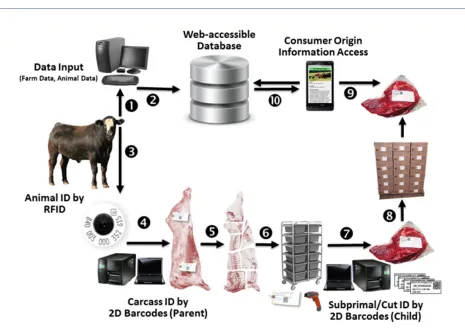
On the cover: “Schematic of Farm-to-Consumer Traceability Model” from the paper in this issue, A Traceability Model for Beef Product Origin Within a Local Institutional Value Chain, by Daniel D. Buskirk, Jeannine P. Schweihofer, Jason E. Rowntree, Robert H. Clarke, Daniel L. Grooms, and Tristan P. Foster. Schematic used with permission of the authors.
In This Issue
The Depth and Breadth of the Emerging Food Systems Literature / Duncan Hilchey 1
Columns
The Economic Pamphleteer: Reflections on Cooperation / John Ikerd 3
Global Views of Local Food Systems: Civil War and the Devastation of Syria’s Food System /
Rami Zurayk 7
Viewpoint and Responses
Viewpoint: Urban Gardening: A Valuable Activity, But… / Alan Hallsworth and Alfred Wong 11
Response 1: Increased Productivity, Role in Alleviating Food Insecurity Possible / Kathryn Colasanti and
Michael Hamm 15
Response 2: Urban Gardens: Part of a Whole System Approach / Laura Lavid 17
Response 3: Cultivating More Than Food: Where Community Gardens Fit with What Cities Do /
Terri L. Evans and Christiana Miewald 19
Response 4: No Buts About It…The Value of Urban Food Production / Evan Weissman 23
Commentary and Response
Cultivating Narratives: Cultivating Successors — A Reply to Steiger et al. / Hannah Chiswell 25
Rejoinder: “Dumb Farmers”: Or, They Can’t Possibly Know What They’re Talking About — We’re the
Experts / Jay D. Gatrell, Thomas Steiger, Neil Reid, Jeanette Eckert, and Paula Ross 29
Open Call
A Traceability Model for Beef Product Origin Within a Local Institutional Value Chain / Daniel D. Buskirk, Jeannine P. Schweihofer, Jason E. Rowntree, Robert H. Clarke, Daniel L. Grooms,
Toronto Farmers’ Markets: Towards Cultural Sustainability? / Deborah Bond and Robert Feagan 45
A GIS-based Methodology Toward Refining the Concept of Rural Food Deserts: A Case Study from
Rutland County, Vermont / John Van Hoesen, Brandy Bunkley, and Cody Currier 61
Reading from Farmers’ Scripts: Local Perceptions of Climate Variability and Adaptations in Laikipia,
Rift Valley, Kenya / Sarah Ayeri Ogalleh, Christian Vogl, and Michael Hauser 77
Can We Have Our (Safe and Local) Cake and Eat It Too? Oregon Re-crafts Food Safety Regulations for
Farm Direct Marketed Foods / Christy Anderson Brekken 95
Challenges and Strategies Among the Poor: Focus on Urban Agriculture in KwaMashu, Durban, South Africa / Hangwelani (Hope) Magidimisha, Lovemore Chipungu, and Rosemary Awuorh-Hayangah 109
Iowan Women Farmers’ Perspectives on Alternative Agriculture and Gender / Andrea L. Rissing 127
The Importance of Quantifying Food Waste in Canada / Majd Abdulla, Ralph C. Martin, Martin
I
NT
HISI
SSUEDUNCAN HILCHEY
The depth and breadth of the emerging food systems literature
Published online 28 March 2013
Citation: Hilchey, D. L. (2013). The depth and breadth of the emerging food systems literature [Editorial]. Journal of Agriculture, Food Systems, and Community Development, 3(2), 1–2. http://dx.doi.org/10.5304/jafscd.2012.032.015
Copyright © 2013 by New Leaf Associates, Inc.
eef origin traceability, cultural sustainability, rural food deserts, climate variability and adaptations, food safety regulations, urban agriculture, and food waste — the topics offered by authors of this open call edition of the Journal of Agriculture, Food Systems, and Community Development (also called JAFSCD or the Food Systems Journal) reflect the enormous diversity of the nascent field of food systems. We hold in high esteem the researchers across a broad range of disciplines working in collaboration with practitioners in the field to produce the papers contained herein. Anthropologists, economists, animal scientists, sociologists, educators, and even lawyers, are working with food policy council members, planners, and staffers from community-based organizations with increasing frequency. It is rewarding to see the transdisciplinary literature on food systems grow, and the Food Systems Journal community is very proud to be contributing to it. This issue is a testament to the remarkable depth and breadth of the emerging food systems literature.
We start out this issue with John Ikerd’s Economic Pamphleteer column, in which he gives us a sneak preview of what’s to come in our forthcoming issue on cooperatives and food alternative food systems initiatives. And in his Global Views of Local Food Systems column, Rami Zuryak reveals the devastating impact of civil war in Syria on that country’s food system.
Next we share a provocative viewpoint prepared by Alan Hallsworth and Alfred Wong entitled Urban Gardening: A Valuable Activity, But…” Four teams of previous authors offer their responses, including
Kathryn Colasanti and Michael Hamm; Laura Lavid; Terri Evans and Christiana Miewald; and
Evan Weissman.
Similarly, Hannah Chiswell stirs a constructive debate around the farm succession and intergenerational farm transfer literature with a critique of Cultivating Narratives: Cultivating Successors, by Steiger, et al., in this journal (http://dx.doi.org/10.5304/jafscd.2012.022.012). In turn, Jay D. Gatrell, Thomas Steiger, and
colleagues respond with a rejoinder, “Dumb Farmers”: Or, They Can’t Possibly Know What They’re Talking About — We’re the Experts.
In A Traceability Model for Beef Product Origin Within a Local Institutional Value Chain, Daniel Buskirk,
Jeannine Schweihofer, Jason Rowntree, Robert Clarke, Daniel Grooms, and Tristan Foster explore a state-of-the-art system for sharing detailed product information with consumers. Their model is featured on the cover of this issue. In Toronto Farmers’ Markets: Towards Cultural Sustainability?, Deborah Bond and
Robert Feagan examine how farmers’ markets can address and potentially benefit from catering to an increasingly diverse consumer base. John Van Hoesen, Brandy Bunkley, and Cody Currier move us a bit closer to defining rural food deserts in A GIS-based Methodology Toward Refining the Concept of Rural Food Deserts: A Case Study from Rutland County, Vermont. Local knowledge may play a critical role in coping with climate change according to Sarah Ayeri Ogalleh, Christian Vogl, and Michael Hauser in their paper, Reading from Farmers’ Scripts: Local Perceptions of Climate Variability and Adaptations in Laikipia, Rift Valley, Kenya.
Christy Anderson Brekken provides a case study of Oregon’s attempt to balance food safety and small producer interests in Can We Have Our (Safe and Local) Cake and Eat It Too? Oregon Re-crafts Food Safety Regulations for Farm Direct Marketed Foods. In Challenges and Strategies Among the Poor: Focus on Urban Agriculture in KwaMashu, Durban, South Africa, Hangwelani (Hope) Magidimisha, Lovemore Chipungu, and
Rosemary Awuorh-Hayangah find that while urban agriculture is flourishing, it could become a much more significant livelihood strategy with government acceptance and support. Andrea L. Rissing gives voice to women farmers through an ethnographic study described in Iowan Women Farmers’ Perspectives on Alternative Agriculture and Gender. Finally, Majd Abdulla, Ralph C. Martin, Martin Gooch, and Eduardo Jovel offer the first study to estimate Canadian food waste over time in The Importance of Quantifying Food Waste in Canada.
One final note: We have established a new feature on the Journal website called the JAFSCDBook Nook.
Here you’ll find books our authors have written, books we seek reviewers for, and a list of all the book reviews published to date in JAFSCD. Feel free to email me at [email protected] to suggest a title for inclusion in the Book Nook.
T
HEE
CONOMICP
AMPHLETEERJOHN
IKERD
Reflections on cooperation
Published online 5 February 2013
Citation: Ikerd, J. (2013). Reflections on cooperation. Journal of Agriculture, Food Systems, and Community Development, 3(2), 3–5.
http://dx.doi.org/10.5304/jafscd.2013.032.001
Copyright © 2013 by New Leaf Associates, Inc.
hen I was growing up in the late ’40s and early ’50s, the local “farmers’ exchange” was where we sold our chickens and eggs and bought feed for our chickens, pigs, and dairy cows. The exchange was operated by a cooperative, the Missouri Farmers Association or MFA. Its jingle on the local radio station proudly proclaimed,
“MFA, MFA, it’s the profit-sharing way. All agree, plain to see, it’s the farmer’s friend.” I didn’t have any reason to doubt its claims.
However, the MFA has long since betrayed its farmer-members’ trust by supporting the
industrialization of agriculture. During the mid-1990s, the president of the MFA regularly
W
Why did I name my column “The Economic Pamphleteer”? Pamphlets historically were short, thoughtfully written opinion pieces and were at the center of every revolution in western history. Current ways of economic thinking aren’t working and aren’t going to work in the future. Nowhere are the negative
consequences more apparent than in foods, farms, and communities. I know where today’s economists are coming from; I have been there. I spent the first half of my 30-year academic career as a very conventional free-market, bottom-line agricultural economist. I eventually became convinced that the economics I had been taught and was teaching wasn’t good for farmers, wasn’t good for rural communities, and didn’t even produce food that was good for people. I have spent the 25 years since learning and teaching the principles of a new economics of sustainability. Hopefully my “pamphlets” will help spark a revolution in economic thinking.
John Ikerd is professor emeritus of agricultural economics, University of Missouri, Columbia. He was raised on a small dairy farm in southwest Missouri and received his BS, MS, and Ph.D. degrees in agricultural economics from the University of Missouri. He worked in private industry for a time and spent 30 years in various professorial positions at North Carolina State University, Oklahoma State University, University of Georgia, and the University of Missouri before retiring in 2000. Since retiring, he spends most of his time writing and speaking on issues related to sustainability with an emphasis on economics and agriculture. Ikerd is author of Sustainable Capitalism; A Return to Common Sense; Small Farms Are Real Farms; Crisis and Opportunity:Sustainability in American Agriculture; A Revolution of the Middle; and the just-released The Essentials of Economic Sustainability.
More background and selected writings are at
proclaimed that Missouri only needed a few dozen large farming operations, and smaller farmers should look elsewhere for their future. As a young agricultural economist, I had made similar state-ments. I didn’t know any better at the time. The leader of a farmers’ cooperative, however, should not have been so naïve — or perhaps uncaring. Economic efficiency is good only insofar as it improves the well-being of people. The large agricultural cooperatives in the U.S. have become virtually indistinguishable from the rest of corporate agriculture.
Consequently, I have been skeptical of cooperation as a strategy for agricultural sustainability. I have been forced to reconsider, however. As I have written previously in this column, I believe we are going to have to re-create the entire food chain linking consumers and farmers, “from dirt to dinner plate.” Our current food system is dominated by large corporations that keep relentless pressure on producers to increase economic efficiency in order to maximize returns to their stockholders. This pressure is a natural consequence of “vertical integration.” It is more economically efficient to extract and exploit than to renew and regenerate because economic
value is inherently short-run in nature. In a struggle for economic survival, farmers are being forced to deplete and degrade the natural and human resources upon which long-run agricultural productivity ultimately depends.
My first thought was that we simply needed to restore true economic competition to the food system. We needed a large number of small farms and food firms, accurate information about products and prices, and the freedom to make economic choices without coercion or persuasion. If we removed corporate influence and control, we would remove the economic pressure to exploit and extract. We just needed to replace vertical integration with vertical competition.
With further thought, however, I realized that economically competitive markets also are driven toward ever-greater economic efficiency. In truly competitive markets no competitor has the ability to retain profits for itself or its investors. Still, if there is a possibility of increasing economic efficiency at any level within the system, competi-tion will provide a profit incentive to do so. Profits provide economic incentives to expand produc-tion, which forces competitors to adopt the same or similar technologies or methodologies “to remain competitive.” As producers expand produc-tion, prices fall and/or costs increase until initial increases in profits disappear, for everyone.
A similar process takes place at other levels in a vertically competitive system as prices and costs adjust to new technologies. The bene-fits of economic innovations are eventually reflected in lower product prices or higher-value products for consumers. In a purely com-petitive market, all benefits from increases in economic efficiency at any level in the food system, including farming, ultimately would be passed on to food consumers. Farmers would remain under continuous pressure to exploit their natural and human resources to remain competitive and ultimately to survive.
As I have indicated in previous columns, I believe sustainability ultimately will depend on replacing vertical integration and vertical compe-tition with vertical cooperation. I started writing about the need for vertical cooperation in 2011, before I learned the United Nations had designated 2012 as the “International Year of Cooperatives.” I have continued to read and write about coopera-tives during the year. In a vertically cooperative food system, prices at the various levels within the system would be determined though cooperation rather than by competition. There would still be incentives for economic efficiency, in that those
Economic efficiency is
good only insofar as it
improves the well-being
of people. The large
agricultural cooperatives
in the U.S. have become
virtually indistinguishable
from the rest of corporate
who had lower costs would retain greater eco-nomic benefits. However, prices at all stages in the system would be set at levels that would not force anyone to exploit and extract to
survive economically. Sustaina-bility would take priority over economic efficiency.
This conclusion compli-cates economic sustainability in that cooperative relationships are ultimately social and ethical in nature. There is a tendency within the sustainability move-ment to try to redefine eco-nomic value to include social and ethical values. However, economic value, as it is generally understood and reflected in today’s economy, is individual, instrumental, and impersonal in nature; it is an exchange value. It is not social or ethical. The decision to
cooperate rather than compete, as opposed to cooperating as a means of competing, is a cultural or ethical decision. The actual act of cooperation is inherently personal and thus social in nature. There will always be some point in time in a cooperative organization where it will be more economically efficient for some members to compete rather than cooperate. Cooperation is rooted in long-run ethical and social values, whereas economic value is inherently short-run in nature.
As we have seen, a legal cooperative business structure will not ensure the type of cooperative
relationships necessary for sustainability. I recently spent a month in Poland teaching economic sustainability at the Lublin Institute of Technology.
During the trip I was able to talk with members of the National Academies of Science of both the Ukraine and Poland. I thought Eastern Europe might be fertile ground for sustainable cooperation. Instead, I learned the old Soviet Union used cooperatives to impose their will on unwilling rural communities. My contacts there saw little hope for restoring faith in cooperatives as sustainable organizations. Even the classic “Rochdale Principles” for cooperatives,1 such as open membership, may not be consistent with sustain-able social relationships. Classical cooperatives may not be the answer.
Nevertheless, I believe that cooperation, by whatever name, will be essential for sustainability. Sustainable cooperatives may be called alliances, collaboratives, affiliations, networks, or any of a variety of names. Their sustainability will depend on the willingness and ability of people to establish and maintain cooperative economic relationships, sustained by social relationships, rooted in shared social and ethical values. Consequently, learning the art and science of human relationships could well be the greatest challenge of sustainability.
1 According to Wikipedia, “The Rochdale Principles are a
set of ideals for the operation of cooperatives. They were first set out by the Rochdale Society of Equitable Pioneers in Rochdale, United Kingdom, in 1844, and have formed the basis for the principles on which co-operatives around the world operate to this day.” See
http://en.wikipedia.org/wiki/Rochdale_Principles
Cooperatives’ sustainability
will depend on the
willingness and ability of
people to establish and
maintain cooperative
economic relationships,
sustained by social
relationships, rooted in
shared social and ethical
G
LOBALV
IEWS OFL
OCALF
OODS
YSTEMSReflections on the growing worldwide local food movement
RAMI ZURAYK
Civil war and the devastation of Syria’s food system
Published online 19 March 2013
Citation: Zurayk, R. (2013). Civil war and the devastation of Syria’s food system. Journal of Agriculture, Food Systems, and Community Development, 3(2), 7–9. http://dx.doi.org/10.5304/jafscd.2013.032.009
Copyright © 2013 by New Leaf Associates, Inc.
t is unfortunate that food and war make such good bedfellows. History is replete with instances of food being used as a weapon of siege or as a tool of control. In our globalized world, the domination of food trade has become an integral part of the modern arsenal. Henry Kissinger’s alleged quote, “Control oil and you control nations, control food and you control the people,” ade-quately captures this approach to what might be called “breadboat diplomacy,” which was deployed effectively in Iraq’s oil-for-food program (Arnove, 2003).
Food is also a major mover of people and, while no one knows if Marie Antoinette really did sug-gest that the people of France replace bread with
cake on the eve of the French Revolution, the message here is quite clear: beware of the hungry masses. As many researchers have suggested (see “Let them eat baklava,” 2012), the wave of popular uprisings that continue to shake the Arab world is interwoven with increased world food prices and chronic food insecurity. Food has also been associated with mass displacement and even with genocides. The “scorched earth” strategy essentially implies the removal of the capacity to produce food in order to destroy the fabric of society. One of the earliest such instances comes to us from the Romans, who reputedly plowed salt into the fertile land of Carthage after the end of the Third Punic War in 146 BC. Unable to produce crops, Carthage was abandoned.
Food shortages can also be the result of conflicts and wars. Messer and Cohen argue convincingly that “most modern wars…are ‘food wars,’ meaning that food is used as a weapon, food systems are destroyed in the course of conflict, and food insecurity persists as a legacy of conflict” (2006, p. 1). In their analysis they refer to the work of Nobel Laureate Amartya Sen, who links
con-I
Rami Zurayk is professor at the Faculty of Agricultural and Food Sciences at the American University of Beirut, Lebanon. He studied at the American University of Beirut and at Oxford University, UK. His research addresses issues at the nexus of food, landscapes, and livelihoods. He is an active member of Lebanese civil society and a founder of Slow Food Beirut. He can be contacted at
flicts with food insecurity through the destruction of human entitlements such as access to food and to the resources necessary to produce food, the environment, welfare, health care, education, and other social infrastructure. It therefore is not by coincidence that 20 out of the 36 countries listed by the FAO as requiring external assistance in food (FAO, 2013) are either in the midst of conflicts or have received large numbers of refugees from war-torn neighboring countries.
These include, but are not limited to, the Democratic Republic of Congo, Mali, Afghanistan, Iraq, Yemen, and, most recently, Syria. Syria’s case is particularly heartbreaking as the uprising that started two years ago as mass protests against an authoritarian regime has now developed into a full-fledged civil war that threatens to irreversibly destroy its local food systems. As in many other crises, food insecurity in Syria has accompanied a
“perfect storm” that provided the backdrop for a massive disaster. Wheat, which is native to the Levant, provides up to 40 percent of the calories consumed by the Syrian people (FAO, n.d.). Until 2007, the combination of centrally planned eco-nomy and state support, in addition to the techni-cal support offered by the International Center for Agricultural Research in Dry Areas (ICARDA), the CGIAR center responsible for the improvement of dryland farming, had made Syria self-sufficient in wheat (see for example FAO, 2010). During the global food crisis of 2008, Syria was one of the countries where local wheat prices were weakly affected by price increases (Khouri, 2012). The combination of economic liberalization accom-panied with crony capitalism that was imposed by the Assad regime in the past decade shook the basis of this precarious balance. Five years of recurrent droughts from 2007 through 2012, associated with climatic changes, caused massive migration from the rural areas and fostered
discontent with the security state (Femia & Werrell, 2012).
The rebellions started in the rural town of Daraa, located in the center of the wheat-produc-ing belt of Hawran, and quickly extended to Raqqa and Hassakah. These regions had borne the brunt of rural-urban migration driven by droughts and economic policies. The flames of unrest were fanned by the winds of changes that were shaking
the Arab region.
Regardless of the rights and wrongs in the Syrian civil war, as in all other conflicts, it is the rural poor who suffer first. Of a total population of 21 mil-lion, the UN estimates the number of refugees having fled the country at more than one million. Most of the refugees are in Lebanon, Iraq, and Jordan — three countries where national food security is precarious. The number of internally displaced people is estimated at 2.5 million, although the figure may be very underestimated due to the difficulty of gather-ing data. The World Food Program of the United Nations (WFP), which currently feeds 1.7 million people inside Syria and aims at increasing this figure to 2.5 million by April, reports that most of last year’s drought-stricken winter crop (mostly cereals) was left unharvested (WFP, n.d.).1
Increases in the price of inputs and the devaluation of the Syrian currency by 200 percent, together with the precarious security situation, meant that most farmers were unable to sow a crop this year. Last June, the FAO estimated that the losses to the Syrian agricultural sector were in the order of USD2 billion (FAO, 2012).
The war in Syria has dealt a severe blow to the livelihoods of Syrian people and to the farming sector. But it also has implications that go beyond the country’s borders. The headquarters of ICARDA in Aleppo were devastated and pillaged.
1 For detailed information about food and refugees in the
Syrian crisis, check http://www.wfp.org/crisis/syria
Syria’s case is particularly heartbreaking as the uprising that started two years ago as
The center, which contributed to improving the livelihoods of millions of small farmers across the drylands of the world, has closed its doors, and many of its staff have joined the swelling ranks of the refugees. A number of its programs were relocated to neighboring
countries such as Egypt, Jordan, and Lebanon. While its invaluable gene bank was spared (at least until September 2012, the date the Nature article from which this information was obtained (Yahia, 2012), and its contents have been replicated in the Svalbard gene bank in Norway and in various locations around the world.
The war in Syria is a calamity for the Syrian people, for the poor, for the farmers, and for every person who feels concerned by the fate of a fellow human being. Alas, the situation in Syria is not unique. As I write, there is a protracted human disaster taking place simultaneously in tens of regions all around the globe. The media may not be updating us about them, and the Democratic Republic of Congo may have yielded the front page to Syria, but the fire of wars still burns on the kill-ing fields. In Syria as elsewhere, poor farmers are the first to bear the brunt of violence and displace-ment. And while there is no lack of hands to feed the wars, the people who feed the world are reduced to mendacity and charity.
References
Arnove, A. (Ed.). (2003). Iraq under siege: The deadly impact of sanctions and war (Updated ed.). London: Pluto Press.
Femia, F., & Werrell, C. (2012, February 29). Syria: Climate change, drought and social unrest [Web log post]. Retrieved from http://climateandsecurity.org/
2012/02/29/syria-climate-change-drought-and-social-unrest/
Food and Agriculture Organization of the United Nations [FAO]. (n.d.) FAOSTAT: Syrian Arab Republic. Retrieved March 15, 2013, from
http://faostat.fao.org/CountryProfiles/Country_
Profile/Direct.aspx?lang=en&area=212
FAO (2010, October). Country Profile: Food Security Indicators for Syrian Arab Republic. Retrieved March 15, 2013, from
http://www.fao.org/fileadmin/ templates/ess/documents/food_ security_statistics/country_
profiles/eng/Syria_E.pdf
FAO. (2012, August 2). Three million Syrians need food, crops and livestock assistance. Retrieved from http://www.fao.
org/news/story/en/item/153731/icode/
FAO. (2013, March). Countries requiring external assistance for food. Retrieved March 14, 2013, from
http://www.fao.org/giews/english/hotspots/index.
htm
Khouri, N. (2012, February). Setting priorities for food security in the Arab world. Presentation at the Food Secure Arab World, A roadmap for policy and research, organized by IFPRI-UNESCWA. Beirut. Retrieved from http://www.slideshare.net/
fsaw2012/keynote-nadim-khouri
Let them eat baklava. (2012, March 17). The Economist. Retrieved from
http://www.economist.com/node/21550328
Messer, E., & Cohen, M. J. (2006). Conflict, food insecurity, and globalization (FCND Discussion Paper 206). Washington, D.C.: International Food Policy Research Institute. Retrieved from
http://www.ifpri.org/sites/default/files/pubs/
divs/fcnd/dp/papers/fcndp206.pdf
World Food Program of the United Nations [WFP]. (n.d.). Syria emergency. Retrieved March 14, 2013, from http://www.wfp.org/crisis/syria
Yahia, M. (2012, September 16). Conflict in Syria forces international research centre to move staff. Nature. http://dx.doi.org/10.1038/nmiddleeast.2012.133 The war in Syria is a calamity
VIEWPOINT
Urban gardening: A valuable activity, but…
Alan Hallsworth a *
University of Portsmouth
Alfred Wong b
Friends of Aboriginal Health
Submitted January 3, 2013 / Published online March 25, 2013
Citation: Hallsworth, A., & Wong, A. (2013). Urban gardening: A valuable activity, but… Journal of Agriculture, Food Systems, and Community Development, 3(2), 11–14. http://dx.doi.org/10.5304/jafscd.2013.032.010
Copyright © 2013 by New Leaf Associates, Inc.
Abstract
Urban gardening has a high popularity among civic politicians as well as certain vocal advocates. However, there is no basis to expect that this food-supply concept could ever deliver fresher food and/or lower cost foods to most people living within the contemporary structure of a modern urbanized society.
Urban gardening1 exemplifies one of the more admirable civic developments of recent years (see, for example, Colasanti & Hamm, 2010; Kremer & DeLiberty, 2011; Rudolf, 2010). But sadly the societal benefits of urban gardening may have been exaggerated by civic politicians and vocal advocates.
1 In this paper, urban gardening, synonymous with community
urban gardening, means gardening by citizens voluntarily in city land allocated or recognized by a civic authority. Decades ago, urban gardening simply denoted recreational gardening by individuals or families in the front or back yards of single-family homes located within the city limits.
There are limits to what can be achieved, depend-ent upon the why and the where. There are several motivations for urban gardening; some are largely self-contained, while others apparently seek to compete with existing food supply systems. The latter, we argue, are likely to find it difficult to succeed.
Turning to motivations, a desire for food security may be a key driver. Yet security relates not only to food availability, but also to accessibil-ity and a perhaps the belief that greater securaccessibil-ity flows from food that is in some way local. Depend-ing on locality, the definition of “local” is highly elastic to suit the interested parties (Feagan, 2007; Hand & Martinez, 2010). As civilization has
a Visiting researcher, Portsmouth Business School, University
of Portsmouth, Portsmouth, UK
b Friends of Aboriginal Health, Vancouver, Canada
evolved from an agrarian society to a mercantile-industrial society, food supply has basically become a specialized activity delegated to full-time farmers. There is effectively no possibility of nostalgic return to the days of “growing (all) one’s own food.”
In North America as well as in Western Europe, food supply is now dominated by increasingly effi-cient international transportation networks exclu-sively serving large commercial food retailers. Indeed, the vast majority of fresh vegetables and fruit are not sourced locally but come instead from agri-business farms often located abroad. Despite this monolithic food-supply structure, more infor-mal and pro-local sources of food have gained political currency.
The driving force behind urban gardening is local pressure for innovative food sources offering fresher, better food. This is always, however, tem-pered by systemic obstacles — affecting all urban-ized societies — that include substantial changes in employment patterns, accelerating densification, and changing family structures. For illustration, we have chosen Vancouver (Canada). Some of the key characteristics of Vancouver include (a) having a climate that is not ideal for growing tropical and subtropical vegetables such as tomatoes and bell peppers, and (b) having a high urban density, at about 12,950 per square mile (5,000 persons per square km). Furthermore, the Vancouver metro-politan area cannot expand as it is hemmed in by mountains, the sea, and the nearby U.S. border. In 2006, the Vancouver city government enacted bylaws to promote community gardens and other forms of urban agriculture, as important neighborhood gathering places to promote “sustainability, neighborhood livability, urban greening, community building, social interaction and food production” (City of Vancouver, 2012). In Vancouver, available gardening space is reduced steadily by the implementation of the “ecodensity” development model whereby single-family dwell-ings are routinely demolished and replaced by multioccupancy apartment towers. Ecodensity is being promoted ostensibly to reduce, among other things, the city’s carbon footprint, including shorter commuting distance between home and work. The side effect is the creation of highly
densified and unlivable spaces in which people are compacted into minuscule “bedroom boxes” with substantially less open-air environment. Increased logistical problems of food supply and domestic waste disposal have largely been ignored. The ecodensity development scheme would appear to contradict Vancouver City’s “greenest livable city by 2020” policy goal. Urban gardening is a poor substitute for traditional single-family home gardening inside the city limits. Predictably, the demand for garden plots greatly exceeds the plots available, and so undeveloped private land may obtain certain city property tax reductions if the land is donated, even temporarily, for urban gardening uses. The typical size of a Vancouver garden plot is just 43 square feet (4 square meters), which is suitable only for the growing of some flowers, vegetables, and herbs for personal enjoy-ment. Inexplicably, the city of Vancouver does not maintain an accurate and publicly available inven-tory of land in active use for urban gardening. Nevertheless, we have used various nonofficial sources to estimate that about 430,600 square feet (40,000 sq. m) (i.e., 0.04 percent of the total land area) were used for urban gardening in Vancouver in 2011. If the allocation were one person per plot, the beneficiaries would be, at best, about 1.5 percent of the entire city population.
Black Community Food Security Network [DBCFSN], n.d.) could not and would not be realized under these and other intractable physical and societal constraints.
Additionally, Vancouver city government has been promoting weekend farmers’ markets principally during the summer months as a venue for the sale of “local” produce to local citizens (McDonald & Cooley, 2012). There is essentially no evidence to suggest that these farmers’ markets could ever provide an adequate supply of locally produced fresh vegetables to feed the entire Vancouver population. The fundamental factor remains that in the northern climatic zone, the growing season is short and is limited to certain cool-weather crops. Fossil-fuel heated greenhouses are used routinely to grown warm-weather crops such as tomatoes, bell peppers, and cucumbers almost year-round. Furthermore, vendors typically are vague about the carbon footprint of produce grown locally in the nonsummer months. Fresh vegetables grown in local heated greenhouses have been found recently to have a substantially higher carbon footprint than those grown in open fields in warmer northern Mexico (Wong & Hallsworth, 2012). The carbon footprint incurred by the road transportation of produce from distant fields to retail outlet (e.g., from Mexicali to Vancouver) is of minor consequence.
The official popularization of “pocket markets” (Evans & Miewald, 2010) and sidewalk produce carts in Vancouver carries an inherent energy-inefficiency in the truck delivery of small amounts of produce to multiple retail locations. Novelty apart, these simply offer improved shopping con-venience for some time-pressured people working in large office buildings. There is no inherent assurance that the produce sold is any fresher than that purchased from a fixed-location grocery store. Another contentious issue is the potentially unfair competition against food retailers who have to pay city taxes for rented or owned fixed locations. Indeed, such concerns are often leveled against farmers’ markets as well.
In reality, most nonagribusiness sources could provide just a small supplement to the basic supply of seasonal vegetables. Furthermore, if food pro-duction were to extend well beyond the own-use
regime, then commercial, large-scale operations would be essential to maintain profitability. More productive land would be required within the confined city land base. How, then, would this differ from mainstream commercial farming? The inherent localness would surely be lost.
What can a civic government really do to improve food security in an urban setting? Does encouraging urban gardening in private and/or community lots meaningfully improve a city’s food system? Regrettably, no. Given the prevailing struc-ture of modern, urbanized mercantile-industrial society, urban gardening can only afford the per-sonal enjoyment of having grown one’s own vegetables and fruits, while communal gardens bring intangible socializing benefits. It would be misleading to pretend that urban gardening could significantly improve food security and
affordability.
References
City of Vancouver. (2012). Food policy: Urban gardens. Retrieved October 22, 2012, from
http://vancouver.ca/commsvcs/socialplanning/
initiatives/foodpolicy/projects/gardens.htm
Colasanti, K. A., & Hamm, M. W. (2010). Assessing the local food supply capacity of Detroit, Michigan. Journal of Agriculture, Food Systems, and Community Development, 1(2), 41–58.
http://dx.doi.org/10.5304/jafscd.2010.012.002
Detroit Black Community Food Security Network [DBCFSN]. (n.d.). A city of Detroit policy on food security:Creating a food secure Detroit. Retrieved May 20, 2012, from
http://detroitblackfoodsecurity.org/policy.html
Evans, T. L., & Miewald, C. (2010). Assessing the pocket market model for growing the local food movement: A case study of metropolitan Vancouver. Journal of Agriculture, Food Systems, and Community Development, 1(2), 129–144.
http://dx.doi.org/10.5304/jafscd.2010.012.011
Feagan, R. (2007). The place of food: Mapping out the “local” in local food systems. Progress in Human Geography, 31(1), 23–42.
http://dx.doi.org/10.1177/0309132507073527
Koc, M., MacRae, R., Mougeot, L. J. A., & Welsh, J. (Eds.). (1999). For hunger-proof cities: Sustainable urban food systems. Ottawa: International Development Research Centre.
Kremer, P., & DeLiberty, T. L. (2011). Local food practices and growing potential: Mapping the case of Philadelphia. Applied Geography, 31(4), 1252–1261.
http://dx.doi.org/10.1016/j.apgeog.2011.01.007
MacRae, R., Gallant, E., Patel, S., Michalak, M., Bunch, M., & Schaffner, S. (2010). Could Toronto provide 10% of its fresh vegetable requirements from within its own boundaries? Matching consumption requirements with growing spaces. Journal of Agriculture, Food Systems and Community Development, 1(2), 105–127.
http://dx.doi.org/10.5304/jafscd.2010.012.008
McDonald, T., & Cooley, P. (2012). Your Local Farmers Market Society: Growing farmers markets in Vancouver’s neighbourhoods — Strategic Plan
2012–2014. Vancouver: Your Local Farmers Market Society.
Rudolf, J. C. (2010, November 18). Reimaging Detroit as Grow Town [Blog post]. The New York Times Green Blog. http://green.blogs.nytimes.com/
2010/11/18/reimagining-detroit-as-grow-town/
Shore, R. (2011, December 13). High-tech greenhouse planned for downtown Vancouver parkade rooftop. TheVancouver Sun. Retrieved from
http://www.vancouversun.com/High+tech+green house+planned+downtown+Vancouver+parkade+
rooftop/5854302/story.html
Wong, A., & Hallsworth, A. (2012). Farm-to-fork: A proposed revision of the classical food miles concept. International Journal on Food System Dynamics, 3(1), 74–81. Retrieved from
http://centmapress.ilb.uni-bonn.de/ojs/
Increased productivity, role in alleviating food insecurity possible
Response #1 to Hallsworth and Wong’s viewpoint, “Urban gardening: A valuable activity, but…”
Kathryn Colasanti * and Michael Hamm
Michigan State University Center for Regional Food Systems
Submitted January 31, 2013 / Published online March 25, 2013
Citation: Colasanti, K., & Hamm, M. (2013). Increased productivity, role in alleviating food insecurity possible. Journal of Agriculture, Food Systems, and Community Development, 3(2), 15–16.
http://dx.doi.org/10.5304/jafscd.2013.032.011
Copyright © 2013 by New Leaf Associates, Inc.
It’s true that urban agriculture may provide a modest contribution to most cities’ food supply. However, Hallsworth and Wong (2013) fail to recognize the range of cities across North America as well as the numerous opportunities to increase the productivity of urban agriculture and its potential role in alleviating food insecurity. They also underemphasize the value of urban agriculture beyond the quantity of food produced.
There are many cities — Detroit, Cleveland, and Milwaukee come to mind — with large amounts of open space and notions of incorporating agricul-ture into the fabric of a 21st century green city. The authors fail to acknowledge the potential for expanded productivity per unit of land beyond what is currently observed, for example with the use of passive solar, season-extension methods. In Michigan, with average low temperatures below Vancouver’s, unheated hoophouses allow for at
least 30 crops to be grown, many year-round (Colasanti, Matts, Blackburn, Corrin, & Hausler, 2010). The authors dismiss what can be grown in a 4-square-meter (43-square-feet) garden as “suitable only for… personal enjoyment,” but during the frost-free period an extra vegetable serving for a family of four per day is easily accomplished in this space.
The authors assume that more capital-intensive forms of urban agriculture are incompatible with food security due to cost. However, examples like sliding scale prices to serve both high-end restau-rants and low-income customers exist. They also state that commercial, large-scale forms of urban agriculture would lose their “inherent localness.” Yet “local” implies only geographic proximity, not scale. Commercial urban agriculture retains the potential for the community to obtain fresher food, connect with production, and establish a food system that is connected to their region, nation, and the globe, and is compatible with their values. Ultimately, while there are places with popula-tion densities well below, and available vacant land * Corresponding author: Kathryn Colasanti, 480 Wilson Road,
well above, the authors’ example of Vancouver (see above), highlighting either end of the urban density spectrum merely points to the insufficiency of generalizing. The number of people responsible for garden plots is likewise an inadequate gauge of urban agriculture’s worth. Not only do garden plots likely serve multiperson households, but, more importantly, urban gardens provide value to the broader community — aesthetic and social value to the surrounding neighborhood, educa-tional value to a nearby school, and recreaeduca-tional value to community youth groups. While a garden probably doesn’t supply all food needs, research shows that gardening increases consumption of healthy, fresh produce (Alaimo, Packnett, Miles, & Kruger, 2008), a key dietary improvement strategy. We reject the implied premise that because urban agriculture doesn’t encapsulate the solution for food security, it shouldn’t be part of the toolkit (as well as the premise that because farmers’ markets cannot supply all a city’s population, they aren’t worthwhile). While we would certainly argue for expanded resources to address the fundamental causes of food insecurity, in an era of economic austerity, we would also argue for maintaining the
current investments in urban agriculture strategies that improve food security for participating house-holds. We would furthermore argue for expanding urban agriculture’s role in a number of our urban
areas.
References
Alaimo, K., Packnett, E., Miles, R. A., & Kruger, D. J. (2008). Fruit and vegetable intake among urban community gardeners. Journal of Nutrition Education and Behavior, 40(2), 94–101.
http://dx.doi.org/10.1016/j.jneb.2006.12.003
Colasanti, K., Matts, C., Blackburn, R., Corrin, S., & Hausler, J. (2010). Putting Michigan produce on your menu: How to buy and use Michigan produce in your institution. East Lansing, Michigan: C. S. Mott Group for Sustainable Food Systems, Michigan State University. Available from
http://foodsystems.msu.edu/resources/mi-produce-institution
Hallsworth, A., & Wong, A. (2013). Urban gardening: A valuable activity, but… Journal of Agriculture, Food Systems, and Community Development, 3(2), 11–14.
Urban gardens: Part of a whole system approach
Response #2 to Hallsworth and Wong’s viewpoint, “Urban gardening: A valuable activity, but…”
Laura Lavid
Florida Organic Growers
Submitted January 15, 2013 / Published online March 25, 2013
Citation: Lavid, L. (2013). Urban gardens: Part of a whole system approach. Journal of Agriculture, Food Systems, and Community Development. Advance online publication. http://dx.doi.org/10.5304/jafscd.2013.032.012
Copyright © 2013 by New Leaf Associates, Inc.
Hallsworth and Wong ask the question, “Does encouraging urban gardening in private and/or community lots meaningfully improve [Vancou-ver’s] food system?” (2013, p. 3). They believe the answer is no, but community gardens and urban agriculture do impact a city’s food system. Are they the only solution? No. In our world of recessions and fiscal cliffs, so much seems to revolve solely on economics while other significant benefits are often discredited or diminished. Community gar-dens are important aspects of an urban landscape for its people and environment, but also do impact the economics, on the individual and community levels as well.
Even though most plots are relatively small, a community gardener is able to produce a signifi-cant amount of produce. During World War II, “20 million victory gardeners produced 44 percent of the fresh vegetables in the United States” (WhyHunger, 2011, “Vegetables for Victory,” para. 2). More recently, “studies have estimated that a
community garden can yield around USD500 to USD2,000 worth of produce per family a year” (PolicyLink, n.d., “Why Use It?” bullet “Save families money…”). And not only do community gardeners grow healthy produce, but they eat it. A study in Denver found that compared to non-gardeners or home non-gardeners, community garden-ers ate significantly more fruits and vegetables (Litt, Soobader, Turbin, Hale, Buchenau, & Marshall, 2011). While the food grown in community gar-dens is not enough to sustain one, it does affect the gardener’s food budget and is healthy produce that otherwise may not have been accessible to him or her. “A study of all food stores in three low-income zip codes in Detroit found that only 19 percent, or fewer than one in five stores, carried a minimal ‘healthy food basket’ [of] products based on the food pyramid” (Pothukuchi, 2003, p. 5). Additionally, for many immigrants, this might be the only way to have access to crops they have a tradition of eating.
Community gardens also affect the economic health of a neighborhood. They are part of making a neighborhood a desirable place to live, including reducing crime and increasing neighborhood Laura Lavid is Community Food Project Coordinator at
attachment. Additionally, they do affect the pros-perity of a neighborhood. “A New York University study examined over 636 New York City commu-nity gardens and found a statistically significant, positive effect on sales prices of residential proper-ties within a 1,000 foot radius of a community gar-den when compared to properties outside the 1,000 foot ring, but still within the same neighbor-hood” (Been & Voicu, 2006).
Additionally, some community garden and urban agricultural projects work with disadvan-taged populations to teach farming and business skills. These programs provide job training to groups such as youth, refugees, and individuals who are homeless. The intention of these programs is training, but in the process they also provide a valuable product: fresh, healthy, affordable pro-duce. One such program, New Roots for Refugees, generated more than USD120,000 in revenue, including USD30,000 worth of produce to food stamp recipients in 2012.
As Hallsworth and Wong point out, the city of Vancouver acknowledges that there are multiple benefits of urban gardening, not just economic or food security: “In 2006, the Vancouver city gov-ernment enacted bylaws to promote community gardens and other forms of urban agriculture, as important neighborhood gathering places to pro-mote ‘sustainability, neighborhood livability, urban greening, community building, social interaction and food production.’” Community gardens increase food security with improved access to healthy, local food, address social justice, improve individual and community health, encourage resili-ent communities, offer therapeutic benefits, beautify neighborhoods, and much more. Com-munity gardens and urban agriculture are just one piece of a new food system that values all aspects
of the system to promote a more just and sustaina-ble society where not only healthy food is accessi-ble and affordaaccessi-ble but also where local communi-ties thrive.
References
Been, V., & Voicu, I. (2006). The effect of community gardens on neighboring property values (New York University Law and Economics Working Papers No. 46). Available from http://lsr.nellco.org/nyu_lewp/46 Hallsworth, A., & Wong, A. (2013). Urban gardening: A
valuable activity, but… Journal of Agriculture, Food Systems, and Community Development, 3(2), 11–14.
http://dx.doi.org/10.5304/jafscd.2013.032.010
Litt, J. S., Soobader, M., Turbin, M. S., Hale, J., Buchenau, M., & Marshall, J. A. (2011). The influences of social involvement, neighborhood aesthetics and community garden participation on fruit and vegetable consumption. The American Journal of Public Health, 101, 1466–1473. New Roots for Refugees. (2013). 2012 program report.
Retrieved from
http://www.newrootsforrefugees.org/
PolicyLink. (n.d.). Urban agriculture and community gardens: Why use it? Retrieved January 2013 from
http://www.policylink.org/site/c.lkIXLbMNJrE/ b.7634055/k.102B/Urban_Agriculture_and_ Community_Gardens.htm
Pothukuchi, K. (2003). The Detroit food system: A handbook for community planners. Wayne State University. In: Community Food Security Coalition. (October 2003). Urban Agriculture and Community Food Security in the United States: Farming from the City Center to the Urban Fringe. Retrieved from http://www.foodsecurity.org
Cultivating more than food: Where community gardens fit with what cities do
Response #3 to Hallsworth and Wong’s viewpoint, “Urban gardening: A valuable activity, but…”
Terri L. Evans a *
Urban Studies Program, Simon Fraser University
Christiana Miewald b
Centre for Sustainable Community Development, Simon Fraser University
Submitted January 29, 2013 / Published online March 25, 2013
Citation: Evans, T. L., & Miewald, C. (2013). Cultivating more than food: Where community gardens fit with what cities do. Journal of Agriculture, Food Systems, and Community Development, 3(2), 19–21.
http://dx.doi.org/10.5304/jafscd.2013.032.013
Copyright © 2013 by New Leaf Associates, Inc.
Hallsworth and Wong’s viewpoint (2013) asserts that urban gardening, and by extension, other local food initiatives (farmers’ markets, etc.) are
insufficient strategies to replace the quantity and efficiency provided by contemporary globalized food systems for supplying cheap food to the (urbanizing) masses. We agree.
Urban gardening, on its own, is not a panacea for addressing food insecurity in urban settings. At
current production levels, it can only supply a small fraction of the food needed for urban residents. However, the value of urban gardening and other alternative food initiatives (e.g., farmers’ and pocket markets, good food box programs, etc.) goes beyond simply providing food. As the authors note, the city of Vancouver considers urban gardens to be beneficial public spaces that allow citizens to connect with nature, facilitate the consumption of supplemental levels of fresh food, encourage physical activity, and strengthen social relations (see also Alaimo, Reischl, & Allen, 2010; Ober Allen, Alaimo, Elam, & Perry, 2008; Turner, Henryks, & Pearson, 2011; Wakefield, Yeudall, Taron, Reynolds, & Skinner, 2007).
There are many examples of urban gardening from Detroit, Buffalo, Seattle and Milwaukee (among others), cities where land is much more
aCorresponding author: Terri L. Evans, Urban Studies Program,
Simon Fraser University, Suite 2100, 515 West Hastings Street, Vancouver, BC V6B 5K3 Canada; +1-778-782-7914;
b Christiana Miewald, Centre for Sustainable Community
Development, Simon Fraser University, West Mall Complex, Burnaby, BC V5A 1S6 Canada; +1-778-782-6955;
available, that suggest that it is a viable use of urban space, particularly in low-income urban communities with limited access to fresh produce through traditional grocery store outlets (Atkinson, 2012; Broadway, 2009; Metcalf & Widener, 2011). While some cities, such as Vancouver and Toronto, struggle to find available land for extensive urban gardening, they are also becoming increasingly inventive with land use of marginal space (e.g., brownfields), and there is a growing interest in vertical agriculture in order to increase production capacity (Ehrenberg, 2008; Iverson, Holmes, & Bomke, 2012).
Toward the end of their piece, Hallsworth and Wong ask what civic governments can do to improve food security in an urban setting, and this represents both a critical question and challenge. Within British Columbia and elsewhere across Canada, local food and urban agriculture initiatives are supported in local planning and policy docu-ments, with more formalized food systems plan-ning approaches finding their way into official community plans and regional growth strategies (Donald, 2008). By embedding local food strategies within wider frameworks, cities and city-regions are, by intention, taking action to address climate change, sustainability, and quality-of-life
imperatives.
These plans, initiatives, and innovations acknowledge the connection between food and other civic priorities that relate to economic development, tourism, greenhouse gas reduction, waste management, protection of green space, health, wellness, and culture. They represent a less piecemeal approach to land-use development and recognize the food system as an important urban system (Pothukuchi & Kaufman, 1999).
The growing need for community gardens provides added evidence to the ways in which local governments are reacting to issues that increasingly fall at their doorsteps but are often beyond their jurisdiction (in B.C., the reduction in provincial welfare eligibility, as one example) and how these responses are framed, i.e., through a poverty reduction framework (via community gardens, food banks, etc.), or through a different one (e.g., Vancouver’s Greenest City initiative), or both. Thus, community gardens in particular, and
alternative food initiatives more broadly, have larger effects than simply providing food. While they may not enjoy the efficiencies and economies of scale of traditional retail, alternative food initiatives contribute numerous other place-based benefits that large-scale systems are not able to accomplish. Whether through providing space for social interaction and residents with access to and control over a small portion of the fresh food they eat, or teaching children about where food comes from, and greening otherwise unused and derelict spaces, community gardens support social goods that meaningfully benefit the health and well-being of cities and their citizens.
References
Alaimo, K., Reischl, T. M., & Allen, J. O. (2010). Community gardening, neighborhood meetings, and social capital. Journal of Community Psychology, 38(4), 497–514.
http://dx.doi.org/10.1002/jcop.20378
Atkinson, A. E. (2012). Promoting health and
development in Detroit through gardens and urban agriculture. Health Affairs, 31(12), 2787–2788.
http://dx.doi.org/10.1377/hlthaff.2012.1106
Broadway, M. (2009). Growing urban agriculture in North American cities: The example of Milwaukee. Focus on Geography, 52(3-4), 23–30. http://dx.doi.
org/10.1111/j.1949-8535.2009.tb00251.x
Donald, B. (2008). Food systems planning and sustain-able cities and regions: The role of the firm in sustainable food capitalism. Regional Studies, 42(9), 1251–1262.
http://dx.doi.org/10.1080/00343400802360469
Ehrenberg, R. (2008). Let’s get vertical: City buildings offer opportunities for farms to grow up instead of out. Science News, 174(8), 16–20.
http://dx.doi.org/10.1002/scin.2008.5591740818
Hallsworth, A., & Wong, A. (2013). Urban gardening: A valuable activity, but… Journal of Agriculture, Food Systems, and Community Development, 3(2), 11–14.
http://dx.doi.org/10.5304/jafscd.2013.032.010
Iverson, M. A., Holmes, E. P., & Bomke, A. A. (2012). Development and use of rapid reconnaissance soil inventories for reclamation of urban brownfields: A Vancouver, British Columbia, case study. Canadian Journal of Soil Science, 92(1), 191–201.
Metcalf, S. S., & Widener, M. J. (2011). Growing Buffalo’s capacity for local food: A systems framework for sustainable agriculture. Applied Geography, 31(4), 1242–1251.
http://dx.doi.org/10.1016/j.apgeog.2011.01.008
Ober Allen, J., Alaimo, K., Elam, D., & Perry, E. (2008). Growing vegetables and values: Benefits of
neighborhood-Based community gardens for youth development and nutrition. Journal of Hunger & Environmental Nutrition, 3(4), 418–439.
http://10.1080/19320240802529169
Pothukuchi, K., & Kaufman, K. (1999). Placing the food system on the urban agenda: The role of
municipal institutions in food systems planning. Agriculture and Human Values 16, 213–24.
http://dx.doi.org/10.1023/A:1007558805953
Turner, B., Henryks, J., & Pearson, D. (2011). Community gardens: Sustainability, health and inclusion in the city. Local Environment, 16(6), 489–492.
http://dx.doi.org/10.1080/13549839.2011.595901
Wakefield, S., Yeudall, F., Taron, C., Reynolds, J., & Skinner, A. (2007). Growing urban health: Community gardening in South-East Toronto. Health Promotion International, 22(2), 92–101.
No buts about it…The value of urban food production
Response #4 to Hallsworth and Wong’s viewpoint, “Urban gardening: A valuable activity, but…”
Evan Weissman Syracuse University
Submitted February 4, 2013 / Published online March 25, 2013
Citation: Weissman, E. (2013). No buts about it…The value of urban food production. Journal of Agriculture, Food Systems, and Community Development, 3(2), 23–24. http://dx.doi.org/10.5304/jafscd.2013.032.014
Copyright © 2013 by New Leaf Associates, Inc.
In their provocative essay, Alan Hallsworth and Alfred Wong (2013) contend that academics, activists, and policy makers exaggerate the benefits of urban food gardening. They state: “There is no basis to expect that [urban gardening] could ever deliver fresher food and/or lower cost foods.” The authors attempt to explain the shortcomings of urban gardening as a food security strategy by highlighting its barriers in Vancouver, Canada, especially the climactic obstacles to production in northern regions and the age-old real estate adage of “highest and best land use” that precludes urban food production. Hallsworth and Wong’s assump-tions could not be more incorrect, and rather than simply stoking debate, the authors unwittingly pro-vide fodder for the detractors of urban agriculture, of which there are many. Indeed, urban gardening plays a significant role within the city as public
space, as an economic development strategy, and as a community-organizing tool. Most importantly, urban food production contributes to household food security. To cite just one example from my own research: a ½ acre (0.2 ha) urban farm project in Brooklyn, New York — East New York Farms! — produces over USD20,000 of fresh produce annually in a neighborhood defined by disparities in fresh food access. Over 70 percent of the farm’s transactions are made through the Supplemental Nutrition Assistance Program (i.e., food stamps), meaning that fresh produce is reaching community members in high need (personal interview with East New York Farms manager, June 15, 2010). The essay fails to convince precisely because it relies on false assumptions and narrow understand-ings of urban gardening. Hallsworth and Wong acknowledge the value of only the “personal enjoy-ment” of growing food and the “socializing” benefits of community gardening. The authors suggest that urban gardening has some redeeming productive capacity, but not for “most people” who believe that “greater [food] security flows from food that is in some way local.” Certainly it is Evan Weissman, Assistant Professor of Food Studies,