1535-9778/07/$08.00⫹0 doi:10.1128/EC.00214-06
Copyright © 2007, American Society for Microbiology. All Rights Reserved.
Peroxisome Function Regulates Growth on Glucose in the
Basidiomycete Fungus
Cryptococcus neoformans
䌤
Alexander Idnurm,
1Steven S. Giles,
2John R. Perfect,
1,3and Joseph Heitman
1,3*
Departments of Molecular Genetics and Microbiology,1Cell Biology,2and Medicine,3
Duke University Medical Center, Durham, North Carolina 27710
Received 6 July 2006/Accepted 3 October 2006
The function of the peroxisomes was examined in the pathogenic basidiomycete Cryptococcus neoformans.
Recent studies reveal the glyoxylate pathway is required for virulence of diverse microbial pathogens of plants
and animals. One exception isC. neoformans, in which isocitrate lyase (encoded byICL1) was previously shown
not to be required for virulence, and here this was extended to exclude also a role for malate synthase (encoded
byMLS1). The role of peroxisomes, in which the glyoxylate pathway enzymes are localized in many organisms,
was examined by mutation of two genes (PEX1 andPEX6) encoding AAA (ATPases associated with various
cellularactivities)-type proteins required for peroxisome formation. Thepex1andpex6deletion mutants were
unable to localize the fluorescent DsRED-SKL protein to peroxisomal punctate structures, in contrast to
wild-type cells. pex1and pex6single mutants and a pex1 pex6 double mutant exhibit identical phenotypes,
including abolished growth on fatty acids but no growth difference on acetate. Because bothicl1 andmls1
mutants are unable to grow on acetate as the sole carbon source, these findings demonstrate that the glyoxylate
pathway can function efficiently outside the peroxisome inC. neoformans. Thepex1mutant exhibits wild-type
virulence in a murine inhalation model and in an insect host, demonstrating that peroxisomes are not required
for virulence under these conditions. An unusual phenotype of thepex1andpex6mutants was that they grew
poorly with glucose as the carbon source, but nearly wild type with galactose, which suggested impaired
hexokinase function and thatC. neoformansperoxisomes might function analogously to the glycosomes of the
trypanosomid parasites. Deletion of the hexokinaseHXK2gene reduced growth in the presence of glucose and
suppressed the growth defect of thepex1mutant on glucose. The hexokinase 2 protein ofC. neoformanscontains
a predicted peroxisome targeting signal (type 2) motif; however, Hxk2 fused to fluorescent proteins was not localized to peroxisomes. Thus, we hypothesize that glucose or glycolytic metabolites are utilized in the peroxisome by an as yet unidentified enzyme or regulate a pathway required by the fungus in the absence of peroxisomes.
The paucity of applicable antimicrobial agents and the grow-ing resistance to existgrow-ing agents raise concern about the long-term control of infectious diseases, particularly those caused by fungi. The search for novel genes that lack human counterparts and are essential for pathogen survival or virulence and the design of molecules that target these genes or encoded pro-teins represent an approach to new drug discovery. An exciting discovery towards this goal was the identification of the glyoxy-late pathway as playing a role in microbial virulence (reviewed in reference 43). This pathway catalyzes the conversion of isocitrate to malate and succinate and is essential for the uti-lization of two-carbon molecules (e.g., ethanol and acetate) as carbon sources. The first enzyme in the pathway, isocitrate lyase, is required for virulence ofMycobacterium tuberculosis
andCandida albicans in mice (44, 47, 50), as well as for the
fungiColletotrichum lagenarium,Leptosphaeria maculans, and
Magnaporthe griseain plants (2, 27, 78). The second enzyme in
the pathway, malate synthase, is involved in virulence in the bacteriumRhodococcus fasciansand the fungusStagonospora
nodorum towards plants (67, 75). The pathway is absent in
vertebrates; hence, drugs targeting it, perhaps aided by the crystal structure (5, 65, 66) or gene-specific inactivation (40), may therefore be broad-spectrum and safe human therapeu-tics. Although plants contain glyoxylate pathway enzymes, there is also potential for application in agricultural settings, given the temporal expression of the pathway enzymes in plants (e.g., during seed germination and plant senescence).
Peroxisomes are single-membrane-bound organelles associ-ated with a suite of cellular functions, including peroxide de-toxification, -oxidation of fatty acids, and utilization of D -amino acids (reviewed in reference 46). The glyoxylate pathway in plants and fungi is most often a component of peroxisome function (53, 81). Peroxisomes are also essential for human health. Twelve complementation groups have been identified in humans with deficiencies in peroxisome function, most of which are lethal or lead to early death or debilitating disease (79). In otherwise healthy individuals, peroxisomes are required for metabolism of fatty acids and produce reactive oxygen as part of this process. Many aspects of the functions of the human proteins required for peroxisome formation have been elucidated by using fungi, particularlySaccharomyces
cer-evisiae, as model systems for peroxisome function, including
the identification of the human genes mutated in 9 of the 12 complementation groups (reviewed in reference 22).
Peroxisomes can be required for microbial virulence. Dele-tion ofpex6in the fungus Colletotrichum lagenariumreduces
* Corresponding author. Mailing address: Room 322 CARL Build-ing, Box 3546, Department of Molecular Genetics and Microbiology, Duke University Medical Center, Durham, NC 27710. Phone: (919) 684-2824. Fax: (919) 684-5458. E-mail: [email protected].
䌤Published ahead of print on 13 October 2006.
60
on September 8, 2020 by guest
http://ec.asm.org/
disease on bean leaves by impairing appressorium function during the initial stages of infection (36). Recently, a PEX6
homolog and a peroxisome-targeted acetyltransferase have been shown to be required for appressorium formation and pathogenicity of the major rice pathogenMagnaporthe grisea
(4, 60). Similarly,hex1mutations impair appressorium forma-tion inM. grisea(68). Hex1 is a protein required for formation of Woronin bodies, which are specialized peroxisomes found only in filamentous ascomycete fungi, which function to block septal pores in damaged hyphae. The Kinetoplastida para-sites, such as those in the Trypanosoma and Leishmania
genera, contain an unusual type of peroxisome named the glycosome because up to seven of the nine enzymes for glycolysis are targeted within them, and no Kreb’s cycle occurs within these organisms. Reduced expression of genes required for peroxisome assembly is lethal to trypanosomes as a consequence of enzyme mislocalization to the cyto-plasm, and as such, the glycosomes are proposed drug tar-gets for these parasites (15, 23, 49).
One concern with developing a drug that targets the glyoxy-late pathway enzymes was the discovery thatCryptococcus
neo-formansdoes not require isocitrate lyase for virulence, despite
the observation that the transcript is highly up-regulated in the central nervous system during infection of mammals (61). In addition, in aSaccharomyces cerevisiaevirulence study, anicl1
mutant also showed no reduction in virulence (21).C. neofor-mansis a basidiomycete fungus that causes disease, most com-monly in immunocompromised people. The genome se-quences of five different isolates are available, and together with the development of a suite of genetic approaches, this fungus serves as an excellent model system to study eukaryote biology and microbial pathogenesis (7, 26). The initial aim of this research was to investigate further the role of the glyoxy-late pathway and peroxisome function in this fungus. We dis-covered that peroxisomes are not required for glyoxylate path-way activity, but rather interact in a novel path-way with growth in the presence of glucose.
MATERIALS AND METHODS
Fungal strains.Cryptococcus neoformansserotype A strains H99 (MAT␣), KN99a, KN99␣, KN3B7#12 (MATa, the eighth backcross to generate serotype A congenic parents KN99aand KN99␣) (52), andicl1(MAT␣) mutant (61) were used. Serotype D strains JEC20 (MATa) and JEC21 (MAT␣) were used to assay the mating type of serotype A strains (39).Saccharomyces cerevisiaeBY4743 wild-type reference andicl1⌬andpex1⌬mutant diploid strains were obtained from theS. cerevisiaegene deletion set (18). TheC. neoformansstrains generated in this study are listed in Table 1.
Database analyses of theC. neoformansgenome.The protein sequences en-coded by theS. cerevisiae MLS1, PEX1,PEX5,PEX6, andPEX7genes were used to search theC. neoformansgenome database (www.tigr.com) (42) with BLASTp and tBLASTn using default parameters. The sequences of the nine enzymes required for glycolysis inS. cerevisiaewere likewise used in searches against the C. neoformansgenome databases. The subcellular localizations of the putativeC. neoformanshomologs were predicted using PSORT II software and manual searches of peroxisomal targeting signals.
Creation ofC. neoformansmutant strains.Mutations of theHXK2,MLS1, PEX1,PEX5,PEX6, andPEX7genes were isolated by replacing 95 to 100% of the coding regions of these genes with a cassette conferring resistance to nourseothricin (NAT) (28). A disruption allele was generated in which approx-imately 1.5 kb of DNA flanking the NAT cassette was obtained by overlap PCR (14) using the primers in Table 2 and transformed using a biolistic apparatus into H99 or KN99␣ cells (Bio-Rad model PDS-1000/He biolistic particle delivery system) (72). Mutation was confirmed by PCR and Southern blot analysis with DNA extracted using cetyltrimethylammonium bromide buffer (58). Apex1
mu-tant was crossed to the congenic isolate KN3B7#12, and basidiospores from the cross were isolated by micromanipulation and analyzed to obtain apex1 MATa strain. Crosses were conducted on V8 medium (5% Campbell’s V8 juice, 0.5 g/liter KH2PO4, 40 g/liter Bacto-agar, pH 5) for up to 3 weeks in the dark. Mating
was unaffected inpex1mutants, includingpex1⫻pex1crosses. Thepex1 MATa strain was crossed to apex6strain, and the progeny of this cross were analyzed by Southern blotting to identify a doublepex1 pex6mutant strain. Anmls1::NAT disruption allele was created by overlap PCR and subcloning. The cassette was cloned into plasmid pPZP-201BK and introduced into cells ofAgrobacterium tumefaciensstrain LBA4404 or EHA105 by electroporation.Agrobacterium -me-diated transformation ofC. neoformanswas performed as described previously (28). Attempts to mutateMLS1usingAgrobacterium-mediated transformation were unsuccessful. Themls1::NATconstruct was therefore amplified by PCR using the plasmid as template and used successfully to delete theMLS1gene via biolistic transformation. Thepex1mutation was complemented by the ectopic introduction of a wild-type copy of thePEX1gene fused to a cassette conferring resistance to neomycin via biolistic transformation (14). Thehxk2mutation was complemented by the ectopic introduction of a wild-type copy of theHXK2gene fused to the cassette conferring resistance to neomycin (pPZP-NEO1) (76) via Agrobacterium-mediated transformation.
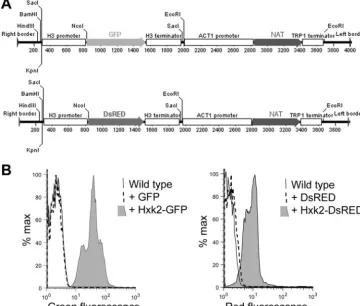
Fluorescent protein constructs and microscopy.To assess organelle localiza-tion, overlap fusion products were created for green or red fluorescent proteins expressed from theC. neoformanshistone H3 promoter using primers listed in Table 3. Green fluorescent protein (GFP) (S65T) was provided by Tian Lian and Jim Kronstad, and red fluorescent protein (DsRED) was provided by Connie Nichols as a derivative of pDsRED-Express (BD Biosciences, Palo Alto, CA). A peroxisome-targeted fluorescent protein (DsRED-SKL) driven by the histone H3 promoter and terminator was fused to the neomycin resistance marker using overlap PCR and introduced intoC. neoformansstrain KN99␣by biolistic trans-formation. The same strategy was used to create a DsRED construct without the -SKL-terminal amino acids. Overlap fusion products to express GFP or DsRED were subcloned into the SacI site of pPZP-NATcc (76), as illustrated in Fig. 1A. To visualize the cell wall, strains were grown in YPD (yeast extract, peptone, dextrose) medium with Calcofluor white (40g/ml) for 5 min and washed three times in phosphate-buffered saline. Cells were mounted in Vectashield (Vector Laboratories, California). DsRED or GFP protein and Calcofluor fluorescence was examined using a Zeiss Axioskop 2 Plus fluorescence microscope and
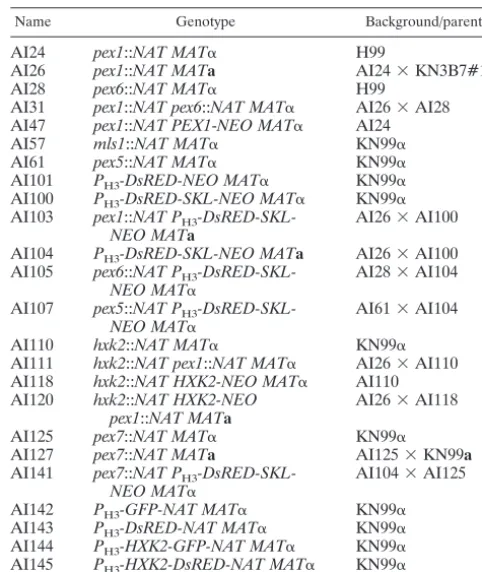
pho-TABLE 1. C. neoformansstrains used in this study
Name Genotype Background/parents
AI24 pex1::NAT MAT␣ H99
AI26 pex1::NAT MATa AI24⫻KN3B7#12
AI28 pex6::NAT MAT␣ H99
AI31 pex1::NAT pex6::NAT MAT␣ AI26⫻AI28 AI47 pex1::NAT PEX1-NEO MAT␣ AI24
AI57 mls1::NAT MAT␣ KN99␣
AI61 pex5::NAT MAT␣ KN99␣
AI101 PH3-DsRED-NEO MAT␣ KN99␣
AI100 PH3-DsRED-SKL-NEO MAT␣ KN99␣
AI103 pex1::NAT PH3 -DsRED-SKL-NEO MATa
AI26⫻AI100 AI104 PH3-DsRED-SKL-NEO MATa AI26⫻AI100
AI105 pex6::NAT PH3 -DsRED-SKL-NEO MAT␣
AI28⫻AI104 AI107 pex5::NAT PH3
-DsRED-SKL-NEO MAT␣
AI61⫻AI104
AI110 hxk2::NAT MAT␣ KN99␣
AI111 hxk2::NAT pex1::NAT MAT␣ AI26⫻AI110 AI118 hxk2::NAT HXK2-NEO MAT␣ AI110 AI120 hxk2::NAT HXK2-NEO
pex1::NAT MATa
AI26⫻AI118
AI125 pex7::NAT MAT␣ KN99␣
AI127 pex7::NAT MATa AI125⫻KN99a
AI141 pex7::NAT PH3 -DsRED-SKL-NEO MAT␣
AI104⫻AI125 AI142 PH3-GFP-NAT MAT␣ KN99␣
AI143 PH3-DsRED-NAT MAT␣ KN99␣
AI144 PH3-HXK2-GFP-NAT MAT␣ KN99␣
AI145 PH3-HXK2-DsRED-NAT MAT␣ KN99␣
on September 8, 2020 by guest
http://ec.asm.org/
tographed with an AxioCam MRM digital camera. For fluorescence, the Zeiss filters for 4⬘,6⬘-diamidino-2-phenylinodle (DAPI) (Calcofluor white staining; ex-citationmax, 365 nm), GFP gr (excitation, 450 to 480 nm), and both tetramethyl
rhodamine isothiocyanate (TRITC) (DsRED; excitation 510 to 560 nm) and Texas red (DsRed; excitation, 530 to 580 nm) were used. As an independent measure of fluorescence, strains grown overnight in liquid YPD were sorted for size and fluorescence by flow cytometry.
InC. neoformans, GFP and DsRED have been used previously to study protein localization or expression (10, 80). However, use of GFP has been problematic and few published vectors are available for expression inC. neofor-mans. The constructs were introduced inA. tumefaciensstrain EHA105, and these strains were used to transformC. neoformans. Weak autofluorescence was observed in wild-type cells, particularly associated with the plasma membrane. While cytoplasmic red fluorescence was observed with the DsRED construct, green fluorescence was very weak with the GFP construct, despite the same promoter being used to drive expression (Fig. 1B). The reasons are unknown; however, fusion of theC. neoformansHxk2 protein to the N terminus dramati-cally enhanced levels of fluorescence (Fig. 1B and 8C), suggesting a requirement forC. neoformansnucleotide bias or introns for stable expression. A similar result has been observed for GFP expression in other basidiomycete fungi, TABLE 2. Oligonucleotide primers used to make gene disruption
alleles by overlap PCR
Primer name
(GenBank reference no.)a Primer sequence (5⬘33⬘)b PEX1(CND06230) disruption 1. JOHE8689...CAAAGTTGGGCTTCGGTGGC 2. JOHE8720...AGCTCACATCCTCGCAGCCACAGATA CTGACTTGGC 3. JOHE8719...GCCAAGTCAGTATCTGTGGCTGCGA GGATGTGAGCTG 4. JOHE8722...GAATGTATTGACTTGCCGGAAGAGA TGTAGAAACTAG 5. JOHE8721...TAGTTTCTACATCTCTTCCGGCAAGT CAATACATTC 6. JOHE8690...AGCAAGACCAACTGTAAGCGG PEX6(CNI03110) disruption 1. JOHE8691...GCCTTTCCATTGCTACCTCC 2. JOHE8724...AGCTCACATCCTCGCAGCCTACACAT ACAAATTCCG 3. JOHE8723...CGGAATTTGTATGTGTAGGCTGCGA GGATGTGAGCTG 4. JOHE8726...CGTTCAAAGCTGCGGTCTGAAGAGA TGTAGAAACTAG 5. JOHE8725...TAGTTTCTACATCTCTTCAGACCGCA GCTTTGAACG 6. JOHE8692...ACTTTGAGCGAAAGAGCC MLS1(CNBL2980) disruption 1. JOHE10129...GTCGACATTTGAACAGTATC 2. JOHE10132...CACAAACGAGGTACCGATACAATAAT CTAGAGATGTGATCGC 5. JOHE10131...GCGATCACATCTCTAGATTATTGTATC GGTACCTCGTTTGTG 6. JOHE10130...CTGAGCCCAACCAAGATAC PEX5(CNBK0870) disruptionc 1. JOHE11465...GAAAAGAGCATGTGGTCAGG 2. JOHE11466...GTCATAGCTGTTTCCTGACTGGATTC TGCTAAAGC
3. M13R ...CAGGAAACAGCTATGAC 4. M13F...GTAAAACGACGGCCAG 5. JOHE11467...CTGGCCGTCGTTTACCGGCCTTAAAG GAACGTC 6. JOHE11469...AAGCGAAGGGCGTTACATAC PEX7(CNA04980) disruption 1. JOHE12196...TGGTCCCAAGTCTGAGCAC 2. JOHE12197...CTGGCCGTCGTTTTACTAGAGCCAAA TGATGATCG 3. M13F...GTAAAACGACGGCCAG 4. M13R ...CAGGAAACAGCTATGAC
5. JOHE12198...GTCATAGCTGTTTCCTGACTGGGCCT TGTTTGACC 6. JOHE12199...ATTCTATGAAATGTGGTGGG HXK2(CNBB3020) disruption 1. JOHE13893...TTCACAGCTGGTCAATCCC 2. JOHE13894...GCTTATGTGAGTCCTCCCATTGCTTG CAAACTTCGG 3. JOHE11866...GGGAGGACTCACATAAGC 4. JOHE86777...GAAGAGATGTAGAAACGAG 5. JOHE13895...CTCGTTTCTACATCTCTTAGGTCATCC AAGTTCGTC 6. JOHE13896...TTCGAAGTTGAGATTGCG
aPrimers 1 and 2 and 5 and 6 were used onC. neoformansH99 genomic DNA,
and primers 3 and 4 were used on a plasmid conferring resistance to nourseo-thricin. Equimolar amounts of the three products were mixed, and the overlap PCR was performed with primers 1 and 6.
bThe NAT cassette was ligated into the KpnI-XbaI sites (boldface). cIncludes signature tag JKL 211.
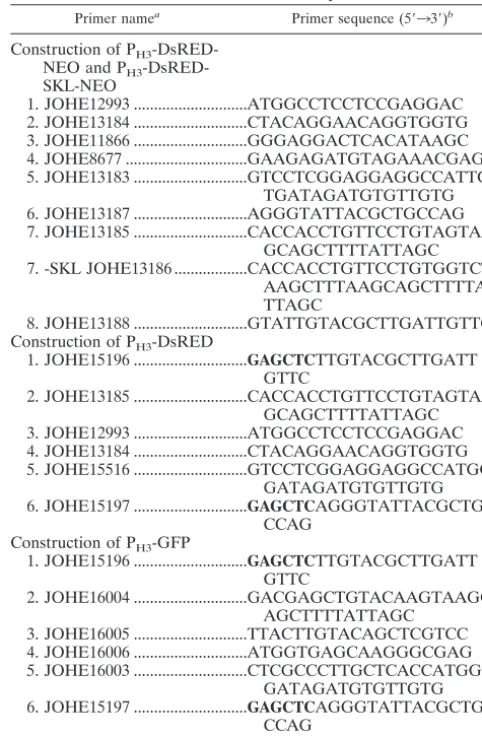
TABLE 3. Oligonucleotide primers for overlap PCR to make DsRed or GFP constructs or plasmids
Primer namea
Primer sequence (5⬘33⬘)b
Construction of PH3
-DsRED-NEO and PH3
-DsRED-SKL-NEO
1. JOHE12993 ...ATGGCCTCCTCCGAGGAC 2. JOHE13184 ...CTACAGGAACAGGTGGTG 3. JOHE11866 ...GGGAGGACTCACATAAGC 4. JOHE8677 ...GAAGAGATGTAGAAACGAG 5. JOHE13183 ...GTCCTCGGAGGAGGCCATTG
TGATAGATGTGTTGTG 6. JOHE13187 ...AGGGTATTACGCTGCCAG 7. JOHE13185 ...CACCACCTGTTCCTGTAGTAA
GCAGCTTTTATTAGC 7. -SKL JOHE13186 ...CACCACCTGTTCCTGTGGTCT
AAGCTTTAAGCAGCTTTTA TTAGC
8. JOHE13188 ...GTATTGTACGCTTGATTGTTC Construction of PH3-DsRED
1. JOHE15196 ...GAGCTCTTGTACGCTTGATT GTTC
2. JOHE13185 ...CACCACCTGTTCCTGTAGTAA GCAGCTTTTATTAGC 3. JOHE12993 ...ATGGCCTCCTCCGAGGAC 4. JOHE13184 ...CTACAGGAACAGGTGGTG 5. JOHE15516 ...GTCCTCGGAGGAGGCCATGG
GATAGATGTGTTGTG 6. JOHE15197 ...GAGCTCAGGGTATTACGCTG
CCAG Construction of PH3-GFP
1. JOHE15196 ...GAGCTCTTGTACGCTTGATT GTTC
2. JOHE16004 ...GACGAGCTGTACAAGTAAGC AGCTTTTATTAGC
3. JOHE16005 ...TTACTTGTACAGCTCGTCC 4. JOHE16006 ...ATGGTGAGCAAGGGCGAG 5. JOHE16003 ...CTCGCCCTTGCTCACCATGGT
GATAGATGTGTTGTG 6. JOHE15197 ...GAGCTCAGGGTATTACGCTG
CCAG
aFor DsRED-NEO overlap PCR, primers 1 and 2 were used on the DsRED
plasmid, primers 3 and 4 were used on the NEO plasmid, and primers 5 and 6 or 7 and 8 were used on JEC21 genomic DNA. Primers 4 and 8 were used for the full overlap PCR. For overlap constructs that were subcloned using SacI sites into theAgrobacteriumT-DNA vector, primers 1 and 2 and 5 and 6 were used on JEC21 genomic DNA and primers 3 and 4 were used on the DsRED or GFP plasmid. Overlap PCR was performed with primers 1 and 6.
bSacI sites are in boldface.
on September 8, 2020 by guest
http://ec.asm.org/
includingAgaricus bisporusandCoprinus cinereus, in which inclusion of introns is hypothesized to stabilize protein expression (6). Recently, the GFP gene has been optimized forC. neoformanscodon usage to enhance fluorescence (41).
In vitro phenotypic analysis.The growth of strains was compared on YPD (yeast extract, peptone, dextrose) and YNB (yeast nitrogen base) agar medium supplemented with different carbon sources: glucose (0.2%, 0.5%, 1%, or 2%), fructose (2%), mannose (2%), galactose (2%), sodium acetate (1% or 2%), and oleic acid (5 mM plus 1% tergitol). Melanin and capsule were assayed on L-DOPA medium (100 mg/liter) and in low-iron medium (with the chelator EDDHA). Growth curves were conducted on cells that were grown overnight in liquid YPD medium, washed, and added to yeast nitrogen base with different carbon sources in shaking or rotating cultures at 30°C or 37°C, using starting inocula at an optical density at 600 nm (OD600) of⬃0.1.
Virulence assays.For murine assays,C. neoformanscells were used to infect 4-to 6-week-old female A/Jcr mice (NCI/Charles River Labora4-tories) by nasal inhalation. Ten animals each were inoculated with a 50-l inoculum containing 1⫻105yeast cells of KN99a, H99,mls1,pex1, orpex1 PEX1complemented
strains. Animals were examined daily and sacrificed when signs of morbidity were observed. The experiment was double blinded, such that the strain genotypes remained anonymous during inoculum preparation and administration into an-imals, as well as until all animals were sacrificed. The murine experimental protocol was approved by the Duke University Animal Use Committee.
The wax moth virulence assay followed the previous protocol (51), with Gal-leria mellonellalarvae purchased from Vanderhorst, Inc. (St. Marys, Ohio). The inoculum was 1⫻105yeast cells, and larvae were incubated at 37°C
postinocu-lation. Larvae were examined daily, and those not responding to touch were scored as inviable.
RESULTS
A malate synthase mutant is virulent, demonstrating the
glyoxylate pathway is not required for virulence.The
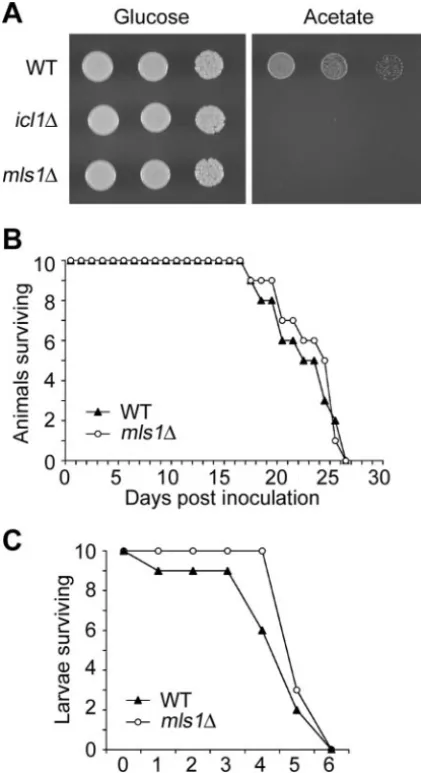
glyoxy-late pathway enzyme isocitrate lyase is essential for virulence in diverse pathogenic organisms. One exception isC. neoformans: despite high transcription ofICL1in the host, no reduction in virulence was observed when the gene was mutated (61). Here a mutation was isolated in the gene encoding the second en-zyme unique to this pathway, malate synthase (MLS1), to test if this gene played a role in virulence. We hypothesized that the high transcription of ICL1 in vivo in an mls1 mutant back-ground may cause metabolic perturbation to the fungus and thaticl1andmls1mutations might confer different phenotypes. Like theicl1mutant, themls1mutant was unable to grow on acetate as the sole carbon source (Fig. 2A). A wild-type strain and an mls1 mutant strain were inoculated into mice or an alternative insect host (wax moth larvae), and survival was monitored daily. Mice or wax moths infected with either strain succumbed to lethal infection with the same efficiency as the wild type, indicating that MLS1 plays no role in virulence under these conditions (Fig. 2B and C). Thus, the two compo-nents of the glyoxylate pathway, isocitrate lyase and malate synthase, have similar functions inC. neoformansto promote growth on the two-carbon substrate acetate, but appear to play no role in virulence in a murine inhalation or insect assay.
Protein localization to peroxisomes is impaired by mutating
thePEX1orPEX6genes.The glyoxylate pathway is generally
considered to be localized within the peroxisomes of plants and fungi (53, 81). We therefore aimed to disrupt peroxisomes to
FIG. 1. (A) Construct design of the T-DNA region in plasmids for expression of GFP and DsRED protein fusions inC. neoformans. (B) Flow cytometry of the fluorescence levels of 10,000 cells from each strain analyzed for green or red fluorescence (fluorescein isothiocyanate [FITC] or
Texas red filters, respectively).
on September 8, 2020 by guest
http://ec.asm.org/
test their function with respect to the glyoxylate pathway and virulence. The completed genome sequence ofC. neoformans
(35) was searched for homologs of highly conserved peroxin (PEX) genes that have been identified from organisms as re-quired for peroxisome formation or function. To test the func-tion of peroxisomes in the biology ofC. neoformans, two key genes required for peroxisome function in other organisms were disrupted. Pex1 and Pex6 homologs are functionally-re-lated AAA (ATPases associated with various cellular a ctivi-ties)-type proteins with a role in the assembly of small per-oxisomal vesicles into peroxisomes, aiding vesicle fusion in an ATP-dependent manner, and/or protein import into the per-oxisomes (32, 59, 64, 71). The PEX1 and PEX6genes of C.
neoformanswere mutated by targeted disruption, and apex1
pex6double mutant was obtained as a meiotic segregant from
apex1⫻pex6cross. Thepex1mutation was complemented by reintroduction of a wild-type copy of thePEX1gene.
Peroxisome function was assayed based on localization of a fluorescent protein into these organelles. Addition of a per-oxisome targeting signal 1 (PTS1), such as variants of the tripeptide -SKL, to the C-terminal end of proteins can enable their translocation into the peroxisome (16). Even conjugation of the -SKL tripeptide to gold beads targets their import into peroxisomes (77).C. neoformans Icl1 terminates with -HKL. When a DsRed-SKL protein was expressed in a wild-type back-ground, a punctate fluorescence pattern was observed, indicat-ing that the DsRED protein was localized to peroxisomes (Fig. 3). Punctate fluorescence was observed in cells growing on normal carbon sources (i.e., glucose) and did not require in-duction by fatty acid carbon sources, which is consistent with peroxisomes being present in the relatedCryptococcus
humi-colusspecies under glucose conditions (30) but in contrast to
several other fungi in which peroxisomes are either not formed or are degraded in the presence of glucose (1, 24, 73).
The DsRED-SKL strain with punctate peroxisomal fluores-cence was crossed to thepex1mutant, and meiotic progeny (a total of 18) were isolated. Half of those that were fluorescent (4/9) showed a pattern of discrete localization, whereas the other half (5/9) showed fluorescence throughout the cell. Those five progeny with diffuse cytoplasmic fluorescence all bore a disruption of thepex1 gene. In a similar genetic ap-proach (38 progeny analyzed: 12/22 localized, wild type for
PEX6wild type; 10/22 nonlocalized,pex6deletion), no distinct localization was observed when the DsRED-SKL protein was
FIG. 2. Malate synthase ofC. neoformansis required for growth on acetate as the sole carbon source, but is not required for virulence. (A) Dilutions (10-fold) of yeast cells were inoculated onto minimal medium plates containing glucose or acetate as the sole carbon source, and grown for 2 days at 30°C. Yeast cells (1⫻105) of wild-type (WT)
and themls1mutant strains were inoculated into mice (B) or the wax mothGalleria mellonella(C), and survival was monitored daily.
FIG. 3. Disruption of peroxisome function inC. neoformanscauses mislocalization of DsRed-SKL.C. neoformanscells were transformed with constructs to express the red fluorescent DsRED protein with or without an additional -SKL tripeptide at the C-terminal end. The protein localizes to peroxisomes as punctate structures in wild-type strains, while thepex1 andpex6 mutant strains show a cytoplasmic distribution.
on September 8, 2020 by guest
http://ec.asm.org/
expressed in thepex6background (Fig. 3). Thus,pex1orpex6
deletions impair the transport of a peroxisomal marker protein and likely impact the function of peroxisomes in C.
neofor-mans.
PEX1 and PEX6 are required for growth on minimal
me-dium containing glucose, but not acetate.The phenotypes of
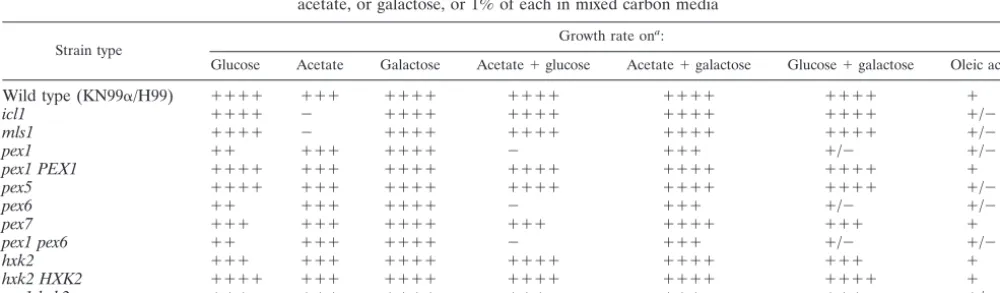
thepex1andpex6mutant strains were compared to those of the wild-type strain (H99), the pex1 PEX1complemented strain, and the icl1 and mls1 mutants (Fig. 4; Table 4). As noted above, themls1andicl1strains were unable to grow on acetate as their sole carbon source. The pex1, pex6, and pex1 pex6
mutant strains ofC. neoformansshowed growth equivalent to that of the wild type on YNB with acetate. Wild-typeC.
neo-formansexhibits slow growth on many fatty acids (19); theicl1,
mls1, andpexmutants all show a marked reduction in growth on YNB with the fatty acid oleic acid as the carbon source (Table 4). Curiously, pex mutant strains all grew poorly on YNB media with glucose as the sole carbon source. Growth of
pex1 or pex6 mutant strains was also inhibited on medium
containing a mixture of glucose and acetate, which can be interpreted as the presence of glucose either is toxic to the cells or causes carbon catabolite repression of genes required for acetate utilization (Table 4). To ensure that the phenotype of thepex1andpex6mutants in the presence of glucose was not due to an artifact of medium preparation, growth of the C.
neoformansstrains was compared to that of S. cerevisiae icl1
andpex1mutant strains. TheS. cerevisiae pex1mutant showed equal growth to the reference strain on YNB with either glu-cose or acetate, while theicl1mutant was unable to grow on acetate (Fig. 4).
Pex5 functions in -SKL targeting to peroxisomes, while Pex7
functions in the growth defect seen inpex1orpex6mutants.To
elucidate which proteins are responsible for the glucose-defec-tive growth phenotype ofpex1 and pex6 mutants, two genes that control targeting of proteins to peroxisomes were mu-tated:PEX5andPEX7, which were identified based on their similarity to the S. cerevisiae homologs. Pex5 is a conserved protein that binds to the peroxisome-targeting signal 1 (PTS1) located at the C-terminal end of proteins and assists in their import into the peroxisome. There are two putative homologs
ofPEX5inC. neoformans, similar to the situation in humans,
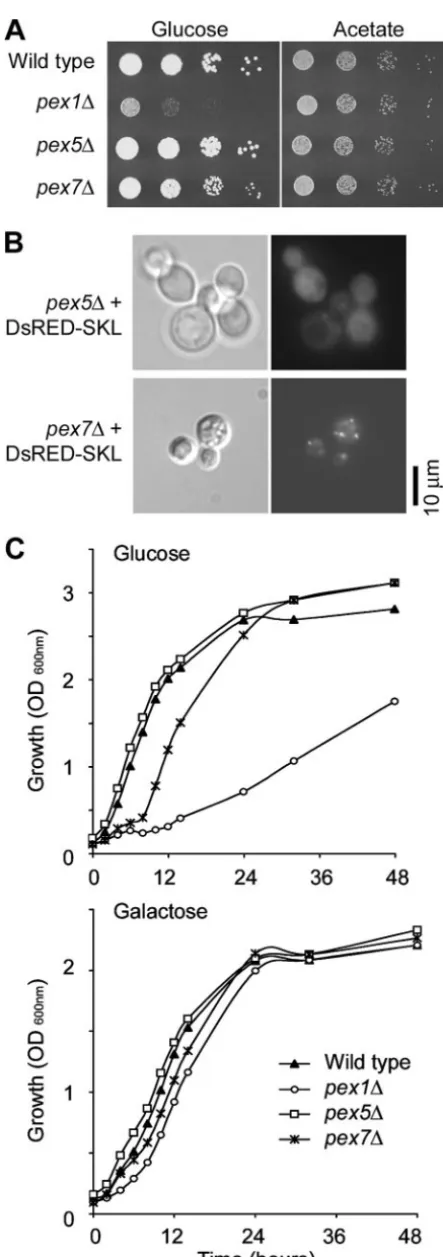
while there is only one copy in ascomycete fungi (34). There is a single copy ofPEX7, which encodes the protein that binds a second class of peroxisome targeting signal (PTS2). The gene encoding the DsRed-SKL protein was crossed into the pex5
and pex7mutant backgrounds. Localization was severely im-paired inpex5cells. However, occasional punctate localization was observed, which may be consistent with a partially func-tional second homolog ofPEX5in theC. neoformansgenome (Fig. 5B). Punctate localization equivalent to that seen in DsRED-SKL in wild-type cells was observed in thepex7 mu-tant background, indicating that Pex7 is dispensable for target-ing this type of protein to the peroxisomes.
Growth rates of the wild-type andpex1,pex5, andpex7 mu-tant strains were compared on minimal media supplemented with glucose or acetate (Fig. 5A) and other carbon sources (Table 4). Thepex5mutant grew like the wild type, while the
pex7mutant exhibited reduced growth on YNB with glucose, although not as dramatically as that seen with thepex1mutant (Fig. 5A). To further illustrate this reduction in growth rate,
FIG. 4. ThePEX1or PEX6gene is required for metabolism on minimal media with glucose as an additional carbon source, but is not required for growth on acetate. Shown are phenotypes ofC. neofor-mans(C. n.) andS. cerevisiae(S. c.) strains growing on different carbon sources.
TABLE 4. Qualitative growth rates ofC. neoformansstrains grown on yeast nitrogen base agar supplemented with 2% glucose, acetate, or galactose, or 1% of each in mixed carbon media
Strain type Growth rate on
a
:
Glucose Acetate Galactose Acetate⫹glucose Acetate⫹galactose Glucose⫹galactose Oleic acid
Wild type (KN99␣/H99) ⫹⫹⫹⫹ ⫹⫹⫹ ⫹⫹⫹⫹ ⫹⫹⫹⫹ ⫹⫹⫹⫹ ⫹⫹⫹⫹ ⫹
icl1 ⫹⫹⫹⫹ ⫺ ⫹⫹⫹⫹ ⫹⫹⫹⫹ ⫹⫹⫹⫹ ⫹⫹⫹⫹ ⫹/⫺
mls1 ⫹⫹⫹⫹ ⫺ ⫹⫹⫹⫹ ⫹⫹⫹⫹ ⫹⫹⫹⫹ ⫹⫹⫹⫹ ⫹/⫺
pex1 ⫹⫹ ⫹⫹⫹ ⫹⫹⫹⫹ ⫺ ⫹⫹⫹ ⫹/⫺ ⫹/⫺
pex1 PEX1 ⫹⫹⫹⫹ ⫹⫹⫹ ⫹⫹⫹⫹ ⫹⫹⫹⫹ ⫹⫹⫹⫹ ⫹⫹⫹⫹ ⫹
pex5 ⫹⫹⫹⫹ ⫹⫹⫹ ⫹⫹⫹⫹ ⫹⫹⫹⫹ ⫹⫹⫹⫹ ⫹⫹⫹⫹ ⫹/⫺
pex6 ⫹⫹ ⫹⫹⫹ ⫹⫹⫹⫹ ⫺ ⫹⫹⫹ ⫹/⫺ ⫹/⫺
pex7 ⫹⫹⫹ ⫹⫹⫹ ⫹⫹⫹⫹ ⫹⫹⫹ ⫹⫹⫹⫹ ⫹⫹⫹ ⫹
pex1 pex6 ⫹⫹ ⫹⫹⫹ ⫹⫹⫹⫹ ⫺ ⫹⫹⫹ ⫹/⫺ ⫹/⫺
hxk2 ⫹⫹⫹ ⫹⫹⫹ ⫹⫹⫹⫹ ⫹⫹⫹⫹ ⫹⫹⫹⫹ ⫹⫹⫹ ⫹
hxk2 HXK2 ⫹⫹⫹⫹ ⫹⫹⫹ ⫹⫹⫹⫹ ⫹⫹⫹⫹ ⫹⫹⫹⫹ ⫹⫹⫹⫹ ⫹
pex1 hxk2 ⫹⫹⫹ ⫹⫹⫹ ⫹⫹⫹⫹ ⫹⫹⫹ ⫹⫹⫹ ⫹⫹⫹ ⫹/⫺
aOleic acid was added at 5 mM with 0.5% tergitol.⫹/⫺indicates very poor growth. Growth was observed at 24, 48, and 72 h at 30°C and 37°C.
on September 8, 2020 by guest
http://ec.asm.org/
strains were assessed in YNB media with glucose or galactose as the carbon sources. The pex7 mutant exhibits a modest reduced growth rate over the first 24 h of culture (Fig. 5C). The
pex5mutant showed an equivalent reduction in growth on oleic acid, as seen in strains bearingpex1orpex6deletions. In con-trast, deletion ofpex7had no effect on growth on oleic acid. These data suggest that Pex5 mediates the targeting of the PTS1 proteins to the peroxisomes, including those for fatty acid utilization. Second, the data suggest that the PTS2 (Pex7-dependent) pathway of protein import into the peroxisomes could in part mediate the reduced growth rates seen inpex1or
pex6mutant backgrounds on glucose medium.
Peroxisome function is not required for C. neoformans
vir-ulence in two animal host models.Thepex1orpex6mutants
show a growth defect on YNB medium, which is the standard minimal medium used for this fungus. We hypothesized that this defect might compromise the virulence of these strains.
TheC. neoformansmutants were examined for in vitro changes
in traits most commonly associated with virulence. Growth at mammalian temperature (37°C) was equal to that at 30°C. Melanin and capsule were produced normally in theC.
neo-formansmutants. Thepex1mutant strain was tested for
viru-lence in the murine nasal inhalation model. Surprisingly, wild-type, pex1 mutant, and pex1 PEX1 complemented strains showed equivalent virulence in this assay (Fig. 6A). As a sec-ond test of virulence, the wax moth larvae model was used. As with the murine inhalation model, no decrease in virulence was observed in thepex1 mutant background (Fig. 6B). Thus, in two diverse models there is no evidence for a role of peroxi-somes inC. neoformansvirulence.
C. neoformansperoxisomes are required for efficient growth
on glucose and other monosaccharides.The most unexpected
and curious phenotype of the C. neoformans pex1 or pex6
mutants was represented by their growth defects on minimal medium (YNB). Peroxisomes have numerous and diverse functions in different organisms (46). Disruption of peroxi-some function does not usually impair fungal growth under rich growth conditions (25, 32, 36): these data onC. neofor-mans provide a rare exception. A second exception is the ascomycete fungusPenicillium chrysogenum. In this fungus, a strain with a mutation in thePEX5gene, required for transport of peroxisomally targeted proteins, shows poor growth, while isolation of mutants with mutation inPEX1orPEX6was not possible, suggesting that these genes may be essential (31, 33). A recent report from another ascomycete,M. grisea, suggests that growth rate of thepex6mutant strain is also slightly re-duced (60).
There are two possible explanations for the adverse effects of glucose on growth of thepex1andpex6mutants. The first is a defect in response to oxidative stress, e.g., that the mitochon-dria are producing reactive oxygen intermediates during res-piration that cannot be detoxified in the absence of the per-oxisomes. The second hypothesis is that some component of
FIG. 5. Function of the Pex5 and Pex7 proteins for targeting pro-teins to peroxisomes or growth on minimal media, respectively. (A) Se-rial dilutions (10-fold) of strains were grown for 3 days on YNB with
2% glucose (at 22°C) or 2% acetate (at 30°C). (B) Punctate localiza-tion of DsRED-SKL is impaired in thepex5mutant background, but not in thepex7mutant background. (C) Growth of the strains shown in panel A on glucose or galactose (at 30°C).
on September 8, 2020 by guest
http://ec.asm.org/
primary metabolism, such as nitrogen/amino acid or carbon metabolism, is localized to the peroxisomes ofC. neoformans.
First, the possible role of reactive oxygen detoxification by peroxisomes was examined. To test this hypothesis, we exam-ined the four catalases in the C. neoformans genome. One catalase (encoded byCAT2) contains a PTS2 motif, suggesting it could be targeted to the peroxisomes in a Pex7-dependent manner. Cat2 also clusters within the peroxisomal catalase clade by phylogenetic analysis (20). The catalaseCAT2 gene was mutated (20), and thecat2mutant strain exhibited wild-type growth in the presence of glucose, in contrast to apex1or
pex6 mutant, showing that this gene is not required for the phenotype. However, the C. neoformans quadruple catalase mutant also grows like the wild type on glucose and has no in vitro phenotype (20), and the recent finding of the absence of catalases inN. crassaperoxisomes suggests that this enzymatic marker may not be representative of peroxisome function (63). Thepex1andpex6mutants are no more hypersensitive to H2O2
than the wild type, and addition of the antioxidant ascorbic acid (vitamin C) did not improve growth of pex mutants in YNB medium (data not shown). Further evidence against an oxidative stress phenotype is that no change in growth was observed at 37°C, a high temperature that can trigger increased reactive oxygen species (Fig. 7B) (data not shown). Taken together, these observations suggest that the glucose-specific
phenotype is not attributable to a change in oxidative stress tolerance.
Second, the role of nutrient availability was examined. Con-sistent with normal growth on acetate, but not glucose, growth rates on a wide selection of synthetic omission media were the same for the strains (data not shown), suggesting that poor growth was not due to a role for the peroxisomes in biosyn-thesis of a specific amino acid or nucleotide. Next, different carbon sources were investigated. Of four monosaccharides tested, glucose, fructose, and mannose showed similar reduced growth rates ofpex1orpex6mutant strains compared to wild-type cells. In contrast, growth of the pex1 and pex6 mutant strains on galactose was nearly identical to that of the wild type (Fig. 7A and B). This was apparent in both solid agar and liquid cultures. All four monosaccharides enter glycolysis to produce fructose 6-phosphate as a common intermediate. The key difference between galactose with fructose, glucose, and mannose is that the later three require hexokinase activity to enter the glycolytic pathway. Yeast extract-peptone base is a rich medium. While we observed a slight decrease in growth rate of thepex1andpex6strains on YPD medium that contains glucose, we note thatC. neoformansexhibits robust growth on yeast extract-peptone in the absence of glucose, whereas no difference in growth was observed between the pex mutants and the wild type. In addition, hexokinases have various spec-ificities towards different sugars, which may account for the slight variations in growth observed on different carbon sources (Fig. 7A).
The C. neoformans genome was searched for hexokinase
homologs using theS. cerevisiae HKX1andHXK2genes and the glucose-specific glucokinase (GLK1) gene. Two matches were obtained: one (HXK1) most similar toHXK1andHXK2
ofS. cerevisiaeand the other (HXK2) with highest similarity to
GLK1. The predicted protein sequences of the twoC. neofor-mansgenes were examined for potential peroxisome targeting sequences. There is no evidence of a C-terminal PTS1-type sequence (like -SKL) for either. For C. neoformans Hxk2, there was an N-terminal stretch of nine amino acids (KVVDI VKHF) similar to the most recently described consensus for PTS2 (R/K)(L/V/I/Q)XX(L/V/I/H/Q)(L/S/G/A/K)X(H/Q)(L/ A/F) (56). We hypothesized that impaired function of Hxk2 in the peroxisome mutants could be due to mislocalization of this protein to the cytoplasm, leading to inactivity or a new dele-terious function.
Hexokinase 2 (Hxk2) deletion partially suppresses thepex1
phenotype, but Hxk2 is not localized to the peroxisomes.Based
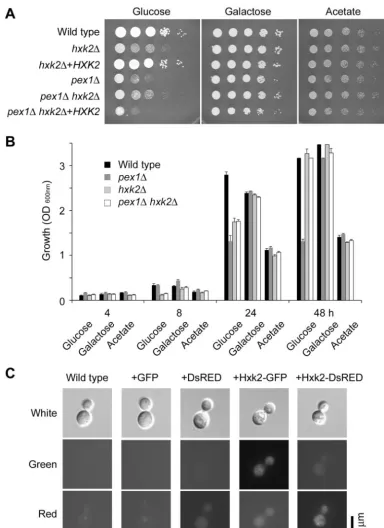
on the potential PTS sequence in hexokinase and aided by the new fluorescence protein vectors, theHXK2gene was studied. TheHXK2gene was deleted, and a doublehxk2 pex1mutant was isolated by crosses and confirmed by Southern blot ana-lyses (data not shown). The hxk2 mutant showed reduced growth on glucose, but equal growth on galactose, relative to the wild-type strain (Fig. 8A and B; Table 4). However, growth in thehxk2mutant was not as severely reduced as that in the
pex1mutant, providing an opportunity to assess the effects of deletion of both genes. The hxk2 pex1double mutant had a growth rate like that of thehxk2 single mutant, not thepex1
mutant, in the presence of glucose, as well as in media con-taining glucose and acetate or galactose. Thus, a partial sup-pression of the growth defects of thepex1mutation by deletion
FIG. 6. The pex1 mutant is virulent, despite an in vitro growth defect. Yeast cells (1⫻105) of the wild-type (WT),pex1mutant, and pex1 PEX1complemented strains were inoculated into mice (A) or wax mothGalleria mellonella(B), and survival was monitored daily.
on September 8, 2020 by guest
http://ec.asm.org/
ofHXK2suggests that the defects observed in pex1mutants could be due to incorrect localization of Hxk2.
TheHXK2gene was fused to the DsRED or GFP genes and expressed inC. neoformans cells from a constitutively active promoter (from histone H3; fluorescence was too low from the nativeHXK2promoter [data not shown]). In most cells, the protein was localized to the cytoplasm and a single structure in the cell (Fig. 8C). However, when the Hxk2-DsRED protein was expressed in a pex5orpex1 background, no change was seen in this punctate localization (data not shown), suggesting it may be an artifact of overexpression or fusion to the DsRED protein. In further confirmation, theHXK2gene was fused to the GFP gene and introduced intoC. neoformanscells. In this case, localization was solely cytoplasmic, with no evidence of any punctate localization (Fig. 8C). Thus, we conclude that Hxk2 is not localized to the peroxisomes inC. neoformansand that the fungus therefore does not contain the equivalent of a glycosome.
DISCUSSION
C. neoformansis a fungus, pathogenic to humans, that lives
in both the environment and the mammalian host. Therefore,
the fungus must be able to adapt to diverse nutrient conditions to be successful. Here we investigated the role of peroxisomes in the biology ofC. neoformans. To assess peroxisome function, two genes were selected initially for targeted mutation. Pex1 and Pex6 homologs are well studied as functionally-related AAA-type proteins with a role in the assembly of small per-oxisomal vesicles into mature peroxisomes and import of pro-teins into peroxisomes (59). Pex1 and Pex6 interact physically in fungal and mammalian cells and function in early stages of peroxisome formation (13, 17, 32, 69, 71). Disruption of the interaction between Pex1 and Pex6 is a common pathophysi-ological mechanism in patients with Zellweger syndrome, which is a class of peroxisomal defects causing early death due to accumulation of toxic intermediates usually metabolized in the peroxisome (17). A homolog ofPEX6is essential for vir-ulence of the fungi Colletotrichum lagenarium on bean and
Magnaporthe griseaon rice or barley (36, 60). In both fungi, the
PEX6homologs are required for fatty acid utilization, such as growth on Tween 80 or olive oil. Mutants are unable to use fatty acids during formation of the specialized infection struc-ture, the appressorium, but can infect plants when inoculated into a wound site.
FIG. 7. Peroxisome function is carbon source specific. (A) Ten-fold serial dilutions of strains were grown on YPD or YNB supplemented with glucose, mannose, fructose, galactose (all 2%), or glucose plus galactose (1% each) and photographed. Growth was for 2 days at 30°C. (B) Growth curves ofC. neoformanswild-type,pex1mutant, andpex1 PEX1complemented strains in glucose and galactose at 30°C and 37°C.
on September 8, 2020 by guest
http://ec.asm.org/
The phenotype of theC. neoformans pex1orpex6mutants includes reduced growth on fatty acids; however, the mutants can use acetate as a sole carbon source. These data suggest that, like many other organisms, peroxisomes are required for
utilization of some fatty acid sources. In contrast to both plants and other fungi, the ability to utilize acetate in thepex1orpex6
mutants suggests that glyoxylate pathway components are un-likely to be localized solely in the peroxisome or are present in
FIG. 8. Hexokinase 2 is required for efficient utilization of glucose but is not localized to peroxisomes. (A) Growth of 10-fold dilutions of strains on acetate, galactose (30°C), or glucose (22°C) medium for 3 days. (B) Growth of strains in liquid yeast nitrogen base supplemented with 2% glucose, galactose, or acetate at 30°C. Error bars are the standard error of the mean (n⫽3). (C) Intensity and localization of DsRED or GFP expressed from the histone H3 promoter fused or unfused to the Hxk2 protein in the wild-type background. Micrographs were overexposed (10,000 ms) for the green and red channels to highlight the lack of fluorescence or autofluorescence, except for⫹Hxk2-GFP (1,400-ms green channel), ⫹DsRed (3,200-ms red channel) and⫹Hxk2-DsRed (1,400-ms red channel).
on September 8, 2020 by guest
http://ec.asm.org/
remnant peroxisome bodies or mislocalized (but functional) in the cytoplasm or another organelle. There is evidence that the glyoxylate pathway is localized to peroxisomes in fungi, includ-ing the ascomycetesAshbya gossypii,Aspergillus nidulans,
Can-dida tropicalis, Botryosphaeria dothidea, Hansula polymorpha,
andNeurospora crassa(3, 11, 29, 35, 45, 74) and in the
basidio-mycetesFomitopsis palustrisandCoprinusspecies (8, 54, 62). Thus, the peroxisomes of C. neoformansfunction somewhat similarly to those ofS. cerevisiae, which are also not required for acetate metabolism (12) (Fig. 4). Current evidence suggests Icl1 is not localized in the peroxisomes, while Mls1 is localized there only in the presence of oleic acid (9, 38, 70). In recent studies, it has been shown that mutants lacking thePEX5or
PEX6homologs ofC. albicansorA. nidulans, respectively, can also grow efficiently on acetate (25, 57), whereas at least in another ascomycete species, C. lagenarium, mutation of the
PEX6 homolog reduces growth on acetate (2). While these studies do not exclude the glyoxylate pathway enzymes from being present in the peroxisomes during-oxidation of fatty acids, the glyoxylate pathway can function under other growth conditions inpex mutants. It is possible that the use of fatty acids as a peroxisome induction source may have biased pre-vious reports on the localization of the enzymes in fungi.
In contrast to other fungi, C. neoformans has an unusual requirement for peroxisomes for efficient growth in the pres-ence of monosaccharides like glucose, fructose, and mannose that are metabolized by hexokinase. Hexokinase is the first enzyme of glycolysis. The glycosomes of kinetoplasts like try-panosomes (e.g.,TrypanosomaandLeishmaniaspecies) repre-sent an unusual and unique form of peroxisome because of their role in glycolysis. Seven to nine of the enzymes for gly-colysis, including hexokinase, are localized in the peroxisomes (reviewed in reference 55). Mutation of eitherPEX2orPEX14
inT. bruceiby double-stranded RNA interference causes the
organisms to die in the presence of glucose (15, 23). The proteins ofC. neoformansencoding the other nine enzymes in the glycolytic pathway were examined for possible peroxisomal targeting sequences. No evidence for a PTS1 was found, and only enolase had a potential PTS2 sequence (KIDQLLIQL), although not at the N terminus where PTS2 is usually, though not invariably, located. We were excited by the prospect thatC.
neoformansmay also have the equivalent of a glycosome.
De-letion of theHXK2gene results in a reduced growth rate on glucose, and thehxk2 pex1double mutants partially rescue the reduced growth rates seen in thepex1single mutants grown in the presence of glucose. However, Hxk2 fusions to fluorescent markers were localized either in the cytoplasm or to a nonper-oxisomal structure, depending on the fusion protein. Thus, we hypothesize that Hxk2 regulates a peroxisomal protein re-quired forC. neoformansgrowth, either directly or via a gly-colytic intermediate, such as glucose-6-phosphate, which is a signaling molecule in other fungi (48).
Our initial aim was to investigate aspects of the genetic controls of virulence ofC. neoformans. Enzymes of the glyoxy-late pathway (here Mls1 and previously Icl1) are dispensable
for C. neoformans virulence. We were reluctant to test the
virulence of thepex1mutant towards mice because the strain showed a clear growth defect on minimal medium. Neverthe-less, when tested for virulence, pex1 mutant strains were as virulent as the wild type, thus showing that (i) growth patterns
on minimal medium in vitro are not reliable predictors for virulence outcome and (ii) during mammalian infection, fatty acid utilization and glucose metabolism are unlikely to be the major nutrients available for growth, in contrast to other fungi (37). It has recently been shown that thepex5 mutant ofC.
albicansshows virulence equivalent to that of wild-type strains
in a murine infection model (57). C. neoformans associates with environmental predators, like amoeba and possibly in-sects. We also tested themls1 and pex1 mutants in the wax moth system and found no reduction in virulence in this insect host. While our research aimed to identify potential new drug targets for controlling cryptococcosis, these data show that the glyoxylate pathway and peroxisomes are less than ideal targets. Future research on peroxisome function in C. neoformans, which is an outstanding system for molecular genetic analysis, will focus on the identification of the mechanisms of interac-tion of these organelles with glucose metabolism via proteomic or genetic analyses.
ACKNOWLEDGMENTS
We thank Weihua Fan and Kirsten Nielsen for assistance with ex-periments, and Connie Nichols, Tian Lian, and Jim Kronstad for fluorescent protein vectors.
This research was funded in part by NIAID grants AI028388 (J.R.P.) and AI063443 (J.H.).
REFERENCES
1.Amor, C., A. I. Domı´nguez, J. R. De Lucas, and F. Laborda.2002. The catabolite inactivation ofAspergillus nidulansisocitrate lyase occurs by spe-cific autophagy of peroxisomes. Arch. Microbiol.174:59–66.
2.Asakura, M., T. Okuno, and Y. Takano.2006. Multiple contributions of peroxisomal metabolic function to fungal pathogenicity inColletotrichum lagenarium. Appl. Environ. Microbiol.72:6345–6354.
3.Berardi, E., A. Gambini, and A. R. Bellu.2003.ALG2, theHansenula poly-morphaisocitrate lyase gene. Yeast20:803–811.
4.Bhambra, G. K., Z.-Y. Wang, D. M. Soanes, G. E. Wakley, and N. J. Talbot. 2006. Peroxisomal carnitine acetyl transferase is required for elaboration of penetration hyphae during plant infection byMagnaporthe grisea. Mol. Mi-crobiol.61:46–60.
5.Britton, K., S. Langridge, P. J. Baker, K. Weeradechapon, S. E. Sedelnikova, J. R. De Lucas, D. W. Rice, and G. Turner.2000. The crystal structure and active site location of isocitrate lyase from the fungusAspergillus nidulans. Structure8:349–362.
6.Burns, C., K. E. Gregory, M. Kirby, M. K. Cheung, M. Riquelme, T. J. Elliott, M. P. Challen, A. Bailey, and G. D. Foster.2005. Efficient GFP expression in the mushroomsAgaricus bisporusandCoprinus cinereus re-quires introns. Fungal Genet. Biol.42:191–199.
7.Casadevall, A., and J. Perfect.1998.Cryptococcus neoformans.ASM Press, Washington, D.C.
8.Chaure, P. T., L. A. Casselton, and I. F. Connerton.1997. Molecular analysis of the isocitrate lyase gene (acu-7) of the mushroomCoprinus cinereus. Gene 184:185–187.
9.Chaves, R. S., P. Herrero, I. Ordiz, M. Angeles del Brio, and F. Moreno. 1997. Isocitrate lyase localisation inSaccharomyces cerevisiaecells. Gene 198:165–169.
10.del Poeta, M., D. L. Toffaletti, T. H. Rude, S. D. Sparks, J. Heitman, and J. R. Perfect.1999.Cryptococcus neoformansdifferential gene expression detected in vitro and in vivo with green fluorescent protein. Infect. Immun. 67:1812–1820.
11.de Zoysa, P. A., and I. F. Connerton.1994. The function and specificity of the C-terminal tripeptide glyoxysomal targeting signal in Neurospora crassa. Curr. Genet.26:430–437.
12.Erdmann, R., M. Veenhuis, D. Mertens, and W.-H. Kunau.1989. Isolation of peroxisome-deficient mutants ofSaccharomyces cerevisiae. Proc. Natl. Acad. Sci. USA86:5419–5423.
13.Faber, K. N., J. A. Heyman, and S. Subramani.1998. Two AAA family peroxins, PpPex1p and PpPex6p, interact with each other in an ATP-depen-dent manner and are associated with different subcellular membranous structures distinct from peroxisomes. Mol. Cell. Biol.18:936–943. 14.Fraser, J. A., R. L. Subaran, C. B. Nichols, and J. Heitman.2003.
Recapit-ulation of the sexual cycle of the primary fungal pathogenCryptococcus neoformans var. gattii: implications for an outbreak on Vancouver Island, Canada. Eukaryot. Cell2:1036–1045.
on September 8, 2020 by guest
http://ec.asm.org/
15.Furuya, T., P. Kessler, A. Jardim, A. Schnaufer, C. Crudder, and M. Parsons.2002. Glucose is toxic to glycosome-deficient trypanosomes. Proc. Natl. Acad. Sci. USA99:14177–14182.
16.Gatto, G. J., Jr., E. L. Maynard, A. L. Guerrerio, B. V. Geisbrecht, S. J. Gould, and J. M. Berg.2003. Correlating structure and affinity for PEX5: PTS1 complexes. Biochemistry42:1660–1666.
17.Geisbrecht, B. V., C. S. Collins, B. E. Reuber, and S. J. Gould.1998. Disruption of a PEX1-PEX6 interaction is the most common cause of the neurologic disorders Zellweger syndrome, neonatal adrenoleukodystrophy, and infantile Refsum disease. Proc. Natl. Acad. Sci. USA95:8630–8635. 18.Giaever, G., A. M. Chu, L. Ni, C. Connelly, L. Riles, S. Ve´ronneau, S. Dow,
A. Lucau-Danila, K. Anderson, B. Andre´, A. P. Arkin, A. Astromoff, M. El-Bakkoury, R. Bangham, R. Benito, S. Brachat, S. Campanaro, M. Cur-tiss, K. Davis, A. Deutschbauer, K.-D. Entian, P. Flaherty, F. Foury, D. J. Garfinkel, M. Gerstein, D. Gotte, U. Gu¨ldener, J. H. Hegemann, S. Hempel, Z. Herman, D. F. Jaramillo, D. E. Kelly, S. L. Kelly, P. Ko¨tter, D. LaBonte, D. C. Lamb, N. Lan, H. Liang, H. Liao, L. Liu, C. Luo, M. Lussier, R. Mao, P. Menard, S. L. Ooi, J. L. Revuelta, C. J. Roberts, M. Rose, P. Ross-Macdonald, B. Scherens, G. Schimmack, B. Shafer, D. D. Shoemaker, S. Sookhai-Mahadeo, R. K. Storms, J. N. Strathern, G. Valle, M. Voet, G. Volckaert, C.-Y. Wang, T. R. Ward, J. Wilhelmy, E. A. Winzeler, Y. Yang, G. Yen, E. Youngman, K. Yu, H. Bussey, J. D. Boeke, M. Snyder, P. Philippsen, R. W. Davis, and M. Johnston.2002. Functional profiling of the Saccharo-myces cerevisiaegenome. Nature418:387–391.
19.Giles, S. S., J. R. Perfect, and G. M. Cox.2005. Cytochrome c peroxidase contributes to the antioxidant defense ofCryptococcus neoformans. Fungal Genet. Biol.42:20–29.
20.Giles, S. S., J. E. Stajich, C. Nichols, Q. D. Gerrald, J. A. Alspaugh, F. Dietrich, and J. R. Perfect.2006. TheCryptococcus neoformanscatalase gene family and its role in antioxidant defense. Eukaryot. Cell5:1447–1459. 21.Goldstein, A. L., and J. H. McCusker.2001. Development ofSaccharomyces
cerevisiaeas a model pathogen: a system for the genetic identification of gene products required for survival in the mammalian host environment. Genetics 159:499–513.
22.Gould, S. J., and D. Valle.2000. Peroxisome biogenesis disorders: genetics and cell biology. Trends Genet.16:340–345.
23.Guerra-Giraldez, C., L. Quijada, and C. E. Clayton.2002. Compartmenta-tion of enzymes in a microbody, the glycosome, is essential inTrypanosoma brucei. J. Cell Sci.115:2651–2658.
24.Gunkel, K., I. J. van der Klei, G. Barth, and M. Veenhuis.1999. Selective peroxisome degradation inYarrowia lipolyticaafter a shift of cells from acetate/oleate/ethylamine into glucose/ammonium sulfate-containing media. FEBS Lett.451:1–4.
25.Hynes, M. J., S. L. Murray, A. Duncan, G. S. Khew, and M. A. Davis.2006. Regulatory genes controlling fatty acid catabolism and peroxisomal functions in the filamentous fungusAspergillus nidulans. Eukaryot. Cell5:794–805. 26.Idnurm, A., Y.-S. Bahn, K. Nielsen, X. Lin, J. A. Fraser, and J. Heitman.
2005. Deciphering the model pathogenic fungusCryptococcus neoformans. Nat. Rev. Microbiol.3:753–764.
27.Idnurm, A., and B. J. Howlett.2002. Isocitrate lyase is essential for patho-genicity of the fungusLeptosphaeria maculansto canola (Brassica napus). Eukaryot. Cell1:719–724.
28.Idnurm, A., J. L. Reedy, J. C. Nussbaum, and J. Heitman.2004.Cryptococcus neoformansvirulence gene discovery through insertional mutagenesis. Eu-karyot. Cell3:420–429.
29.Kamada, Y., M. Ueda, H. Atomi, K. Oda, T. Kurihara, N. Naito, R. Ukita, N. Kamasawa, M. Osumi, and A. Tanaka.1992. Localization ofCandida tropi-calisperoxisomal isocitrate lyase highly expressed in peroxisome-proliferated Saccharomyces cerevisiae. J. Ferment. Bioeng.74:368–371.
30.Kera, Y., A. Niino, T. Ikeda, H. Okada, and R.-H. Yamada.1998. Peroxiso-mal localization of D-aspartate oxidase and development of peroxisomes in the yeastCryptococcus humicolusUJ1 grown on D-aspartate. Biochim. Bio-phys. Acta1379:399–405.
31.Kiel, J. A. K. W., R. E. Hilbrands, R. A. L. Bovenberg, and M. Veenhuis. 2000. Isolation ofPenicillium chrysogenum PEX1andPEX6encoding AAA proteins involved in peroxisome biogenesis. Appl. Microbiol. Biotechnol. 54:238–242.
32.Kiel, J. A. K. W., R. E. Hilbrands, I. J. van der Klei, S. W. Rasmussen, F. A. Salomons, M. van der Heide, K. N. Faber, J. M. Cregg, and M. Veenhuis. 1999.Hansenula polymorpha Pex1pandPex6pare peroxisome-associated AAA proteins that functionally and physically interact. Yeast15:1059–1078. 33.Kiel, J. A. K. W., M. van den Berg, R. A. L. Bovenberg, I. J. van der Klei, and M. Veenhuis.2004.Penicillium chrysogenumPex5p mediates differential sort-ing of PTS1 proteins to microbodies of the methylotrophic yeastHansenula polymorpha. Fungal Genet. Biol.41:708–720.
34.Kiel, J. A. K. W., M. Veenhuis, and I. J. van der Klei.2006.PEXgenes in fungal genomes: common, rare or redundant. Traffic7:1291–1303. 35.Kim, K. W., E. W. Park, and K. S. Kim.2004. Glyoxysomal nature of
microbodies complexed with lipid globules inBotryosphaeria dothidea. Phy-topathology94:970–977.
36.Kimura, A., Y. Takano, I. Furusawa, and T. Okuno. 2001. Peroxisomal
metabolic function is required for appressorium-mediated plant infection by Colletotrichum lagenarium. Plant Cell13:1945–1957.
37.Kingsbury, J. M., A. L. Goldstein, and J. H. McCusker. 2006. Role of nitrogen and carbon transport, regulation, and metabolism genes for Sac-charomyces cerevisiaesurvival in vivo. Eukaryot. Cell5:816–824.
38.Kunze, M., F. Kragler, M. Binder, A. Hartig, and A. Gurvitz.2002. Targeting of malate synthase 1 to the peroxisomes ofSaccharomyces cerevisiaecells depends on growth on oleic acid medium. Eur. J. Biochem.269:915–922. 39.Kwon-Chung, K. J., J. C. Edman, and B. L. Wickes.1992. Genetic
associa-tion of mating types and virulence inCryptococcus neoformans. Infect. Im-mun.60:602–605.
40.Li, J., D. Zhu, Z. Yi, Y. He, Y. Chun, Y. Liu, and N. Li.2005. DNAzymes targeting theiclgene inhibit ICL expression and decreaseMycobacterium tuberculosissurvival in macrophages. Oligonucleotides15:215–222. 41.Liu, X., G. Hu, J. Panepinto, and P. R. Williamson.2006. Role of aVPS41
homologue in starvation response, intracellular survival and virulence of Cryptococcus neoformans. Mol. Microbiol.61:1132–1146.
42.Loftus, B. J., E. Fung, P. Roncaglia, D. Rowley, P. Amedeo, D. Bruno, J. Vamathevan, M. Miranda, I. J. Anderson, J. A. Fraser, J. E. Allen, I. E. Bosdet, M. R. Brent, R. Chiu, T. L. Doering, M. J. Donlin, C. A. D’Souza, D. S. Fox, V. Grinberg, J. Fu, M. Fukushima, B. J. Haas, J. C. Huang, G. Janbon, S. J. M. Jones, H. L. Koo, M. I. Krzywinski, J. K. Kwon-Chung, K. B. Lengeler, R. Maiti, M. A. Marra, R. E. Marra, C. A. Mathewson, T. G. Mitchell, M. Pertea, F. R. Riggs, S. L. Salzberg, J. E. Schein, A. Shvartsbeyn, H. Shin, M. Shumway, C. A. Specht, B. B. Suh, A. Tenney, T. R. Utterback, B. L. Wickes, J. R. Wortman, N. H. Wye, J. W. Kronstad, J. K. Lodge, J. Heitman, R. W. Davis, C. M. Fraser, and R. W. Hyman.2005. The genome of the basidiomycetous yeast and human pathogenCryptococcus neoformans. Science307:1321–1324.
43.Lorenz, M. C., and G. R. Fink.2002. Life and death in a macrophage: role of the glyoxylate cycle in virulence. Eukaryot. Cell1:657–662.
44.Lorenz, M. C., and G. R. Fink.2001. The glyoxylate cycle is required for fungal virulence. Nature412:83–86.
45.Maeting, I., G. Schmidt, H. Sahm, J. L. Revuelta, Y.-D. Stierhof, and K.-P. Stahmann.1999. Isocitrate lyase ofAshbya gossypii—transcriptional regula-tion and peroxisomal localizaregula-tion. FEBS Lett.444:15–21.
46.Masters, C. J., and D. Crane.1995. The peroxisome: a vital organelle. Cambridge University Press, Cambridge, United Kingdom.
47.McKinney, J. D., K. Ho¨ner zu Bentrup, E. J. Mun˜oz-Elias, A. Miczak, B. Chen, W.-T. Chan, D. Swenson, J. C. Sacchettini, W. R. Jacobs, Jr., and D. G. Russell.2000. Persistence ofMycobacterium tuberculosisin macro-phages and mice requires the glyoxylate shunt enzyme isocitrate lyase. Na-ture406:735–738.
48.Moreno, F., and P. Herrero. 2002. The hexokinase 2-dependent glucose signal transduction pathway ofSaccharomyces cerevisiae. FEMS Microbiol. Rev.26:83–90.
49.Moyersoen, J., J. Choe, E. Fan, W. G. J. Hol, and P. A. M. Michels.2004. Biogenesis of peroxisomes and glycosomes: trypanosomatid glycosome as-sembly is a promising new drug target. FEMS Microbiol. Rev.28:603–643. 50.Mun˜oz-Elı´as, E. J., and J. D. McKinney.2005.Mycobacterium tuberculosis isocitrate lyases 1 and 2 are jointly required for in vivo growth and virulence. Nat. Med.11:638–644.
51.Mylonakis, E., R. Moreno, J. B. El Khoury, A. Idnurm, J. Heitman, S. B. Calderwood, F. M. Ausubel, and A. Diener.2005.Galleria mellonellaas a model system to studyCryptococcus neoformanspathogenesis. Infect. Im-mun.73:3842–3850.
52.Nielsen, K., G. M. Cox, P. Wang, D. L. Toffaletti, J. R. Perfect, and J. Heit-man.2003. Sexual cycle ofCryptococcus neoformansvar.grubiiand virulence of congenicaand␣isolates. Infect. Immun.71:4831–4841.
53.Olsen, L. J., W. F. Ettinger, B. Damsz, K. Matsudaira, M. A. Webb, and J. J. Harada.1993. Targeting of glyoxysomal proteins to peroxisomes in leaves and roots of a higher plant. Plant Cell5:941–952.
54.O’Sullivan, J., and P. J. Casselton.1973. The subcellular localization of glyoxylate cycle enzymes inCoprinus lagopus(sensu Buller). J. Gen. Micro-biol.75:333–337.
55.Parsons, M.2004. Glycosomes: parasites and the divergence of peroxisomal purpose. Mol. Microbiol.53:717–724.
56.Petriv, O. I., L. Tang, V. I. Titorenko, and R. A. Rachubinski.2004. A new definition for the consensus sequence of the peroxisome targeting signal type 2. J. Mol. Biol.341:119–134.
57.Piekarska, K., E. Mol, M. van den Berg, G. Hardy, J. van den Burg, C. van Roermund, D. MacCallum, F. C. Odds, and B. Distel.2006. Peroxisomal fatty acid-oxidation is not essential for virulence of Candida albicans. Eukaryot. Cell5:1847–1856.
58.Pitkin, J. W., D. G. Panaccione, and J. D. Walton.1996. A putative cyclic peptide efflux pump encoded by theTOXAgene of the plant-pathogenic fungusCochliobolus carbonum. Microbiology142:1557–1565.
59.Platta, H. W., S. Grunau, K. Rosenkranz, W. Girzalsky, and R. Erdmann. 2005. Functional role of the AAA peroxins in dislocation of the cycling PTS1 receptor back to the cytosol. Nat. Cell Biol.7:817–822.
60.Ramos-Pamplona, M., and N. I. Naqvi.2006. Host invasion during rice-blast
on September 8, 2020 by guest
http://ec.asm.org/
disease requires carnitine-dependent transport of peroxisomal acetyl-CoA. Mol. Microbiol.61:61–75.
61.Rude, T. H., D. L. Toffaletti, G. M. Cox, and J. R. Perfect.2002. Relationship of the glyoxylate pathway to the pathogenesis ofCryptococcus neoformans. Infect. Immun.70:5684–5694.
62.Sakai, S., T. Nishide, E. Munir, K. Baba, H. Inui, Y. Nakano, T. Hattori, and M. Shimada.2006. Subcellular localization of glyoxylate cycle key enzymes involved in oxalate biosynthesis of wood-destroying basidiomycete Fomitop-sis palustrisgrown on glucose. Microbiology152:1857–1866.
63.Schliebs, W., C. Wu¨rtz, W.-H. Kunau, M. Veenhuis, and H. Rottensteiner. 2006. A eukaryote without catalase-containing microbodies: Neurospora crassaexhibits a unique cellular distribution of its four catalases. Eukaryot. Cell5:1490–1502.
64.Shani, N., and D. Valle.1996. ASaccharomyces cerevisiaehomolog of the human adrenoleukodystrophy transporter is a heterodimer of two half ATP-binding cassette transporters. Proc. Natl. Acad. Sci. USA93:11901–11906. 65.Sharma, V., S. Sharma, K. Hoener zu Bentrup, J. D. McKinney, D. G.
Russell, W. R. Jacobs, Jr., and J. C. Sacchettini.2000. Structure of isocitrate lyase, a persistence factor ofMycobacterium tuberculosis. Nat. Struct. Biol. 7:663–668.
66.Smith, C. V., C.-C. Huang, A. Miczak, D. G. Russell, J. C. Sacchettini, and K. Ho¨ner zu Bentrup.2003. Biochemical and structural studies of malate synthase fromMycobacterium tuberculosis. J. Biol. Chem.278:1735–1743. 67.Solomon, P. S., R. C. Lee, T. J. G. Wilson, and R. P. Oliver.2004.
Patho-genicity ofStagonospora nodorumrequires malate synthase. Mol. Microbiol. 53:1065–1074.
68.Soundararajan, S., G. Jedd, X. Li, M. Ramos-Pamplon˜a, N. H. Chua, and N. I. Naqvi.2004. Woronin body function inMagnaporthe griseais essential for efficient pathogenesis and for survival during nitrogen starvation stress. Plant Cell16:1564–1574.
69.Tamura, S., N. Shimozawa, Y. Suzuki, T. Tsukamoto, T. Osumi, and Y. Fujiki. 1998. A cytoplasmic AAA family peroxin, Pex1p, interacts with Pex6p. Biochem. Biophys. Res. Commun.245:883–886.
70.Taylor, K. M., C. P. Kaplan, X. Gao, and A. Baker.1996. Localization and targeting of isocitrate lyases inSaccharomyces cerevisiae. Biochem. J.319: 255–262.
71.Titorenko, V. I., and R. A. Rachubinski.2000. Peroxisomal membrane fusion requires two AAA family ATPases, Pex1p and Pex6p. J. Cell Biol.150:881– 886.
72.Toffaletti, D. L., T. H. Rude, S. A. Johnston, D. T. Durack, and J. R. Perfect. 1993. Gene transfer inCryptococcus neoformansby use of biolistic delivery of DNA. J. Bacteriol.175:1405–1411.
73.Tuttle, D. L., A. S. Lewin, and W. A. J. Dunn.1993. Selective autophagy of peroxisomes in methylotrophic yeasts. Eur. J. Cell Biol.60:283–290. 74.Valenciano, S., J. R. De Lucas, I. Van der Klei, M. Veenhuis, and F. Laborda.
1998. Characterization ofAspergillus nidulansperoxisomes by immunoelec-tron microscopy. Arch. Microbiol.170:370–376.
75.Vereecke, D., K. Cornelis, W. Temmerman, M. Jaziri, M. Van Montagu, M. Holsters, and K. Goethals.2002. Chromosomal locus that affects pathoge-nicity ofRhodococcus fascians. J. Bacteriol.184:1112–1120.
76.Walton, F. J., A. Idnurm, and J. Heitman. 2005. Novel gene functions required for melanization of the human pathogenCryptococcus neoformans. Mol. Microbiol.57:1381–1396.
77.Walton, P. A., P. E. Hill, and S. Subramani.1995. Import of stably folded proteins into peroxisomes. Mol. Biol. Cell6:675–683.
78.Wang, Z. Y., C. R. Thornton, M. J. Kershaw, L. Debao, and N. J. Talbot. 2003. The glyoxylate cycle is required for temporal regulation of virulence by the plant pathogenic fungusMagnaporthe grisea. Mol. Microbiol.47:1601– 1612.
79.Weller, S., S. J. Gould, and D. Valle.2003. Peroxisome biogenesis disorders. Annu. Rev. Genomics Hum. Genet.4:165–211.
80.Xue, C., Y.-S. Bahn, G. M. Cox, and J. Heitman.2006. G protein-coupled receptor Gpr4 senses amino acids and activates the cAMP-PKA pathway in Cryptococcus neoformans. Mol. Biol. Cell17:667–679.
81.Zimmerman, R., and W. Neupert.1980. Biogenesis of glyoxysomes. Synthesis and intracellular transfer of isocitrate lyase. Eur. J. Biochem.112:225–233.