ISSN: 2231-5381
http://www.ijettjournal.org
Page 198
Analysis and Comparison of Cubic Quantum Dot
Nanocrystals of Different Materials
K M Mohibul Kabir, Md. Taslim Reza, Md. Ashraful Hoque
Department of Electrical and Electronic Engineering Islamic University of Technology (IUT)
Gazipur, Bangladesh.
ABSTRACT— Different nanostructured quantum dot can be implemented and used in different applications and also quantum dots can be fabricated using different materials. In this paper, electronic properties of quantum dot nanocrystals with different Nanomaterials such as InAs, GaAs, Ge and Si were analyzed by analytical solution of Schrödinger Equation for 1D, 2D and 3D particle in a cube box. Different Quantum Dots have been compared against their electron energy states and finally wavefunctions and probability density function is presented.
KEYWORDS— Quantum dot, Nanocrystal, Schrödinger Equation, Particle in a Box.
I. INTRODUCTION
Quantum dots are small semiconductors or portion of semiconductors with dimensions between nanometers to a few micrometers. Their excitons are confined in all three dimensions and exposes electronic properties between the properties of bulk semiconductor and discrete molecules [1]. There is no lower limit of size of quantum dots. So, even a single impurity atom can be called quantum dot.
The quantization of energy levels in nanometer size crystals results significant changes in their properties [2]. Researcher has shown that the wavelength of fluorescence is dependent on the dimensions and material composition of the nanocrystals. Use of materials having different band gaps: CdSe (blue), InP (green), and InAs (red) results large wavelength differences between the blue, green, and red emissions. The fine-tuning of the fluorescence emission within each color is controlled by the size of the Quantum dots [3].
Another great advantage of quantum dots is flexibility in control over the conductive properties of the material. It is because of the high level of control possible over the size of the crystal produced.
II. MATHEMATICALREVIEW
The solution of Schrödinger equation has shown by several researchers using different methods [4]-[6]. The well known
Schrödinger equation is written as following for different dimensions
For three dimensions,
− 2 2m
(
d2 dx2 +d 2 dy2 +d 2dz2
)
ψ(x , y , z)+V(x , y , z)ψ(x , y , z)=Eψ(x , y , z)
If three dimensions of the particle are expresses as Lx, Ly and Lz, inside the particle zero energy is confined and outside the dimension energy is infinite. That means V(x)= 0 at 0<x<Lx, 0<y<Ly and 0<z<Lz and V(x)= ∞ at outside the dimension.
After solving the Schrödinger equation for 3D we can get the equations for 3D wave function (Eqn. 2), probability density function (Eqn. 3) and Eigen-energy equation (Eqn. 4).
Where,
= Planck’s constant m= effective mass nx, ny, nz= 1, 2,3….For a cube, Lx=Ly=Lz =L So the equations become
z
L
n
y
L
n
x
L
n
L
z y x n n nx y z
2
sin
sin
sin
2 3 (2
)
(3)
(4)
(5)
2 2 2 2 2 2 \ 2 \2
sin
sin
sin
2
2
2
)
,
,
(
sin
sin
sin
2
2
2
)
,
,
(
z z y y x x z z y y x x z y x n n n z z y y x x z y x n n nL
n
L
n
L
n
m
E
z
L
n
y
L
n
x
L
n
L
L
L
z
y
x
z
L
n
y
L
n
x
L
n
L
L
L
z
y
x
z n y n x n z y x z y x
2 2 3 2sin
sin
sin
2
z
L
n
y
L
n
x
L
n
L
z y x n n nxyzISSN: 2231-5381
http://www.ijettjournal.org
Page 199
)
(
)
(
2
2 2 2 2 2 2 2 2 2 z y x z y x n nn
n
n
n
K
n
n
n
mL
E
xyz
Similarly, 1D and 2D Schrodinger Equation can be solved for
obtaining the equations for 1D (Eqn. 10) and 2D wavefunction (Eqn. 8) and 1D (Eqn. 11) , 2D probability density function (Eqn. 9).
For 2D particle in a box,
For 1D particle in a box,
III.RESULTSANDDISCUSSIONS
Different energy states, wave functions and probability density function of InAs, GaAs, Ge and Si Quantum Dot Nanocrystal have been analyzed on the basis of 1D, 2D and 3D particle solution of Schrödinger equation discussed in the mathematical analysis section. Then, their properties have been compared.
It is assumed that at the surface of quantum dot the electron has an infinite potential barrier [7].
The dimensions of the geometry and several standard boundary conditions have been set accordingly. Following boundary conditions has been set for each calculation.
Lx= 8nm, Ly= 8nm, Lz= 8nm
Effective mass= 0.026mo (InAs), 0.067 (GaAs), 0.55(Ge), 1.08(Si) (mo= 9.31*10^-31 kg)
From Eqn. 7 different energy states of InAs, GaAs, Ge and Si have been calculated. Table 1, Table 2, Table 3 and Table 4 list the value of eigenvalues of lower energy states of InAs, GaAs, Ge and Si respectively.
TABLEI
FIRST FEW ENERGY STATES OF INAS CUBIC QD WITH LX=LY=LZ=8NM Energy
State nx/ ny/ nz
Eigen Energy (eV)
1 1/1/1 0.662666504 2 1/1/2 1.325333008 3 1/2/1 1.325333008 4 2/1/1 1.325333008 5 1/2/2 1.987999512 6 2/1/2 1.987999512 7 2/2/1 1.987999512 8 1/1/3 2.4297771813 9 1/3/1 2.4297771813 10 3/1/1 2.4297771813 11 2/2/2 2.650666016 12 1/2/3 3.0924436853 13 1/3/2 3.0924436853 14 2/1/3 3.0924436853 15 2/3/1 3.0924436853 16 3/1/2 3.0924436853 17 3/2/1 3.0924436853
TABLEII
FIRST FEW ENERGY STATES OF GAAS CUBIC QD WITH LX=LY=LZ=8NM Energy
State nx/ ny/ nz
Eigen Energy (eV)
1 1/1/1 0.2571541657 2 1/1/2 0.5143083315 3 1/2/1 0.5143083315 4 2/1/1 0.5143083315 5 1/2/2 0.7714624972 6 2/1/2 0.7714624972 7 2/2/1 0.7714624972 8 1/1/3 0.9428986077 9 1/3/1 0.9428986077 10 3/1/1 0.9428986077 11 2/2/2 1.0286166629 12 1/2/3 1.2000527734 13 1/3/2 1.2000527734 14 2/1/3 1.2000527734 15 2/3/1 1.2000527734 16 3/1/2 1.2000527734 17 3/2/1 1.2000527734 2 2
sin
sin
2
y
L
n
x
L
n
L
y x n n nx y z
2 2sin
2
x
L
n
L
x n n nx y z
y
L
n
x
L
n
L
y x n n nx y z
2
sin
sin
x
L
n
L
x n n nx y z
2
sin
(7
)
(8
)
(9
)
(10
)
ISSN: 2231-5381
http://www.ijettjournal.org
Page 200
TABLEIIIFIRST FEW ENERGY STATES OF GE CUBIC QD WITH LX=LY=LZ=8NM Energy
State nx/ ny/ nz
Eigen Energy (eV)
1 1/1/1 0.0313260529 2 1/1/2 0.0626521058 3 1/2/1 0.0626521058 4 2/1/1 0.0626521058 5 1/2/2 0.0939781587 6 2/1/2 0.0939781587 7 2/2/1 0.0939781587
8 1/1/3 0.114862194
9 1/3/1 0.114862194
10 3/1/1 0.114862194 11 2/2/2 0.1253042117 12 1/2/3 0.1461882469 13 1/3/2 0.1461882469 14 2/1/3 0.1461882469 15 2/3/1 0.1461882469 16 3/1/2 0.1461882469 17 3/2/1 0.1461882469
TABLEIV
FIRST FEW ENERGY STATES OF SI CUBIC QD WITH LX=LY=LZ=8NM
Energy
State nx/ ny/ nz
Eigen Energy (eV)
1 1/1/1 0.0162540841 2 1/1/2 0.0325081681 3 1/2/1 0.0325081681 4 2/1/1 0.0325081681 5 1/2/2 0.0487622522 6 2/1/2 0.0487622522 7 2/2/1 0.0487622522 8 1/1/3 0.0595983082 9 1/3/1 0.0595983082 10 3/1/1 0.0595983082 11 2/2/2 0.0650163362 12 1/2/3 0.0758523923 13 1/3/2 0.0758523923 14 2/1/3 0.0758523923 15 2/3/1 0.0758523923 16 3/1/2 0.0758523923 17 3/2/1 0.0758523923
After analyzing the properties of cubic nanostructured quantum dots of different device materials (InAs, GaAs, Ge and Si), we have seen that for similar boundary conditions and dimensions InAs has the highest energy gap. We have also seen that Si has the lowest energy gap for similar boundary condition and dimension while GaAs and Ge have medium energy gap for similar conditions.
Now, if we look at the effective mass of these particular device materials we can see that, Si has the highest effective mass while InAs has the lowest. It is clear that Energy Gap for different quantum dots of same nanostructure for similar boundary condition is related to their effective mass.
In Fig. 1, transition energy for cubic quantum dots of different materials (InAs, GaAs, Ge and Si) has been shown. For Si, which has the highest effective mass, the transition energy is very small (almost a straight line). Heavy Si needs very low energy for an electron to occupy a higher energy level. It is also clear from Fig. 1 that, InAs needs higher transition energy for occupying a higher state compared to GaAs and Ge quantum dots. InAs has also the lowest effective mass.
Figure 1: Transition of Energy of InAs, GaAs, Ge and Si Cubic QD of 8nm length
So, it is conclusive that, quantum dots with lower effective mass absorb higher energy for an electron to jump from a lower energy state to higher energy state.
ISSN: 2231-5381
http://www.ijettjournal.org
Page 201
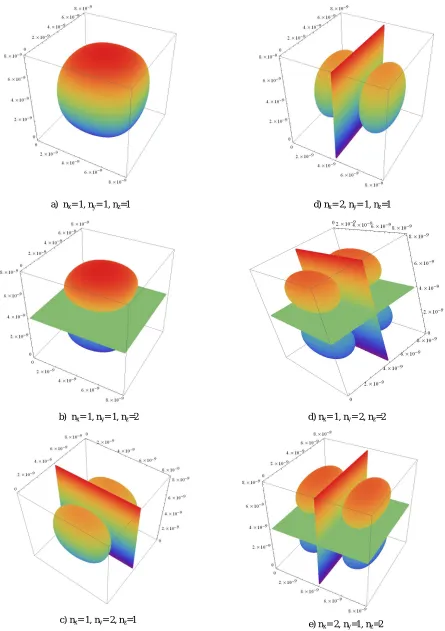
a) nx= 1, ny= 1, nz=1
c) nx= 1, ny= 2, nz=1
b) nx= 1, ny= 1, nz=2 d) nx= 1, ny= 2, nz=2
e) nx= 2, ny=1, nz=2 d) nx= 2, ny= 1, nz=1
ISSN: 2231-5381
http://www.ijettjournal.org
Page 202
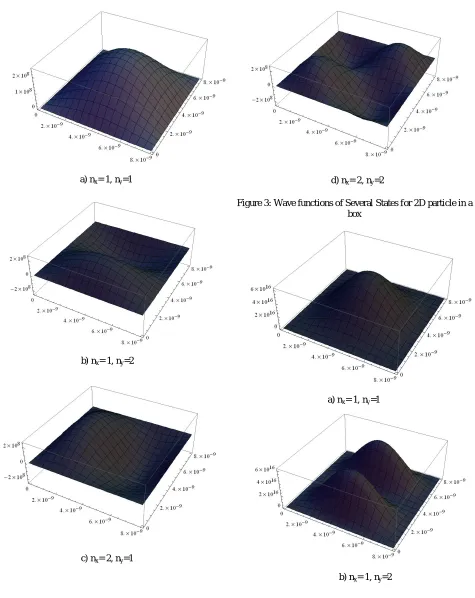
Figure 3: Wave functions of Several States for 2D particle in a box
a) nx= 1, ny=1
b) nx= 1, ny=2
c) nx= 2, ny=1
d) nx= 2, ny=2
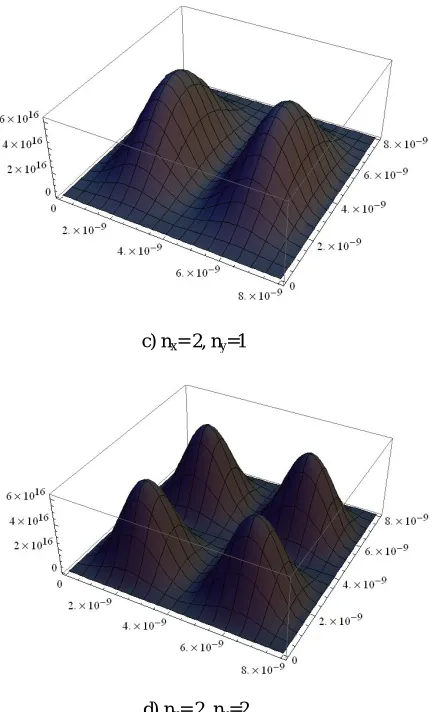
a) nx= 1, ny=1
ISSN: 2231-5381
http://www.ijettjournal.org
Page 203
Figure 4: Probability density functions of Several States for 2D particle in a box
IV.CONCLUSION
As quantum dots are considered as revolution in nanotechnology and are great prospect for a wide range of electronic and optical applications, it is necessary that the characteristics of these types of materials are closely studied and explored. This paper tried to give an idea about common properties of different quantum dots and shows the dependency of quantum dots on their fabrication materials.
REFERENCES [1] http://en.wikipedia.org
[2] Haug, Hartmut, and Stephan W. Koch. Quantum Theory of the Optical and Electronic Properties of Semiconductors. World Scientific, 2004. [3] Fredrik Boxberg and Jukka Tulkki, Quantum Dots: Phenomenology,
Photonic and Electronic Properties, Modeling and Technology, The Handbook of Nanotechnology. Nanometer Structures: Theory, Modeling, and Simulation, Chapter 4, pp.107-143) 2004.
[4] M.D Feit, J.A Fleck Jr., A Steiger, Solution of the Schrödinger equation by a spectral method, Journal of Computational Physics, Volume 47,
Issue 3, September 1982, Pages 412-433, ISSN 0021-9991, http://dx.doi.org/10.1016/0021-9991(82)90091-2.
(http://www.sciencedirect.com/science/article/pii/0021999182900912) [5] R.C. Grimm, R.G. Storer, J. Comput. Phys. 7 (1971) 134.
[6] S. Janecek, E. Krotscheck,A fast and simple program for solving local Schrödinger equations in two and three dimensions,Computer Physics Communications, Volume 178, Issue 11, 1 June 2008, Pages 835-842 [7] V.V. Mitin, V.A. Kochelap and M.A. Stroscio, Quantum
Heterostructures (Microelectronics and Optoelectronics)
c) nx= 2, ny=1