CSUSB ScholarWorks
CSUSB ScholarWorks
Electronic Theses, Projects, and Dissertations Office of Graduate Studies
6-2015
Symmetric Presentations and Generation
Symmetric Presentations and Generation
Dustin J. Grindstaff
California State University - San Bernardino
Follow this and additional works at: https://scholarworks.lib.csusb.edu/etd
Part of the Algebra Commons
Recommended Citation Recommended Citation
Grindstaff, Dustin J., "Symmetric Presentations and Generation" (2015). Electronic Theses, Projects, and Dissertations. 202.
https://scholarworks.lib.csusb.edu/etd/202
A Thesis
Presented to the
Faculty of
California State University,
San Bernardino
In Partial Fulfillment
of the Requirements for the Degree
Master of Arts
in
Mathematics
by
Dustin Grindstaff
A Thesis
Presented to the
Faculty of
California State University,
San Bernardino
by
Dustin Grindstaff
June 2015
Approved by:
Dr. Zahid Hasan, Committee Chair Date
Dr. Joseph Chavez, Committee Member
Dr. J. Paul Vicknair, Committee Member
Dr. Charles Stanton, Chair, Dr. Corey Dunn
Department of Mathematics Graduate Coordinator,
Abstract
The aim of this thesis is to generate original symmetric presentations for finite
non-abelian simple groups. We will discuss many permutation progenitors, including
2∗14:D28, 2∗9: (3•(32)), 3∗9 : (3•(32)), 2∗21: ((7×3) : 2) as well as monomial progenitors,
including 7∗5:mA5, 3∗5 :m S5. Their homomorphic images include the sporadic Mathieu
groupsM11andM12, the sporadic Janko group 3•J2, the Symplectic group 2×S(4,5), as
well as, many linear and alternating groups. We will give proofs of the isomorphism types
of each progenitor, either by hand using double coset enumeration or using MAGMA. We
have also constructed Cayley diagrams of the following groups, 25 :S5 overS5,P GL(3,4)
over M10, P SL(2,8) over D14 and M12 over the maximal subgroup 2×S5. We have
developed a lemma using relations to factor permutation progenitors of the formm∗n:N
to give the group mn :N. We will present a program written in MAGMA that, when
given a target finite non-abelian simple group, generates possible progenitors that will give
the target simple group. Iwasawa’s lemma is also discussed and used to show P SL(2,8)
Acknowledgements
My thanks, first and foremost, to my adviser and mentor, Dr. Zahid Hasan.
Thank you for helping me to develop my understanding of group theory and the countless
hours spent helping me with this project. Without your help, this thesis could not have
been completed. To my committee, Dr. Joseph Chavez and Dr. J Paul Vicknair, thank
you for the encouragement and passion for mathematics that inspired me to continue my
education and write this thesis. To Dr. Charles Stanton, Dr. Corey Dunn and the math
department staff, thank you for the support that made this project possible. Thank you
to my colleague Leonard Lamp, the late nights and weekends discussing ideas and solving
problems were instrumental to completing this project. Thank you to my colleague Elvia
Jackson, your positive attitude and support made this project possible.
Most importantly, I want to thank my wife Rosie, whose patience and
under-standing made this project possible. Your unwavering support and encouragement has
been instrumental, not only in my education, but in my life as a whole. Without you, I
Table of Contents
Abstract iii
Acknowledgements iv
List of Tables vii
List of Figures viii
1 Introduction 1
2 Writing Progenitors 2
2.1 Related Theorems and Definitions . . . 2
2.2 Permutation Progenitor Examples . . . 5
2.2.1 2∗5 :S5 . . . 5
2.2.2 3∗9 : 3•(32) . . . 6
2.3 Monomial Progenitors . . . 8
2.3.1 7∗5 :mA5 . . . 8
2.4 Writing Relations . . . 13
2.4.1 Factoring Lemma . . . 13
2.4.2 First Order Relations . . . 15
2.4.3 Curtis’ Lemma . . . 17
3 Double Coset Enumeration 19 3.1 Related Theorems and Definitions . . . 19
3.2 Construction of 25:S 5 overS5 . . . 21
3.3 Construction of P GL(3,4) overM10 . . . 29
3.4 ConstructingP SL(2,8) overD14 . . . 31
3.5 ConstructingM12 over the Maximal Subgroup 2×S5 . . . 35
4 The Extension Problem (Isomorphism Types) 40 4.1 Related Theorems and Definitions . . . 40
4.2 Extension Examples . . . 42
4.2.1 Direct Product . . . 42
4.2.3 Central Extension . . . 46
4.2.4 Mixed Extension . . . 49
5 Program to Generate Progenitors 53 6 Progenitor Charts 57 6.1 2∗14:D28 . . . 57
6.2 2∗16: 2•(((2×2) : 3) : 2) . . . 58
6.3 2∗21: ((7×3) : 2) . . . . 58
6.4 2∗9 : (3•32) . . . 59
6.5 3∗9 : (3•32) . . . 59
6.6 2∗7 :D 14 . . . 60
6.7 2∗5 :D10 . . . 60
6.8 2∗8 : (23 • : 2) . . . 61
7 Iwasawa’s Lemma 62 7.1 Related Theorems and Definitions . . . 62
7.2 Example: ProveP SL(2,8) is Simple using Iwasawa’s Lemma . . . 64
7.3 ProveM12 is Simple using Iwasawa’s Lemma . . . 69
Appendix A MAGMA Code: DCE of P SL(2,8) over D14 72
Appendix B MAGMA Code: DCE of M12 over 2×S5 80
Appendix C MAGMA Code: Progenitor 7∗5:mA5 156
Appendix D MAGMA Code: Composition Factors for 2∗14:D
28 158
Appendix E MAGMA Code: Composition Factors for
2∗16: 2•(((2×2) : 3) : 2) 161
Appendix F MAGMA Code: Composition Factors for 2∗21: ((7×3) : 2) 171 Appendix G MAGMA Code: Composition Factors for 2∗9: 3•(3×3) 178
List of Tables
2.1 Character Table ofA5 . . . 8
2.2 Character Table ofA4 . . . 8
2.3 Labelingt′is . . . 11
2.4 Permutations of thet′isusing A(x) . . . 11
2.5 Permutations of thet′isusing A(y) . . . 12
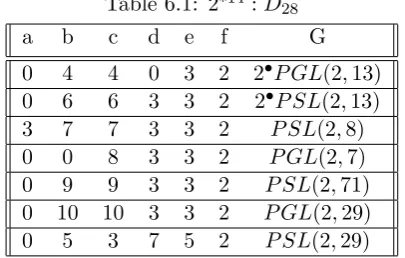
6.1 2∗14:D28 . . . 57
6.2 2∗16: 2•(((2×2) : 3) : 2) . . . 58
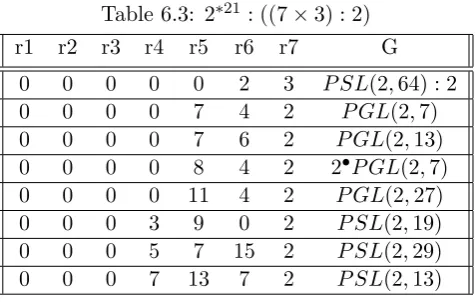
6.3 2∗21: ((7×3) : 2) . . . 59
6.4 2∗9 : (3•32) . . . . 59
6.5 3∗9 : (3•32) . . . 60
6.6 2∗7 :D14 . . . 60
6.7 2∗5 :D 10 . . . 61
List of Figures
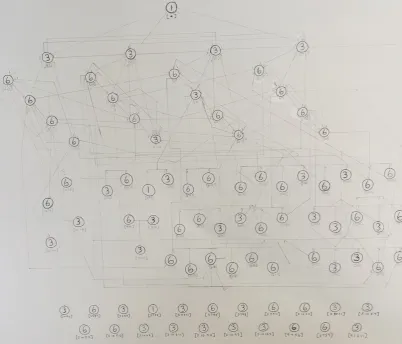
3.1 Cayley Diagram of 25:S5 overS5 . . . 28
3.2 Cayley Diagram of PGL(3,4) overM10 . . . 30
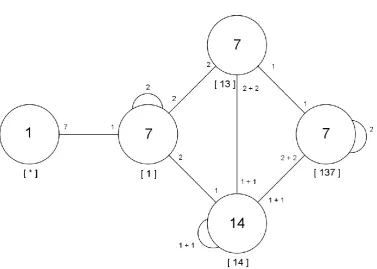
3.3 Cayley Diagram ofP SL(2,8) overD14 . . . 34
3.4 Cayley Diagram ofM12 over 2×S5 . . . 39
Chapter 1
Introduction
The goal of this thesis is to find homomorphic images of finite non-abelian simple
groups. We do this through the use of a progenitor, m∗n : N, whereN is transitive on
n letters. To find finite homomorphic images, we factor the progenitor by appropriate
relations of the form πw(t1, ...tn), where π ∈ N and w is a word in the symmetric
generators. This will give us finite homomorphic images of the infinite group m∗n : N.
It takes immense effort to find suitable relations to factor the progenitor by. Through
the course of our research, we have developed a lemma for writing relations that can be
used to factorm∗n:N to give the group mn:N. Of our own means and along with two
previously developed methods, we will factor these progenitors by suitable relations to
generate homomorphic images.
We can then determine the isomorphism type by solving the extension problem
using the groups composition factors. Through the process of double coset enumeration,
we can construct a graphical representation of the group, called a Cayley diagram. We can
then prove the order of the group using the Cayley diagram and the First Isomorphism
Theorem.
During our research, the question was posed that if we are given a target finite
non-abelian simple group, can we come up with control groups N, when written in the
progenitor 2∗n:N, can give the target simple group. Using a theorem proved by Robert
T. Curtis and expanding on it, we were able to develop an algorithm and prove its validity.
We implemented this algorithm in MAGMA. This program generates possible progenitors
Chapter 2
Writing Progenitors
2.1
Related Theorems and Definitions
Definition 2.1. Operation
Let G be a set. A (binary) operation onG is a function that assigns each ordered pair
of elements of G an element onG.[Rot95]
Definition 2.2. Semigroup
Asemigroup (G,∗) is a nonempty setGequipped with an associative operation∗.[Rot95]
Definition 2.3. Group
A group is a semigroupG containing an element esuch that
(i) e∗a=a=a∗e for alla∈G
(ii) for every a∈G, there is an element b∈G with a∗b=e=b∗a.[Rot95]
Definition 2.4. Free Group
If Xis a nonempty subset of a groupF, thenF is afree group with basisXif, for every
group G and every functionf :X→G, there exists a unique homomorphism ϕ:F →G extending f. Moreover, X generatesF.[Rot95]
Definition 2.5. Presentation
Let X be a set and let ∆ be a family of words on X. A group G has generators X
Definition 2.6. Progenitor
LetGbe a group andT ={t1, t2, ..., tn}be a symmetric generating set forGwith|ti|=m. Then ifN =NG( ¯T), then we define theprogenitorto be the semi direct productm∗n:N,
where m∗n is the free product of ncopies of the cyclic group Cm.[Cur07]
Definition 2.7. Character
Let A(x) = (aij(x)) be a matrix representation of G of degree m. We consider the
characteristic polynomial of A(x), namely
det(λI−A(x)) =
λ−a11(x) −a12(x) · · · −a1m(x) λ−a11(x) −a12(x) · · · −a1m(x)
· · · · · · · · ·
λ−am1(x) −am2(x) · · · λ−amm(x)
This is a polynomial of degree m inλ, and inspection shows that the coefficient of −λm−1 is equal to
ϕ(x) =a11(x) +a22(x) +..+amm(x)
It is customary to call the right-hand side of this equation the trace of A(x), abbreviated
to trA(x), so that
ϕ(x) =trA(x)
We regard ϕ(x) as a function on G with values in K, and we call it the character of
A(x).[Led87]
Theorem 2.8. The number of irreducible character of G is equal to the number of
con-jugacy classes of G.[Led87]
Definition 2.9. Degree of a Character
Definition 2.10. Lifting Process
Let N be a normal subgroup of G and suppose that A0(N x) is a representation of degree
m of the group G/N. ThenA(x) =A0(N x) defines a representation of G/N lifted from
G/N. If ϕ0(N x) is a character of A0(N x), thenϕ(x) =ϕ0(N x) is the lifted character of
A(x). Also, if u ∈N, then A(u) = Im, ϕ(u) =m =ϕ(1). The lifting process preserves irreducibility.[Led87]
Definition 2.11. Induced Character
Let H ≤G andϕ(u) be a character of H and define ϕ(x) = 0 if x∈H, then
ϕG(x) =
ϕ(x), x∈H 0, x /∈H
is an induced character of G.[Led87]
Definition 2.12. Formula for Induced Character
Let G be a finite group and H be a subgroup such that [G : H] = n. Let Cα,
α = 1,2,· · ·m be the conjugacy classes of G with |Cα|=hα, α= 1,2,· · ·m. Let ϕ be a character of H andϕG be the character of Ginduced from the characterϕof H up toG.
The values of ϕG on the m classes of G are given by:
ϕGα = n hα
∑
w∈Cα∩H
ϕ(w), α= 1,2,3,· · · , m.
2.2
Permutation Progenitor Examples
2.2.1 2∗5 :S5
We want write the progenitor 2∗5:S5. Here, our control groupN isS5.
Therefore we write a presentation for S5 given by,
S5 =< x, y|x5, y2,(x∗y)4,(x, y)3 >.
We can quickly check this presentation in MAGMA with the following code.
> G<x,y>:=Group<x,y|x^5,y^2,(x*y)^4,(x,y)^3>; > f,G1,k:=CosetAction(G,sub<G|Id(G)>);
> s,t:=IsIsomorphic(G1,Sym(5)); > s;
true
We need to add the free product 2∗5 to this group to form our progenitor. Since our progenitor has 2∗5, we also know that we have 5 t′s of order 2. We will add a t of order 2 and let t commute with the point stabilizer of 1 inN. This step will label our t
ast1 and ensure thatt1 has exactly 5 conjugates under conjugation byN. To determine
the stabilizer of 1 in N, we need to representN with permutations. In this case, we will
use N =< x, y >, wherex= (1,2,3,4,5)and y= (1,2).
With the help of MAGMA, we can see that the stabilizer of 1 in N is equal to
< (2,3),(3,4),(4,5)>. Representing these permutations as words, we have yx = (2,3),
yx2 = (3,4),yx3 = (4,5),
therefore our finished progenitor follows.
2.2.2 3∗9 : 3•(32)
Our control group N = 3•(32) and t′isare of order 3. We write a presentation forN and check in MAGMA.
> G<a,b,c>:=Group<a,b,c|a^3,b^3,(a,b)=c,c^3,(a,c),(b,c)>; > #G;
27
Note: This presentation has been checked by solving the extension problem discussed in
chapter 4. This example is given in section 4.2.3.
Now that we have a presentation for our control group, we just need to add a
t of order 3 and let tcommute with the one point stabilizer in N. The generators ofN
in this case with the stabilizer of 1 in N are given in the following MAGMA code. The
SchreierSystem code is used to change the permutations in the stabilizer into words in
the generators ofN.
> S:=Sym(9);
> aa:=S!(1,3,8)(2,4,5)(6,7,9); > bb:=S!(1,2,5)(3,7,8)(4,6,9); > cc:=S!(1,4,7)(2,6,8)(3,5,9); > N:=sub<S|aa,bb,cc>;
> #N; 27
> Sch:=SchreierSystem(G,sub<G|Id(G)>); > ArrayP:=[Id(N): i in [1..#N]];
> for i in [2..#N] do
for> P:=[Id(N): l in [1..#Sch[i]]]; for> for j in [1..#Sch[i]] do
for|for> if Eltseq(Sch[i])[j] eq 1 then P[j]:=aa; end if; for|for> if Eltseq(Sch[i])[j] eq 2 then P[j]:=bb; end if; for|for> if Eltseq(Sch[i])[j] eq 3 then P[j]:=cc; end if; for|for> if Eltseq(Sch[i])[j] eq -1 then P[j]:=aa^-1; end if; for|for> if Eltseq(Sch[i])[j] eq -2 then P[j]:=bb^-1; end if; for|for> if Eltseq(Sch[i])[j] eq -3 then P[j]:=cc^-1; end if; for|for> end for;
for> PP:=Id(N);
for> for k in [1..#P] do
for|for> PP:=PP*P[k]; end for; for> ArrayP[i]:=PP;
for> end for; >
Permutation group acting on a set of cardinality 9 Order = 3
(2, 8, 6)(3, 5, 9) > for i in [1..#N] do
for> if ArrayP[i] eq S!(2,8,6)(3,5,9) then Sch[i]; end if; end for; a * b * c
Therefore, we let t commute with a∗b∗c and the progenitor is complete. The finished progenitor for 3∗9 : 3•(32) follows:
2.3
Monomial Progenitors
2.3.1 7∗5 :m A5
We will write a presentation for the monomial progenitor 7∗5 :m A5. Note: 7∗5
represents 5t′sof order 7. LetG=A5=<(1,2)(3,4),(1,3,5)>. First we need to induce
a non-trivial linear character from a subgroup H ofG such that ||GH|| = 5 (the number of
t′s in our presentation). |G|= 60, therefore we must have |H|= 12. LetH =A4 =<(1,2)(3,4),(1,2,3)>.
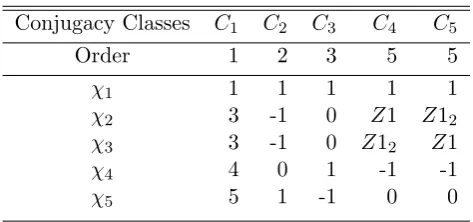
From MAGMA, we have the following character tables, withJ representing the
cube root of unity.
Table 2.1: Character Table of A5
Conjugacy Classes C1 C2 C3 C4 C5
Order 1 2 3 5 5
χ1 1 1 1 1 1
χ2 3 -1 0 Z1 Z12
χ3 3 -1 0 Z12 Z1
χ4 4 0 1 -1 -1
χ5 5 1 -1 0 0
Table 2.2: Character Table of A4
Conjugacy Classes C1 C2 C3 C4
Order 1 2 2 2
ϕ1 1 1 1 1
ϕ2 1 1 J −1−J
ϕ3 1 1 −1−J J
ϕ4 3 -1 0 0
Now, we must induce a non-trivial linear character of H, eitherχ2 orχ3 in this
case. We will induce χ2 up toG. Next, we find the right transversals of H in G. Using
MAGMA, these are {e,(1,3,5),(1,5,3),(1,4,3,5,2),(1,5,4,3,2)}. Label these transver-sals as
T1 =e
T2 = (1,3,5)
T4 = (1,4,3,5,2)
T5 = (1,5,4,3,2).
Now, the matrices A(x) and A(y) will be a representation of G induced from
the character in H,χ2. The general forms forA(x) and A(y) are
A(x) =
B(T1x T1−1) B(T1x T2−1) B(T1x T3−1) B(T1x T4−1) B(T1x T5−1)
B(T2x T1−1) B(T2x T2−1) B(T2x T3−1) B(T2x T4−1) B(T2x T5−1)
B(T3x T1−1) B(T3x T2−1) B(T3x T3−1) B(T3x T4−1) B(T3x T5−1)
B(T4x T1−1) B(T4x T2−1) B(T4x T3−1) B(T4x T4−1) B(T4x T5−1)
B(T5x T1−1) B(T5x T2−1) B(T5x T3−1) B(T5x T4−1) B(T5x T5−1)
A(y) =
B(T1y T1−1) B(T1y T2−1) B(T1y T3−1) B(T1y T4−1) B(T1y T5−1)
B(T2y T1−1) B(T2y T2−1) B(T2y T3−1) B(T2y T4−1) B(T2y T5−1)
B(T3y T1−1) B(T3y T2−1) B(T3y T3−1) B(T3y T4−1) B(T3y T5−1)
B(T4y T1−1) B(T4y T2−1) B(T4y T3−1) B(T4y T4−1) B(T4y T5−1)
B(T5y T1−1) B(T5y T2−1) B(T5y T3−1) B(T5y T4−1) B(T5y T5−1)
where B(x) is the value of the induced character for the class of H containing
x, recall if x /∈H, thenB(x) = 0.
Note: The cube roots of unity are represented as 1,2 and 4 from a field of order 7.
Now, x= (1,2)(3,4) andy = (1,3,5) and the classes of H are
Class 1 = e
Class 2 = (1,2)(3,4),(1,3)(2,4),(1,4)(2,3)
Class 3 = (1,3,4),(2,4,3),(1,4,2),(1,2,3)
Class 4 = (1,4,3),(2,3,4),(1,2,4),(1,3,2).
Therefore, we have
B(T1x T1−1) =B(e(1,2)(3,4)e) =B((1,2)(3,4)) = 1
B(T1x T2−1) =B(e(1,2)(3,4)(1,5,3)) =B((1,2,5,3,4)) = 0
B(T1x T3−1) =B(e(1,2)(3,4)(1,3,5)) =B((1,2,3,4,5)) = 0
B(T1x T4−1) =B(e(1,2)(3,4)(1,2,5,3,4)) =B((1,5,3)) = 0
B(T2x T1−1) =B((1,3,5)(1,2)(3,4)e) =B((1,4,3,5,2)) = 0
B(T2x T2−1) =B((1,3,5)(1,2)(3,4)(1,5,3)) =B((1,4)(2,5)) = 0
B(T2x T3−1) =B((1,3,5)(1,2)(3,4)(1,3,5)) =B((1,4,5,2,3) = 0
B(T2x T4−1) =B((1,3,5)(1,2)(3,4)(1,2,5,3,4)) =B(e) = 1
B(T2x T5−1) =B((1,3,5)(1,2)(3,4)(1,2,3,4,5)) =B((1,5,3)) = 0
B(T3x T1−1) =B((1,5,3)(1,2)(3,4)e) =B((1,5,4,3,2)) = 0
B(T3x T2−1) =B((1,5,3)(1,2)(3,4)(1,5,3)) =B((1,3,2,5,4)) = 0
B(T3x T3−1) =B((1,5,3)(1,2)(3,4)(1,3,5)) =B((2,3)(4,5)) = 0
B(T3x T4−1) =B((1,5,3)(1,2)(3,4)(1,2,5,3,4)) =B((1,3,5)) = 0
B(T3x T5−1) =B((1,5,3)(1,2)(3,4)(1,2,3,4,5)) =B((e)) = 1
B(T4x T1−1) =B((1,4,3,5,2)(1,2)(3,4)e) =B((1,3,5)) = 0
B(T4x T2−1) =B((1,4,3,5,2)(1,2)(3,4)(1,5,3)) =B((e)) = 1
B(T4x T3−1) =B((1,4,3,5,2)(1,2)(3,4)(1,3,5)) =B((1,5,3)) = 0
B(T4x T4−1) =B((1,4,3,5,2)(1,2)(3,4)(1,2,5,3,4)) =B((1,4)(2,5)) = 0
B(T4x T5−1) =B((1,4,3,5,2)(1,2)(3,4)(1,2,3,4,5)) =B((1,4,5,2,3)) = 0
B(T5x T1−1) =B((1,5,4,3,2)(1,2)(3,4)e) =B((1,5,3)) = 0
B(T5x T2−1) =B((1,5,4,3,2)(1,2)(3,4)(1,5,3)) =B((1,3,5)) = 0
B(T5x T3−1) =B((1,5,4,3,2)(1,2)(3,4)(1,3,5)) =B((e)) = 1
B(T5x T4−1) =B((1,5,4,3,2)(1,2)(3,4)(1,2,5,3,4)) =B((1,3,2,5,4)) = 0
B(T5x T5−1) =B((1,5,4,3,2)(1,2)(3,4)(1,2,3,4,5)) =B((2,3)(4,5)) = 0.
Substituting the above values intoA(x), we have the following matrix.
A(x) =
1 0 0 0 0
0 0 0 1 0
0 0 0 0 1
0 1 0 0 0
0 0 1 0 0
Using the same method for A(y) we have the following matrix.
A(y) =
0 1 0 0 0
0 0 1 0 0
1 0 0 0 0
0 0 0 2 0
0 0 0 0 4
Now, < A(x), A(y)> gives a faithful representation of A5 because,|A(x)|= 2,
|A(y)|= 3 and|A(x)A(y)|= 5.
Using the following rule, we can write permutation representations of the above
matrices. For each matrix entry, aij =nimplies ti goes totjn
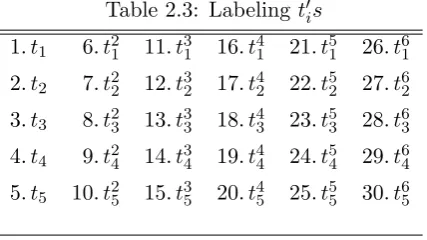
The labeling of the t′isis given in the following table.
Table 2.3: Labelingt′is
1. t1 6. t21 11. t31 16. t41 21. t51 26. t61
2. t2 7. t22 12. t32 17. t42 22. t52 27. t62
3. t3 8. t23 13. t33 18. t43 23. t53 28. t63
4. t4 9. t24 14. t34 19. t44 24. t54 29. t64
5. t5 10. t25 15. t35 20. t45 25. t55 30. t65
We will start by looking at the non-zero entries of A(x). a11 = 1, therefore t1
goes to t1 and similarly for all powers of t1. Next in row 2 of A(x), we have the entry
a24= 1, thereforet2 goes to t4 and similarly all powers oft2 go to corresponding powers
of t4.
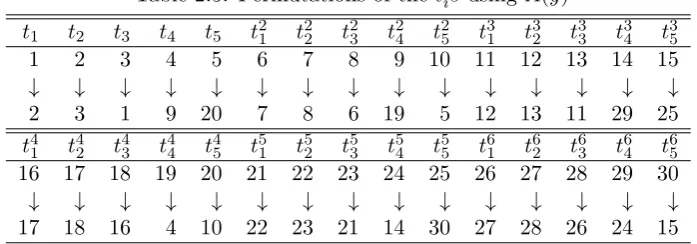
Following this pattern, we develop the following charts.
Table 2.4: Permutations of the t′isusingA(x)
t1 t2 t3 t4 t5 t21 t22 t23 t24 t25 t31 t23 t33 t34 t35
1 2 3 4 5 6 7 8 9 10 11 12 13 14 15
↓ ↓ ↓ ↓ ↓ ↓ ↓ ↓ ↓ ↓ ↓ ↓ ↓ ↓ ↓
1 4 5 2 3 6 9 10 7 8 11 14 15 12 13
t41 t42 t43 t44 t45 t51 t52 t53 t54 t55 t61 t62 t63 t64 t65
16 17 18 19 20 21 22 23 24 25 26 27 28 29 30
↓ ↓ ↓ ↓ ↓ ↓ ↓ ↓ ↓ ↓ ↓ ↓ ↓ ↓ ↓
Using the chart above, we develop the following permutation representation for A(x),
xx= (2,4)(3,5)(7,9)(8,10)(12,14)(13,15)(17,19)(18,20)(22,24)(23,25)(27,29)(28,30).
Table 2.5: Permutations of the t′isusing A(y)
t1 t2 t3 t4 t5 t21 t22 t23 t24 t25 t31 t23 t33 t34 t35
1 2 3 4 5 6 7 8 9 10 11 12 13 14 15
↓ ↓ ↓ ↓ ↓ ↓ ↓ ↓ ↓ ↓ ↓ ↓ ↓ ↓ ↓
2 3 1 9 20 7 8 6 19 5 12 13 11 29 25
t41 t42 t43 t44 t45 t51 t52 t53 t54 t55 t61 t62 t63 t64 t65
16 17 18 19 20 21 22 23 24 25 26 27 28 29 30
↓ ↓ ↓ ↓ ↓ ↓ ↓ ↓ ↓ ↓ ↓ ↓ ↓ ↓ ↓
17 18 16 4 10 22 23 21 14 30 27 28 26 24 15
Using the chart above, we develop the following permutation representation for A(y),
yy= (1,2,3)(6,7,8)(11,12,13)(16,17,18)(21,22,23)(26,27,28)(4,9,19)(5,20,10)
(14,29,24)(15,25,30).
Now the presentation for Gfollows.
< x, y, t|x2, y3,(x∗y)5, t7,(t, N ormalizer(N, < t1 >)>
The N ormalizer(N, < t1 >) is the stabilizer of all powers oft1 inN. Thus, we want the
permutations in N that stabilize{1,6,11,16,21,26}set wise.
Using MAGMA, we can find the stabilizer of{1,6,11,16,21,26} inN, which is the group generated by the following permutations.
(2,5)(3,4)(7,10)(8,9)(12,15)(13,14)(17,20)(18,19)(22,25)(23,24)(27,30)(28,29)
(2,3)(4,5)(7,8)(9,10)(12,13)(14,15)(17,18)(19,20)(22,23)(24,25)(27,28)(29,30)
(1,16,6)(2,8,19)(3,9,17)(4,7,18)(5,10,20)(11,21,26)(12,28,24)(13,29,22)(14,27,23)(15,30,25)
Using MAGMA to change the permutations into words in terms ofxandy, and
letting t commute with the generators of the stabilizer, we have the presentation of the
progenitor 7∗5 :
m A5.
G<x,y,t>:=Group<x,y,t|x^2,y^3,(x*y)^5,t^7,(t,y*x*y^-1*x*y*x*y^-1*x*y), (t,x*y*x*y^-1*x*y*x*y^-1*x*y),(t,x*y*x*y^-1*x*y^-1)>;
2.4
Writing Relations
Now that we have a firm grasp of how to write a progenitor, we will look at
a few methods for finding appropriate relations to factor our progenitors by. The first
lemma was developed during our research and is used as more of a check to determine if
the progenitor was written correctly. The second and third methods were developed by
Robert T. Curtis throughout his research and they are simply explained here.
2.4.1 Factoring Lemma
Lemma 2.13. Factoring Lemma
Factoring the progenitor m∗n:N by (ti, tj) for 1≤i < j ≤n gives the group mn:N.
Proof. We need to show that the two presentations are equivalent. LetN =< x1,· · · , xr >
where xk, 1≤k≤r, are the generators of N.
We first write the presentation for mn : N. mn is the direct product of n
elements of order m. We will list these as t′is, 1≤ i≤n and all t′is will commute with each other (definition of a direct product).
Next, we have to list the generators ofN and the action of the generators ofN
on the t′is. The presentation follows: < t1,· · · , tn, x1,· · ·, xr|tmi ,(ti, tj), N, txik >where
1≤i < j ≤n and 1≤k≤r.
The presentation for m∗n:N along with the relation (t1, t2) for 1≤i < j ≤n
is written: < x1,· · ·, xr, t|N, tm,(t, N1),(t1, t2)>whereN1 denotes the stabilizer of 1 in
N.
Now, to show the presentations are equivalent, we need to show the following
three things.
1)tm is equivalent totmi , since we can conjugate ourt′isby all ofN. Given that
N is transitive onnletters, there is a permutation that will sendt1 to all the othert′is.
2) (t1, t2) is equivalent to (ti, tj) for 1 ≤ i < j ≤ n, since we can conjugate
(t1, t2) by all of N. Similar to step (1), there will be a permuation that sends t1 and t2
to all the other t′is.
3) (t, N1) is equivalent to txk
i for 1≤i≤n and 1≤k≤r, since (t, N1) implies tN1 = t. Now conjugating this relationship by all of N determines the action of the
Therefore, the presentations are equivalent.
This lemma is particularly useful because we can factor our progenitors using
this lemma as a way to verify that our progenitors are written correctly.
Example: 2∗3:S3
t0t1=t1t0 =< x, y, t|x
3, y2,(x∗y)2, t2,(t, tx),(t, y)>. x∼(1,2,3) and y∼(2,3) and t∼t1.
t21 = 1 impliest1 =t1 thereforetx1 =tx1 =⇒t2 =t2 =⇒t22= 1
t21 = 1 impliest1 =t1 thereforetx
2
1 =tx
2
1 =⇒t3=t3 =⇒t23 = 1
This shows 3 elements of order 2.
(t, tx) = (t1, t2) =⇒t1t2 =t2t1
(t1t2=t2t1)y =⇒t1t3=t3t1
(t1t2=t2t1)x=⇒t2t3 =t3t2
Thus, all 3 elements of order 2 commute.
Now we have 23 and we need to show the extension problem of 23 :S 3.
Note N1 =y= (2,3).
(t, y) =⇒(2,3)t1(2,3) =t1=⇒t(21 ,3) =t1.
Now conjugate byx= (1,2,3).
t1(2,3)(1,2,3) =t1(1,2,3)=⇒tx1 =t2.
Continuing this process we see
txx
1 =tx2 =⇒t2x =t3 andtxy1 =t
y
2 =⇒t
y
2 =t3
tyx2 =tx3 =⇒tx3 =t1 and tyy2 =t
y
3 =⇒t
y
3 =t2
Therefore, we have the action of the generators of S3 on 23.
Thus, the progenitor shown above is isomorphic to 23 :S3.
We can show another example of this lemma using the first symmetric progenitor
written in this chapter. The progenitor we wrote was 2∗5 : S5. Now, if we factor this
progenitor by letting all the 5 t′s commute, the progenitor should generate the group
25:S5. The order of 25:S5 is 3840. We will show this using MAGMA.
> xx:=S!(1,2,3,4,5); > yy:=S!(1,2);
> N:=sub<S|xx,yy>; > N1:=Stabiliser(N,1); > N1;
Permutation group N1 acting on a set of cardinality 5 Order = 24 = 2^3 * 3
(2, 3) (3, 4) (4, 5)
> G<x,y,t>:=Group<x,y,t|x^5,y^2,(x*y)^4,(x,y)^3,t^2,(t,y^x),(t,y^x^2),(t,\ y^x^3),(t,t^x)>;
> #G; 3840
2.4.2 First Order Relations
Given a progenitor of the form m∗n:N, a method for generating all first order
relations of the form (xti)k = 1 wherex∈N is outlined below.
First, we must find the conjugacy classes of N and compute the centralizer of
a representative from each class in N. We then calculate the orbits for each one of the
centralizers. Next, we take the representative from each class and right multiply by a
ti from each orbit. We have developed a small program in MAGMA to generate such
representatives and orbits.
Note: The ScheierSystem code for N must be ran for this program to work.
CL:=Classes(N);
for ii in [2..NumberOfClasses(N)] do for i in [1..#N] do
if ArrayP[i] eq CL[ii][3] then Sch[i]; end if; end for; C12:=Centraliser(N,CL[ii][3]);
Orbits(C12); end for;
We will demonstrate the method with the example 2∗4 :S
4. First we calculate
the conjugacy classes of S4, which follow:
> N:=Sym(4); > CL:=Classes(N); > CL;
---[1] Order 1 Length 1
Rep Id(N)
[2] Order 2 Length 3
Rep (1, 2)(3, 4)
[3] Order 2 Length 6
Rep (1, 2)
[4] Order 3 Length 8
Rep (1, 2, 3)
[5] Order 4 Length 6
Rep (1, 2, 3, 4)
Now, we can calculate the centralizer of each class representative and the orbit
of the centralizer.
> for i in [2..#CL] do
for> C12:=Centraliser(N,CL[i][3]); for> CL[i][3]; Orbits(C12);
for> end for; (1, 2)(3, 4) [
GSet{@ 1, 2, 4, 3 @} ]
(1, 2) [
GSet{@ 1, 2 @}, GSet{@ 3, 4 @} ]
(1, 2, 3) [
GSet{@ 4 @}, GSet{@ 1, 2, 3 @} ]
(1, 2, 3, 4) [
GSet{@ 1, 2, 3, 4 @} ]
Recall our relations will take the form (xti)k = 1, such thatxis the
Following this rule, the list of first order relations follow:
((1,2)(3,4)t1)a= 1
((1,2)t1)b= 1
((1,2)t3)c= 1
((1,2,3)t1)d= 1
((1,2,3)t4)e= 1
((1,2,3,4)t1)f = 1
Of course, when writing the progenitor we will need to convert these permutations into
words in terms of the generators of N.
2.4.3 Curtis’ Lemma
An outline of the lemma developed by Robert T. Curtis follows:
If we have a progenitor of the form 2∗n:N, where N is transitive onn letters.
First we calculate the stabilizer of two points in our control group N. Without loss of
generality, let the two points be 1 and 2, and call this stabilizerN12. Now we calculate the
centralizer of N12 in N, call this group C12. Note: Centralizer(N, H) = {n ∈N|hn =
h∀h∈H}. We can use all elements of C12 for the lemma, but it is sufficient to use just
the generators of C12. Therefore, we look at the generators of C12 and produce relations
based on the following rule.
Letx be a generator ofC12, then
If x fixes 1 and 2 then we write (t1t2)k=x where k is even.
If x sends 1 and 2 to each other then we write (xt1)k = 1 where k is odd.
Example:
We want to write relations for the progenitor 2∗5 :A5, therefore we want to look
at the point stabilizer of 1 and 2 inA5, then calculate the centralizer ofN12 inA5. This
group is easily shown using MAGMA.
> N:=Alt(5);
> N12:=Stabiliser(N,[1,2]); > N12;
(3, 4, 5)
> C12:=Centraliser(N,N12); > C12;
Permutation group C12 acting on a set of cardinality 5 Order = 3
(3, 4, 5)
Now, C12=<(3,4,5)>, so let x= (3,4,5). x fixes 1 and 2, so the relation will
Chapter 3
Double Coset Enumeration
3.1
Related Theorems and Definitions
Definition 3.1. Double Coset
Let H and K be subgroups of the group G and define a relation on G as follows:
x∼y ⇐⇒ ∃h∈H andk∈K such that y=hxk
where ∼ is an equivalence relation and the equivalence classes are sets of the following form
HxK ={hxk|h∈H, k∈K}=∪k∈KHxk=∪h∈HhxK Such a subset of G is called a double coset.[Cur07]
Definition 3.2. Point Stabilizer
Let G be a group of permutations of a set S. For each g, s∈S, let gs =g, then we call the set of s∈S the point stabilizer of g∈G.[Cur07]
Definition 3.3. Coset Stabilizing Group
The coset stabilizing groupof a coset N w is defined as
Theorem 3.4. Number of single cosets in N wN
From above we see that,
N(w)={π∈N|N wπ =N w}={π ∈N|N wπw−1=N} ={π∈N|(N w)π =N w}
and the number of single cosets in N wN is given by [N :N(w)].[Cur07] Definition 3.5. Orbits
3.2
Construction of
2
5:
S
5over
S
525 :S5∼= 2
∗5:S 5
t3t5t3t5=1
P rogenitor = 2∗5 : S5 =⇒< t1 > ∗ < t2 > ∗ < t3 > ∗ < t4 > ∗ < t5 >: S5,
where the t′ishave order 2.
We havet3t5t3t5= 1. By multiplying both sides of the equation on the right by
t5t3 we can obtain the equivalent relation t3t5=t5t3.
Control Group N =S5.
Definition of double coset: N tN = {N tn|n ∈ N}. A Cayley diagram will be constructed to track the manual double coset enumeration of GoverS5.
We first need to calculate the total number of unique cosets ofN inG. This is
the index of G inN. The index will be the order ofGdivided by the order ofN. |G|
|N|=
3840 120 = 32.
Now we know that we will have 32 unique single cosets.
Constructing the Cayley Diagram.
Circle One: First Double Coset.
We start constructing the Cayley diagram with one circle, this is the double coset
N eN, it contains one single coset and it is labeled [∗]. N is transitive on {1,2,3,4,5} so it has a single orbit {t1, t2, t3, t4, t5}. Next, take a representative from the orbit and
see which double coset it belongs to. We pick 3 because of the given relation. N t3N =
{N t3n|n∈ N}= {N t1, N t2, N t3, N t4, N t5}. Since all five t′isare in the same orbit, we
know all five t′iswill extend to the next double coset.
Circle Two: Second Double Coset.
Now, there are fivet′isextending to the second double coset, we label the double
coset [3], which representsN t3N. We next find the coset stabilizer,N(3) inS5. The coset
stabilizer, N(3) will be elements of S5 that fix 3. Therefore,
N(3)={e,(1,2),(1,5,2),(1,4,5,2),(2,5),(1,2,5),(1,5),(1,4,5),(2,4,5), (1,2,4,5),(1,5)(2,4),(1,4,2,5),(4,5),(1,2)(4,5),(1,5,4,2),(1,4,2),(2,5,4),
(1,2,5,4),(1,5,4),(1,4),(2,4),(1,2,4),(1,5,2,4),(1,4)(2,5)}
Now, the number of single cosets inN t3N will be at most |N|N(3)|| =
120 24 = 5.
We can see which t′is share orbits, by seeing which t′is share permutations in
N(3). The orbits for N(3) will be {t3} and {t1, t2, t4, t5}. Choose a representative from
N t3t3=N eN (t′ishave order 2) : this meanst3 goes back to [∗].
N t3t5 ∈N t3t5N: There is no relation that sends two t′isto oneti. This means t5 extends to the next double coset. All of the t′is in the same orbit will extend also.
Therefore, {t1, t2, t4, t5} all extend to the next double coset.
Circle Three: Third Double Coset.
We chooset5as a representative from this orbit. We label the third double coset
[35] and compute the coset stabilizer,N(35). We needn∈N ∋N(t3t5)n=N t3t5. Using
the given relation (t3t5 =t5t3), we can see that the coset stabilizer will be all elements of
S5 that fix 3 and 5 , as well as, the elements of S5 that send 3 to 5 and 5 to 3. Therefore,
N(35)={e,(1,2),(1,4),(2,4),(1,2,4),(1,4,2),(3,5),(1,2)(3,5),(1,4)(3,5),(2,4)(3,5), (1,2,4)(3,5),(1,4,2)(3,5)}.
Now, the number of single cosets inN t3t5N will be at most, |N|N(35)| | =
120 12 = 10
Next, we calculate the transversals for [35] by finding the right cosets of N(35) inN.
N(35)(e) =N(35)
N(35)(13) ={(13),(123),(143),(13)(24),(1243),(1423),(135),(1235),(1435),(135)(24),
(12435),(14235)}
N(35)(15) ={(12),(125),(145),(15)(24),(1245),(1425),(153),(1253),(1453),(153)(24), (12453),(14253)}
N(35)(23) ={(23),(132),(14)(23),(243),(1324),(1432),(235),(1352),(14)(235),(2435), (13524),(14352)}
N(35)(25) ={(25),(152),(14)(25),(245),(1524),(1452),(253),(1532),(14)(253),(2453),
(15324),(14532)}
N(35)(34) ={(34),(12)(34),(134),(234),(1234),(1342),(354),(12)(354),(1354),(2354), (12354),(13542)}
N(35)(45) ={(45),(12)(45),(154),(254),(1254),(1542),(345),(12)(345),(1534),(2534), (12534),(15342)}
N(35)(1543) ={(1543),(12543),(13)(45),(15423),(123)(45),(13)(254),(15)(34), (125)(34),(1345),(15)(234),(12345),(13425)}
N(35)(1325) ={(1325),(15)(23),(14325),(13245),(15)(243),(23)(145),(13)(25),(1523), (143)(25),(13)(245),(15243),(14523)}
(132)(45),(154)(23),(2543),(13254),(15432)}
Now, we find the relations based on twot′isby conjugating our original relation
(t3t5=t5t3), with a representative of each transversal.
Notation: 35∼53 means N t3t5=N t5t3.
(35∼53)(e)⇔(35∼53) (35∼53)(13)⇔(15∼51) (35∼53)(15)⇔(31∼13) (35∼53)(23)⇔(25∼52) (35∼53)(25)⇔(32∼23) (35∼53)(34)⇔(45∼54) (35∼53)(45)⇔(34∼43) (35∼53)(1543)⇔(14∼41) (35∼53)(1325)⇔(21∼12) (35∼53)(2345)⇔(42∼24)
This gives the 10 distinct right cosets in the double coset N t3t5N. The orbits
for N(35) on {1,2,3,4,5} are{t
3, t5} and {t1, t2, t4}. Choose a representative from each
orbit to find the behavior for all elements of that orbit.
N t3t5t5 =N t3N : this means t3, t5 go back to [3]. N t3t5t1 =N t3t5t1N : there
is no relation that takes threet′isback to twot′is, sot1, t2, t4all extend to the next double
coset.
Circle Four: Fourth Double Coset.
We choose t1 as a representative from this orbit. Now, label the fourth double
coset [351] and look for the coset stabilizer, N(351). We need n ∈ N ∋ N(t3t5t1)n =
N t3t5t1. Using the relations that we developed for two t′is, we can form relations for t3t5t1.
Notation: 351∼531 meansN t3t5t1 =N t5t3t1.
351∼531∼513∼153∼135∼315
Now, the coset stabilizer will be the point stabilizerN351 and any permutation that maintains the above relation.
N(351)={e,(13),(15),(35),(135),(153),(24),(24)(13),(24)(15),(24)(35), (24)(135),(24)(153)}.
Now, the number of single cosets inN t3t5t1N will be at most|N|(351)N| | =
Now, we find the transversals for [351] by calculating the right cosets ofN(351). N(351)(e) ={e,(13),(15),(35),(135),(153),(24),(24)(13),(24)(15),(24)(35),(24)(135),
(24)(153)}
N(351)(12) ={(12),(132),(152),(12)(35),(1352),(1532),(124),(1324),(1524),(124)(35), (13524),(15324)}
N(351)(14) ={(14),(134),(154),(14)(35),(1354),(1534),(142),(1342),(1542),(142)(35), (13542),(15342)}
N(351)(23) ={(23),(123),(15)(23),(235),(1235),(1523),(243),(1243),(15)(243),(2435), (12435),(15243)}
N(351)(25) ={(25),(13)(25),(125),(253),(1325),(1253),(245),(13)(245),(1245),(2453), (13245),(12453)}
N(351)(34) ={(34),(143),(15)(34),(354),(1435),(1543),(234),(1423),(15)(234),(2354), (14235),(15423)}
N(351)(45) ={(45),(13)(45),(145),(345),(1345),(1453),(254),(13)(254),(1425),(2534), (13425),(14253)}
N(351)(2543) ={(2543),(12543),(14325),(25)(34),(125)(34),(143)(25),(23)(45),
(123)(45),(145)(23),(2345),(12345),(14523)}
N(351)(1452) ={(1452),(13452),(12)(45),(14532),(132)(45),(12)(345),(14)(25), (134)(25),(1254),(14)(253),(13254),(12534)}
N(351)(1234) ={(1234),(14)(23),(15234),(12354),(14)(235),(154)(23),(12)(34),(1432), (152)(34),(12)(354),(14352),(15432)}
Now, we find the relations based on threet′isby conjugating our above
relation-ship (t3t5t1 = t5t3t1 = t5t1t3 = t1t5t3 = t1t3t5 = t3t1t5), with a representative of each
transversal.
(351 ∼ 531 ∼ 513 ∼ 153 ∼ 135 ∼ 315)(e) ⇔ (351 ∼ 531 ∼ 513 ∼ 153 ∼ 135 ∼ 315) (351 ∼ 531 ∼ 513 ∼ 153 ∼ 135 ∼ 315)(12) ⇔ (352 ∼ 532 ∼ 523 ∼ 253 ∼ 235 ∼ 325) (351 ∼ 531 ∼ 513 ∼ 153 ∼ 135 ∼ 315)(14) ⇔ (354 ∼ 534 ∼ 543 ∼ 453 ∼ 435 ∼ 345) (351 ∼ 531 ∼ 513 ∼ 153 ∼ 135 ∼ 315)(23) ⇔ (251 ∼ 521 ∼ 512 ∼ 152 ∼ 125 ∼ 215) (351 ∼ 531 ∼ 513 ∼ 153 ∼ 135 ∼ 315)(25) ⇔ (321 ∼ 231 ∼ 213 ∼ 123 ∼ 132 ∼ 312)
(351 ∼ 531 ∼513 ∼ 153∼ 135∼ 315)(1452) ⇔ (324∼ 234 ∼243 ∼ 423∼ 432 ∼342) (351∼531∼513∼153∼135∼315)(1234) ⇔(452∼542∼524∼254∼245∼425)
The orbits for N(351) on {1,2,3,4,5} are {t
3, t5, t1} and {t2, t4}. Choose a
representative from each orbit to find the behavior for all elements of that orbit.
N t3t5t1t1=N t3t5N : so {t3, t5, t1}all go back to [35].
N t3t5t1t2 =N t3t5t1t2N : there is no relation that takes four t′is back to three t′is, so{t2, t4}all extend to the next double coset.
Circle Five: Fifth Double Coset.
We chooset2as a representative from the second orbit. Now, label the fifth
dou-ble coset [3512] and look for the coset stabilizer,N(3512). We needn∈N ∋N(t3t5t1t2)n=
N t3t5t1t2. Using the relations that we developed for 3 t′is, we can form relations for t3t5t1t2.
Notation: 3512∼5312 means N t3t5t1t2=N t5t3t1t2.
The following are equivalent: 1235 ∼ 1253 ∼ 1325 ∼ 1352 ∼ 1523 ∼ 1532 ∼ 2135 ∼ 2153 ∼ 2315 ∼ 2351 ∼ 2513 ∼ 2531 ∼ 3125 ∼ 3152 ∼ 3215 ∼3251 ∼ 3512 ∼ 3521∼5123∼5132∼5213∼5231∼5312∼5321
Now, the coset stabilizer will be the point stabilizerN3512 and any permutation that maintains the above relation. Which is essentially the point stabilizer, N4.
N(3512) ={e,(12),(13),(15),(23),(25),(35),(12)(35),(13)(25),(15)(23),(123),(125),(132), (135),(152),(153),(235),(253),(1235),(1352),(1325),(1532),(1523),(1253)} Now, the number of single cosets inN t3t5t1t2N will be at most
|N|
|N(3512)| =
120 24 = 5.
Now, we find the transversals for [3512] by calculating the right cosets ofN(3512). N(3512)(e) ={e,(12),(13),(15),(23),(25),(35),(12)(35),(13)(25),(15)(23),(123),(125),
(132),(135),(152),(153),(235),(253),(1235),(1352),(1325),(1532),(1523),
(1253)}
N(3512)(14) ={(14),(124),(134),(154),(14)(23),(14)(25),(14)(35),(124)(35),(134)(25), (154)(23),(1234),(1254),(1324),(1354),(1524),(1534),(235)(14),(253)(14),
(12354),(13524),(13254),(15324),(15234),(12534)}
N(3512)(24) ={(24),(142),(13)(24),(15)(24),(234),(254),(35)(24),(142)(35),(254)(13), (234)(15),(1423),(1425),(1342),(135)(24),(1542),(153)(24),(2354),(2534),
N(3512)(34) ={(34),(12)(34),(143),(15)(34),(243),(25)(34),(354),(12)(354),(25)(143), (15)(243),(1243),(34)(125),(1432),(1435),(152)(34),(1543),(2435),(2543),
(12435),(14352),(14325),(15432),(15243),(12543)}
N(3512)(45) ={(45),(12)(45),(13)(45),(145),(23)(45),(245),(345),(12)(345),(13)(245), (145)(23),(123)(45),(1245),(132)(45),(1345),(1452),(1453),(2345),(2453),
(12345),(13452),(13245),(14532),(14523),(12453)}
Now, we find the relations based on fourt′isby conjugating our above relations
with a representative of each transversal.
1235∼ 1253∼ 1325∼ 1352∼ 1523∼ 1532∼
2135∼ 2153∼ 2315∼ 2351∼ 2513∼ 2531∼
3125∼ 3152∼ 3215∼ 3251∼ 3512∼ 3521∼
5123∼ 5132∼ 5213∼ 5231∼ 5312∼ 5321
(e)
=
1235∼ 1253∼ 1325∼ 1352∼ 1523∼ 1532∼
2135∼ 2153∼ 2315∼ 2351∼ 2513∼ 2531∼
3125∼ 3152∼ 3215∼ 3251∼ 3512∼ 3521∼
5123∼ 5132∼ 5213∼ 5231∼ 5312∼ 5321
1235∼ 1253∼ 1325∼ 1352∼ 1523∼ 1532∼
2135∼ 2153∼ 2315∼ 2351∼ 2513∼ 2531∼
3125∼ 3152∼ 3215∼ 3251∼ 3512∼ 3521∼
5123∼ 5132∼ 5213∼ 5231∼ 5312∼ 5321
(14) =
4235∼ 4253∼ 4325∼ 4352∼ 4523∼ 4532∼
2435∼ 2453∼ 2345∼ 2354∼ 2543∼ 2534∼
3425∼ 3452∼ 3245∼ 3254∼ 3542∼ 3524∼
5423∼ 5432∼ 5243∼ 5234∼ 5342∼ 5342
1235∼ 1253∼ 1325∼ 1352∼ 1523∼ 1532∼
2135∼ 2153∼ 2315∼ 2351∼ 2513∼ 2531∼
3125∼ 3152∼ 3215∼ 3251∼ 3512∼ 3521∼
5123∼ 5132∼ 5213∼ 5231∼ 5312∼ 5321
(24) =
1435∼ 1453∼ 1345∼ 1354∼ 1543∼ 1534∼
4135∼ 4153∼ 4315∼ 4351∼ 4513∼ 4531∼
3145∼ 3154∼ 3415∼ 3451∼ 3514∼ 3541∼
5143∼ 5134∼ 5413∼ 5431∼ 5314∼ 5341
1235∼ 1253∼ 1325∼ 1352∼ 1523∼ 1532∼
2135∼ 2153∼ 2315∼ 2351∼ 2513∼ 2531∼
3125∼ 3152∼ 3215∼ 3251∼ 3512∼ 3521∼
5123∼ 5132∼ 5213∼ 5231∼ 5312∼ 5321
(34) =
1245∼ 1254∼ 1425∼ 1452∼ 1524∼ 1542∼
2145∼ 2154∼ 2415∼ 2451∼ 2514∼ 2541∼
4125∼ 4152∼ 4215∼ 4251∼ 4512∼ 4521∼
5124∼ 5142∼ 5214∼ 5241∼ 5412∼ 5421
1235∼ 1253∼ 1325∼ 1352∼ 1523∼ 1532∼
2135∼ 2153∼ 2315∼ 2351∼ 2513∼ 2531∼
3125∼ 3152∼ 3215∼ 3251∼ 3512∼ 3521∼
5123∼ 5132∼ 5213∼ 5231∼ 5312∼ 5321
(45) =
1234∼ 1243∼ 1324∼ 1342∼ 1423∼ 1432∼
2134∼ 2143∼ 2314∼ 2341∼ 2413∼ 2431∼
3124∼ 3142∼ 3214∼ 3241∼ 3412∼ 3421∼
4123∼ 4132∼ 4213∼ 4231∼ 4312∼ 4321
The orbits for N(351) on {1,2,3,4,5} are {t3, t5, t1, t2} and {t4}. Choose a
representative from each orbit to find the behavior for all elements of that orbit.
N t3t5t1t2t2=N t3t5t1N : so{t3, t5, t1, t2}all go back to the fourth double coset.
N t3t5t1t2t4 =N t3t5t1t2t4N : there is no relation that takes five t′isback to four t′is, so {t4}extends to the next double coset.
Circle Six: Sixth Double Coset.
We take the lone t4 from this orbit. Now, label the sixth double coset [35124]
and look for the coset stabilizer, N(35124). N(35124)={e}
Now, the number of single cosets inN t3t5t1t2t4N will be at most
|N|
|N(35124)| =
120 120 = 1.
Therefore, the only one orbit of N(35124) on {1,2,3,4,5} is {t3, t5, t1, t2, t4}.
Choose a representative from this orbit to find the behavior for all elements of this orbit.
N t3t5t1t2t4t4 =N t3t5t1t2N : so {t3, t5, t1, t2, t4} all go back to the fifth double
A Cayley diagram for this group follows.
3.3
Construction of
P GL
(3
,
4)
over
M
10P GL(3,4)∼= 2∗10:M10
(yt)5=1
Progenitor : 2∗10:M10=⇒< t1 >∗...∗< t10>:M10 (t′ishave order 2).
Relation : (yt)5 = 1, with y= (1,2)(3,4,7,9,10,8,6,5) =⇒(yt)5 =y5ty104ty103t10y2ty10t10=y5t3t5t6t8t10= 1
A Cayley diagram will be constructed to track the manual double coset
enumer-ation of GoverM10.
We first need to calculate the total number of unique cosets of N in the group
G. This is called the index. Let N =M10. The index will be the order of G divided by
the order of N. |G|
|N|=
40320 720 = 56
Now we know that we will have 56 unique single cosets.
Constructing the Cayley Diagram.
Circle One: First Double Coset.
We start constructing the Cayley diagram with the first double coset,N eN. This
coset contains one single coset and it is labeled [∗]. Nis transitive on{1,2,3,4,5,6,7,8,9,10} so it has a single orbit {t1, t2, t3, t4, t5, t6, t7, t8, t9, t10}. Next, take a representative from
the orbit and see which double coset it belongs to. We pick 10 because of the given
relation. N t10N ={N t10n|n∈N}={N t1, N t2, N t3, N t4, N t5, N t6, N t7, N t8,
N t9, N t10}. Since all ten t′isare in the same orbit, we know all tent′iswill extend to the
next double coset.
Circle Two: Second Double Coset.
Now, there are tent′isextending to the second double coset. We label the double
coset [0], which represents N t10N. We next find the coset stabilizer, N(0) in M10. The
coset stabilizer, N(0) will be elements of M10 that fix (10). Therefore,
N(0)=<(2,3)(4,6)(5,7)(8,9),(1,8,4,2)(3,9,7,5),(2,4,3,6)(5,9,7,8), (2,9,3,8)(4,5,6,7)>. Now, the number of single cosets inN t10N will be at most