Watts, Martin (2007) Implementation of a flexible online delivery model to
replace a traditional face-to-face delivery of a PGCE ICT module. Practitioner
Research in Higher Education, 1 (1). pp. 51-55.
Downloaded from: http://insight.cumbria.ac.uk/id/eprint/3316/
Usage of any items from the University of Cumbria’s institutional repository ‘Insight’ must conform to the
following fair usage guidelines.
Any item and its associated metadata held in the University of Cumbria’s institutional repository Insight (unless
stated otherwise on the metadata record) may be
copied, displayed or performed, and stored in line with the JISC
fair dealing guidelines (available
here
) for educational and not-for-profit activities
provided that
• the authors, title and full bibliographic details of the item are cited clearly when any part
of the work is referred to verbally or in the written form
• a hyperlink/URL to the original Insight record of that item is included in any citations of the work
• the content is not changed in any way
• all files required for usage of the item are kept together with the main item file.
You may not
• sell any part of an item
• refer to any part of an item without citation
• amend any item or contextualise it in a way that will impugn the creator’s reputation
• remove or alter the copyright statement on an item.
The full policy can be found
here
.
online delivery model to replace
a traditional face-to-face delivery
of a PGCE ICT module
Martin Watts University of Cumbria [email protected]
Abstract
This paper describes aspects of the planning and delivery of a 10 credit
module to learners participating in a full-time, Secondary Informational
Communication Technology (ICT) PGCE course and the decision to replace
an existing face to face delivery with a fl exible, online delivery. The paper
focuses upon four associated aspects of the module, including the conceptual
framework for delivering the module, the online model implemented,
the online tasks and the module evaluation.
Introduction
This paper describes aspects of the planning and delivery of a 10 credit module to learners participating in a full-time, Secondary Informational Communication Technology (ICT) PGCE course and the decision to replace an existing face to face delivery with a fl exible, online delivery. The paper focuses upon four associated aspects of the module, including the conceptual framework for delivering the module, the online model implemented, the online tasks and the module evaluation.
It is widely accepted that the mediation of online technologies has potential to, ‘engage in rich effective construction of knowledge’ (Doolittle, 1999). Leask and Younie (2001) argue that ICT rich pedagogical contexts are in fact the basis for a new paradigm of constructivism they call ‘communal constructivism’ and that teachers have already intuitively adopted a communal constructivist approach in classrooms by integrating ICT and the Internet into their teaching.
Lave and Wenger (1991) identifi ed the existence of communities of practice, characterized by common purpose, varying levels of participation, open-ended activities and a recognition of, ‘the importance of dialogue, interaction and shared narrative’ (Lewis and Allan, 2005) and it is against this background that an online model of learning was chosen. The conceptual framework is provided by four fundamental propositions which led to our decision to redesign the module.
Four propositions
The fi rst proposition relates to the widely accepted belief that effective teaching professionals should be critically refl ective professionals. Schön (1983) proposed the practice of refl ection-in-action as a result of a perceived crisis of confi dence among some professions, in which individuals were not, ‘bound by the dichotomies of Technical Rationality’, nor, ‘dependent on the categories of established theory and technique,’ but, in becoming a refl ective practitioner, the individual, ‘constructs a new theory of the unique case’ (Schön, 1983. p.68). Moon (1997) extended Dewey’s original argument to state that it is ‘truly educative in value’. Brookfi eld (1995) directed these ideas specifi cally towards teachers and stressed the need for a more critically refl ective approach to become an effective teacher.
The second proposition which prompted the module redesign was based upon the notion of constructive in Higher Education
Copyright © 2007 University of Cumbria
PRACTITIONER RESEARCH IN HIGHER EDUCATION 1 (1)
The third proposition for the redesign of the module was based upon the concepts of deep and surface approaches to learning in which Marton and Saljo (1997) make the case for learners to maintain high levels of engagement with their learning in order to utilise high order thinking skills and to support deeper levels of understanding of new knowledge. Biggs (2003) argues that traditional lectures have tended to promote a passive approach to learning resulting in a surface level of understanding. Good teaching, which is interactive, creates the conditions for deep level understanding and focuses upon activities such as arguing, hypothesizing and synthesizing as contributing to desirable levels of knowledge. Whilst activities which promote these characteristics can be straightforward in a face to face situation, it is a greater challenge to maintain these conditions within the fl exible, distance, online learning environment. Indeed Entwistle (1996) was cautious about the likelihood that these approaches really could achieve levels of learning which were being predicted. However, more recently, a barrage of literature is available which supports the notion that fl exible and distance learning, mediated by technology, can indeed contribute to deeper levels of learning and understanding (Lewis and Allan, 2005, Maor, 2003, Salmon 2003, Inglis et al, 2002, Palloff and Pratt, 1999, Harry, 1999).
The online model
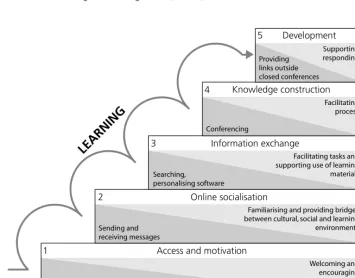
The online module was redesigned around a 5 stage, online distance learning model suggested by Salmon (2002). Figure 1 is a diagrammatic representation of the model. It should be noted that Salmon’s model was originally intended for distance learning environments and therefore its adoption for a module usually delivered face to face could legitimately be viewed with a degree of caution.
Figure 1 Model of teaching and learning online (Salmon, 2002:11)
1 Access and motivation
E-Moderating
Technical support
Welcoming and encouraging Setting up system
and accessing
2 Online socialisation
Familiarising and providing bridges between cultural, social and learning environments Sending and
receiving messages
3 Information exchange
Facilitating tasks and supporting use of learning materials Searching,
personalising software
4 Knowledge construction
Facilitating process
Conferencing
5 Development
Supporting responding Providing
links outside closed conferences
Amount of int
e
ra
ct
ivit
y
Designing and implementing the e-tivities
College periods were scheduled for work on the module. Timetabling of fi xed periods facilitated the potential need for face to face sessions in case of technical diffi culties. The scheduling of fi xed periods was also useful for moderating purpose as it was possible to indicate times when participants could reasonably expect to receive rapid feedback from moderators. The online nature of the module allowed suffi cient fl exibility for students to engage with the module at times other than those scheduled. The following e-tivites have been highlighted here because they occur at signifi cant points in the online module and were designed to consolidate and progress the participants through various stages of the model.
Key e-tivity one
The fi rst key e-tivity occurred during the third week of the module and was designed to support participant progress into Stage Three of Salmon’s model. The learning objectives of the task were to identify modes for the delivery of ICT in secondary schools, to build an understanding of the advantages and disadvantages of each, and to understand how the existing framework for teaching ICT would fi t into their preferred mode of delivery. The outcomes of the task were to present a supported argument in favour of a particular mode for the delivery of ICT in a secondary school, and to critically respond to the case presented by other participants. This e-tivity necessitated reading literature related to the delivery of ICT. The participants presented their own case, and read the contributions from other participants and critically responded to 3 of these identifying why they felt their peers had made a robust presentation. The tutor/moderator summarised the major issues as they emerged from the discussion boards. Moderating the discussion board involved ‘weaving’ and ‘threading’ (Salmon, 2002) themes made by the participants and presenting them at the end of the e-tivity period. Moderating in this way enabled the moderator to track participation in the e-tivity.
Key e-tivity two
The second e-tivity centered on the requirement to prepare a group response to a controversial view of ICT in education. The tutor moderator was required to make the responses available to other groups for comment. The activity was designed to allow the participants to experience the collaborative potential of the VLE and to be a ‘warm-up’ before a more complex and demanding e-tivity to follow. The participants were requested to record their experiences, focusing upon potential opportunities and challenges in their personal log or ‘electric diary’. The e-tivity marked the point where a large proportion of the participants appeared to be working at stage three of Salmon’s (2002) model and were beginning to explore the value of the networking potential of the online discussion environment as a precursor to moving into the communal constructive stage, indicative of e-tivities at stage four.
Key e-tivity three
This e-tivity continued to build upon the previous collaborative activity. By this point in the module and after 6 weeks of participation, the majority of the participants appeared to be working at a level in which they were able to construct knowledge as a result of being actively engaged in the discussion forums, indicative of reaching Stage Four in Salmon’s Five Stage model. For participants engaged in these high level processes, it was considered appropriate that subsequent e-tivities would involve the synthesis of information upon which the basis of the fi nal summative assessment might be constructed. Each group was required to prepare a 1500-1800 word collaborative response to a controversial statement associated with ICT teaching. In constructing their responses the groups were to refl ect the views of a range of published contributors and ensure that appropriate references to these sources conform to accepted formats. A consensus view of the statement was not necessary but a balanced response was. It was stressed that it was reasonable to fi nd no ‘right’ or ‘wrong’ answer.
Module evaluation and discussion
An evaluation of the module in which participants were asked to refl ect upon the value of the model both for their own learning and also for use in teaching in schools revealed that a majority of the evaluations were positive and this comment was indicative of the positive feedback
PRACTITIONER RESEARCH IN HIGHER EDUCATION 1 (1)
One student comment provided a useful summary Some of the advantages of this exercise are
• it is easy to update the content, as well as being able to see the overall development of the task
• the fl exibility of the time and place that the task is carried out
• allows contact with people in a different location.
Disadvantages
• can lead to isolation of group members.
• can be a long wait for input, and feedback.
• requires self-motivation!!
One participant offered a useful suggestion for future refi nements of the module
it might have been more valuable to have a task where there was maybe a debate between two groups with one having to say about positive aspects of a nature of ICT education and another having to disagree. If this makes any sense to anyone but me!
All in all like the discussion area and hope it stays as a feature of the course.
A small minority of students did not feel comfortable working in an online medium. For example, one participant commented
I personally do not like working in this way and fi nd it extremely frustrating, whereas I am sure that there are many individuals that fi nd working in this way a pleasure.
There were no quantitative data available to support any claim that being involved with a computer mediated, fl exible and distance learning model of teaching and learning, had better prepared the cohort for writing the summative module assessment. However, the consensus among tutors was that, as a result of participating in the adapted delivery of this module, some participants were better able to articulate their own philosophy of ICT education than had been evident in previous cohorts. The nature of this evidence was qualitative in nature and was refl ected in a marked ‘maturity’ in their progress when compared with previous cohorts at the same stage of training. As a result, the tutor team has decided that the new approach to delivering the module represented an improvement in the programme for the participants. With further refi nement of the e-tivities and e-moderating of the module, plus the addition of explicit support for students who are challenged by academic writing, the team is confi dent that the delivery of the module in this way is a valuable addition to the programme.
Conclusion
References
Biggs, J. B. (2003). Teaching for quality learning at university, 2nd Ed. Buckingham—Open University Press. Brookfi eld, S. (1995). Becoming a critically refl ective teacher. San Francisco—Jossey-Bass.
Doolittle, P. (1999). http://www.chre.vt.edu/f-s/doolittle/tohe/tohe2.html (accessed 07.05).
Dewey, J. (1997). How we think. Mineola—Dover (Original work published 1910 by D.C. Heath and Co. Boston).
Entwistle, N. (1996). Recent research on student learning and the learning environment. In Tait, J. and Knight, P. (Eds.), The management of independent learning. Kogan Page. 97-110.
Harry, K. (Ed). (1999). Higher education through open and distance learning. London—Routledge. Inglis, A., Ling, P. and Joosten, V. (2002). Delivering digitally—Managing the transition to the knowledge media. 2nd Ed. London—Kogan Page.
Lave, J. and Wenger, E. (1991). Situated learning. Legitimate peripheral participation. Cambridge—Cambridge University Press.
Leask, M. and Younie, S. (2001). “Communal constructivist theory—Information and communications technology pedagogy and internationalisation of the curriculum”. Journal of information technology for teacher education. 10.117-113.
Lewis, D. and Allan, B. (2005). Virtual learning communities—A guide for practitioners. Berkshire—Open University Press.
Maor, D. (2003). Teachers and student’s perspectives on on-line learning in a social consrtuctivist learning environment, in Technology, pedagogy and education. 12 (2). 201-218.
Marton, F. and Saljo, R. (1997). Approaches to learning, in F. Marton, D. Hounsell and Entwistle, N. (Eds.) The experience of learning. Implications for teaching and studying in higher education. Edinburgh—Scottish Academic Press.
Moon J (1999). Refl ection in learning and professional development. London—Kogan Page.
Palloff, R. M. and Pratt, K. (1999). Building learning communities in cyberspace—Effective strategies for the online classroom. San Francisco, California—Jossey-Bass.
Salmon, G. (2002). E-tivities—The key to active online learning. London—Routledge Falmer. Salmon, G. (2000). E-moderating—The key to teaching and learning online. 2nd Ed. London—Routledge Falmer.