Evaluation of a Final Year Module Using Online Asynchronous Discussion.
Tony Ward
University of the West of England, Coldharbour Lane, Frenchay, Bristol, BS16 1QY.
Lorna Dodd
Evaluation of a Final Year Module Using Online Asynchronous Discussion.
Abstract.
This report evaluates the use of online asynchronous discussions as a main delivery strategy in a final year undergraduate counselling psychology module. These discussions were student facilitated and the assessment criteria emphasised analysis, critique, application and originality. Students were assessed through the production of a written critique of one of the discussions, again using similar criteria. Student’s judgments of their progress were determined using a single Likert style item scored one to eight, and attitudes to the online components were assessed using seven Likert style items scored one to five. Both of these measures were significantly related to module outcomes. Students were asked for their comments about the module, and the results were analysed using thematic analysis. Overall the results suggest that whilst such a novel delivery strategy has much to commend it, many students perceive it negatively. This seems to be due to the novelty of the strategy, and a belief that traditional lectures and assignments are preferable.
Introduction.
The use of online learning activities is becoming increasingly common in traditional mainstream universities. Examples can be found of its use to deliver courses across many disciplines, including psychology (e.g. Guiller, Durndell Ross & Thompson 2007), social work (Stocks & Freddolino, 1998), and medicine (Reid, Duvall & Evans 2007). Students with expectations around traditional delivery patterns may have reservations about engaging in such techniques (e.g., Campbell, 2004). However, where students are amenable to it, the results can be equally as good as traditional methods (Meyer, 2007, Poirier & Feldman, 2004).
Online learning needs to be carefully designed (Borrego, 2010, Williams, 2002). The structure of online activities and the various roles assigned to students will impact upon the quality of the learning experience (e.g., Ashby & Broughan, 2002). A key strategy often used to elicit student engagement with online learning is the use of asynchronous online discussion forums (i.e. an online forum which students visit and contribute to at different times). Since such forums are often a key strategy in online courses, how to design and run effective discussion activities is clearly an important topic. Lack of student engagement in such forums is often one of the difficulties in underperforming online courses (Williams, 2002). As Borrigio (2010) points out, simple forums are likely to encourage trivial postings by students. It can be difficult to get students to engage in online discussions more than the absolute required minimum, despite the fact that greater engagement is linked to better performance (Palmer, Halt & Bray, 2008).
Many authors suggest that for online discussions to be effective there need to be rules governing how they operate and clear guidance for students (e.g., Ashby & Broughan, 2002, Chen, Wang & Hung, 2009). De Wever, Van Keer, Schellens and Valke (2009) found that the use of roles, especially that of facilitator, and asking the students to evaluate the discussion were useful in increasing the quality of engagement (see also Wing Sum and Khe Foon (2010)).
tutoring and e-moderation. Clearly there is some tension between the dual roles; on the one hand e-moderating and then later assessing the discussion.
If effective online discussions can be designed then there are pedagogical advantages to this form of instruction, according to some authors. For example, Baglione and Nastanski (2007) point out that it gives students time to research and reflect on the unfolding discussion and is less intimidating for some students. It has also been linked to better achievement (Johnson and Buck, 2007).
This study describes an attempt to design and evaluate a blended learning module, which made extensive use of an asynchronous online discussion as part of both the delivery and assessment strategy. Previous research has shown that positive attitudes to online asynchronous discussion are associated with course outcomes in terms of grade (Cereijo, 2006, Schellens, Van Keer, Valke, De Wever, 2007). The module was a final year course in counselling psychology. This is a topic, which due to the many competing notions (e.g., see Woolfe, Strawbridge, Douglas & Dryden, 2010), lends itself to a discursive teaching approach and critical understanding is a key learning outcome in psychology modules at this level. In designing the activity, close attention was paid to the principles described above in the literature.
This study therefore aims to evaluate student reactions to a module which uses online asynchronous discussion as a main part of the delivery and assessment strategy. Attitudes towards the module were determined using a sequence of Likert scale items. Students were also asked to rate their current academic performance, using the single item provided for this from the Approaches and Study Skills Inventory for students (ASSIST) questionnaire (Entwistle, 1997). The rationale for including this item was to see if this module behaved in accordance with student expectations, i.e. those students who perceive they are doing well also do well on this module, despite its rather untraditional delivery method. Finally, final grades were used to assess success on the module.
and high self rated performance. We expected that the thematic analysis would confirm points previously made in the literature.
Methods.
Participants.
The participants in this study were 40 final year undergraduate psychology students who were studying the blended learning final year counseling psychology module. The mean age was 25.0, with a standard deviation of 8.5. There were 35 female and 5 male participants. First language was English for all participants.
Measures.
The single item rating of current progress from the ASSIST questionnaire (Entwistle, 1997) was administered. This rating is done on a 1 to 8 scale, where 1 represents poor progress, and 8 represents good progress.
To assess students attitude to the module, seven likert-style items were administered, scored on a scale of 1-5. These asked students to agree or disagree with a series of statements about the module, which varied in their strength. On the scale, 1 was strongly disagree, 3 was neutral and five was strongly agree. See results section table 1 for details of the items.
The grades achieved on the module by students were used as the measure of success. The grade was a percentage score, following conventional British norms, i.e. all scores were in the range 40-80. The assessment consisted of a 2000 word critique along with a 2000 word appendix containing the student’s contributions to the online discussions.
Students were also invited to give written comments on the module at the end, and these were subject to a standard thematic analysis (Braun and Clarke, 2006).
This third year counselling psychology module consisted of five lectures; one introductory and the other four on key topics. After each lecture followed a two week period when students engaged in online discussions on some aspect of the topic. These aspects were chosen to facilitate discussion, e.g. “To what extent are the core conditions formulated by Carl Rogers necessary and sufficient to successful outcomes in therapy?”
The discussions took place in groups of ten students as pilot work had indicated that this was an optimal size in terms of manageability. Three to four students from each group were allocated the role of “facilitator” (all students were assigned at least one of the discussions to facilitate, with different facilitators for each, thus the first two discussions had three facilitators and the final discussion had four). These students were given a briefing paper the week before the discussion began so that they could prepare. The briefing paper outlined possible issues and pointed to relevant references. These references were also provided to the wider group.
Students were given clear rules about how the discussion should work. Students were given a suggested limit of 500 words, which could be made in a single or multiple contributions. Facilitators were not restricted by this limit. Students were told not to repeat what others had said, but to aim for originality. They were given guidance on critique, analysis and application and it was made very clear, through the module assessment criteria, that these were the criteria by which their contributions and summative assessment would be judged. For the module assessment, students had to collate their contributions to the various discussions and write a detailed 2000 word critique of one of the discussions. Students were given extensive guidance on how they might go about this critique. The work was single marked and moderated.
Students signed a consent form and completed the ASSIST progress item in week 1, and the module attitude questionnaire and qualitative feedback in the final week of the module.
Results.
Table 1 about here.
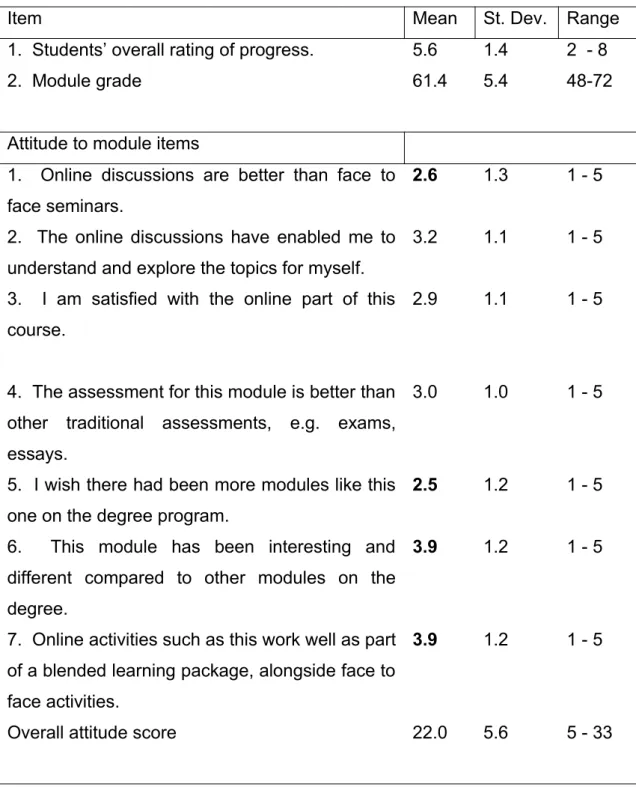
In reference to table 1, it can be seen that the students in this study generally rated their progress quite favorably given that the mean score for item 1 is 5.6, somewhat above the mid point of the scale. The average module grade was 61.4. The range and standard deviation achieved in respect to the module grade is typical of modules in Psychology at the institution concerned.
In reference to the attitude items in table 1, it can be seen that items one and five elicit an overall negative response. As indicated in the table, these ratings were significantly below the neutral mid-point of 3.0. Items six and seven result in overall means above the mid point, reflecting a generally positive response. Again, as indicated in the table, these scores were significantly different from the neutral mid-point of 3.0.
To check the internal consistency and reliability of the attitude items, Cronbach’s alpha coefficient was calculated across the seven items. The resulting value was 0.82, suggesting good internal consistency. There were no obvious discrepant items, in that the removal of any one item decreased the scale reliability rather than increased it.
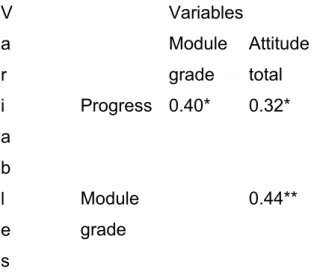
In order to look at the outcomes of the main predictions in this study, a series of correlations were carried out, using Pearson methodology. The resulting correlation coefficients and an indication of significance can be found in table 2 (note that only one side of the leading diagonal is shown to avoid repetition).
Table 2 about here.
Referring to table 2, it can be seen that there are significant positive correlations between all three variables. Thus higher grades on the module were associated with students ratings of their progress at the start of the module, and positive attitudes towards the module at the end.
using the methodology described by Braun and Clarke (2006). A summary is provided in table 3.
Table 3 about here.
Discussion.
This report describes an attempt to evaluate a module which used an online asynchronous discussion format. From table 1 it can be seen that the attitude ratings are somewhat mixed. Clearly from items 1 and 5, a majority would prefer face-to-face discussions rather than online discussions, and they did not want to see more of this kind of activity within their degrees. However, a significant minority were strongly supportive of the module approach. These students commented on their forms that the module allowed them to participate more fully than they might have done in a traditional seminar, and for others it gave flexibility of learning. The students were split down the middle in terms of this evaluation; whether they felt they had been able to engage effectively and whether they were satisfied. Finally, there was a majority endorsement that this module had added variety, and could work well as part of a blended learning package.
As expected, performance on the module was positively correlated with overall attitude to the module, and with students prior ratings of their progress.
From the thematic analysis, it was obvious that some students equate face-to-face teaching and a directive learning style with value for money. As Campbell (2004) points out, students with traditional expectations can have reservations about online techniques. In contrast, a key advantage for some students is the lack of perceived intimidation of this delivery technique, and students appreciate having time to research their contributions (both points in accordance with Baglione and Nastanski, 2007).
one novel feature at a time. For example one might use online asynchronous discussion groups linked to a fairly conventional essay type assessment.
In terms of student satisfaction, we have shown that some students used to a more traditional and tutor led teaching style, react badly to this kind of approach. However, a significant minority of students expressed strongly favorable attitudes, and favorable attitudes are associated with module success.
In an ideal world, students could be offered a variety of learning opportunities so that those preferring a more flexible online approach can have this, whilst others have a more traditional face-to-face experience. Where face-to-face is not an option, and where students crave flexibility, we predict that online asynchronous discussion will be highly successful.
References.
Arend, B. (2009). Encouraging Critical Thinking in Online Threaded Discussions. Journal of Educators Online, 6, 1-23.
Ashby, R. and Broughan, C. (2002). Factors Affecting Student’s Usage of Virtual Learning Environments. Psychology Learning and Teaching, 2, 140 – 141.
Campbell, C. (2004). Student Use of Information and Communication Technology: Does it Foster a Deep Approach to Learning? Psychology Learning and Teaching, 5 (1), 67 -69.
Baglione, S., Nastanski, M. (2007). The Superiority of Online Discussion. Quarterly Review of Distance Education [serial online], 8, 139-150.
Borrego, J. (2010). Roadmap For A Successful Transition To An Online Environment. Contemporary Issues in Education Research, 3, 59-66.
Cereijo, M. V. P. (2006). Attitude as Predictor of Success in Online Training. International Journal on E-Learning, 5, 623-639.
Chen, D., Wang, Y., & Hung, D. (2009). A Journey on Refining Rules for Online Discussion: Implications for the Design of Learning Management Systems. Journal of Interactive Learning Research, 20, 157-173.
De Wever, B., Van Keer, H., Schellens, T., & Valcke, M. (2009). Structuring Asynchronous Discussion Groups: the Impact of Role Assignment and Self-assessment on Students' Levels of Knowledge Construction Through Social Negotiation. Journal of Computer Assisted Learning, 25, 177-188.
Entwistle, N. J. (1997) The Approaches and Study Skills Inventory for Students (ASSIST) (Edinburgh, Centre for Research on Learning and Instruction, University of Edinburgh).
Guiller, J., Durndell, A., Ross, A., & Thomson, K. (2007). Issues Surrounding Use of Online Discussion Groups on Traditional Undergraduate Psychology Modules. Psychology Learning & Teaching, 6, 130-138.
Johnson, G., & Buck, G. (2007). Asynchronous and Synchronous Online Discussion: Real and Perceived Achievement Differences. Paper presented at the Annual Meeting of the American Educational Research Association (Chicago, IL, Apr 2007)
Meyer, K. (2007). Student Perceptions of Face-to-face and Online Discussions, the Advantage Goes to… Journal of Asynchronous Learning Networks, 11(4), 53-69.
Palmer, S., Holt, D., & Bray, S. (2008). Does the Discussion Help? The Impact of a Formally Assessed Online Discussion on Final Student Results. British Journal of Educational Technology, 39, 847-858.
Reid, W., Duvall, E., & Evans, P. (2007). Relationship Between Assessment Results and Approaches to Learning and Studying in Year Two Medical Students. Medical Education, 41(8), 754-762.
Schellens, T., Van Keer, H., Valcke, M., De Wever, B. (2007). Learning in Asynchronous Discussion Groups: A Multilevel Approach to Study the Influence of Student, Group and Task Characteristics. Behaviour & Information Technology, 26, 55-71.
Stocks, J. T. and Freddoline, P. P. (1998). Evaluation of a World Wide Web-based Graduate Social Work Research Methods Course. Computers in Human Services, 15, 51 – 69.
Vlachopoulos, P., & Cowan, J. (2010). Reconceptualising Moderation in Asynchronous Online Discussions Using Grounded Theory. Distance Education, 31, 23-36.
Wing Sum, C., & Khe Foon, H. (2010). Examining Facilitators' Habits of Mind in an Asynchronous Online Discussion Environment: A Two Cases Study. Australasian Journal of Educational Technology, 26, 123-132.
Williams, C. (2002). Learning On-line: a Review of Recent Literature in a Rapidly Expanding Field. Journal of Further and Higher Education, 26 (3), 263 – 272.
Table 1. – Mean, standard deviation and range of the main variables measured in the study (N=40)
Item Mean St. Dev. Range
1. Students’ overall rating of progress. 5.6 1.4 2 - 8
2. Module grade 61.4 5.4 48-72
Attitude to module items
1. Online discussions are better than face to face seminars.
2.6 1.3 1 - 5
2. The online discussions have enabled me to understand and explore the topics for myself.
3.2 1.1 1 - 5
3. I am satisfied with the online part of this course.
2.9 1.1 1 - 5
4. The assessment for this module is better than other traditional assessments, e.g. exams, essays.
3.0 1.0 1 - 5
5. I wish there had been more modules like this one on the degree program.
2.5 1.2 1 - 5
6. This module has been interesting and different compared to other modules on the degree.
3.9 1.2 1 - 5
7. Online activities such as this work well as part of a blended learning package, alongside face to face activities.
3.9 1.2 1 - 5
Overall attitude score 22.0 5.6 5 - 33
Table 2. Correlations between the key variables included in the study, with significance levels.
V a r i a b l e s
Variables Module grade
Attitude total Progress 0.40* 0.32*
Module grade
0.44**
Table 3. Themes and example comments from the thematic analysis. The main themes are shown in bold.
More Flexible
The online discussions made the module more flexible, I could fit this activity in with my other commitments.
The online nature of the course meant I didn’t have to come into university very often. I could do the course activities anytime
Less intimidating
The online discussions allowed me to contribute to an extent that I probably would not have done in face to face seminars.
I felt less self conscious than I would in a face to face seminar. Improves the nature of the learning.
I think the module has allowed me to think about the concepts in a deeper way than tends to be the case on other modules.
The way the module worked meant you could go away and think about what to say, and then come back later.
Untraditional, not value for money.
I would have preferred face to face seminars, I think this is what we are paying our fees for.
I would have preferred more moderation and feedback from the tutor. Novelty
The assessment was quite new and complicated, I would have preferred to have had something similar before to build up to it.
This module has added variety to the degree programme.