How to Combine Text-Mining Methods to Validate
Induced Verb-Object Relations?
Nicolas B´echet1, Jacques Chauch´e2, Violaine Prince2, and Mathieu Roche2,3 1 GREYC – UMR 6072, CNRS – Univ. de Caen Basse-Normandie,
14032 Caen Cedex – France 2
LIRMM – UMR 5506, CNRS – Univ. Montpellier 2, 34000 Montpellier – France
3
TETIS – Cirad, Irstea, AgroParisTech, 34093 Montpellier Cedex 5 – France
Abstract. This paper describes methods using Natural Language Processing ap-proaches to extract and validate induced syntactic relations (here restricted to the Verb-Object relation). These methods use a syntactic parser and a semantic close-ness measure to extract such relations. Then, their validation is based on two dif-ferent techniques: A Web Validation system on one part, then a Semantic-Vector-based approach, and finally different combinations of both techniques in order to rank induced Verb-Object relations. The Semantic Vector approach is a Roget-based method which computes a syntactic relation as a vector. Web Validation uses a search engine to determine the relevance of a syntactic relation according to its popularity. An experimental protocol is set up to judge automatically the relevance of the sorted induced relations. We finally apply our approach on a French corpus of news by using ROC Curves to evaluate the results.
Keywords:Text-Mining, Web-Mining, Syntactic Analysis
1.
Introduction
Semantic knowledge acquisition is an important issue in Natural Language Processing (NLP), since such knowledge can be used in information retrieval and/or classification tasks. Semantic knowledge deals with the existing relationships between words (seen as concept names). Some of these relationships are classically known to help building on-tologies, terminological sets and classifications, etc. Several other applications, such as machine aided translation or indexing, naturally rely on semantic knowledge.
Syntactic information, i.e., knowledge about sentence and phrase structures and there-fore, knowledge about structural relations between words in discourse, is quite useful to build semantic knowledge [10]. It helps dealing with compound concept names (e.g. country house) and could be used to create conceptual classes (gatherings of words). For instance, the wordshouse,hangar, andfarmhousecan be gathered in a set representing the buildingconcept. Since they also act as concept names, they can be hierarchically organized to build conceptual hiearchies. Note that the way these words are related in sentences (i.e. syntactic relations in the texts) can help to discover semantic relations.
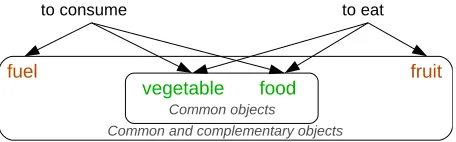
Fig. 1.Common and complementary objects of verbs ’to consume’ and ’to eat’
so calledoriginalrelations, directly extracted by a syntactic parser from a text [17], [28]. Second, relations can be considered asinducedsyntactic relations. The latter have been introduced in the Asium system [11]. The system underlying principle consists in gather-ing verbs object complements considered to becloseaccording to a quality measure. For example, in Figure 1, if the verbs ’to consume’ and ’to eat’ are seen asclose verbs, and if they are related to objects such as ’fuel, vegetable, meat, and fruit’ in different sentences, then the latter are gathered in the same set, induced by the similarity of their syntactic position in sentences. Note that this method is not specific to verb-object relations. It also applies to verb-subject relations, and on might gather verb subjects consideredclose. The similarity is conveyed by verbs and delivered to their possible complements. Other ap-proaches of the literature gather terms by using proximity measures such as cosine, Dice coefficient, or Jaccard [25,21]. These proximity measures are based on statistical infor-mation [3,27,25].
Our issue deals with the Asium system measure. The latter is the most adapted in buildinginduced syntactic relations[2,13]. This type of relations is introduced in the following paragraph. In addition, in a syntactic relation proximity context, the Asium measure produces results very close to usual measures like cosine, Mutual Information, or Dice coefficient, as discussed in section 2.2.
The way closeness is defined is already related to the existence of syntactic relations: In fact,consumeandeathaving two common objects (vegetableandmeatrepresent the seed of the ’food’ concept), retrieved by a parser as original relations, they are assumed to be ’close’. As a feedback, closeness is assumed for other possible objects for which occurrences in corpora have appeared. As a summary, letV1andV2be two verbs that are said to be close if they have at least a common object (closeness will be measured as a function of the common objects number). LetObjV1
1 ...ObjnV1andObj V2
1 ...ObjmV2 be the objects of the verbsV1andV2,ObjiV1(i∈[1, n]) is called a common object if∃j∈[1, m] whereObjV1
i =Obj V2
j . IfObj V1
k (resp.Obj V2
k ) is not a common object then theV2-Obj V1
k relation (resp.V1-ObjV2
k ) is called aninduced syntactic relationandObj V1
k is called a
be validated by a human expert who will assess their likelihood. A relation is said to be
likelyif it is accepted by the expert as a possible occurring sentence. If a relation is likely we can add the object to the seed concept (e.g. we can addfruitto the ’Food’ concept).
This work aims at determining the quality of induced syntactic relations to alleviate the expert task in validating extracted knowledge (e.g.to eat fuel: Unlikely vsto consume fruit: Likely). We propose to rank induced relations by using different approaches. A first approach considers a syntactic relation as a combination of different concepts represen-tations based on a thesaurus indexing words and their meanings with a small set of basic concepts. A second approach is deliberately Web-oriented, and uses statistical measures relying on the number of pages retrieved by a Web search engine. Both approaches are compared (with their pros and cons) and finally combined to get the best of both.
Next section describes the first validation techniques used to rank induced syntactic relations. Section 3 presents experimental results obtained by using a specific protocol. Protocol capacities and obtained results are then discussed. Conclusions are sketched in section 4.
2.
Thesaurus and Web Based Methods Determining Induced
Relations Likelihood
2.1. Contextual Semantic Vectors (SV)
We have chosen the Semantic Vectors Approach to represent words and sentences seman-tics. We first consider the representation of verbs and objects withContextual Semantic Vectors. Then we compute a relevance measure between the verb and the object vectors, to finally rank all the induced syntactic relations by likelihood.
The vector base is defined with the space in which words and sentences are repre-sented, i.e. the 873 concepts described in the Larousse French thesaurus [15], a French version of the Roget for English. The vector base is sort of a ’conceptual ontology’, whose items index all dictionary words. Actually, more than 60,000 words are indexed with this ontology and thus represented as vectors. Each term, and ontology concepts are included, is indexed by one or many items. For example, ’to consume’ is related to ’thin, nutrition, accomplishment, use, expense, and meal’. Thus, the resulting vector will be composed of active concepts as illustrated in Figure 2. The ontology concepts (vector base) are num-bered (from 1 to 873). The word vector gets a 1 value if the ontology concept contributes to its meaning, 0 otherwise. In Figure 2, the following French concepts are positives: “Fin” (i.e.Thin), “Nutrition” (i.e.Nutrition), “ ´Education” (i.e.Thin), “Accomplissement” (i.e.Accomplishment), “Usage” (i.e.Use), “D´epense” (i.e.Expense), “Repas” (i.e.Meal).
Fig. 2.The Semantic Vector representation of ’to consume’. Grey sections are filled with null values.
takes into account the syntactic role of a word or a phrase, in a sentence. SYGFRAN transforms a sentence in a constituents tree by identifying governing constituents from governed ones. Weights are defined as powers of 2 beginning with20for the leaf of the most dependent constituent to2p,prepresenting the rank of the highest governing com-ponent in the parsing tree (i.e. verb and subject are highest nodes). Then, the contextual Semantic Vector representation of a term extracted from a sentence includes contextual information by weighting these active concepts. An example of a contextual Semantic Vector computation for the verb ’to consume’, in a sentence where ’to consume meat’ occurs, is given in Figure 3. More details on the weight computation are given in [19]. It is obvious that theNutritionandMealcomponents, semantically related to the wordmeat (they belong to its class) are quite enhanced whenmeatoccurs withto consume.
Fig. 3. The contextual Semantic Vector representation of ’to consume’ in a sentence where ’to consume’ and ’meat’ co-occur
The purpose of this article is to determine if an induced Verb-Object relation is likely (i.e. if the association of a complementary object and a verb is semantically rele-vant). To do so, one has to rely on the largest contextualized representation of a verb. In other words, what are the most ’popular’ concepts which are enhanced for a given verb, in the sentences where it is used? Therefore, we consider every sentence (of a given cor-pus) where a term appears and build all corresponding contextual Semantic Vectors. The global Contextual semantic representation of this term is defined as the centroid of all the contextual Semantic Vectors representing this term in the corpus sentences. An example of the global representation for the verb ’to consume’ is given in Figure 4 (computed in the corpus used in the experiments described in next section).
Fig. 4.Thecontextualglobal representation of ’to consume’ in the corpus
and two options were available: Either the word itself or the whole sentence that contains it. Therefore two representations of an object have been used: TheNoun itself and the Noun-Phraseor sentence which acts as an Object in the dependency relation determined by the parser, as well as two representations of the verb: TheVerbitself and the Verb-Phrase. This paper presents the couple which performs the best in experiments:Verband Noun-Phrase.
Measuring Semantic Relevance by Ranking Vectors Similarity Measuring the semantic relevance of an object to a verb in an induced syntactic relation, relies on a similarity assessment between an object vector, and the contextual global representation of the verb. Thecosinemeasure has been the first to be used in Information Retrieval, and it is since regularly applied to determine vectors similarity. Its values rank between 0 and 1. When cosine values get close to 1, then vector angles tend to get very small. An angle between two vectors indicates their respective directions. The smaller the angle, the closer vectors are, thus emphasizing their similarity. Cosine is computed as the scalar product of both vectors divided by the norms product of both vectors.
Other similarity measures can be used such as theMatching Measure[19]. Let us con-sider two vectorsAandB. Their components values are sorted, from the most activated to the less activated (i.e.the most activated concepts are those having the most important weight, for instance concepts Nutrition and Accomplishment in Figure 4). Then, to have a reliable and discriminating comparison between two vectors, we considered that only the most activated concepts need to be kept. In this way, only the873×1/s first vec-tors components are used in order to compute the proximity between vecvec-tors, withsa scalar empirically chosen, and 873 the number of concepts in the Larousse thesaurus. Re-spective resulting vectors are notedAtrandBtr. If these new vectors have no common components, the matching measure is1. Otherwise, we need to compute the rank and the intensity differences.
The rank differenceEi,ρ(i)is:
Ei,ρ(i)=
(i−ρ(i))2
N b2+ (1 + i 2)
(1)
Whereiis the rank ofCta component ofAtrandρ(i)the rank of the same component inBtr, whereN bis the number of values kept.
Ii,ρ(i)=
ai−bρ(i)
N b2+ (1+i 2 )
(2)
Whereaiis the intensity ofirank component fromAtrandbρ(i)the intensity of the same component inBtr(its rank isρ(i)).
Remark: Two remarks have to be made, in order to explain the rationale of these two formulas.
First bothEi,ρ(i)andIi,ρ(i)are not symmetrical, thus leading to a matching measure that does not act as a distanceper se(later on, for other needs, another formula, called ’concor-dance distance’ has been defined by A. Labadi´e by transforming both intensity and rank differences into symmetrical elements). Second, in the rank difference, if theirank com-ponent is leading (i.e close to1) the value of the rank difference is emphasized whereas it is bit less important in the intensity difference. Intensity is an interesting measure only if ranksiandρ(i)are close, and if the rank of the leading component is a small figure (good ranks).This explains why, in the first formula,iis directly divided by2whereas it is1 +iin the second. Wheniis not leading (i.e.imuch bigger than1), then the difference betweeniand1 +itends to fade, and the biggeriis, the more1 +2i gets close to 1+i2 . It means that the measure will emphasize the differences in rank and intensity mostly on the best ranks and will neglect the lesser ones.
With both differences, thematching measureP is computed as:
P(Atr,Btr) = (
PN b−1
i=0
1 1+Ei,ρ(i)∗Ii,ρ(i)
N b )
2 (3)
AsPconcentrates on components intensities and ranks, the overall components direction is introduced by mixingPwith the angular distance notedδ(A,B)for vectorsAandB. We note∆(Atr,Btr)the resulting measure:
∆(Atr,Btr) = P(Atr,Btr)∗δ(A,B)
w∗P(Atr,Btr) + (1−w)∗δ(A,B)
(4)
Wherewis a coefficient used to give more (or less) weight toP. To compute a distance, symmetry is needed. Therefore, thematching measureD(A,B)is define by the follow-ing formula:
D(A,B) = ∆(Atr,Btr) +∆(Btr,Atr)
2 (5)
In order to compute the scalar combination of the validation approaches, a final compu-tation is applied to the matching measure. Thus, the resulting score between two close Semantic Vectors will be close to 1.
D(A,B)F inal= 1−D(A,B) (6)
2.2. The Web Validation Approach (WV)
(in a lexical base of 60,000 vectors), a syntactic parser computing dependency relations, a Semantic Vector calculus procedure computing sentence vectors and, afterwards, contex-tualizing words vectors. Moreover, contextualized vectors are fed by sentences extracted from corpora. So the question was: Could we use NLP knowledge combined with statisti-cal information in order to validate induced relations (i.e. constructed relations not present in texts)? Therefore, we tried to build a Web based method to measure the semantic rele-vance of an object to a verb in an induced syntactic relation.Semantic Relevance is here assumed to be approached by Web Popularity. This type of assumption already exists in several works that are briefly exposed hereafter.
Related Work. Web Validation has been more or less initiated by Turney [24], in a com-pletely different context, but which has in common with ours that it tries to fathom a ’similarity’ or ’compatibility’ between items. The algorithm PMI-IR (Pointwise Mutual Information and Information Retrieval), described in [24], queries the Web via the Al-taVista search engine to determine appropriate synonyms to a given query. For a given word, notedword, PMI-IR chooses a synonym among a given list. These selected terms, notedchoicei,i∈[1, n], correspond to the TOEFL questions. The aim is to compute the
choicei synonym that gives the best score. To obtain scores, PMI-IR uses several mea-sures based on the proportion of documents where both terms i.e, ’word’ and ’choicei’, are present. Turney’s formula is given below (7): It is one of the basic measures used in [24]. It is inspired from Mutual Information[6].
score(choicei) =
nb(word N EAR choicei)
nb(choicei)
(7)
–nb(x)computes the number of documents containing the wordx,
–N EAR(used in the ’advanced research’ field of AltaVista) is an operator indicating if two words are present in a10words wide window.
With formula (7), the proportion of documents containing bothwordandchoicei(within a10words window) is calculated, and compared with the number of documents contain-ing the wordchoicei. The higher this proportion is, the morewordandchoiceiare seen as synonyms. More sophisticated formulas have also been applied: They take into account the existence of negation in the10words windows. For instance, the wordsbigandsmall are not synonyms if, in a given window, a negation associated to one of these two words has been detected. Let us note that antonymy, the lexical function tyingbigtosmall, is not considered here.
Other papers in the literature propose to use the Web. For instance, in [7], the authors de-tail a measure evaluating a similarity between words and phrases by using, among others, the Google search engine.
Our Approach. We propose to query the Web with a syntactic relation represented by a string (for instance the French relation ’consommer un fruit’, meaning ’to consume a fruit’). The underlying assumption is the following:If this query happens to be present, and is frequent, then it is a measure of its consistency, and therefore, its likelihood.
The query outcome is given by thenb(x)function which is the number of pages pro-vided by the search engine Yahoo by using an API4. In French,the language we use in our experiments, a verb and its object are usually separated by an article. So we consider five usual French articlesun, une, (i.e. ’a’), le, la, l’ (i.e. ’the’)to compose the string rep-resenting our query. Then,nb(v, o)is the number of pages provided by the search engine for the Verb-Object syntactic relation (v,o) wherevandoare respectively the Verb and the Object. The following formula presents thenb(v, o)computation:
nb(v, o) =nb(vuno) +nb(vuneo) +nb(vleo) +nb(vlao) +nb(vl’o)
nb(vuno)is the value returned by the search engine Yahoo for the string ’vuno’. Then, a statistic measure is applied to compute the semantic relevance of the objectoand the verbvfrom the list of induced Verb-Object relations (among which we have ’to consume a fruit’). Four statistical measures have been examined to assess the quality of a given verb-Object pair. The first one is thesumdefined by the nb(v, o)computation. It is the most obvious one, and highlights the characters string occurrence frequency. The three others are presented next.
Mutual Information. One of the most commonly used measures to compute a sort of relationship between words composing what is called aco-occurrenceof two wordsx
andy, is Church’s Mutual Information (MI) [6]. The formula is the following:
M I(x, y) = log2 P(x, y)
P(x)P(y) (8)
Such a measure tends to extract rare and specific co-occurrences according to [9,23]. We suggest to apply this measure in a different context, to evaluate the quality of extracted Verb-Object relations. Let us notice that, in formula (8), thelog2function is not manda-tory, since it is strictly ascending. Thus, the order of Verb-Object relations likelihood provided by the measure is not impacted by the application oflog2. In this framework, theP(v, o)measure is the probability ofobeing the object ofvin the given language. For instance, in a sentence such asThe congressman talks to the consul’,v is to talk andoisconsul(in French, “le d´eput´e parle au consul”)5. When simplified by making an empirical approximation based on maximum likelihood estimation, formula (8) could be written as follows, wherenbdesignates the number of answers returned by the search engine:
M I(v, o) = nb(v, o)
nb(v)nb(o) (9)
4
http://api.search.yahoo.com
5
Cubic Mutual Information. The Cubic Mutual Information is an empirical measure based onM I, that enhances the impact of frequent co-occurrences, a feature absent from the originalM I [8]. This measure is defined by formula (10). Vivaldiet al.have estimated that the Cubic MI was the best behaving measure [26] in terminology extraction domain. We also suggest to apply this measure in the evaluation of extracted Verb-Object relations quality.
M I3(v, o) = nb(v, o)
3
nb(v)nb(o) (10)
Of course other formulas exist but we have preferred to focus on M I3, because of its good behavior. We can cite for instance the MI correction factor of [18].
Dice’s Coefficient. An interesting quality measure is Dice’s coefficient [22]. It is defined by the following formula (11).
D(x, y) = 2×P(x, y)
P(x) +P(y) (11)
Formula (11) leads directly to formula (12).6
Dice(v, o) = 2×nb(v, o)
nb(v) +nb(o) (12)
After computing the score of all Verbs and Objects of induced Verb-Object relations, the rank of all induced Verb-Object relations is obtained.
Note: The Web Validation approach was experimented on 50,000 induced Verb-Object relations (section 3). It needed 350,000 queries when usingM I3(1 for the verb, 1 for the object and 5 for an induced Verb-Object relation: 50,000×7 = 350,000). Thus, the Web Validation approach is time-costly.
2.3. Combining Both Approaches
Both Contextual Semantic Vectors (SV) and Web Validation (WV) have pros and cons. SV are precise, linguistically grounded, but rely on important resources, and could be biased by the nature of the corpora at hand. On the other hand, WV is easy, available, browses a large amount of data, but could be criticized in its basic principles: Popularity is not necessarily a proof of quality, and Web pages are quite speckled with wrong sen-tences and poor style.
In order to take into account both types of knowledge, we searched for combinations that would give the best results. We tried two different combinations and selected the best fitting one.
6
Combination 1: A Combined System with a Variant Scalar. In the first combination, a scalark ∈ [0,1]has been introduced to reinforce one approach over the other when it behaves better. The results obtained with SV and WV methods are first normalized. Next, results of both SV and WV are combined according to the following formula for a Verb-Object relationc:
combine scorec=k×SV + (1−k)×W V (13)
Combination 2: An Adaptive Combined System. With the second combination, the first step consists in ranking Verb-Object relations with SV (and cosine as similarity mea-sure). Then, thenfirst Verb-Object relations (obtained with SV) are ranked with the WV. This second process (WV applied on the ranked relations with SV) enables to accurately sort these n Verb-Object relations. Thus, with this adaptive combination, SV offers a global selection using semantic resources, and WV sorts out the most popular among the most semantically accurate relations. Let us note that we also experiment the opposite cascade, first WV and then SV but this kind of approach does not appear relevant.
3.
Experiments
3.1. Experimental Protocol
Experiments used two corpora. A corpus from Yahoo’s site7: 8,948 news items (16.5 MB), used as a test corpus, and called corpusT. The second one, called corpusV, comes from the French newspaperLe Monde, and plays the role of the validation corpus. It con-tains more than 60,000 news items (123 MB). It is needed to determine whether Induced Syntactic Relations (ISR) of corpusT are likely (We use here the general term ’syntac-tic relation’, although experiments ran and were designed for Verb-Object, assuming that other relations such as Subject-verb will behave as such, as discussed in previous sec-tions). Corpora T andV address the same field (newspaper with journalistic writing). The goal is to automatically evaluate the Induced Syntactic Relations quality from corpus T by checking if they occur in corpus V. If an ISR of corpusT appears in corpusV, we consider it aspositive, else it isnegative. The different approaches presented in section 2 (Semantic Vectors,Web Validation, and theCombined Systems) are used to rank induced syntactic relations. ROC curves measure the quality of the obtained ranking.
Initially ROC curves (Receiver Operating Characteristic), detailed in [12], come from the field of signal processing. ROC curves are often used in medicine to evaluate the va-lidity of diagnosis tests. ROC curves show in X-coordinates the rate of false positives (in our case, rate of unlikely induced syntactic relations) and in Y-coordinates the rate of true positives (rate of likely induced syntactic relations). The surface under the ROC curve (AUC - Area Under the Curve), can be seen as the effectiveness of a measurement of in-terest. The criterion related to the surface under the curve is equivalent to the statistical test of Wilcoxon-Mann-Whitney (see [29]).
7
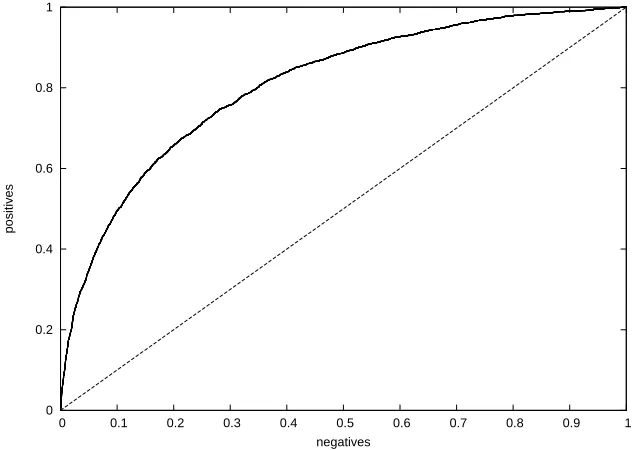
In the case of the ISR ranking with SV and WV measurements, a perfect ROC curve corresponds to obtaining all likely ISR at the beginning of the list and all unlikely syntac-tic relations at the end of the list. This situation corresponds toAU C = 1. The diagonal corresponds to the performance of a random system, progress of the rate of true positives being accompanied by an equivalent degradation of the rate of false positives. This situ-ation corresponds toAU C = 0.5. The Figure 5 is an instance of a ROC Curve with in
0 0.2 0.4 0.6 0.8 1
0 0.1 0.2 0.3 0.4 0.5 0.6 0.7 0.8 0.9 1
positives
negatives
Fig. 5.Example of ROC Curve
diagonal a random system distribution. If the ISR are ranked by decreasing interest (i.e. all likely ISR are behind the unlikely ones in the ordered list) thenAU C = 0. An effec-tive measurement of interest to rank ISR consists in obtaining the highest possible AUC. This is strictly equivalent to minimizing the sum of the positive examples ranks.
The advantage of ROC curves comes from their resistance to imbalance (for example, an imbalance in number of positive and negative examples). The interest of this measure is developed in [20].
We should notice that unlikely relations (a negative case in the ROC curve application) can get a false negative value. Indeed, according to this evaluation protocol, an unfound ISR in the corpusV is an irrelevant one.
3.2. Results
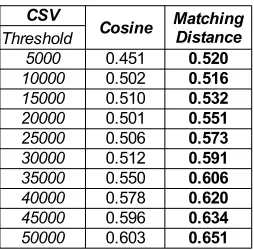
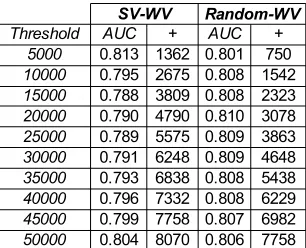
Table 1.AUC obtained with the Contextual Semantic Vectors approach (CSV)
both corpora) at the top of the list. Results are presented with different thresholds. Table 1 presents AUC with different thresholds using the SV with the Verb and Noun Phrase pair. This threshold value is the number of induced syntactic relations we take into account to calculate the AUC. For example, for a threshold at10,000, we compute the AUC only on the10,000first ranked relations. For all measures computed, results obtained with SV are poor, very close to a random distribution (AUC=0.5) for the first thresholds. This unsatis-factory results could be explained by the nature of the SV. Actually, Semantic Vectors are composed of 873 general concepts which are not always adapted to measure the quality of induced syntactic relations.
Even if the experiments have been conducted on journalistic documents, which deal with general topics (e.g. politics, sports, or sciences), some used terms are very specific. So the linguistic knowledge given by Semantic Vectors are not enough specialized. In our context, all available semantic resources have the same limit, they are too general. So we plan to investigate this point in order to enrich semantic resources such as Larousse French thesaurus to improve our SV approach.
However this approach performs better for important thresholds (0.60for a threshold at 50,000). In our experiments, we use two similarity measures: cosine and matching measure (see Section 2.1). We select matching measure that gives best results between both similarity measures (see Table 1).
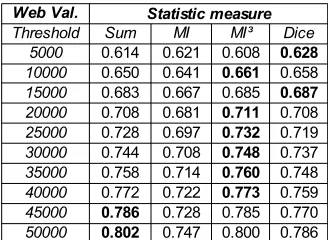
Table 2.AUC obtained with the Web Validation approach
Table 3.AUC obtained with the first combined system
Evaluation of the Hybrid Approaches. In order to improve the first induced syntac-tic relations ranking (i.e. first thresholds), we computed combinations of both precedent approaches: SV and WV. The AUC obtained by applying the combination detailed in sec-tion 2.3 are given in Table 3. Since parameterkis variable, we tested different values of
k ∈ {0.1...0.9}with an increment of1/10. We also report thek = 0results (WV) and
k= 1results (SV). Results are clearly better for small thresholds with akvalue∈ {2,5}. For instance with a threshold at5,000, we improve the WV scores by0.05points with
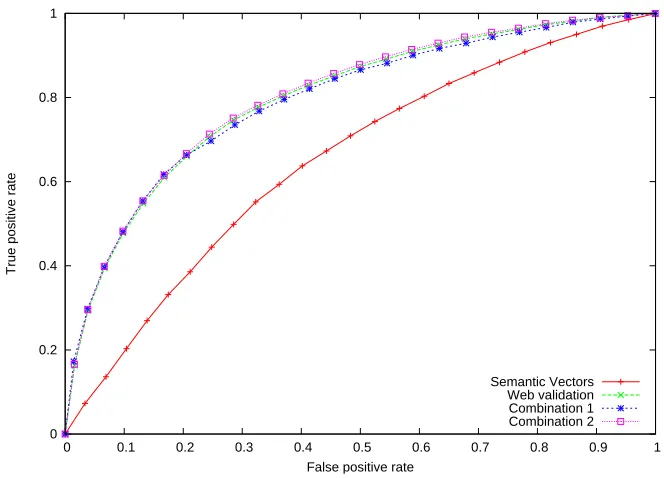
k= 4. However, these improvements are not sufficient since AUCs are still poor. The second combination presented in section 2.3 was then applied. For example, for a threshold at10,000, all syntactic relations are first sorted with the SV approach and then the ordered 10,000first syntactic relations are sorted using the WV method. This ap-proach improves all previous obtained AUC (Table 4). For instance with a threshold at
5,000, the AUC of the second combination is0.813vs.0.643for the first combination and 0.608 for the WV. Thus, the second combination seems to be the better approach to rank induced syntactic relations.
0 0.2 0.4 0.6 0.8 1
0 0.1 0.2 0.3 0.4 0.5 0.6 0.7 0.8 0.9 1
True positive rate
False positive rate
Semantic Vectors Web validation Combination 1 Combination 2
Fig. 6.ROC Curves for a threshold of 5,000
0 0.2 0.4 0.6 0.8 1
0 0.1 0.2 0.3 0.4 0.5 0.6 0.7 0.8 0.9 1
True positive rate
False positive rate
Semantic Vectors Web validation Combination 1 Combination 2
Table 4.AUC obtained with the second combined system compared to others
their ROC Curves, we can conclude that the WV is more adapted for high or medium thresholds (for instance in a corpus expansion task) and the second combination is more adapted with small thresholds (for instance in a conceptual classes building). Results ob-tained with the second combination seem to be the most promising. They are based on a first selection determined by the SV approach, which, as previously said, relies on lin-guistic information to ground semantic relevance of an object to a verb. However, AUC obtained with the SV is very close to a random distribution. From a sole statistical point of view, linguistic information does not introduce a noticeable change. We wanted to inves-tigate this ’negative result’ which, epistemologically, is quite problematic. We produced a random rank of the induced syntactic relations. Then we sorted the first relation with WV. We called this approach the ’random’ second combination. Table 5 compares the AUCs obtained with the ’classical’ second combination and the ’random’ second combination. AUCs for both approaches are similar.
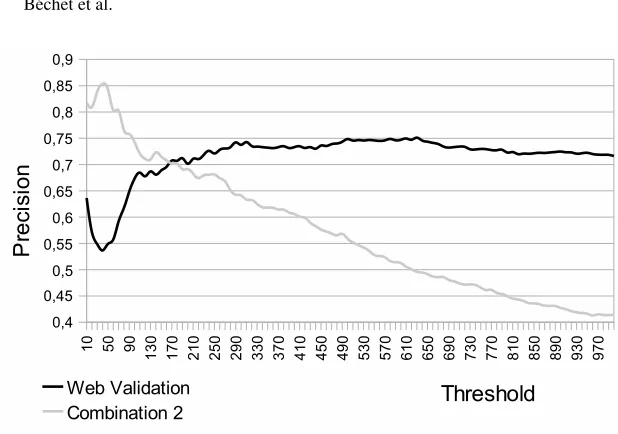
Fig. 8.Lift curve comparing Web Validation and Combination 2 approaches
However, the difference is in the number of positive relations (i.e. the number of in-duced syntactic relations found in the Validation Corpus) obtained with both approaches. The ’classical’ second combination approach gets almost twice the number of relations than obtained by the ’random’ one, while maintaining the same ratio of true positives over false positives. This means that the linguistic information is truly helpful since it notice-ably gathers more ’good’ relations. This effect tends to diminish when augmenting the threshold.
3.3. Discussion
Quality. The results given by the ROC curves are a relevant indication measuring the quality of the presented approaches. But this evaluation criterion does not give indications about precision. The likelihood of the first induced syntactic relations is an important feature for building of conceptual classes. Actually we can considerably reduce the expert task by giving an expert the first correctly ranked induced syntactic relations. Thus we propose to compute precision of both WV and second combination approaches scores for the first1,000induced syntactic relations. We define precision as the number of positive syntactic relations divided by the total number of syntactic relations.
Table 6.Comparing rank of WV and Combination 2 position
When focusing on the first sorted induced syntactic relations with the second combi-nation, the next step was to determine if the first syntactic relations sorted by it are the same relations found by WV. Table 6 shows an extract of the first 500 relations sorted by the second combination, and the respective rank with the WV. Results show that the first ranked induced syntactic relations with the second combination are not Web ’popu-lar’ relations. Actually, the syntactic relations found with the second combination are not frequently used in the Web (i.e. because they are not at the top of the list returned by the WV approach). Two possible explanations: Either these relations are too ’literary’, and the Web mostly deals with everyday language, or they are effectively new information, and corpora may contain knowledge nuggets.
The Minimum Size of the Validation Corpus in the Experimental Protocol. Quality has been discussed in the previous paragraph. Here, the experimental protocol needs to be considered. A second corpus (namedV) is used to validate relevant induced syntactic relations. A question arises: Does the Validation Corpus size impact quality? In other words, we needed to find the required minimum size of corpusV to produce a correct AUC.A Correct AUCis defined as the AUC performed with the entire corpusV. Thus, the Validation corpus is split innsub-sections. Then a validation of the induced syntactic relations of the Test corpus is performed with all sub-sections of the Validation corpus, by computing a cross validation. In other terms, forn= 1000, we make1000experiments to compute the average AUC.n= 1000is similar to a corpus size of50,000/1000, that is,50average articles in the Validation corpus. Whenn = 1, then the entire Validation corpus is considered.
Figure 9 presents theAU Cobtained forn∈ {1; 10,000}. Here, only results obtained with the WV approach (for the 4 statistical measures) are presented, with a threshold of
Fig. 9.AUC obtained for different statistical measures depending of the size of the corpus V (50,000/n)
Table 7 presents the average of the number of covered relations according to the size of the Validation corpus (size of the corpus is the size of the original Validation corpus divided by thenparameter). With anvalue lower than4,000, AUC is very similar to scores obtained with the original Validation corpus. Thus, in the Table 7, we see that only
5syntactic relations covered are required to apply our automatic evaluation protocol. The Figure 10 presents the AUC obtained with the statistical measures used in WV approach. We confirm that forn∈ {1; 4,000}, AUC are similar, and fornscore upper than4,000
AUC is decreased. We also show in this table that whatever thenvalue, the rank defined by the statistical measure is respected.
4.
Conclusion
We present in this paper different approaches in order to reduce the human involvement in producing and validating new knowledge, either to build conceptual classes (domain on-tologies, terminology networks) or to produce indexes, and discover knowledge in texts. We focus on the automatic validation of syntactic relations called induced relations, which are new combinations of text segments. These induced relations are not originally present in a corpus. An induced relation is built by assigning the object of a verb, and both object and verb are extracted from a corpus, to another verb, which is determined as semantically close.This assignment is seen as an assumption, and the likelihood of such a combination is questioned. Since several of these relations might appear as unlikely for many possible reasons, this paper describes different computational approaches to rank them.
Table 7. Number of syntactic relations found according to the size of corpus V (50,000/n)
to rely on linguistic information (lexical semantics, syntactic dependency determination in sentences, sentence semantics seen as a function of word semantics modified by syn-tactic roles). It represents words, and more generally, terms, as combinations of concepts defined in Roget-like thesaurus. It proposes to compute the semantics of any portion of texts with vector operations, and provides a contextual word vector, representing the word ’semantics’ when the latter is waded in a given corpus acting as its context. The semantic closeness between a verb and a possible object (in an induced relation) is calculated with measures such as cosine.
The second approach is a WV approach which consists in querying the Web with in-duced syntactic relations. Statistical measures such asSum, theMutual Information, the Cubic Mutual Information, and theDice’s Coefficientare used to sort results given by a search engine (Yahoo API).
Both approaches rely on different claims: SV try to stick to linguistic consistency, WV relies on popularity, and frequency in a large amount of produced discourse as a clue for validity. Each one has its weaknesses and strengths. Therefore, we tried to combine both approaches within two possible procedures: One adding both results with a parameter af-fecting each method, and the other, using the first (SV) as a prime filter, and the second (WV) as a ranking function on a filtered list from which linguistically aberrant associa-tions have been rejected.
To evaluate such methods, we chose to define an automatic protocol by opposition to a human evaluation. Actually the important number of induced syntactic relations results in too many potential tests to be manually performed. The proposed protocol considers an in-duced syntactic relation aslikelyif this relation exists in another corpus of the same field. We show in section 3.3 that a small corpus of an average of only five syntactic relations found can be used. A ROC Curves-based score, with the AUC, is computed to evaluate the different ranking methods quality. Various thresholds have been experimented in order to propose our validation procedure for different tasks. Actually for the ontology acquisition improvement task by using new knowledge (i.e. the induced syntactic relations), only a quality ranking of the first relations is required.
With small thresholds (i.e. a small number of induced syntactic relations) the second combined approach is the most accurate one. Otherwise, the best AUC are obtained with the WV method with theM I3andSumstatistical measures.
We consider evaluating the quality of this experimental protocol by comparing the human evaluation of induced syntactic relations quality results with the protocol results, as a future work. One of the possible future directions would be to let humans focus on those relations suggested by the combined approach (SV + WV in second combination) but rejected by the ROC AUC.
As an improving process, we might also use the methods presented in this paper to enhance the ExpLSA approach [1]. ExpLSA enables context expansion to improve docu-ment classification tasks. This approach consists in making expansion by using syntactic Verb-Object relations extracted from a corpus. The goal should be to use induced relations in expansion process.
References
1. B´echet, N., Roche, M., Chauch´e, J.: How the ExpLSA approach impacts the document classi-fication tasks. In: Proceedings of IEEE International Conference on Digital Information Man-agement (ICDIM). pp. 241–246 (2008)
2. B´echet, N., Roche, M., Chauch´e, J.: Towards the selection of induced syntactic relations. In: Proceedings of ECIR, LNCS, Springer. pp. 786–790 (2009)
3. Bourigault, D.: UPERY : un outil d’analyse distributionnelle ´etendue pour la construction d’ontologies `a partir de corpus. In: Actes de TALN, Nancy. pp. 75–84 (2002)
4. Bronzi, M., Guo, Z., Mesquita, F., Barbosa, D., Merialdo, P.: Automatic evaluation of relation extraction systems on large-scale. In: Proceedings of the Joint Workshop on Automatic Knowl-edge Base Construction and Web-scale KnowlKnowl-edge Extraction. pp. 19–24. AKBC-WEKEX ’12 (2012)
5. Chauch´e, J.: Un outil multidimensionnel de l’analyse du discours. In: Proceedings of Coling, Standford University, California. pp. 11–15 (1984)
6. Church, K.W., Hanks, P.: Word association norms, mutual information, and lexicography. In: Proceedings of the 27th Annual Conference of the Association of Computational Linguistic. vol. 16, pp. 76–83 (1989)
7. Cilibrasi, R., Vitanyi, P.M.B.: The google similarity distance. IEEE Transactions on Knowledge and Data Engineering 19, 370 (2007),http://www.citebase.org/abstract?id= oai:arXiv.org:cs/0412098
8. Daille, B.: Approche mixte pour l’extraction automatique de terminologie : statistiques lexi-cales et filtres linguistiques. Ph.D. thesis, Univ. Paris 7 (1994)
9. Daille, B.: Study and Implementation of Combined Techniques for Automatic Extraction of Terminology. In: P. Resnik and J. Klavans (eds). The Balancing Act: Combining Symbolic and Statistical Approaches to Language, MIT Press. pp. 49–66 (1996)
10. Fabre, C., Bourigault, D.: Extraction de relations s´emantiques entre noms et verbes au-del`a des liens morphologiques. In: TALN’06, 10-13 avril 2006. pp. 121–129 (2006)
11. Faure, D.: Conception de m´ethode d’apprentissage symbolique et automatique pour l’acquisition de cadres de sous-cat´egorisation de verbes et de connaissances s´emantiques `a partir de textes : le syst`eme ASIUM. Ph.D. thesis, Universit´e Paris-Sud (20 D´ecembre 2000) 12. Ferri, C., Flach, P., Hernandez-Orallo, J.: Learning decision trees using the area under the ROC
curve. In: Proceedings of ICML’02. pp. 139–146 (2002)
14. Keller, F., Lapata, M.: Using the web to obtain frequencies for unseen bigrams. Comput. Linguist. 29(3), 459–484 (Sep 2003), http://dx.doi.org/10.1162/ 089120103322711604
15. Larousse, T.: Th´esaurus Larousse - des id´ees aux mots, des mots aux id´ees. Ed.Larousse, Paris (1992)
16. L’Homme, M.C.: Le statut du verbe en langue de sp´ecialit´e et sa description lexicographique. In: Cahiers de Lexicologie 73. pp. 61–84 (1998)
17. Lin, D.: Extracting collocations from text corpora. In: In First Workshop on Computational Terminology. pp. 57–63 (1998)
18. Pantel, P., Ravichandran, D.: Automatically labeling semantic classes. In: HLT-NAACL. pp. 321–328 (2004)
19. Prince, V., Chauch´e, J.: Building a Bilingual Representation of the Roget Thesaurus for French to English Machine Translation. In: LREC’08: Sixth International Language Resources and Evaluation Conference. pp. 438–446 (2008)
20. Roche, M., Kodratoff, Y.: Pruning terminology extracted from a specialized corpus for cv on-tology acquisition. In: OTM Workshops (2). pp. 1107–1116 (2006)
21. Salton, G., Wong, A., Yang, C.S.: A vector space model for automatic indexing. Commun. ACM 18(11), 613–620 (1975)
22. Smadja, F., McKeown, K.R., Hatzivassiloglou, V.: Translating collocations for bilingual lexi-cons: A statistical approach. Computational Linguistics 22(1), 1–38 (1996)
23. Thanopoulos, A., Fakotakis, N., Kokkianakis, G.: Comparative Evaluation of Collocation Ex-traction Metrics. In: Proceedings of LREC’02. vol. 2, pp. 620–625 (2002)
24. Turney, P.: Mining the Web for synonyms: PMI–IR versus LSA on TOEFL. In: Proceedings of ECML’01, Lecture Notes in Computer Science. pp. 491–502 (2001)
25. Turney, P.D., Pantel, P.: From frequency to meaning: Vector space models of semantics. J. Artif. Intell. Res. (JAIR) 37, 141–188 (2010)
26. Vivaldi, J., M`arquez, L., Rodr´ıguez, H.: Improving term extraction by system combination using boosting. Proc of ECML, LNCS, 2167, 515–526 (2001)
27. Weeds, J., Weir, D., McCarthy, D.: Characterising measures of lexical distributional similarity. In: IN COLING-04. pp. 1015–1021 (2004)
28. Wermter, J., Hahn, U.: Collocation extraction based on modifiability statistics. In: COLING ’04. p. 980. Association for Computational Linguistics, Morristown, NJ, USA (2004) 29. Yan, L., Dodier, R., Mozer, M., Wolniewicz, R.: Optimizing classifier performance via an
ap-proximation to the Wilcoxon-Mann-Whitney statistic. In: Proceedings of ICML’03. pp. 848– 855 (2003)
Nicolas B´echetis Associate Professor (Maˆıtre de Conf´erences) at Universit´e de Bretagne-Sud, France. He obtained his PhD in Computer Sciences from Universit´e Montpellier 2 in 2009. His main research domains are Text Mining and NLP, and he leads the Text topic of the EXPRESSION team at IRISA laboratory. He is involved in many academic and industrial projects and has supervised many students in master degree. He published more than 20 papers in international conferences and journals.
University of Montpellier 2 in 1992. He developed the Sygmart system used for the french syntaxico-semantic analyzer Sygfran. He published many papers about this in numerous international conferences of which Coling.
Violaine Princeis full Professor at Montpellier 2 University in Computer Science since 2000. Her main research domain is Natural Language Processing. She had led the NLP research team at LIRMM, the Computer Science Lab in Montpellier for 10 years, as well as the CS Reasearch Department (2010-2012), and the CS Teaching Department (2003-2006). She obtained her PhD in 1986 from University Denis Diderot (Paris 7), then her HDR in 1992 from University Paris 11 (Orsay). She moved from Paris 11 to Ecole Normale de Cachan as an associate professor, then to Paris 8 as a full professor where she co-founded a CS lab and Distant Learning curricula in CS, and was elected president of the University National Council for Computer Science. She had supervised 24 PhD Students, participated to European and international research projects, and led a few national academic and industrial projects. Violaine Prince published and edited several books, counts more than 100 papers in major international conferences and journals, and also chaired several conferences.
Mathieu Rocheis CIRAD Research Scientist (PhD, HDR) at TETIS lab. Between 2005 and 2013, he has been Associate Professor (Maˆıtre de Conf´erences) at the University Montpellier 2, France. Mathieu Roche obtained a PhD in Computer Science from Univer-sity Paris XI (Orsay) in 2004. He defended his HDR (Habilitation `a Diriger des Recherches - Accreditation to supervise research) in 2011. Mathieu Roche led several academic and industrial projects in text-mining. He has supervised 7 PhD students. Mathieu Roche pub-lished more than 120 papers in major international conferences and journals.