Available online on 15.09.2018 at http://jddtonline.info
Journal of Drug Delivery and Therapeutics
Open Access to Pharmaceutical and Medical Research© 2011-18, publisher and licensee JDDT, This is an Open Access article which permits unrestricted non-commercial use, provided the original work is properly cited
Open
Access
Review Article
A REVIEW ON FAST DISSOLVING TABLET
R.D. Rahane
1*, Dr. Punit R. Rachh
21
Department of Pharmaceutics, Shri. Vivekanand Nursing Home Trust’s College of B. Pharmacy, Shrishivajinagar, Rahuri Factory, Dist-Ahmednagar, M.H., India
2 Department of Pharmaceutical Sciences, Bhagwant University, Ajmer, Rajasthan, India
ABSTRACT
The convenience of administration and improved patient compliance are important in the design of oral drug delivery system which remains the preferred route of drug delivery inspite of various disadvantages. Fast disintegrating tablets (FDTs) have received ever-increasing demand during the last decade, and the field has become a rapidly growing area in the pharmaceutical industry. The popularity and usefulness of the formulation resulted in development of several FDT technologies. These techniques render the disintegration of tablet rapidly and dissolve in mouth in five seconds without chewing and the need of water which is advantageous mainly for pediatrics, geriatrics and patients having difficulty in swallowing tablets and capsules. Formulation of a convenient dosage form for administration, by considering swallowing difficulty and poor patient compliance, leads to development of orally disintegrating tablets. Conventional preparation methods are spray drying, freeze drying, direct compression, Molding, and sublimation while new technologies have been developed for the production of orodispersible tablets.
Keywords: Fast Dissolving Tablet, drug delivery system, fast disintegrating, fast melting.
Article Info:Received 08 Aug, 2018; Review Completed 30 Aug 2018; Accepted 31 Aug 2018; Available online 15 Sep 2018
Cite this article as:
Rahane RD, Rachh PR, A review on fast dissolving tablet, Journal of Drug Delivery and Therapeutics. 2018; 8(5):50-55 DOI:http://dx.doi.org/10.22270/jddt.v8i5.1888
*Address for Correspondence:
R.D. Rahane, Department of Pharmaceutics, Shri. Vivekanand Nursing Home Trust’s College of B. Pharmacy, Shrishivajinagar, Rahuri Factory, Dist-Ahmednagar, M.H., India
INTRODUCTION
Despite of tremendous innovations in drug delivery, the oral route remains the preferred route for administration of therapeutic agents because of accurate dosage, low cost therapy, self medication, non invasive method and ease of administration leading to high level of patient compliance. Pediatric patients may suffer from ingestion problems as a result of underdeveloped muscular and nervous control. Moreover, patients traveling with little or no access to water, limit utility of orally administered conventional tablets or capsules1, 2, 3
A wide variety of pharmaceutical research is directed at developing new dosage forms. Most of these efforts have focused on either formulating novel drug delivery systems or increasing the patient compliance. Fast dissolving tablet (FDT) is the most widely preferred
formation of inclusion complex, polymer coating, resin complex.5, 6
Keeping in mind the advantages of the “oral cavity”, an Oral Dispersible Tablet, commonly known as the Fast Dissolving Tablets are a widely accepted formulations. According to European pharmacopoeia “ODT (Oral Dispersible Tablet) should disperse or disintegrate in less than 3 minute when placed on tongue”. Fast dissolving drug delivery system (FDDDS) is a newer concept which combines the advantages of both liquid and solid formulations and at the same time, offer advantages over the traditional dosage forms.7-10
The benefits of Fast dissolving tablets are to improve patients’ compliance, rapid onset of action, increased bioavailability and good stability which make these tablets popular as a dosage form of choice in the current market 11-13. This review presented the concise information about the Fast dissolving tablet (FDT).
CHARACTERISTICS OF FDTs
Rapid-breakdown or fast disintegrating tablet of the type of those intended to undergo disaggregation in the mouth in contact with the saliva in less than 60 seconds, preferably in less than 40 seconds, forming a suspension
which is easy to swallow. It is better known by the phrase "orodispersible tablets". It is estimated that 50% of the population has difficulties in swallowing tablets or capsules. This problem results in the prescribed medicament not being taken and hence in the efficacy of the treatment being severely affected 14. So orodispersible tablets are easy administration for patients who have problems of deglutition or for those persons who would like to take their treatment without simultaneous ingestion of liquid.15, 16
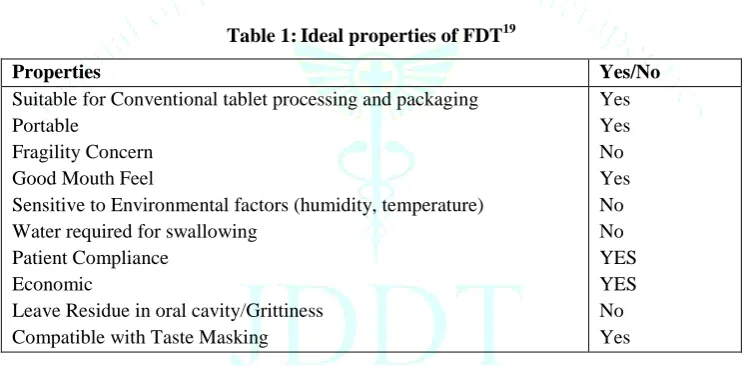
Recent advances in novel drug delivery (NDDS) aims to enhance safety and efficacy of drug molecule by formulating a convenient dosage form for ease of administration and to achieve better patient compliance. One such approach is oral disintegrating tablets (ODTs). ODTs are solid unit dosage forms, which disintegrates or dissolves rapidly in the mouth without the general requirement for swallowing, the chewing and water. Developments in the dosage form designing the ODTs fulfill the requirement of patient needs without compromising its efficacy. The ODTs satisfies the patient’s requirements that are difficulty in the swallowing of the conventional tablets or capsules.17,18 Basic properties are listed in following table;
Table 1:Ideal properties of FDT19
Properties Yes/No
Suitable for Conventional tablet processing and packaging Portable
Fragility Concern Good Mouth Feel
Sensitive to Environmental factors (humidity, temperature) Water required for swallowing
Patient Compliance Economic
Leave Residue in oral cavity/Grittiness Compatible with Taste Masking
Yes Yes No Yes No No YES YES No Yes
ADVANTAGES OF FDTs
141. Improved compliance/added convenient new business opportunities product differentiation, line extension and lifecycle management, exclusivity of product promotion, and patent‐life extension.
2. No water needed.
3. No chewing needed. 4. Better taste.
5. Improved stability.
6. Suitable for controlled/sustained release actives. 7. Allows high drug loading.
8. Ability to provide advantages of liquid medication in the form of solid preparation.
9. Cost‐ effective.
10. Rapid drug therapy intervention. 11. High drug loading is possible.
12. Have acceptable taste and pleasant mouth feeling
DRUGs FORMULATED AS FDTs
Table 2: Some drugs formulated asFDTs
Therapeutic Category Drugs
Anti-fungal Griseofulvin, Miconazole
Anti-bacterial Doxycycline, Erythromycin, Rifampin, Tetracycline Anti--Malarial Chloroquine, Amodiaquine
Anti-hypertensive Amlodipine, Nifedipine, Prazocin23 Ant-ithyroid Carbimazole
Analgesic/Anti-inflammatory Ibuprofen, Mefenamic acid, Piroxicam Anticancer Acyclovir24
Antiemetic Ondensatron25
EXCIPIENTS COMMONLY USED FOR FDTs
PREPARATION
Mainly seen excipients in FDT are as follows at least one disintegrant, diluent, lubricant, and swelling agent, permeabilizing agent, sweeteners, and flavoring26
Table 3: Name and weight percentage of different excipients26
Name of the excipients Percentage Used Disintegrants 1 to15% Diluents 0 to 85% Binder 5 to 10% Antistatic Agent 0 to 10%
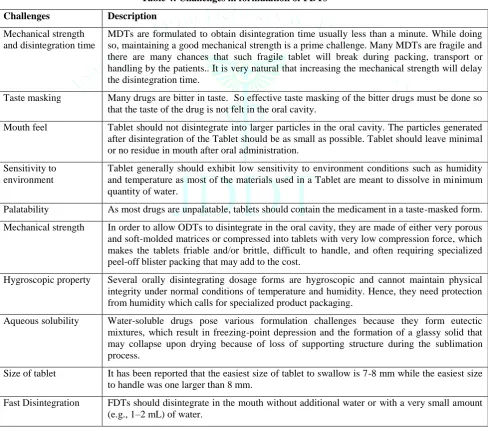
Table 4: Challenges in formulation of FDTs 27-30
Challenges Description
Mechanical strength and disintegration time
MDTs are formulated to obtain disintegration time usually less than a minute. While doing so, maintaining a good mechanical strength is a prime challenge. Many MDTs are fragile and there are many chances that such fragile tablet will break during packing, transport or handling by the patients.. It is very natural that increasing the mechanical strength will delay the disintegration time.
Taste masking Many drugs are bitter in taste. So effective taste masking of the bitter drugs must be done so that the taste of the drug is not felt in the oral cavity.
Mouth feel Tablet should not disintegrate into larger particles in the oral cavity. The particles generated after disintegration of the Tablet should be as small as possible. Tablet should leave minimal or no residue in mouth after oral administration.
Sensitivity to environment
Tablet generally should exhibit low sensitivity to environment conditions such as humidity and temperature as most of the materials used in a Tablet are meant to dissolve in minimum quantity of water.
Palatability As most drugs are unpalatable, tablets should contain the medicament in a taste-masked form.
Mechanical strength In order to allow ODTs to disintegrate in the oral cavity, they are made of either very porous and soft-molded matrices or compressed into tablets with very low compression force, which makes the tablets friable and/or brittle, difficult to handle, and often requiring specialized peel-off blister packing that may add to the cost.
Hygroscopic property Several orally disintegrating dosage forms are hygroscopic and cannot maintain physical integrity under normal conditions of temperature and humidity. Hence, they need protection from humidity which calls for specialized product packaging.
Aqueous solubility Water-soluble drugs pose various formulation challenges because they form eutectic mixtures, which result in freezing-point depression and the formation of a glassy solid that may collapse upon drying because of loss of supporting structure during the sublimation process.
Size of tablet It has been reported that the easiest size of tablet to swallow is 7-8 mm while the easiest size to handle was one larger than 8 mm.
TECHNIQUES IN PREPARATION OF FDTs
The various methods have been attempts for formulation of FDTs;Freeze drying
Lyophilization means drying at low temperature under condition that involves the removal of water by sublimation. Drug in a water soluble matrix which is then freeze dried to give highly porous structure. The tablets prepared by lyophilization disintegrate rapidly in less than 5 seconds due to quick penetration of saliva in pores when placed in the oral cavity. Lyophilization is useful for heat sensitive drugs i.e. thermo-labile substances.31
Molding:
In this method, molded tablets are prepared by using water-soluble ingredients so that the tablets dissolve completely and rapidly. The powder blend is moistened with a hydroalcoholic solvent and is molded into tablets under pressure lower than that used in conventional tablet compression. The solvent is then removed by air-drying .Molded tablets are very less compact than compressed tablets. These posses porous structure that increase dissolution 32 .
Tablet Molding
Molding process is of two type’s i.e. solvent method and heat method. The tablets manufactured by solvent method are less compact than compressed tablets and posses a porous structure that hastens dissolution. The mechanical strength of moulded tablets is a matter of great concern. Binding agents, which improve the mechanical strength of the tablets, need to be incorporated33. Masking of taste is an added problem to this technology and the masked drug particles are prepared by spray congealing a molten mixture of hydrogenated polyethylene glycol, cottonseed oil, lecithin, and sodium carbonate an active ingredient into a lactose based tablet triturate form. Tablets produced by the moulding technique are easy to scale up for industrial manufacturer, compared to the lyophillisation technique 34
Direct Compression:
Direct compression represents the most cost effective and simplest tablet manufacturing technique. Because of the accessibility of improved excipients especially superdisintegrants and sugar based excipients, this technique can now be utilized for preparation of Fast Dissolving Tablets 35.
Spray drying
Spray drying can produce highly porous and fine powders that dissolve rapidly. This technique is based on a particulate support matrix, which is prepared by spray drying an aqueous composition containing support matrix and other components to form a highly porous and fine powder. This then mixed with active ingredients and compressed into tablets. The formulations are incorporated by hydrolyzed and non hydrolyzed gelatins as supporting agents, mannitol as
crosscarmellose sodium as disintegrating and an acidic material (e.g. citric acid) and / or alkali material (e.g. sodium bicarbonate) to enhance disintegration and dissolution. Tablet compressed from the spray dried powder disintegrated within 20 seconds when immersed in an aqueous medium. 36, 37
Mass Extrusion
In this technique, a blend of active drug and other ingredients is softened using solvent mixture of water soluble polyethylene glycol, using methanol and then softened mass is extruded through the extruder or syringe to get a cylinder of product, which is finally cut into even segments with the help of heated blades to get tablets. The dried cylinder can be used to coat the granules of bitter tasting drugs and thereby masked their bitter taste38, 39.
EVALUATION OF FAST DISSOLVING
TABLETS
23, 24, 25, 40Organoleptic properties:
The size and shape of the tablet can be dimensionally described, monitored and controlled. Tablet Tablet thickness is an important characteristic in reproducing appearance and also in counting by using filling equipment. Some filling equipment utilizes the uniform thickness of the tablets as a counting mechanism. Ten tablets were taken and their thickness was recorded using micrometer.
Hardness:
A significant strength of ODT is difficult to achieve due to the specialized processes and ingredients used in the manufacturing. The limit of hardness for the ODT is usually kept in a lower range to facilitate early disintegration in the mouth. The hardness of the tablet may be measured using conventional hardness testers.
Friability23,25:
To achieve % friability within limits for an ODT is a challenge for a formulator since all methods of manufacturing of ODT are responsible for increasing the % friability values. Thus, it is necessary that this parameter should be evaluated and the results are within bound limits (0.1-0.9%)
Wetting time:
The method reported by Yunixia et al., was followed to measure tablet wetting time. A piece of tissue paper (12 cm X 10.75 cm) folded twice was placed in a small petridish (ID = 6.5 cm) containing 6 ml of Sorenson’s buffer pH 6.8. A tablet was put on the paper, and the time for complete wetting was measured. Three trials for each batch and the standard deviation were also determined.
In-Vivo Disintegration test23-25:
Dissolution test:
Commonly the drugs may have dissolution conditions as in USP monograph. Other media such as 0.1 N Hcl, pH 4.5 and pH 6.8 buffers should be used for evaluation of ODT in the same way as their ordinary tablet counterparts. Experience has indicated that USP 2 paddle apparatus is most suitable and common choice for dissolution test of ODT tablets, where a paddle speed of 50 rpm is commonly used. Typically the dissolution of ODTs is very fast when using USP monograph conditions. Hence slower paddle speeds may be utilized to obtain a comparative profile. Large tablets approaching or exceeding one gram and containing relatively dense particles may produce a mound in the dissolution vessel, which can be prevented by using higher paddle speeds. These two situations expand the suitable range of stirring to 25-75 rpm. 40.
CONCLUSION
FDTs are dosage forms which are formulated to dissolve/disintegrate rapidly in the saliva generally within few seconds. FDTs offer lot of advantages over
conventional dosage forms such as improved efficacy, bioavailability, rapid onset of action, better patient compliance. Particularly FDTs provide more comfort to pediatric and geriatric patients. FDTs can be prepared by several methods based on the drug and additives used. Usually FDTs possess less mechanical strength. But by applying some new technologies and additives FDTs with sufficient mechanical strength can be prepared41. The basic fundamental used in the development of the fast-dissolving tablet is to maximize its pore structure. Vacuumdrying and freeze-drying techniques have been tried by researchers to maximize the pore structure of tablet matrix. Freeze drying is cumbersome and yields a fragile and hygroscopic product. Therefore, a vacuum-drying technique was adopted in the present investigation after addition of a subliming agent to increase porosity of the tablets. Even bitter drugs can be incorporated in FDTs by using taste masking agents. The research for FDTs is still going on. FDTs provide wide marketing also which makes the dosage form successful in the market. Many drugs will be formulated as FDTs in future for its market potential42.
REFERENCES
1. Garg A, Gupta M, Mouth dissolving tablets: a review. Journal
of Drug Delivery and Therapeutics, 2013; 3(2):207-214. doi:10.22270/jddt.v3i2.458
2. Garg A, Gupta M, Taste masking and formulation
development & evaluation of mouth dissolving tablets of levocetrizine dihydrochloride. Journal of Drug Delivery and Therapeutics, 2013; 3(3):123-130.
3. Hardenia S., Darwhekar G. Formulation and optimization of
fast dissolving tablets of promethazine theoclate using 32 factorial design. Journal of Drug Delivery and
Therapeutics, 2017; 7(7):12-14. https://doi.org/10.22270/jddt.v7i7.1571
4. Sharma D, Chopra R, Bedi N, “Development and Evaluation
of Paracetamol Taste Masked Orally Disintegrating Tablets Using Polymer Coating Technique” IJPPS; 4(3):129-134.
5. Ratnaparkhi M, “Formulation and Development of Taste
Masked Orally Disintegrating Tablets of Perindopril Erbumine by Direct Compression Method” PAA; 3(5):1-10.
6. Rang HP, Dale MM, Ritter JM, Flower RJ, Henderson G.
Rang and Dale’s Pharmacology. 7th
ed. Published by Elsevier Churchill Livingstone; 2012.P. 199-202, 350.
7. Bhowmik D et al, Fast Dissolving Tablet: An Overview,
J.Chemical and Pharma.Research, 2009; 1(1):163-17
8. Kumari, S., Visht, S., Sharma, P.K., Yadav, R.K., Fast
dissolving Drug delivery system: Review Article; J. Pharmacy Research, 2010; 3(6):1444-1449.
9. Bandari, S., Mittapalli, R.K., Gannu, R., Rao, Y.M.,
Orodispersible tablets: An overview. Asian J Pharm, 2008; 2:2–11
10. Khanna K, Xavier G, Joshi SK, Patel A, Khanna S, Goel B,
Fast Dissolving Tablets- A Novel Approach, International Journal of Pharmaceutical Research & Allied Sciences, 2016; 5(2):311-322.
11. Cheng R, Guo X, Burusid B, Couch R.A review of fast
dissolving tablets. Pharm Tech, (North America). June, 2000; 52-58.
12. Bi Y, Sunada H, Yonezawa Y, Dayo K, Otsuka A, Iida K.
Preparation and evaluation of compressed tablet rapidly disintegrating in oral cavity. Chem Pharm Bull (Tokyo) 1996; 44:2121-2127.
13. Quick dissolving tablets. http:/www.biospace.com. 27 may,
2001.
14. Shaikh S,.Khirsagar R.V, Quazi A. Fast Disintegrating
Tablets: An Overview Of Formulation And Technology. Inter J. Pharmacy Pharma Sci.2010; 2(3):9-15.
15. Kundu S, Sahoo P. K. Recent Trends in The Developments of
Orally Disintegrating Tablet Technology. Pharma Times.2008; 40(4):11-15.
16. Mohire N.C, Yadav A.V, Gaikwad V. K. Novel Approaches in
Development of Metronidazole Orodispersible Tablets. Research J. Pharm. and Tech.2009; 2(2):283-286.
17. Manivannan R. Oral disintegrating tablets: a future
compaction. Inter. J. Pharma Res. Development.2009; 1(10):1-10.
18. Kakade S.M, Mannur V.S, Kardi R.V, Ramani K.B, Dhada
A.A. Formulation and Evaluation of Orally Disintegrating Tablets of Sertraline. Inter. J. Pharma Res. Development.2010; 1(12):1-7.
19. Debjit, B., Chiranjib, B., Krishnakanth, Pankaj, R.Margret
Chandira, Fast Dissolving Tablet: An Overview,J Chemical and Pharma Res,2009, 1(1):163-177.
20. Kaur, T., Gill, B., Kumar, S., Gupta, G.D., Mouth Dissolving
Tablets: A Novel Approach to Drug Delivery,Int. J. of Current Pharma. Research, 2011; 3(1):1-7
21. Mudgal, V. K., Sethi, P., Kheri, R., Saraogi, G.K.,
Singhai,A.K., Orally Disintegrating Tablets: A Review,Int. Research J. Pharmacy, 2011; 2(4):16-22
22. Fu, Y., Yang, S., Jeong, S. H., Kimura, S., Park, K.,
Therapeutic Drug Carrier Systems, Orally Fast Disintegrating Tablets: Developments, Technologies, Taste- Masking and Clinical Studies; Critical Reviews™ in Therapeutic Drug Carrier Systems,2004; 21(6):433–475
23. Mallika,T., Anand,D., Harikrishna,E. Isolation,
characterization and investigation of starch phthalate as novel superdisintegrant in developing of acyclovir fast dissolving tablets. Journal of Drug Delivery and Therapeutics, 2018; 8(1):33-42. https://doi.org/10.22270/jddt.v8i1.1550
24. Siraj S., Kausar S., Khan G., Khan T. Formulation and
evaluation of oral fast dissolving tablet of ondansetron hydrochloride by coprocess excipients. Journal of Drug Delivery and Therapeutics, 2017; 7(5):102-108. https://doi.org/10.22270/jddt.v7i5.1498
25. Aher S, Saudagar R, Chaudhari D, Formulation and evaluation
of taste masked fast dissolving tablet of prazosin
2018; 8(4):263-271 DOI:
http://dx.doi.org/10.22270/jddt.v8i4.1785 .
26. Kundu S, Sahoo P. K. Recent Trends In The Developments of
Orally Disintegrating Tablet Technology. Pharma Times.2008; 40(4):11-15.
27. Erande, K.,Joshi, B., Mouth Dissolving Tablet: A
comprehensive Review, Int. J. of Pharma Research and Review, 2013; 2(7):26-28
28. Shaikh, S., Khirsagar, R.V., Quazi, A.,Fast Disintergating
Tablets an overview of formulations and technologies,Int. J of Pharmacy and Pharma Sci, 2010; 2(3):9-11
29. Chaudhari, P.D., Chaudhari, S.P., Lanke, S.D., Patel, N.,
Formulation and in vitro evaluation of taste masked
orodispersible dosage form of Levocetirizine dihydrochloride, Indian J. Pharma Education and Research, 2007; 41(4):319-327.
30. Khemariya, P., et al, Preparation and evaluation of mouth
dissolving tablets of meloxica, Int. J. Drug Delivery, 2010; 2(1):76-79.
31. Habib W, Khankari RK, Hontz J. Fast-dissolve drug delivery
systems. Crit Rev Ther Drug Carrier Sys 2000; 17:61-72.
32. Van Scoik KG. Solid Pharmaceutical dosage in tablet triturates
form and method of producing the same. US Patent 5,082, 667.
33. Sharma, R., Rajput, M., Prakash, P., Sharma, S., Fast
dissolving drug delivery system: A Review, Int Res J Pharm, 2011; 2(11):21-29.
34. Rai, R.R., Chirra,P., Thanda, V., Fast dissolving tablets: A
novel approch to drug delivery–A Review,Int J Preclinical and Pharma Res,2012; 3(1):23-32.
35. Ito, A., Sugihara, M., Development of Oral Dosage forms for
elderly patients: Use of agar as Base of rapidly disintegrating oral tablets,Chem Pharm.Bull,1996; 44(11):2132-2136.
36. Allen LV, Wang B. Process for making a particulate support
matrix for making a rapidly dissolving tablet. US Patent 5,587,180; 1996.
37. Allen LV, Wang B, Davis LD. Rapidly dissolving tablet. US
Patent 5,807,576; 1998.
38. Wagh M. A, Kothawade P. D, Salunkhe K.S, Chavan N.V,
Daga V.R. Techniques used in orally disintegrating drug delivery system. Inter. J. Drug Delivery 2010; 2:98-107.
39. Hirani J.J, Rathod D.A, Vadalia K.R. Orally Disintegrating
Tablets: A Review. Trop J Pharm Res. 2009; 8 (2):161-172.
40. Keshari A., Tripathi, D. P., Srivastava A., Vishwas R.
Formulation and evaluation of effervecent floating tablets of antidiabetic drug. Journal of Drug Delivery and
Therapeutics, 2015; 5(6):43-55. https://doi.org/10.22270/jddt.v5i6.1176
41. Ravichandiran V, Masilamani V, Kumar SS,
Kumaragurubaran T, Senthilnathan B, Kamalakkannan V. Fast Dissolving Tablets: A Review, Journal of Pharmacy Research. 2011; 4(8):2590-2592
42. Sharma N, Sharma J, Jat RC, Rathore AS, Fast is dissolving