RESEARCH ARTICLE
HOLOGRAPHIC LASING
*Zurab V. Wardosanidze
Department of Food and Nutrition, School for Home Science, BBAU, Lucknow, India
ARTICLE INFO
ABSTRACT
The spatially modulated lasing controllable by the transversely distributed pumping was implemented in the dye-doped layers of Cholesteric Liquid Crystal (DD CLC) and polymer (DDP).The interference pattern of two mutually coherent beams of the second harmonic of Nd: YAG (532nm) laser was used for the pumping. The interference pattern of the pumping light was located in the plane of the laser active layer. The emission of laser cells was observed perpendicular to laser active layers from the opposite side of the incidence of the light of pumping. The periodical character of the spatial modulation of intensity along cross section of the lasing depends and corresponds to the parameters of the interference pattern of the pumping. So, the emitted light field qualitatively looks like as diffraction from an elementary hologram (from the holographic grating) and therefore obtained process of light emission can be called as a holographic lasing.
Copyright © 2018, Zurab Wardosanidze. This is an open access article distributed under the Creative Commons Attribution License, which permits unrestricted
use, distribution, and reproduction in any medium, provided the original work is properly cited.
INTRODUCTION
The holographic method has undergone enormous development and transformation since the discovery (1948) up to present time (Gabor, 1948). The holography also has made great strides in the development of many scientific methods and many technological problems starting with the simplest holograms and ending by the digital holograms (Leith and Upatnieks, 1962; Denisiuk, 1963; Kakichashvili, 1972). Especially it should be noted that already is reached the holographic recording and reconstruction of almost all parameters of the light wave: of the amplitude, phase, wavelength and polarization characteristics (Kakichashvili, 1974; Collier et al., 1971; Shatalin et al., 1987; Todorov et al.,
1984; Naydenova et al., 1998; Kakichashvili and Wardosanidze, 1987; Wardosanidze, 1990; Kakichashvili et al.,
1983; Kakichashvili and Wardosanidze, 1989; Wardosanidze, 2000;Wardosanidze,2006;Wardosanidze,2006; Wardosanidze,
2007; Wardosanidze, 2007; Zurab Wardosanidze et al., 2011). Anyway the main task of the holographic method is obtaining of the diffractive structure corresponding to distribution of relative phase of the reference and object waves. On this basis it was possible to say that holography is almost exhausted its potential for further development, but it turned out that there are certain prospects in terms of new nonstandard approaches. The typical holograms and holographic optical elements including
*Corresponding author: Zurab V. Wardosanidze,
Department of Food and Nutrition, School for Home Science, BBAU, Lucknow, India.
dynamic, represent passive diffractive structures that means that for the holographic reconstruction of the recorded wave front requires existence of the external source of the light. Particularly the light from the external light source is incident on the holographic diffraction structure and reconstructs the initial wave front of the light because of diffraction. However it turned out that there exists a possibility of creation of a laser structure in which its individual micro areas corresponding to the holographic profile obtained by interference field of pumping can themselves emit mutually coherent radiation. In this case, the summary field of lasing has spatial modulation which carries information about the wave front of pumping wave. Therefore there exists a possibility of reconstruction of the optical information by laser radiation of this structure but not by the diffraction of light incident from outside. According to the author's opinion, this approach, in addition to the initiation of interesting new research in the field of laser physics and holography, can support to develop optical information technologies and in particular in the technology of holographic 3D displays. So as it was mentioned above, the known holographic structures (holograms) are passive diffraction elements but in difference of them holographic structures suggested will reconstruct the wave front of light by own laser radiation and they might be termed also as active holograms. Laser active holographic structures are fundamentally different because the reconstruction of optical information, in this case, takes place not as a result of diffraction of incident outside light wave, but as a result of own lasing. Typical holograms represents oneself certain distribution of microscopic optical heterogeneities that provides
ISSN: 0976-3376
Vol. 09, Issue, 10, pp.8949-8954, October,Asian Journal of Science and Technology 2018Available Online at http://www.journalajst.com
ASIAN JOURNAL OF
SCIENCE AND TECHNOLOGY
Article History:
Received 17th July, 2018 Received in revised form 25th August, 2018
Accepted 20th September, 2018 Published online 30th October, 2018
Key words:
Laser, Coherence, Pumping, Dye lasers, Interference, Diffraction, Holography, Lasing.
diffraction of the light wave and reconstructs the wave front of the light scattered by an object (Fig.1). Now let us assume that all of the microscopic heterogeneities of such a holographic structure represent oneself mutually coherent micro lasers. In this case the summary lasing of such a structure will create the wave front analogous to the previous, i.e. will reconstruct of the image of the object but on the wavelength of own radiation. Thus, the radiation of such a laser active holographic structure and such a holographic process might be termed as a holographic lasing. The first results in this direction have been obtained in the layer of Cholesteric Liquid Crystal (CLC) doped by the dye DCM (4-Dicyanomethylene-2-methyl-6-p-dimethylaminostyryl-4H-pyran) and in the layer of Polyvinyl Alcohol (PVA) doped by dye Rhodamine 6G (Wardosanidze, 2002; Zurab et al., 2014; Wardosanidze, et al., 2014; Zurab Wardosanidze et al., 2014; Chilaia et al., 2015; Wardosanidze
et al., 2016).
Fig. 1. General structure of the usual hologram
Experiment:The scheme of the experimental setup is shown
in Fig.2. The second harmonic (λp = 532nm) of the Nd3+:YAG
pulsed laser is divided with the help of beam splitter containing two laser mirrors with reflectivity 50% (1) and 99.9% (2) accordingly for the wavelength of 532nm. The mirror 1 is oriented at 45o and the mirror 2 is oriented so that divided beams are overlapping on the plane of laser cell containing DD CLC or DDP layers. The distance of 15mm between the mirrors 1 and 2 of the beam splitter provides stable interference of the divided beams with maximal contrast of interference pattern of the pumping radiation with the coherence length 7.5cm. The pumping interference pattern is located in the plane of the laser active layers DD CLC or DDP of the laser cell. The duration of the pumping pulses was 15 - 20 ns. Excited spot with the help of interference pattern of pumping on the laser layer has a size 1-2 millimeters. Laser radiation of the DD CLC and DDP layers were observed perpendicular to the laser cell from the opposite side of the pumping. Such an experimental setup (Fig.2) ordinarily is used for the recording of the holographic gratings and for the pumping of the dye doped DFB lasers (Kogelnik and Shank, 1971; Bjorkholm and Shank, 1971 & 1972; Katarkevich et al.,
1994; Loiko and Rubinov, 2000; Fukuda and Mito, 2000; Bjorkholm and Shank, 1972). So, the pumping light field in this case represents oneself the interference pattern as periodically arranged bright and dark strips (Fig.3). The period
d of the interference pattern of the pumping light is determined by the well-known formula:
Fig. 2.The scheme of double-beam coherent pumping
)
2
sin(
s
d
p (1)where
pis the wavelength of and
is the convergence angle of the pumping beams.
Fig. 3. Formation of the interference pattern of the pumping in the DD CLC and DDP layers
As a result was obtained array of micro lasers which emit light simultaneously in perpendicular direction regarding to DD CLC and DDP laser layers. The picture of the array of the micro lasers was observed by microscope and was fixed by digital camera (Fig.4). Fig. 4 (a) and (b) correspond to the convergence angles of 1.80 and 0.60 for the pumping beams accordingly for the laser cell with DD CLC layer. Fig. 4 (c), (d) and (e) correspond to the convergence angles of 1.80; 0.90 and 0.60 for the pumping beams accordingly for the laser cell with DDP film. Thus, micro lasers were formed as a separate strips of lasing the width of which depends on the angle of convergence of the pumping beams. The DD CLC laser cell was prepared by conventional, well-known technology. For the active laser medium was used DCM - exciton dye, introduced in the CLC matrix. A mixture of nematic liquid crystal BL-036 and optically active component MLC-6247 (both from Merck) was used as a CLC matrix where 0.4% of dye DCM - exciton was added. The period of the helix of the DD CLC mixture was about 370nm that provided the spectral range of maximal reflection for the spectrum of fluorescence of the used dye. The thickness of the obtained plane parallel layer of the CLC was approximately 40μ. The spectral absorption of this layer for the light wave of the pumping (λp = 532nm) was about ≈95%. Glass plates for the windows of the DD CLC laser cell were pre-coated with thin layers of polyvinyl alcohol (PVA) and are oriented by mechanical unidirectional rubbing by the
cotton wool. Emitted laser fields have a spatial modulatio (Fig.5). The periodical character of the modulation of intensity along cross section of the lasing in this case depends and corresponds to the parameters of the interference pattern of the pumping and the pattern of the lasing field qualitatively looks like as diffraction from an elementary hologram i.e. from the diffractive grating.
Fig.4. Picture of lasing from DD CLC laser cell at the pumping interference pattern of two beams (a,b) and at the pumping
one beam(c)
Fig. 4. Picture of lasing from DD CLC laser cell at the pumping interference pattern of two beams (a,b) and at the pumping
one beam(c)
Fig. 5. Lasing spectrum of the DD CLC cell with transversely distributed pumping
The distance between the maximums (or minimums) of intensity of the pattern of lasing in Fig. 4 (a), (b) is approximately 2.3mm (a) and 6.5mm (b) accordingly at the distance from the DD CLC layer to the screen was 20cm. Thus, according to calculation, the angles between the directions of propagation of the nearby maximums, from the excited spot of the DD CLC layer, have values
0.66°that closely enough agrees to angles of diffraction
a b
c d
a b
8951 Asian Journal of Science and Technology,
Emitted laser fields have a spatial modulation (Fig.5). The periodical character of the modulation of intensity along cross section of the lasing in this case depends and corresponds to the parameters of the interference pattern of the pumping and the pattern of the lasing field qualitatively looks ike as diffraction from an elementary hologram i.e. from the
DD CLC laser cell at the pumping by at the pumping by
DD CLC laser cell at the pumping by at the pumping by
Fig. 5. Lasing spectrum of the DD CLC cell with transversely
The distance between the maximums (or minimums) of intensity of the pattern of lasing in Fig. 4 (a), (b) is approximately 2.3mm (a) and 6.5mm (b) accordingly at the distance from the DD CLC layer to the screen was 20cm. angles between the directions of propagation of the nearby maximums, from the excited spot of the DD CLC layer, have values ≈1.860 and ≈ 0.66°that closely enough agrees to angles of diffraction ≈ 1.810
and≈ 0.640 calculated by the formula (2) for the diffr grating:
)
2
arcsin(
2
d
L
Where
L is the wavelength of lasing of the DD CLC laser cell and d is the period of the interference pattern of pumping. The modulation of the intensity of the emission pattern of lasing disappears when one of the pumping beams is removed (Fig. 4 (c). Fig.5 shows the lasing spectrum of the DD CLC cell with transversely distributed pumping. Therefore regarding to the spectral characteristics of emission, this laser doesn't differ from the known DD CLC lasers with the single beam-pumping.The DDP laser cell represents oneself the dye doped polymer film sandwiched between two laser mirrors forming a laser resonator. The mirrors were placed with their reflective surfaces inwards to the laser cell and have optical contact with the polymer layer by the optical glue. As a laser dye was used Rhodamine-6G. Concentration of the dy
thickness of the polymer film was 130µm. The cavity mirrors were enough transparent (≈75%) for the pumping light ( =532nm) that provides sufficient excitation for lasing of the laser layer. Particularly the summary
falling on the laser cell was 20
energy of the pumping pulse (i.e. the energy incident on the laser layer) was 14-20mJ. The pumping was carried out at the angles of the convergence of the pumping beams 0.6
1.80. The picture of the cross section of the lasing of this laser cell is shown in Fig. 6. The photos
corresponding to the convergence angles of the pumping beams of 0.60 , 0.90 and 1.80 respectively. As can be seen, the intensity has a transversely distributed character and qualitatively looks like as a diffraction pattern from a diffraction grating. The angles between the directions of nearby maximums of intensity correspond to the formu
)
2
arcsin(
2
d
L
(3) where
Lis the wavelength of lasing andthe interference pattern of the pumping. When shutting one of the pumping beams the pattern of the spatial modulation, of the laser emission disappears (Fig. 7).
the emitted light field in all photos is a result of t
concave structure of the laser resonator because of concave of output mirror. To avoid Fabre
generated emission, the pumping was performed not at the central but at the peripheral part of the resonator.
Fig. 6.The emission of the DDP laser cell the convergence angles 0.60, 0.90, 1.80 for the pumping beams
e
c
a
Asian Journal of Science and Technology, Vol. 09, Issue, 10, pp. 8949-8954, October,
≈ 0.640 calculated by the formula (2) for the diffractive
(2)
is the wavelength of lasing of the DD CLC laser is the period of the interference pattern of pumping. The modulation of the intensity of the emission pattern of lasing disappears when one of the pumping beams is removed Fig.5 shows the lasing spectrum of the DD CLC istributed pumping. Therefore regarding to the spectral characteristics of emission, this laser doesn't differ from the known DD CLC lasers with the
single-The DDP laser cell represents oneself the dye doped polymer two laser mirrors forming a laser resonator. The mirrors were placed with their reflective surfaces inwards to the laser cell and have optical contact with the polymer layer by the optical glue. As a laser dye was used 6G. Concentration of the dye was 0.148% and the thickness of the polymer film was 130µm. The cavity mirrors ≈75%) for the pumping light (
L =532nm) that provides sufficient excitation for lasing of the laser layer. Particularly the summary energy of the pumping falling on the laser cell was 20-30mJ, so the real effective energy of the pumping pulse (i.e. the energy incident on the 20mJ. The pumping was carried out at the angles of the convergence of the pumping beams 0.60, 0.90and The picture of the cross section of the lasing of this laser The photos a, b and c are corresponding to the convergence angles of the pumping respectively. As can be seen, the intensity has a transversely distributed character and qualitatively looks like as a diffraction pattern from a diffraction grating. The angles between the directions of nearby maximums of intensity correspond to the formula(3)
is the wavelength of lasing and d is the period of the interference pattern of the pumping. When shutting one of the pumping beams the pattern of the spatial modulation, of the laser emission disappears (Fig. 7). The elongated shape of the emitted light field in all photos is a result of the plane-concave structure of the laser resonator because of plane-concave of
To avoid Fabre-Perot interference of the generated emission, the pumping was performed not at the central but at the peripheral part of the resonator.
The emission of the DDP laser cell the convergence angles for the pumping beams (a); (b); (c).
b c
Fig. 7. The view of the emission of the Rhodamine cell with single beam pumping
To avoid Fabre-Perot interference of the generated emission, the pumping was performed not at the central but at the peripheral part of the resonator. Because of high density of pumping the can be induced nonlinear effects in the polymer film. Therefore could be formed the dynamic grating enough modulation depth and it is possible the observation of diffraction. To check this possibility, the area of lasing was tested with a beam of He-Ne laser (632nm) but no signs of diffraction, and thus, no signs of any grating induced by pumping were detected. The emission spectrum of DDP laser cell is shown In Fig. 8. Analogous to DD CLC laser the spectrum of lasing along the cross section of the
and is strongly constant. The obtained spectrum of lasing is caused by the dye concentration, polymer matrix properties and spectral reflection characteristics of the cavity mirrors.
Fig. 8. Spectrum of the Rhodamine-6G DDP laser cell
DISCUSSION
Periodical spatial modulation of lasing is connected with characteristics of coherence of obtained DD CLC and DDP lasers. Particularly, the interference pattern of the pumping beams creates periodical distribution of excitation in the plane of the DD CLC and DDP laser layers forming a laser structure representing a periodical set of micro lasers. The total interference of emission from these micro lasers forms the lasing picture which looks like to diffraction from a periodical structure. So, obtained lasers can be considered as lasers and, at the same time, as elementary holograms simultaneously and the process itself may be called holographic lasing.
seen that the intensity distribution along the cross section of lasing has the periodical character, which differs from distribution of intensity of lasing of conventional DD
DDP lasers. In author’s opinion, the spatial modulation of laser emission field is a result of the mutual correlation between the emitting centers of the individual strips of radiation. Probably, correlation effects, in this case, are of the same n
provides spatial coherence in the conventional lasers. Thus, the
8952 Asian Journal of Science and Technology,
Fig. 7. The view of the emission of the Rhodamine-6G DDP laser cell with single beam pumping
of the generated emission, the pumping was performed not at the central but at the Because of high density of pumping the can be induced nonlinear effects in the polymer film. Therefore could be formed the dynamic grating with enough modulation depth and it is possible the observation of diffraction. To check this possibility, the area of lasing was Ne laser (632nm) but no signs of diffraction, and thus, no signs of any grating induced by The emission spectrum of DDP laser cell is shown In Fig. 8. Analogous to DD CLC laser the along the cross section of the isn't changing and is strongly constant. The obtained spectrum of lasing is tion, polymer matrix properties and spectral reflection characteristics of the cavity mirrors.
6G DDP laser cell emission
Periodical spatial modulation of lasing is connected with coherence of obtained DD CLC and DDP lasers. Particularly, the interference pattern of the pumping beams creates periodical distribution of excitation in the plane of the DD CLC and DDP laser layers forming a laser structure f micro lasers. The total interference of emission from these micro lasers forms the lasing picture which looks like to diffraction from a periodical structure. So, obtained lasers can be considered as lasers and, simultaneously and the process itself may be called holographic lasing. As it is seen that the intensity distribution along the cross section of lasing has the periodical character, which differs from distribution of intensity of lasing of conventional DD CLC and DDP lasers. In author’s opinion, the spatial modulation of laser emission field is a result of the mutual correlation between the emitting centers of the individual strips of radiation. Probably, correlation effects, in this case, are of the same nature that provides spatial coherence in the conventional lasers. Thus, the
emitting area, of the described laser cells, represents a periodical structure of the mutually coherent micro lasers. The total radiation of such a periodical structure, according Huygens–Fresnel principle, must form summary interference pattern similar to that shown in Fig. 4 (a), (b) and Fig.6 a,b,c (Born and Wolf, 1964; Ditchburn
similar to the formation of the diffraction pattern from the diffractive grating of the corresponding periodical structure from the point of view of Huygens
Probably, the main factor reducing the contrast of the spati modulation of the pattern of lasing is the significant value of the scattering of the light that is characteristic of liquid crystals and polymers. These new types of lasers, which combine the properties of a laser and a hologram, will have important fo the optical-information technologies. The field of emission of this laser has a spatial modulation with the periodical distribution of the intensity, controlled by the transversely distributed excitation. Therefore, the spatial distribution of the lasing intensity in this case carries information about the wave front of the pumping light that gives to these lasers the function of hologram.
According to theory and as is customary the diffraction from the diffractive grating is the result of interference o
waves from strips of the optical heterogeneities of the periodical structure of the grating. The diffraction picture in this case represents itself periodical distribution of intensity containing so called diffractive orders (maximums). In our case the periodical character of the lasing is the result of interference of radiation of separate strips of micro lasers and is not the result of diffraction.
in this case is the spatial coherence of the laser radiation tha provided by mutually correlation of the fluorescent centers of the separate strips of micro lasers.
beams is used in various spheres of science and technology and, amongst them, for the pumping of lasers and achieving of tunable laser emission. In particular, double
pumping has long been used in the dye lasers with distributed feedback (DFB) (Fig.2). In these cases the mutually coherent pumping beams in the active medium form an interference pattern whose bright and dark strips are distributed along to generated laser emission (Fig.9).
Fig.9 Optical pumping and lasing of the DFB dye laser
In this case two mutually coherent pumping beams form an interference pattern in the active medium that’s bright and strips are distributed perpendicular to the generated emission. Because of nonlinear effect is induced corresponding distribution of refractive index which creates reflecting planes and provides the distributed feedback. The distance between separate strips with the same refractive index defines the wave length of lasing. So changing of the
Asian Journal of Science and Technology, Vol. 09, Issue, 10, pp. 8949-8954, October,
emitting area, of the described laser cells, represents a periodical structure of the mutually coherent micro lasers. The total radiation of such a periodical structure, according to the Fresnel principle, must form summary interference pattern similar to that shown in Fig. 4 (a), (b) and Fig.6 a,b,c Ditchburn, 1976). This phenomenon is similar to the formation of the diffraction pattern from the diffractive grating of the corresponding periodical structure from the point of view of Huygens-Fresnel principle. Probably, the main factor reducing the contrast of the spatial modulation of the pattern of lasing is the significant value of the scattering of the light that is characteristic of liquid crystals and polymers. These new types of lasers, which combine the properties of a laser and a hologram, will have important for information technologies. The field of emission of this laser has a spatial modulation with the periodical distribution of the intensity, controlled by the transversely distributed excitation. Therefore, the spatial distribution of the intensity in this case carries information about the wave front of the pumping light that gives to these lasers the
According to theory and as is customary the diffraction from the diffractive grating is the result of interference of secondary waves from strips of the optical heterogeneities of the periodical structure of the grating. The diffraction picture in this case represents itself periodical distribution of intensity containing so called diffractive orders (maximums). In our case the periodical character of the lasing is the result of interference of radiation of separate strips of micro lasers and is not the result of diffraction. Accordingly the decisive factor in this case is the spatial coherence of the laser radiation that is provided by mutually correlation of the fluorescent centers of the separate strips of micro lasers. The interference of the laser beams is used in various spheres of science and technology and, amongst them, for the pumping of lasers and achieving of tunable laser emission. In particular, double-beam coherent pumping has long been used in the dye lasers with distributed In these cases the mutually coherent pumping beams in the active medium form an interference ght and dark strips are distributed along to generated laser emission (Fig.9).
Fig.9 Optical pumping and lasing of the DFB dye laser
In this case two mutually coherent pumping beams form an interference pattern in the active medium that’s bright and dark strips are distributed perpendicular to the generated laser emission. Because of nonlinear effect is induced corresponding distribution of refractive index which creates reflecting planes and provides the distributed feedback. The arate strips with the same refractive index defines the wave length of lasing. So changing of the
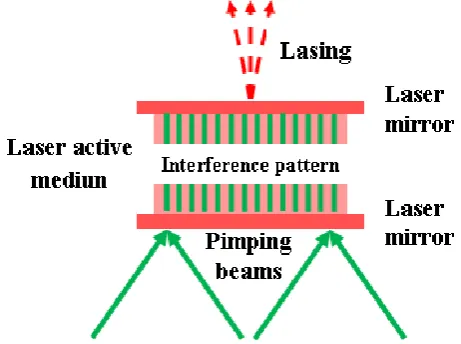
convergence angle between pumping beams provide the spectral tuning of the DFB laser. However, it is clear that, in addition to modulating the refractive index, the establishment of the DFB also related with the mutual correlation between the fluorescent centers of the individual bands. In difference of usual DFB lasers optical pumping of suggested laser cells is realized so that fluorescent strips are distributed perpendicular to lasing (Fig,10). So obtained laser looks out as a laser with transversely DFB.
Fig. 10. Optical pumping of DD CLC and DDP laser cells
Therefore luminescent areas of the laser cell can lasing separately, but due to correlation between the emitting centers of different emitting strips provide the condition for the interference that gives spatially modulated lasing represented in Fig.4 and Fig.6. So we are obtaining holographic lasing. According to future plans possibility of the reconstruction of the image on the basis of such approach when the one of the pumping beams will be modulated by the two-dimensional transparent object will be investigated the.
Conclusion
This work shows the possibility of creation of laser cells on the basis of DD CLC and DDP layers that creates a lasing field containing information about the structure of optical pumping. These optical elements simultaneously operate as lasers and also as elementary holograms because the spatially modulated light beam giving by them is not the result of diffraction but is the result of lasing. So obtained lasing is the result of mutual coherence of the micro lasers forming with the help of transversely distributed pumping. So the lasing field of such laser active structures carries information about the interfering wave fronts of the pumping light field. Accordingly, on author’s opinion, similar structures can be reconstruct optical information analogically to usual holograms and can create a basis for the development of a new direction of optical information technologies. After solving the problem of controlled mutually correlation of emitting centers and, accordingly, controlled spatial coherence of lasers it is possible to develop the conception of holographic 3D displays on the basis of this approach. After sufficient development of technology of control of phase characteristics of of emission of semiconductor light sources it will possible to create 3D displays on the basis of mutually coherent laser diodes (LED). Besides of this obtained results and presented approach may initiate new researches in holography, laser physics and spectroscopy.
REFERENCES
Gabor, D. 1948. A New Microscope Principle, Nature, vol.161, pp. 777-778.
Leith, E.N.; Upatnieks, I. 1962. Reconstructed wave fronts and communication theory. JOSA, vol.52, № 11, pp.1123-1130. Denisiuk, J.N. 1963. On the mapping of the optical properties of the object of the wave field scattered light from them.
Opt.and Spectr., vol. 15, № 4, pp.522-532, (Russian). Kakichashvili, Sh. D. 1972. On Polarization Recording of
Holograms. Opt. and Spectr., vol.1, No.6, pp. 324-327, (Russian).
Kakichashvili, Sh.D. 1974. Method of Polarization Recording of Holograms. Kvantovaja Electron (Quant. Electr.), vol.1, N 6, pp.1435-1441, (Russian).
Collier R. J., B. C. Burckhardt, H. L. Lin, Optical Holography, Academic Press, NY, London (1971).
Shatalin, I.D., Kakichashvili, 1987. Polarization hologramm with 100% diffractive efficiency (polarization cinoform). Pisma v JTF (Sov. Tech. Phys. Lett.), vol.13, No.17, 1051--1055, (Russian).
Todorov et al. 1984. Polarization holography. 2: Polarization holographic gratings in photoanisotropicmaterials with and without intrinsic birefringence, Appl. Opt. Vol. 23, Issue 24, 4588-4591.
Naydenova, L. et al. 1998. Diffraction from polarization holographic gratings with surface relief in side-chain azobenzene polyesters, J. Opt. Soc. Am., B Vol. 15, Issue 4, 1257-1265.
Kakichashvili D., Z.V. Wardosanidze, 1987. Recovery of polarization microstructure of natural light by the polarization-holographic method, Sov.Tech.Phys.Lett., v.13, No.19, pp. 1180-1183(Russian).
Wardosanidze, Z. V. 1990. Holographic recording by using of unpolarized light/scalar response of the medium, Sov.Tech. Phis. Lett., v.17,No.10,pp.35-39(Russian).
Kakichashvili D., Z.V. Wardosanidze, D.V. Leselidze, 1983. Highly efficient holographic mirrors on the dichromated gelatin, Sov. Tech. Phis.Lett., v.9, No.18, pp.1102-1104 (Russian).
Kakichashvili D., Z.V. Wardosanidze, 1989. Zone plate of anisotropic profile, Sov.Tech.Phis.Lett., v.15, No.17, pp.41-44 (Russian).
Wardosanidze, Z.V. 2001. Holographic Freshnel microlenses and rasters with an anisotropic profile, Micro- and Nano-optics for Optical Interconnection and Information Processing, Abstracts, SPIE Annual meeting, SanDiego, USA, Proceedings SPIE, Vol.4455 [4455-09], July 29-31. Wardosanidze, Z.V. 2006. Holographic chiral structure on the
basis of Weigert's effect, Applied Optics, Vol. 45, Issue12, pp. 2666-2671.
Wardosanidze, Z.V. 2006. Holographic recording in the genera case of linear polarization, Optical Engineering, Volume45, Issue 8, pp.085801-085807.
Wardosanidze, Z.V. 2007. On the reversibility of Weigert’s effect in Azo-Dye colored materials, Appl. Opt., vol. 46, Issue 27, pp. 6727 -6732.
Wardosanidze, Z.V. 2007. Self-recording phenomenon in the process of reconstruction from a highly efficient dynamic hologram on azo-dye-colored material with powerful Weigert’s effect, Applied Optics, Vol.46, Issue14, pp.2575-2580.
Zurab V. Wardosanidze, 2011. Holography Based On The Weigert’s Effect, Book–HOLOGRAMS–Recording
Materials and Applications, INTECH OPEN ACCESS PUBLISHER, Chapter 6, pp.117-144.
Wardosanidze, Z. V. 2002. “Distributed feedback laser”, Patent of Georgia№2780.
Zurab V. Wardosanidze, 2014. Andro Chanishvili, Gia Petriashvili, GuramChilaya, (2014), Cholesteric liquid crystal holographic laser, Optics Letters,A 39, 1008–1010. Wardosanidze Z.V., A.G.Chanishvili, G. Sh. Petriashvili, G.S.
Chylaia, M.N. Aronishidze, S.P.Tavzarashvili, Q.G. Tevdorashvili, 2014. Laser with double distributed feedback, Georgian Engineering News, Vol. 1, pp.23-26. Wardosanidze Z.V., M.N. Aronishidze, A.G.Chanishvili, G.S.
Chilaya, S.P. Tavzarashvili, K.G. Tevdorashvili, 2014. Polymer Film Holographic Lazer, Georgian Engineering News, N3.
Chilaya G., Z. Wardosanidze, G. Petriashvili, S. Tavzarashvili, A. Chanishvili, M. Aronishidze, K. Tevdorashvili, 2015. Spatially Modulated Laser Emission, Bulletin of the Moscow State Regional University: Physics and Mathematics, N2, pp.90-95.
Zurab Wardosanidze, Andro Chanishvili, Guram Chilaya, Gia Petriashvili, Svetlana Tavzarashvili, 2014. Array of mutually coherent photonic liquid crystal micro-lasers, International Schoolon Nanophotonics and Photovoltaics, August 28-September 03, Tbilisi, Georgia.
Zurab Wardosanidze, Andro Chanishvili, Svetlana Tavzarashvili, 2014. Array of mutually coherent polymer film micro-lasers, International School on Nanophotonics and Photovoltaics, August 28– September 03, Tbilisi, Georgia.
Chilaia G.S., Z.V. Wardosanidze, G. Petriashvili, C.P.Tavzarashvili, A.G.Chanishvili, M.N.Aronishidze, K.G.
Tevdorashvili, 2015. Spatially Modulated Laser Emission, International Conference “Physical properties of the materials and dispersion media for information system elements, nanoelecronic equipments and ecology technologies”, Moskow, April 21-24.
Wardosanidze, Z.V., Chanishvili, A., Chilaya, G. 2016. A polymer film dye laser with spatially modulated emission controlled by transversely distributed pumping, Adv. Opt.Technol., Article ID 1548927, 4 pages.
Kogelnik H., C. V. Shank, 1971. Stimulated emission in a periodic structure”, Appl. Phys. Lett., A 18, 152-154. Bjorkholm J. E., Shank C. V. 1972. HigherOrder Distributed
Feedback Oscillators, Appl. Phys. Lett., A 20, 306- 308. Bjorkholm J. E., Shank C. V. 1972. Distributed-feedback
lasers in thin-filmoptical waveguides, Quantum Electronics, A 8, 833-838.
Katarkevich V. M., A. N. Rubinov, S. A. Ryzhechkin, T. Sh. Efendiev, 1994. Compact holographic solid-state distributed-feedback laser, Quantum Electronics, A 24, 871–873.
Loiko N. A., A. N. Rubinov, 2000. Suppression of superluminescence in a dyeDFB-laser with a dynamic grating, Journal of Applied Spectroscopy, A 67, 642-649. Fukuda M., K. Mito, 2000. Solid-State Dye Laser with
Photo-Induced Distributed Feedback, Jpn. J. Appl. Phys., A 39, 5859-5863.
Bjorkholm J. E., Shank C. V. 1972. Higher Order Distributed Feedback Oscillators, Appl. Phys. Lett., A 20, 306- 308. Born M., E. Wolf, 1964. Principles of Optics, Pergamon press,
Oxford-London-Edinbugh-New York-Paris-Frankfurt. Ditchburn, R.W. 1976. “Light”, 3rd ed., Academic Press, New
York.
8954 Asian Journal of Science and Technology, Vol. 09, Issue, 10, pp. 8949-8954, October,2018