Available online on 15.09.2018 at http://jddtonline.info
Journal of Drug Delivery and Therapeutics
Open Access to Pharmaceutical and Medical Research© 2011-18, publisher and licensee JDDT, This is an Open Access article which permits unrestricted non-commercial use, provided the original work is properly cited
Open
Access
Research Article
STUDY ON ANTICANCER EFFECT OF SYNTHETIC BIOGENIC
SOURCE OF GERMACRENE A
Haiyan Cao
1, Zihui Li
1, Ruqi Li
1, Boyang Mao
1, Chen Liu
1, Yutong Li
1, Guowei Zhang
1*1
Department of Traditional Chinese Medicine, Hebei University, Baoding, China
ABSTRACT
Objective: Based on obtaining germacrene A, which is the analogue of synthetic β-elemene, by means of synthetic biology,this experiment
aims to explore the anti-tumor effect of germacrene A.
Methods: The cell line used in this study was bladder cancer T24 cells. The morphological changes of bladder cancer T24 cells treated with
germacrene A were observed by inverted microscope; the death of cancer cells was observed by trypan blue staining; cell viability was measured by the MTT assay and the inhibition rate of the cancer cells by the germacrene A was investigated. Based on the results obtained from the experiments, the anti-cancer effect of germacrene A derived from synthetic biology was analyzed.
Results: After administration, the volume of T24 cells was significantly reduced. The shape of the T24 cells gradually changed from
wedge-shaped and polygonal to round, and the T24 cells soon fell off, atrophied and disintegrated. After Tet blue staining, a large number of T24 cells after administration were observed to be dead; It was found by means of MTT assay that T24 cells were inhibited to varying degrees by the effects of different concentrations of germacrene A.
Conclusion: The above experimental results show that the synthetic biological source of germacrene A has obvious inhibitory effect on
bladder cancer T24 cells, and this effect has obvious time and concentration dependence.
Keywords:Germacrene A; Synthetic drugs; Antitumor; β-elemene
Article Info:Received 15 July, 2018; Review Completed 03 Sep 2018; Accepted 05 Sep 2018; Available online 15 Sep 2018
Cite this article as:
Cao H, Li Z, Li R, Mao B, Liu C, Li Y, Zhang G, Study on anticancer effect of synthetic biogenic source of
germacrene A , Journal of Drug Delivery and Therapeutics. 2018; 8(5):421-429
DOI:http://dx.doi.org/10.22270/jddt.v8i5.1896
*Address for Correspondence:
Guowei Zhang, Department of Traditional Chinese Medicine, Hebei University, Baoding, China
Source of Funding: The study was funded by the Hebei University’s Student Innovation and Entrepreneurship Project
1 INTRODUCTION
1.1 Research status and significance
According to a global survey of cancer by scientists, the
incidence of cancer has continued to rise in recent years,
and new cancer cases in China are at the forefront.
Bladder cancer is a malignant tumor that occurs on the
bladder mucosa. It is the most common malignant tumor
in the urinary system and one of the top ten common
tumors in the body. It accounts for the first incidence of
urogenital tumors in China. Bladder cancer has a high
mortality rate as a common tumor in the urinary system,
and its main cause of death is postoperative recurrence.
It ranks fourth among common malignant tumors in the
United States and ninth in the genitourinary system
worldwide. Although the treatment of other cancers is
progressing rapidly, the treatment of bladder cancer is
relatively stagnant. The treatment of superficial bladder
cancer includes a thorough transurethral resection of
bladder tumor plus postoperative intravesical instillation
of BCG, bladder infusion chemotherapy drug epirubicin,
pirarubicin, intravesical chemotherapy and immune
therapy, etc. But it is always difficult to remove all
lesions and does not solve the problem of high
recurrence after surgery and progressing to a higher
level. Therefore, identifying new treatments and
improving response to existing treatments may help
improve the prognosis of patients with bladder cancer.
The national second-class anticancer drug, elemene, is
an effective anti-cancer ingredient extracted from
sputum, with mild side effects, clear curative effect, and
many advantages 1. And its anti-cancer effect is better
than some traditional chemotherapy drugs, and elemene
shows low toxicity to normal cells2.
This kind of anticancer drug mainly comes from natural
plant extraction, but the direct extraction production
method has many uncontroll abilities and shortcomings.
Therefore, finding a new mode of production has
become an inevitable trend.
In recent years, many researchers have developed new
ways, such as the introduction of dehydrogenase and
cytochrome P450 enzymes derived from Artemisia
annua plants, so that the production of artemisinin can
increase to industrial level3. This idea of producing
recognized by the scientific community.
1.2 β-elemene
Elemene is a kind of non-cytotoxic anti-tumor drug
extracted from natural plant Wenyujin, which has
inhibitory effects on various tumor cells. The most
important active ingredient is β-elemene. The chemical name of β-elemene is 1-methyl-1-vinyl-2,4-diisopropyl
cyclohexane, and its molecular formula is C15H24. The
molecular weight of β-elemene is 204 4, β-elemene
mainly exerts direct anti-tumor effects by inhibiting
tumor cell proliferation, inducing apoptosis of tumor
cells and inhibiting angiogenesis in tumor tissues, and it
also can inhibit distant metastasis of tumors, and exert
direct or indirect resistance. Meanwhile,β-elemene can
be used in a variety of cancers in clinical applications.
As an effective ingredient in the extraction of pure natural Chinese herbal medicines, β-elemene has excellent properties such as abundant sources and less
toxic side effects, and it has broad prospects in
anti-tumor therapy.
According to the current research results, β-elemene is mainly played by inhibiting tumor cell migration and
invasion 5-7, inducing tumor cell apoptosis 8-9 and
inhibiting tumor angiogenesis 10. It has broad prospects
for use in clinical treatment.
1.3 Synthetic biology
Synthetic biology, as a discipline of biology and
engineering, is actually the application of engineering
thinking in biology 11. Most of the plant-derived natural
drugs are synthesized by the organism itself, and they
are a trace amount of secondary metabolites, such as,
artemisinin, glycyrrhizic acid, morphine, asiaticoside,
paclitaxel, and etc. These substances are widely used in
the fields of anti-cancer, anti-HIV, cosmetology, liver
protection and flavoring. Direct extraction from natural
plants is the main form of production of natural
medicines from these plants today, and many of our
well-known drugs are derived from this type of
production. However, this production method directly
extracted from the original plant has many shortcomings,
such as, low drug content, large production difference,
difficult product purification, long plant growth, and
precious Chinese herbal medicines such as ginseng and
Ganoderma lucidum are endangered due to excessive
utilization and destruction. Although some varieties can
be supplemented by cultivation methods, due to the
deterioration of varieties and other reasons, especially
the problems of continuous cropping, the sustainability
of resource utilization in China is facing great
difficulties. Synthesizing corresponding active
ingredient through biotechnology will become a new
way for the protective production of Chinese herbal
medicines 12.
2 EXPERIMENTAL MATERIALS
2.1 Cell line
The bladder cancer T24 cell line, purchased from
Shanghai Hongshun Biotechnology Co., Ltd., meets the
requirements of ADCC.
2.2 Reagent
Reagent name Company
Germacrene A (purity above 96%) Tianjin Institute of Industrial Biotechnology,
Chinese Academy of Sciences
0.25 Trypsin American Gibco
EDTA Tianjin Dingshengxin Chemical Co., Ltd.
DMSO Xingchang Chemical
RPMI-1640 Medium American Gibco
Fetal Bovine Serum (FBS) American Gibco
PBS Zhejiang Hangzhou Xinfu Pharmaceutical Co., Ltd.
Thiazole Blue (MTT) Shanghai Baili Biotechnology Co., Ltd.
Dimethyl sulfoxide Sigma USA American Sigma
0.4% trypan blue Beijing Aidelai cyclic peptide organism
2.3 Main instruments
Instrument Manufacturer
Ultra-clean work bench Changsha Qiulong Instrument Equipment Co., Ltd.
Thermostat cell incubator American Thermo
Frozen Multi-Function Centrifuge American Beckman
Electronic balance Shanghai Shenghui Electronics Co., Ltd.
Inverted microscope Shanghai Zhongheng Instrument Co., Ltd.
Microplate reader American BIO-TEK company
1000μL pipetting gun Eppenddorf, Germany
100μL pipetting gun Eppenddorf, Germany
Water bath box Shanghai Zhiyu Analytical Instrument Manufacturing Co., Ltd.
Liquid nitrogen tank (East Asia brand liquid
nitrogen container)
Leshan East Asia Machine Electric Co., Ltd.
UV disinfection vehicle (SNXIN) Jiangsu Shenxing Optoelectronic Medical Equipment Co., Ltd.
Electric thermostat blast drying oven
(DHG-9075A)
Shanghai Feiyue Experimental Instrument Co., Ltd.
6-well sterile plate American Costar
3 EXPERIMENTAL CONTENT
3.1 Solution preparation
3.1.1 Germacrene A solution
The germacrene A solution was filtered using a 0.22 μm
sterile filter. The solution density was adjusted to 10
mmol/L with PBS buffer to prepare a gemalene A
mother liquor. The prepared mother liquid was diluted
stepwise with a serum-free medium to prepare a solution
of gemasene A of 0.02, 0.01, and 0.008 mg/ml. Please
use the drug solution right after it was ready.
3.1.2 Preparation of PBS buffer
Pour a packet of PBS into 2000 mL of ultrapure water.
After it is fully dissolved, adjust the pH to 7.2 and
dispense with a screw bottle to prevent contamination of
the PBS in subsequent experiments and cause waste.
Autoclave for 30 minutes, cool down to room
temperature and store at 4 °C.
3.1.3 Preparation of cell culture medium
Take an appropriate amount of fetal bovine serum and
medium, and arrange it in a ratio of 1:9. After mixing
evenly, it is dispensed with a screw bottle to prevent
contamination due to mistakes during the experimental
operation, so that the culture solution is completely
wasted. The preparation was completed and stored at
4 °C, and it was rewarmed at 37 °C before use.
3.1.4 Preparation of MTT (5mg/mL)
Weigh accurately 0.5 g of MTT, dissolve it in 1000 mL
of PBS buffer in the dark, mix well, and store at 4 °C.
3.1.5 Preparation of 0.25% trypsin
Weigh 0.25 g of trypsin, dissolve it in 100 mL of PBS
buffer, stir at low speed, filter and dispense, store at 4 °C,
and use it for a short time.
3.1.6 Preparation of cell cryopreservation solution
Take appropriate amount of DMSO and FBS, mix well
in a ratio of 1:9, and use it after it is ready.
3.2 Cell culture
3.2.1 Cellular resuscitation
The cryotube containing the cells was taken out and
thawed at 37°C. After thawing thoroughly, the cell
with an appropriate amount of the culture solution and
centrifuged (500 rpm, 3 min) in a centrifuge. Discard the
supernatant and add an appropriate amount of the
culture solution to the centrifuge tube until the cells are
evenly distributed to prepare a suspension. The cell
suspension was transferred to a culture flask, cultured in
a 37°C, 5% CO 2 incubator, and the culture solution was
changed in time during the culture. Pay attention to
observe the cell growth under a microscope, and the
cells need subculturing when they are grown to about
80% to 95% of bottle bottom.
3.2.2 Cell passaging
Remove the flask from the incubator and tighten the cap
during the procedure. Place the culture flask on the
ultra-clean workbench, aspirate the culture solution,
discard it, rinse it with appropriate amount of PBS
buffer for 2~3 times and discard the PBS. Slowly add an
appropriate amount of 0.05% trypsin solution along the
cell-free side and digest at room temperature for about 1
to 3 minutes. During the period, observe the cell
morphology under the microscope. After the cells are
completely digested, discard most of the trypsin and
gently tap. The culture solution was added and pipetted
into a single cell suspension. Transfer the suspension to
the centrifuge tube and continue to blow. After pipetting
evenly, count using a cell counting plate to adjust the
concentration. The desired suspension is placed in a
culture flask, and an appropriate amount of the culture
solution is added, and the culture is continued in a
constant temperature incubator.
3.2.3 Cell cryopreservation
The culture medium was aspirated, and the bladder
cancer T24 cells in the logarithmic growth phase were
digested with trypsin digestive solution containing
EDTA, observed under a microscope, and after
centrifugation was completed, centrifuged (1000 rpm, 5
min), the supernatant was discarded, And add
appropriate amount of frozen solution (containing 10%
DMSO and 90% FBS), adjust the cell density to 1 × 10⁶
~ 1 × 10⁷ / ml, blow evenly and dispense into the
cryotube, put in 4°C 4h; -20°C 4h; -80°C 4h conditions,
the temperature was lowered, and finally store the
3.3 Grouping
Control group: only medium was added.
Experimental group: The concentration of germacrene A
was set to be 0.008 mg/ml, 0.01 mg/ml, and 0.02 mg/ml,
respectively.
Each of the above groups is provided with three
duplicate holes.
3.4 Experimental methods
This study is based on obtaining germacrene A,which is
the analogue of synthetic β-elemene, by means of synthetic biology, the following three detection methods
were used to conduct experiments and investigate the
effect of germacrene A on T24 bladder cancer cells:
3.4.1 Observation of cell morphology changes by
inverted microscope
Human bladder cancer T24 cells in logarithmic growth
phase were inoculated into 6-well cell culture plates and
cultured in a 37 °C, 5% CO 2 incubator for 24 h. After
the cells were attached, each group of drugs was added
and cultured for 24 h, respectively. Morphological
changes of human bladder cancer T24 cells were
observed under a microscope.
3.4.2 Trypan blue exclusion method to detect cell
death
Human bladder cancer T24 cells in logarithmic growth
phase were inoculated into 6-well cell culture plates and
cultured for 24 hours. The mice were divided into
experimental group and control group. Different
concentrations of germacrene A were added and cultured
for 24 hours. The cells in the culture wells were
collected and trypsinized to prepare a single cell
suspension. Adjust the cell density appropriately and
blow evenly. Take 0.5-1.0 ml of cell suspension into the
centrifuge tube, add 0.4% trypan blue dye solution in
equal amount, stain for 2-3 min, and add a small amount
of cell suspension with a micropipette. Slides were used
to observe cell staining. Dead cells can be stained by
trypan blue, which can be seen as light blue cells under
the microscope. Live cells cannot be stained, and the
cells are colorless and transparent.
3.4.3 MTT assay for the effect of germacrene A on
cancer cell proliferation
The log phase cells were seeded into 96-well plates, and
the cells in the 96-well plates were cultured at constant
temperature in a cell culture incubator. After adherence,
different concentrations of germacrene A were added to the corresponding wells. 20 μL of the prepared MTT solution was added to each well after 24 hours and 48
hours of drug action, respectively. After incubating for 4
h at a constant temperature, the upper medium was discarded, 100 μL of DMSO was added, and shaken for 10 min. The treated 96-well plates were examined using
a microplate reader. The absorbance A value was
measured at a wavelength of 490 nm.
Cell proliferation inhibition rate (%) = (control hole OD
value - drug hole OD value) / control hole OD value ×
100%
The cell proliferation inhibition rate was calculated
according to the above formula.
4 EXPERIMENTAL RESULTS
4.1 Cell morphology change results
The changes in the morphology of human bladder
transitional cell carcinoma T24 cells by germacrene A
are shown in the figure below. In the control group, the
cells were wedge-shaped or long fusiform, adherent to
the wall and vigorous, with high cell density, uniform
growth distribution, clear contour and visible cell
membrane.. In the experimental group T24 cells treated
with germacrene A, cell growth was inhibited and the
number was significantly reduced. In the experimental
group with increased concentration, the cell volume of
the tumor cells was significantly reduced, the shape was
gradually changed from a wedge shape to a polygonal
shape, and the cells were soon fell off,atrophied and
fragmented. There were many broken cell fragments in
the medium. The greater the concentration of
administration, the changes in cell morphology are more
4.2 Tray blue rejection method results
The membrane structure of normal living cells is intact,
and they can repel the trypan blue; The membrane
permeability of cells which lose their activity or
incomplete cell membrane increases, and those cells can
be dyed blue by trypan blue, So living cells and dead
cells can be differentiate by trypan blue. Through the
experimental results, it can be found that the number of
cell staining of the tumor cells in the experimental group
after the treatment with germacrene A was significantly
increased. In the experimental group with increased
concentration, the number of cells stained was higher,
and only a few were colorless and transparent cells. The
morphology of germacrene A in human bladder
transitional cell carcinoma T24 cells was stained with
4.3 MTT test results
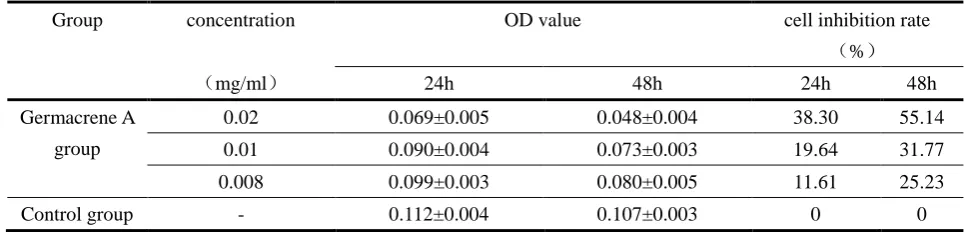
After treatment with different concentrations of
germacrene A, cell growth was inhibited to varying
degrees, and this effect showed time and concentration
dependence, as shown in Table 1 and Figure 9. At the
same time, the inhibition rate increases with the increase
of the concentration; at the same concentration, the
inhibition rate increases with the increase of the action
time.
Table 1: Effect of in vitro Germacrene A on cell growth inhibition
Group concentration OD value cell inhibition rate
(%)
(mg/ml) 24h 48h 24h 48h
Germacrene A
group
0.02 0.069±0.005 0.048±0.004 38.30 55.14
0.01 0.090±0.004 0.073±0.003 19.64 31.77
0.008 0.099±0.003 0.080±0.005 11.61 25.23
Control group - 0.112±0.004 0.107±0.003 0 0
5
EXPERIMENTAL
DISCUSSION
AND
PROSPECTS
T24 cells are wedge-shaped or long fusiform, adherent
growth, T24 cells without drug treatment have strong
growth, large cell density, uniform growth distribution,
clear outline and clear cell membrane. After TMA cells
treated with germacrene A, cell growth was inhibited,
the number of cells was significantly reduced, and the
cell volume was also significantly reduced. The shape
was gradually changed from a wedge shape to a
polygonal shape, as the action time lengthens, the
phenomenons such as shedding, shrinkage,
fragmentation begin to appear. And as the concentration
of the drug is increased, the change in cell morphology
is more obvious, and the number of cell survival is less,
showing a certain gradient.
Normal living cells, whose membrane structure are
intact ,can repel the trypan blue, so that the trypan blue
can not get inside the cells; While the cells that lose
activity or incomplete cell membranecan be dyed blue
by trypanblue because the permeability of the membrane
increases, It can be considered that the cell has died
when cell membrane lose integrity, and it has same
effect on necrotic, So living cells and dead cells can be
distinguished quickly and easily.
Afer the T24 cells treated with germacrene A were
stained with trypan blue, it can be found that the cells
began to die and the cell density decreased when they
are reacted with different concentrations of germacrene
A. Compared with the viable cells, the dead cells were
stained. Compared with the blank control group, the
morphological effect of germacrene A on T24 cells was
significant, and it became more and more significant
with the increase of concentration. From this result, it
can be seen that gemalene A has a significant effect on
The principle of MTT assay is that succinate
dehydrogenase in living cell mitochondria can reduce
exogenous MTT to water-insoluble blue-purple crystal
formamidine and deposit it in cells, while dead cells do
not. Dimethyl sulfoxide can dissolve the
hyperthyroidism in the cells, and its light absorption
value is measured by a microplate reader at a
wavelength of 490 nm. The amount of MTT crystal
formation is proportional to the number of cells in a
certain cell number range. The number of viable cells is
judged based on the measured absorbance value.
From the result of the experiment which detects the
proliferation of germacrene A on T24 cells by the MTT
assay, it can be found that after different concentrations
of germacrene A, the growth of cells is affected to
varying degrees. With the increase of drug concentration,
the cell inhibition rate begins to rise; the action time is
longer, the inhibition rate is higher. This inhibition of
cancer cells exhibits a dependence on time and
concentration. Germacrene A has a very significant
effect in inhibiting the proliferation of bladder cancer
T24 cells, especially under high dose treatment. The
discovery of this phenomenon is conducive to the further
study of germacrene A, which can provide a certain
experimental basis for the clinical trial of germacrene A.
From the above experimental results, it can be found that
after different concentrations of germacrene A, cell
growth was inhibited by different levels, and the
inhibition was time-dependent and concentration-
dependent. Germacrene A can inhibit the growth of
cancer cells in a concentration-dependent manner, and
high dose can significantly prevent the proliferation of
cancer cells. The drug effects at different times also have
different effects on tumor cells. These results
demonstrate that germacrene A has a good performance
in inhibiting tumor cell proliferation. This finding
contributes to the experimental basis for further research
and clinical trials of gemasene A.
In summary, gemalene A has obvious curative effect on
anti-tumor effect. The anti-tumor mechanism of
germacrene A may be through induction of apoptosis,
but a clearer mechanism remains to be explored.
Nowadays, the anti-tumor mechanism of β-elemene,
which has been put into clinical use, has been relatively
mature, and it has made some progress in the research on
the mechanism of anti-drug resistance 13-14 . Further
investigation and research are needed on the study of
resistance of germacrene A.
Cancer is one of the leading causes of human death, and
countless researchers are working on anti-tumor drugs.
For the research of anti-tumor drugs, the road is still
very long, and it is an inevitable trend to continuously
explore new drugs. With the development of
biotechnology, synthetic biology has become a green
production method, which has important significance in
the research of various natural medicines 15, and its
development prospects are worthy of expectation.
REFERENCES
[1] Zhang J, Zhang Hd, Chen L et al. β-elemene reverses chemoresistance of breast cancer via regulating MDR-related microRNA expression [J].Cell Physiolog Biochem,2014; 34(6):2027-2037.
[2] Tan W, Lu J, Huang M, et al. Anti-cancer natural products isola-ted from chinese medicinal herbs [J]. Chinese Medicine, 2011; 6(1):27. [3] Paddon C J, Westfall P J, Pitera D J, Benjamin K, Fisher K, Mcphee D et al. High-level semi-synthetic production of the potent antimalarial artemisinin [J]. Nature, 2013, 496(7446):528-532. [4] Zhang R, Tian A, Shi X, et al. Downregulation of IL-17 and IFN-γ
encephalomyelitis [J]. Int Immunopharmacol, 2010; 10 (7):738-743. [5] Zhang X, Li Y, Zhang Y, et al. Beta-elemene blocks epithelial mesenchymal transition in human breast cancer cell linee MCF-7 through Smad3-Mediated down-regulation of nuclear transcription factors [J]. PLo S One, 2013; 8(3):e58719.
[6] Shi H, Liu L, Chen L, et al. Inhibition of tumor growth by β-elemene through dow nregulation of the expression of u PAR, MMP-2, and MMP-9 in a murine intraocular melanoma modet [J]. Melanoma Res, 2015; 25(1):15-21.
Chin J Cancer Res, 2013; 25(6):770-776.
[8] Li CL, Chang L, Guo L, et al. β-elemene Induces Caspase-dependent Apoptosis in Human Glioma Cell in vitro through the Up-regulation of Bax and Fas / Fas L and Downregulation of Bcl-2[J]. Asian Pac Asian Pac J Cancer Prev, 2014; 15(23):10407-10412.
[9] Li Q, Wang G, Huang F, et al. Antineoplastic effect of beta-elemene on prostate cancer cells and other types of solid tumour cells [J]. J Pharm Pharmacol, 2010; 62(8):1018-1027.
[10] Chen W, Lu Y, Wu J, et al. Beta-elemene inhibits melanoma growth and metastasis via suppressing vascular endothelial growth factor-mediated angiogenesis [J]. Cancer Chemother Pharmacol, 2011; 67(4):799-808.
[11] Andrianantoandro E, Basu S, Karig DK, et al. Synthetic biology: new engineering rules for an emerging discipline. Mol Syst Biol, 2006; 2(1):2006.0028.
[12] Zhou T, Huang LQ, Lü DM. Modes and types of protecting natural resources of Chinese medicine [J]. China J Chin Mater Med, 2008; 33:1353−1356.
[13] Xu H, Li L, Fu J, et al. Reversion of Multidrug Resistance in a Chemoresistant Human Breast Cancer Cell Line by β-Elemene[J]. Pharmacology, 2012; 89(5/6):303-312.
[14] Yao C, Tu Y, Jiang J, et al. β-elemene reverses the drug resistance of lung cancer A549/DDP cells via the mitochondrial apoptosis pathway [J]. Oncol Rep, 2014; 31(5):2131-2138.