ARTICLE
Evaluation of a Learning Collaborative to Improve
the Delivery of Preventive Services by
Pediatric Practices
Paul C. Young, MDa,b, Gordon B. Glade, MDa,c, Gregory J. Stoddard, MPHd, Chuck Norlin, MDa,b
aUtah Pediatric Partnership to Improve Healthcare Quality, Salt Lake City, Utah;bDepartment of Pediatrics, University of Utah School of Medicine, Salt Lake City, Utah; cUtah Valley Pediatrics, American Fork, Utah;dDepartment of Medicine, University of Utah School of Medicine, Salt Lake City, Utah
The authors have indicated they have no financial relationships relevant to this article to disclose.
ABSTRACT
OBJECTIVE.Effective delivery of preventive services is an essential component of high-quality pediatric health care. However, both variation in and deviation from accepted guidelines have been reported. Learning collaboratives (LCs) have been shown to result in improvement in several aspects of pediatric care. The objective of this study was to determine whether pediatric practices that participated in a preventive services LC would improve their delivery of preventive services.
METHODS.After conducting an initial audit of the medical records of twenty 2-year-olds and twenty 4-year-2-year-olds for documentation of preventive services on the basis of national standards, practice teams attended a quality improvement workshop. They were presented with evidence to support the value of preventive services and the results of their audits and taught quality improvement methods, eg, rapid cycles of change. Each team developed plans to improve 1 or more services. Brief audits with feedback and monthly conference calls were used to support practices to conduct rapid cycles of change, to discuss barriers and solutions, and to monitor progress. The results of final chart audits of twenty 2-year-olds and 4-year-olds were compared with the initial chart audits. A Preventive Service Score (PSS) was assigned to each practice on the basis of the number of services provided, and initial to final comparisons were made.
RESULTS.Fourteen practices participated. PSSs improved for all practices after the LC. Mean PSS for 2-year-olds increased from 4.0⫾1.1 to 4.9⫾1.2 and for 4-year-olds increased from 3.8⫾1.8 to 5.6⫾1.9. The proportions of children who received 9 of the 10 individual preventive services also improved significantly.
CONCLUSION.LCs are a potentially effective method of improving the quality of care that is delivered by pediatric practices.
www.pediatrics.org/cgi/doi/10.1542/ peds.2005-2210
doi:10;1542/peds.2005-2210
This work was presented in part at the Pediatric Academic Societies meeting; May 17, 2005; Washington, DC.
Key Words
quality improvement, preventive services
Abbreviations
NICHQ—National Initiative for Child Healthcare Quality
LC—learning collaborative QI— quality improvement AAP—American Academy of Pediatrics IPS—Intermountain Pediatric Society UPIQ—Utah Pediatric Partnership to Improve Child Healthcare Quality VCHIP—Vermont Child Health Improvement Project PSS—preventive service score ETS— environmental tobacco smoke
Accepted for publication Oct 17, 2005 Address correspondence to Paul C. Young, MD, Department of Pediatrics, University of Utah School of Medicine, 50 N Medical Dr, Salt Lake City, UT 84132. E-mail: paul.young@hsc. utah.edu
T
HE GAP BETWEENthe quality of health care that pa-tients should receive and the care that they actually do receive is widely recognized.1–3 Increasingly, thecauses of this “chasm” are understood as defects in the system in which care is delivered rather than as resulting from a lack of knowledge or desire on the part of indi-vidual physicians or other providers.2,3To assist
provid-ers to develop the knowledge and skills that are neces-sary to improve quality, national organizations such as the Institute for Healthcare Improvement and the Na-tional Initiative for Child Healthcare Quality (NICHQ) have developed approaches called breakthrough series and learning collaboratives (LCs). These improvement partnerships bring health care provider teams together to learn how to overcome within their particular system (eg, a hospital, practice, clinic) the barriers that impede the delivery of high-quality care. Together, they learn to identify an explicit quality goal or aim, to work with their team to develop innovative plans for change within their system, and to use appropriate measurement tools to indicate whether the changes do result in the desired improvement. Two states, Vermont and North Carolina, have developed statewide improvement partnerships of providers and quality experts to help pediatric practices learn about and engage in practice-based quality im-provement (QI) activities. Their reports and those of others have demonstrated success in improving the care of children in the areas of preventive services, develop-mental screening, asthma, and attention/deficit-hyper-activity disorder.4–8
Preventive services, also known as well-child care or health supervision/health promotion, are the most com-mon services delivered by primary care pediatricians. The American Academy of Pediatrics (AAP) has devel-oped a periodicity schedule, Recommendations for Pre-ventive Pediatric Health Care, specifying the content, frequency, and timing of the components of preventive services.9Most states and many insurers have adopted
the schedule, and there is general agreement that the recommendations serve as a standard of preventive care for US children. However, it also is widely known that many children do not receive many of the recom-mended preventive services.
Responding to a perceived need to improve quality at the practice level, the Utah chapter of the AAP, also known as, the Intermountain Pediatric Society (IPS), developed the Utah Pediatric Partnership to Improve Child Healthcare Quality (UPIQ). UPIQ brought together many of the major stakeholders for child health care quality in Utah, including, in addition to the IPS, the Department of Pediatrics of the University of Utah School of Medicine; the Division of Health Care Financ-ing of the Utah Department of Health (Medicaid); the Division of Family and Community Health Services of the Utah Department of Health; Intermountain Health Care, a large vertically integrated health care corporation
in Utah; and Health Insight, a QI organization. After consultation with the Vermont Child Health Improve-ment Project (VCHIP) and the NICHQ and with initial funding from the Primary Children’s Medical Center Foundation, UPIQ conducted an LC that was designed to improve the delivery of preventive services by primary care pediatrics practices. In this article, we describe how the LC functioned and report its effect on the delivery of preventive services. We hypothesized that participating practices would improve their delivery of preventive services after the LC.
METHODS
The LC
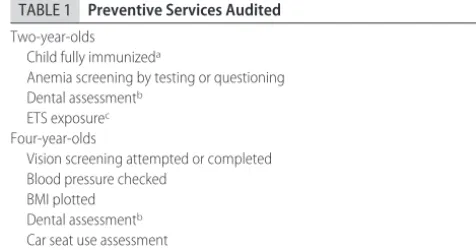
Fourteen practices participated in a 4-phase LC; notices in the chapter newsletter, direct mailings to provider offices, and personal contacts by IPS leadership were used to recruit practices for participation. Each practice formed a team that consisted of a pediatrician, a nurse or medical assistant, and a member of the office adminis-trative staff (eg, receptionist, office manager). In phase 1 of the LC, practice teams audited the medical records of 20 of their 2-year-old and 20 of their 4-year-old patients for evidence that selected preventive services had been provided. Table 1 displays the services that were audited and the criteria that were used for the 2 age groups.
Phase 1 was a 1-day QI workshop. In the first portion of the workshop, a local expert in prevention (Tamara Lewis, MD, Medical Director, Preventive Services, Inter-mountain Health Care, Salt Lake City, UT) presented the evidence for the value of preventive services and de-scribed the current status of prevention efforts in Utah. Teams then were provided with the results of their au-dits and, working with UPIQ and VCHIP/NICHQ staff, identified the particular service or services that they wanted to improve. Teams were taught the essentials of practice-based QI methods on the basis of the “Model for
TABLE 1 Preventive Services Audited Two-year-olds
Child fully immunizeda
Anemia screening by testing or questioning Dental assessmentb
ETS exposurec
Four-year-olds
Vision screening attempted or completed Blood pressure checked
BMI plotted Dental assessmentb
Car seat use assessment Child fully immunizeda
ETS indicates environmental tobacco smoke
aFour doses of diphtheria-tetanus-acellular pertussis/diphtheria-tetanus-pertussis, 4
Hae-mophilus influenzaetype B, 3 inactivated poliovirus, 3 hepatitis B; 1 measles-mumps-rubella, and 1 varicella zoster virus.
Improvement” that was developed by Associates in Pro-cess Improvement (www.apiweb.org) and based on the work of W. Edwards Deming. Emphasis on “small rapid cycles of change” and the “plan, do, study, act” approach were discussed by the VCHIP/NICHQ consultants, who provided examples that were based on the improvement activities of pediatric practices in Vermont. Practice teams then developed specific plans for change and de-signed methods of measurement that would enable them to determine whether the plans had resulted in the desired improvement. A copy of each practice’s plan then was submitted to the UPIQ project manager.
The LC’s third phase consisted of monthly conference calls with the practices, facilitated by UPIQ staff, and brief audits of the medical records of five 2-year-olds and five 4-year-olds. Practices were provided with the results of these audits and those of the other 13 practices in the LC. Each practice’s results were identifiable only to them, but they were able to compare their results with those of the other participating practices that were iden-tified only by a number. During the conference calls, practice teams discussed with each other and with UPIQ staff their plans, results, problems, and the approaches that they had used to overcome problems. The third phase lasted 6 months. Phase 4 was a final audit of the records of twenty 2-year-olds and twenty 4-year-olds that was conducted by the practice teams and that was identical to that in phase 1.
Analysis
We compared the results of the phase 1 and phase 4 audits for each of the preventive services. For the im-munization category, we considered a child to be “fully immunized” when they had received 4 doses of diph-theria-tetanus-acellular pertussis/diphtheria-tetanus-pertussis, 4Haemophilus influenzaetype B, 3 inactivated poliovirus, 3 hepatitis B; 1 measles-mumps-rubella, and 1 varicella zoster virus (4,4,3,3,1,1). Some practices in-cluded audits for heptavalent pneumococcal conjugate vaccine and hepatitis A, but we did not include these in the determination of fully immunized or not, because the recommendation for hepatitis A was relatively new and there had been national and state shortages of hep-tavalent pneumococcal conjugate vaccine. We devel-oped an overall preventive service score (PSS) for the 2 age groups. The PSS was calculated by assigning 1 point for each preventive service provided and summing the results. Results of the phase 1 and phase 4 audits were compared using first the patient and then the practice as the units of analysis. When the patient was the unit of analysis, each patient had a score of 1 when the preven-tive service was performed and 0 when it was not per-formed. Patients were clustered within clinics; therefore, patients in the same clinic were more alike than were patients between clinics. To account for this lack of independence in the data, we used a random-effects
logistic regression model. The proportion of patients with preventive service performed at phase 1 was com-pared with the proportion at phase 4, using the signifi-cance test for the before versus after main effect term. A matched-pairs approach was not used, because the be-fore and after patients were different patients at the 2 sampled time points. For the PSS outcome, a random-effects linear regression model was used. When the prac-tice or clinic was the unit of analysis, a summary mea-sure approach was used. First, the proportion of patients for which the preventive service was performed, sepa-rately for phase 1 and phase 4, was computed. The proportions then were compared using a paired samplet
test. The PSS outcome was tested in the same way. In actuality, the patient as the unit of analysis model tested the same hypothesis as the practice as the unit of anal-ysis comparison. However, the paired samplettest pro-vides a Pvalue that is more aligned with the practice-level descriptive statistics displayed in the corresponding table, as each practice’s proportion is given equal weight in the significance test, just as in the descriptive statistics. We also used a random-effects logistic regression model to test whether goal setting had an effect on whether a preventive service was performed. In this model, how-ever, main effects were included for both goal setting (yes versus no) and time (phase 1 versus phase 4). A goal setting by time interaction term was used to test whether goal setting influences change. Specifically, it tested whether the change from phase 1 to phase 4 was greater when the service was set as a goal compared with when it was not. All reportedPvalues are for 2-sided compar-isons, with aP⬍.05 considered statistically significant. The University of Utah Health Sciences Center Insti-tutional Review Board approved the project. Each prac-tice team member provided informed consent for his or her participation. Because no identifiable patient-related data left the practices, patient consent was not required.
RESULTS
improve the delivery of a particular service when they made improving it a specific goal, we compared the amount of change between audits for practices that chose a particular service as an improvement goal with those that had not selected that service as a goal. These results are shown in Table 4. Goal setting did seem to have an effect on some of the services. For example, practices that decided to target the assessment of expo-sure to environmental tobacco smoke (ETS) at the 2-year well-child checkup demonstrated a mean im-provement of 54% (from 25% to 79%), where practices that did not identify this service as a goal showed a mean improvement of 27% starting from a similar baseline. As can be seen in the tables, however, the relationship between goal setting and improvement was inconsistent.
DISCUSSION
There is a widely recognized need to improve the quality of the American health care system. Although there are many aspects to QI, one that has received much
atten-tion is the importance of reducing deviaatten-tion and varia-tion from evidenced-based or generally agreed-on best practice guidelines for care. Just as the goal of biomedical research is to reduce the gap between “what we know and what we don’t know,” the goal of QI interventions is to narrow the gap between “what we know and what we do.” Although the evidence base for many aspects of primary health care for children is either thin or nonex-istent, preventive services generally are agreed on to be beneficial. Their content and value for children generally are agreed on by professional organizations such as the AAP,9and most pediatricians believe that children who
receive them are likely to have better outcomes com-pared with those who do not. Some of the preventive services that are targeted by the UPIQ preventive ser-vices LC, such as immunizations and vision screening, have a stronger evidence base with regard to improved child health than others, such as screening for exposure to ETS by questioning parents or screening for over-weight by determining the BMI.10 Although we
recog-nize the importance of conducting research to determine
TABLE 2 Before-and-After Comparisons Using the Total Number of Patients as the Unit of Analysis
Preventive Service Performed Initial Final P
Two-year-olds, % total sample (range among practices) N⫽267 N⫽265
Fully immunized 64 (30–100) 81 (41–100) ⬍.001a
Anemia screening 48 (5–95) 59 (0–100) .002a
Dental assessment 67 (20–100) 91 (67–100) ⬍.001a
ETS exposure assessment 26 (0–85) 65 (0–100) ⬍.001a
PSS, total sample mean⫾SD 4.0⫾1.1 4.9⫾1.2 ⬍.001b
Four-year-olds, % total sample (range among practices) N⫽277 N⫽252
Fully immunized 75 (45–100) 75 (22–100) .96a
Vision screening 45 (0–100) 78 (30–100) ⬍.001a
BP screening 59 (10–100) 77 (20–100) ⬍.001a
BMI recorded 23 (0–90) 47 (0–100) ⬍.001a
Dental assessment 30 (0–95) 67 (0–100) ⬍.001a
Car seat advice 39 (0–100) 73 (10–95) ⬍.001a
PSS, mean⫾SD 3.8⫾1.8 5.6⫾1.9 ⬍.001b
aRandom-effects logistic regression. bRandom-effects linear regression.
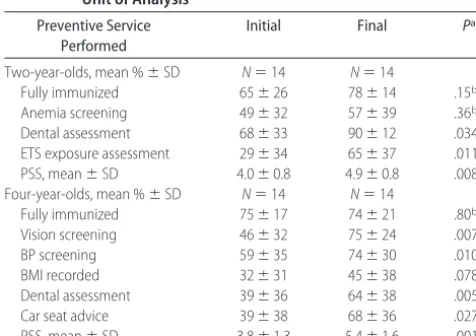
TABLE 3 Before-and-After Comparisons Using the Practice as the Unit of Analysis
Preventive Service Performed
Initial Final Pa
Two-year-olds, mean %⫾SD N⫽14 N⫽14
Fully immunized 65⫾26 78⫾14 .15b
Anemia screening 49⫾32 57⫾39 .36b
Dental assessment 68⫾33 90⫾12 .034b
ETS exposure assessment 29⫾34 65⫾37 .011b
PSS, mean⫾SD 4.0⫾0.8 4.9⫾0.8 .008a
Four-year-olds, mean %⫾SD N⫽14 N⫽14
Fully immunized 75⫾17 74⫾21 .80b
Vision screening 46⫾32 75⫾24 .007
BP screening 59⫾35 74⫾30 .010
BMI recorded 32⫾31 45⫾38 .078
Dental assessment 39⫾36 64⫾38 .005
Car seat advice 39⫾38 68⫾36 .027
PSS, mean⫾SD 3.8⫾1.3 5.4⫾1.6 .001
aPaired samplettest.
TABLE 4 Effect of Goal Setting
Preventive Service % at Baseline (% Change) Pa
If Service Was a Goal
If Service Was Not a Goal
Two-year-olds
Fully immunized 55 (28) 68 (11.5) .075
Anemia screening 48 (14) 48 (10) .58
Dental assessment 46 (47) 76 (13.5) .002
ETS exposure assessment 25 (54) 27 (27) ⬍.001 Four-year-olds
Fully immunized 90 (⫺20) 74 (1) .114
Vision screening 42 (32) 49 (34) .80
BP screening 38 (24) 68 (16) .56
BMI plotted 21 (51) 25 (⫺5) ⬍.001
Dental assessment 29 (38) 31 (37) .86
Car seat advice 57 (36) 30 (24) ⬍.001
whether providing preventive services actually benefits children, the mission of UPIQ is to assist pediatricians with implementing in their practice changes that result in consistently delivering a high level of the particular aspect of pediatric practice that UPIQ’s leadership, in collaboration with practitioners, believes to be best prac-tice, on the basis of the available evidence and expert opinion. There is evidence to suggest that even immu-nizations, perhaps the most uniformly agreed-on pre-ventive service for children, is provided inconsistent-ly.5,11
Practice-based QI projects such as the one described here assume that clinicians know what it is they want to do but face within their practices barriers that prevent them from doing it consistently. They are designed to help them first to identify these barriers and then to develop and implement quickly plans to overcome the barriers, to use measurement tools to determine whether the plans are working, and to use rapid small cycles of change to make any necessary adjustments. Our results add to a growing body of literature that suggests that when practice teams engage in joint im-provement partnerships and receive appropriate sup-port, quality does improve in a measurable way.6–8,12,13
We engaged 14 practices in a preventive services LC that included prework, ie, an initial determination by chart audit of how well they were doing with delivering selected preventive services. From the list of preventive services that are recommended by the AAP’s periodicity schedule,9we chose some traditional services, such as
being up to date for immunizations at age 2 and assess-ing car seat use, and some that were of particular local interest, such as assessing exposure to ETS and deter-mining and plotting the BMI at age 4. Our goal was not to convince practices of the value of the selected services but to help practices deliver the ones that they them-selves thought were appropriate for their patients. In reality, the services that we selected required little selling to the practices, but the teams varied in their choices of services that were targeted for improvement. For exam-ple, 7 of the 14 practices wanted to improve the propor-tion of 4-year-olds who had a BMI plotted, 7 wanted to improve the proportion of their patients who had a vision screen, and 3 chose to improve their rates of anemia screening. Only 1 team chose to improve the proportion of 4-year-olds in their practice who were fully immunized. This may reflect the results of the initial audits, which revealed that practices were more successful in delivering this service than any of the oth-ers.
The second phase of the LC was a 1-day QI workshop. Presentations were made by VCHIP staff (Drs Paula Dun-can and Wendy Davis and Kim Paul, an improvement specialist) describing the Model for Improvement and Rapid Cycles of Change using “plan, do, study, act” cycles. The Model for Improvement includes the
impor-tance of setting a goal (what are we trying to achieve?), of developing a plan (what innovative ideas for change can we develop?), and the importance of measurement (how will we know that the change resulted in an im-provement?). Teams were provided with tools to de-velop plans and measurement tools. UPIQ staff then worked with each team on the specific details of their plans and measures and established the protocols for follow-up conference calls and audits. Teams had little difficulty determining which services on which to work. However, the importance of implementing changes on a small scale right away and systematically measuring the results were new to most of the practices. Those from larger practices expressed frustration with some of their earlier attempts at change because of a necessity to ob-tain agreement from everyone in the practice before anything could be changed. UPIQ and VCHIP staff sug-gested instead that the team start, for example, with 1 physician, on 1 afternoon, with 1 subset of patients and measure what happened. In contrast, 1 solo practitioner whose entire staff, consisting of himself and 3 staff mem-bers, attended the workshop, decided on an improve-ment plan, and, not needing to get approval from any-one else, implemented it within a few days!
The third phase of the LC was a 6-month period of monthly conference calls, audit, and feedback to the practices. Practice teams audited 5 charts in each of the age groups, submitted the results to UPIQ, and then were provided with their results and those of the other participating practices; the latter were presented anony-mously. Participation in this phase of the LC varied from month to month and among the practices, but all prac-tices completed some of the audits and participated in some of the conference calls.
practice changes, which are likely to be the most impor-tant to the practice teams and will influence how likely they are to extend the approach to other services.
One of the reasons for variability among the practices may have been related to whether the practice chose a particular service as an improvement goal. We antici-pated that a practice would be much more likely to improve the delivery of a service when they chose im-proving it as a specific goal. However, as shown in Table 4, this was not consistently the case. Of the 4 practices that set improving dental screening of 4-year-olds as a goal, 1 went from 100% to 95%, 1 went from 0% to 60%, and 1 went from 100% to 89%, whereas the mean change for the other 11 practices was an improvement from an initial 33% to 65%. Conversely, all 6 practices that targeted screening for ETS exposure improved (mean from 30% to 80%), whereas only 1 of the other 8 improved with respect to this service.
Others have reported positive results from efforts to improve quality at the practice level. Margolis et al6
described a randomized, controlled trial that compared 22 primary care practices in North Carolina that received conventional continuing medical education with 22 that received continuing medical education plus training in process improvement. There was significant and sus-tained improvement in the intervention practices in the delivery of 4 preventive services to children compared with control practices. In another study, this group re-ported that delivery of appropriate anticipatory guidance to 1- and 6-month-olds increased significantly in the intervention practices compared with control practices, although the final percentages achieved still were rela-tively low (24% in the 1-month-olds and 18% in the 6-month-olds).12Shaw et al7from the VCHIP described
significant and clinically important improvement in the delivery of preventive services by pediatric practices in Vermont. VCHIP staff served as consultants for the UPIQ project, and there are many similarities between the processes that are used by VCHIP and by UPIQ. Some outcomes of care for adults with asthma improved after a breakthrough series asthma care collaborative involv-ing 6 intervention and 3 control sites. In particular, patient self-management practices, which were targeted by the faculty and by the practices, showed clinically important levels of improvement.13More impressive
re-sults with respect to asthma were reported by Cloutier et al.8Six primary care urban clinics in Connecticut were
enrolled in a disease management program that resulted not only in improved adherence to National Asthma Education and Prevention Program guidelines but also in significant reductions in rates of hospitalization and emergency department visits for children with asthma after the intervention.
Despite these reports of success, some have expressed skepticism regarding the benefits of quality collabora-tives, citing highly variable results, inconsistent
ap-proaches, and generally small sample sizes.14–17A recent
Cochrane Review of QI interventions that were tailored specifically to identify and overcome barriers to change concluded that the effectiveness of such interventions was uncertain and that more rigorous trials were need-ed.16
Some experts in QI characterize the goals of projects such as the one we conducted as improving the “reli-ability” of health care.18–20 The reliability level is
deter-mined by dividing the number of times that a service is provided correctly by the total number of times that it should have been provided. According to Nolan et al18at
the Institute for Healthcare Improvement, level 1 reli-ability is achieved when 90% of the time the patient receives the desired care. Stated another way, this is an error rate of 10⫺1. Some segments of the American
economy strive for and achieve rates of 10⫺6. The
ap-proach that we evaluated for this report is unlikely to achieve rates that exceed level 1, according to many experts.18–20 However, the practices that agreed to
par-ticipate in our LC were not achieving rates of 90% reliability in the delivery of preventive services. Achiev-ing even level 1 reliability would be, we believe, of great value for our patients.
Research to determine the best method of improving health care and evaluating whether a particular QI in-tervention has been successful and whether its results are generalizable presents numerous challenges.14–21
Krumholz and Herin21listed 5 challenges that those who
particular geographic area are important for others to consider when developing their own QI initiatives. Fi-nally, most QI interventions actually contain multiple strategies, and it is difficult to determine which compo-nent is most effective. The LC that we describe here contained at least 4 components: baseline measurement; a 1-day workshop; a 6-month period of conference calls, audit, and feedback; and a final measurement. We did not attempt to determine or compare the value of any of these individual components, and it is potentially impor-tant to do so. For example, the 1-day workshop required that a 3-person team from each practice attend, but we acknowledge that the absence of key personnel from a practice is disruptive and expensive. We believe that bringing the practice teams together to hear experts in QI to develop jointly plans for change and appropriate measurement tools was a valuable part of the LC, but if measurement, audit, feedback, and brief conference calls alone were just as effective, then more practices may be willing to participate. Additional research that is devoted to examining which components of a QI project or an LC and doing so in a more rigorous manner should be undertaken.21
In addition to the issues noted above, there are sev-eral other important limitations to the study reported here. First, participation in the LC was voluntary; the practice teams that participated may not be representa-tive of pediatric practices in general. Second, there were no control practices. It is possible that the practices that did participate might have improved without participat-ing in the LC. Third, the before-and-after results are based on data from chart audits of a modest number of patients. Fourth, we did not attempt to measure actual child health outcomes, and we cannot assume that even if the children had received the services, their health would be better. Finally, we do not know whether these results will be sustained over time.
Despite the limitations of our study and of those reported by others, our findings are suggestive that mo-tivated practice teams can learn and apply easily basic improvement methods and, when they do so, that the quality of the care that they deliver seems to improve. However, we believe that pediatricians want to improve the reliability of preventive and other services beyond the levels achieved here. Nolan et al18 described the
attitudes and innovations that are required to achieve 95% to 98% reliability in health care settings, and in-terested readers are referred to their white paper, which is downloadable from the Institute for Healthcare Im-provement (www.ihi.org).
Although we chose to focus on the preventive ser-vices that are listed in the AAP guidelines,9some have
suggested that new approaches to well-child care, em-phasizing behavioral and developmental issues, are needed.22 We believe that the approach described here
could be used easily to target and improve the quality of
care related to these important services. We also believe that participation in LCs or similar improvement part-nerships that are led by state AAP chapters or other professional organizations would be a good way for pe-diatricians to meet the American Board of Pediatrics’ new requirements for pediatricians to engage in QI ac-tivities to maintain their board certification.
ACKNOWLEDGMENTS
This project was supported in part by a grant from the Primary Children’s Medical Center Foundation and a Building Research Infrastructure and Capacity grant from the Agency for Healthcare Research and Quality (59001414).
REFERENCES
1. Homer CJ. Quality in pediatrics: a progress report to the Amer-ican Academy of Pediatrics.Pediatrics.2001;108:1362–1364 2. Committee on Quality of Health Care in America, Institute of
Medicine.Crossing the Quality Chasm: A New Health System for the 21st Century. Washington, DC: National Academy Press; 2001 3. Plsek P. Quality improvement methods in clinical medicine.
Pediatrics.1999;103(1 suppl E):203–214
4. Bordley WC, Margolis PA, Stuart J, Cannon C, Keyes L. Im-proving preventive service delivery through office systems.
Pediatrics.2001;108:1– 8
5. Bordley WC, Margolis PA, Lannon CM. The delivery of immu-nizations and other preventive services in private practices.
Pediatrics.1996;97:467– 485
6. Margolis PA, Lannon CM, Stuart JM, Fried BJ, Keyes-Elstein L, Moore DE Jr. Practice based education to improve delivery systems for prevention in primary care: randomized trial.BMJ.
2004;328:388
7. Shaw J, Wasserman R, Barry S, et al. Statewide QI outreach improves preventive services for young children [abstract].
Pediatr Res.2003;53:21A
8. Cloutier MM, Hall CB, Wakefield DB, Bailit H. Use of asthma guidelines by primary care providers to reduce hospitalizations and emergency department visits in poor minority, urban chil-dren.J Pediatr.2005;146:591–597
9. American Academy of Pediatrics, Committee on Practice and Ambulatory Medicine. Recommendations for Preventive Pedi-atric Health Care.Pediatrics.2000;105:645– 646
10. US Preventive Services Task Force.Guide to Clinical Preventive Services.3rd ed. 2000 –2002. Washington, DC: Office of Disease Prevention and Health Promotion, US Government Printing Office; 2002
11. Centers for Disease Control and Prevention (CDC). National, state, and urban area vaccination coverage levels among chil-dren aged 19 –35 months. United States, 2000.MMWR Morb Mortal Wkly Rep.2001;50:637– 641
12. Rosenthal MS, Lannon CM, Stuart JM, Brown L, Miller WC, Margolis PA. A randomized trial of practice based education to improve delivery systems for anticipatory guidance.Arch Pedi-atr Adolesc Med.2005;159:456 – 463
13. Schonlau M, Mangione-Smith R, Chan KS, et al. Evaluation of a quality improvement collaborative in asthma care: does it improve processes and outcomes of care?Ann Fam Med.2005; 3:200 –208
15. Solberg LI. If you’ve seen one quality improvement collabora-tive. . . .Ann Fam Med.2005;3:198 –199
16. Shaw B, Cheater F, Baker R, et al. Tailored interventions to overcome identified barriers to change: effects on professional practice and health care outcomes [Cochrane review]. In:The Cochrane Library, Issue 3. Chichester, United Kingdom: John Wiley & Sons, Ltd; 2005
17. Mittman BS. Creating the evidence base for quality improve-ment collaboratives.Ann Intern Med.2004;140:897–901 18. Nolan T, Resar R, Haraden C, Griffen FA.Improving the
Reliabil-ity of Health Care. Cambridge, MA: Institute for Healthcare
Improvement; 2004. Available at: www.ihi.org. Accessed Oc-tober 10, 2005
19. Muething SE, Kotagal U. Reliability of the health care delivery system.J Pediatr.2005;146:581–582
20. Acton JD, Kotegal U. Improvements in healthcare: how can we change the outcome?J Pediatr.2005;147:279 –281
21. Krumholz HM, Herin J. Quality improvement studies: the need is there but so are the challenges.Am J Med.2000;109: 501–503
22. Schor EL. Rethinking well-child care. Pediatrics. 2004;114: 210 –216
INTERNATIONAL TELERADIOLOGY
“In published studies of teleradiology, reports of technical problems have been rare, and the readings have been rapid (average turnaround, one hour) and accurate. The American College of Radiology (ACR) had, unsurprisingly, stated that it is ‘very concerned’ about overseas teleradiology, though its concern is tempered by a recognition that the practice fills a vacuum left by its own members, who would like to sleep at night. The ACR recommends that radiologists who are performing distant readings be board certified and carry licenses and malpractice coverage in the state where the image was obtained and appropriate credentials at the source facility. Several hundred US hospitals use overseas teleradiology services. Industry leaders, such as Teleradiology Solutions, NightHawk Radiology Services, and Virtual Radio-logic, state that they adhere to the ACR guidelines with respect to licensure, insurance, and hospital privileges. As for compensation, regulations of the Centers for Medicare and Medicaid Services (CMS) prohibit payments to providers outside the United States—an obstacle that many of the companies finesse by providing a ‘preliminary report,’ which is later followed by a US radiologist’s ‘final primary report.’ The overseas radiologists are paid directly (by the hospital or the local radiologists) at a rate of $50 to $75 per radio-graph, whereas the local radiologists bill the payer.”
Wachter R. The ‘dislocation’ of US medicine—the implications of medical outsourcing.N Engl J Med.
DOI: 10.1542/peds.2005-2210
2006;117;1469
Pediatrics
Paul C. Young, Gordon B. Glade, Gregory J. Stoddard and Chuck Norlin
Services by Pediatric Practices
Evaluation of a Learning Collaborative to Improve the Delivery of Preventive
Services
Updated Information &
http://pediatrics.aappublications.org/content/117/5/1469 including high resolution figures, can be found at:
References
http://pediatrics.aappublications.org/content/117/5/1469#BIBL This article cites 18 articles, 9 of which you can access for free at:
Subspecialty Collections
sub
http://www.aappublications.org/cgi/collection/quality_improvement_ Quality Improvement
_management_sub
http://www.aappublications.org/cgi/collection/administration:practice Administration/Practice Management
following collection(s):
This article, along with others on similar topics, appears in the
Permissions & Licensing
http://www.aappublications.org/site/misc/Permissions.xhtml in its entirety can be found online at:
Information about reproducing this article in parts (figures, tables) or
Reprints
DOI: 10.1542/peds.2005-2210
2006;117;1469
Pediatrics
Paul C. Young, Gordon B. Glade, Gregory J. Stoddard and Chuck Norlin
Services by Pediatric Practices
Evaluation of a Learning Collaborative to Improve the Delivery of Preventive
http://pediatrics.aappublications.org/content/117/5/1469
located on the World Wide Web at:
The online version of this article, along with updated information and services, is
by the American Academy of Pediatrics. All rights reserved. Print ISSN: 1073-0397.