University of Pennsylvania
ScholarlyCommons
Publicly Accessible Penn Dissertations
1-1-2014
Essays on Service Operations Management
Jaelynn Oh
University of Pennsylvania, [email protected]
Follow this and additional works at:http://repository.upenn.edu/edissertations Part of theBusiness Commons
This paper is posted at ScholarlyCommons.http://repository.upenn.edu/edissertations/1393
For more information, please [email protected].
Recommended Citation
Oh, Jaelynn, "Essays on Service Operations Management" (2014).Publicly Accessible Penn Dissertations. 1393.
Essays on Service Operations Management
Abstract
This dissertation studies three different problems service firms can face. The first chapter looks at the optimal way to price reservations and services when customers make reservations in advance, while they are uncertain about the future value of service, to avoid waiting on the day of service. We show that charging customers the full price as non-refundable deposit when they make reservations and charging zero for service when they show up to claim their reservations is optimal for the firm. When the firm faces very large potential market, then it is better for the firm to not take reservations and accept only walk-ins. The second chapter looks at a problem of how to mitigate worker demotivations due to fairness concerns, when workers have intrinsic difference in quality, and higher quality server tends to be overcrowded by customers willing to receive higher quality service. We suggest distributing workload fairly between workers and compensating workers per workload as potential remedies and show which remedy works well under what operational conditions. We show that compensating workers per customer they serve results in high customer expected utility and expected quality. However, when customers also care about fairness and dislike receiving inferior service compared to other customers, then there does not exist a single remedy that results in both high customer expected utilization and high expected quality. In the third chapter, we study how a service firm should choose its advertising strategy when the service quality is not perfectly known to the customers. We model customers' learning process using a Markov chain, and show that when customers do not perfectly learn the quality of service from advertisements, then the firm is better off by advertising actively when customers' initial belief about service quality is low. Oppositely, when customers initially believe the service quality to be high, then it is better for the firm to stay silent and not use advertisement to signal its quality. In all three chapters, we use game theory to model the interactions among the participants of the problem and find the equilibrium outcomes.
Degree Type Dissertation
Degree Name
Doctor of Philosophy (PhD)
Graduate Group
Operations & Information Management
First Advisor Xuanming Su
Keywords
Game Theory, Pricing, Service Operations Management
ESSAYS ON SERVICE OPERATIONS MANAGEMENT
Jaelynn Oh
A DISSERTATION
in
Operations and Information Management
For the Graduate Group in Managerial Science and Applied Economics
Presented to the Faculties of the University of Pennsylvania
in
Partial Fulfillment of the Requirements for the
Degree of Doctor of Philosophy
2014
Supervisor of Dissertation
Xuanming Su,
Associate Professor of Operations and Information Management
Graduate Group Chairperson
Eric Bradlow,
K.P. Chao Professor, Professor of Marketing, Statistics and Education, Vice-Dean and Director of Wharton Doctoral Programs
Dissertation Committee:
Morris Cohen,
Acknowledgements
I would like to express my special appreciation to my advisor, Professor Xuanming Su,
who has been a great mentor, friend and a supporter throughout my Ph.D. studies. My
non-native English cannot express my thanks to Xuanming enough, but I do not think my
native Korean can do either. I feel extremely grateful to have an advisor who became my
role model both academically and personally. I would also like to thank professor Morris
Cohen and professor Senthil Veeraraghavan for serving as my committee members and for
the brilliant comments and suggestions. I also thank the faculties in the OPIM department I
had interactions with. I felt lucky to be at the same place as the great scholars in operations
management with outstanding scholarly achievements but who still kept humble attitudes
towards life and research.
I thank my friends at Wharton, Hengchen, Jun, Vibhanshu, Hessam, Pnina, Necati,
Alessandro, Santiago, Bob, Joel, Fazil, and John who became my brothers and sisters. I
enjoyed their presence throughout the program, and will truly miss the good times we spent
together as Ph.D. students. I also give thanks to my church friends, Daehwan, Jungmin and
Helen who kept me in their prayers when I was going through hardships of life. I give
special thanks to Myung, who gave me unconditional support and volunteered to be called
as my “crew” to make my first year in Salt Lake City a wonderful one.
I give special thanks to my family. The prayer of my mother and father is what sustained
from them studying overseas. I cannot help but mention my mother’s effort to send
mom-made Korean food to the U.S. to feed me well. I also thank Yonggwan, who gave me the
energy to finish up the dissertation.
Lastly, I thank God, who made all the goodness in my life happen.
“I am not saying this because I am in need, for I have learned to be content whatever
the circumstances. I know what it is to be in need, and I know what it is to have plenty.
I have learned the secret of being content in any and every situation, whether well fed or
hungry, whether living in plenty or in want. I can do everything through him who gives me
ABSTRACT
ESSAYS ON SERVICE OPERATIONS MANAGEMENT
Jaelynn Oh
Xuanming Su
This dissertation studies three different problems service firms can face. The first chapter
looks at the optimal way to price reservations and services when customers make
reserva-tions in advance, while they are uncertain about the future value of service, to avoid waiting
on the day of service. We show that charging customers the full price as non-refundable
deposit when they make reservations and charging zero for service when they show up to
claim their reservations is optimal for the firm. When the firm faces very large potential
market, then it is better for the firm to not take reservations and accept only walk-ins. The
second chapter looks at a problem of how to mitigate worker demotivations due to
fair-ness concerns, when workers have intrinsic difference in quality, and higher quality server
tends to be overcrowded by customers willing to receive higher quality service. We suggest
distributing workload fairly between workers and compensating workers per workload as
potential remedies and show which remedy works well under what operational conditions.
We show that compensating workers per customer they serve results in high customer
ex-pected utility and exex-pected quality. However, when customers also care about fairness and
dislike receiving inferior service compared to other customers, then there does not exist
a single remedy that results in both high customer expected utilization and high expected
quality. In the third chapter, we study how a service firm should choose its advertising
strategy when the service quality is not perfectly known to the customers. We model
cus-tomers’ learning process using a Markov chain, and show that when customers do not
perfectly learn the quality of service from advertisements, then the firm is better off by
when customers initially believe the service quality to be high, then it is better for the firm
to stay silent and not use advertisement to signal its quality. In all three chapters, we use
game theory to model the interactions among the participants of the problem and find the
Contents
Acknowledgements ii
Abstract iv
Contents vi
List of Figures ix
1 Introduction 1
2 Optimal Pricing of Reservations and Services in Queues 5
2.1 Introduction . . . 5
2.2 Literature Review . . . 8
2.3 Model . . . 12
2.3.1 Model Fundamentals . . . 12
2.3.2 Problem Formulation . . . 15
2.4 Analysis . . . 19
2.4.1 Pricing of Reservations . . . 19
2.4.2 Pricing of Services . . . 20
2.4.3 Setting Booking Limits for Reservations . . . 22
2.5.1 Heterogeneous Customers . . . 26
2.5.2 Overbooking . . . 28
2.6 Conclusion . . . 30
3 Workload Inequality and Fairness Concerns in Service Firms 32 3.1 Introduction . . . 32
3.2 Literature Review . . . 34
3.3 Model . . . 37
3.4 Analysis . . . 39
3.4.1 No Fairness Benchmark . . . 40
3.4.2 A Model of Fairness Concerns Among Workers in Service Firms . . 41
3.4.3 Impact of Workload Inequality on Work Performance . . . 43
3.4.4 How to Mitigate Worker Fairness Concerns . . . 45
3.4.5 Comparing the Modes of Operation . . . 46
3.5 Interaction with Customer Fairness Concerns . . . 50
3.5.1 The Effect of Customer Fairness Concerns in Service Quality . . . 51
3.5.2 Impact of Workload Inequality on Work Performance . . . 54
3.5.3 Mitigating Worker Fairness Concerns . . . 55
3.5.4 Comparing the Modes of Operation . . . 56
3.6 Discussion . . . 59
3.7 Conclusion . . . 62
4 Signaling Service Quality through Advertising: A Model of Consumer Mem-ory 64 4.1 Introduction . . . 64
4.2 Literature Review . . . 66
4.4 Results . . . 76
4.5 Conclusion . . . 83
5 Conclusion 85
List of Figures
2.1 Sequence of Events . . . 15
2.2 Customers’ Decision . . . 16
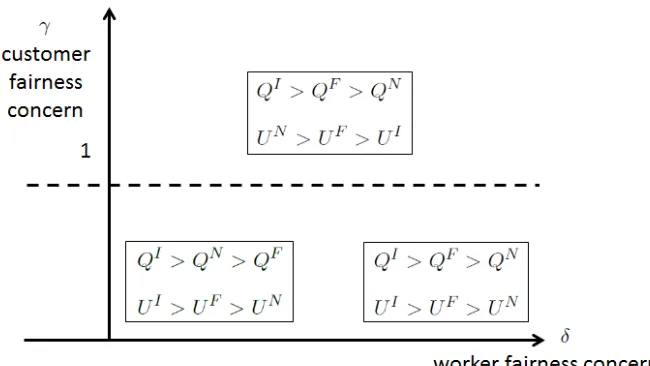
3.1 Summary of the findings in Section 3.4 and Section 3.5 . . . 60
Chapter 1
Introduction
My dissertation thesis is on theoretically modeling the decision makers’ behavior in service
operation management problems. The thesis is comprised of three projects that focus on
problems service firms face.
The first paper, “Optimal Pricing of Reservations and Services in Queues”, looks at
what the optimal pricing policy of reservations for services is. We model the service firm
as a queue and frame reservations as an option selling strategy where strategic customers
pay a non-refundable deposit while they are uncertain about their future valuation of
ser-vice in return for a no-wait guarantee. We characterize the rational expectations equilibrium
and offer recommendations on pricing, which defines the reservation policy to be one of
three regimes: fully-prepaid reservations, partially-prepaid reservations, and no
reserva-tions. The result of our model suggests that service firms should sell fully-prepaid
reser-vations by charging the full price of service for the non-refundable deposit and offering
the service for free if a reservation holder shows up when customers hold homogeneous
expectation about the valuation of service. The firm should have walk-in customers pay a
higher price for service than what the reservation customers pay if it decides to both take
the firm is better off by not offering any reservation and spot selling all its capacity even
though the customers may have to wait on the day of service. We also show that it is
op-timal to sell partially-prepaid reservations when customers hold heterogenous expectations
about the service valuation or the firm allows overbooking. A modeling contribution we
make to the literature is that we model reservations as means to avoid waiting in a queue,
while other existing works see it as a way to secure capacity.
The second paper, “Workload Inequality and Fairness Concerns in Service Firms”,
looks at a problem where service firms hiring multiple workers to supply necessary
ca-pacity, and difference in server ability leading to variance in quality. When customers can
observe the difference in server quality, they tend to crowd the higher quality sever, and
the better workers end up being overloaded with more customers. This may trigger the
good workers’ fairness concerns and lead them to work less hard. We consider two ways
to deal with worker demotivation due to fairness concerns on workload: eliminating and
compensating. A firm can eliminate inequality by distributing customers fairly between
workers, or it can let the inequality in workload persist, but compensate the workers for
having more work by paying workers piece rate. We compare the two remedies using two
metrics, expected customer utility and expected quality. Our results show that eliminating
inequality in workload helps fix the situation and provides higher expected customer utility
and average quality, but compensating workers per customers they serve works even better.
However, when customers also care for equality in service quality, congestion externality
for the higher quality server exacerbates, and a remedy that leads to both high customer
expected utility and average quality no longer exists. In this case, quality-utility trade-off
exists, and paying workers piece rate leads to high expected quality but low customer
ex-pected utility by increasing service quality difference. Distributing workload fairly between
workers then emerges as an option, which provides reasonable quality without sacrificing
aware of, it is the first paper to model fairness concerns of workers in service firms, while
most papers that consider fairness in congestion prone environment talks about customer
fairness concerns about service speed or priority in service.
In the third paper, “Signaling Service Quality through Advertising: A Model of
Con-sumer Memory”, we try to answer how intensively service firms with certain service quality
should advertise when their service qualities are not exactly known to the customers. We
look at a model where the service value, either high or low, is known only to the firm and
customers are only aware of the distribution of the service value. Given its service value,
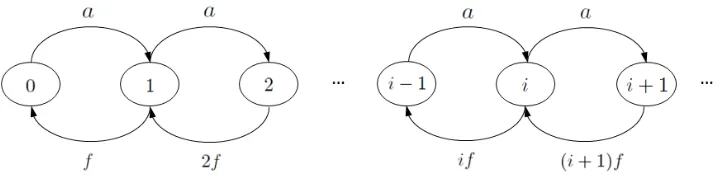
the firm chooses the frequency of advertising messages it releases to maximize profit. Each
customer then encounters and forgets the messages stochastically, and forms heterogeneity
in the number of advertisement messages they remember. Based on the number of
mes-sages a customer remembers, she updates her belief about the firm’s service quality and
strategically decides whether to purchase the service or not by comparing her updated
ex-pected value and the exex-pected cost from crowding at the server that will be incurred upon
purchase. We model the interaction between the firm and the customers using a
signal-ing game. By analyzsignal-ing the separatsignal-ing equilibrium, we first show that when customers’
initial belief about service quality is low, service firms use separating strategy, and they
“actively” use advertisement to attract more customers. Even when the firm chooses a
separating equilibrium, because there is randomness in the way customers encounter and
process the advertisement messages, advertisements cannot signal service quality perfectly.
Therefore, not only a high-quality firm but also a low-quality firm benefits from
advertise-ment for there will be some customers who may think that the firm is of high type after
seeing the ad. We also find that when customers’ initial expected service value is high,
then not only a low-quality firm but also a high-quality firm will prefer not to signal its
quality through advertisement by choosing a pooling strategy. In this case, the high-quality
as the low-quality firm so that the customers cannot update their initial belief about the
Chapter 2
Optimal Pricing of Reservations and
Services in Queues
2.1
Introduction
Reservations for services allow customers to receive immediate service without waiting
and thus, help firms attract delay-sensitive customers. Because of this additional utility
reservations bring to customers, there can be opportunity for higher profit to the firm when
reservations are priced carefully. When choosing the price of reservations, firms should
be aware of customers’ uncertainty about future plans that lead to no-shows and trade-offs
between taking reservations and having walk-in customers wait longer.
As an effort to benefit from the pros and fight the cons, service firms adopt various
reservation policies with different pricing schemes. Some firms that have enough demand
walking in even without reservations choose not to take any reservation. Popular
restau-rants in New York City such as Grimaldi’s Pizzeria and Roberto are well known for not
taking reservations and having their customers queue to dine at their restaurants.
waits on the spot, selling fully-prepaid reservations. Some restaurants and doctor’s offices
sell partially-prepaid reservations by asking for non-refundable deposits to customers (or
patients) making reservations or by taking their credit card information so as to charge a
fee in case of a no-show.
In this paper, we are interested in finding the optimal way to price reservations.
Es-pecially, we intend to answer three questions. First, we study how reservations should be
priced. In order to answer this question we find the optimal non-refundable deposit a firm
should ask for when taking reservations. Depending on the amount of deposit the customers
should pay, reservations can be fully-prepaid or partially-prepaid. Second, we address how
service should be priced with or without reservation. To answer this question, we solve the
optimal prices of service with and without reservation and compare the two. Third, we ask
whether service firms should take any reservation at all and provide conditions under which
reservations are profitable. By answering the above research questions, we can eventually
find which pricing regime among fully-prepaid reservation, partially-prepaid reservation,
and no reservation should be adopted under what operational circumstance.
We build an analytic model where a firm is a monopoly that takes walk-in customers on
the day of service but sets a booking limit in advance to take reservations. When the
num-ber of customers requesting reservations exceeds the booking limit, those excess customers
cannot secure a reservation. Reservation holders receive priority in service and need not
wait in line before being served when they show up for the service. However, when
reser-vations are made, customers need to pay a non-refundable deposit in addition to the price of
service they pay on the day of service when they show up. At the moment customers make
a reservation they are uncertain about their future valuation of service, so that they bear the
risk of losing the deposit if they are unable to keep the reservation. On the other hand, to
customers who were not able to make a reservation, the service firm is a queue where
expectations (RE) and assume that although customers do not know the exact waiting time
they will face in case they walk in without reservations, they form rational expectations
of waiting time, and make their decisions to reserve in advance or walk in on the spot,
accordingly. Customers are strategic in that they anticipate future outcomes and make a
reservation only if theex anteexpected payoff from reservation is higher than that from the
outside option of walking in. In equilibrium, customers make reservation decisions given
their expectations about the wait time and the firm’s price and reservation policy, and the
restaurant determines its optimal deposit and price of service given customers’ behavior.
By solving for the equilibrium non-refundable reservation deposit and service prices,
we first find that it is optimal to sell fully-prepaid reservations to customers that have
ho-mogeneous ex ante valuation of service when the firm does not overbook. That is, the
firm should charge customers the full price of service the moment they make reservations
and provide service for free when reservation holders show up on the day of service. We
also find that when the firm decides to take both reservations and walk-ins, then walk-in
customers should be charged a higher price despite the disutility they incur from
wait-ing. Because the firm can better match capacity with demand from reservation holders,
marginal revenue is higher for unit capacity reserved than the capacity waiting for
walk-ins, and this leads the firm to give discounts to reservation customers. However, when a
firm has a very large potential market size, then it is better that the firm does not take any
reservation. Since reservations are made before customers observe their valuation of
ser-vice, reservation price can only be decided based on customers’ ex antebelief about their
future valuation, whereas walk-in prices can be determined based on the realized valuation
of customers. Thus, when the market size is large, there can be large number of customers
with high realized valuation who are willing to pay high price.
We also show in the extension that partially-prepaid reservations are optimal either
ser-vice. When capacity is overbooked, the firm can serve other customers with capacity
orig-inally reserved but unclaimed by no-shows. Therefore, charging non-zero price for service
can increase profit for the firm. When customers are heterogeneous in their valuation of
service, then the firm charges low reservation deposit and high service price to sell
reser-vation to customers even with low ex ante valuation but induce only the ones with high
realized valuation to keep the reservation.
The reminder of the paper is structured as follows. Section 2 provides literature review.
Section 3 describes the model fundamentals. Section 4 provides the equilibrium analysis.
Section 5 discuss extensions of the model, and Section 6 concludes.
2.2
Literature Review
This paper is closely related to literature on advance selling in which purchase and
con-sumption are temporally separate, and customers are uncertain about the concon-sumption
val-uation and the availability of the capacity at the point of purchase. Shugan and Xie (2000)
show how customers make a purchasing decision when they do not know their valuation
of consumption at the time they purchase the product. They show that service providers
can earn profit up to the level of first degree price discrimination through advance
sell-ing strategy. DeGraba (1995) shows that capacity constraints and the threat of subsequent
unavailability induce customers to buy in advance and allow prices to be set above
market-clearing levels. Shugan and Xie (2005) show how advance selling can increase profitability
of the seller under competition. Reservations are an example of advance selling in that
customers make a reservation when there may still be uncertainty over their preferences at
the time the service will take place.
Some papers in the advance selling literature further develop models of customer
advance selling when customers’ valuations are correlated. Fay and Xie (2008) and Jerath
et al. (2010) study opaque selling where the uncertainty is in “which product” instead of the
consumption valuation of a certain product. In other words, customers make a purchasing
decision without knowing exactly what product or service they will receive from a seller
that sells multiple distinct items. Nasiry and Popescu (2012) look at how anticipated regret
can affect customers’ decision and firms’ profit in an advance selling context. In our paper,
restaurant patrons face two types of uncertainty: an independent idiosyncratic shock on the
day of consumption (reflecting changes in their schedule, mood, or health condition), and
the waiting cost they may incur when walking in without any reservation.
Another stream of research considers advance selling as means to acquire demand
in-formation for a later selling period. Fisher and Raman (1996) look at a quick response
system for fashion products where a greater portion of production is scheduled in response
to initial demand. Tang et al. (2004) suggest an advance booking discount program that
at-tracts customers to commit to their orders prior to selling season. The authors evaluate the
benefit of the program and characterize the optimal price when the seller uses the sales
in-formation collected from the program to update demand forecast for the selling season. In
a similar context, Boyacı and ¨Ozer (2010) study a seller’s capacity decision problem with
exogenously given prices and Prasad et al. (2011) consider the price and inventory decision
when the seller is a newsvendor. Li and Zhang (2013) study preorders as means to acquire
demand information of the regular sales period. They show that accurate demand
informa-tion can increase the availability of the product and thus, undermine the seller’s ability to
charge a high preorder price. Chu and Zhang (2011) consider information that flows from
the seller to the customers. They study how much information about the product the seller
should release in the preorder stage in order to maximize profit. Although some restaurant
managers use reservations to forecast demand and staff accordingly, information is not our
are known both to the restaurant and the customers.
There are papers on the specific topic of reservation systems as a form of advance
selling in the presence of strategic customers. Png (1989) introduces a model where
reser-vations act as an insurance mechanism that allows customers to show up only when their
realized valuation is high. The author shows that when a seller with limited capacity sells
its capacity to risk-averse customers who are uncertain about both the valuation of
con-sumption and the availability of capacity, then the most profitable pricing strategy takes
the form of a reservation system. Our paper is closely related to Gallego and S¸ahin (2006)
in that they compare the revenue under call options (or an advance selling strategy that
charges customers partially refundable fees) to those under pure advance selling, pure spot
selling, and low-to-high pricing to find the best pricing policy. They show that call options
result in significantly higher revenue than all other alternatives for wide range of capacity
levels. They allow the firm to overbook the option capacity, and thus, revenue comes from
the value of capacity itself and the value of option from overbooking. This result is similar
to what we show in the overbooking extension in our paper although our model is
funda-mentally different from theirs in that customers who buy on the spot in our model has to
join a queue and wait before receiving the service. Alexandrov and Lariviere (2012) look
at a restaurant with fixed capacity facing uncertain demand. Customersa prioriincur travel
costs to visit the restaurant and incur additional costs when the restaurant is full and they
cannot receive the service. The authors show that reservation is valuable on nights with
small demand because it reduces uncertainty for customers and increases demand, while
reservation is costly on busy nights due to no-shows. Cil and Lariviere (2013) assume that
advance demand customers who request a reservation are more profitable to the service
provider than customers who walk-in. The service provider then decides how much of a
limited capacity to allocate to advance customers. Georgiadis and Tang (2012) determine
non-refundable deposit to avoid loss from no-shows, and a booking limit. The customers are
heterogeneous and divided into four pools: valuation high or low and show-up probability
high or low. They show that when the capacity and the demand are large so that they can be
approximated by continuous values, then the firm discriminates customers based on their
valuation, whereas when the demand and the capacity are finite, then the customers are
discriminated based on their show-up probability.
As reviewed above, there is a vast body of literature on advance selling, and our work
borrows the concepts introduced in the literature. Note that the three pricing regime that we
consider come from the advance selling literature, where fully-prepaid reservations follow
the form of advance selling, partially-prepaid reservations are call options, and no
reserva-tion corresponds to pure spot selling. However, our work uniquely applies the concept to
a service setting and looks at advance selling as means to avoid waiting in a queue rather
than ways to secure capacity. In addition, or work can be distinguished from the previous
research in that we build one model that can result in one of three different regimes as the
optimal pricing mechanism.
The last stream of literature our work is related to is the queueing literature that study
pricing of services in a congested server. Naor (1969a) studied how a social planner should
price a service when customers who arrive to the service center and queue to obtain the
service cause negative congestion externalities to other customers. Customers have
homo-geneous valuation of the service, incur cost of waiting when standing in the queue, and
decide whether to join the queue upon observing the queue length. The queue in our model
resembles that of Mendelson and Whang (1990a) since customers do not observe the exact
queue length before deciding to join the queue. Customers make the queueing decision
based on their expected waiting cost. For an extensive review on queueing systems, we
re-fer the readers to Hassin and Haviv (2003). In most of the queueing literature, customers’
model to the service operations context, where the corresponding decisions are “whether
to show up after making a reservation,” and whether to “walk in on the spot or reserve in
advance”.
2.3
Model
2.3.1
Model Fundamentals
The Service Firm: The service firm is a monopoly with a fixed market size equal toΛ
and capacity equal toµ. The market size and the capacity are fixed and exogenously given
to the firm. For service that takes place in period 2, the firm takes reservations in period
1. It reserves a proportionαof its capacity to take reservations. Throughout the paper, we
use the term “booking limit” to denote this proportion of capacity reserved. On the day
of service, or in period 2, the firm also takes walk-in customers using its capacity that is
either not booked by reservation customers or was originally reserved but unclaimed by
reservation holders. In our base model we assume that αis exogenous to the firm. Later
we consider the case where the decision of the booking limit,α, is endogenized.
Reservations can be thought of as real call options where the customer pays the price
of reservation, φ, in period 1 for the right to purchase the service in period 2 at service
price, pr. For customers who make a reservation the firm provides service immediately
after their arrival so that reservation holders do not wait before being served when they
show up. When more customers try to make reservations than the capacity reserved to
serve reservation customers, then the firm only takes reservations up to the capacity set
aside for reservation customers.
Customers who were willing but not able to secure a reservation stay in the market to
walking in without reservations may have to wait in line in order to be served upon arriving
to the service firm and are chargedpwfor the service they receive. Thus, to the walk-in
cus-tomers the service process is a queue with an effective arrival rate,λw ∈[0,Λ], determined
in equilibrium, and the capacity,µw, that is used to serve walk-in customers, which
con-sists of the capacity that was originally set aside to receive walk-ins on the spot and capacity
that was originally booked but is unclaimed. In equilibrium, the expected waiting time for
a customer who walks into the firm without reservation is given asw(λw, µw). We do not
assume any specific form of queue for the firm. However, the expected waiting time
func-tion,w(λ, µ), satisfies general convexity conditions: 1)w(λ, µ)is convex and increasing in
λ. 2) It is decreasing inµ. 3) Pooling the capacity is beneficial, i.e.,w(nλ, nµ) < w(λ, µ)
forn >1.
The firm’s decision is to choose the price of service charged to walk-in customers, pw,
price of service charged to reservation customers,pr, and the price of making a reservation,
φ, that maximize its profit. Note that the price of service charged to reservation customers
need not be equal to the price charged to walk-in customers, i.e., pr 6= pw is possible.
We interchangeably use the term option price and strike price for φ andpr, respectively,
throughout this paper.
The Customers: Customers are strategic utility maximizers. They areex ante
homo-geneous butex post differentiated in their valuation of service. A customer’s valuation,v,
consists of two parts,v = v0 +ε. v0 is the average customer valuation, which is known
both to the firm and the customers in period 1. We assume that v0 is exogenously given,
equal for all customers and remains constant. Later in the paper, we relax the assumption
of all customers having the same expected valuation, v0, and consider a model with
het-erogeneous customers. On the day of service, customers face a random shock, ε, in their
valuation of service. The shock may be due to medical emergency, change of outside
density,g, and support,(−∞,∞)and is i.i.d. over all customers. For notational simplicity,
we define a distribution forv to beF with density,f, so thatF(x) =G(x−v0). We useF¯
andG¯to denote the complement ofF andG, respectively, i.e.,F¯= 1−F andG¯ = 1−G.
We assume thatεhas mean0so that the end valuation of service, v, is in expectation the
same as the initial perception of value,v0.
Customers do not observe the queue length at the server before they show up. However,
each customer possesses a belief about how long she will have to wait to be served when
she walks into the firm without making a reservation in advance. We denote the customers’
belief about the expected waiting time using wˆ. For example, customers usually have a
good idea about what the average waiting time at their favorite restaurant is on Saturday
nights and take this knowledge into account when they make their plans. In equilibrium,
each customer’s belief about waiting time is accurate. Based on this belief and the prices
the service firm charges, customers’ decisions are first, whether to make a reservation or to
wait based on their expected valuation. On the day of service, contingent on the realized
valuation, reservation holders decide whether to exercise the option or not, and customers
without reservations decide whether to walk in or not.
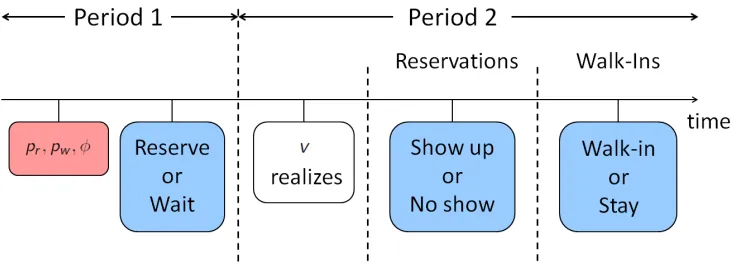
Sequence of Events: Our model is a two-period model. In period 1 the firm chooses the
price of service charged to walk-in customers,pw, price of service charged to reservation
customers, pr, and the non-refundable deposit, φ. Given the prices, customers choose
whether to make a reservation or not without knowing their valuation of service. At the
beginning of period 2, the shock, ε, realizes, and customers observe their valuation of
service,v =v0+ε. Reservation holders first decide whether to show-up or not. Customers
who were not able to secure a reservation in period 1 then decide whether to walk in or stay
home based on their realized valuation and the belief about the expected waiting time. We
use the term “advance period” interchangeably with period 1 and “spot period” or “the day
Figure 2.1:Sequence of Events
2.3.2
Problem Formulation
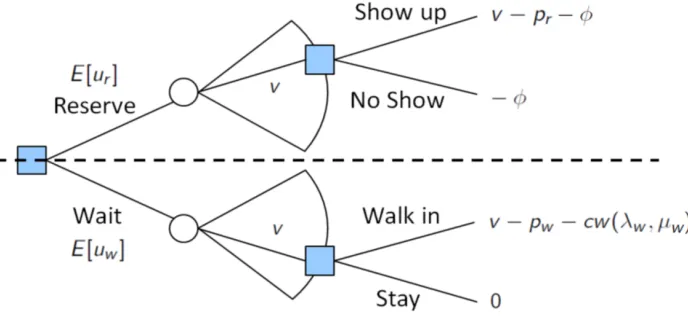
In this section we characterize the Rational Expectations (RE) equilibrium resulting from
our model. Given the belief about the expected waiting time, wˆ, and the price vector,
(pw, pr, φ), chosen by the firm, customers’ decisions are summarized in Figure 2.2. In the
advance period, a customer decides whether to make a reservation or not without knowing
her valuation of service exactly. In the spot period, both reservation holders and walk-in
customers decide whether to purchase the service or not. Given the customers’ strategy, the
firm solves its profit maximization problem to compute the equilibrium price. Customers’
belief, wˆ, on the expected waiting time then should be consistent with the equilibrium
outcome, i.e.,wˆ =w(λw, µw).
The Reservation Market:We first explore a reservation holder’s decision to exercise the
option or not and the resulting profit for the firm from the reservation market. On the day
of service, a customer who has made a reservation observes her valuation shock, ε, and
decides to exercise the option when her realized valuation v = v +ε is greater than the
price of service for reservation holders, pr. Recall that reservation holders need not wait
Figure 2.2:Customers’ Decision
expected utility gained by making a reservation is given as
Ev[ur] =−φ+Ev[v−pr]+ =−φ+
Z ∞
pr
(v−pr)f(v)dv.
Moreover, given that making a reservation is an attractive option for customers, the
equi-librium in-flow of reservation holders who exercise the option and show up on the day of
service,λr, is given as
λr = min{Λ, αµ}F¯(pr).
Note that since customers areex antehomogeneous, if making a reservation is attractive,
then all customers in the potential market will try to make a reservation. However, since the
firm’s capacity to take reservations is limited toαµ, it only takesmin{Λ, αµ}reservations.
Hence, given that the price of service charged to reservation customers,pr, and the price
of reservation, φ, are chosen so that reservation is an attractive option over waiting, the
expected profit the firm earns from the reservation market is determined as
πr(pr, φ) = min{Λ, αµ}
The Walk-in Market: Given the belief, wˆ, about the expected waiting time, a customer
who has not made a reservation in advance anticipates to incur a total cost of pw +cwˆ if
she walks in for the service on the day of service. Here,pw is the price of service charged
to walk-in customers, and cis the cost of waiting per unit time. Then, a customer with
realized valuation, v, and without reservation will walk into the firm if and only if her
belief about the net utility of walking in, v−pw −cwˆ, is greater than the outside option
that is normalized to zero. The decision of a walk-in customer on the day of service can
then be summarized as
walk in if v ≥pw+cw,ˆ
stay home if v < pw+cw.ˆ
The equilibrium walk-in arrival rate,λw(pw), is then given as
λw(pw) = max{Λ−αµ,0}F¯(pw+cwˆ), (2.1)
where the walk-in traffic consists of customers who were not able to secure a reservation
in advance, max{Λ−αµ,0}, and among those who have realized valuation greater than
the total cost the customers believe to incur,F¯(pw+cwˆ). The expected utility earned from
walking in on the day of service is then given as
Ev[uw] =Ev[v−pw−cwˆ]+ =
Z ∞
pw+cwˆ
(v−pw−cwˆ)f(v)dv.
Given that the customers behave according to the above equilibrium, the firm’s profit
earned from the walk-in market can be written as
πw(pw) = pwλw(pw).
maximiza-tion problem, which solves for the optimal prices. First, note that customers will make a
reservation in the advance period only when the expected utility gained by doing so,Ev[ur],
is greater than the expected utility gained by waiting,Ev[uw]. This condition becomes an
individual rationality (IR) constraint for the firm’s problem. Note that by imposing the (IR)
constraint to the firm’s profit maximization problem, we are implicitly assuming that taking
reservations is profitable to the firm, which may not necessarily be true in all cases. We
will revisit this matter when we compare the profitability reservations and walk-ins. Note
that when the (IR) constraint does not satisfy, customers will not make any reservation, and
the firm will become a pure walk-in service process. For now, we focus on the case where
the firm charges prices,(pw, pr, φ) so that making reservations is attractive to customers.
In this case, the firm’s profit maximization problem is given as
max
pw,pr,φ
πr(pr, φ) +πw(pw) (2.2)
s.t. Ev[ur]≥Ev[uw] (IR)
Rational Expectations Equilibrium: We use rational expectations equilibrium as a
solution approach, originated in Muth (1961) and was developed in Stokey (1981), and
define it as below.
Definition 1 A rational expectations equilibrium (p∗w, p∗r, φ∗, λ∗w, λ∗r,wˆ∗)satisfies the
fol-lowing:
(i) Customers’ strategy: Givenwˆ∗,p∗w,p∗r, andφ∗,
λ∗w = max{Λ−αµ,0}F¯(p∗w+cwˆ∗),
λ∗r = min{Λ, αµ}F¯(p∗r).
(ii) Firm’s strategy: Givenwˆ∗,λ∗w, andλ∗r,
(p∗w, p∗r, φ∗) = arg max
pw,pr,φ:
E[ur]≥E[uw]
min{Λ, αµ}φ+prλ∗r +pwλ∗w.
(iii) Consistent belief:
ˆ
w∗ =w(λ∗w, µ∗w),
whereµ∗w =µ−λ∗r.
Conditions (i) and (ii) assert that under expectations wˆ∗, customers and the firm will
ra-tionally choose the appropriate utility-maximizing actions. Condition (iii) assures that the
belief, wˆ∗, should coincide with the expected waiting time resulting from the equilibrium
outcome.
2.4
Analysis
Recall that our goal is to answer the following three questions: 1) How should service
firms price reservations? 2) How should services be priced with or without reservation? 3)
Should firms offer reservations or not?
2.4.1
Pricing of Reservations
To answer our first question of what the profit maximizing pricing policy for reservations
is, we focus on the equilibrium non-refundable deposit, φ∗ (the price of option), and the
price of service for reservation customers, p∗r (the strike price), in this section. We first
formally state the result of the firm’s profit maximization problem that tells usp∗r andφ∗.
price vector,(p∗w, p∗r, φ∗), satisfies
p∗r = 0
φ∗ =
Z ∞
0
vf(v)dv−
Z ∞
p∗
w+cwˆ∗
(v−p∗w−cwˆ∗)f(v)dv, (2.4)
wherewˆ∗is the equilibrium belief given as in Definition 1.
Proposition 2 suggests that the best way to price reservations is to sell fully-prepaid
reser-vations by setting the price of option, φ, as high as possible and charging 0 for the price
of service when reservation holders show up to exercise the option. This is equivalent to
advance selling the capacity to customers when they have uncertainty in their valuation of
service. This is interesting in that the firm chooses to advance sell the capacity for
reserva-tion customers, while it has freedom to choose any other opreserva-tion prices,(pr, φ). Therefore, a
reservation holder with non-negativeex postvaluation will show up to claim the valuation.
This outcome is socially efficient because when a customer with non-negative realized
val-uation receives the service, it adds welfare to the whole society, while the prices are only
economic transfers within the society.
Although selling fully-prepaid reservations seems to be a rare practice in reality, there
are some restaurants that sell tickets for their prix-fixe menu for certain date and time. If a
customer does not show up after purchasing a ticket, then no refund is given, and the ticket
can be thought of as an option with zero strike price.
2.4.2
Pricing of Services
In order to answer our second question, we compare the equilibrium walk-in price, p∗w,
and the equilibrium reservation price,(φ∗, p∗r)in this section. For a proper comparison, we
assume that the market size is large enough,Λ> µ, so that there are enough customers who
compare the two prices for reservations and walk-ins, we only consider the case where it is
profitable for the firm to both take reservations and reserve some capacity to serve walk-in
customers. Thus, we endogenize the booking limits for reservations,α, as a decision to the
firm’s revised profit maximization problem defined as the following:
max
pw,pr,φ,α,
πr(pr, φ) +πw(pw) (2.5)
s.t.
Z ∞
pr−φ
(v−pr)f(v)dv−φF(pr−φ)− Z
pw+cwˆ
(v−pw−cwˆ)f(v)dv≥0, ifα >0,
α∈[0,1],
and compare the prices when the optimal capacity reserved for reservations,α∗, is an
inte-rior solution withα∗ ∈(0,1).
When the firm optimally chooses to reserve positive capacity for both reservation
cus-tomers and walk-in cuscus-tomers, we show that the equilibrium price a reservation holder
pays, φ∗, is strictly less than the equilibrium price of service for walk-in customers, p∗w.
The following proposition formally states this.
Proposition 3 (Price of Service) Assume that Λ > µ and the optimal proportion of
ca-pacity reserved to take reservations, α∗, satisfiesα∗ ∈ (0,1). Then, the equilibrium price
vector,(p∗w, p∗r, φ∗)satisfies
p∗r = 0,
φ∗ < p∗w.
Hereby, we answer our second question of how the firm should price its service. This
result states that if a firm can charge a different price for service to its reservation holders
compared to that charged to customers walking in, it should give a discount to customers
who pay money to buy an option before realizing their valuation of service and bear the
To understand why the price of reservationφ∗ is strictly less thanp∗w, let us assume that
the two prices are equally set topso thatpw =φ = p. Then, for each unit of capacity set
aside to serve reservation customers the firm earns price,p, independent of the reservation
holder’s choice to show up or not. However, for a unit of capacity set aside to serve walk-in
customers the firm earns strictly less thanpsince a queueing system needs slack capacity
to prevent the queue from exploding to infinity. Therefore, if the price of reservation were
either greater than or equal to the price of service charged to walk-in customers, it would
be more profitable for the firm to reserve its entire capacity to take reservations. This
contradicts our assumption that the firm is optimally reserving positive capacity to walk-in
customers, and shows that in equilibriumφ∗ < p∗w whenα∗ ∈(0,1).
Now, a natural question that follows is when does the firm indeed want to take both
reservations and walk-ins. We answer this question by solving for the optimal proportion
of capacity that should be reserved to take reservations.
2.4.3
Setting Booking Limits for Reservations
In this section we answer our last question: When is it profitable for the firm to take
reser-vations? To answer this question, we solve for the optimal proportion of capacity that
should be reserved for appointments, (2.5), and letα∗(Λ)denote the optimal booking limit
for reservations as a function of market size,Λ, when the capacity is fixed toµ.
We begin our analysis by comparing the firm’s profit under two special case models,
pure reservation (α= 1) and pure walk-in (α = 0), under the same market size and
capac-ity. Under pure reservation system, the entire capacity is sold as an option, and customers
cannot walk into the service process on the day of service. The firm decides the
equi-librium price of option, φ˜∗, and the equilibrium strike price, p˜∗r. Throughout, we use the
“tilde” symbol(˜·)to denote equilibrium measures of a pure system (i.e. either a pure
(2.2), reduces to
max
pr,φ
µ
φ+prF¯(pr)
s.t. Ev[ur]≥0.
Solving the above optimization problem gives the profit maximizing prices,(˜p∗r,φ˜∗),
char-acterized as
˜ p∗r = 0,
˜
φ∗ =R0∞vf(v)dv.
On the other hand, under pure walk-in system, the customers cannot make a reservation
in advance, and the firm decides the price, p˜∗w. In other words, pure walk-in system can
be considered as the firm allowing spot selling only. When reservation is not offered, the
firm’s profit maximization becomes
max
pw
pwλw,
whereλ˜∗w = Λ ¯F(˜p∗w+cwˆ∗), andwˆ∗ =w(˜λ∗w, µ)in equilibrium.
Now, we compare the equilibrium profits under the two special cases and address that
a firm with a sufficiently small market size is better off under pure reservation system,
whereas a firm with a sufficiently large potential market performs better under pure
walk-in system.
Proposition 4 (Market Size) Let ˜πw∗(Λ)and π˜∗r(Λ) be the equilibrium profit for the firm
as a function of Λ, under pure walk-in system and that under pure reservation system,
respectively. Then given a fixed µand the valuation distribution, F, there exists Λ˜ such
that
(ii)π˜w∗(Λ)>π˜r∗(Λ), for allΛ >Λ˜.
Note that customers’ purchasing decisions under pure reservation system are madeex ante
so that the firm’s price decision,(˜p∗r,φ˜∗), depends purely on the customers’ valuation
dis-tribution,F, and not on the market size,Λ. Therefore, the price and the profit the firm can
earn under pure reservation system do not change as the market size increases.
Neverthe-less, since the walk-in customers’ purchasing decisions are made after they realize their
valuations, the firm can find more customers with higher valuation as the market size
in-creases. To illustrate, let us assume that the valuation of consumption,v, follows a uniform
distribution,U(0,$100). If there are 100 customers in the market, the realized valuations
of top 75 customers are likely to be greater than $25, while if the market size is 200, those
75 customers would have valuations greater than $62.5. Hence, the firm can charge higher
price when the potential market is larger, and earn more profit. This explains why pure
walk-in system performs better in larger markets, while pure reservation system is more
profitable in smaller markets.
Popular restaurants in New York City such as Grimaldi’s Pizzeria and Roberto are well
known for not taking reservations and have their customers queue up to dine at their
restau-rants. There are currently more restaurants that are adopting the strategy to not take any
reservation and operate as a pure walk-in restaurant. There are many reasons for them to
switch to a pure walk-in system, but one thing the restaurant managers agree is that they
need high traffic for the pure walk-in system to work (Collins, 2010).
Next, we consider how scaling up the demand and the capacity changes a firm’s
equi-librium profit under pure walk-in system and that under pure reservation system.
Proposition 5 (Economies of Scale) Let π˜w∗(Λ, µ)and π˜∗r(Λ, µ) be the optimal profit for
the firm as a function of parameters,Λ andµ, under pure walk-in system and that under
(1)π˜w∗(nΛ, nµ)> nπ˜∗w(Λ, µ), (increasing returns to scale)
(2)π˜r∗(nΛ, nµ) =nπ˜r∗(Λ, µ). (constant returns to scale)
We find that scaling the market size and capacity by the same constant, n > 1, scales
the walk-in profit by greater than n, while the same scaling in potential market size and
capacity only scales the pure reservation profit exactly byn. This means that pure walk-in
system has increasing returns to scale, while pure reservation system has constant returns
to scale.
With the intuition developed above, we now return to the “hybrid” system and discuss
the result of the capacity allocation problem, (2.5), which is summarized in the following
proposition:
Proposition 6 (Optimal Booking Limit) LetΛ0 > Λ > µ. Then, corresponding optimal
booking limit for reservations,α∗(Λ0)andα∗(Λ0)satisfy:
α∗(Λ0)≤α∗(Λ),
and
lim
Λ→∞α ∗
(Λ) = 0.
This result conforms to our previous finding in Proposition 4. In Proposition 4 we stated
that for a service firm with greater market size, pure walk-in system brings higher profit
than pure reservation system. This is also true in the hybrid system, so that the capacity that
should be reserved decreases as the market size increases. Moreover, when the market size
increases above a certain value, it shows that operating as a pure walk-in service process
performs better than accepting any reservations. In other words, when potential market size
is large, the service firm should spot sell all its capacity. Note that this is similar to setting a
market size is large, service firms should set the protection limit to its entire capacity.
2.5
Extensions
2.5.1
Heterogeneous Customers
In this section, we relax the assumption of all customers having equal ex ante valuation
and analyze the firm’s equilibrium reservation pricing strategy when the customers have
heterogeneous expected valuation, v0. We assume that a customer is either of two types,
high or low. For mathematical simplicity we consider a pure reservation system in this
section. We denotei ∈ {H, L} to be a superscript that represents the type of a customer.
Customer’sex anteexpected valuation isvH0 if the customer is of high-type andvL0 if she
is of low-type, where v0H > v0L. q ∈ [0,1] is the proportion of high-type customers in
the potential market, which is exogenously given and fixed. Type-i customer’s ex post
valuation of service is given as vi = vi
0 + ε with ε being her valuation shock, which
realizes on the day of service. We denote the equilibrium price vector of the firm with
heterogeneous customers as(ph∗
r , φh
∗), where the superscript,h, represents “heterogeneity”
in customer types. Given a price vector, (ph
r, φh), type-i customers’ expected utility of
making a reservation and that of walking-in on the spot period are given as
Eε[uir] =Eε[v0i +ε−p
h r]
+=−φ+
Z ∞
ph r−vi0
(v0i +ε−phr)g(ε)dε.
Type-i customers then make a reservation whenEε[uir]is no less than the outside option,
which is normalized to0.
With heterogeneous customer types, there are two possible strategies for the firm: (i)
Charge the price of reservation and the strike price of service to the level that only high-type
customers purchase reservations. Note that high-type customers gain higher utility from
making reservations than low-type customers, and the case where only low-type customers
making reservations is infeasible. The sets of incentive compatibility constraints for the
firm then become
Eε[uHr ]≥0 (IC-H) Eε[uHr ]≥0 (IC-H)
Eε[uLr]<0 (IC-H) Eε[uLr]≥0 (IC-H)
if strategy (i) is adopted. if strategy (ii) is adopted.
For each strategy, the firm solves its profit maximization problem given as (2.2) subject to
corresponding (IC) constraints. After comparing the maximum profits that can be earned
from the two strategies, the firm decides its price vector, (ph
r, φh). By solving this profit
maximization problem, we can show the following:
Proposition 7 (Prices with Heterogeneous Customers) Let(phr∗, φh∗)denote the
equilib-rium price vector for the firm. When there are two types of customers in the potential
mar-ket, for fixedΛandµthere existsq˜∈(0,1), such that
(i) forq≥q˜, only high-type customers make a reservation, and
ph∗
r = 0,
φh∗ =R∞ −vH
0
(vH
0 +ε)g(ε)dε,
(ii) forq <q˜, both high-type and low-type customers make reservations, and
phr∗ >0,
φh∗ =R−∞vL
0+phr∗(v
H
The above proposition shows that when there are enough proportion of customers that have
high expected valuation, the firm should have only the high-type customers make
reserva-tions. In this case, the firm sells fully-prepaid reservareserva-tions. The price of reservation is equal
to the expected gain, while the strike price is equal to zero. However, as more customers
have low expected valuation of service, the firm is better off by selling partially-prepaid
reservations than by selling fully-prepaid reservations. This is because when both types of
customers purchase reservations, then the firm can no longer extract all surplus from the
high-type customers, and selling options works similarly to price discrimination between
customers with highex postvaluation and those with lowerex postservice valuation.
2.5.2
Overbooking
In this section, we consider the option to overbook under pure reservation system. Note
that overbooking affects the firm’s operation only when the market size is greater than the
capacity, and thus, we will focus on the case, whereΛ> µ, for this section. When the
mar-ket size is smaller than or equal to the capacity, the analysis is equivalent to that under pure
reservation system without overbooking. Now, let(por∗, φo∗)denote the equilibrium
reser-vation price vector when the firm overbooks its capacity, where the superscriptorepresents
“overbooking”.
Given any price vector, (po
r, φo), the firm anticipates that fraction F(por) of customers
who have purchased a reservation will not exercise the reservation on the day of service.
Thus, the firm can, in expectation, sell up toµ/F¯(po
r)reservations without having to reject
any reservation-holding customers due to shortage of capacity on the day of service. The
firm’s profit under overbooking is then given asπo
r(por, φo) = min
Λ, µ/F¯(po r)
φo+po
rF¯(por) .
This expression shows that when the potential market sizeΛis smaller than the amount of
maximiza-tion problem is then given as
max
po r,φo
min
Λ, µ/F¯(por)
φo+porF¯(por)
s.t. −φo+
Z ∞
po r
(v−por)f(v)dv≥0.
Solving the above optimization problem gives the equilibrium price policy, (po∗
r , φo
∗), as
the following proposition suggests.
Proposition 8 (Overbooking Prices) For fixedΛandµ, withΛ> µ, the equilibrium price
vector,(por∗, φo∗), is given as the following:
(i) IfΛ≤µ/F¯(0):
por∗ = 0,
φo∗ =R0∞vf(v)dv.
(ii) IfΛ> µ/F¯(0):
por∗ = ¯F−1 Λµ>0,
φo∗ =Rp∞o∗
r (v−p
o∗
r )f(v)dv.
The result states that when the market size is small so that there is enough capacity to
serve everybody that are willing to receive the service when it is given for free, then the
firm should sell fully-prepaid reservations, or in other words, reservation should take the
form of advance selling. As in the case without overbooking, the strike price (or the price
of service) charged to reservation holders should be zero, and the price customers pay to
make a reservation should equal the expected gain from reservation.
On the other hand, when the capacity is not as large as to cover the entire market when
the service is provided for free, then the firm should sell partially-prepaid reservations. In
other words, customers should payφo∗ >0
in period 1 for the right to purchase the service
in period 2 at pricepo∗
r > 0. The firm sets the price of option,φo
∗ > 0
the option to the entire market,Λ, while it sets the strike price,por∗ >0. so that the capacity
can, in expectation, serve all customers who exercise the option.
Note that when we allow overbooking, capacity that was reserved but was unclaimed
by a customer has additional value to the value of capacity, φo∗
. Because there are more
than one customer who booked the capacity, there will be customers who are willing to pay
the strike price,po∗
r , and claim the option. This model with overbooking is equivalent to the
model Gallego and S¸ahin (2006) use in their paper. Allowing for overbooking, they show
that the use of a call option results in higher profit than the forward selling does unless
capacity is large enough to satisfy demand when the product is free, which is in line with
the result we just showed.
However, note that the above result showing overbooking as a profitable policy to the
firm holds when the profits were computed ex ante. While overbooking seems to benefit
the firm’s profit, there is always a chance that all reservation holders will show upex postto
exercise the option. Although this may be a rarity for large firms that are protected by the
law of large numbers, smaller firms should exercise caution when adopting overbooking
policies.
2.6
Conclusion
In this paper, we consider the optimal reservation pricing policy that results in the highest
revenue. We build an analytic framework where a service firm is modeled as a queue, and
reservations are modeled as call-options, i.e., customers pay a non-refundable deposit when
they are uncertain about the valuation of consumption in return for a no-wait guarantee. We
assume that customers are endowed with rational expectations about the waiting time they
will face if they walk in to receive the service on spot, and solve for the RE equilibrium
We offer three main recommendations to service firms. First, service firms should
ad-vance sell their reservations by charging the full price of service as the non-refundable
de-posit and charging zero strike price. This results in an socially efficient outcome in that
cus-tomers with non-negativeex postvaluation will show up and receive the service. However,
such high non-refundable deposit may not be warranted when customers have
heteroge-neous expected valuation, in which case the firm should sell partially-prepaid reservations.
Second, we show that reservation customers should be given discounts compared to the
price of service charged to walk-in customers to encourage them to purchase the option
despite having uncertainty about their future valuation at the point of purchase. Third, by
solving for the optimal booking limit for reservations, we show that it is optimal to book
less capacity for reservations as the potential market size increases. In particular, when the
market size becomes greater than a certain threshold, it is optimal for the service firm to
operate as a pure walk-in system, and thus, sell all its capacity on the spot.
The recommendations made above have solid theoretical support, but there are
addi-tional considerations when it comes to implementing them in practice. How would the
customers feel about paying such a high non-refundable deposit to make reservations and
being charged a different price from other customers? To address these issues there are
multiple directions to take. One way is to model the interaction between the firm and
customers as a repeated game, where the firm has to consider future customer goodwill.
Another broad topic is to incorporate hidden information and reputation concerns. For
ex-ample, when service valuation is unknown, the reservation policy can be a useful signaling
device. Finally, we can incorporate behavioral concerns such as loss aversion and fairness.
Even in the simplest one-shot settings, customers may not respond to price discrimination
and reservation deposits in the perfectly rational manner as modeled in this paper. Future
Chapter 3
Workload Inequality and Fairness
Concerns in Service Firms
3.1
Introduction
Service firms often hire multiple workers to supply necessary capacity, but difference in
server ability leads to variance in quality. When customers can observe the difference in
server quality, they tend to crowd the higher quality sever, and the better workers end up
being overloaded with more customers. According to statistics provided by Korean labor
organization, workers with higher ability tend to receive more work and burn out more
easily than those with lower ability in the same hierarchical rank do (Kim, 2013). This
disparity in workload triggers the good workers’ fairness concerns and lead them to work
less hard. When customers also care for equality and dislike receiving lower quality service
than others, crowding and worker demotivation for higher quality server exacerbate.
In education, for example, class size inequality causes envy among teachers (Symour,
1999), and larger class size lowers teacher morale (Glass, 1982). In college, students can
fairness concerns. Since instructors’ teaching quality is easily shown to the students, when
students are given freedom to choose their instructors, better instructors end up with larger
classes. Overloaded instructors then may find an incentive to deliberately put less effort to
avoid having too much students. “And yes, if I could figure out how to get students to drop
my class, I probably would,” writes an instructor that teaches math to college students in
Texas on her blog, complaining that her class size is much larger compared to other small
classes.
In this paper, we consider two ways to deal with worker demotivation due to fairness
concerns on workload: eliminating and compensating. A firm can eliminate inequality
by distributing customers fairly between workers. This can be done by routing customers
evenly or setting the same capacity limit across different workers. On the other hand, the
firm can let the inequality in workload persist, but compensate the workers for having more
work, which is done by paying workers piece rate. We compare the two remedies in two
metrics, expected customer utility and expected quality, to give recommendations under
different operational environment.
More specifically, we answer the following questions by modeling the interaction
be-tween customers and two workers with different abilities. (1) How does worker fairness
concern and workload inequality affect expected customer utility and average quality? (2)
What is the best mode of operation that deals with negative effects of worker fairness
con-cerns due to workload disparity and leads to high customer utility and quality? (3) What
happens when customers dislike inequality in service quality? What mode of operation
should firms choose when customers care for fairness as well?
Our results show that workload disparity leads better workers to work less hard because
they will become overcrowded when they provide higher quality service. Eliminating
in-equality in workload helps fix the situation and provides higher expected customer utility