An Observational Study of Object Mouthing Behavior by Young Children
Daland R. Juberg, PhD*; Kathleen Alfano, PhD‡; Robert J. Coughlin‡; and Kimberly M. Thompson, ScD§
ABSTRACT. Objective. Mouthing behavior in infants and young children<3 years old is a poorly quantified yet normal part of early childhood development. Increas-ingly, safety and risk assessments involving materials that may be mouthed depend on accurate estimates of oral contact time. This study reports the results of an observational study performed to investigate and obtain data on mouthing behavior of objects for children up to 3 years old.
Methodology. The study used a standard diary form with instructions for participating parents to observe their child in a normal environment (primarily home), and to document both the type and duration of each item mouthed. Phase I (pilot) consisted of 30 children each observed for 1 day, divided equally between the ages of 0 to 18 months (nⴝ 15) and 19 to 36 months (nⴝ 15), whereas Phase II included more participants (nⴝ92 aged 0 –18 months;nⴝ95 aged 19 –36 months). Phase III in-cluded observations for 5 nonconsecutive days over a 2-month period on 168 children between the ages of 3 to 18 months (at study initiation), and focused on total mouthing time of objects, exclusive of pacifiers.
Results. The data collected during the first 2 phases were pooled and analyzed together. For all participants between the ages of 0 and 18 months (n ⴝ 107), the average daily duration of mouthing objects included: pacifiers (108 minutes), plastic toys (17 minutes), teethers (6 minutes), and other objects (9 minutes). The results for children 19 to 36 months old (nⴝ110) included: pacifiers (126 minutes), plastic toys (2 minutes), teethers (0 min-utes), and other objects (2 minutes). Although no signif-icant difference existed between the 2 age ranges for pacifier mouthing duration, a statistically significant dif-ference was observed for nonpacifier objects. For Phase III, the average daily mouthing time for all objects (ex-cluding pacifiers), based on 5 nonconsecutive days of observation for 168 children, was 36 minutes (n ⴝ 793 valid child observation days).
Conclusions. Results of this study indicate that mouthing behavior is dependent on age and the types of items that are mouthed. Duration of mouthing varies among children, with some consistently not mouthing any objects and with a very small number mouthing objects for>2 hours a day. The study also revealed wide variability in the types of objects mouthed, including many nontoy objects. Children mouth pacifiers signifi-cantly longer than other objects, regardless of age. Sig-nificantly increased mouthing time of all nonpacifier objects is reported for children in the 0- to 18-month
range compared with the 19- to 36-month range. Pediatrics2001;107:135–142;toys, mouthing behavior, ex-posure, young children, mouthing duration.
ABBREVIATION. CPSC, US Consumer Product Safety Commis-sion.
M
outhing and sucking activity among infants and young children is a very common and necessary part of early childhood behavior that satisfies both nutritive (eg, breast or bottle-feed-ing) and non-nutritive (eg, pacifier, thumb, toy, blan-ket) needs.1Historical interest in mouthing activityfocused on the motivational aspects and causes of this behavior. However, recognition that mouthed items could pose health and safety hazards has fo-cused attention on evaluation of potential oral haz-ards and stimulated interest in accurate, quantitative estimates of child mouthing activity.
For example, both the US Consumer Product Safety Commission (CPSC) and the Consumer Prod-ucts Division within Health Canada, recently re-viewed children’s exposure to a plasticizer (ie, di-isononyl phthalate) sometimes used in various children’s products and the associated potential risk.2,3 During the assessment of potential health
risks posed by the plasticizer, the need for estimates of children’s oral exposure to the plasticizer led to demand for knowledge about the mouthing patterns and characteristics of children⬍3 years old.
Only 2 studies provide some limited information about children’s mouthing behavior of objects. Zartarian et al4observed 4 Mexican-American
chil-dren of farm workers for a single day using a video-tape methodology. Zartarian et al4reported these 4
children (including one 2-year old child and one 4-year old child of each gender) mouthed nondietary objects for a total of approximately 6, 10, 25, and 30 minutes (V. G. Zartarian, personal communication, February 22, 2000). They found that the 4 children mouthed each object for a very short duration (aver-age mouthing times per event varied for the 4 chil-dren between 9 and 13 seconds), and that the objects most frequently mouthed included skin (primarily hands), hard toys, and hard surfaces. In addition, 1 child frequently mouthed photographs on the ob-served day.
Groot et al5performed an observation study of 42
children in the Netherlands. The investigators asked parents to observe children mouthing objects (in-cluding pacifiers and nonpacifiers) for ten 15-minute periods on 2 separate days while the children were From the *International Center for Toxicology and Medicine, Rochester,
New York; ‡Fisher-Price, Inc., East Aurora, New York; and §Harvard Uni-versity, School of Public Health, Center for Risk Analysis, Boston, Massa-chusetts.
Received for publication Apr 7, 2000; accepted Jul 3, 2000.
awake, leading to a total of 2.5 hours of time ob-served for each child. Using information from the parents about the total time their children spent awake and engaged in various activities, they extrap-olated the shorter-term observation results to obtain daily mouthing duration estimates. They found no differences between the results on the 2 separate days for each child and consequently combined the daily estimates for each child into a single (average) estimate. Groot et al5categorized the objects as
non-toys, toys intended to be mouthed, toys not intended to be mouthed, and fingers. They initially divided the participants into 4 age categories: 3 to 6 months (n⫽5), 6 to 12 months (n⫽14), 12 to 18 months (n⫽ 12), and 18 to 36 months (n ⫽11). Using a Kruskal-Wallis test, they found a significant decreasing trend in mouthing duration with older age groups, with average extrapolated daily mouthing duration (ex-cluding pacifiers) of 37, 44, 16, and 9 minutes for the youngest to oldest age groups, respectively.
In its review, the CPSC emphasized that the data on children’s mouthing behavior were very limited and relied on the results reported by Groot et al5for
its risk assessment.2A recommendation of the CPSC
review was that additional studies were needed in-cluding “an extensive exposure study to obtain a broader range of data from which to better define the amount of time children mouth products that could contain phthalates”.2 Better information would
re-duce the uncertainty associated with current esti-mates of mouthing behavior and improve exposure assessments for children in numerous scientific, so-ciological, psychological, or clinical situations.
METHODS
Difficulties associated with determining the mouthing behavior of children can be minimized through direct observational tech-niques such as videotaping4,6or parental observation and
record-keeping (eg, diary study). This study used a standard diary form with instructions that asked participating parents to observe their children for an entire day in a normal environment (eg, primarily home), and to document each item mouthed and its time (in minutes) in and out of the child’s mouth. Parents were informed of the study objectives and asked to observe and record their child’s normal mouthing behavior and all mouthing events for the entire day. The study consisted of 3 phases: a pilot (Phase I), a larger sample based on the successful pilot (Phase II), and a more focused and multiday observation study (Phase III). For Phases I and II the participants were divided into 2 age groups: 0 to 18 months and 19 to 36 months old. Phase III focused on the younger of these 2 age groups and included participants between 3 to 18 months at study initiation (4 –21 months old during the study). Although participation in multiple phases by any given child was possible, any overlap was minimal or nonexistent because differ-ent zip code regions were used for each of the 3 phases of the study.
Participants were recruited for the study by contacting people in the Child Research Center Play Laboratory database maintained by Fisher-Price, Inc, which currently contains⬎6000 families in Western New York with children between the ages of birth and 6 years. In addition, one of the authors (K.A.) obtained permission from the East Aurora Community Nursery School and Day Care Center to distribute forms to parents with children in the school. All participants of the study were volunteers and neither parents nor child participants were monetarily compensated for their in-volvement.
Phase I
The first phase, conducted in February 1998, entailed distribu-tion of diary forms to approximately 150 local families with
chil-dren of the appropriate age for the study. Distributed forms were divided approximately equally between the Fisher-Price Child Research Center Play Laboratory and the East Aurora Community Nursery School and Day Care Center. A total of 30 respondents (n ⫽ 15 for 0 –18 months old; n ⫽ 15 for 19 –36 months old) returned the completed diary forms within the 1-week time frame requested for Phase I.
Phase II
In April 1998, approximately 300 forms were similarly distrib-uted to local families, and parents were asked to observe and record similar information as for Phase I. For Phase II, 187 respon-dents (0 –18 months old, n ⫽ 92; 19 –36 months old, n ⫽ 95) participated during the 3-week return period, which was ex-panded (from the 1-week period for the pilot) to allow additional time for the parent(s) to devote a day to observation.
Phase III
The final phase of the study focused on younger children (3–18 months old at study initiation). This phase also expanded the information obtained during Phases I and II by asking parents to observe their children for 5 nonconsecutive days over a 2-month period and record the mouthing time of objects, exclusive of pacifiers. By excluding pacifiers in Phase III, the study sought to obtain better information about mouthing behavior for toys and teethers. For Phase III, diary forms were distributed to approxi-mately 300 participants and 168 respondents completed the forms within the 2-month time period.
Data Analysis and Statistical Evaluation
For all phases of the study, observational diary forms were returned to the authors for evaluation. Survey forms that did not conform to established criteria of analysis were not included for data summarization purposes. For example, responses that listed objects but did not record duration times or listed “in and out” or “on and off” as the duration times were not considered to be accurate quantitative measures of mouthing behavior and were excluded. Similarly, responses that included long gaps in data (eg, child dropped off at day care for entire day) were also excluded. For 18 of the 0- to 18-month-old children and 15 of the 19- to 36-month-old children in Phases I and II, parents reported at least 1 mouthing event that, because of its intermittent nature and short duration, was not quantitatively recorded. These events were typically of very short duration, some of relatively high frequency, and are consistent with the observations by Zartarian et al4and
Reed et al.6Given the lack of duration times reported by the
parents, we were unable to include times associated with these events and consequently the numbers reported may represent underestimates of the actual duration times. However, because the events typically occurred too quickly for the parents to record them and because this was not a common observation among all participants, we believe that this is not a significant source of error. In Phase III, nonusable responses resulted in 9, 5, 4, and 4 participants with 4, 3, 2, and 1 day(s) of observation, respectively, whereas 146 children had usable data for all 5 days, which yielded a total of 793 valid child observation days.
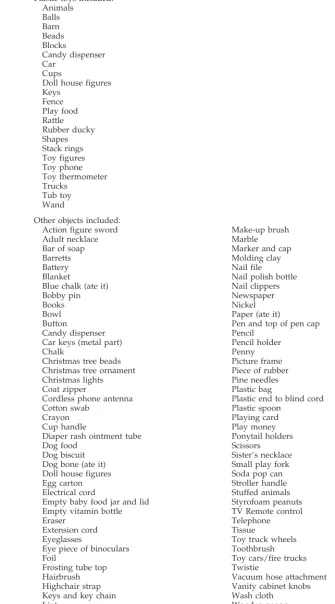
For each form, the duration (in minutes) of each mouthing event was determined by subtracting the recorded “time in” from the “time out” of the mouth. In addition, in Phases I and II, mouthed items were categorized as pacifiers, teethers, plastic toys, or other objects, with the last 3 categories collectively called “non-pacifier” objects or “nonpacifiers.” The total daily duration of mouthing objects for each category was recorded, and these esti-mates were appropriately combined to estimate each child’s daily mouthing duration of nonpacifier objects and total mouthing du-ration of all objects. For Phase III, no distinction was made be-tween the “nonpacifier” objects, and the average total mouthing time (in minutes) was calculated for each participant based on 5 nonconsecutive days of observation. Parents reported children mouthing fingers and thumbs, and a wide range of objects. A partial list of some of the more uncommon objects mentioned on the returned forms is shown in Table 1.
RESULTS
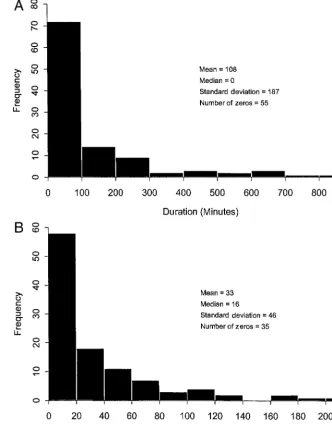
be-tween birth and 36 months, and that wide variability exists in mouthing behavior among children. Figure 1 shows histograms of the distributions, and the means, medians, and standard deviations of the ob-served daily mouthing duration and the number of
zeros reported for the combined Phase I and II par-ticipants 0 to 18 months old for pacifiers and non-pacifiers (ie, the total of teethers, toys, and other objects), respectively. The average duration of mouthing pacifiers for this age group (108 minutes)
TABLE 1. Partial List of the More Uncommon Items That Parents Reported Children Mouthing
Plastic toys included: Animals Balls Barn Beads Blocks Candy dispenser Car Cups
Doll house figures Keys Fence Play food Rattle Rubber ducky Shapes Stack rings Toy figures Toy phone Toy thermometer Trucks Tub toy Wand
Other objects included: Action figure sword Adult necklace Bar of soap Barretts Battery Blanket
Blue chalk (ate it) Bobby pin Books Bowl Button
Candy dispenser Car keys (metal part) Chalk
Christmas tree beads Christmas tree ornament Christmas lights Coat zipper
Cordless phone antenna Cotton swab
Crayon Cup handle
Diaper rash ointment tube Dog food
Dog biscuit Dog bone (ate it) Doll house figures Egg carton Electrical cord
Empty baby food jar and lid Empty vitamin bottle Eraser
Extension cord Eyeglasses
Eye piece of binoculars Foil
Frosting tube top Hairbrush Highchair strap Keys and key chain Lint
Lip balm Magnet
Make-up brush Marble Marker and cap Molding clay Nail file Nail polish bottle Nail clippers Newspaper Nickel Paper (ate it)
Pen and top of pen cap Pencil
Pencil holder Penny Picture frame Piece of rubber Pine needles Plastic bag
Plastic end to blind cord Plastic spoon Playing card Play money Ponytail holders Scissors Sister’s necklace Small play fork Soda pop can Stroller handle Stuffed animals Styrofoam peanuts TV Remote control Telephone Tissue
Toy truck wheels Toothbrush Toy cars/fire trucks Twistie
Vacuum hose attachment Vanity cabinet knobs Wash cloth
significantly exceeds the average duration of non-pacifiers (33 minutes).
Figure 2 shows the distributions, means, medians, and standard deviations of the observed daily mouthing duration and number of zeros for the com-bined Phase I and II participants 19 to 36 months old for pacifiers and nonpacifiers (ie, the total of teethers, toys, and other objects), respectively. The average duration of mouthing pacifiers for this age group (126 minutes) similarly exceeds the average duration of nonpacifiers (5 minutes) significantly.
Between the age groups, the results show a greater amount of mouthing time of nonpacifier objects (in-cluding teethers, plastic toys, and other objects) for the 0- to 18-month-old group, than for the 19- to 36-month-old group. Using a 2-sample t test with unequal variance, the hypothesis that children 0 to 18 months old (mean ⫽ 33) and children 19 to 36 months old (mean⫽5) exhibit no difference in non-pacifier mouthing duration was rejected (P⬍ .001). Comparison of the mouthing time of pacifiers sug-gests no difference between groups, although a slightly higher mean was observed for the 19- to
36-month-old group. Using a 2-sample t test with unequal variance, the hypothesis that children 0 to 18 months old (mean ⫽ 108) and children 19 to 36 months old (mean ⫽ 126) exhibit no difference in pacifier mouthing duration was not rejected (P ⫽ .54).
Table 2 summarizes the combined Phase I and II results for the separate categories of objects mouthed, averaged both for each age group overall and for only the children in the group who mouthed objects in that category (ie, excluding the zeros). Table 2 shows that a much smaller percentage of the sample participants in the 19- to 36-month-old group mouthed nonpacifier objects, which partially ex-plains the significantly decreased mouthing duration for this group compared with the 0- to 18-month-old group participants. For all nonpacifier objects, the mean daily duration of mouthing for those children who actually mouthed nonpacifier objects was ap-proximately 10 to 30 minutes depending on the ob-ject mouthed. No significant correlation was found between mouthing duration of pacifiers and mouth-ing duration of nonpacifier objects.
Fig 1. A, Distribution of daily mouth-ing duration for pacifiers (Phases I and II, 0 –18 months,n⫽107). (Note: 8 par-ticipants used pacifiers throughout the night and the exact mouthing time for these infants is not known.) B, Distri-bution of daily mouthing duration for nonpacifiers (including teethers and toys; Phases I and II, 0 –18 months,n⫽
Figure 3A shows the distribution, mean, median, and standard deviation of all of the observed daily mouthing duration estimates for the participants in
Phase III (results for nonpacifier objects only) (n ⫽ 793). Fig 3B shows the distribution, mean, median, and standard deviation of the 5-day average daily mouthing duration for the Phase III participants (n⫽ 168). The medians for the distributions differ slightly (16 minutes for the daily estimates shown in Fig 3A compared with 17 minutes for the 5-day average estimates shown in Fig 3B). Duration of mouthing varies among children over the 5 nonconsecutive days of observation, with some children consistently not mouthing any objects, and a very small number (5 out of 168) of children consistently mouthing ob-jects for⬎2 hours per day (see Fig 3B).
Figure 4 shows the results of regression of the natural logarithm of the average mouthing duration (in minutes) by the average age of the child over the 5 days of observation in Phase III. The natural loga-rithm transformation is used because the data are skewed to the right. The large amount of variability within children by age is obvious from the spread of the data around the line (R2⫽0.15). The slope of the
line is significant based on anFtest (P⬍.001), which suggests that the observed decrease in mouthing Fig 2. A, Distribution of daily
mouth-ing duration for pacifiers (Phases I and II, 19 –36 months,n⫽110). B, Distribu-tion of daily mouthing duraDistribu-tion for nonpacifiers (including teethers and toys; Phases I and II, 19 –36 months,
n⫽110).
TABLE 2. Summary of Average Daily Mouthing Duration Re-sults (in Minutes) From Phase I and Phase II
0 to 18 Months
All Participants (Includes Zeros)
Only Those Who Mouthed Object (Includes Only Non-zeros) Mean (Number)
Mean (Number)
Pacifier 108 (n⫽107) 221 (n⫽52) Teether 6 (n⫽107) 20 (n⫽34) Plastic toy 17 (n⫽107) 28 (n⫽66) Other objects 9 (n⫽107) 22 (n⫽46)
19 to 36 Months
All Participants (Includes Zeros) Mean (Number)
Only Those Who Mouthed Object (Includes Only Non-zeros)
Mean (Number) Pacifier 126 (n⫽110) 462 (n⫽52) Teether 0* (n⫽110) 30* (n⫽1) Plastic toy 2 (n⫽110) 11 (n⫽21) Other objects 2 (n⫽110) 15 (n⫽18)
duration with age is unlikely to be explained by chance.
Comparing the results of daily mouthing duration of nonpacifier objects for Phase III participants to participants (of the same age) in Phases I and II combined shows no difference in the results. Using a 2-sample t test, the hypothesis that participants in Phases I and II (mean⫽33) and participants in Phase III (mean ⫽ 36) exhibit no difference in mouthing duration was not rejected (P⫽.47).
DISCUSSION
This observational study of 385 children revealed some important new findings pertaining to child-hood mouthing behavior and contributed to the ex-isting database of estimates of young children’s mouthing behavior of objects (eg, Zartarian et al’s study of 4 children4; Groot et al study of 42
chil-dren5). Quantitatively, the daily mouthing duration
results reported for US children in the present study are comparable to the results reported for Dutch children obtained by Groot et al.5
Mouthing behavior of children, as demonstrated by the results of this study, depends on age and the items mouthed (eg, teethers, pacifiers, toys, etc). Pac-ifier use clearly dominated as the single item most frequently mouthed by children in both the 0- to 18-month-old and the 19- to 36-month-old age range. This may indicate preference or desirability of this particular item by children or parents (who fre-quently determine accessibility to mouthed items). As also reported by Groot et al,5this study showed a
clear trend that mouthing duration decreases as age increases. This is consistent with patterns of child development, which show a peak period for mouth-ing activity that is positively correlated with teethmouth-ing and negatively correlated with increased mobility. Observations from this study as well as interviews with parents by one author (K.A.) confirm this trend. Both the present study and Groot et al5showed wide
variation in childhood mouthing behavior.
This study also demonstrated (see Table 1) that children mouth many items other than pacifiers, teethers, and toys expected to be mouthed (ie, those Fig 3. A, Distribution of daily
products specifically designed for mouthing). The variety of objects mouthed (Table 1) indicate that young children have access to a wide range of non-toy objects, some of which could pose an immediate hazard to them. Observations of this nature are sim-ilar to those of Groot et al5 who reported children
mouthing balloons, pen tops, puzzle pieces, etc; items that typically are not intended or designed to be mouthed. Zartarian et al4 similarly reported a
variety of nontoy objects mouthed.
These results also demonstrate the importance of collecting exposure data for the appropriate (ie, tox-icologically relevant) averaging time for use in risk assessment.7In particular, comparison of Fig 3A and
3B shows that fewer zeros and a lower maximum value are observed for the 5-day average (Fig 3B) than for the daily observations (Fig 3A). This is evi-dence of regression to the mean, a phenomenon that arises from the considerable variation in mouthing duration from day-to-day for a single child. It reflects the tendency of participants with a low observation on one day to have a higher observation on the next day, and for participants with a high observation on one day to tend to have a lower observation on the next day. In this study, one of the authors (K.A.) interviewed parents of 3 child participants who ex-hibited high mouthing activity consistently over the 5 days, and confirmed that the behavior does not occur every day. We expect that similar interviews with the parents that reported no mouthing behavior at all over the 5 days would indicate that these chil-dren do mouth objects occasionally. Thus, although these results provide good estimates of the mean duration (5-day average) and variability associated with mouthing behavior, they are not necessarily predictive of the longer averaging times that might be required for risk assessments (eg, annual averag-es), specifically because of the wide variance ob-served in this study. Further, the decreasing trend in mouthing duration that occurs with increasing age must be addressed to estimate the average mouthing duration over longer times.
Comparison of these results to recent quantitative estimates of mouthing behavior used in exposure and risk assessments shows some important differ-ences. Health Canada3used average daily mouthing
duration estimates for plastic toys of 2 hours for children 3 to 12 months old and 2.5 hours for chil-dren 12 to 36 months old. The results obtained in this study are significantly lower with an average of 23 minutes for plastic toys for the 48 children in Phase II 3 to 12 months old, and an average of 5 minutes for plastic toys among 149 children in Phase I and II between 13 and 36 months old. Health Canada3also
estimated mouthing duration of pacifiers of 5.5 hours/day for 3 to 12 month old children and 4 hours for 12 to 36 month-olds based on an unpub-lished study. These estimates are close to the actual duration times observed for children who used pac-ifiers in this study (see right column of Table 2). Differences between modeled mouthing estimates3
and measured mouthing behavior may be partially attributed to consideration of the actual available time for mouthing activity. For example, infants and young children by the nature of their daily routines and regimes (eg, sleeping, nursing, eating) may have less available time for mouthing than anticipated, and this may be reflected by reduced mouthing ac-tivity.
The daily mouthing duration results obtained in this study are similar to those estimates used by the CPSC. The CPSC relied on the Groot et al5 data to
estimate geometric means of 12 minutes for 3- to 12-month-olds and 2 minutes for 13- to 26-month-olds for teethers, rattles, and toys assuming that the data distributed lognormally.2Efforts to fit
paramet-ric distributions to the data obtained in this study did not yield any distributions with sufficiently good fit (ie, including the lognormal distribution). The lack of fit may be attributable to the mixed nature of the data (ie, children of various ages and proclivity for mouthing), and other studies will be needed to better characterize predictors of mouthing behavior over longer time scales.
Several important methodologic issues warrant at-tention in future studies. In particular, future re-searchers will need to address issues of how to cap-ture and quantify the high frequency but very low duration (eg, “in and out” nature) of some mouthing behaviors. As noted by Zartarian et al,4video studies
may be useful for capturing these. Note, however, that video studies may miss some events during times when the child’s mouth is not in the camera’s view.4The extent to which parents missed mouthing
events in this study that may have been captured if the children had been videotaped is unknown. In addition, the extent to which parents reported “in and out” behavior as “in,” which might mean a positive bias in the results, or did not report inter-mittent “in and out” behavior at all, which might mean a negative bias in the results, is also unknown. Asking parents to record duration in minutes may have led them to round to the nearest minute, and although we have no indication of any systematic bias, this methodology should be considered in the interpretation of the results. Additional research is needed to assess the reliability of using a diary form approach for collecting exposure data and to explore changes in mouthing behavior, if any, that occur with participation in a study of this type.
ACKNOWLEDGMENTS
Preparation of the manuscript was funded under a contract to the International Center for Toxicology and Medicine (a private consulting firm) from the American Toy Institute, Inc (a not-for-profit charitable educational and scientific organization).
We thank the parents and children who participated in all phases of the study and the East Aurora Community Nursery School and Day Care Center for assisting in the recruitment of participants. K. Alfano and R. Coughlin participated in the re-search as part of their full-time employment with Fisher-Price, Inc, which funded the development of the study and data collection.
REFERENCES
1. Turgeon-Obrien H. Nutritive and nonnutritive sucking habits: a review.
J Dent Child. 1996;63:321–326
2. Consumer Product Safety Commission. The Risk of Chronic Toxicity Associated With Exposure to Diisononyl Phthalate (DINP) in Children’s Products. Washington DC: Consumer Product Safety Commission; 1998 3. Health Canada.Risk Assessment on Diisononyl Phthalate in Vinyl Chil-dren’s Products. Ottawa, Ontario: Consumer Products Division, Health Canada; 1998
4. Zartarian VG, Ferguson AC, Leckie JO. Quantified mouthing activity data from a four-child pilot field study.J Exp Analg Environ Epidemiol. 1998;8:543–553
5. Groot ME, Lekkerkerk MC, Steenbekkers, LPA.Mouthing Behaviour of Young Children: An Observational Study. Wageningen: Agricultural University, Household and Consumer Studies; 1998. ISBN 90-6754-548-1
6. Reed KJ, Jimenez M, Freeman NCG, Lioy PJ. Quantification of chil-dren’s hand and mouthing activities through a videotaping methodol-ogy.J Exp Analg Environ Epidemiol. 1999;9:513–520
7. Thompson KM. Developing univariate distributions from data for risk analysis.Hum Ecol Risk Assess. 1999;5:755–783
THE DIRTY-WATER VIEW OF WORLD HISTORY
One of the accurate truisms of history is that a civilization which allows the quality of its water to decline is on its way out . . . By the standards of the Roman and Islamic empires, we are now well-advanced in our own decline since we have fouled most of our surface sources and are doing the same to our water tables . . . The sight of millions of Westerners drinking bottled water is a reminder of our disconnection from reality.
Saul JR.The Doubter’s Companion.New York, NY: Penguin Books; 1994
DOI: 10.1542/peds.107.1.135
2001;107;135
Pediatrics
Daland R. Juberg, Kathleen Alfano, Robert J. Coughlin and Kimberly M. Thompson
An Observational Study of Object Mouthing Behavior by Young Children
Services
Updated Information &
http://pediatrics.aappublications.org/content/107/1/135
including high resolution figures, can be found at:
References
http://pediatrics.aappublications.org/content/107/1/135#BIBL
This article cites 4 articles, 0 of which you can access for free at:
Subspecialty Collections
milestones_sub
http://www.aappublications.org/cgi/collection/growth:development_
Growth/Development Milestones
rning_disorders_sub
http://www.aappublications.org/cgi/collection/cognition:language:lea
Cognition/Language/Learning Disorders
al_issues_sub
http://www.aappublications.org/cgi/collection/development:behavior
Developmental/Behavioral Pediatrics following collection(s):
This article, along with others on similar topics, appears in the
Permissions & Licensing
http://www.aappublications.org/site/misc/Permissions.xhtml
in its entirety can be found online at:
Information about reproducing this article in parts (figures, tables) or
Reprints
http://www.aappublications.org/site/misc/reprints.xhtml
DOI: 10.1542/peds.107.1.135
2001;107;135
Pediatrics
Daland R. Juberg, Kathleen Alfano, Robert J. Coughlin and Kimberly M. Thompson
An Observational Study of Object Mouthing Behavior by Young Children
http://pediatrics.aappublications.org/content/107/1/135
located on the World Wide Web at:
The online version of this article, along with updated information and services, is
by the American Academy of Pediatrics. All rights reserved. Print ISSN: 1073-0397.