TECHNICAL REPORT
Electronic Documentation in Pediatrics:
The Rationale and
Functionality Requirements
Heather C. O’Donnell, MD, MSc, FAAP,a,bSrinivasan Suresh, MD, MBA, FAAP,cCOUNCIL ON CLINICAL INFORMATION TECHNOLOGY
abstract
Clinical documentation has dramatically changed since the implementation and use of electronic health records and electronic provider documentation. The purpose of this report is to review these changes and promote the development of standards and best practices for electronic documentation for pediatric patients. In this report, we evaluate the unique aspects of clinical documentation for pediatric care, including specialized information needs and stakeholders specific to the care of children. Additionally, we explore new models of documentation, such as shared documentation, in which patients may be both authors and consumers, and among care teams while still maintaining the ability to clearly define care and services provided to patients in a given day or encounter. Finally, we describe alternative documentation techniques and newer technologies that could improve provider efficiency and the reuse of clinical data.
Clinical documentation is defined as the capturing and recording of clinical information, often in real time while the patient is present (eg, during consultation, assessment, imaging, and treatment).1However, clinical documentation has grown to encompass more than just provider notes at the time of a patient visit. Patient care activities often take place outside in-person encounters and include events involving care coordination and communication with patients and caregivers. The records of such events also represent clinical documentation. In addition, newer technologies, including patient portals, connected home monitoring devices, and patient-controlled mobile devices, potentially enable patients and families to act as authors of clinical documentation, a title previously assigned only to health care providers.2
Clinical documentation is primarily intended to facilitate the synthesis of patient information, develop medical care and wellness plans, and communicate patient information. Initially, documentation was intended for sharing information among various health care providers but has since
aDepartment of Pediatrics, Children’s Hospital at Montefiore and Albert
Einstein College of Medicine, Bronx, New York;bPediatric Physicians’
Organization at Children’s Hospital, Boston Children’s Hospital, Brookline, Massachusetts; andcDivisions of Health Informatics and
Emergency Medicine, Department of Pediatrics, University of Pittsburgh School of Medicine and UPMC Children’s Hospital of Pittsburgh, Pittsburgh, Pennsylvania
Drs O’Donnell and Suresh equally contributed as coauthors to draft, review, and revise the manuscript with input of all reviewers and the Board of Directors; and both authors approved thefinal manuscript as submitted.
Technical reports from the American Academy of Pediatrics benefit from expertise and resources of liaisons and internal (AAP) and external reviewers. However, technical reports from the American Academy of Pediatrics may not reflect the views of the liaisons or the organizations or government agencies that they represent.
The guidance in this report does not indicate an exclusive course of treatment or serve as a standard of medical care. Variations, taking into account individual circumstances, may be appropriate.
All technical reports from the American Academy of Pediatrics automatically expire 5 years after publication unless reaffirmed, revised, or retired at or before that time.
This document is copyrighted and is property of the American Academy of Pediatrics and its Board of Directors. All authors havefiled conflict of interest statements with the American Academy of Pediatrics. Any conflicts have been resolved through a process approved by the Board of Directors. The American Academy of Pediatrics has neither solicited nor accepted any commercial involvement in the development of the content of this publication.
DOI:https://doi.org/10.1542/peds.2020-1684
Address correspondence to Srinivasan Suresh, MD, MBA, FAAP. Email: [email protected]
To cite:O’Donnell HC, Suresh S, AAP COUNCIL ON CLINICAL INFORMATION TECHNOLOGY. Electronic Documentation in Pediatrics: The Rationale and Functionality Requirements.
expanded to include communication with patients and their caregivers as integral members of the care team. In pediatrics, clinical care teams also include adolescents who may have the right to manage their own reproductive health, substance use, and mental health issues and the school systems that serve as important caregivers for pediatric patients. Clinical documentation also serves other important roles, including the record of patient care and services provided for billing purposes, a means to protect the legal interest of providers and patients, a resource for research data for quality monitoring and improvement, and an educational tool for health care provider trainees.3
The transition of clinical documentation from paper to electronic health records (EHRs) has provided many positive opportunities in clinical care and documentation but has also introduced new challenges. Most importantly, electronic clinical documentation is more accessible and legible than paper records, may include more structured data elements contained elsewhere in the medical record, and is available remotely to health care providers, patients, and other stakeholders.
One downside with electronic documentation is that providers may be overwhelmed with large amounts of textual and tabular data. In addition, nonclinical stakeholders may have a more direct influence on the design and content of clinical documentation. For example, electronic documentation tools can remind or even require (required fields, forcedfields, or hard stops) an author to include specific items in his or her documentation. Interventions on paper were much less invasive (education or reminders that could be avoided) and likely less effective at changing documentation behavior. This additional input can lead to increasing documentation burden,
especially when some of these requirements are redundant or not relevant to the clinical narrative, and can have the effect of blurring the understanding of the purpose of a note. There is increasing recognition that documentation burden can lead to clinician burnout, and new federal legislation is aimed at developing strategies to reduce documentation burden.4
Electronic clinical documentation may also be more onerous than using paper. Efficient typing and navigation of the electronic record may not be skills possessed by all providers. Documentation tools such as copying functions, templates and scripts (allowing for clicking rather than typing), or the importation of data from other areas in the medical record can alleviate some of the burden. However, these tools may introduce new unintended
consequences of their own, including increased length and decreased effectiveness of notes (“note bloat”) and inaccurate documentation.5–7 The American Academy of Pediatrics (AAP) has addressed several topics related to EHRs, including electronic prescribing systems,8health
information technology and the medical home,9standards for health information technology to ensure adolescent privacy,10pediatric aspects of inpatient health information technology systems,11 and electronic communication of the health record and information with pediatric patients and their guardians.12Although these areas cover aspects of electronic documentation, there is a lack of a single unified AAP policy statement or technical report that provides an overall view of clinical documentation of pediatric care. In this technical report, we aim to review electronic clinical documentation in pediatrics and provide background information for the recommendations in the accompanying policy statement13to maximize the benefits of such
technology to improve the care of children as well as to mitigate the potential negative aspects.
CONTENT AND STRUCTURE REQUIREMENTS FOR RECORDING CLINICAL INFORMATION
Similar to what has been emphasized in AAP policy statements and technical reports,9–14an Agency for Healthcare Research and Quality technical brief,15and the Children’s EHR Format,16,17pediatric care providers need certain core
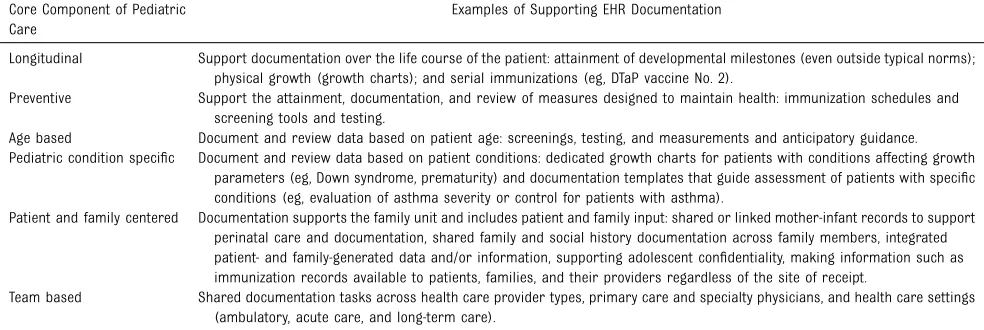
functionalities in EHRs, including the ability to document in a manner that supports and facilitates the care of pediatric patients. Templates or similar tools designed to guide providers through the task of documentation should facilitate longitudinal, preventive, team-based, and age- and condition-specific care central to the core of pediatric medicine (Table 1).18In addition, pediatric care providers have long been on the forefront of family-centered care,19but many EHRs lack the ability to support the hallmarks of this aspect of care, such as team-based documentation and documentation of familial
connections.9For example, familial linkages in the EHR and the ability to share certain parts of documentation, such as family and social histories, across family members could increase the robustness of this information and strengthen the delivery of family-centered care (Table 1). This feature could also serve as a method to reduce redundant
documentation tasks.
Discrete Data
relatively easy use and reuse for clinical decision support, quality measurement, research, or reporting to regulatory agencies.2For example, discrete data can be used to support clinical decision aids that are valuable to pediatric care providers, including health maintenance schedules that address vaccinations and screening on the basis of AAP preventive care guidelines.21However, free-text or narrative documentation provides its own benefits because it allows for nuanced documentation for individual patients, which is critical for patient-centered care.
The need or desire for discrete data entry can have negative impacts on the relevance and clarity of clinical documentation and may increase documentation burden for health care providers.20Furthermore, the required components for some structured data entry for clinical information can result in an inability to record data that do notfit neatly into the structured syntactic organization or that are partially incomplete or unknown. For instance, some EHRs may limit the recording of immunization receipt or current medications if the exact immunization date is unknown or the patient or caregiver does not remember the name of a medication. This information, although incomplete,
still may be clinically relevant, and theflexibility should be present to allow for inclusion of these data alongside other discrete data in that category, so important information is not missed.
Examples of discrete data of importance to pediatric care providers include vital signs, growth parameters, immunizations,
screening tests (eg, hearing tests, visual acuity testing, and
developmental and mental health questionnaires) and validated scoring and screening tools (eg, Apgar score, Pediatric Early Warning Score, Pediatric Quality of Life
Inventory).11,14,17The discrete nature of the documentation of some of these items also makes them suitable for device integration and for machine-readable technology that streamline documentation and data entry. For example, the use of barcoding for vaccine administration eliminates the need to manually document the lot number and expiration date for every vaccine. Alternative technologies such as these can both serve to reduce
documentation burden and reduce documentation errors.22
Data Display and Standards
Documentation should only have to be entered once for these key metrics,
but retrieval and display of this information also requires careful consideration and build. Data display should be sensitive to both pediatric providers’needs and patients’ conditions. As examples,
immunizations should be displayed by vaccine components rather than by brand names or combinations, and vital signs should be displayed with their corresponding age-, sex-, height-, and/or weight-based percentiles.
Data elements should also be displayed on the basis of patient-specific conditions, such as growth charts for prematurity and Down syndrome. Other examples include immunization displays, the ability to document new vaccines for patients who have not responded to the original vaccine series, and patients who have received a stem cell transplant. In addition, there is a need for these displays to rapidly evolve with evidence-based updates, such as the recommendation to use the World Health Organization growth charts for children 0 to 2 years of age rather than those of the Centers for Disease Control and Prevention23and new guidelines for the management of hypertension.24Delays in updates may lead to the persistence of suboptimal or out-of-date care. However, even if optimal and current care is provided, any out-of-date TABLE 1Clinical Documentation Framework Based on Core Components of Pediatric Care
Core Component of Pediatric Care
Examples of Supporting EHR Documentation
Longitudinal Support documentation over the life course of the patient: attainment of developmental milestones (even outside typical norms); physical growth (growth charts); and serial immunizations (eg, DTaP vaccine No. 2).
Preventive Support the attainment, documentation, and review of measures designed to maintain health: immunization schedules and screening tools and testing.
Age based Document and review data based on patient age: screenings, testing, and measurements and anticipatory guidance. Pediatric condition specific Document and review data based on patient conditions: dedicated growth charts for patients with conditions affecting growth
parameters (eg, Down syndrome, prematurity) and documentation templates that guide assessment of patients with specific conditions (eg, evaluation of asthma severity or control for patients with asthma).
Patient and family centered Documentation supports the family unit and includes patient and family input: shared or linked mother-infant records to support perinatal care and documentation, shared family and social history documentation across family members, integrated patient- and family-generated data and/or information, supporting adolescent confidentiality, making information such as immunization records available to patients, families, and their providers regardless of the site of receipt.
Team based Shared documentation tasks across health care provider types, primary care and specialty physicians, and health care settings (ambulatory, acute care, and long-term care).
information populated in the documentation could be
misinterpreted. For example, the provider made a clinical decision using the new hypertension management guidelines and blood pressure percentiles, but the old percentiles and/or guideline information still populate into the note.
Importantly, the value of discrete data is enhanced if the data can be used across health care institutions and organizations. For example, if patients’immunization records were shared seamlessly across EHRs and vaccine registries, the data at every location could be more robust and accurate. In addition, the task of documenting immunization histories into separate systems would be eliminated. For this reason, the AAP and other volunteer organizations should continue to support the creation and alignment of clinical data standards.25,26The integration of these standards within various EHRs would increase the likelihood that individual organizations would adopt these standards and would promote technical interoperability.
Note Structure
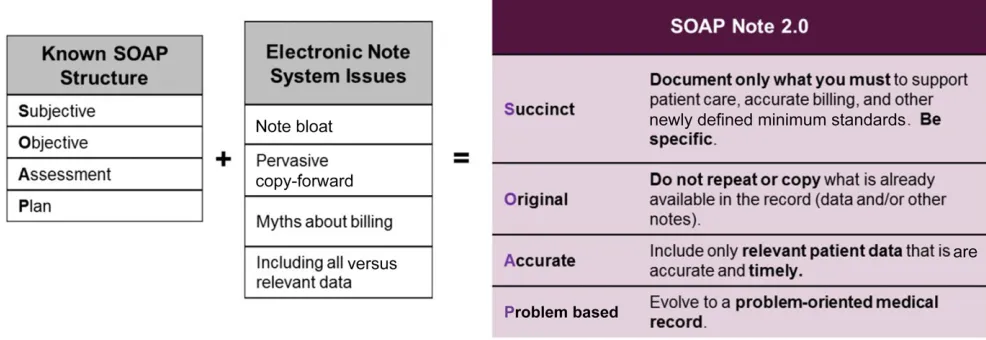
Given the evolution of electronic charting and regulatory requirements of documentation, note structure and the elements that should be included in various clinical note types (eg, ambulatory visit note, inpatient progress note, and operative report) need to be constantly reviewed. The increasing length and limited use of notes argue for a more streamlined structure in which the most important clinical information is more readily found.27A solution framework to address this pervasive issue is a modified subjective, objective, assessment, plan (SOAP) note (Fig 1), which retains the original SOAP note structure from the paper-based era28but mitigates known concerns of electronic note systems (M.J Curren, MD, and V.K.
Reddy, MD, personal communication, 2017).
Managing Information Overload
The rapidly expanding volume of clinical documentation and its accessibility potentially across a patient’s lifetime regardless of the location of care has important clinical benefits, but it has also introduced a new problem in clinical care: information overload. The concern is that the large volume of clinical information can lead to the inability of a clinical care provider to quickly retrieve appropriate diagnostic and therapeutic information when needed and may lead to a clinical care provider overlooking important clinical information. Technological solutions are likely necessary to mitigate this problem and maintain clinical care efficiency and value, including integrating graphs, tabular data, knowledge management tools, smart search engines, links to Web-based resources, and customized menus.29Functionalities that
promote a more hierarchal display of data and promote the value of the synthesis of these data into information are needed to achieve this goal and mitigate information overload. For example, as the number of notes per patient continues to increase, standard naming convention,filtering, and semantic searching functions may help providers access necessary information in a timely manner. Whenever possible, usability and information design should be an essential part of the EHR certification process. There should be a focus on graphical visualization of numerical data. Custom development of patient summaries for various provider types and care settings requires effort but can be valuable.
DOCUMENTATION FOR ADDITIONAL STAKEHOLDERS
Electronic clinical documentation also serves important functions for other
stakeholders and plays important roles in supporting regulatory requirements, legal protections, medical research, quality
improvement, and medical education. Although important, the needs of these additional stakeholders often add to the complexity and amount of information captured and contained within EHR systems.
Regulatory Requirements
Developing and implementing clinical templates, customized electronic forms, and computer-assisted coding for patient encounters may result in more complete evaluation and management (E&M) coding. There is evidence that the use of EHRs may have contributed to increased use of higher-levelCurrent Procedural Terminology(CPT) codes, particularly in the emergency department setting.30Although it is important for EHR documentation tools to guide and facilitate providers in
documenting pertinent information, the EHR should not promote the inclusion of extraneous or irrelevant information that then can be used to select a more complex CPT code. The Office of the Inspector General holds individual physicians
responsible for all professional coding in their name regardless of the EHR tools used or other coding support used to select the CPT code. For this reason, it may be useful for pediatric care providers to familiarize
themselves with common CPT codes rather than relying solely on EHR tools for CPT selection guidance.31 The Centers for Medicare and Medicaid Services (CMS) has begun the process of revising the E&M requirements in this new electronic era.32
In addition to E&M coding
requirements, processes must be in place to ensure that the
documentation serves as a key record to provide legal protection for providers and patients.
Documentation standards should include recommendations regarding the use of electronic documentation functionalities, such as copy and paste, copy and forward, and automated insertion of data documented elsewhere in the EHR. Misuse of these functionalities can result in inaccurate, outdated, or irrelevant information, which may lead to significant quality of care and medical liability issues as well as the upcoding concerns noted previously. However, it is important to recognize that with proper use, these
functionalities can save time and enhance documentation. After reviewing the literature on safety risks related to copying and pasting, the Partnership for Health IT Patient Safety made 4 recommendations that could improve the safety of its use: making copied and pasted text readily identifiable, referencing the text’s origin, providing education on its safe use, and having practices in place to monitor its use.7
Clinical documentation is also an integral data source for reporting, quality improvement, and research. For example, electronic clinical quality measures are a set of quality
objectives that have been developed for both ambulatory and inpatient hospital quality reporting programs and must be reported to the CMS.33A robust electronic documentation system also creates the platform for patient care–based research and quality improvement projects that are crucial for pediatric care providers to provide safer, higher-quality care.34 The data used for these purposes often require more structured or specific data entry. Effective
reporting, quality measurement, and medical research depend on accurate clinical documentation. In the development of new quality or research measures existing data should be used whenever possible and primary data entry should not be required explicitly for that measure, thereby avoiding additional
documentation burden by providers. When making decisions about additional data elements required or requested from clinicians, we should take this fact into consideration and be judicious in implementation.
As electronic clinical documentation and documentation tools continue to evolve, it is key that clinicians, clinical informaticists, health information management professionals, and quality, regulatory reporting,
research, and billing specialists work
together on electronic documentation design, implementation, and
improvement as well as the policies and procedures surrounding
documentation and EHR use. The goal should be complying with billing, coding, and payer guidelines and providing data for quality reporting programs but also following best practices for electronic
documentation.35In addition, it is crucial that the documentation burden placed on providers is not too high, and as much as possible, data solely necessary for other
stakeholders should not disrupt the clinical narrative.
Documentation as a Vehicle for Medical Education
The steady shift of health care documentation from paper to electronic over the past 2 decades has had an impact on the learning process of medical students and pediatric residents and fellows. The EHR is an essential part of the daily work of medical students as they care for children and can also serve as an interactive learning tool by providing clinical decision support and ready access to the medical literature. Medical interns are estimated to spend 40% of their time dealing with EHR systems,36and in academic FIGURE 1
medical centers, residents are a key source of clinical documentation. Clinical documentation, itself, is an important learning objective of medical training, and close attention should be paid to trainees’
understanding of the purpose of medical documentation and proper documentation technique in the electronic environment. In teaching institutions, trainees may be the primary documenters of clinical care because the CMS allows attending providers to verify both resident physician and medical student notes rather than redocumenting the work.37Trainees are often recipients of heavy workloads and may be more susceptible to some of the pitfalls of electronic documentation.5Medical school and residency programs should prioritize informatics resources to aid and assist in designing curriculums and providing instruction on the best practices for clinical documentation. Mentoring physicians should continue to provide feedback to their trainees regarding their documentation and proper mastery of the use of the EHR system. In the 2013 Accreditation Council for Graduate Medical Education common program requirements, use of information technology is listed as one of the competencies under practice-based learning and improvement.38There are specific suggestions for EHR-related
enhancements to core competencies, such as maintaining accurate problem and medication lists within the EHR to facilitate multispecialty care, which exemplifies the core competency of systems-based practice.39
Trainees are also in a unique position to advance health information technology. Trainees who are technically savvy and perhaps the heaviest users of the EHRs can provide important feedback on specific areas in which the EHR functionality can be improved. EHR and electronic documentation
improvement efforts in teaching hospitals should include input of trainees.
UNIQUE STAKEHOLDERS FOR PEDIATRICS
Schools
Pediatricians have a unique relationship with school systems because children spend much of their time at the school and teachers and school nurses serve as important caregivers for children. Federal law, specifically the Individuals with Disabilities Act40and section 504 of the Rehabilitation Act of 1973,41 ensures that all children, regardless of disability, have a right to free and public education that meets their needs. Schools are responsible for the care of any child’s medical needs at school and are also important partners with pediatric care providers in ensuring that children with learning disabilities or developmental delays receive evaluations and appropriate education and therapies. There is a vital need for school systems and child health providers to communicate and share relevant information in a bidirectional manner. Currently, much of the
communication between schools and medical providers takes place via parents, who communicate between the 2 parties either with verbal information or by transporting paper school forms completed by educators and child health providers back and forth. This method leads to excessive work for parents and providers and presents multiple opportunities for error. In addition, the variability and constant changing of school forms required by private and public schools and child care centers causes great difficulty for health care providers and for the potential use of EHRs to aid form completion. Communication between schools and health care providers could be facilitated by the streamlining and
standardization of documentation essential for this process for schools and child care centers across the country. In addition, efforts should be made to enable sharing of this information electronically with parents and the school system and direct communication between health care and education providers. Privacy, consent, and security specifications would need to be defined for this information exchange.
Adolescents
Pediatric care providers need to document information regarding adolescent mental health, substance use, and reproductive health so that it can be used for their care and communicated with other providers. However, as discussed in an AAP policy statement,10this information is protected by federal and state laws. Although the adolescent is a minor, in some states, certain information cannot be shared with parents or guardians without the adolescent’s permission unless there is a risk of harm.10Many EHR systems lack the technology to segment orfilter confidential clinical data to prevent inadvertent disclosure to
unauthorized parties, including the sharing of this protected information with parents in written form or electronically through a portal.10,12 Unless a nationwide consensus on adolescent confidentiality issues is reached, there would also need to be flexibility in EHR settings regarding adolescents to account for state variations in laws.
NEW SHARED DOCUMENTATION PARADIGM
Shared Documentation With Patients and Families
Historically, the patient medical record, including clinical
in the Health Insurance Portability and Accountability Act.42Until more recently, most patient requests for medical records were handled in person and/or through a process of written request.
This paradigm is changing rapidly with improvements in patient portal technology and with the requirement to share information electronically with patients as part of the Promoting Interoperability Program
requirements43and the 21st Century Cures Act.44In general, there is growing support that although the medical care establishment remains the steward of the data, patients should have more control over their clinical records. Although current meaningful use criteria do not explicitly require the sharing of specific clinical documentation, such as office visit notes, daily progress notes, or discharge summaries,45 a few institutions have begun doing so and have found this sharing to be well received by patients. A study at 2 institutions in 3 geographic areas (OpenNotes) revealed improvements in patient-reported medication adherence, engagement, and satisfaction after the institutions began sharing provider notes electronically.46
The ease with which patients can now access their health records and information electronically could lead to a more shared model of EHRs and clinical documentation. Although concerns have been raised about the possibility of patient
misunderstanding or worry regarding the information contained within the record,47the rates of this occurring, as reported by patients with access to clinical notes, were low.46,48Even so, providers should be educated on ways to document without using needless medical jargon,
abbreviations, and judgmental language.49Guidelines on creating patient-centric notes without losing the documentation’s role as a communication tool among
providers and to substantiate billing are needed. In addition, because a significant portion of parents in America have basic or below-basic levels of health literacy,50their ability to make use of these notes to improve their child’s care should be
investigated.
It is also important to recognize that the sharing of clinical documentation between providers and patients could also reduce documentation burden for clinical providers. The plan section of notes and written patient instructions given to the patient (eg, after-visit summary and discharge instructions) often contain similar content but may be crafted separately. If one document could serve both purposes, it could eliminate redundancy and ensure that
providers and patients communicate the medical plan effectively.
Patient-Generated Health Data
There is an opportunity in pediatrics to capitalize on patient-generated health data (PGHD), defined as
“health-related data—including health history, symptoms, biometric data, treatment history, lifestyle choices, and other information— created, recorded, gathered, or inferred by or from patients or their designees (ie, care partners or those who assist them) to help address a health concern.”51,52There is growing evidence that PGHD have value to both patients and
providers.52The application of PGHD in pediatrics should continue to be explored and evaluated.
The value of PGHD includes the possibility of improving efficiency by the sharing of documentation tasks that would otherwise fall on providers and support staff or the time taken during the visits for patients and families to complete paper forms or questionnaires.17This value may only truly be reaped, however, if the data are safely and seamlessly integrated within clinical
workflows and EHRs in a manner acceptable for patients and providers.
Another potential value of PGHD is the capture of important information that may otherwise be missed during a short visit and the empowerment of patients to have a significant voice in their own health care. Early-use cases in pediatrics include previsit surveys to tailor a clinical visit and
questionnaires to assess and track development, quality of life, and indicators for various chronic medical conditions.53
Shared Provider Documentation
Communication among providers is an important function of clinical documentation. For example, to enable successful communication between a referring primary care provider and a medical subspecialist or surgical specialist, the reason for consultation and urgency should be clear and readily available. This information can then be reviewed by specialty providers and their support staff as the appointment is being scheduled and at the time of the visit. Similarly, the specialty assessment and plan should clearly delineate the plan, including which provider is responsible, and needs to be clearly communicated to the referring provider and the patient.54
Although primary care providers, medical subspecialists, surgical specialists, emergency physicians, and hospitalists may all provide care for the same medical problem for a given patient in the same EHR system, their documentation,
Problem-Oriented Charting
Shared patient medical problem lists and problem-oriented charting could allow providers to view plans by all providers related to a particular medical problem. However, the use of problem-oriented charting has challenges, including problem list incompleteness and inaccuracies. An institution’s use of problem-oriented charting or linkages between billing data and problem lists was associated with higher rates of problem list completeness.55
In addition, the success of
maintaining accurate problem lists for patients, as well as problem-oriented documentation, is associated with a culture in which primary care physicians and medical subspecialists and surgical specialists share responsibility for the problem list.56 However, actual completion of the problem list is difficult to both support and enforce, and that culture may not exist at every practice or institution. There is some evidence that primary care providers are responsible for the clear majority of problem list documentation, and although primary care providers believe medical subspecialists should contribute to the problem list, medical subspecialists believe it may be an incursion on the primary care provider’s territory.57,58In addition, some medical subspecialists are likely to prefer documenting in a more systems-based format (eg, intensivists who care for more children with active multisystem issues). Providers may have differing needs for the information granularity level of any one given problem. Guidance and policies regarding how to effectively share problem lists and other shared documentation are necessary to support this new paradigm.
Although linking billing with problem lists is associated with more complete problems lists, basing a patient’s problems on billable diagnosis codes
(eg, theInternational Statistical Classification of Diseases and Related Health Problems, 10th Revision) can introduce additional issues. Diagnosis codes may be insufficient to reflect the clinical picture. For example, there are limited codes available for working diagnoses and for problems related to social determinants of health. In addition, multiple diagnosis codes or problems are often used for interrelated conditions, raising the concern that problem-oriented documentation does not help manage the patient as a whole individual.59
Medication Documentation and Management
Another example of shared documentation is medication lists. The idea behind shared medication documentation is to build on existing medication lists that multiple provider types across clinical settings contribute to rather than maintain separate lists, thereby reducing the harm caused by medication discrepancies during patient transitions.60However, similar to shared problem lists, not all providers believe they have ownership over the entire medication list. There is an inherent issue of medical
subspecialists preferring to reconcile medications that are only relevant to their scope of care. Despite this, studies have revealed that a structured, systemwide intervention can be successful in achieving medication reconciliation compliance.59
One medication list may not be able to serve all purposes of medication documentation, however. For instance, there is a difference between prescribed medications and medications taken by the patient, and both are important information to maintain. In addition, many medication lists require structured entry of the medication name, concentration, dose, route, frequency, and dispense amount to prescribe medications and refills. There is also
another layer of complexity when documenting medications in children, in that there may be multiple concentrations of the same liquid medication. However, even in the absence of knowing every detail, providers should be able to record partial medication information alongside all other active medications. Successful electronic medication documentation and management requires appropriate context,
properly designed tools, and attention to implementation.61,62
EVOLVING CLINICAL DOCUMENTATION METHODS
The technologies and methodologies associated with electronic
documentation continue to mature. New tools should be evaluated for their ability both to improve clinical care and to alleviate provider documentation burden. For instance, the scope of clinical documentation has expanded beyond textual rendition. Images (rashes and wound care), audiofiles (abnormal heart and breath sounds), and videofiles (seizures and endoscopefindings) may be useful adjuncts in the EHR. These alternative media could prove more valuable to clinical care than text description of thefindings and could reduce some documentation load. However, more information is needed about how clinicians can include these media in EHRs using existing or future technology in a way that complies with the Health Insurance Portability and
Accountability Act. Another example is using alternative EHR data sources, such activity logs, to justify payment for services and eliminate the need for redundant documentation. The use of different types of media and EHR data sources as clinical documentation needs to be incorporated into E&M guidelines.
Speech Recognition
potential to improve the efficiency of clinical documentation. As speech recognition software continues to improve, it may offer advantages over standard dictation and
documentation by using a keyboard and mouse. However, further investigation is needed to assess its impact on documentation time and error rates.63–65The maturity and increasing use of artificial intelligence computing techniques has greatly improved speech recognition capabilities.
Scribes
In addition to technological solutions, the use of physician extenders or scribes has been considered as a possible solution to alleviate physicians’documentation burden. A scribe’s core responsibility is to capture accurate and detailed documentation of the encounter in a timely manner. The general duties of a scribe may include assisting the provider in navigating the EHR, responding to various messages as directed by the provider, locating information for review, and entering information into the EHR. It is imperative that all entries regarding a patient’s health information be completed in the presence of and at the direction of the provider. It is also important that authentication of each entry be completed in a timely manner as defined by a practice’s policies and regulatory
requirements.66Research in this area is limited and has shown
discrepancies in whether scribes have led to improvements in provider efficiency and satisfaction.67,68
Technology to Enhance Data Reuse
New technologies could reduce documentation tasks by eliminating the need to document discrete information by enabling the reuse of text for research, quality metrics, and clinical decision support. Effective use of natural language-understanding tools, in which unstructured narrative information is converted into a structured form, could increase the amount of data usable for other purposes without increasing documentation burden on providers or favoring heavily structured notes over clinical narratives.69For example, natural
language-understanding tools can enable the use of free-text information to drive clinical decision support.70
CONCLUSIONS
Electronic documentation is now the norm for the care of children in most industrialized countries. However, there are still struggles to fulfill the many roles of electronic
documentation. Strategies to meet these multiple, often competing needs have shifted from replicating paper documentation to exploring different models that may better suit these requirements and achieve maximum value for pediatric providers and for the care of children. Examples include shared documentation and
medication management. Documentation improvement is a multidisciplinary venture that should include input from clinical, research, regulatory, and education stakeholders.
LEAD AUTHORS
Heather C. O’Donnell, MD, MSc, FAAP Srinivasan Suresh, MD, MBA, FAAP
COUNCIL ON CLINICAL INFORMATION TECHNOLOGY EXECUTIVE COMMITTEE, 2018–2019
Emily Chui Webber, MD, FAAP Gregg M. Alexander, DO Sandy Lee Chung, MD, FAAP
Alexander M. Hamling, MD, MBA, FAAP Eric S. Kirkendall, MD, MBI, FAAP Ann M. Mann, MD, FAAP
Heather C. O’Donnell, MD, MSc, FAAP Reza Sadeghian, MD, MBA, MSc, FAAP Eric Shelov, MD, MBI, FAAP
Srinivasan Suresh, MD, MBA, FAAP Andrew M. Wiesenthal, MD, SM, FAAP
LIAISONS
Dale C. Alverson, MD, FAAP–Section on Telehealth Care
Francis Dick-Wai Chan, MD, FAAP–Section on Advances in Therapeutics and Technology Melissa S. Van Cain, MD, FAAP–Section on Pediatric Trainees
STAFF
Lisa Krams, MAHS
ABBREVIATIONS
AAP: American Academy of Pediatrics
CMS: Centers for Medicare and Medicaid Services CPT:Current Procedural
Terminology
E&M: evaluation and management EHR: electronic health record PGHD: patient-generated health
data
SOAP: subjective, objective, assessment, plan
PEDIATRICS (ISSN Numbers: Print, 0031-4005; Online, 1098-4275).
Copyright © 2020 by the American Academy of Pediatrics
FINANCIAL DISCLOSURE:The authors have indicated they have nofinancial relationships relevant to this article to disclose.
FUNDING:No external funding.
REFERENCES
1. The Free Dictionary by Farlex. Medical dictionary. Available at: http://medical-dictionary.thefreedictionary.com. Accessed August 20, 2018
2. Kuhn T, Basch P, Barr M, Yackel T; Medical Informatics Committee of the American College of Physicians. Clinical documentation in the 21st century: executive summary of a policy position paper from the American College of Physicians.Ann Intern Med. 2015;162(4): 301–303
3. Ho YX, Gadd CS, Kohorst KL, Rosenbloom ST. A qualitative analysis evaluating the purposes and practices of clinical documentation.Appl Clin Inform. 2014;5(1):153–168
4. Office of the National Coordinator for Health Information Technology. Strategy on reducing regulatory and
administrative burden relating to the use of health IT and EHRs. Available at: https://www.healthit.gov/sites/default/
files/webform/reducing_burden_ report/draft-strategy-on-reducing- regulatory-and-administrative-burden-relating—rkb-comments.pdf. Accessed June 4, 2019
5. O’Donnell HC, Kaushal R, Barrón Y, Callahan MA, Adelman RD, Siegler EL. Physicians’attitudes towards copy and pasting in electronic note writing.J Gen Intern Med. 2009;24(1):63–68
6. Hirschtick RE. A piece of my mind. Copy-and-paste.JAMA. 2006;295(20): 2335–2336
7. Tsou AY, Lehmann CU, Michel J, Solomon R, Possanza L, Gandhi T. Safe practices for copy and paste in the EHR. Systematic review, recommendations, and novel model for Health IT collaboration.Appl Clin Inform. 2017; 8(1):12–34
8. Gerstle RS; American Academy of Pediatrics Council on Clinical Information Technology. Electronic prescribing systems in pediatrics: the rationale and functionality
requirements.Pediatrics. 2007;119(6): 1229–1231
9. Council on Clinical Information Technology. Health information technology and the medical home. Pediatrics. 2011;127(5):978–982
10. Blythe MJ, Del Beccaro MA; Committee on Adolescence; Council on Clinical and Information Technology. Standards for health information technology to ensure adolescent privacy.Pediatrics. 2012;130(5):987–990
11. Lehmann CU; Council on Clinical Information Technology. Pediatric aspects of inpatient health information technology systems.Pediatrics. 2015; 135(3). Available at: www.pediatrics. org/cgi/content/full/135/3/e756
12. Webber EC, Brick D, Scibilia JP, Dehnel P; Council on Clinical Information Technology; Committee on Medical Liability and Risk Management; Section on Telehealth Care. Electronic communication of the health record and information with pediatric patients and their guardians.Pediatrics. 2019; 144(1):e20191359
13. O’Donnell HC, Suresh S; Council on Clinical Information Technology. Electronic documentation in pediatrics: the rationale and functionality requirements.Pediatrics. 2019;146(1): e20201682
14. Gerstle RS, Lehmann CU; American Academy of Pediatrics Council on Clinical Information Technology. Electronic prescribing systems in pediatrics: the rationale and functionality requirements.Pediatrics. 2007;119(6).Available at: www. pediatrics.org/cgi/content/full/119/6/ e1413
15. Dufendach KR, Eichenberger JA, McPheeters ML, et al.Core Functionality in Pediatric Electronic Health Records. Rockville, MD: Agency for Healthcare Research and Quality; 2015
16. Agency for Healthcare Research and Quality. Children’s Electronic Health Record Format. Available at: https:// ushik.ahrq.gov/mdr/portals/cehrf? system=cehrf. Accessed August 20, 2018
17. Wald JS, Haque SN, Rizk S, et al. Enhancing health IT functionality for children: The 2015 Children’s EHR Format.Pediatrics. 2018;141(4): e20163894
18. Committee on Pediatric Workforce. Definition of a pediatrician.Pediatrics. 2015;135(4):780–781. Reaffirmed December 2019
19. Medical Home Initiatives for Children With Special Needs Project Advisory Committee, American Academy of Pediatrics. The medical home. Pediatrics. 2002;110(1 pt 1):184–186. Reaffirmed May 2008
20. Rosenbloom ST, Denny JC, Xu H, Lorenzi N, Stead WW, Johnson KB. Data from clinical notes: a perspective on the tension between structure andflexible documentation.J Am Med Inform Assoc. 2011;18(2):181–186
21. Bright Futures, American Academy of Pediatrics. Recommendations for preventive pediatric health care. Available at: https://www.aap.org/en-us/documents/periodicity_schedule. pdf. Accessed August 20, 2018
22. Daily A, Kennedy ED, Fierro LA, et al. Evaluation of scanning 2D barcoded vaccines to improve data accuracy of vaccines administered.Vaccine. 2016; 34(47):5802–5807
23. Centers for Disease Control and Prevention. WHO growth chart standards are recommended for use in the U.S. for infants and children 0 to 2 years of age. Available at: https://www.cdc.gov/growthcharts/ who_charts.htm. Accessed August 20, 2018
24. Flynn JT, Kaelber DC, Baker-Smith CM, et al; Subcommittee on Screening and Management of High Blood Pressure in Children. Clinical practice guideline for screening and management of high blood pressure in children and adolescents.Pediatrics. 2017;140(3): e20171904
25. Spooner SA, Classen DC. Data standards and improvement of quality and safety in child health care. Pediatrics. 2009;123(suppl 2):S74–S79
26. Lehmann C, Kim GR, Johnson KB, eds. Pediatric Informatics: Computer Applications in Child Health. New York, NY: Springer-Verlag; 2009
27. Venkat KK. Short and sweet: writing better consult notes in the era of the electronic medical record.Cleve Clin J Med. 2015;82(1):13–17
29. Hall A, Walton G. Information overload within the health care system: a literature review.Health Info Libr J. 2004;21(2):102–108
30. Pitts SR. Higher-complexity ED billing codes–sicker patients, more intensive practice, or improper payments?N Engl J Med. 2012;367(26):2465–2467
31. American Medical Association. CPT. Available at: https://www.ama-assn.org/ practice-management/cpt. Accessed August 20, 2018
32. Centers for Medicare and Medicaid Services. CMS-1676-P. Available at: https://www.cms.gov/Medicare/ Medicare-Fee-for-Service-Payment/ PhysicianFeeSched/PFS-Federal-Regulation-Notices-Items/CMS-1676-P. html. Accessed August 20, 2018
33. Centers for Medicare and Medicaid Services. eCQM library. Available at: https://www.cms.gov/regulations-and-guidance/legislation/
ehrincentiveprograms/ecqm_library. html. Accessed August 20, 2018
34. National Quality Registry Network. What is a clinical data registry? Available at: www.abms.org/media/1358/what-is-a-clinical-data-registry.pdf. Accessed August 20, 2018
35. American Health Information Management Association. Integrity of the healthcare record: best practices for EHR documentation (2013 update). Available at: http://library.ahima.org/ doc?oid=300257. Accessed August 20, 2018
36. Block L, Habicht R, Wu AW, et al. In the wake of the 2003 and 2011 duty hours regulations, how do internal medicine interns spend their time?J Gen Intern Med. 2013;28(8):1042–1047
37. Centers for Medicare and Medicaid Services. E/M service documentation provided by students (manual update). Available at: https://www.cms.gov/ Outreach-and-Education/Medicare-Learning-Network-MLN/
MLNMattersArticles/Downloads/ MM10412.pdf. Accessed August 20, 2018
38. Accreditation Council for Graduate Medical Education. Common program requirements. 2013. Available at: www. acgme.org/acgmeweb/Portals/0/ PFAssets/ProgramRequirements/ CPRs2013.pdf. Accessed August 20, 2018
39. Pageler NM, Friedman CP, Longhurst CA. Refocusing medical education in the EMR era.JAMA. 2013;310(21):2249–2250
40. Individuals with Disabilities Act, Pub L No. 94-142, 89 Stat 773 (1975). Available at: https://www.govinfo.gov/content/ pkg/STATUTE-89/pdf/STATUTE-89-Pg773. pdf. Accessed June 4, 2020
41. Rehabilitation Act of 1973, Pub L No. 93-112, 87 Stat 394 (1973). Available at: https://www.govinfo.gov/content/pkg/ STATUTE-87/pdf/STATUTE-87-Pg355. pdf#page=1. Accessed June 4, 2020
42. Health Insurance Portability and Accountability Act of 1996, Pub L No. 104-191, 100 Stat 2548 (1996). Available at: https://www.gpo.gov/fdsys/pkg/ PLAW-104publ191/content-detail.html. Accessed August 20, 2018
43. Centers for Medicare and Medicaid Services. Promoting interoperability Programs. Available at: https://www. cms.gov/Regulations-and-Guidance/ Legislation/EHRIncentivePrograms/ index.html?redirect=
/EHRIncentiveprograms/. Accessed June 4, 2019
44. Federal Register. 21st Century Cures act: interoperability, information blocking, and the ONC health IT certification program. 2019. Available at: https://www.govinfo.gov/content/ pkg/FR-2019-03-04/pdf/2019-02224.pdf. Accessed June 4, 2020
45. Federal Register. Centers for Medicare & Medicaid Services. Medicare and Medicaid programs; electronic health record incentive program–stage 3 and modifications to meaningful use in 2015 through 2017. Final rules with comment period. 2015. Available at: https://www. govinfo.gov/content/pkg/FR-2015-10-16/ pdf/2015-25595.pdf. Accessed June 4, 2020
46. Delbanco T, Walker J, Bell SK, et al. Inviting patients to read their doctors’ notes: a quasi-experimental study and a look ahead.Ann Intern Med. 2012; 157(7):461–470
47. Walker J, Leveille SG, Ngo L, et al. Inviting patients to read their doctors’ notes: patients and doctors look ahead: patient and physician surveys [published correction appears inAnn Intern Med. 2012;157(1):80].Ann Intern Med. 2011;155(12):811–819
48. Nazi KM, Turvey CL, Klein DM, Hogan TP, Woods SS. VA OpenNotes: exploring the experiences of early patient adopters with access to clinical notes.J Am Med Inform Assoc. 2015;22(2):380–389
49. Agency for Healthcare Research and Quality. Patient access to medical notes in primary care: improving engagement and safety. Available at: https://www. ahrq.gov/sites/default/files/wysiwyg/ professionals/quality-patient-safety/ patient-family-engagement/ pfeprimarycare/opennotes-1.pdf. Accessed August 20, 2018
50. Yin HS, Johnson M, Mendelsohn AL, Abrams MA, Sanders LM, Dreyer BP. The health literacy of parents in the United States: a nationally representative study.Pediatrics. 2009;124(suppl 3): S289–S298
51. Shapiro M, Johnston D, Wald J, Mon D. Patient-generated health data. 2012. Available at: www.rti.org/pubs/ patientgeneratedhealthdata.pdf. Accessed August 20, 2018
52. Cohen DJ, Keller SR, Hayes GR, Dorr DA, Ash JS, Sittig DF. Integrating patient-generated health data into clinical care settings or clinical decision-making: lessons learned from Project HealthDesign.JMIR Hum Factors. 2016; 3(2):e26
53. Bergman DA, Beck A, Rahm AK. The use of internet-based technology to tailor well-child care encounters.Pediatrics. 2009;124(1). Available at: www. pediatrics.org/cgi/content/full/124/1/ e37
54. Newton J, Eccles M, Hutchinson A. Communication between general practitioners and consultants: what should their letters contain?BMJ. 1992; 304(6830):821–824
55. Wright A, McCoy AB, Hickman TT, et al. Problem list completeness in electronic health records: a multi-site study and assessment of success factors.Int J Med Inform. 2015;84(10):784–790
56. Wright A, Feblowitz J, Maloney FL, Henkin S, Bates DW. Use of an electronic problem list by primary care providers and specialists.J Gen Intern Med. 2012; 27(8):968–973
electronic health record: a mixed-methods qualitative study.BMC Med Inform Decis Mak. 2012;12:127
58. Huynh C, Wong IC, Tomlin S, et al. Medication discrepancies at transitions in pediatrics: a review of the literature. Paediatr Drugs. 2013;15(3):203–215
59. Chowdhry SM, Mishuris RG, Mann D. Problem-oriented charting: a review.Int J Med Inform. 2017;103:95–102
60. Rappaport DI, Collins B, Koster A, et al. Implementing medication reconciliation in outpatient pediatrics.Pediatrics. 2011;128(6). Available at: www. pediatrics.org/cgi/content/full/128/6/ e1600
61. Marien S, Krug B, Spinewine A. Electronic tools to support medication reconciliation: a systematic review. J Am Med Inform Assoc. 2017;24(1): 227–240
62. Centers for Medicare and Medicaid Services. Meaningful use core measures. Available at: https://www.
cms.gov/Regulations-and-Guidance/Legi slation/EHRIncentivePrograms/downloa ds/Stage2_EPCore_14_MedicationReco nciliation.pdf. Accessed August 20, 2018
63. Hodgson T, Coiera E. Risks and benefits of speech recognition for clinical documentation: a systematic review. J Am Med Inform Assoc. 2016;23(e1): e169–e179
64. Hodgson T, Magrabi F, Coiera E. Efficiency and safety of speech recognition for documentation in the electronic health record.J Am Med Inform Assoc. 2017;24(6):1127–1133
65. Payne TH, Alonso WD, Markiel JA, Lybarger K, White AA. Using voice to create hospital progress notes: description of a mobile application and supporting system integrated with a commercial electronic health record. J Biomed Inform. 2018;77:91–96
66. American Health Information Management Association. Using medical scribes in a physician practice.
Available at: http://library.ahima.org/ doc?oid=106220. Accessed December 7, 2017
67. Gidwani R, Nguyen C, Kofoed A, et al. Impact of scribes on physician satisfaction, patient satisfaction, and charting efficiency: a randomized controlled trial.Ann Fam Med. 2017; 15(5):427–433
68. Heaton HA, Nestler DM, Lohse CM, Sadosty AT. Impact of scribes on emergency department patient throughput one year after
implementation.Am J Emerg Med. 2017; 35(2):311–314
69. Griffon N, Charlet J, Darmoni SJ. Managing free text for secondary use of health data.Yearb Med Inform. 2014;9: 167–169
DOI: 10.1542/peds.2020-1684 originally published online June 29, 2020;
2020;146;00
Pediatrics
INFORMATION TECHNOLOGY
Heather C. O'Donnell, Srinivasan Suresh and COUNCIL ON CLINICAL
Requirements
Electronic Documentation in Pediatrics: The Rationale and Functionality
Services
Updated Information &
http://pediatrics.aappublications.org/content/146/1/00
including high resolution figures, can be found at:
References
http://pediatrics.aappublications.org/content/146/1/00#BIBL
This article cites 42 articles, 13 of which you can access for free at:
Subspecialty Collections
rds_sub
http://www.aappublications.org/cgi/collection/electronic_health_reco Electronic Health Records
chnology_sub
http://www.aappublications.org/cgi/collection/health_information_te Health Information Technology
nformation_technology
http://www.aappublications.org/cgi/collection/council_on_clinical_i Council on Clinical Information Technology
http://www.aappublications.org/cgi/collection/current_policy Current Policy
following collection(s):
This article, along with others on similar topics, appears in the
Permissions & Licensing
http://www.aappublications.org/site/misc/Permissions.xhtml
in its entirety can be found online at:
Information about reproducing this article in parts (figures, tables) or
Reprints
http://www.aappublications.org/site/misc/reprints.xhtml
DOI: 10.1542/peds.2020-1684 originally published online June 29, 2020;
2020;146;00
Pediatrics
INFORMATION TECHNOLOGY
Heather C. O'Donnell, Srinivasan Suresh and COUNCIL ON CLINICAL
Requirements
Electronic Documentation in Pediatrics: The Rationale and Functionality
http://pediatrics.aappublications.org/content/146/1/00
located on the World Wide Web at:
The online version of this article, along with updated information and services, is
by the American Academy of Pediatrics. All rights reserved. Print ISSN: 1073-0397.