University of Pennsylvania
ScholarlyCommons
Publicly Accessible Penn Dissertations
1-1-2015
Essays on Contracts
Zenan Wu
University of Pennsylvania, [email protected]
Follow this and additional works at:http://repository.upenn.edu/edissertations
Part of theEconomic Theory Commons
This paper is posted at ScholarlyCommons.http://repository.upenn.edu/edissertations/1167
For more information, please [email protected].
Recommended Citation
Wu, Zenan, "Essays on Contracts" (2015).Publicly Accessible Penn Dissertations. 1167.
Essays on Contracts
Abstract
This dissertation consists of two essays on contract theory. I investigate contracts under different economics contexts. In the first chapter, I consider a two-period model in which the success of the firm depends on the effort of a first-period manager (the incumbent) and the ability of a second-period manager. At the end of the first period, the board receives a noisy signal of the incumbent manager's ability and decides whether to retain or replace the incumbent manager. I show that the information technology the board has to assess the incumbent manager's ability is an important determinant of the optimal contract and replacement policy. The contract must balance providing incentives for the incumbent manager to exert effort and ensuring that the second-period manager is of high ability. I show that severance pay in the contract serves as a costly commitment device to induce effort. Unlike existing models, I identify conditions on the information structure under which both entrenchment and anti-entrenchment emerge in the optimal contract. In the second chapter, I use a dynamic model of life insurance with one-sided commitment and bequest-driven lapsation, as in Daily, Hendel and Lizzeri (2008) and Fang and Kung (2010), but with policyholders who may underestimate the probability of losing their bequest motive, to analyze how the life settlement market -- the secondary market for life insurance -- may affect consumer welfare in equilibrium. I show that life settlement may increase consumer welfare in equilibrium when (i) policyholders are sufficiently overconfident; and (ii) the intertemporal elasticity of substitution of consumption (IES) of policyholders is greater than one.
Degree Type
Dissertation
Degree Name
Doctor of Philosophy (PhD)
Graduate Group
Economics
First Advisor
Hanming Fang
Keywords
contract, entrenchment, lapsation, managerial turnover, overconfidence
Subject Categories
ESSAYS ON CONTRACTS
Zenan Wu
A DISSERTATION
in
Economics
Presented to the Faculties of the University of Pennsylvania
in
Partial Fulfillment of the Requirements for the Degree of Doctor of Philosophy
2015
Supervisor of Dissertation
_____________________
Hanming Fang
Professor of Economics
Graduate Group Chairperson
______________________
George J. Mailath
Walter H. Annenberg Professor in the Social Science
Dissertation Committee:
Andrew Postlewaite, Harry P. Kamen Professor of Economics and Professor of Finance Aislinn Bohren, Assistant Professor of Economics
! !
ESSAYS ON CONTRACTS
COPYRIGHT
2015
Zenan Wu
This work is licensed under the Creative Commons Attribution- NonCommercial-ShareAlike 3.0 License
To view a copy of this license, visit
ACKNOWLEDGMENTS
I owe my deepest gratitude to my advisor, Professor Hanming Fang. Hanming was
very strict about even small shortcomings in my research. His precious advice and
enthusiasm for economics research enabled me to overcome all the difficulties along
the journey. From Hanming, I have learned not only economics, but also what is like
being a first-tier economist.
I have been so lucky to have Professor Aislinn Bohren on my committee, without
whom it would have never been possible for me to finish this dissertation. Her constant
support and encouragement have greatly inspired and motivated me at various stages
of this dissertation.
I also greatly thank for the help from the members of my dissertation committee:
Professors Andrew Postlewaite and David Dillenberger. I am immensely grateful for
their constructive advice and invaluable input in my dissertation. Special thanks go
to Xi Weng, with whom I wrote one chapter of my dissertation.
I would also like to express my gratitude to my wonderful and supportive parents
who have provided more encouragement than anyone deserves. They were always
ABSTRACT
ESSAYS ON CONTRACTS
Zenan Wu
Hanming Fang
This dissertation consists of two essays on contract theory. I investigate contracts
under di↵erent economics contexts. In the first chapter, I consider a two-period
model in which the success of the firm depends on the e↵ort of a first-period manager
(the incumbent) and the ability of a second-period manager. At the end of the
first period, the board receives a noisy signal of the incumbent manager’s ability
and decides whether to retain or replace the incumbent manager. I show that the
information technology the board has to assess the incumbent manager’s ability is an
important determinant of the optimal contract and replacement policy. The contract
must balance providing incentives for the incumbent manager to exert e↵ort and
ensuring that the second-period manager is of high ability. I show that severance
pay in the contract serves as a costly commitment device to induce e↵ort. Unlike
existing models, I identify conditions on the information structure under which both
entrenchment and anti-entrenchment emerge in the optimal contract. In the second
chapter, I use a dynamic model of life insurance with one-sided commitment and
bequest-driven lapsation, as in Daily, Hendel and Lizzeri (2008) and Fang and Kung
(2010), but with policyholders who may underestimate the probability of losing their
bequest motive, to analyze how the life settlement market – the secondary market for
may increase consumer welfare in equilibrium when (i) policyholders are sufficiently
overconfident; and (ii) the intertemporal elasticity of substitution of consumption
Contents
1 Managerial Turnover and Entrenchment 1
1.1 Introduction . . . 1
1.2 Model . . . 6
1.3 The Optimal Contract . . . 10
1.3.1 The benchmark case: contractible e↵ort . . . 10
1.3.2 Characterizing the Optimal Contract . . . 11
1.4 The Optimal Replacement Policy . . . 16
1.4.1 Replacement at limiting distribution . . . 16
1.4.2 Optimal replacement and informativeness . . . 17
1.4.3 Discussion . . . 25
1.5 Extensions . . . 28
1.5.1 More e↵ort vs. better selection . . . 28
1.5.2 Costly execution . . . 29
1.5.3 Signal of outcome instead of ability . . . 34
1.6 Conclusion . . . 38
2.1 Introduction . . . 40
2.2 The Baseline Model without the Settlement Market . . . 45
2.2.1 The Model . . . 45
2.2.2 Equilibrium contracts . . . 47
2.2.3 E↵ect of the policyholder’s overconfidence . . . 55
2.3 Introducing the Life Settlement Market . . . 57
2.3.1 Equilibrium contracts with the settlement market . . . 58
2.3.2 E↵ect of overconfidence with settlement market . . . 62
2.4 Welfare Comparison . . . 65
2.5 Conclusion and Future Research . . . 68
Appendices 70 Appendix A Appendix for Chapter 1 70 A.1 Appendix: Proofs of the propositions . . . 70
A.2 Appendix: Normalization of information structure . . . 96
A.3 Appendix: Properties of the ⇢-concave order . . . 98
List of Figures
1.1 Timeline . . . 8
1.2 The optimal replacement policy . . . 24
1.3 Severance pay in the optimal contract . . . 25
1.4 The optimal replacement policy at the limiting distribution . . . 29
2.1 Equilibrium Period-2 Premium Profiles without the Settlement Market. 55 2.2 Equilibrium Period-2 Premium Profiles with the Settlement Market: Case I. . . 63
Chapter 1
Managerial Turnover and
Entrenchment
This chapter is a joint work with Xi Weng.
1.1
Introduction
Designing compensation schemes in managerial contracts and deciding whether to
replace a manager, such as a CEO, are important aspects of firm organization. These
decisions are linked through the severance agreement, a key component of the
con-tracts between a board and a manager. The severance agreement specifies payments
to the manager upon his forced departure. Approximately 50% of the CEO
compen-sation contracts implemented between 1994 and 1999 involved some form of severance
agreement (Rusticus, 2006). The percentage of S&P firms that included a severance
than 55% in 2007 (Huang, 2011). In general, a contract with a severance agreement
adds an explicit cost to the board’s retention decision and makes replacement more
difficult relative to a compensation contract without such an agreement.
A widely held belief is that CEOs are replaced too infrequently, or entrenched.1
Entrenchment may arise for many reasons. For example, it may be an instance of
governance failure in the form of a captive board of directors (Inderst and Mueller,
2010; Shleifer and Vishny, 1989; Hermalin and Weisbach, 1998) or a way to mitigate
a moral hazard problem (Almazan and Suarez, 2003; Casamatta and Guembel, 2010;
Manso, 2011). Taylor (2010) makes the first attempt to measure the cost of
entrench-ment using a structural model of CEO turnover and finds suggestive evidence of the
opposite. In particular, he finds that boards in large firms fire CEOs with higher
frequency than is optimal. We refer to this phenomenon as anti-entrenchment. This
finding cannot be rationalized by the existing models on CEO turnover and thus calls
for a new model to better understand the determinants of managerial turnover.
This paper investigates how optimal design of the severance agreement influences
managerial entrenchment. A manager is said to be entrenched if the board retains
an incumbent manager who has an expected ability lower than that of a replacement
manager. Anti-entrenchment occurs when the board fires some managers with higher
than average expected ability. We propose a two-period principal-agent model of
managerial turnover and identify conditions that predict the emergence of
entrench-1Although evidence shows forced CEO turnover is increasing over time and indicates boards are
ment and anti-entrenchment. Formally, we consider a setup in which the first-period
manager is incentivized by a contract that contains performance-related pay and
severance pay. The firm’s success depends on the initial manager’s e↵ort and the
second-period manager’s ability. Thus, the board faces an ability selection problem
and a moral hazard problem. After the initial manager exerts e↵ort, the board
ob-serves a non-contractible signal regarding his ability. The board can fire the initial
manager by paying the severance pay specified in the contract and hire a replacement
manager. Since the board’s information about the initial manager’s ability is
non-contractible, it lacks commitment power and cannot write a contract that specifies a
retention decision contingent on the signal. Severance pay is used as a costly device
to provide commitment to not firing the initial manager. By committing to a high
severance pay, the board ensures a low expected profit for itself after replacement,
which leads to a less aggressive replacement policy. The board’s optimal replacement
policy balances incentive provision, manager selection and commitment.
Our main result characterizes the optimal replacement policy and shows how it
depends on the precision of the signal of the manager’s ability. When this monitoring
technology is noisy, entrenchment is optimal. In such a scenario, the board places
higher priority on motivating the incumbent manager to exert e↵ort rather than on
maximizing the manager’s ability. Setting an aggressive replacement policy will fire
the incumbent of high ability too often and dis-incentivize the incumbent to exert
e↵ort, while saving little on severance pay. As a result, a contract that induces
entrenchment is optimal for the board.
suffi-ciently informative. The board is reluctant to provide commitment. On the one
hand, a contract that favors the incumbent manager does not increase e↵ort by much
because of the low probability of replacement when the incumbent is of high ability.
On the other hand, an aggressive replacement policy helps the board avoid paying the
performance-related pay to the incumbent manager and can increase the firms profit.
Thus, anti-entrenchment is optimal for the board. To the best of our knowledge,
we are the first to study the interaction between the board’s monitoring
technol-ogy and managerial turnover, and to show that a contract with anti-entrenchment is
sometimes optimal.
Our model can be applied to a variety of real-world settings. For example, the
model can be used to analyze the turnover of founder CEOs in venture-capital-backed
companies where the venture capitalist is a large shareholder and engages in active
monitoring. It could also be used to analyze the contracts between head coaches and
professional sports teams.
Related Literature: This paper belongs to the literature on the principal-agent
model with replacement.2 One strand of research views entrenchment as a
po-tential source of inefficiency that the board aims to mitigate. Consequently,
anti-entrenchment cannot be observed. Inderst and Mueller (2010) solve the optimal
contract for the incumbent manager who holds private information on the firm’s
future performance and can avoid replacement by concealing bad information.
Con-sequently, the optimal contract is designed to induce the incumbent to voluntarily
step down when evidence suggests low expected profit under his management.
ilarly, entrenchment occurs if the incumbent can make manager-specific investments
to create cost of replacement to the board (Shleifer and Vishny, 1989) or if there exist
close ties between the board and manager (Hermalin and Weisbach, 1998).
Another strand of research views entrenchment as a feature of the optimal contract
(board structure) that helps overcome the moral hazard problem. Manso (2011) shows
that tolerance for early failure (entrenchment) can be part of the optimal incentive
scheme when motivating a manager to pursue more innovative business strategies is
important to the board. Casamatta and Guembel (2010) study the optimal contract
for the incumbent manager with reputational concern. In their model, entrenchment
is optimal because the incumbent manager would like to see his strategy succeed and
is less costly to motivate than the replacement manager. Almazan and Suarez (2003)
study the optimal board structure for incentivizing the incumbent manager. They
show that it can be optimal for shareholders to relinquish some power and choose a
weak board, where the incumbent can veto his departure, rather than a strong board,
where the board can fire the incumbent at will. In the same spirit, Laux (2008)
studies the optimal degree of board independence for shareholders. He shows that
some lack of independence can increase shareholder value. In these papers, boards
(shareholders) provide better job security to the incumbent by making dismissal more
difficult to induce more e↵ort. Our paper contributes to the existing literature by
pointing out that despite all the incentive-providing merits of entrenchment, the cost
of incentivizing can be high when the board’s monitoring technology is sufficiently
informative.
They study the benefits and costs of di↵erent review policies and identify conditions
under which the principal commits not to utilize the agent’s information and chooses
blind review as optimal policy. We apply their model to analyze managerial turnover
by adding a contract stage to endogenize the agent’s payo↵and allowing the principal
to replace the agent in the interim stage.
The remainder of the paper is organized as follows. Section 2 describes the model.
Section 3 defines entrenchment and anti-entrenchment and characterizes the optimal
contract. Section 4 studies the impact of informativeness on optimal replacement
policy. Section 5 discusses extensions of the model. Section 6 concludes. All proofs
are in the Appendix.
1.2
Model
There are two periods t= 1,2 and an initial contract stage.
Contract stage.The board (principal), hires a manager (agent) from a pool with
unknown ability✓i 2{0,1} to work for the firm with common prior Pr(✓i = 1) = 12.3
The ability is unknown to both sides. The board o↵ers a contract to the manager.
We describe the contract details below.
Both the board and the managers are risk-neutral. Moreover, we assume that
managers are protected by limited liability.4 Finally, we assume the value of the
outside option to the manager is 0. This assumption guarantees that the individual
3The analysis is unchanged for a di↵erent prior of✓
i.
4This assumption is necessary because it excludes the possibility that the board sells the whole
rationality (IR) constraint never binds and simplifies the analysis.
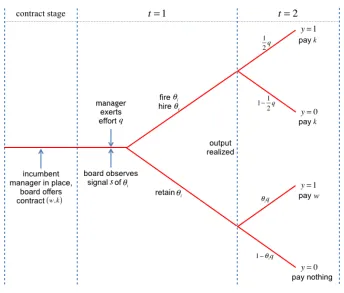
Period 1. The manager exerts e↵ort to create a project of quality q with cost
C(q) = 12q2. Simultaneously, the board receives a signals2Sof the manager’s ability
and decides whether to replace the incumbent manager. If the incumbent manager
is fired, a replacement manager is hired and has ability✓r randomly drawn from the
same pool of managers.5
Period 2. The manager who stays in office implements the project with no
ad-ditional e↵ort and payo↵s are realized. Implementation is assumed to be costless
and depends only on manager’s ability.6 To formalize this idea, we assume that the
expected quality of the project is equal to q✓˜, where q is the incumbent manager’s
choice of how much e↵ort to exert and ˜✓ is the ability of the manager who stays in
office at the beginning of period 2. With probabilityq✓˜, the project is of high quality
and yields outcome y = 1. With complementary probability 1 q✓˜, the project is
of low quality and yields outcome y = 0. After payo↵s are realized, the incumbent
manager receives payment according to the contract signed in period 0 and the game
comes to an end.
In the optimal contract, the wage for low output is 0. A contract is defined by
the tuple (w, k), wherew is the wage rate wheny = 1 and k is the severance pay to
the incumbent manager if he is fired. By the limited liability assumption,w 0 and
5The project generation process can also be interpreted as a project selection process as in
Casamatta and Guembel (2010). Assume some unknown state of the world⌘ 2[0,1] is randomly drawn, and a manager is hired to select a project a 2 [0,1] to match the underlying state. The quality of the project is 1 if a = ⌘ and 0 otherwise. The manager incurs cost C(q) to receive a signal ⌫ of the true state. With probabilityq, the manager identifies ⌘, that is, ⌫ = ⌘, and with probability 1 q,⌫ is pure noise. Givenq, the expected quality of the selected project isq. These two specifications lead to the same model.
Figure 1.1: Timeline
k 0.
Information structure. The board receives a noisy signal s 2 S about
in-cumbent manager’s ability ✓i. s is drawn from distribution with cdf F✓i(·) and pdf
f✓i(·) for ✓i 2 {0,1}. Without loss of generality, we assume S = [0,1] and
nor-malize s = 12F1(s) + 12F0(s) for s 2 [0,1].7 The two conditional density functions
f1(s), f0(s) suffice to define an information structure under such normalization.
Three assumptions are imposed on the information structure.
Assumption 1 The monotone likelihood ratio property (MLRP): f1(s)
f0(s) is strictly
in-creasing in s for s2[0,1].
7This assumption is without loss of generality due to the fact any information structure can be
For binary states, the MLRP assumption is without loss of generality because
signals can always be relabeled according to likelihood ratio to satisfy this assumption.
Assumption 2 Perfectly informative at extreme signals: lims!0ff10((ss)) = 0 and lims!1 ff10((ss)) = +1.
Assumption 2 guarantees that support of the posterior belief is always [0,1]. The
last assumption imposed on the information structure is symmetry. This assumption
allows us to define the first best replacement policy on the signal space.
Assumption 3 f1(s) =f0(1 s) for all s2[0,1].
By Assumption 3, f1(12) = f0(12). Thus the likelihood ratio at s = 12 is always
1 and the Bayesian update of the incumbent manager’s ability at 12 is equal to the
prior.
Finally we introduce an index ↵ 2(0,1) to parameterize the information
struc-ture. We assume thatf✓i(s;↵) is continuous ins and ↵for ✓i 2 0,1 and define the
information structures for the two extreme values of ↵ as follows.
Assumption 4 (Completely informative/uninformative information structure)
1. The information structure becomes completely uninformative when ↵!0, i.e.,
lim↵!0[f0(s;↵) f1(s;↵)] = 0 for s 2(0,1).
2. The information structure becomes completely informative when ↵ ! 1, i.e.,
lim↵!1f1(s;↵) = 0 for s2[0,12) and lim↵!1f0(s;↵) = 0 for s2(12,1].8 8Both completely informative and uninformative information structures are defined using
When the information structure becomes completely uninformative (↵ !0), the
two conditional density functions are the same. When the information structure
becomes completely informative (↵! 1), the board will not observe a signal below
1
2 when the incumbent manager is of high ability and a signal above
1
2 when the
incumbent manager’s ability is low.
1.3
The Optimal Contract
1.3.1
The benchmark case: contractible e
↵
ort
We first pin down the socially optimal replacement policy. By Assumption 1, the
socially optimal replacement policy is a cuto↵ rule. Denote ˆs as the signal cuto↵.
Lemma 1 (First best cuto↵) Suppose the board can contract on e↵ort q of the
incumbent manager. Then the optimal e↵ort is qFB = 12 + 14⇥F0(ˆsFB) F1(ˆsFB)
⇤
,
where the optimal replacement cuto↵ sˆFB = 12.
When e↵ort is contractible, the board is able to optimize e↵ort and selection
sepa-rately. Thus, there is no tradeo↵ between the moral hazard problem and the selection
problem. It is optimal to replace the incumbent manager when the posterior belief
about the incumbent’s ability falls below the expected value of the pool and retain the
incumbent otherwise. By Assumption 3, the likelihood ratio f1(s)
f0(s) at s=
1
2 is always
equal to 1. Consequently, the Bayesian update of the incumbent manager’s ability
is always equal to the prior independent of the informativeness ↵ of the information
structure. Consequently, the socially optimal cuto↵ sˆFB = 1
Given the first best cuto↵, we can now define entrenchment. Denote (w⇤, k⇤) as
the optimal contract to the board. Let (ˆs⇤, q⇤) be the equilibrium replacement cuto↵ and e↵ort of the continuation game induced by the optimal contract.
Definition 1 We defineentrenchmentas a cuto↵sˆ⇤ < 1
2 andanti-entrenchment
as sˆ⇤ > 1 2.
For the case where ˆs⇤ = 1
2, we say that neither entrenchment nor anti-entrenchment
is observed. The replacement policy coincides with the socially optimal policy. When
ˆ
s⇤ < 12, the replacement policy favors the incumbent manager: the board could have
improved implementation by replacing the incumbent. Similarly, the replacement
policy is considered aggressive and places the incumbent manager at a disadvantage
when ˆs⇤ > 12.
1.3.2
Characterizing the Optimal Contract
In this section, we solve the equilibrium outcome when e↵ort is non-contractible. The
board can only commit to the wage w and severance pay k in the contract. We are
interested in the cuto↵ ˆs⇤ induced by the optimal contract.
Incentives under fixed contract (w, k)
A contract (w, k) induces a simultaneous move game. We first solve the sub-game in
period 1, fixing contract (w, k). The incumbent manager’s e↵ort q and the board’s
For contract (w, k), the incumbent manager’s best response to cuto↵ sˆis e↵ort q that maximizes: max q 1 2 ⇥
1 F1(ˆs)
⇤
qw+1 2 ⇥
F1(ˆs) +F0(ˆs)
⇤
k C(q).
)q(ˆs;w, k) = 1 2 ⇥
1 F1(ˆs)
⇤
w. (1.1)
The board can provide incentive on e↵ort by increasing wagewor lowering equilibrium
cuto↵ ˆs. For a fixed contract (w, k) the board’s best response to the incumbent
manager’s e↵ort level q is cuto↵ ˆs that maximizes:
max ˆ s 1 2 ⇥
1 F1(ˆs)
⇤
q(1 w) + 1 2 ⇥
F1(ˆs) +F0(ˆs)
⇤ 1
2q k .
)sˆ(q;w, k) solves f1(ˆs)
f1(ˆs) +f0(ˆs)
q(1 w) = 1
2q k. (1.2)
Because a higher cuto↵ implies higher posterior belief about the incumbent
man-ager’s ability, the board chooses a cuto↵ such that the expected profit created by the
marginal incumbent manager is equal to the expected profit under replacement in
equilibrium.
Given contract (w, k), the optimal cuto↵ and e↵ort ˆs(w, k), q(w, k) are pinned
down by equations (1.1) and (1.2). We can calculate the corresponding contract (w, k)
that induces any tuple (ˆs, q) as follows,
w(ˆs, q) = 1 q 2
⇥
1 F1(ˆs)
and
k(ˆs, q) = 1 2q
f1(ˆs)
f1(ˆs) +f0(ˆs)
q⇥1 w(ˆs, q)⇤.9 (1.4)
Derive the optimal contract for fixed replacement policy
The board chooses contract (w, k) to maximize expected profit:
max {w,k}
1 2 ⇥
1 F1(ˆs)
⇤
q(1 w) + 1 2 ⇥
F1(ˆs) +F0(ˆs)
⇤ 1
2q k
s.t.
q = 1 2 ⇥
1 F1(ˆs)
⇤
w
and
f1(ˆs)
f1(ˆs) +f0(ˆs)
q(1 w) = 1
2q k.
Equivalently, the board is maximizing expected profit over (ˆs, q), withw(ˆs, q) and
k(ˆs, q) as determined in equations (1.3) and (1.4). Substituting equations (1.3) and
(1.4) into the board’s profit function yields expected profit as a function of (ˆs, q),
q
1 1 q
2
⇥
1 F1(ˆs)
⇤ ⇢
1 2 ⇥
1 F1(ˆs)
⇤
+1
2 ⇥
F1(ˆs) +F0(ˆs)
⇤ f1(ˆs)
f1(ˆs) +f0(ˆs)
.
It can be verified that q = 14⇥1 F1(ˆs)
⇤
under the optimal contract. Consequently,
w⇤ = 1
2. We summarize the results of the previous pages in a lemma.
Lemma 2 Fixing sˆ, the board maximizes expected profit by o↵ering a contract,
w = 1
2
and
k(ˆs) = 1 4 ⇥
1 F1(ˆs)
⇤1 2
1 2
f1(ˆs)
f1(ˆs) +f0(ˆs)
.
Moreover, in equilibrium, the incumbent manager chooses e↵ort
q(ˆs) = 1 4 ⇥
1 F1(ˆs)
⇤
.
By Lemma 2, k(ˆs) is decreasing in the equilibrium cuto↵ sˆ. By committing to
a higher severance pay, the board chooses a lower replacement cuto↵ in equilibrium
and is able to induce more e↵ort. The expected profit can be rewritten in terms of ˆs
alone:
⇡(ˆs) := 1 8 ⇥
1 F1(ˆs)
⇤⇢1 2 ⇥
1 F1(ˆs)
⇤
+ 1
2 ⇥
F1(ˆs) +F0(ˆs)
⇤ f1(ˆs)
f1(ˆs) +f0(ˆs)
.
The optimal cuto↵ depends on the informativeness of the information structure.
Rewrite the expected profit as follows:
⇡(ˆs) = 1 8 h
1 F1(ˆs)
i
| {z }
incentive e↵ect (h
1 2 ⇥
1 F1(ˆs)
⇤
+ 1
4 ⇥
F1(ˆs) +F0(ˆs)
⇤i
| {z }
selection e↵ect
+ 1
2 h
F1(ˆs) +F0(ˆs)
i⇣ f1(ˆs)
f1(ˆs) +f0(ˆs) 1 2 ⌘
| {z }
commitment e↵ect
)
Three e↵ects play a role in determining the optimal cuto↵. Because the outcome
depends on the expected ability of the manager in period 2, the board faces a selection
problem. This is captured by h1
2
⇥
1 F1(ˆs)
⇤
+1
4
⇥
F1(ˆs) +F0(ˆs)
⇤i
, which is called the
selection e↵ect. This is the expected ability of the manager in period 2. Increasing
ˆ
s will increase the expected ability of the manager in office when ˆs < 12 and decrease
the expected ability when ˆs 1
2. To optimize selection independently, the board
would choose ˆs= 12.
Because the outcome also depends on the e↵ort choice of the incumbent manager,
the board faces a moral hazard problem and needs to incentivize the incumbent.
This is captured by ⇥1 F1(ˆs)
⇤
, which is referred to as the incentive e↵ect. As the
equilibrium replacement cuto↵ sˆ increases, the incumbent manager expects a lower
retaining probability in equilibrium and exerts less e↵ort accordingly. The board
provides more job security to better incentivize the incumbent manager in response.
By this e↵ect alone, the board sets ˆs= 0.
If the selection e↵ect and the incentive e↵ect were the only e↵ects, a cuto↵
be-low 12 is optimal to the board and entrenchment emerges under optimal contract.
However, because the signal is non-contractible, board lacks commitment power on
replacement policy. Severance pay serves as a costly commitment device that helps
make replacement of the incumbent less likely. As the severance pay increases, it
lowers the expected payo↵ of replacement, which creates a stronger incentive for the
board to not replace the incumbent. In equilibrium the expected profit of
replace-ment is equal to the expected profit created by the marginal incumbent manager.
increase severance pay to make the equilibrium replacement policy credible. This
generates a net loss compared to the first best replacement policy. It is captured
by 1 2
h
F1(ˆs) +F0(ˆs)
i⇣ f1(ˆs)
f1(ˆs)+f0(ˆs)
1 2
⌘
, which is referred to as the commitment e↵ect.
Compared to the first best cuto↵ sˆ= 1
2, the board obtains a net commitment gain
by providing less commitment and designing a contract that induces cuto↵ above
1
2. Similarly, the board su↵ers a commitment loss by committing to a cuto↵ that is
below 12. The net commitment e↵ect is shown by⇣ f1(ˆs)
f1(ˆs)+f0(ˆs)
1 2
⌘
. Multiplied by the
probability of replacement, this yields the total net commitment gain/loss. By this
e↵ect alone, the board sets ˆs= 1.
If incentive e↵ect dominates commitment e↵ect, entrenchment is optimal to the
board. Otherwise, anti-entrenchment is optimal.
1.4
The Optimal Replacement Policy
In this section, we study how the optimal replacement policy varies depending on the
informativeness of the board’s monitoring technology.
1.4.1
Replacement at limiting distribution
Proposition 1 Suppose f1(·;↵), f0(·;↵) satisfies Assumptions 1 - 4. Then there
exist ↵ and ↵ such that,
1. sˆ⇤(↵)> 1
2 for ↵>↵;
When the information structure is noisy, providing incentives is more profitable
than obtaining more commitment. Choosing ˆs > 12 reduces severance pay by a small
amount because the Bayesian update around ˆs = 1
2 changes very slowly and the
expected ability of the incumbent manager at the cuto↵ is close to the expected
ability at a cuto↵ of 12. On the other hand, choosing ˆs > 12 reduces the incumbent
manager’s incentive to exert e↵ort. Consequently, it is optimal for the board to design
a contract that leads to entrenchment.
When the board’s monitoring technology is sufficiently informative, the benefit
of commitment dominates and choosing ˆs < 1
2 is not optimal for the board. Since
the probability of firing a high ability manager is very small for all signals below
1
2, lowering the equilibrium replacement cuto↵ does not have a large e↵ect on the
incumbent’s e↵ort. On the other hand, it is easy to obtain commitment gain. The
expected ability of the manager in the right neighborhood of 12 is very close to 1
when the information structure is sufficiently informative. That is, the board can
largely reduce the severance pay by choosing a cuto↵ slightly above 1
2. Thus,
anti-entrenchment is optimal to the board.
1.4.2
Optimal replacement and informativeness
Proposition 1 does not characterize the equilibrium replacement policy for
Distribution of posterior beliefs
Denote p = '(s) as the posterior belief of ✓ after observing signal s. Then '(s) =
f1(s)
f1(s)+f0(s). By Assumption 1, '(s) is strictly increasing in s. By Assumption 2,
the support of p is [0,1]. Denote g(p) as the corresponding density function. Since
E(E(✓|s)) = 1
2, the only constraint we impose ong(·) is that
R1
0 pg(p)dp= 1 2.
Given an information structure f1(·), f0(·) , the density function of posterior
belief pcan be calculated as follows:
g(p) = 1 2
f1(' 1(p)) +f0(' 1(p))
d' 1(p)
dp .
Lemma 3 For any density functiong(·)with support[0,1]that satisfiesR01pg(p)dp=
1
2, there exists a unique information structure f1(·), f0(·) that induces g(·).
By Lemma 3, there exists a one-to-one mapping between g(·) and information
structure f1(·), f0(·) . Thus working on the information structure f1(·), f0(·) is
equivalent to working on distribution of the posterior beliefg(·). Consequently, we can
define information order on g(·). By Assumption 3 on f1(·), f0(·) , g(p) =g(1 p)
and G(p) = 1 G(1 p) for p2[0,1]. Thus, it suffices to order di↵erent information
The ⇢-concave order
We use ⇢-concavity to define the informativeness of the information structure.10 To
the best of our knowledge, this is the first paper that defines information order using
⇢-concavity.
Given G(·), define local ⇢-concavity at p as,
⇢(p) := 1 G(p)g
0(p)
g2(p) .
By definition, ⇢(p) is the power of G(·) such that the second order Taylor expansion
at p drops out. Thus, ⇢(p) is a measure of the concavity of G(·) at point p.
Log-concavity is equivalent to ⇢(p) 0 and concavity is equivalent to ⇢(p) 1. We
focus on the distributions such that ⇢(p) 2 (0,1). This assumption is a necessary
condition to guarantee the initial condition G(0) = 0 is satisfied.11
Definition 2 (⇢-concave order) G1(p) is said to be more informative than G2(p)
in the ⇢-concave order if ⇢(p|G1)>⇢(p|G2) for all p2[0,12].
By definition, G1(p) is more informative than G2(p) if G1(p) is everywhere more
concave than G2(p) measured by local ⇢-concavity. The ⇢-concave order is a stronger
condition than the rotation order and Blackwell’s order: if a family of distributions
is ordered according to the ⇢-concave order, then it is rotation-ordered and ordered
in the sense of Blackwell.12
10For more applications of ⇢-concavity in economics, see Mares and Swinkels (2014) on auction theory; Anderson and Renault (2003), Weyl and Fabinger (2013) on industry organization.
11Imposing this non-negativity assumption on ⇢(
·) is without loss of generality: a completely uninformative information structure can still be defined under this constraint.
Assume that maxp2[0,1
2] ⇢(p;↵) and maxp2[0,21] ⇢(p;↵) exist for all ↵2(0,1).
Denote ⇢(↵) = maxp2[0,1
2] ⇢(p;↵) and ⇢(↵) = minp2[0, 1
2] ⇢(p;↵) for notational
convenience.
Lemma 4 Suppose 0<⇢⇢<1. Then 12(2p)1⇢ G(p) 1
2(2p)
1
⇢ for p2[0,1
2].
By Lemma 4, G(p) can be bounded by two constant cumulative density functions
with constant ⇢-concavity. A completely informative information structure
corre-sponds to the case where lim↵!1⇢(↵) = 1 and a completely uninformative
infor-mation structure is equivalent to lim↵!1⇢(↵) = 0.13 The following assumptions are
imposed on the family of distribution G(·;↵) indexed by ↵2(0,1).
Assumption 5 (a) Log concavity: ⇢(p;↵)2(0,1) for (p,↵)2[0,12]⇥(0,1).
(b) ⇢-concave order: If ↵1 >↵2, ⇢(p;↵1)>⇢(p;↵2) for p2[0,12].
(c) Regularity 1: 8↵, ⇢(p;↵) is weakly decreasing in p for p2[0,1 2].
14
(d) Regularity 2: There exists ↵ such that ⇢(p;↵) = 1 for all p2[0,12].
(e) Normalization: lim↵!1⇢(↵) =1 and lim↵!0⇢(↵) = 0.
By Assumption 5(a), we focus on G(p;↵) which is log-concave in p 2 [0,12].
To-gether with Assumption 5(c), Assumption 5(d) guarantees that the concavity/convexity
of G(·) will not change for given ↵. Assumption 5(e) restates Assumption 4 in the
language of the⇢-concavity.
13See Appendix C for detailed proof.
14As will be clear later, this assumption generates a well-behaved profit function forp 2[0,1
The optimal replacement policy
Denote ˆp as the cuto↵ of the posterior belief and ˜⇡(ˆp) as the board’s profit as a
function of ˆp. Then
˜
⇡(ˆp) = 1 4
Z 1
ˆ
p
tg(t)dt
| {z }
incentive e↵ect ⇢
1
2G(ˆp) + Z 1
ˆ
p
tg(t)dt
| {z }
selection e↵ect
+ ˆp 1
2 Z pˆ
0
g(t)dt
| {z }
commitment e↵ect
.
The profit function can be further simplified by combining the selection e↵ect and
the commitment e↵ect,
˜
⇡(ˆp) = 1 4
Z 1
ˆ
p
tg(t)dt
| {z }
incentive e↵ect ⇢ Z 1
ˆ
p
tg(t)dt + ˆpG(ˆp)
| {z }
selection+commitment e↵ect
.
The expression of the total selection and commitment e↵ect is intuitive. In
equi-librium, the board’s expected profit of replacement is equal to the expected profit
created by the marginal incumbent manager with expected ability ˆp. Hence the
board is replacing the incumbent manager of abilityppˆwith ˆptaking commitment
into consideration. It can be verified that the total of the selection e↵ect and the
commitment e↵ect is increasing in ˆp and thus is maximized at ˆp= 1.
The first order derivative with respect to ˆp yields,
˜
⇡0(ˆp) = 1 4
2
4 pgˆ (ˆp) 1 Z 1
ˆ
p
G(t)dt
!
+G(ˆp) Z 1
ˆ
p
tg(t)dt
) ⇡˜0(ˆp)S0 , pgˆ (ˆp)
G(ˆp) T R1
ˆ
p tg(t)dt 1 Rpˆ1G(t)dt.
From the first order condition, ˆpg(ˆp) is the marginal incentive e↵ect andG(ˆp) is the
marginal selection plus commitment e↵ect. Whether profit is increasing or decreasing
in ˆplargely depends on the ratio of these two marginal e↵ects, which is also the
elas-ticity of G(·) at point ˆp. Since ˜⇡(1) = 0, the incentive e↵ect dominates the selection
plus commitment e↵ect when ˆpis close to 1. To relate⇢-concavity to the profit
func-tion, notice that pgˆG(ˆ(ˆpp)) =
Rpˆ 0 ⇢(t)dt
ˆ
p
1
, which is the inverse of the average ⇢-concavity
of G(·) from 0 to ˆp. This ratio is weakly increasing if ⇢(p;↵) is weakly decreasing in
p for p 2 [0,12] by Assumption 5(c). This assumption guarantees that the marginal
incentive e↵ect changes faster than the marginal selection plus commitment e↵ect
and yields a well-behaved profit function for ˆp2 [0,12]. Assumption 5(b) (⇢-concave
order) guarantees that the marginal selection plus commitment e↵ect changes faster
than the marginal incentive e↵ect for given ˆp 2 [0,1
2] as ↵ increases. Consequently,
the selection plus commitment e↵ect takes over as board’s monitoring technology
improves and anti-entrenchment is more likely to emerge.
Proposition 2 Suppose the family of distribution G(·;↵) , indexed by ↵2(0,1),
satisfies Assumption 5. Then there exists ↵1 and ↵2 such that
1. sˆ⇤(↵) = 0 for ↵2(0,↵
1];
2. sˆ⇤(↵)2(0,12) for ↵2(↵1,↵2);
3. sˆ⇤(↵)2(1
where ↵1 satisfies ⇢(p;↵1) = 1 8p2[0,12] and ↵2 >↵1.
Proposition 2 characterizes the optimal replacement policy for all ↵. When ↵ is
small, the board provides full job security and never fires the incumbent manager.
When ↵is moderate, the board replaces the incumbent manager less frequently than
the socially optimal level and entrenchment is optimal. When ↵ is large, the board
uses an aggressive replacement policy and anti-entrenchment emerges. There exists
a clear cuto↵ between entrenchment and anti-entrenchment: once anti-entrenchment
is optimal for informativeness level ↵0, the optimal replacement policy is never
en-trenchment under a more informative information structure↵ >↵0.
A tractable example
Example 1 Suppose G(p) has the following functional form,
G(p) = 8 > > > < > > > :
1 2(2p)
1
↵ for pˆ2[0,1
2]
1 12[2(1 p)]↵1 for pˆ2(1
2,1]
.
Then the optimal cuto↵ is
1. for ↵1, pˆ⇤(↵) = 0;
2. for 1<↵ < p5+12 , pˆ⇤ 2(0,1 2);
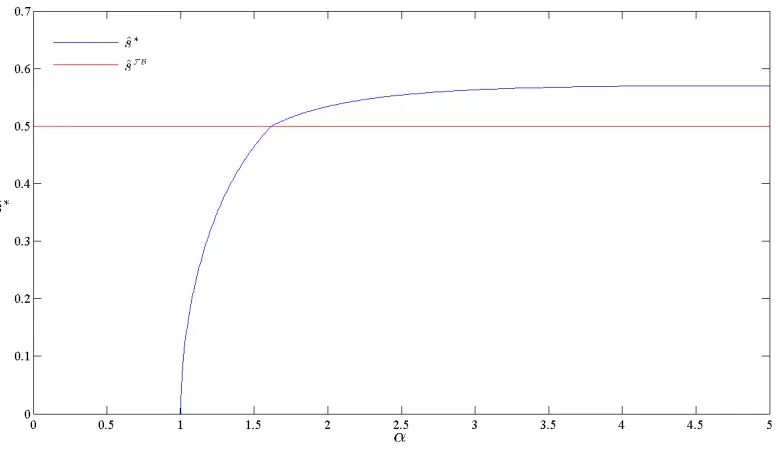
3. for ↵> p5+1
Figure 1.2: The optimal replacement policy
Given G(·), the two corresponding conditional density functions are
f1(s) =
8 > > > < > > > :
(2s)↵ for s2[0,1 2]
2 ⇥2(1 s)⇤↵ for s2(1
2,1]
and
f0(s) =
8 > > > < > > > :
2 (2s)↵ for s2[0,1 2]
⇥
2(1 s)⇤↵ for s2(1
2,1]
.
Figure 1.2 shows the optimal cuto↵ for di↵erent informativeness levels of the
monitoring technology. Turnover is increasing for ↵2⇥1,p5+1 2
⇤
when the manager is
entrenched. The relationship between turnover and the informativeness of the board’s
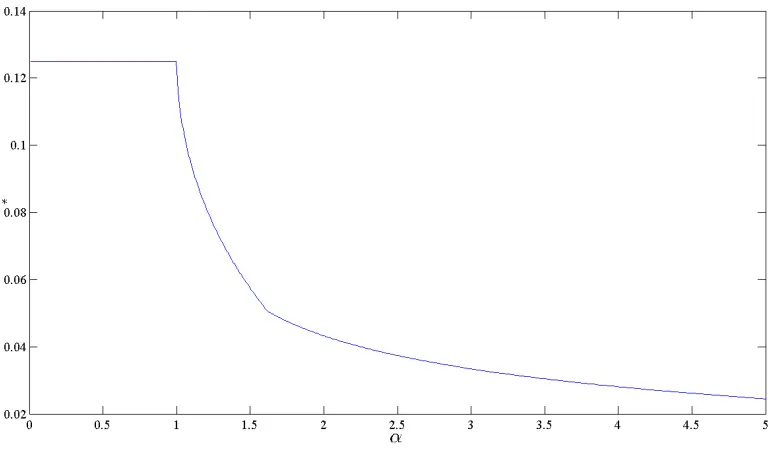
Figure 1.3: Severance pay in the optimal contract
the optimal cuto↵ converges to 1
2.
Figure 1.3 shows that severance pay in the optimal contract is decreasing in the
in-formativeness of the board’s monitoring technology. When the information structure
becomes more informative, it is easier for the board to obtain net commitment gain.
Thus the board is less willing to commit to not replacing the incumbent manager and
the size of severance pay o↵ered in the optimal contract decreases as a result. This
generates a testable implication of the model: the size of the severance package is
decreasing in the informativeness of the board’s monitoring technology.
1.4.3
Discussion
An optimal replacement policy that di↵ers from the first best stems from two
respect to outcome, i.e., the board cannot provide performance-based severance pay.
Without either of these assumptions, neither entrenchment nor anti-entrenchment
emerges: the optimal replacement policy is always ˆs⇤ = 1
2.
First consider what happens if the board’s signal is contractible, while maintaining
the assumption that severance pay is constant. A contract is fully characterized by
w(s), r(s), k(s) , wheres2 [0,1]. w(s), k(s) is the promised wage and severance
pay after signal s. r(s) 2 [0,1] specifies the retaining probability of the incumbent
manager at signal s. In particular, r(s) = 1 indicates that the incumbent manager is
retained while r(s) = 0 indicates that the incumbent is fired.15
Proposition 3 Suppose that the signal is contractible and severance pay is constant
with respect to outcome. Then k⇤(s) = 0. Moreover, r⇤(s) = 1 for s 2 [1
2,1] and
r⇤(s) = 0 for s2[0,12).
Allowing the board to contract on signals gives the board commitment power on
its retention decision at no cost. Severance pay is a costly commitment device, and
is no longer used in the optimal contract.
The board can design a contract to induce any e↵ort level without deviating from
the socially optimal replacement cuto↵. The manager is risk-neutral and only cares
about the expected wage. Thus, the board can incentivize the incumbent manager
by increasing the expected wage payment, which is determined by both the wage
function w(s) and the replacement policy r(s). For given e↵ort q and replacement
15Due to the board’s risk neutrality, randomization is not optimal except for the case where the
policyr(s), the board can adjust the wage functionw(s) to induceqwithout changing
r(s). That is, the board can optimize e↵ort and selection separately if the signal is
contractible, and the replacement cuto↵ is equal to 1
2 in the optimal contract.
Next consider what happens when the board can condition the severance pay on
the outcome, while maintaining the assumption that the signal is non-contractible. A
contract is in the form of a triple (w1, w2, k). w1 is the wage rate when the incumbent
manager stays as in the baseline model. The tuple (w2, k) constitutes a severance
package. w2 is the payment to the incumbent manager if he is forced out andy = 1.
k is the constant severance pay as in the baseline model.
Proposition 4 Suppose that the signal is non-contractible and the board can provide
performance-based severance pay. Then k⇤ = 0, w⇤
1 =w⇤2 and sˆ⇤ = 12.
Constant severance pay is less e↵ective to the board than performance-based
sev-erance pay when the incumbent manager is no longer in office because a lump-sum
payment rewards failure. Thus, only performance-based severance pay is employed
in the optimal contract.
Again the board has no incentive to deviate from the first best cuto↵. Due to
man-ager’s risk neutrality, the e↵ort choice of the incumbent manager is only determined
by the expected wage. For a given e↵ort levelq that the board wants to motivate, the
expected wage is fixed, which is also the total cost to hire the incumbent manager.
Since q is fixed, it remains to maximize the expected ability of the manager who
stays in office in period 2. Hence the replacement cuto↵ stays at the first best in the
optimal contract.16
1.5
Extensions
In this section, we show that the main result of the optimal replacement policy is
robust to several di↵erent specifications.
1.5.1
More e
↵
ort vs. better selection
It is interesting to study whether the main result on entrenchment (anti-entrenchment)
remains optimal when e↵ort becomes more important than ability. Anti-entrenchment
is less likely to emerge when selection becomes less important. We model this by
de-creasing the variance of the manager’s ability or inde-creasing the importance of e↵ort
relative to ability in the success probability.
Assume the ability space is ✓ 2 1
2 ,
1
2 + , where 2 0,
1 2
⇤
and the success
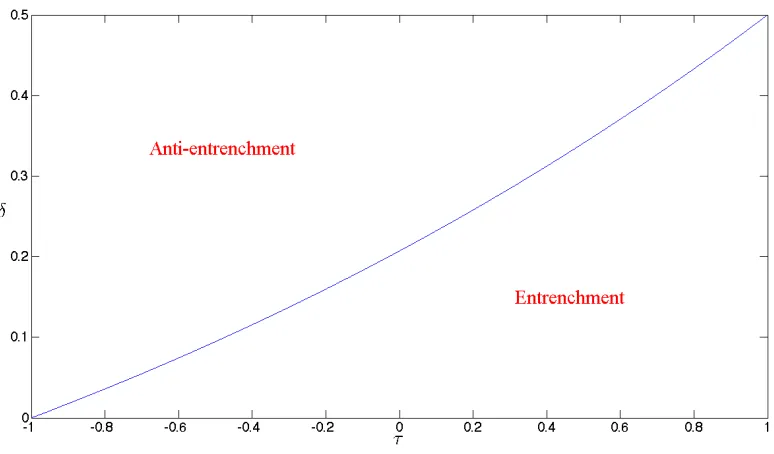
probability is equal to q1+⌧✓, where ⌧ 2 ( 1,1). is a measure of the variance of
manager’s ability ex ante while ⌧ is a measure of the relative importance of e↵ort
compared to selection. The baseline model corresponds to ( ,⌧) = (1
2,0). It is
intuitive that entrenchment remains optimal as ↵ approaches 0. Thus we focus on
the case where ↵ approaches infinity.
Proposition 5 (Comparative static)
1. if > 1 2
1 ⌧
2 1
2, there exists ↵¯A such that anti-entrenchment is optimal for
↵>↵¯A;
2. if < 1212⌧ 1
Figure 1.4: The optimal replacement policy at the limiting distribution
Fixing ⌧, selection becomes more important as the variance of the manager’s
ability increases. The intuition from the baseline model applies when is large, and
anti-entrenchment emerges in the optimal contract. When is small, the marginal
productivity of a low ability manager is close to that of a high ability manager. Since
motivating the low ability manager is also important, the optimal contract leads to
entrenchment as ↵ ! 1.
1.5.2
Costly execution
Suppose the outcome depends on the incumbent manager’s e↵ortq in period 1, e↵ort
e of the manager in period 2 as well as the ability of the manager in office in period
2. E↵ort q can be interpreted as the project quality of the project selected by the
project. Now the board needs to also o↵er a contract to the replacement manager.
Moreover, the optimal contract with the incumbent manager must balance a
two-dimensional moral hazard problem as well as the selection problem.
Assume the success probability is equal to ˜✓⇥(1 )q+ ˜e⇤, where ˜✓ 2 {0,1} is
the manager’s ability in period 2, q 2 [0,1] is the e↵ort of the incumbent manager
in period 1 and ˜e 2 [0,1] is the e↵ort of the manager in period 2. Period 1 e↵ort q
and period 2 e↵ort e are substitutes and 2 [0,1] measures the relative importance
of period 1 e↵ort. When = 0 the model simplifies to the baseline model. After the
board makes a retention decision, the manager in office at the beginning of period 2
exerts e↵ort eto execute the project. The cost function to the incumbent manager is
assumed to be separable and quadratic, i.e., Ci(q, e) = 12q2 +12e2. The cost function
to the replacement manager is assumed to beCr(q, e) = Ci(0, e).
Lemma 5 (First best outcome with costly execution) The socially optimal
cut-o↵ is equal to 1 2.
The proof is similar to Lemma 1 and is omitted. With costly execution, the first
best replacement cuto↵ remains at 1
2. In fact, this result is very general. The optimal
cuto↵ is always 12 as long as the marginal impact of manager’s ability is positive.
The board provides two contracts, contract (w, k) to the incumbent manager and
a wage wr to the replacement manager. Denote variables with subscript r as the
variables related to the replacement manager after retention.
We first calculate the optimal contract with the replacement manager wr after
replacement manager chooses er to maximize:
1 2 ⇥
(1 )q+ er
⇤
wr 1 2e
2
r )er(wr) = 1 2 wr.
Note that the replacement manager’s e↵ort on execution is independent ofq. This is
because q and e are assumed to be substitutes. The board chooses wr to maximize:
1 2 ⇥
(1 )q+ er
⇤
(1 wr))w⇤r = max
n1 2
1
2 q,0
o
.
Since q and e are substitutes by assumption, the optimal wage to the replacement
manager is weakly decreasing in the belief aboutq. When first period e↵ortq is large
or is small, the board provides a contract withwr= 0 to the replacement manager.
Let⇡(q) be the board’s expected profit under optimal contract after replacement.
⇡(q) can be calculated as follows,
⇡(q) = 8 > > > < > > > : 1 4 ⇣ 1 2 +
1 q⌘2 for q 1 2
2
1
1
2(1 )q for q > 1 2
2
1
.
Next we calculate the equilibrium for a given contract (w, k) with the incumbent
manager. For a fixed contract (w, k) and belief about cuto↵sˆ, the incumbent manager
chooses (q, e) to maximize:
1
2[1 F1(ˆs)] ⇥
(1 )q+ e⇤w+1
2[F1(ˆs) +F0(ˆs)]k 1 2q
2 1
4[(1 F1(ˆs)) + (1 F0(ˆs))]e 2.
)q= (1 )1 F1(ˆs)
2 w and e=
1 F1(ˆs)
[1 F1(ˆs)] + [1 F0(ˆs)]
Note thatq is decreasing in ˆswhilee is increasing in ˆs. A higher equilibrium
replace-ment cuto↵ leads to a lower first period e↵ort q and higher second period e↵ort eby
the incumbent manager. The first period e↵ort q is decreasing in ˆs because a higher
cuto↵ implies lower retaining probability in period 2 and dis-incentivizes the
incum-bent manager as in the baseline model. Conditional on the fact that the incumincum-bent
manager is retained, a higher cuto↵yields a higher estimate of the incumbent’s ability
and thus the incumbent is willing to exert more e↵ort in period 2 (✓andeare assumed
to be compliments). As a result, e is increasing in equilibrium cuto↵ ˆs. Similarly to
Casamatta and Guembel (2010), the incumbent is easier to motivate, but for di↵erent
reasons. The incumbent manager is easier to motivate in Casamatta and Guembel
(2010) due to his reputational concern while in our model it is due to the incumbent’s
learning of his ability. For a given wage rate w, the replacement manager chooses
er = 12 w while the incumbent manager choosese= [1 F1(ˆ1s)]+[1F1(ˆs)F0(ˆs)]w > 12 w. The
incumbent manager learns from his retention that his ability is above average. Since
ability and e↵ort are assumed to be compliments, a higher estimate of ability implies
a higher marginal return on e↵ort. Thus, the incumbent manager exerts more e↵ort
in period 2 than the potential replacement manager given the same wage.
For a fixed contract (w, k) and belief about e↵ort (q, e), the board chooses cuto↵
ˆ
s to maximize:
1
2[1 F1(ˆs)] ⇥
(1 )q+ e⇤(1 w) + 1
2[F1(ˆs) +F0(ˆs)] ⇥
) f1(ˆs)
f1(ˆs) +f0(ˆs)
⇥
(1 )q+ e⇤(1 w) = ⇡(q) k.
Not every ˆscan be implemented. For instance, ˆsvery close to 1 cannot be induced by
a contract. This is due to the limited liability assumption of severance pay. Extremely
high cuto↵ can only be induced if severance pay is allowed to be negative. This is
di↵erent from the baseline model. Using an aggressive replacement policy results in
a small q, making the board’s outside option very unattractive. On the other hand,
an aggressive replacement policy improves learning and makesevery high, increasing
the value of keeping the current manager. Thus, unless the board is compensated by
negative severance pay, a very aggressive replacement policy cannot be induced by a
contract subject to the limited liability constraint.
Similarly to the baseline model, the expected profit can be written as a function
of cuto↵ sˆalone, assuming away the limited liability constraint of k,17
⇡(ˆs) = 1 8
(
(1 )2 1 F1(ˆs) 2
| {z }
incentive e↵ect
+ 2 1 F1(ˆs)
[1 F1(ˆs)] + [1 F0(ˆs)]
| {z }
learning e↵ect
)
· (
h⇥
1 F1(ˆs)
⇤
+1
2 ⇥
F1(ˆs) +F0(ˆs)
⇤i
| {z }
selection e↵ect
+hF1(ˆs) +F0(ˆs)
i⇣ f1(ˆs)
f1(ˆs) +f0(ˆs) 1 2 ⌘
| {z }
commitment e↵ect
)
.
Proposition 6 (Optimal replacement policy with costly execution) 1. If 2
[0,p2 1), there exists ↵ such that sˆ⇤(↵)> 1
2 for ↵ >↵.
2. For 2[0,1], there exists ↵ such that ˆs⇤(↵)< 1
2 for ↵<↵.
A learning e↵ect enters into the board’s profit function along with the three
afore-mentioned e↵ects. When the information structure is sufficiently noisy (↵ !0), the
incumbent’s learning is very slow for all s2(0,1). The learning e↵ect plays a minor
role in determining the optimal replacement policy since 1 F1(ˆs)
[1 F1(ˆs)]+[1 F0(ˆs)]
2 can be
considered as a constant. Thus, entrenchment is expected to be optimal when ↵ is
sufficiently small independent of the size of .
When the information structure is sufficiently informative (↵ ! 1), the
incum-bent’s learning becomes very fast. When execution becomes sufficiently important,
entrenchment can be optimal to the board. When period 1 e↵ort q is sufficiently
important relative to period 2 e↵ort e (i.e., <p2 1), the incentive e↵ect is more
important than the learning e↵ect in board’s contractual problem. Thus, the main
insight in the baseline model follows through and entrenchment is expected to emerge
in the optimal contract.
1.5.3
Signal of outcome instead of ability
In the baseline model, it is assumed that the board observes a signal of the incumbent
manager’s ability rather than the outcome under the incumbent’s management. Since
the signal is not related to the incumbent manager’s e↵ort, the incumbent cannot
increase his probability of retention by exerting more e↵ort. When the board receives
a signal related to e↵ort, the incumbent manager is able to increase his probability
of being retained by exerting more e↵ort.
hy(·) and cdf Hy(·). Similarly, we assume h1(·), h0(·) satisfies Assumptions 1
-4. The signal provides information about the expected outcome and the incumbent
manager’s ability.
The social planner chooses (ˆs, q) to maximize:
max {ˆs,q}
1 2q
⇥
1 H1(ˆs)
⇤
+1
2q h1
2qH1(ˆs) + 1 1
2q H0(ˆs)
i 1
2q 2.
Lemma 6 (First best outcome) ˆsFB= 1
2 andqFB =
1+H0(12) H1(12)
2+H0(12) H1(12) in the first best
outcome.
The proof is similar to Lemma 1 and is omitted. Given e↵ort levelq, the Bayesian
update of the incumbent manager’s ability is
'(ˆs, q) = 1
2qh1(ˆs) + 1
2(1 q)h0(ˆs) 1
2qh1(ˆs) + 1 1
2q h0(ˆs)
.
It can be verified that'(12, q) = 12 independent ofq and↵. Thus it is socially optimal
to replace the incumbent manager if and only if the posterior belief of his ability falls
below the prior.
Given a contract (w, k) and belief about replacement cuto↵sˆ, the manager chooses
q to maximize:
1
2q[1 H1(ˆs)]w+ (
1
2qH1(ˆs) + ✓
1 1
2q ◆
H0(ˆs)
)
k 1
2q 2.
q = max ⇢
1
2[1 H1(ˆs)]w 1
2[H0(ˆs) H1(ˆs)]k,0 .
Unlike the baseline model, here the incumbent manager is directly dis-incentivized by
severance pay. An increase in severance pay increases the opportunity cost of exerting
e↵ort and leads directly to a decrease in e↵ort. If the severance pay is high enough,
the incumbent manager exerts no e↵ort at all and is willing to be fired. Under this
extension, severance pay is a double-edged sword. By the direct e↵ect (better outside
option if the incumbent manager is replaced), e↵ort decreases. By the indirect e↵ect
(better job security with lower equilibrium replacement cuto↵), e↵ort increases. The
design of the optimal contract should take this non-trivial incentive of k on q into
consideration.
Fixed (w, k) and q, the board chooses ˆs to maximize:
1 2q
⇥
1 H1(ˆs)
⇤
(1 w) +
( 1
2qH1(ˆs) + ✓
1 1
2q ◆
H0(ˆs)
) ✓ 1
2q k
◆
.
The board’s indi↵erence condition is:
1 2qh1(ˆs) 1
2qh1(ˆs) + 1 1
2q h0(ˆs)
(1 w) = 1
2q k.
ˆ
s is the solution to⇣(ˆs, q) = maxnmin 12q k
1 w ,1 ,0 o
, where ⇣(ˆs, q) is the estimate of
the outcome under the incumbent’s management at ˆs given q,
⇣(ˆs, q)⌘
1 2qh1(ˆs) 1
2qh1(ˆs) + 1 1
2q h0(ˆs)
It is difficult to write the expected profit as a function of ˆsalone because q is now
a↵ected by (w, k) directly and by equilibrium cuto↵ sˆ indirectly. However, we can
still discuss the optimal replacement policy under extreme information structure.
Multiple equilibria may exist for some contract (w, k) because incentive on e↵ort
q is not monotone in k as in the baseline model. For the same reason, equilibria may
not be Pareto-ranked. We further assume that the equilibrium most favorable to the
board is selected when multiple equilibria exist.
Proposition 7 (Optimal replacement policy) There exist ↵ and ↵ such that,
1. sˆ⇤(↵)> 12 for ↵>↵;
2. sˆ⇤(↵)< 12 for ↵<↵.
When the information structure is sufficiently noisy (↵ !0), H0(s) is very close
to H1(s) for s 2 [0,1]. The direct negative e↵ect of severance pay on e↵ort is small
and the model is back to the baseline in the limit. Knowing that the board has noisy
monitoring technology, the incumbent manager has little incentive to manipulate the
realization of the signal. Entrenchment is expected to be optimal when↵is sufficiently
small.
When the information structure is sufficiently informative (↵ ! 1), the
magni-tude of the direct negative e↵ect of k (i.e., 12[H0(ˆs) H1(ˆs)]) is very large. Under
this scenario, the board can simply avoid the disadvantage of k by setting k = 0.
Moreover, this does not contradict the possibility of obtaining a net commitment
that yields anti-entrenchment and dominates all possible contracts that yield
en-trenchment. Thus, anti-entrenchment emerges in the optimal contract as the board’s
information structure becomes sufficiently informative.
1.6
Conclusion
This paper explores how the problem of motivating the incumbent manager to exert
e↵ort and keeping the flexibility to choose a high ability manager interacts with the
equilibrium replacement policy. We focus on the situation where the board observes
a non-contractible signal after the incumbent manager exerts e↵ort and solve for the
optimal contract. We show that the information technology that the board uses to
assess the incumbent manager’s ability is an important determinant of the optimal
contract and of managerial turnover. Unlike the existing literature on managerial
turnover, which aims to rationalize entrenchment, we show that anti-entrenchment
can also be optimal for shareholders in some situations. This result is robust to
allowing costly execution and the possibility that the board observes a signal of the
outcome rather than incumbent manager’s ability. The model highlights the board’s
monitoring technology as an important determinant of managerial turnover.
There are several interesting questions that can be pursued using the stylized
model introduced in this paper. For future research, it would be interesting to
en-dogenize the informativeness of the board’s monitoring technology. In practice,
in-formativeness is often the choice of the board. Some boards actively monitor their
technology could help us better understand the di↵erences of monitoring intensity
that occur across industries.
Another intriguing research avenue would be to incorporate voluntary departure
into the model by allowing the possibility that manager possesses private information
about the firm’s profit. As Inderst and Mueller (2010) point out, managers sometimes
have private information about a firm’s performance. In such scenarios, the optimal
contract needs to provide incentives for the incumbent manager to step down
volun-tarily. It would be interesting to build a unified model with both forced departure
Chapter 2
Life Settlement Market with
Overconfident Policyholders
This chapter is a joint work with Hanming Fang.
2.1
Introduction
Life insurance is a prevalent long-term contract for people to keep their dependents
from economic disaster when the policyholders die. The life insurance is a large and
growing industry. According to Life Insurance Marketing and Research Association
International (LIMRA international), 70% of U.S. households owned some type of life
insurance in 2010. U.S. families purchased $2.8 trillion of insurance coverage in 2013
and the total life insurance coverage in the US was $19.7 trillion by the end of 2013.
The average face amount of the individual life insurance policies purchased increased