University of Pennsylvania
ScholarlyCommons
Publicly Accessible Penn Dissertations
1-1-2015
Neural Correlates of Adaptive Learning in the
Cingulate Cortex
Yin Li
University of Pennsylvania, [email protected]
Follow this and additional works at:http://repository.upenn.edu/edissertations Part of theNeuroscience and Neurobiology Commons
This paper is posted at ScholarlyCommons.http://repository.upenn.edu/edissertations/1856
Recommended Citation
Li, Yin, "Neural Correlates of Adaptive Learning in the Cingulate Cortex" (2015).Publicly Accessible Penn Dissertations. 1856.
Neural Correlates of Adaptive Learning in the Cingulate Cortex
Abstract
Learning from experience is critical for adaptive decision-making. When the world is unpredictable, the learning process itself must be adaptive. Outcomes that are attributed to a fundamental change in the environment should have a large impact on behavioral adjustment, whereas outcomes that are attributed to noisy, but expected, fluctuations in an otherwise stable environment should be largely ignored. There is growing interest in understanding the neural mechanisms of adaptive learning. However, studies to date have primarily used functional magnetic resonance imaging, which has limited temporal and spatial resolution. Relatively little is therefore known about how the brain implements adaptive learning at the level of individual neurons. Here, I advance the thesis that two reciprocally connected regions of the cingulate cortex—the anterior and the posterior cingulate cortex—contribute to adaptive learning by encoding environmental context and by encoding outcomes in a context-dependent manner. I support this thesis with recordings from individual neurons in the ACC and the PCC in monkeys performing an adaptive learning task.
Degree Type
Dissertation
Degree Name
Doctor of Philosophy (PhD)
Graduate Group
Neuroscience
First Advisor
Joshua I. Gold
Keywords
ACC, adaptive learning, cingulate cortex, feedback, PCC
Subject Categories
NEURAL CORRELATES OF ADAPTIVE LEARNING IN THE CINGULATE CORTEX
Yin Li
A DISSERTATION
in
Neuroscience
Presented to the Faculties of the University of Pennsylvania
in
Partial Fulfillment of the Requirements for the
Degree of Doctor of Philosophy
2015
Supervisor of Dissertation
__________________________________ Joshua I. Gold
Professor, Neuroscience
Graduate Group Chairperson
__________________________________ Joshua I. Gold
Professor, Neuroscience
Dissertation committee:
Yale Cohen, Associate Professor, Otorhinolaryngology Nicole Rust, Assistant Professor, Psychology
NEURAL CORRELATES OF ADAPTIVE LEARNING IN THE CINGULATE CORTEX
COPYRIGHT 2015
Yin Li
This work is licensed under the Creative Commons Attribution-‐ NonCommercial-‐ShareAlike 3.0 License
To view a copy of this license, visit
http://creativecommons.org/licenses/by-‐ny-‐sa/2.0/
iii
ACKNOWLEDGMENTS
I have many people to thank for the course of my scientific journey. First and foremost, I
want to express my gratitude to my graduate adviser, Dr. Joshua Gold, whose steady hand has guided
me through turbulent waters. He has done everything in his power to make my bumpy journey as
smooth and as productive as possible. The Gold Lab has been a tremendously supportive
environment. I want to acknowledge the help of lab members past and present, including Matt
Nassar (who conceived of and continues to be an integral part of the adaptive learning project),
Takahiro Doi (with whom I shared many recording sessions), David Barack (who prompted my
exploration of the posterior cingulate), Sidd Joshi, Long Ding, Chris Glaze, Kamesh Krishnamurthy,
Yunshu Fan, Rishi Kalwani, and Jeff Law. I would especially like to thank lab manager Jean Zweigle,
who not only provided extraordinary care for our monkeys, but also provided a much needed
perspective on life in the real world.
I want to thank the members of my thesis committee, Yale Cohen, Nicole Rust, Javier Medina
and Michael Platt, who have been a source of encouragement and wisdom throughout my graduate
career. The systems and computational neuroscience community at Penn has been both intellectually
stimulating and generous with their time. The Neuroscience Graduate Program (embodied in Mikey
Nusbaum, Jane Hoshi, and Christine Clay) and the MD-‐PhD Program (embodied in Maggie Krall and
Skip Brass) provided necessary institutional support (and cheerleading).
A career in academia would not have been possible without the support of family and
friends. My life has been a typical immigrant story with exceptional parents who sacrificed
everything back home to ensure that I would have a successful future. Most of all, I thank my proof-‐
reader, fellow scientist and fiancée—Anna Stern—who has been my anchor for the past few years as
I roughed the seas of noisy, unpredictable experiments.
iv
ABSTRACT
NEURAL CORRELATES OF ADAPTIVE LEARNING IN THE CINGULATE CORTEX
Yin Li
Joshua I. Gold
Learning from experience is critical for adaptive decision-‐making. When the world
is unpredictable, the learning process itself must be adaptive. Outcomes that are
attributed to a fundamental change in the environment should have a large impact
on behavioral adjustment, whereas outcomes that are attributed to noisy, but
expected, fluctuations in an otherwise stable environment should be largely ignored.
There is growing interest in understanding the neural mechanisms of adaptive
learning. However, studies to date have primarily used functional magnetic
resonance imaging, which has limited temporal and spatial resolution. Relatively
little is therefore known about how the brain implements adaptive learning at the
level of individual neurons. Here, I advance the thesis that two reciprocally
connected regions of the cingulate cortex—the anterior and the posterior cingulate
cortex—contribute to adaptive learning by encoding environmental context and by
encoding outcomes in a context-‐dependent manner. I support this thesis with
recordings from individual neurons in the ACC and the PCC in monkeys performing
an adaptive learning task.
v
TABLE OF CONTENTS
Acknowledgments ... iii
Abstract ... iv
List of Figures and Tables ... vi
Chapter 1: Introduction ... 1
Chapter 2: Adaptive encoding of feedback by the cingulate cortex during adaptive learning ... 13
Chapter 3: Conclusions and Future Directions ... 43
References ... 60
vi
LIST OF FIGURES AND TABLES
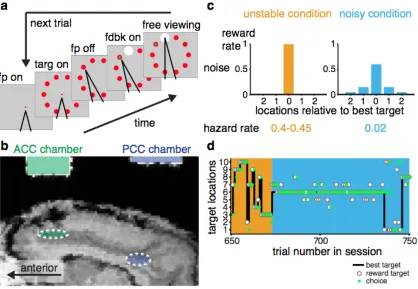
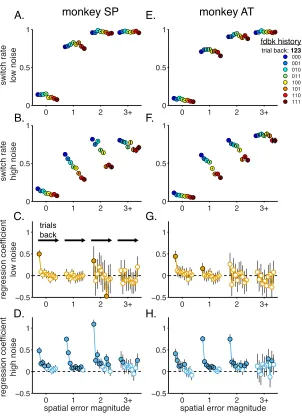
Figure 2-‐1: Change-‐point task and recording sites. ... 32
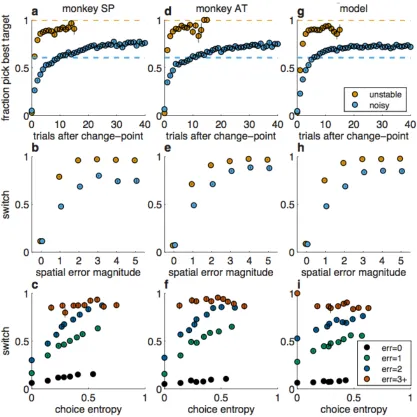
Figure 2-‐2: Behavioral data from monkeys SP (a–c) and AT (d–f) and simulated data from a hybrid Bayesian model (g–i). ... 33
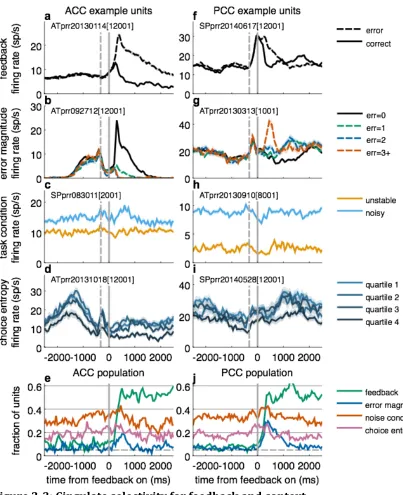
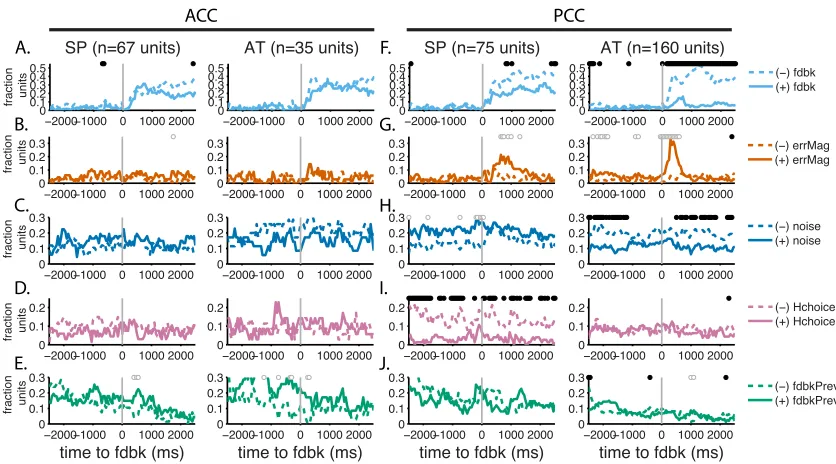
Figure 2-‐3: Cingulate selectivity for feedback and context. ... 35
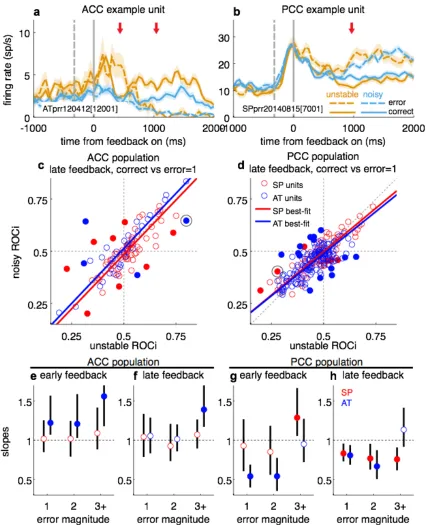
Figure 2-‐4: Context-‐dependent feedback encoding. ... 37
Supplementary Figure 2-‐S1: Adaptive integration of feedback history. ... 39
Supplementary Figure 2-‐S2: Model-‐based evidence for adaptive learning. ... 41
Supplementary Figure 2-‐S3: Heterogeneity and bias in neural selectivity. ... 42
Figure 3-‐1: Actual and simulated behavior on the change-‐point task. ... 56
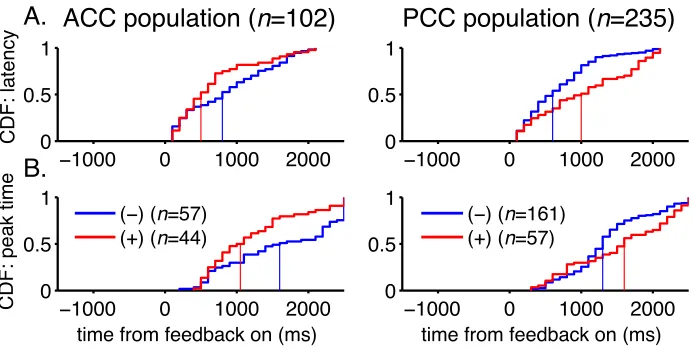
Figure 3-‐2: Temporal dynamics of cingulate feedback responses. ... 57
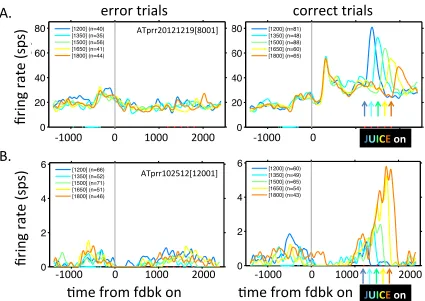
Figure 3-‐3: Two example ACC neurons with reward expectation signals. ... 58
Figure 3-‐4: Cingulate neurons respond to surprising auditory stimuli. ... 59
CHAPTER 1: INTRODUCTION
To make predictions about the future, we need to learn from our past. In an
uncertain world, however, individual experiences are only partially predictive about
future outcomes. A single cold winter does not dispel the notion of global warming.
A single poor quarterly earnings report does not mean long-‐term decline in a
company. And a single failed experiment does not discredit a graduate student's
thesis. In each of these examples, expected noisy fluctuations in outcomes limit our
interpretation of single experiences, and temper how much we should learn from
them.
Expectations about statistical regularities in our environment are critical for
appropriately interpreting experiences to adjust our beliefs and behaviors. This
form of context-‐dependent process is known as adaptive learning. In this
introduction, I review conceptual considerations regarding learning in probabilistic,
dynamic environments, and why adaptive learning is required. I then turn to two
areas in the cingulate cortex that may play a role in adaptive learning, with a focus
on neuroanatomic and neurophysiologic findings that may have bearings on
adaptive learning.
Learning in dynamic environments
To formalize the notion of "the extent of learning," let's first turn to
reinforcement learning (RL) theory, which was independently developed in
machine learning and animal psychology literature (Sutton and Barto, 1998).
According to the Rescorla-‐Wagner model of reinforcement learning, the expectation
at time t+1 is given by updating the pre-‐existing expectation at time t (Vt) according
to the difference between the actual outcome (Rt) and the pre-‐existing expectation
(Vt):
Vt+1 = Vt + αt(Rt – Vt) (1)
where the difference Rt – Vt-‐1 is referred to as the prediction error (PE) and the
constant of proportionality αt is referred to as the learning rate. In classic learning
experiments, R is usually a reward outcome and V is the expected reward (also
known as the value) of a particular action or stimulus. However, the same
framework can also be applied to more abstract problems, such as inferring the
mean of a probability distribution (µ) that gives rise to observable outcomes (R)
(Nassar et al., 2010).
In this framework, the learning rate serves to determine the relative
weighting (or influence) of the new outcome versus past experiences (aggregated in
terms of the pre-‐existing expectation). When the learning rate is 1, all of the weight
is placed on the most recent outcome (i.e., Vt+1 = Rt), whereas when the learning rate
place (i.e., Vt+1 = Vt). For a constant learning rate between 0 and 1, the update
equation performs a weighted sum of all previous outcomes, with the largest weight
for the most recent outcome.
In order to ensure that V converges to the true reward rate rather than
continuing to fluctuate in response to new outcomes even after the average reward
rate has been learned, it is common in the machine learning literature to set the
learning rate to the inverse of the number of outcomes that have been observed
(Sutton & Barto, 1998). This procedure in essence takes an average of all the
outcomes in an environment. As more and more data is accumulated, new
information has decreasing influence on the expected reward rate of the
environment.
In the real world, however, we often don't know when the environment has
changed (and thus how many outcomes to average over). One solution for this
problem is suggested by the Pearce-‐Hall model of learning, in which the learning
rate itself depends on the absolute value of the prediction error (Pearce and Bouton,
2001). Such a model deals better with a dynamic environment because more
unexpected or "surprising" outcomes lead to a higher learning rate, allowing the
learner to also effectively discard past outcomes that are likely to be no longer
relevant. In other words, the Pearce-‐Hall model uses the magnitude of the
prediction error as a built in change-‐point detector.
A limitation of the Pearce-‐Hall model is that its conception of "surprise" fails
monkey keeping track of how rewarding a fruit tree is. Finding no fruit when the
typical yield is consistently 5 pieces of fruit is a lot more surprising than if the
typical yield varies between 0 and 10 pieces of fruit, even if the average yield is 5
pieces of fruit both situations. How surprising an outcome is should thus depend on
not just the mean of the reward distribution, but also its variance, what is referred
to as "noise." It's the signal-‐to-‐noise ratio of a prediction error that matters for
detecting environmental changes, not just the absolute value.
Another aspect of the environment that affects the interpretation of an
outcome is the "volatility" of the environment. In a more volatile environment,
where changes happen frequently, an unexpected outcome is more likely to result
from a true change in the environment than if the environment were generally
stable. For the foraging example, if a monkey knows that trees at a particular
foraging site have a short life span, then finding 0 pieces of fruit should lead him to
abandon that tree. On the other hand, if trees were long-‐lived, then he should be
more persistent in returning to a tree that had yielded abundant fruit in the past.
Noise and volatility thus play opposite roles in determining how much an animal
should learn from the same prediction error: higher noise should suppress learning
from an outcome, whereas higher volatility should enhance it.
These notions of noise and volatility can be formalized with a Bayesian
framework that considers learning as a form of statistical inference. Estimating the
environment (µor mean reward rate) is inferred from a noisy sequence of outcomes
(R) that provide evidence about the current state (Yu and Dayan, 2004; Courville et
al., 2006; Adams and MacKay, 2007; Behrens et al., 2007; Fearnhead and Liu, 2007;
Nassar et al., 2010, 2012; Wilson et al., 2013). In this framework, the pre-‐existing
expectation Vt from Eq. 1 can be thought of as a prior with distribution P(µ), the
outcome Rt as the evidence with likelihood distribution P(R|µ), and the updated
expectation Vt+1 as the posterior P(µ |R). "Noise" is formalized as a type of
uncertainty about the outcome, related to the width of the likelihood distribution.
"Volatility" is formalized as a type of uncertainty about the prior, related to an
overall "offset" that affects the likelihood that on average the environment could be
in any other state. In reinforcement learning, the learning rate arbitrates between
the relative influence of new outcomes and pre-‐existing expectations. In Bayesian
learning, this arbitration occurs naturally as a function of the relative uncertainties
for the prior versus the likelihood, by way of Bayes theorem:
P(µ |R) ∝ P(µ)P(R|µ). (2)
When outcomes are noisy (wide likelihood), more weight is placed on the prior, and
less learning occurs. When the average volatility is high, the prior is more uncertain,
and more weight is placed on the outcomes, increasing learning. Moreover, recent
changes in the environment also increase learning, since changes increase the
uncertainty of a learner in its estimate of underlying environmental state (leading to
interpreting unexpected outcomes in a dynamic environment, and thus a normative
account of how to adjust the learning rate.
Various names have been used to partition these types of uncertainties in the
priors and likelihoods. In an influential review, Yu & Dayan (2005) coined the
phrases "expected" and "unexpected uncertainties." Expected uncertainty arises
from known unreliability in the relationship between outcome and the underlying
state of the environment, and is thus related to noise. Unexpected uncertainty, by
contrast, arises from outcomes that violate existing expectations about an
environment, i.e., outcomes that are unexpected if the environment hadn't changed,
and is thus related to both the volatility of an environment and the signal-‐to-‐noise
ratio of an outcome. Yu & Dayan (2005) also noted, however, that expected
uncertainty can be further divided into uncertainty arising from "ignorance" (which
can be reduced by accumulating evidence) and "inherent stochasticity" in the task
(related to noise), that cannot be reduced. The uncertainty from "ignorance" has
been variously referred to as "estimation uncertainty" (Payzan-‐LeNestour et al.,
2013) and "relative uncertainty" (Nassar et al., 2010), whereas the irreducible
uncertainty has been referred to as "risk" (Bach and Dolan, 2012). Unexpected
uncertainty has also been termed "change-‐point probability" (Nassar et al., 2010),
"second-‐order uncertainty" (Bach and Dolan, 2012), and "surprise" (O’Reilly et al.,
2013). A cautionary note is that the mappings between these terms are not always
Regardless of what they are called, many recent studies have demonstrated
that humans and animals are sensitive to these various forms of uncertainties and
adapt learning accordingly (Gallistel et al., 2001; Daw et al., 2006; Behrens et al.,
2007; Nassar et al., 2010, 2012; O’Reilly et al., 2013; McGuire et al., 2014; Diederen
and Schultz, 2015). Behrens et al. (2006) found that human subjects adapted their
learning rates according to the volatility of the environment. Nassar et al. (2010)
found that human subjects adjusted their learning rates in a trial-‐by-‐trial fashion, as
a function of both how noisy the environment is and how long they have been in a
changed environment, which is related relative uncertainty. Diederen & Schultz
(2015) likewise found that the sensitivity human subjects to reward prediction
errors were scaled by reward variability. Even rodents are sensitive to
environmental statistics: rats that are used to a volatile environment detected
changes in reward contingencies more quickly than rats used to a stable
environment (Gallistel et al., 2001).
Despite the abundance of behavioral evidence, the neural substrates
underlying adaptive learning are poorly understood. The vast majority of the
adaptive learning literature have used functional magnetic resonance imaging to
probe the representation of these various forms of uncertainty and behavioral
adaptation. However, blood oxygenation level dependent (BOLD) signals measured
by functional imaging have limited spatial and temporal resolution (Logothetis,
2008). Moreover, BOLD signals do not map linearly onto neural responses
adaptive learning, it is thus important to directly record from neurons in humans or
other animals as they perform adaptive learning. Below, I outline the rationale for
doing such recordings in the cingulate cortex.
The cingulate cortex and adaptive learning
The cingulate cortex consists of a vast sheath of gray matter in the medial
wall of the cerebral cortex that overlay the corpus callosum (Vogt and Pandya,
1987). The anterior cingulate cortex, which consists of Brodmann areas 24 and 32,
has long been implicated in high-‐order cognitive function, including cognitive
control and conflict-‐monitoring, pain and emotional processing, action selection and
reward processing, although its exact function remains hotly contested
(Ridderinkhof et al., 2004; Walton et al., 2007; Cole et al., 2009; Mansouri et al.,
2009; Rushworth et al., 2011; Shenhav et al., 2013; Silvetti et al., 2014). The
posterior cingulate cortex, which includes Brodmann areas 23 and 31, has
traditionally been designated a node of the default-‐mode network, based originally
on the striking activation of this area in functional imaging experiments when
subjects are not performing tasks, although more recent work have focused on its
role evaluating decision options and outcomes (McCoy et al., 2003; McCoy and Platt,
2005; Schacter et al., 2007; Hayden et al., 2008; Heilbronner and Platt, 2013; Leech
and Sharp, 2013; Pearson and Platt, 2013). Several lines of evidence indicate that
Neuroanatomical connectivity indicate that both ACC and PCC are nodes of
highly connected hubs, allowing them to rapidly integrate sensory, motor and
affective signals (Vogt et al., 1979, 2006; Vogt and Pandya, 1987; Heilbronner and
Haber, 2014). In addition to their reciprocal connections with each other, both ACC
and PCC are connected to the orbitofrontal cortex, which is implicated in value
encoding, the dorsolateral prefrontal cortex, which is involved in working memory
and executive function, and the hippocampal formation, which plays a key role in
consolidation of long-‐term memory (Vogt and Pandya, 1987; Vogt and Gabriel,
1993; Heilbronner and Haber, 2014). The ACC is additionally connected to primary
and association motor cortices, whereas the PCC receives strong projections from
sensorimotor areas of the posterior parietal cortex (Vogt and Pandya, 1987;
Heilbronner and Haber, 2014).
The innervation of the cingulate cortex by neuromodulatory systems bears
special attention. Dopamine (DA), released by the midbrain neurons of the ventral
tegmental area and substantia nigra pars compacta, are thought to encode reward
prediction error signals that drive reinforcement learning (Schultz et al., 1997).
Norepinephrine (NE), released by the pontine nucleus locus coeruleus, is involved in
physiological arousal and has been proposed to signal unexpected uncertainty or
change-‐point probability (Yu and Dayan, 2004; Aston-‐Jones and Cohen, 2005;
Payzan-‐LeNestour et al., 2013). Acetylcholine (ACh), released by neurons in the
basal forebrain as well as the brainstem, is involved in attention and learning and is
2012). All three of these neuromodulatory systems send projections to the ACC
(Vogt et al., 1979; Porrino and Goldman-‐Rakic, 1982; Heilbronner and Haber, 2014).
Moreover, ACC is a primary cortical input to the locus coeruleus (Porrino &
Goldman-‐Rakic, 1982). The connectivity of the PCC to neuromodulatory systems is
less well documented, partly reflecting the relatively lesser attention that has been
paid to this caudal cingulate area. However, metabotropic receptors for dopamine,
acetylcholine and norepinephrine are all present in PCC (Palomero-‐Gallagher et al.,
2009). Fibers that terminate in the PCC stain positive for enzymes required for
catecholamines (DA and NE) and ACh biosynthesis, suggesting that PCC also receive
inputs from these three neuromodulatory systems (Heilbronner et al., 2014). The
ACC and PCC are thus well suited anatomically to integrate outcomes and contextual
cues in mediating adaptive choices.
Single-‐unit recordings from monkeys are also consistent with a role for ACC
and PCC in adaptive learning. Both regions encode actions and outcomes of actions,
with subpopulations of neurons that encode positive and negative outcomes,
prediction errors, and reward magnitude (McCoy et al., 2003; Amiez et al., 2005,
2006; Matsumoto et al., 2007; Hayden et al., 2008, 2009; Hayden and Platt, 2010;
Kennerley et al., 2011). In ACC, a subpopulation of neurons encodes the
surprisinginess of outcomes, regardless of whether it is positive or negative, which
may support a role in detecting environmental changes (Hayden et al., 2011). Both
regions also encode the outcomes of previous trials, potentially allowing these areas
Hayden et al., 2008; Bernacchia et al., 2011; Kennerley et al., 2011). Finally, activity
of these areas predict behavioral switching on tasks where switching represent a
change in strategy or learning (Quilodran et al., 2007; Hayden et al., 2008).
Lesion experiments further highlight the importance of ACC and PCC in
adaptive behavior. Notably, monkeys with ACC lesions were able to learn from
errors on single trials, but could integrate feedback from across multiple trials to
maintain optimal choices (Kennerley et al., 2006). Muscimol inactivation of ACC led
to impaired performance in a probabilistic reversal task (Amiez et al., 2006).
Muscimol inactivation of PCC impaired the ability to learn arbitrary visuo-‐saccadic
associations when the expected rewards were low (but not when those rewards
were high), suggesting a context-‐dependent role for the PCC in learning
(Heilbronner and Platt, 2013).
Human neuroimaging studies have directly implicated ACC and PCC in
adaptive learning. ACC activity has been found to track volatility, change-‐point
probability, relative uncertainty, and model updating in subjects learning from
probabilistic, dynamic environments (Behrens et al., 2007; Krugel et al., 2009;
O’Reilly et al., 2013; McGuire et al., 2014). Moreover, ACC activity is stronger when
feedback is more indicative of reversal in reward contingencies in a probabilistic
reversal task, suggesting an adaptive coding function for the ACC (Jocham et al.,
2009). PCC has similarly been implicated in the signaling of change-‐point
probability and various forms of uncertainty (Payzan-‐LeNestour et al., 2013;
In summary, neuroanatomical studies, recording and lesion experiments in
monkeys, and neuroimaging studies in humans are consistent with roles for the ACC
and the PCC in adaptive learning. Indeed, Pearson et al. (2011) has recently outlined
a model whereby the ACC encodes task-‐relevant variables that are then integrated
by the PCC to detect changes in the environment. Alternatively, the ACC and PCC
might each encode contextual variables that are needed to drive adaptive learning.
To test these hypotheses and better understand the contributions of the cingulate
cortex in adaptive learning, I recorded from single neurons in the ACC and the PCC
in two monkeys trained on a task developed by a previous graduate student in the
lab, Matt Nassar, in which optimal performance required adaptive learning. The
results of these experiments are presented in the main chapter of this dissertation.
CHAPTER 2: ADAPTIVE ENCODING OF FEEDBACK BY THE
CINGULATE CORTEX DURING ADAPTIVE LEARNING
Yin Li, Matthew R. Nassar, Joseph W. Kable, Joshua I. Gold
Abstract
Effective error-‐driven learning in a dynamic environment must distinguish
between different sources of errors, such as those arising from fundamental change-‐
points that require behavioral adjustments versus those arising from noise that
should be ignored (Yu and Dayan, 2004; Courville et al., 2006; Adams and MacKay,
2007; Fearnhead and Liu, 2007; Nassar et al., 2010; Wilson et al., 2013). Despite
extensive evidence for representations of errors in the brain, little is known about if
and how these representations are modulated by information about the source of
the errors to guide effective learning behaviors. Here we show that individual
neurons in both the anterior (ACC) and posterior (PCC) cingulate cortex, which can
represent error-‐related feedback signals (McCoy et al., 2003; Behrens et al., 2007;
Matsumoto et al., 2007; Seo and Lee, 2007; Heilbronner and Platt, 2013), can also: 1)
encode contextual signals needed to distinguish different sources of those errors,
and 2) use those signals to adaptively modulate error encoding, particularly in the
PCC, in accordance with behavioral adjustments. We recorded from ACC and PCC
change-‐point task. Individual neurons in both regions were sensitive to error
feedback and the relative balance of noise and change-‐points that contributed to the
errors. Furthermore, in PCC but not in ACC, feedback encoding was adaptively
modulated by context in a manner consistent with behavioral adjustments, such that
errors related to change-‐points were enhanced relative to errors related to noise.
These results suggest that cingulate-‐mediated, adaptive encoding of feedback may
contribute to complex, adaptive learning behaviors.
Text
To examine the role of the cingulate cortex in adaptive learning, we recorded
from ACC and PCC neurons in two monkeys performing a novel change-‐point task.
The task required them to make a saccadic eye movement to predict the likely
location of a single, stochastically determined "reward target" from among a circular
array of ten visual targets, based on the outcomes of previous trials (Fig 1). The
monkeys performed this task under two different, explicitly cued, blockwise
conditions. In the zero-‐noise, high-‐change (“unstable”) condition, reward was
always paired with a single target that changed location relatively often (at a fixed
“hazard rate” of 0.4–0.45 per trial). Thus, feedback was highly reliable. The best
target to choose was always the previously rewarded target, even just after a change
point. In contrast, in the high-‐noise, low-‐change (“noisy”) condition, the location of
often (hazard rate=0.02). Thus, feedback was less reliable. Identifying the best
target required integrating noisy feedback information across trials and often
suppressing behavioral adjustments to small errors.
We analyzed the performance of the two monkeys from all sessions for which
we have neural recordings (n=93,278 trials over 67 sessions for monkey SP; 71,422
trials over 65 sessions for monkey AT). Overall, the monkeys chose the reward
target well above chance in both the unstable (49% for SP, 50% for AT) and noisy
(42% for SP, 43% for AT) condition. The monkeys tended to choose the best target
>50% of the time after just one trial after a change-‐point of the best target in the
unstable condition and within 5–6 trials in the noisy condition (Fig. 2a,d). In the
noisy condition, the monkeys reliably chose the best target more frequently than the
reward rate for that target (60%, blue lines in Fig. 2a,d,g) within 10–15 trials after
change-‐points and thus were not just choosing the most recent reward target or
matching reward probabilities (Sugrue et al., 2004; Lau and Glimcher, 2005).
Both monkeys used adaptive, feedback-‐driven strategies to solve the task.
They were more likely to switch choices after error versus correct feedback but did
not treat all error feedback equally (Fig. 2b,e). Switching was more common when
the spatial error magnitude (the distance from the reward target to the chosen
target) was large. Moreover, for a given spatial error magnitude, the monkeys were
less likely to switch in the noisy versus unstable condition. This difference was
largest for small spatial errors, which were more predictive of change-‐points in the
likely to switch during times of subjective uncertainty about the environment, as
indexed by the variability of their choices (“choice entropy”) over the past ten trials
(Fig. 2c,f).
These adaptive strategies, including sensitivity to noise condition and
uncertainty, are consistent with human behavior on comparable change-‐point tasks
and are predicted by normative (Bayesian) theory (Courville et al., 2006; Wilson et
al., 2013; Gallistel et al., 2001; Daw et al., 2006; Behrens et al., 2007; Krugel et al.,
2009; Nassar et al., 2010, 2012; O’Reilly et al., 2013; McGuire et al., 2014; Diederen
and Schultz, 2015). The monkeys also exhibited non-‐normative tendencies to persist
in choosing the same target. Accordingly, a hybrid model with fully adaptive,
Bayesian learning plus persistent choices reproduced key features of the monkeys'
behavior, including a dependence on error magnitude, noise, and choice entropy
(Fig. 2g-‐i). This model provided a better fit to behavior than either a purely Bayesian
model (∆BIC = -‐113.48 for SP, -‐121.77 for AT, paired t-‐test, p<0.001 for both) or a
standard, fixed-‐learning rate reinforcement learning model that also included the
same tendency to persist (∆BIC = -‐479.89 for SP, -‐290.33 for AT, paired t-‐test,
p<0.001 for both).
To identify novel neural signals that underlie these adaptive strategies, we
targeted the ACC and PCC. Both encode feedback at the single-‐neuron and
population levels, and both are sensitive to relevant contextual information like
change-‐point probability and subjective uncertainty about the current state of the
Pearson et al., 2011; Heilbronner and Haber, 2014; Matsumoto et al., 2007;
Quilodran et al., 2007; et al., 2008; Heilbronner and Platt, 2013; Behrens et al.,
2007; Jocham et al., 2009; Payzan-‐LeNestour et al., 2013; Economides et al., 2014;
McGuire et al., 2014). However, little is known about how the contextual
information is represented and combined with feedback information by single
neurons. We recorded the activity of 102 ACC units (n=67 from SP, 35 from AT) and
235 PCC units (75 from SP, 160 from AT) as the monkeys performed the change-‐
point task (Fig. 1b).
Units in both areas encoded categorical feedback (correct or error, Fig. 3a,f),
as reported previously (McCoy et al., 2003; Matsumoto et al., 2007; Quilodran et al.,
2007; Hayden et al., 2008; Heilbronner and Platt, 2013). They also encoded the
magnitude of the spatial error, a type of prediction error that strongly influenced
switching behavior (Fig. 3b,g). Both kinds of feedback signals were present in
similar fractions of units in both ACC and PCC (Fig. 3e,j), but they used different
encoding schemes. ACC neurons were divided roughly equally in terms of higher
firing rates for correct or error feedback or as a function of error magnitude (the
median regression coefficient in the early feedback epoch for feedback [-‐0.003] or
error magnitude [-‐0.056] did not differ significantly from zero, Wilcoxon signed-‐
rank test p=0.74 and 0.51, respectively). By contrast, PCC neurons were generally
more active for error trials (median feedback coefficient=–0.574, p<0.001) and
ACC and PCC units were also selective for the contextual factors needed to
evaluate the informativeness of the feedback for adaptive learning, including noise
condition and choice entropy (Fig. 3c-‐e,h-‐j). Whereas feedback signals appeared
transiently after the time of feedback onset, selectivity for noise condition and
choice entropy tended to be stable throughout each trial, even for individual
neurons (Spearman’s correlation coefficient comparing regression coefficients in a
500-‐ms pre-‐fixation epoch and a 500-‐ms reward epoch for noise were 0.73 and 0.72
for ACC and PCC data, respectively, p<0.001 in both cases, and for choice entropy
were 0.59 and 0.60, respectively, p<0.001 in both cases). Encoding of context at the
single-‐unit level was heterogeneous, with no overall bias in encoding either noise
condition or choice entropy (the median regression coefficient for either factor in
the pre-‐fixation epoch did not differ significantly from zero for either ACC or PCC
data, p>0.22 in all cases). Thus, both ACC and PCC may play general roles in
representing a diversity of feedback-‐ and context-‐related information needed for
adaptive learning.
Some individual ACC and PCC neurons also encoded combinations of factors
that were key to adaptive learning, with a more systematic and behaviorally
relevant representation in PCC. Specifically, the monkeys’ behavior showed a
(normative) decreased sensitivity to small errors in the noisy versus unstable
condition (Fig. 2h). Neural encoding of feedback in certain individual cingulate
neurons showed a similar effect. In the unstable condition, the example ACC unit in
then more for correct trials a short time later. In the noisy condition, this same unit
exhibited an attenuated response to error trials in the early epoch and an
attenuated response to correct trials in the late epoch, consistent with the reduced
informativeness of feedback in the noisy condition. The example PCC unit in Fig. 4b
was more sensitive to error trials in the unstable versus noisy condition. Across the
population, these feedback-‐noise interactions were represented differently in ACC
and PCC. In the ACC, we found neurons with both enhancing and suppressing effects
of noise on feedback encoding (fraction of units with significant interactions
between feedback [correct vs error=1] and context [stable vs noisy] in the late
feedback epoch=0.118 [95% CI=0.062, 0.20]), with no systematic relationship
across the population (Fig. 4c,e,f). In the PCC, there also were examples of both
enhancing and suppressing interactions (fraction of significant units=0.0851
[0.0528, 0.128]). However, across the population in PCC there was a consistent and
systematic suppressive effect of noise condition on small errors (spatial
magnitude=1 or 2) in the late feedback epoch (Fig. 4d,g,h), mirroring the behavioral
effect of noise on switch (Fig. 2b,e).
These results suggest a selective role for PCC in integrating feedback and
noise condition to encode errors adaptively. This adaptive feedback encoding
mirrored the differential sensitivity of the monkeys to errors in the two noise
conditions, with higher sensitivity to small errors in the unstable versus noisy
condition. This sensitivity is consistent with the encoding of change-‐point
noise, in BOLD PCC activation (Nassar et al., 2010, 2012; McGuire et al., 2014). Our
results are thus in broad agreement with previous proposals that a key function of
the PCC is to detect environmental changes (Pearson et al., 2011) and show for the
first time how individual neurons encode key factors needed to carry out that
function effectively in a dynamic environment.
In ACC, feedback-‐noise interactions were more heterogeneous and may
reflect more diverse roles in error processing. Approximately half of these neurons
encoded feedback more weakly in the noisy condition and more strongly in the
unstable condition. This kind of encoding was similar to what we found for PCC and
is reminiscent of surprise signals that have been reported for ACC neurons (Hayden
et al., 2011). The remaining ACC neurons we found that were selective for these
feedback-‐noise interactions encoded feedback more strongly in the noisy condition.
This encoding may be related to conflict or cognitive control signals that have been
ascribed to ACC, because feedback is more ambiguous and thus difficult to interpret
in this condition (Sheth et al., 2012; Shenhav et al., 2013; Ebitz and Platt, 2015). The
mixed encoding scheme of ACC neurons may also reflect a general role in
representing feedback and contextual information that can be read out efficiently by
downstream areas in a task-‐specific manner (Rigotti et al., 2013), possibly including
the feedback-‐noise interactions represented in the PCC for this task.
More generally, further processing of these feedback-‐ and context-‐related
representations by downstream areas appears to be necessary to solve the task. We
feedback encoding in either brain area, even though the monkeys interpreted errors
differently according to choice entropy (H0: slopes of ROC [correct vs. error=1] for
high-‐ vs. low-‐choice entropy trials=1, p>0.05 by bootstrap for both ACC and PCC in
both early and late feedback epochs). Moreover, the firing rate of neurons in the two
areas were generally not predictive of whether the monkey would switch or not on
the subsequent trial: when a binary variable indicating whether the monkey
switched or stayed on the following trial was added as a co-‐regressor to a linear
regression model that already includes feedback and context terms, the fractions of
significantly predictive units were 0.088 [95% CI=0.041,0.161] in ACC and 0.111
[0.074,0.158] in PCC in the late feedback epoch.
Thus, the cingulate cortex encodes all of the feedback and contextual
variables necessary for adaptive behavioral adjustments in our task. However, this
region does not appear to be the final common pathway for the integration of
feedback with context to drive behavior. Neither ACC nor PCC integrated feedback
with subjective uncertainty (estimated by choice entropy), and neural activity in
ACC and PCC was not robustly predictive of the behavioral adjustment on the
subsequent trial. Other brain areas, such as the insula, orbitofrontal cortex, the
posterior parietal cortex, and even further downstream oculomotor planning areas,
may be more directly involved in the trial-‐by-‐trial adjustment of learning, as has
been suggested by neuroimaging studies (O’Reilly et al., 2013; McGuire et al., 2014;
Chau et al., 2015). Whether individual neurons in these brain areas encode or make
Methods
Subjects
Two adult male rhesus monkeys (Macaca mulatta) were used for this study.
All training, surgery, and experimental procedures were performed in accordance
with the National Institutes of Health's Guide for the Care and Use of Laboratory
Animals and were approved by the University of Pennsylvania Institutional Animal
Care and Use Committee.
Behavioral task
On each trial, the reward target was drawn probabilistically from a
distribution centered on the best target. The best target was selected uniformly
from the ten possible targets based on a change-‐point process governed by a flat
hazard rate. In the low-‐noise, high-‐hazard condition, the best target was rewarded
100% of the time and the hazard rate was 0.4–0.45 per trial. In the high-‐noise, low-‐
hazard condition (the "high noise" condition), the best target was rewarded 60% of
the time, with adjacent pairs of targets rewarded at 15% and 5%, and the hazard
rate was 0.02 per trial. Noise and hazard rate were counterbalanced to achieve
similar overall performance for the two task conditions. The two environments
of the fixation point (large red disk for "low noise" and small gray disk for "high
noise").
Each trial began with the presentation of a central fixation point. The monkey
had 500 ms to acquire fixation, after which the ten-‐target array (radius 10° visual
angle) appeared. Monkeys needed to maintain fixation for a variable duration
(~500–1000 ms) until the fixation point disappeared, signaling the monkey to
indicate its prediction by making a saccadic eye movement to the predicted reward
target. After the monkey had indicated its choice, visual feedback was given
indicating the chosen target (center of the chosen target turned green) and the
reward target (a large white target was overlaid on top of the reward target). Visual
feedback was present for a variable duration (randomly chosen from 1200, 1350,
1500, 1650, and 1800 ms), during which time the monkey could freely view the
screen. After the feedback was extinguished, the screen went blank, and, if the
reward target had been chosen, the juice was delivered. The variable delay between
feedback onset and juice delivery allowed us to differentiate between the effects of
receiving feedback information and receive the juice reward itself.
Eye position was monitored using a video-‐based system (Eye-‐Link 2000; SR
Research) sampled at 1000 Hz. Visual stimuli were generated using the
Psychtoolbox (Brainard, 1997) and custom Matlab software and presented on an
Electrophysiology
Each monkey was implanted with a head holder and two recording cylinders
that targeted the ACC and PCC on either the left side (monkey SP) or the right side
(monkey AT). ACC cylinders were placed at Horsley-‐Clark coordinates 33 mm AP, 8
mm L for monkey SP and 43 mm AP, 8 mm L for monkey AT. PCC cylinders for both
monkeys were placed at 0 mm AP, 5 mm L, and tilted at an angle of 8.5 deg along the
ML plane to point downward toward the midline. For ACC recordings, we targeted
areas 32/24 along the dorsal bank of the anterior cingulate sulcus (~4–6 mm below
cortical surface). For PCC recordings, we targeted areas 31 and 23, in the posterior
cingulate gyrus (~7–11 mm below cortical surface). Both brain regions were
targeted using magnetic resonance imaging and custom software (Kalwani et al.,
2009) as well as by listening for characteristic patterns of white and gray matter
during recordings. Neural recordings were conducted using either single-‐contact
glass-‐coated tungsten electrodes (Alpha-‐Omega) or multicontact linear electrode
arrays (V-‐probe, Plexon) and a Multi-‐channel Acquisition System (Plexon). Spike
waveforms were sorted offline.
Behavioral analyses
Choice entropy, a measure of behavioral variability that reflects decision
uncertainty (Goñi et al., 2011; Takahashi et al., 2015), was computed using the
monkey's choices in the 10 trials leading up to and including the current trial to
Hchoice was then given, by analogy to entropy in information theory (Shannon, 2001),
by:
(1)
where the 1/log2(10) term scales Hchoice between zero (minimally variable, if the
same target was chosen in the last ten trials) and one (maximally variable, if choices
were equally distributed among the ten targets).
Bayesian inference models
Optimal Bayesian inference in the change-‐point task involves computing the
posterior distribution over the best target µt on trial t after observing the t-‐th
reward target from the history of all reward targets x1, …, xt,, P(µt|x1:t). We developed
a recursive, online algorithm to compute this discrete posterior distribution
(Adams and MacKay, 2007; Behrens et al., 2007; Fearnhead and Liu, 2007; Nassar et
al., 2010; Wilson et al., 2013). Let H be the flat hazard rate determining whether the
best target is the same as from the previous trial or repicked randomly from one of
the ten possible targets. The prior probability over the best targets on trial t is then
given by a weighted sum of the posterior on the best target from the previous trial
and the flat uniform distribution, where H governs the weighting:
. (2)
The posterior probability P(µt|x1:t) after observing the t-‐th outcome xt is then given
by Bayes' Rule:
Hchoice = 1
log2
( )
10"
k !P k( )
log2(
P k( )
)
P
(
µt | x1:t!1)
=P(
µt!1| x1:t!1)
(
1!H)
+ 1
, (3)
where is the known likelihood or noise distribution and acts
as a normalization term. Substituting in Eq. 3 gives a recursive algorithm for
computing the posterior on the best target, given knowledge of the hazard H and the
noise distribution :
, (4)
where equals 1/10 for t = 1.
For the fitted Bayes model, we assumed that the probability of picking target
k on the t + 1 trial was given by the softmax transformation of the posterior
probability on the t-‐th trial:
(5)
where β was an inverse-‐temperature term, with β=0 resulting in all targets being
chosen with equal probability and higher β increasing the probability of picking the
most probable target. We modeled the (discrete) noise distribution after the von-‐
Mises distribution for circular variables (Fisher, 1995):
(6)
P
(
µt|x1:t)
=P x
(
t|µt)
P(
µt |x1:t!1)
P x(
t | x1:t!1)
P x
(
t|µt)
P x(
t | x1:t!1)
P x
(
t|µt)
P
(
µt|x1:t)
=P x
(
t |µt)
P(
µt!1|x1:t!1)
(
1!H)
+1 10H " # $ % & '
P x
(
t | x1:t!1)
P
(
µt!1|x1:t!1)
PBayes
(
k,t+1)
=exp(
!!P(
µt =k|x1:t)
)
exp(
!!P(
µt =k|x1:t)
)
k"
P x
(
t |µt)
=exp !cos "5(xt!µt)
" # $ % & ' " # $ % &
' exp !cos "
5(xt!µt)