R E S E A R C H A R T I C L E
Open Access
Late-life depression and quality of life in a
geriatric evaluation and management unit: an
exploratory study
Jui-Hung Lin
1,2, Min-Wei Huang
2, Deng-Wu Wang
2, Yi-Ming Chen
3,4, Chu-Sheng Lin
3,5, Yi-Jing Tang
3,5,
Shu-Hui Yang
3,6and Hsien-Yuan Lane
1,7*Abstract
Background:Late-life depression is common among elderly patients. Ignorance of the health problem, either because of under-diagnosis or under-treatment, causes additional medical cost and comorbidity. For a better health and quality of life (QoL), evaluation, prevention and treatment of late-life depression in elderly patients is essential. Methods:This study examined (1) the differences of clinical characteristics, degree of improvement on QoL and functionality on discharge between non-depressed and depressed elderly inpatients and (2) factors associated with QoL on discharge. Four hundred and seventy-one elderly inpatients admitted to a geriatric evaluation and management unit (GEMU) from 2009 to 2010 were enrolled in this study. Comprehensive geriatric assessment including the activities of daily living (ADL), geriatric depression scale, and mini-mental state examination were conducted. QoL was assessed using the European Quality of Life-5 Dimensions and the European Quality of Life-5 Dimensions Visual Analog Scale on discharge. Information on hospital stay and Charlson comorbidity index were obtained by chart review. Chi-square tests, independent t-tests, Mann–Whitney U tests and multiple linear regressions were used in statistical analysis.
Results:Worse QoL and ADL on discharge were found among the depressed. Depressive symptoms, female gender, duration of hospital stay, and rehabilitation were significant factors affecting QoL on discharge in linear regression models. Conclusions:The importance of the diagnosis and treatment of depression among elderly inpatients should not be overlooked during hospital stay and after discharge. Greater efforts should be made to improve intervention with depressed elderly inpatients.
Keywords:Elderly, Late-life depression, Geriatric depression, Quality of life, EQ-5D, Geriatric evaluation and management unit, GEMU, ADL, GDS
Background
Late-life depression (LLD) or geriatric depression is common among elderly [1,2]. However, the disorder remains under-diagnosed and under-treated [3,4]. Un-like depression in young adults, physical condition is a more heavily weighted factor in LLD [5]. In addition, comorbidity is particularly common in LLD, probably arising from biological, psychological and social mech-anisms [5]. These include suicidal behavior, decreased
physical, cognitive and social functioning, and greater self-neglect, all of which are associated with increased mortality [1]. The prevalence of LLD was about 10% in community, and about 40% in hospitals and long-term care facilities [2,6-9]. Functional impairment increases in patients with LLD, especially in those with multiple comorbidities [10]. Poor health status and chronic dis-eases are risk factors for depressive symptoms in the elderly inpatients [11]. A recent meta-analysis also showed that stroke, loss of hearing, poor eyesight, car-diac disease, and chronic lung disease were factors as-sociated with depression in old age [12]. Despite the high prevalence of LLD, less than half of geriatric pa-tients with the diagnosis received treatment, especially * Correspondence:[email protected]
1China Medical University, Graduate Institute of Clinical Medical Science, No. 91 Hsueh-Shih Road, Taichung, Taiwan
7Department of Psychiatry, China Medical University Hospital, Taichung, Taiwan
Full list of author information is available at the end of the article
in medical settings without mental health facilities [3,4,13]. Moreover, LLD was related to a significant in-crease in the total cost of medical care even after adjust-ing for the severity of chronic medical illness [14]. Elderly inpatients who had depressive symptoms used more hos-pital and outpatient services than non-depressed counter-parts [15]; after discharge, those who had unresolved depressive symptoms had higher rates of clinic visitation and re-hospitalization [16].
QoL is a surrogate indicator for general well-being. Wu et al. [17]. reported that QoL in elderly patients was a significant independent predictor of functional status after discharge from the hospital. Depressive symptoms are also closely related to QoL. Unsar et al. [18]. reported that depressive symptoms in elderly inpatients with chronic illness were associated with a decline in self-rated QoL. Moreover, LLD also had a significant negative im-pact on quality of life and was associated with increased mortality due to either suicide or chronic illness [11].
With the increasing aging population worldwide, geri-atric evaluation and management units (GEMUs) have been established to meet special needs and deliver inte-grated care to elderly hospitalized patients [19,20]. In previous studies of GEMUs, the research has focused on functional recovery, mortality rates, readmissions, and costs of medical service among the elderly [19,21-23]. In this study, we examined (1) the differences of clinical char-acteristics, degree of improvement on QoL and function-ality on discharge between non-depressed and depressed elderly inpatients and (2) factors associated with QoL on discharge. in a GEMU in Taiwan.
Methods
Study participants
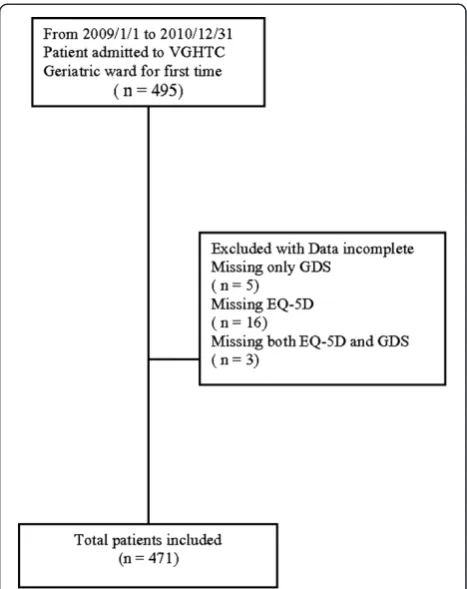
This study was approved by The Ethics Committee of Clinical Research, Taichung Veterans General Hospital, Taiwan (file number CE11118). Four hundred and ninety-five elderly inpatients who had been hospitalized in the GEMU of Taichung Veterans General Hospital during 2009 to 2010 were included initially. After further chart review, 24 patients were excluded because their data were incomplete. A total of 471 patients were finally used in the statistical analysis. The sampling procedures are shown in Figure 1.
Study setting
The GEMU in Taichung Veterans General Hospital is an 18-bed hospital facility devoted to the care of frail eld-erly patients with acute functional decline in a tertiary teaching hospital in central Taiwan. A nearby rehabilita-tion room for onsite physiotherapy and occuparehabilita-tional therapy, along with visual calendars and clocks, provides accessibility for activities related to physical enablement and cognitive integrity. The staff of the GEMU consisted
of two geriatricians, one case manager, one rehabilitation specialist, one psychiatrist, and two residents from the department of internal medicine and family medicine. The nurse members of the GEMU received formal train-ing in geriatric nurstrain-ing and skills for elderly care. The core members of the multi-disciplinary team in the GEMU included a physiotherapist, occupational therap-ist, dietitian, social worker, pharmactherap-ist, and psychologist. Meetings were arranged once a week to report the as-sessments of different specialists, set goals, discuss various problems, and plan discharge. In general, rehabilitation in the GEMU aimed at improving ADL, walking independ-ence, muscle strengthening, and balance training. Tailor-made rehabilitation plans were implemented by physio-therapists, occupational physio-therapists, and nurses to ensure mobilization throughout the day and during holidays.
Comprehensive geriatric assessment
All patients in this study completed the comprehensive geriatric assessment (CGA). The CGA includes basic personal information (age, gender, history of chronic ill-ness, education, source of referral) and various assess-ment tools, comprising the activities of daily living (ADL), geriatric depression scale (GDS), mini-mental state examin-ation (MMSE), and European Quality of Life instrument-5
Dimensions (EQ-5D)/European Quality of Life instrument-5 Dimensions Visual Analog Scale (EQ-instrument-5D VAS). All as-sessments were conducted on admission and discharge.
ADL were evaluated using the Barthel Index (BI), which consists of 10 categories including eating, toilet-ing, personal hygiene, dresstoilet-ing, walktoilet-ing, and climbing stairs [24]. The MMSE was used as a screening tool for cognitive integrity [25]. A 15-item geriatric depression scale (GDS, range 0–15) was used as a screening tool for depressive symptoms [26,27], and higher scores indicated more perceived symptoms. The EQ-5D is a questionnaire composed of five dimensions (mobility, self-care, usual activities, pain/discomfort, and anxiety/depression) for self-rated quality of life [28]. Levels of severity in each dimension are defined as no problems (one point), some problems (two points), and major problems (three points). The total summed score of EQ-5D ranges from five to 15. Higher scores in the EQ-5D mean poorer self-rated qual-ity of life. The EQ-5D VAS is a 20-cm visual analog scale for patients to mark their current health status [29]. Higher scores in the EQ-5D VAS represent better self-rated health status/quality of life (scores from 0 to 100).
Chart review was also performed for information about the hospital stay. A list of chronic illnesses was recorded, including hypertension, diabetes mellitus, cerebral vascu-lar disease, chronic renal disease, chronic obstructive pul-monary disease, atrial fibrillation, arthritis and gout. Comorbid conditions were measured using the Charlson comorbidity index (CCI) [30].
Statistical analysis
Data in the text and tables are expressed as means ± S.D. The Statistical Package for the Social Sciences (SPSS) version 10.0 software (SPSS Ltd., Chicago, IL, USA) was used to perform all statistical analyses. Categorical vari-ables were compared using the Chi-square tests. Inde-pendent sample t-tests and Mann–Whitney U tests were used for comparisons between continuous variables as appropriate. Multiple linear regression analysis was used to identify independent factors for QoL. All tests with p < 0.05 were considered statistically significant.
Results
Comparisons between the non-depressed and depressed group are summarized in Table 1. The prevalence of de-pressive symptoms was 54.4% in the elderly patients. There were no differences in age (80.79 ± 5.98 vs 79.82 ± 6.30), gender (71.5% male vs 74.9% male), education (omitted) and length of hospital stay (13.61 ± 9.18 vs 12.75 ± 9.62) between the non-depressed and depressed group. Minimal differences were seen in the sources of re-ferral to the GEMU in the two groups (p = 0.042). There was no difference in the severity of chronic illness as represented by similar Charlson comorbidity indices
(p = 0.986). MMSE and ADL showed significant differences between the two groups on admission (p values <0.001). De-pressed elderly inpatients showed more cognitive impair-ment and worse ADL scores on admission; worse ADL scores and less satisfaction in QoL were shown on discharge (EQ-5D, EQ-5D-VAS).
Analysis of the subscales of EQ-5D showed significant differences in each subscale between the two groups (Mobility: p < 0.001; Self-care: p = 0.005; Usual activity: p = 0.003; Pain: p = 0.023; Depression and Anxiety: p < 0.001) (Figure 2). A significant difference was also noted in EQ-5D-VAS on discharge (p < 0.001) (Figure 3). The elderly inpatients with depressive symptoms on admission showed worse QoL on discharge.
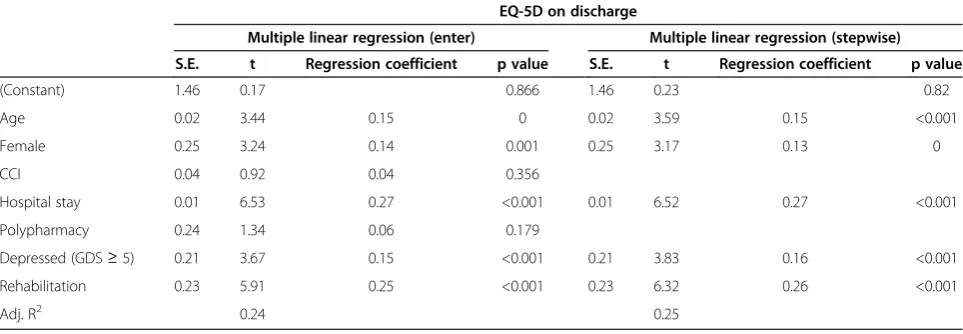
Multiple linear regressions were performed for factors that were significantly associated with QoL on discharge (from Table 1). The results are summarized in Table 2. Depressive symptoms, age, female gender, duration of hospital stay, and in-hospital rehabilitation were sig-nificant factors associated with EQ-5D score on dis-charge (adjusted R2= 0.24 in enter mode and 0.25 in stepwise mode).
Discussion
Late-life depression in GEMUs
Figure 2Comparison of EQ-5D subscales on discharge.The subscales of EQ-5D are shown as Mobility (p < 0.001); Self-care (p = 0.005); Usual activity (p = 0.003); Pain (p = 0.023); Depression and Anxiety (p < 0.001). Mann–WhitneyUtest. (**) p < 0.01. (*) p < 0.05.
Table 1 Total demography data and sub-groups comparison (with/without depressive symptoms)
Paraemeters Total Depressed (GDS≧5) Non-depressed (GDS < 5) Compare depressed and non-depressed
n = 471 n = 256 n = 215
Basic information Mean ± S.D. or n (%) Mean ± S.D. or n (%) Mean ± S.D. or n (%) p value
Age 80.35 ± 6.14 80.79 ± 5.98 79.82 ± 6.30 0.089(a)
Gender (Male) 344 (73.0) 183 (71.5) 161 (74.9) 0.408(c)
Education 0.438(b)
Below elementary school 142 (30.1) 77 (30.1) 65 (30.2)
Elementary school 144 (30.6) 82 (32.0) 62 (28.8)
Junior high school 57 (12.1) 25 (9.8) 32 (14.9)
Senior high school 76 (16.1) 45 (17.6) 31 (14.4)
Above college 52 (11.0) 27 (10.5) 25 (11.6)
Refer source 0.042(b)
General ward 127 (27.0) 58 (22.7) 69 (32.1)
Out patient clinic 199 (42.3) 122 (47.7) 77 (35.8)
Emergency department 120 (25.5) 64 (25.0) 56 (26.0)
Psychiatric department 25 (5.3) 12 (4.7) 13 (6)
Hospital stay (Days) 13.22 ± 9.38 13.61 ± 9.18 12.75 ± 9.62 0.325(a)
Charlson Comorbidity Index 3.65 ± 2.97 3.66 ± 3.00 3.62 ± 2.96 0.986(c)
On admission
GDS on admission 5.65 ± 3.76 8.36 ± 2.73 2.35 ± 1.29 <0.001(c)
MMSE on admission 21.99 ± 5.77 21.03 ± 5.53 23.13 ± 5.86 <0.001(c)
ADL on admission 61.94 ± 31.57 57.68 ± 31.03 67.01 ± 31.53 <0.001(c)
On discharge
ADL on discharge 69 ± 30.13 65.21 ± 30.15 73.51 ± 29.55 <0.001(c)
EQ-5D on discharge 8.09 ± 2.59 8.61 ± 2.58 7.46 ± 2.46 <0.001(c)
EQ-5D-VAS on discharge 62.32 ± 21.89 57.58 ± 21.25 67.96 ± 21.33 <0.001(c)
(a)
Independent-SampleTTest a = 0.05. (b)
Chi-Square Test. (c)
contribute to depression in the elderly [5]. Our data were unable to provide answers about these possibilities.
Late-life depression has been shown to lead to further functional and cognitive decline [4]. In our study, depressed elderly inpatients showed more cognitive impairment and worse ADL on admission compared with non-depressed patients. Furthermore, depressed elderly patients had little improvement in ADL on discharge compared with non-depressed patients.
Quality of life
Depressed elderly inpatients in our GEMU had less sat-isfaction and QoL in our study. Depressive symptoms, age, female gender, duration of hospital stay, and in-hospital rehabilitation were significant factors that af-fected QoL on discharge in a multiple linear regression model. The results were compatible with previous non-GEMU studies. For example, McCall et al. reported that age and severity of depression affect the quality of life in depressed inpatients [35]. Doraiswamy et al. reported late-life depression, female gender, and advanced age were associated with poor quality of life [36].
Saltvedt et al. indicated that to improve QoL, a GEMU should emphasize an integration of interdisciplinary as-sessments of all relevant disorders, prevention of com-plications and iatrogenic conditions, early mobilization/ rehabilitation, and comprehensive discharge planning [37]. Phibbs et al. showed that specialized and individualized in-patient rehabilitation performed in the GEMU improved treatment outcomes and decreased the risk of living in a nursing home [38-41].
In addition, compared with previous rehabilitation stud-ies in settings other than a GEMU, our GEMU had much shorter durations of hospital stay. More time for rehabili-tation to take effect may be needed for better outcomes and QoL. Also, exercise in depressed elderly patients has shown effects on improvement of depression and quality of life [42-44].
Advantage of this study and limitations
The major advantage of this study was the use a com-prehensive set of assessment tools for answering the questions of QoL and functionality in elderly patients. The implications of this study are also limited. The main concern was the short duration of hospital stay which restricts further understanding of the role of the factor. Second, how Taiwan people interpret illness or impair-ment occurred on elderly is unclear. The cultural factor may somewhat impacts levels of self-rated health in QoL or depression.
Conclusion
A high prevalence of depressive symptoms in our GEMU was found. The diagnosis and treatment of late-life de-pression should be emphasized in elderly inpatients since quality of life and functional recovery on discharge would be impacted negatively by the failure to detect and re-mediate this condition. Because of the tertiary medical center policy of limited duration of hospital stays, more ef-forts should be made to develop better brief interventions
Table 2 Multiple linear regression: Factors that significant affect quality of life on discharge
EQ-5D on discharge
Multiple linear regression (enter) Multiple linear regression (stepwise) S.E. t Regression coefficient p value S.E. t Regression coefficient p value
(Constant) 1.46 0.17 0.866 1.46 0.23 0.82
Age 0.02 3.44 0.15 0 0.02 3.59 0.15 <0.001
Female 0.25 3.24 0.14 0.001 0.25 3.17 0.13 0
CCI 0.04 0.92 0.04 0.356
Hospital stay 0.01 6.53 0.27 <0.001 0.01 6.52 0.27 <0.001
Polypharmacy 0.24 1.34 0.06 0.179
Depressed (GDS≥5) 0.21 3.67 0.15 <0.001 0.21 3.83 0.16 <0.001
Rehabilitation 0.23 5.91 0.25 <0.001 0.23 6.32 0.26 <0.001
Adj. R2 0.24 0.25
with depressed elderly inpatients. We suggest that man-agement of depressive symptoms must be continued from the hospital stay to the community to reduce medical costs and improve quality of life.
Abbreviations
ADL:Activity of daily living; BI: Barthel index; CCI: Charlson comorbidity index; CGA: Comprehensive geriatric assessment; EQ-5D: European quality of life instrument-5 dimensions; EQ-5D VAS: European Quality of life
instrument-5 dimensions visual analog scale; QoL: Quality of life;
GDS: Geriatric depression scale; GEMU: Geriatric evaluation and management unit; LLD: Late-life depression; MMSE: Mini-mental state examination.
Competing interests
This was not an industry supported study. The authors have indicated no competing interest.
Authors’contributions
JHL conceived of the study, and participated in its design and coordination and helped to draft the manuscript. MWH, HYL and DWW contributed to statistical analyses and interpretation of the results. YMC, CSL, YJT and SHY participated in clinical assessments and chat review of the patients. All authors revised the manuscript and approved the final manuscript.
Acknowledgement
A special thanks to Dr. El-Wui Loh, Herbacée International Company Limited, Taiwan, for providing critical review of the manuscript.
Author details
1China Medical University, Graduate Institute of Clinical Medical Science, No. 91 Hsueh-Shih Road, Taichung, Taiwan.2Division of Psychiatry, Chia Yi branch, Taichung Veterans General Hospital, No. 600, Sec. 2, Shixian Road, Chiayi City, West District, Taiwan.3Center for Geriatrics and Gerontology, Taichung Veterans General Hospital, No. 160, Section 3, Taichung-Kang Road, Taichung 40705, Taiwan.4Division of Allergy, Immunology and Rheumatology, Taichung Veterans General Hospital, No. 160, Section 3, Taichung-Kang Road, Taichung 40705, Taiwan.5Department of Family Medicine, Taichung Veterans General Hospital, No. 160, Section 3, Taichung-Kang Road, Taichung 40705, Taiwan. 6Department of Nursing, Taichung Veterans General Hospital, No. 160, Section 3, Taichung-Kang Road, Taichung 40705, Taiwan.7Department of Psychiatry, China Medical University Hospital, Taichung, Taiwan.
Received: 11 February 2014 Accepted: 12 June 2014 Published: 18 June 2014
References
1. Blazer DG:Depression in late life: review and commentary.J Gerontol A Biol Sci Med Sci2003,58(3):249–265.
2. Lyness JM, Caine ED, King DA, Cox C, Yoediono Z:Psychiatric disorders in older primary care patients.J Gen Intern Med1999,14(4):249–254. 3. Small GW:Differential diagnoses and assessment of depression in elderly
patients.J Clin Psychiatry2009,70(12):e47.
4. Steffens DC:A multiplicity of approaches to characterize geriatric depression and its outcomes.Curr Opin Psychiatry2009,22(6):522–526. 5. Fiske A, Wetherell JL, Gatz M:Depression in older adults.Annu Rev Clin
Psychol2009,5:363–389.
6. Djernes JK:Prevalence and predictors of depression in populations of elderly: a review.Acta Psychiatr Scand2006,113(5):372–387.
7. Lieberman D, Galinsky D, Fried V, Grinshpun Y, Mytlis N, Tylis R:Geriatric Depression Screening Scale (GDS) in patients hospitalized for physical rehabilitation.Int J Geriatr Psychiatry1999,14(7):549–555.
8. Chang HH, Tsai SL, Chen CY, Liu WJ:Outcomes of hospitalized elderly patients with geriatric syndrome: report of a community hospital reform plan in Taiwan.Arch Gerontol Geriatr2010,50(Suppl 1):S30–S33. 9. Bryant C, Jackson H, Ames D:The role of physical and psychological
variables in predicting the outcome of hospitalization in very old adults.
Arch Gerontol Geriatr2011,53(2):146–151.
10. Katon WJ:Clinical and health services relationships between major depression, depressive symptoms, and general medical illness.Biol Psychiatry2003,54(3):216–226.
11. Chang-Quan H, Xue-Mei Z, Bi-Rong D, Zhen-Chan L, Ji-Rong Y, Qing-Xiu L: Health status and risk for depression among the elderly: a meta-analysis of published literature.Age Ageing2010,39(1):23–30.
12. Huang CQ, Dong BR, Lu ZC, Yue JR, Liu QX:Chronic diseases and risk for depression in old age: a meta-analysis of published literature.Ageing Res Rev2010,9(2):131–141.
13. Levin CA, Wei W, Akincigil A, Lucas JA, Bilder S, Crystal S:Prevalence and treatment of diagnosed depression among elderly nursing home residents in Ohio.J Am Med Dir Assoc2007,8(9):585–594. 14. Katon WJ, Lin E, Russo J, Unutzer J:Increased medical costs of a
population-based sample of depressed elderly patients.Arch Gen Psychiatry2003,60(9):897-903.
15. Koenig HG, Kuchibhatla M:Use of health services by hospitalized medically ill depressed elderly patients.Am J Psychiatry1998,155(7):871–877. 16. Koenig HG, Kuchibhatla M:Use of health services by medically ill
depressed elderly patients after hospital discharge.Am J Geriatr Psychiatry
1999,7(1):48–56.
17. Wu AW, Yasui Y, Alzola C, Galanos AN, Tsevat J, Phillips RS, Connors AF, Jr., Teno JM, Wenger NS, Lynn J:Predicting functional status outcomes in hospitalized patients aged 80 years and older.J Am Geriatr Soc2000, 48(5 Suppl):S6-15.
18. Unsar S, Sut N:Depression and health status in elderly hospitalized patients with chronic illness.Arch Gerontol Geriatr2010,50(1):6–10. 19. Saltvedt I, Saltnes T, Mo ES, Fayers P, Kaasa S, Sletvold O:Acute geriatric
intervention increases the number of patients able to live at home. A prospective randomized study.Aging Clin Exp Res2004,16(4):300–306. 20. Chen YM, Chuang YW, Liao SC, Lin CS, Yang SH, Tang YJ, Tsai JJ, Lan JL, Chen DY:Predictors of functional recovery (FR) for elderly hospitalized patients in a geriatric evaluation and management unit (GEMU) in Taiwan.Arch Gerontol Geriatr2010,50(Suppl 1):S1–S5.
21. Rubenstein LZ, Josephson KR, Wieland GD, English PA, Sayre JA, Kane RL: Effectiveness of a geriatric evaluation unit. A randomized clinical trial.
N Engl J Med1984,311(26):1664–1670.
22. Rubenstein LZ, Josephson KR, Harker JO, Miller DK, Wieland D:The Sepulveda GEU Study revisited: long-term outcomes, use of services, and costs.Aging (Milano)1995,7(3):212–217.
23. Brint JM, Clark KA:Geriatric evaluation is a useful adjunct to traditional medical care of the frail older patient.Tenn Med1998,91(4):146–148. 24. Mahoney FI, Barthel DW:Functional evaluation: the barthel index.
Md State Med J1965,14:61–65.
25. Folstein MF, Folstein SE, McHugh PR:“Mini-mental state”. A practical method for grading the cognitive state of patients for the clinician.J Psychiatr Res
1975,12(3):189–198.
26. Yesavage JA, Brink TL, Rose TL, Lum O, Huang V, Adey M, Leirer VO: Development and validation of a geriatric depression screening scale: a preliminary report.J Psychiatr Res1982,17(1):37–49.
27. Wong MT, Ho TP, Ho MY, Yu CS, Wong YH, Lee SY:Development and inter-rater reliability of a standardized verbal instruction manual for the Chinese geriatric depression scale-short form.Int J Geriatr Psychiatry2002, 17(5):459–463.
28. Rabin R, de Charro F:EQ-5D: a measure of health status from the EuroQol Group.Ann Med2001,33(5):337–343.
29. EuroQol–a new facility for the measurement of health-related quality of life. The EuroQol Group.Health Policy1990,16(3):199–208.
30. Charlson ME, Pompei P, Ales KL, MacKenzie CR:A new method of classifying prognostic comorbidity in longitudinal studies: development and validation.J Chronic Dis1987,40(5):373–383.
31. Cullum S, Tucker S, Todd C, Brayne C:Screening for depression in older medical inpatients.Int J Geriatr Psychiatry2006,21(5):469–476. 32. Cole MG, Bellavance F:Depression in elderly medical inpatients: a
meta-analysis of outcomes.CMAJ1997,157(8):1055–1060.
33. Cole MG:Does depression in older medical inpatients predict mortality? A systematic review.Gen Hosp Psychiatry2007,29(5):425–430.
34. Rojas-Fernandez CH, Miller LJ, Sadowski CA:Considerations in the treatment of geriatric depression: overview of pharmacotherapeutic and psychotherapeutic treatment interventions.Res Gerontol Nurs2010,3(3):176–186.
35. McCall WV, Cohen W, Reboussin B, Lawton P:Effects of mood and age on quality of life in depressed inpatients.J Affect Disord1999,55(2–3):107–114. 36. Doraiswamy PM, Khan ZM, Donahue RM, Richard NE:The spectrum of
37. Saltvedt I, Mo ES, Fayers P, Kaasa S, Sletvold O:Reduced mortality in treating acutely sick, frail older patients in a geriatric evaluation and management unit. A prospective randomized trial.J Am Geriatr Soc2002, 50(5):792–798.
38. Phibbs CS, Holty JE, Goldstein MK, Garber AM, Wang Y, Feussner JR, Cohen HJ: The effect of geriatrics evaluation and management on nursing home use and health care costs: results from a randomized trial.Med Care
2006,44(1):91–95.
39. Saltvedt I, Jordhoy M, Opdahl Mo ES, Fayers P, Kaasa S, Sletvold O: Randomised trial of in-hospital geriatric intervention: impact on function and morale.Gerontology2006,52(4):223–230.
40. Bachmann S, Finger C, Huss A, Egger M, Stuck AE, Clough-Gorr KM:Inpatient rehabilitation specifically designed for geriatric patients: systematic review and meta-analysis of randomised controlled trials.BMJ2010,340:c1718. 41. Van Craen K, Braes T, Wellens N, Denhaerynck K, Flamaing J, Moons P,
Boonen S, Gosset C, Petermans J, Milisen K:The effectiveness of inpatient geriatric evaluation and management units: a systematic review and meta-analysis.J Am Geriatr Soc2010,58(1):83–92.
42. Kerse N, Hayman KJ, Moyes SA, Peri K, Robinson E, Dowell A, Kolt GS, Elley CR, Hatcher S, Kiata L, Wiles J, Keeling S, Parsons J:Home-based activity program for older people with depressive symptoms: DeLLITE–a randomized controlled trial.Ann Fam Med2010,8(3):214–223.
43. Rosenberg D, Depp CA, Vahia IV, Reichstadt J, Palmer BW, Kerr J, Norman G, Jeste DV:Exergames for subsyndromal depression in older adults: a pilot study of a novel intervention.Am J Geriatr Psychiatry2010,18(3):221–226. 44. Underwood M, Eldridge S, Lamb S, Potter R, Sheehan B, Slowther AM, Taylor S,
Thorogood M, Weich S:The OPERA trial: protocol for a randomised trial of an exercise intervention for older people in residential and nursing accommodation.Trials2011,12:27.
doi:10.1186/1471-2318-14-77
Cite this article as:Linet al.:Late-life depression and quality of life in a geriatric evaluation and management unit: an exploratory study.BMC Geriatrics201414:77.
Submit your next manuscript to BioMed Central and take full advantage of:
• Convenient online submission
• Thorough peer review
• No space constraints or color figure charges
• Immediate publication on acceptance
• Inclusion in PubMed, CAS, Scopus and Google Scholar
• Research which is freely available for redistribution