RESEARCH
Efficiency of an electronic device
in controlling tracheal cuff pressure in
critically ill patients: a randomized
controlled crossover study
Anahita Rouzé
1, Julien De Jonckheere
2, Farid Zerimech
3, Julien Labreuche
4, Erika Parmentier‑Decrucq
1,
Benoit Voisin
1, Emmanuelle Jaillette
1, Patrice Maboudou
3, Malika Balduyck
3,5and Saad Nseir
1,6*Abstract
Background: Despite intermittent control of tracheal cuff pressure (Pcuff) using a manual manometer, cuff under‑ inflation (<20 cmH2O) and overinflation (>30 cmH2O) frequently occur in intubated critically ill patients, resulting in increased risk of microaspiration and tracheal ischemic lesions. The primary objective of our study was to determine the efficiency of an electronic device in continuously controlling Pcuff. The secondary objective was to determine the impact of this device on the occurrence of microaspiration of gastric or oropharyngeal secretions.
Methods: Eighteen patients requiring mechanical ventilation were included in this prospective randomized con‑ trolled crossover study. They randomly received either continuous control of Pcuff with Mallinckrodt® device for 24 h, followed by discontinuous control with a manual manometer for 24 h, or the reverse sequence. During the 48 h after randomization, Pcuff was continuously recorded, and pepsin and alpha amylase were quantitatively measured in tra‑ cheal aspirates. Pcuff target was 25 cmH2O.
Results: Clinical characteristics were similar during the two study periods, as well as mean airway pressure. Percent‑ age of time spent with cuff overinflation or underinflation was significantly lower during continuous control com‑ pared with routine care period [median (IQR) 0.8 (0.1, 2) vs 20.9 (3.1, 40.1), p= 0.0009]. No significant difference was found in pepsin [median (IQR) 230 (151, 300) vs 259 (134, 368), p= 0.95] or in alpha amylase level [median (IQR) 1475 (528, 10,333) vs 2400 (1342, 15,391), p= 0.19] between continuous control and routine care periods, respectively.
Conclusions: The electronic device is efficient in controlling Pcuff, compared with routine care using a manometer. Further studies are needed to evaluate the impact of this device on intubation‑related complications.
Trial registration ClinicalTrials.gov Identifier: NCT01965821
Keywords: Tracheal cuff, Intubation, Mechanical ventilation, Complications, Microaspiration
© 2016 The Author(s). This article is distributed under the terms of the Creative Commons Attribution 4.0 International License (http://creativecommons.org/licenses/by/4.0/), which permits unrestricted use, distribution, and reproduction in any medium, provided you give appropriate credit to the original author(s) and the source, provide a link to the Creative Commons license, and indicate if changes were made.
Background
In spite of the increased use of noninvasive ventilation and high-flow nasal oxygen [1–3], intubation is still fre-quently performed in up to 85 % of critically ill patients requiring mechanical ventilation [4]. This invasive proce-dure is associated with several potential complications,
such as microaspiration of contaminated oropharyngeal and gastric secretions, ventilator-associated pneumonia, and tracheal ischemic lesions [5–10]. These intubation-related complications occur when tracheal cuff is inad-equately inflated [11].
Current recommendations are to keep cuff pres-sure (Pcuff) between 20 and 30 cmH2O, using a manom-eter [12]. Unfortunately, these recommendations are not followed in a high percentage of ICUs [13]. Even
Open Access
*Correspondence: s‑nseir@chru‑lille.fr
when tracheal cuff is routinely monitored and adjusted by nurses, patients spend a large amount of time up to 30–50 % outside the targeted range [14–18]. Moreover, Pcuff drops under 20 cmH2O each time the manometer is connected [19]. Several new devices are available to con-tinuously control Pcuff and prevent complications related to underinflation or overinflation of tracheal cuff [20– 22]. Although many devices are available on the market, few of them were evaluated and validated by well-con-ducted clinical studies. These devices could be classified into mechanical and electronic. The advantages in using an electronic device are its easy use and the lower cost, compared with a pneumatic device.
The efficiency of the electronic device was evaluated in one in vitro study [23]. However, to our knowledge no clinical randomized controlled study has evaluated the efficiency of the electronic device in critically ill patients receiving mechanical ventilation for more than 48 h. Therefore, we conducted this randomized controlled trial to determine the efficiency of the electronic device in continuously controlling Pcuff. The secondary objective of this study was to evaluate the impact of continuous con-trol of Pcuff, using the electronic device, on microaspira-tion of gastric contents in intubated critically ill patients.
Methods
This prospective randomized controlled crossover study was performed during a 1-year period, in a 10-bed ICU at the university hospital of Lille (France), in accordance with the Helsinki Declaration.
Inclusion and exclusion criteria
Inclusion criteria were: age >18 years and mechanical ventilation through a tracheal tube for a predicted dura-tion of at least 48 h. Exclusion criteria were: mechani-cal ventilation through a tracheostomy, enrollment in another study that might interfere with the current study results, pregnancy, and contraindication for enteral nutrition.
Randomization
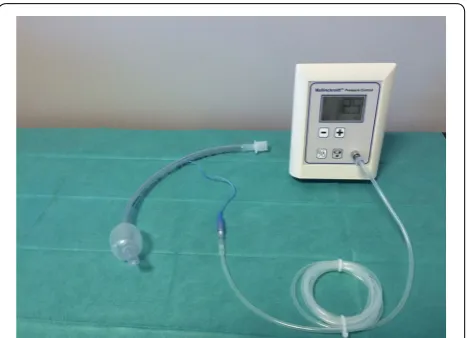
Patients were randomly assigned to receive continuous control of Pcuff with the electronic device (Mallinckrodt electronic cuff pressure controller®, VBM Medizintech-nik GmbH, Sulz am Neckar, Germany) for 24 h, fol-lowed by discontinuous control (every 8 h) with a manual manometer (Hi-Lo Hand Pressure Gauge®, Mallinckrodt, Medtronic TM) for 24 h (Fig. 1), or the reverse sequence (Fig. 2). The target of Pcuff was 25 cmH2O during the two periods. Randomization was performed using a com-puter‐generated random assignment list in balanced blocs of six. Treatment assignments were contained in sealed opaque envelopes sequentially numbered.
Study objectives and outcome measurement
The primary objective was to determine the efficiency of the electronic device in reducing percentage of time spent with underinflation or overinflation of tracheal cuff, compared with routine care using a manometer. The secondary objectives included the impact of the elec-tronic device on percentage of patients with underinfla-tion or overinflaunderinfla-tion of tracheal cuff, percentage of time spent with underinflation of tracheal cuff, percentage of time spent with overinflation of tracheal cuff, percentage of time spent with normal (20–30 cmH2O) tracheal cuff, Pcuff, and coefficient of variation of Pcuff, compared with routine care, and its impact on microaspiration of gastric and oropharyngeal secretions.
Pcuff and airway pressure were continuously recorded at a digitizing frequency of 100 Hz for 48 h (Physiotrace®; Estaris, Lille, France) [24], including 24 h of continuous control of Pcuff using the mechanical device and 24 h of manual control of Pcuff using the manometer (Fig. 3). Pep-sin and alpha amylase were quantitatively measured in all tracheal aspirates during the two study periods [25, 26]. In order to avoid interference between the two periods regarding pepsin and alpha amylase levels, tracheal aspirate performed during the first 2 h of each study period was not analyzed. The engineer who analyzed the data (JDJ) and the physicians who measured pepsin and alpha amylase (FZ, PM, and MB) were blinded to study group assignment.
Study population
All patients were intubated with a high-volume low-pres-sure PVC standard-cuffed tracheal tube. Tracheal tube size was 8 and 7.5 in men and women, respectively. During the manometer period, nurses adjusted Pcuff every 8 h. Tra-cheal suctioning was performed, using open suction sys-tem, 6 times a day, or more frequently if clinically indicated.
Semi-recumbent position was used during mechanical ventilation. During routine care period, Pcuff was adjusted, using the manometer, before turning and oral care.
Definitions
The primary outcome was the percentage of time spent with underinflation or with overinflation of tracheal cuff. Secondary outcomes included mean Pcuff, coefficient of variation of Pcuff, percentage of patients with underinfla-tion of tracheal cuff, percentage of patients with over-inflation of tracheal cuff, percentage of time spent with normal (20–30 cmH2O) cuff pressure, percentage of time spent with underinflation of tracheal cuff, percentage of time spent with overinflation of tracheal cuff, mean
pepsin and alpha amylase level, percentage of tracheal aspirates positive for pepsin, and percentage of tracheal aspirates positive for alpha amylase.
Underinflation of tracheal cuff was defined as Pcuff <20 cmH2O for >5 min over the 24-h period of record-ing. Overinflation of tracheal cuff was defined as Pcuff >30 cmH2O for >5 min over the 24-h period of recording [14]. The coefficient of variation of Pcuff was calculated as standard deviation/mean Pcuff × 100.
Microaspiration of gastric contents was defined by the presence of pepsin at significant level (>200 ng/mL) in tracheal aspirate. Microaspiration of oropharyngeal secretions was defined by the presence of alpha amylase at significant level (>1685 UI/L) in tracheal aspirate [26]. Randomizaon
Connuous control Roune care
× × ×
Roune Connuous control
Connuous recording of Pcuff (48h)
24h 24h
× × ×
× × × × × × × × ×
/8h Pcuff target = 25 cmH2O
Measurement of pepsin in tracheal aspirates (48h) ×
Fig. 2 Study design. Red arrows indicate washout periods for pepsin and amylase measurement, and times symbol indicates each tracheal aspirate performed for pepsin and amylase measurement
Statistical analyses
Sample size calculation
Based on previous results [14, 15], the mean percent-age of time spent with underinflation or overinflation of tracheal cuff was 30 % [standard deviation (SD) = 20 %] in patients intubated with a PVC‐cuffed tracheal tube receiving routine care of Pcuff using a manual manometer. The expected mean percentage of time with underinfla-tion or overinflaunderinfla-tion of tracheal cuff using the mechani-cal device was 10 % (expected difference of 20 %). In a parallel-group design, n = 22 patients per group will be required to detect this difference with a two-sided test, a power of 90 %, an alpha risk of 5 %, and a SD of 20 %. In a crossover design, the sample size determination is based on SD within subject difference, which can be derived from SD of measure and coefficient correlation (r) between the two measures on the same subject [27]. The sample size can therefore be derived from the num-ber of patients to be included in parallel-group design, as follows: n * (1 − r). Thus, assuming a conservative value of 0.2 for r, the number of patients to include is 18.
Result analysis
All analyses were performed in an intention-to-treat manner. Distribution of quantitative variables was tested using Shapiro–Wilk test. Normally and non-normally distributed variables were expressed as mean ± SD and median (25th, 75th interquartile), respectively. The statis-tical significance was set at p < 0.05.
The primary outcome was compared using a mixed linear model, adjusting for the period effect. Interac-tion between study period and assigned treatment, i.e., continuous control of Pcuff or routine care, was tested. Qualitative and quantitative patient characteristics and secondary outcomes were compared between the two 24-h periods using McNemar and Wilcoxon tests, respectively.
Results
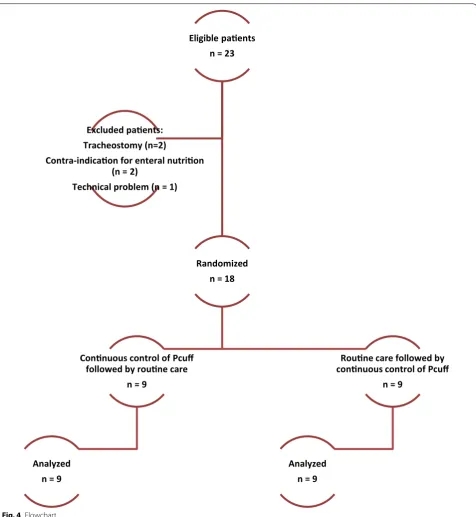
During the study period, 23 patients were eligible. Five patients were excluded for different reasons, and 18 patients were included and were all analyzed (Fig. 4).
Patient characteristics
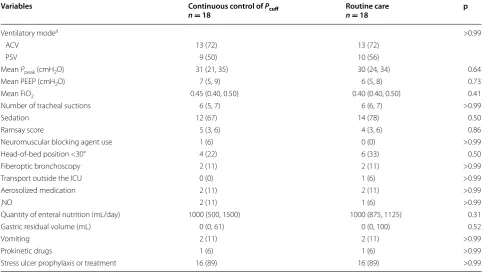
Patient characteristics are presented in Table 1.
No significant difference was found between the two study periods regarding ventilator mode and settings, sedation, Ramsay score, or neuromuscular blocking agent use. Prone position was not used in included patients, during the two study periods. All other characteristics were also similar during the two periods (Table 2).
No significant difference was found in duration of Pcuff and airway pressure recording [median (IQR) 23 (23, 23.3
vs 23.5 h (23, 24), p = 0.066], or in mean airway pressure [13.2 (10.7, 15.5) vs 13.1 cmH2O (10.8, 15.6)] between continuous control and routine care periods, respectively.
Primary outcome
The percentage of time spent with underinflation, or with overinflation, was significantly lower during continu-ous control of Pcuff compared with routine care [median (IQR) 0.8 (0.1, 2) vs 20.9 (3.1, 40.1), p = 0.0009]. No sig-nificant interaction was found between study period and the assigned treatment (p = 0.91).
Secondary outcomes
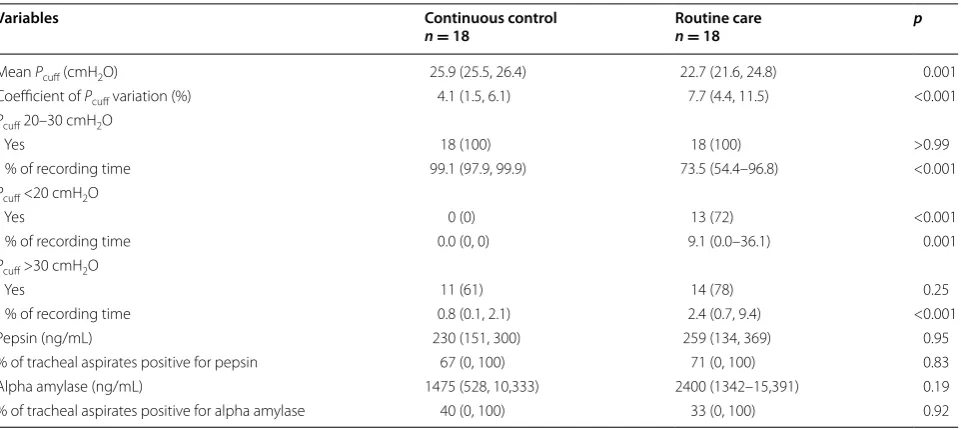
Mean Pcuff and percentage of time spent with Pcuff 20–30 cmH2O were significantly higher during continu-ous control of Pcuff compared with routine care. Percent-age of patients with underinflation, percentPercent-age of time spent with underinflation, percentage of time spent with overinflation, and coefficient of variation of Pcuff were significantly lower during continuous control compared with routine care of tracheal cuff. Percentage of patients with overinflation was similar during the two study peri-ods (Table 3).
No significant difference was found in pepsin level, in percentage of tracheal aspirates positive for pepsin, in alpha amylase level, or in percentage of tracheal aspirates positive for alpha amylase between the two study periods (Table 3).
Discussion
Our results suggest that the electronic device is efficient in controlling Pcuff. However, no significant impact of continuous control of Pcuff was found on microaspiration of gastric or oropharyngeal secretions.
To our knowledge, our study is the first clinical rand-omized controlled study to evaluate the efficiency of the electronic device in continuously controlling Pcuff in criti-cally ill patients. A previous in vitro study found similar results [23]. In addition, Lorente et al. [28] conducted a prospective observational study to determine the impact of continuous control of Pcuff, using the same electronic device, on the incidence of VAP. The authors reported sig-nificantly lower rate of Pcuff determinations <20 cmH2O (mean ± SD 0 vs 9 ± 8, p < 0.001), Pcuff determinations >30 cmH2O (mean ± SD 0 vs 4 ± 5, p < 0.001), and sub-stantial decrease (51 %) in VAP incidence in patients who received continuous control of Pcuff, compared with those received routine care. However, the efficiency of the elec-tronic device in continuously controlling Pcuff was not the primary objective of the study. In addition, Pcuff was not continuously recorded, and the study was not randomized.
during routine care was lower than previously reported [14, 15]. The small number of patients included in the cur-rent study (n = 18) could explain this difference. Duration of prior intubation was identified as an independent risk factor for underinflation of tracheal cuff [14]. However, duration of prior intubation was quite similar in the cur-rent study (median 4 days) compared with previous studies
(2 and 5 days, respectively) [14, 15]. Another explanation could be the different patient characteristics between the current study and previous ones. The percentage of non-sedated patients was lower in the current study (22 %) compared with the two previous ones (35 and 53 %, respec-tively). The absence of sedation was identified as an inde-pendent risk factor for underinflation of tracheal cuff [14].
Eligible paents n = 23
Randomized n = 18
Connuous control of Pcuff followed by roune care
n = 9
Analyzed n = 9
Roune care followed by connuous control of Pcuff
n = 9
Analyzed n = 9 Excluded paents:
Tracheostomy (n=2)
Contra-indicaon for enteral nutrion (n = 2)
Technical problem (n = 1)
No significant impact of continuous control of Pcuff was found on microaspiration of gastric and oropharyngeal secretions. Several explanations could be suggested for
this finding. Microaspiration of gastric contents was a secondary outcome, and our study was probably under-powered to detect such an effect. The higher, but not significant, level of alpha amylase during continuous con-trol, compared with routine care periods, is in keeping with this hypothesis. Although this secondary outcome was negative, the results could be helpful for future stud-ies, aiming at evaluating the impact of continuous con-trol of Pcuff on microaspiration. In addition, the duration of tracheal aspirate collection (24 h) during the two study periods was probably too short to evaluate this effect. Further, the above-mentioned in vitro study reported that the electronic device might interfere with self-expand-ing properties of some PVC-cuffed tracheal tubes [23]. Therefore, the rapid correction of overinflation of Pcuff during cough could result in short sudden drop of Pcuff and microaspiration of gastric contents. Further studies are needed to confirm this hypothesis. The short wash-out period (2 h) used in this study might have resulted in overlap in pepsin and alpha amylase results between the two periods. Whilst pepsin half-life is relatively short [29], alpha amylase half-life is unknown. This might have influenced the impact of continuous control of Pcuff on microaspiration of gastric and oropharyngeal secretions. Table 1 Patient characteristics
SAPS Simplified Acute Physiology Score, LOD logistic organ dysfunction, IQR
interquartile range
Number of included patients 18 Age (years), mean ± SD 54 ± 18
Male gender, n (%) 13 (72)
Weight (kg), median (IQR) 72 (66, 81)
SAPS II, mean ± SD 43 ± 16
LOD score, mean ± SD 6 ± 3 Cause for ICU admission, n 5 %
Neurologic failure 7 (38)
Respiratory failure 6 (33)
Shock 5 (27)
Duration of mechanical ventilation before inclusion (days),
median (IQR) 4 (2, 6)
Total duration of mechanical ventilation (days), median (IQR) 12 (7, 25) Length of ICU stay (days), median (IQR) 21 (11, 30) Ventilator‑associated pneumonia, n (%) 3 (15) ICU mortality, n (%) 10 (55)
Table 2 Patient characteristics during the 48 h following randomization
Data are number of patients (%) or median (Interquartile range)
Pcuff cuff pressure, ACV assist–control ventilation, PSV pressure support ventilation, Ppeak peak pressure, PEEP positive end-expiratory pressure, FiO2 fraction of inspired
oxygen, iNO inhaled nitric oxide
a Some patients received two ventilator modes during continuous control of P
cuff, or during routine care
Variables Continuous control of Pcuff
n = 18 Routine caren = 18 p
Ventilatory modea >0.99
ACV 13 (72) 13 (72)
PSV 9 (50) 10 (56)
Mean Ppeak (cmH2O) 31 (21, 35) 30 (24, 34) 0.64
Mean PEEP (cmH2O) 7 (5, 9) 6 (5, 8) 0.73
Mean FiO2 0.45 (0.40, 0.50) 0.40 (0.40, 0.50) 0.41
Number of tracheal suctions 6 (5, 7) 6 (6, 7) >0.99
Sedation 12 (67) 14 (78) 0.50
Ramsay score 5 (3, 6) 4 (3, 6) 0.86
Neuromuscular blocking agent use 1 (6) 0 (0) >0.99
Head‑of‑bed position <30° 4 (22) 6 (33) 0.50
Fiberoptic bronchoscopy 2 (11) 2 (11) >0.99
Transport outside the ICU 0 (0) 1 (6) >0.99
Aerosolized medication 2 (11) 2 (11) >0.99
iNO 2 (11) 1 (6) >0.99
Quantity of enteral nutrition (mL/day) 1000 (500, 1500) 1000 (875, 1125) 0.31
Gastric residual volume (mL) 0 (0, 61) 0 (0, 100) 0.52
Vomiting 2 (11) 2 (11) >0.99
Prokinetic drugs 1 (6) 1 (6) >0.99
Given the efficiency of the electronic device, the absence of potential harm, and the reduction in nurse workload, one could argue that use of such a device could be recommended in every intubated critically ill patient. However, the level of evidence on the clini-cal benefit of using continuous control of Pcuff is still low [30]. In addition, cost-effectiveness of this preventive measure of VAP was not evaluated. Therefore, further randomized controlled trials aiming at evaluating the impact of continuous control of Pcuff on VAP incidence are required to evaluate the efficiency of this preventive measure.
Some limitations of our study should be acknowledged. First, this was a single-center study. Therefore, our results could not be generalized to patients hospitalized in other ICUs. We did not evaluate the impact of continuous control of Pcuff using the electronic device on ventilator-associated pneumonia or tracheal ischemic lesions. How-ever, our study design did not allow such an evaluation, because each patient was his own control. This design is probably the best first step to evaluate the efficiency of the electronic device, because of potential patient-related confounders, such as tracheal size, shape, respiratory resistance, and airway pressure. Further, the study was not blinded. However, investigators who assessed con-tinuous Pcuff recording and pepsin were blinded to study group assignment.
Conclusions
The electronic device evaluated in this study is efficient in continuously controlling Pcuff in critically ill patients. Fur-ther randomized controlled studies are needed to deter-mine the impact of continuous control of Pcuff, using the electronic device, on intubation-related complications, such as microaspiration, VAP, and tracheal ischemia.
Abbreviations
Pcuff: cuff pressure; SAPS: Simplified Acute Physiology Score; LOD: logistic organ dysfunction.
Authors’ contributions
AR, JDJ, MB, FZ, and SN designed the study. AR, JDJ, EP, BV, EJ, FZ, and PM collected data. JL and SN performed statistical analysis. AR and SN wrote the manuscript. All authors participated in the final revision of the manuscript and approved the submitted version. All authors read and approved the final manuscript.
Author details
1 Centre de Réanimation, CHU Lille, 59000 Lille, France. 2 Centre d’Investigation Clinique, CHU Lille, 59000 Lille, France. 3 Centre de Biologie et de Pathologie, CHU Lille, 59000 Lille, France. 4 EA 2694 ‑ Santé publique : épidémiologie et qualité des soins, CHU Lille, 59000 Lille, France. 5 Faculté de Pharmacie, Université Lille, 59000 Lille, France. 6 Faculté de Médecine, Université Lille, 59000 Lille, France.
Acknowledgements
None.
Competing interests
SN received fees from Medtronic for lecture, and from Ciel Medical for advi‑ sory board. AR, JDJ, FZ, JL, EP, BV, EJ, PM and MB: none.
Table 3 Secondary outcomes
Data are number of patients (%) or median (interquartile range)
Pcuff cuff pressure
Yes indicates that a patient had the variable at least once
Variables Continuous control
n = 18 Routine caren = 18 p
Mean Pcuff (cmH2O) 25.9 (25.5, 26.4) 22.7 (21.6, 24.8) 0.001
Coefficient of Pcuff variation (%) 4.1 (1.5, 6.1) 7.7 (4.4, 11.5) <0.001
Pcuff 20–30 cmH2O
Yes 18 (100) 18 (100) >0.99
% of recording time 99.1 (97.9, 99.9) 73.5 (54.4–96.8) <0.001
Pcuff <20 cmH2O
Yes 0 (0) 13 (72) <0.001
% of recording time 0.0 (0, 0) 9.1 (0.0–36.1) 0.001
Pcuff >30 cmH2O
Yes 11 (61) 14 (78) 0.25
% of recording time 0.8 (0.1, 2.1) 2.4 (0.7, 9.4) <0.001
Pepsin (ng/mL) 230 (151, 300) 259 (134, 369) 0.95
% of tracheal aspirates positive for pepsin 67 (0, 100) 71 (0, 100) 0.83
Alpha amylase (ng/mL) 1475 (528, 10,333) 2400 (1342–15,391) 0.19
All data are available in the manuscript.
Ethic approval and consent to participate
The institutional review board of the Lille University Hospital (Comité de Protection des Personnes Nord‑Ouest IV) approved the study (No. 2013‑ A0022540). Written consent was obtained from the patients or from their next of kin (ClinicalTrials.gov Identifier: NCT01965821).
Received: 11 August 2016 Accepted: 29 September 2016
References
1. Papazian L, Corley A, Hess D, Fraser JF, Frat J‑P, et al. Use of high‑flow nasal cannula oxygenation in ICU adults: a narrative review. Intensive Care Med. 2016;42:1336–49
2. Cabrini L, Landoni G, Oriani A, Plumari VP, Nobile L, et al. Noninvasive ven‑ tilation and survival in acute care settings: a comprehensive systematic review and metaanalysis of randomized controlled trials. Crit Care Med. 2015;43:880–8.
3. Martinez‑Urbistondo D, Alegre F, Carmona‑Torre F, Huerta A, Fernandez‑ Ros N, et al. Mortality prediction in patients undergoing non‑invasive ventilation in intermediate care. PLoS One. 2015;10:e0139702. 4. Esteban A, Frutos‑Vivar F, Muriel A, Ferguson ND, Peñuelas O, et al. Evolu‑
tion of mortality over time in patients receiving mechanical ventilation. Am J Respir Crit Care Med. 2013;188:220–30.
5. Nseir S, Zerimech F, Jaillette E, Artru F, Balduyck M. Microaspiration in intubated critically ill patients: diagnosis and prevention. Infect Disord Drug Targets. 2011;11:413–23.
6. Touat L, Fournier C, Ramon P, Salleron J, Durocher A, et al. Intubation‑ related tracheal ischemic lesions: incidence, risk factors, and outcome. Intensive Care Med. 2013;39:575–82.
7. Blot SI, Poelaert J, Kollef M. How to avoid microaspiration? A key element for the prevention of ventilator‑associated pneumonia in intubated ICU patients. BMC Infect Dis. 2014;14:119.
8. Branson RD, Gomaa D, Rodriquez D. Management of the artificial airway. Respir Care. 2014;59:974–89 (discussion 989–990).
9. Carter EL, Duguid A, Ercole A, Matta B, Burnstein RM, et al. Strategies to prevent ventilation‑associated pneumonia: the effect of cuff pressure monitoring techniques and tracheal tube type on aspiration of subglottic secretions: an in vitro study. Eur J Anaesthesiol. 2014;31:166–71. 10. Blot SI, Rello J, Koulenti D. The value of polyurethane‑cuffed endotracheal
tubes to reduce microaspiration and intubation‑related pneumonia: a systematic review of laboratory and clinical studies. Crit Care. 2016;20:203. 11. Jaillette E, Martin‑Loeches I, Artigas A, Nseir S. Optimal care and design of the tracheal cuff in the critically ill patient. Ann Intensive Care. 2014;4:7. 12. American Thoracic Society, Infectious Diseases Society of America. Guide‑
lines for the management of adults with hospital‑acquired, ventilator‑ associated, and healthcare‑associated pneumonia. Am J Respir Crit Care Med 2005;171:388–16.
13. Talekar CR, Udy AA, Boots RJ, Lipman J, Cook D. Tracheal cuff pressure monitoring in the ICU: a literature review and survey of current practice in Queensland. Anaesth Intensive Care. 2014;42:761–70.
in endotracheal cuff pressure in intubated critically ill patients: preva‑ lence and risk factors. Eur J Anaesthesiol. 2009;26:229–34.
15. Nseir S, Zerimech F, De Jonckheere J, Alves I, Balduyck M, et al. Impact of polyurethane on variations in tracheal cuff pressure in critically ill patients: a prospective observational study. Intensive Care Med. 2010;36:1156–63.
16. Lizy C, Swinnen W, Labeau S, Poelaert J, Vogelaers D, et al. Cuff pressure of endotracheal tubes after changes in body position in critically ill patients treated with mechanical ventilation. Am J Crit Care. 2014;23:e1–8. 17. Geng G, Hu J, Huang S. The effect of endotracheal tube cuff pressure
change during gynecological laparoscopic surgery on postoperative sore throat: a control study. J Clin Monit Comput. 2015;29:141–4.
18. Lou Sole M, Su X, Talbert S, Penoyer DA, Kalita S, et al. Evaluation of an intervention to maintain endotracheal tube cuff pressure within thera‑ peutic range. Am J Crit Care. 2011;20:109–18.
19. Farré R, Rotger M, Ferrer M, Torres A, Navajas D. Automatic regulation of the cuff pressure in endotracheally‑intubated patients. Eur Respir J. 2002;20:1010–3.
20. Duguet A, D’Amico L, Biondi G, Prodanovic H, Gonzalez‑Bermejo J, et al. Control of tracheal cuff pressure: a pilot study using a pneumatic device. Intensive Care Med. 2007;33:128–32.
21. Nseir S, Rodriguez A, Saludes P, De Jonckheere J, Valles J, et al. Efficiency of a mechanical device in controlling tracheal cuff pressure in intubated critically ill patients: a randomized controlled study. Ann Intensive Care. 2015;5:54.
22. Chenelle CT, Oto J, Sulemanji D, Fisher DF, Kacmarek RM. Evaluation of an automated endotracheal tube cuff controller during simulated mechani‑ cal ventilation. Respir Care. 2015;60:183–90.
23. Weiss M, Doell C, Koepfer N, Madjdpour C, Woitzek K, et al. Rapid pressure compensation by automated cuff pressure controllers worsens sealing in tracheal tubes. Br J Anaesth. 2009;102:273–8.
24. De Jonckheere J, Logier R, Dassonneville a, Delmar G, Vasseur C. Physi‑ oTrace: an efficient toolkit for biomedical signal processing. In: Confer‑ ence proceedings of the IEEE engineering in medicine and biology, vol. 7; 2005. p. 6739–41.
25. Nseir S, Zerimech F, Fournier C, Lubret R, Ramon P, et al. Continuous control of tracheal cuff pressure and microaspiration of gastric contents in critically ill patients. Am J Respir Crit Care Med. 2011;184:1041–7. 26. Dewavrin F, Zerimech F, Boyer A, Maboudou P, Balduyck M, et al. Accuracy
of alpha amylase in diagnosing microaspiration in intubated critically‑ill patients. PLoS One. 2014;9:e90851.
27. Julious SA. Sample sizes for clinical trials with normal data. Stat Med. 2004;23:1921–86.
28. Lorente L, Lecuona M, Jiménez A, Lorenzo L, Roca I, et al. Continu‑ ous endotracheal tube cuff pressure control system protects against ventilator‑associated pneumonia. Crit Care. 2014;18:R77.
29. Metheny NA, Dahms TE, Chang Y‑H, Stewart BJ, Frank PA, et al. Detection of pepsin in tracheal secretions after forced small‑volume aspirations of gastric juice. JPEN J Parenter Enter Nutr. 2004;28:79–84.