Cross Layer Interaction of PHY and a Cross Layer Design
Approach for High Speed MANET
1
Benudhar Sahu,
2Mihir Narayan Mohanty,
3Laxmi Prasad Mishra
1,2,3Dept. of ECE, Institute of Technical Education and Research (ITER)
Siksha ‘O’ Anusandhan University, Bhubaneswar, India
Abstract
Cross-Layer design is one of the approaches for performance improvement in Mobile Ad hoc Networks (MANET). Presently, each of the layers is designed to obtain optimum performance in MANET. However, this layered approach may not achieve optimum performance always. So, we discuss a cross layer design approach for improvement of performance in MANET. In this paper, we study the relationship of a couple of issues as observed in the Physical Layer of a high speed MANET with the Medium Access Control (MAC) and routing layers. Subsequently, the merits of cross layer design approach for MANET at routing layer have been considered to elucidate advantages of cross layer design approach of MANET.
Keywords
MANET, Cross Layer, Medium Access Control (MAC)
I. Introduction
An Ad hoc Network is a self-organized network of a collection of wireless nodes even without the support of any fixed infrastructure. Nodes in an ad hoc network may be static or mobile. Mobility of nodes in a Mobile Ad hoc Networks may result in frequent path failure between a source and a destination. Maintaining radio link and satisfactory data communication in an infrastructure less ad hoc network is a challenging task. In recent times, there is a steady increase in demand for the high-speed services in MANET. Orthogonal Frequency Division Multiplexing technology is proposed for providing broadband services in a mobile environment [1]. However, it is well known that an OFDM based air interface is highly susceptible to carrier frequency and timing synchronization errors. Several schemes have been proposed in the literature to minimize the effects of synchronization errors in OFDM systems [2-4]. It has been shown that significant variation in the Frame Error Rate (FER) and Bit Error Rate (BER) pattern may result due to synchronization failures
It is imperative that a poor FER or BER in a given operational environment compels the MAC layer to retransmit data packets frequently. For a Carrier Sense Multiple Access Collision Avoidance (CSMA/CA) MAC protocol, frequent retransmission request of a data packet may occur due to several reasons such as a) inadequate availability of RF channel and b) poor overall data throughput rate. There are two ways to improve overall packet transfer process viz. a) by improving the performance of RF transceiver and b) by keeping the MAC layer informed about the channel impairments so that the MAC protocol can take adaptive measures in line with the temporary channel hindrances. Till date much of the design of wireless networks do not have the mechanism for the layers of the protocol stack to adapt to the above mentioned challenges. Layered protocol is simple and each layer of the protocol stack operates independently [5-6]. However this layered approach may not be suitable for MANET to cope with the dynamics of MANET environment. It is reported that cross-layer design approach can provides significant performance benefit in MANET [7-9]. In a cross-layer design approach interdependencies
among different layers are exploited and the layers adapt their operation based on the exchange of cross layer information. Following this approach information from one layer may pass to adjacent layer or it may also pass to higher layer.
Several cross-layer design approaches have been reported in the literature [9, 10-14] to improve the performance of wireless networks. Liu et al [9] have proposed a cross layer design which combines adaptive modulation and coding at physical layer with truncated automatic repeat request at data link layer, in order to maximize performance in a fading channel. Varshavky et al [10] have proposed a cross layer design approach where application layer controls the packet-sending rate based on the route information from the routing layer. Yang et al [11] have proposed a cross layer design approach where routing layer selects an optimum route with low congestion, low delay and high SNR, based on SNR information from physical layer and delay information from MAC layer. Niang Yang et al [12] have proposed a cross layer design where, MAC layer adapts to different packet sending rate depending on the information on channel condition from physical layer. Further, routing layer selects an appropriate routing protocol depending on the congestion information available from MAC layer. According to the cross layer design approach suggested by Yuen et al [13], routing layer selects a route based on the route information received from the MAC layer. Further application layer utilizes the same route information from MAC to control the sending rate of the packet based on the route information.. Pham et al [14] have proposed a cross layer design approach for MANET based on the channel estimation information indicating the duration for which the channel will go bad. MAC stops transmission for the duration for which channel is bad. This scheme decreases the energy consumption and saves bandwidth resource. In this paper we investigate the need for possible changes in the Adhoc On Demand Distance Vector (AODV) routing algorithm in view of useful side information that may be obtained from a lower layer. Specifically, information related to the channel has been used to search for a value of the maximum number of Route Request (RREQ) control packets that the routing process should generate for optimum performance.
We have arranged this paper as follows. Section II discusses the system model and simulation environment for studying the interaction of PHY layer on higher layers. Effects of frequency offset estimation scheme on higher layers of MANET are studied in Section III. Section IV presents a cross layer design approach at routing layer. Conclusion is provided in Section V.
II. A System Model for Cross Layer interaction
We briefly discuss the physical, MAC and routing protocols for MANET for supporting high speed data rate.
A. Physical Layer
802.11a, have been discussed in literature [1, 4, 15]. We have considered the schemes due to Jimenez et al [2] (PHY Model A) to study the effect of PHY layer design on higher layers of MANET. Jimenez et al have proposed synchronization schemes for OFDM based WLAN system following IEEE 802.11a frame format [2]. Several multipath fading channels have been reported in [26] for the study of different mobile communication systems. However, we have considered two different channels for the evaluation of the performance of the PHY Model A. One of the channels is a clear channel which we refer as AWGN Channel. The other channel is a multuipth fading WLAN channel with 100ns rms delay spread [26], which we refer as WLAN Channel. BER performance of the PHY Models A has been reported for multipath fading WLAN channel and AWGN channel in Fig.1. Plots (1) and (2) of Fig.1 depict the BER performance of the PHY Model A in AWGN and WLAN channel respectively. BER performance presented in Fig.1 is utilized to study the cross layer interaction of PHY on higher layers of MANET in subsequent sections. Bit Error Rate (BER) for given Eb/No and Channel condition is obtained from the plots in Fig.1. Using the BER, and assuming random error, the Probability of the Packet Error (Pe) for packet length of Q bytes is calculated as [17,18].
(
)
81 1
Qe e
P
= − −
b
where Pb is BER at a given Eb/No.
B. MAC Layer
The primary function of MAC layer is to access the channel and achieve reliable transmission through relevant retransmission technique. It tries to reduce collision of packets and save overhead. Medium access operation of an ad hoc network is based on IEEE 802.11 DCF protocol based on CSMA/CA.
C. Routing Protocol
Routing layer is responsible for establishing the best available route from source to destination and repair the route as and when the route breaks. It tries to minimize the routing overhead and delay. Due to mobility of nodes in a MANET routing protocols play a vital role in establishing routes from source to destination during transmission of data packets. Several routing protocols have been proposed for MANET [19-21]. We have considered AODV routing protocol for the study of cross layer interaction. As per the AODV routing protocol, a node having a data to transmit searches for a route to the destination by broadcasting RREQ packets. An RREQ packet propagates to the destination node. A destination sends a unicast Route Reply (RREP) control packet to the sources node. On receipt of the RREP packet, the source node starts sending the data packets. However a node may not get a reply RREP packet in response to RREQ packet due to a) collision or b) route error. So, a source node repeats the process of route search by sending RREQ packet for a specified number of times. The node declares the route to destination unavailable if it fails to get the RREP. The number of maximum RREQ packets retransmitted for one data packet may be different in different channel conditions. So, we investigated for an optimum number of retransmissions for different channel conditions. The cross layer interaction and simulation environments are described in the subsections.
D. Cross Layer Interaction Study of PHY Layer
It is widely accepted that high speed communication is based on the OFDM technique. One of the drawbacks of OFDM is high sensitivity to synchronization error. BER performance of PHY
Model A in AWGN and WLAN channel is reported in Fig.1. It is essential to study the effect of the PFY model A on the higher Layers of MANET. We report the interaction of this PHY layer Model on higher layers in the subsequent sections.
E. Simulation Environment
Simulation approach is popularly used to evaluate performance of wireless networks. Wireless channel and mobility are the two most important performance limiting factors in mobile ad hoc network. So, an extensive physical layer model is required to study the behavior of MANET. However most of the simulation tools today have insufficient support of physical layer model [23-24]. So, the results obtained from these simulators are questionable and there is a need for a better physical model incorporating most of the physical layer phenomena such as, a) multipath effects, b) modulation and c) synchronization aspects of a receiver. A bit level simulation is required to study a physical layer model in detail. Further, there is a mismatch between the time scale involved at MAC and the physical layers. The bit level simulation is highly time consuming [23-24]. So, an approximate physical layer model incorporating most of the physical layer phenomena is commonly used to study protocol layers in a MANET.
We have used the GloMoSim simulator [25], developed in the University of California for performance evaluation of wireless networks. This simulator is useful for simulating multi-hop wireless networks and it supports a basic physical layer, good medium access control and network layer. The mobility model used for our simulation is Random Way Point [26]. Important simulation parameters are presented in Table 1. We have studied specifically the effects of residual frequency offset estimation schemes for OFDM based WLAN systems on the operation of MAC and routing layers.
Several PHY Models [2, 4, 15] have been studied for high-speed WLAN systems. However, we study cross layer interaction of PHY Model A to elucidate the effects of PHY Models on higher layers of MANET. We have considered the following MANET user configuration a) MANET of 50 nodes and b) 10 sources with nodes moving at a speed distributed uniformly between 0 - 10 m/s and 0 - 20 m/s. We have also considered pause time varying from 0s to simulation time. Pause time is the duration for which a node remains in static position after reaching the destination. The node starts moving to the next destination position after the end of the pause time.
In this section, performance of PHY Model A represented by plot (1) and plot (2) of Fig.1 have been used for performance comparison of various parameters of MANET.
1. Packet Delivery Fraction
2. Normalized Routing Load
Fig. 3 depicts normalized routing load vs speed for the PHY Model A in WLAN Channel and AWGN channel. It is observed from plot (1) that the normalized routing load for PHY Model A in AWGN channel increases from 0.119 to 0.12 with increase in speed from static to 10m/s. Normalized routing load for WLAN channel observed from plot (2) also increases from 0.15 to 0.162 with the increase in speed from static to 10m/s. It is noticed that the normalized routing load for AWGN channel is lower than the WLAN channel. Higher normalized routing load at higher speed is due to the increase in the number of link breaks.
It is observed that PHY Model A for WLAN and AWGN channel
with 20dB performance difference at a BER of 10-3 result in a
difference in normalized routing load and packet delivery fraction. So, we make use of these observations to justify a cross layer design approach of a wireless node based on its PHY layer performance
III. Cross Layer Design Approach and a Case Study For PHY and Routing Layer
We have explained earlier in Section II that a source node, which has a data packet to transmit, broadcasts an RREQ packet to the destination node. A destination node on receipt of RREQ packet unicasts an RREP packet to the source node. A source node transmits the data packet on receipt of the RREP packet. However, a source node may not receive the RREP packet due to a) collision or b) link failure. So, a source node retransmits RREQ packets to get RREP packet from destination node. It is reported that the maximum number of RREQ packet retransmission
[Nmax(RREQ)=2] of two achieves optimum performance [Bro ‘98],
[Per ‘99]. However, Nmax(RREQ)=2 may not be optimum for all
conditions. The Nmax(RREQ) required to get an RREP from the
destination may vary from one channel condition to another. In this section, we try to explore suitable values of Nmax(RREQ) in terms of packet delivery and routing load for AWGN Channel and WLAN channel using PHY Model B.
A. Packet Delivery Fraction
Fig. 2 depicts packet delivery fraction vs speed for a MANET in AWGN Channel. Plots (1) and (2) present packet delivery fraction
for Nmax(RREQ) of 3 and 4 respectively for AWGN Channel. It
is observed from plot (1) that the packet delivery fraction for Nmax(RREQ) of 2 increases from 32 to 88% with increase in speed from 0 to 10m/s. Further increase in speed does not change the packet delivery fraction appreciably. Packet delivery fraction for
Nmax(RREQ)=3 as observed from plot (2) is about 2 percent less
than Nmax(RREQ)=2).
Plots (3) and (4) present packet delivery fraction for WAN Channel
with Nmax(RREQ)= 2 and 3 respectively. It is observed from the
plot (3) that the packet delivery fraction increases from 28 to 60 percent with increase in speed from 0 to 20m/s. Plot (4) depicts that
the packet delivery fraction for Nmax(RREQ) of 3 is appreciably
higher than Nmax(RREQ) = 2. The packet delivery fraction for
Nmax(RREQ) = 2 follows a trend similar to Nmax(RREQ) = 3. The maximum number of RREQ packets retransmission
[Nmax(RREQ)] that may ensure high packet delivery fraction,
is dependent on the channel condition. While a value of 2 is preferred for a clear channel, a value of 3 is more suitable for indoor wireless LAN environment. This implies that this parameter should be adapted at the routing layer according to the changes in the propagation channel to maximize packet delivery fraction in a MANET.
B. Normalized Routing Load
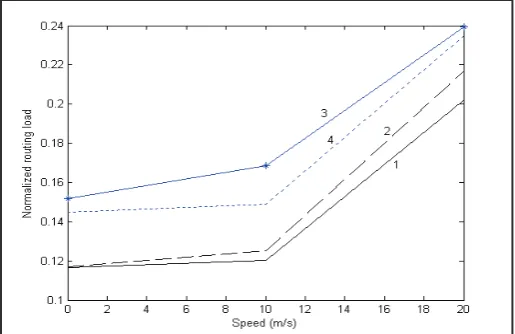
Fig. 3 presents normalized routing load vs speed for AWGN Channel and WLAN Channel. Plots (1) and (2) depict normalized routing
load for Nmax(RREQ)=2 and 3 respectively in AWGN Channel. It
may be observed from plot (1) that the normalized routing load increases marginally with increase in speed from 0 to 10m/s. With further increase in speed of mobile nodes, normalized routing load increases at a higher rate and becomes 0.19 at speed equal to 20m/s. Similar trend is observed from plot (2) for Nmax(RREQ)=3.
However, normalized routing load for Nmax(RREQ) =2 is lower
than Nmax(RREQ) = 3 for AWGN Channel.
Plots (3) and (4) present normalized routing load for WLAN Channel for Nmax(RREQ) of 2 and 3 respectively. It is observed from plot (3) that normalized routing load increases from 0.15 to 0.24 with increase in speed from 0 to 20m/s. Normalized routing load observed for Nmax(RREQ) of 2 and 3 from plots (3) and (4) follow
similar trend. However, normalized routing load for Nmax(RREQ)
of 3 is lower than Nmax(RREQ) of 2 in WLAN Channel.
The maximum number of RREQ packets retransmission
[Nmax(RREQ)] that may ensure low routing load is again affected
by the channel condition. While a value of 2 is preferred for a clear channel, a value of 3 is more suitable for indoor wireless LAN environment. This implies that this parameter should also be adapted at the routing layer to minimize the routing load in a MANET. Received signal SNR threshold criteria may be used to differentiate between a clear channel (AWGN) and fading channel.
IV. Conclusions
It is observed that the performance metrics a) Packet delivery fraction and b) Normalized routing load are sensitive to the propagation channel model and performance of the radio receiver.
We investigated the sensitivity of one parameter namely Nmax(RREQ) to physical layer Model to see its effects in the performance. For comparison of PHY Model, we consider a clear Channel Model
and WLAN Channel Model. Our study shows that Nmax(RREQ)
should be increased when the propagation channel manifests fading temporally compared to clear channel .
References
[1] R. van Nee, Ramjee Prasad,"OFDM for Wireless Multimedia Communications", Boston, M.A: Artech House Publishers, 2000.
[2] V P G Jimenez, M J F G Garcia, F J G Serrano, A G Armada,“Design and Implementation of Synchronization and AGC for OFDM-based WLAN Receivers”, IEEE Trans. On Consumer Electronics, Vol. 50, No. 4, pp. 1016-1025, Nov. 2004.
[3] J. Liu, J. Li,"Parameter Estimation and Error Reduction for OFDM based WLANs", IEEE Trans. on Mobile Computing, Vol. 3, No. 2, pp. 152-163, April-June-2004.
[4] Benudhar Sahu, Saswat Chakrabarti, S.L.Maskara, "An Improved Residual Frequency Offset Estimation Scheme for OFDM based WLAN systems”, Digital Signal Processing, Elsevier Science, Vol. 20, Issue 2, pp. 454-461, March 2010.
[5] E. Setton, T Yoo, X. Zhu, A. Goldsmith, B. Girod, "Cross-Layer Design of Ad-hoc Networks for Real Time Video Streaming”, IEEE Wireless Commun., pp. 59-64, Aug. 2005.
[7] M.Conti, G.Maselli, G.Turi, S.Gioradano.al,“Cross Layering in Mobile Ad-Hoc Network Design”, Computer, IEEE computer society, pp. 48-51, February 2004.
[8] S.Shakkotai, T.S.Rappaport, P.C.Karlsson, T.Sweden, “Cross-Layer Design for Wireless Networks”, IEEE Commun. Magazine, pp. 74-80, Oct. 2003.
[9] Q.Liu,S.Zhou, G.B.Giannakis,"Queuing With Adaptive Modulation and Coding Over Wireless Links: Cross-Layer Analysis and Design”, IEEE Trans. Wireless Commun., Vol. 4, No. 3, pp. 1142-1153, May 2005.
[10] A. Varshavsky, B. Li, E. de Lara,"Cross-Layer Flow Control in Lightly-Loaded Multi-Hop Ad-Hoc Networks”, In proc. IEEE ICPPW’04, pp. 315-321, Aug.2004.
[11] G.Yang, M.Xiao, H.Chen, Y.Yao,"A Novel Cross Layer Routing Scheme of Ad hoc Networks With Multi-Rate Mechanism”, In Proc. IEEE International conference on wireless communications, Networking and mobile computing, pp. 701-704, Sept. 2005.
[12] N.Yang, R.Sankar,"Effects of Cross Layer Processing on Wireless Ad Hoc Network Performance”, In proc. IEEE international conference on wireless and mobile computing, networking and communications, pp. 284-290, Aug. 2005. [13] W.H.Yuen, H.Lee, T.D.Andersen,"A Simple and Effective
Cross Layer Networking for Mobile Ad Hoc Networks”, In proc. IEEE PIMRC-2002, pp. 1952-1956, Sept. 2002. [14] P.P.Pham,S.Perreau, A.Jayasuriya,"New Cross Layer Design
Approach to Ad Hoc Networks Under Rayleigh Fading”, IEEE Journal on select. Area in Commun, Vol. 23, No. 1, pp. 28-39, Jan 2005.
[15] K-W.Yip,Y-C.WuT-S.Ng,"Timimg synchronization analysis for IEEE 802.11a wireless LANs in frequency-Nonselective Rician fading environments”, IEEE Trans. On Wireless communication, Vol. 3, No. 2, pp. 387-394, March 2004. [16] Chayat Naftali,"Updated Submission Template for
Tga-Revision 2”, IEEE, April 1998.
[17] G.Yeung, M.Takai, R.Bagrodia, A.Mehrnia, B.Daneshrad, “Detailed OFDM modeling in network simulation of mobile ad hoc networks”, In Proc.PADS’04, pp. 26-34, 2004. [18] M.V.D. Schaar, S.Krishnamachari, S.Choi, X.Xu, "Adaptive
cross Layer Protection Strategies for Robust Scalable Video Transmission Over 802.11 WLANs”, IEEE journal on select. Area in Commun., Vol. 21, No. 10, December 2005. [19] C.E.Perkins,"Ad-hoc Networking", Text book,
Addison-wesley-2001.
[20] C.E.Perkins, E..Royer, S.R.Das, M.K.Marina, “Performance Comparison of Two on Demand Routing Protocols for Ad-Hoc Networks”, IEEE personal communications, pp. 28, Feb. 2001.
[21] Benudhar Sahu, S, Chakrabarti, S.L.Maskara, “Performance Evaluation of AODV Routing Protocol For Mobile Ad-Hoc Networks”, In Proc. CODEC 04, January 04
[22] X.W.Tjhung, T.T.Y.Wu, B.Caron,"SER Performance Evaluation and Optimization of OFDM System With Residual Frequency and Timing Offset From Imperfect Synchronization, IEEE Trans. on Broadcasting, Vol. 49, No. 2, pp. 170-177, June 2003.
[23] S.Takai, J.Martin, R.Bagrodia,"Effects of Wireless Physical Layer Modeling in Mobile Ad Hoc Networks”, In Proc. Mobicom 2001, pp. 87-94, July 2001.
[24] M. Zorzi, J.Zeidler, A.Anderson, B.Rao, J.Proakis, A.L Swindlehurst, M.Jensen, and S.Krishnamurthy et al.”, Cross-Layer Issues in MAC Protocol Design for MIMO Ad
Hoc Networks”, IEEE Wireless Communication, pp. 62-76, August 2006.
[25] L.Bajaj, M.Takai, R.Ahuja, K.TangR.Bagrodia, M.Gerla, "Glomosim: A scalable network simulation environment”, CSD, Technical report, UCLA, 1997.
[26] J. Broch, D.A.Maltz, D.B.Johnson, Y.C.Hu, J.Jetcheva, “A Performance Comparison of Multi-hop Wireless Ad hoc Network Routing Protocols”, Proceedings of the 4th International Conference on Mobile Computing and Networking (ACM MOBICOM’98), pp. 85-97, October 1998.
[27] Naftali Chayat,"Updated submission template for TGA-revision 2”, IEEE 802.11-98/156r2, April 1998.
Parameters Used for Simulation
Parameters Value/Specification Parameters e 1000Mx500M Routing protocol
Number of Nodes 50 Packet size
Node mobility model Random Waypoint Type of data traffic
Number of sources 10 Routing Protocol
Maximum Speed (M/s) 10 - 20 Simulation time
Pause time 0 sec to 300 sec Mac Protocol
Reception model BER based
1e-007 1e-006 1e-005 0.0001 0.001 0.01 0.1 1
0 5 10 15 20 25 30
BER
SNR in dB
Fig. 1: BER vs Eb/No for Two Different Channel Models With PHY Model A in the Receiver: (1) WLAN Channel and (2) AWGN Channel