Page 124 www.ijiras.com | Email: [email protected]
A Correlative Study On Changes In Concentration Of
Haemolymph Ascorbic Acid Of Multivoltine Races Of Bombyx
Mori.L During 5
th
Instar Development
Dr. Amresh Pattnaik
Research Scholar, Department of Zoology, Berhampur University, Bhanjabihar, Ganjam, Odisha, India
Prof. Subasini Pattnaik
Professor, Department of Zoology, Berhampur University, Bhanjabihar, Ganjam, Odisha, India
I. INTRODUCTION
As per the chemical composition of haemolymph is highly variable among the diverse species and at different developmental stages of the some species (Florkin and Jeuniaux, 1974). It constitutes a variety of nitrogenous substances such as amino acids, proteins, amines, ammonia, peptides and ascorbic acid. Haemolymph ascorbic acid is an important component for the metamorphosis of silkworm. one of the most important factors for the proper growth and development of insect species is its nutritional requirements and metabolism in the body. A number of studies have been undertaken to evaluate the vitamin requirements and their metabolism in many lepidopteron insect species. It has been well known fact that ascorbic acid is an essential nutrient for many plant feeding insects (Chippendale, G.M. 1975). Akhatar and Asghar (1972), found that vitamins and mineral salts played an important role in the nutrition of silkworm. Ascorbic acid (vitamin C) was studied very early in the history of insect diet.Ascorbic acid plays a vital role in participating in
various metabolic functions of the body. It has anti-scorbutic and extra- antiscorbutic functions (Hughes, 1977).
Besides an attempt has also been made to establish an inter-relationship between morphological, biological and certain economic characters like ascorbic acid content, larval body weight, gland weight and economic characters such as cocoon weight, shell weight and S.R %.
Many researchers showed the larval characters improve by different concentrations of complementary compounds such as ascorbic acid, folic acid, thiamine. Vitamin-B complex etc.(Sarkar et.al., 1995 ; Nirwani and kaliwal, 1996, 1998; Etabari et.al., 2004).. Several authors also reported these effects about ascorbic acid (Dobzhenok, 1974: Ito, 1978; Singh and Reddy, 1981; EI-Karkasy and Idriss, 1990). Considering the dynamic roles of ascorbic acid in body metabolism an attempt has been made to evaluate the quantitative changes in ascorbic acid level in seven bivoltine and multivoltine silkworm races of Bombyx mori.L Sometimes it is considered as a taxonomic character for the insect (Florkin, M. 1959).
Abstract: Haemolymph ascorbic acid of 5th instar larvae of three multivoltine races namely MCON-1, MCON-4 and
M6DPC of Bombyx mori .L was studied out of three different verities of multivoltine races MCON-1 race showed best
performance in haemolymph ascorbic acid content as well as certain economic characters like cocoon weight (CW), shell weight (SW) and Shell ratio percentage (SR%). Basing upon the above characters the efficiency of the silkworm races was considered. MCON-1is showing the best performance and highly significant by ANOVA. The correlational study indicates
that MCON-1, MCON-4 are highly significant than M6DPC. Their change in concentration of haemolymph ascorbic acid
is gradually increased from first day to the 3rd day and it started declining from the 4th day up to the 7th day. The present study showed that there is a direct correlationship established between haemolymph ascorbic acid with body weight, cocoon weight and shell weight and shell ration percentage. The above characters were important for the selection for hybridization as well as commercial rearing.
Key words:-Haemolymph, Ascorbic acid, multivoltine, cocoon weight , shell weight shell ration percentage, rearing performance.
Page 125 www.ijiras.com | Email: [email protected] II. RELATED WORK
Some important proteins, growth hormone such as juvenile hormones are transported through haemolymph lipoprotein in silkworm and locusts (Chino et. al, 1977, 1981 and 1982
Basing on this piece of work many work has been done on the basis of the protein of silkgland in this context, but my piece of work is a bit different that is a correlational study on the concentration of the haemolymph ascorbic acid of certain multivoltine larvae of the silkworm Bombyx mori. L during 5th instar development.
It also includes which factors are able to do the concentration change in subsequent varities of bi and multivoltine also.
III. MATERIAL AND METHODS
Three Multivoltine races of Bombyx mori.L namely MCON-1, MCON-4 and M6DPC races were collected from
different breeding stations of Central Silk Board. For the present work silkworms have been collected from Central Sericulture Research and Training Institute (CSRTI), Berhampore (WB). The races were reared and maintained by adopting the Krishnaswami (1978) method. Fifth instar larvae were weighted and sacrificed from the 1st day onwards till cocoon formation. The haemolymph was collected in a clean vile containing few thiourea granules by pricking the abdominal leg just before the last leg. For the estimation of total ascorbic acid content in haemolymph of silkworm the method of Roe (1967) with a little modification was followed. Besides the cocoon weight, the shell weight and shell ratio percentage were calculated. All the data were subjected to ANOVA using standard statistical procedure and the relationships between two continuous variables was computed. The data’s were also subjected to correlation coefficient.
IV. OBSERVATION
The Ascorbic acid content in the haemolymph increased significantly to its peak on 3rd day in all the races and it starts declining from the 4th day up to the last i.e 7th day. (Table-1). Beside haemolymph ascorbic acid progressive significant increments in the body weight were also observed in all the races is a common feature. The present data’s showed a significant variation in the quantity of the haemolymph protein was also recorded as in Table-1.The observed data showed strong degrees of positive Correlationship between the haemolymph ascorbic acid and the body weight. However a significant correlationship was also exists between the cocoon weight and shell weight.
NB: NS=Not Significant, *-- Significant at (0.05) 5% level, ** --Significant at (0.01)1% level
Table 1: Comparison in the Concentration of Ascorbic acid (mg/ml.) in the Haemolymph of some Multivoltine Silkworm
Races, Bombyx mori L during 5th instar development Anova of
Multivoltine Races (Haemolymph Ascorbic acid)
NB: NS=Not Significant, *-- Significant at (0.05) 5% level, ** --Significant at (0.01)1% level
Table 2: Coefficient of correlation between different characters of Multivoltine silkworm races Bombyx mori.L.
V. RESULT AND DISCUSSION
A number of studies have been undertaken to evaluate the vitamin requirements and their metabolism in many lepidopteron insect species. It has been well known fact that ascorbic acid is an essential nutrient for many plant feeding insects (Chippendale, G.M. 1975). Akhatar and Asghar (1972), found that vitamins and mineral salts played an important role in the nutrition of silkworm. Ascorbic acid (vitamin C) was studied very early in the history of insect diet. Many insects are now known to require dietary ascorbic acid. It was found that the tobacco hornworm, Manduca sexta
lacked the enzyme L-gulonolactone oxidase and thus could not synthesize ascorbic acid. They found no ascorbic acid in the tissue of larvae feed on a diet without the vitamin. Ascorbic acid plays a vital role in metabolism besides being a powerful antiscorbutic agent and acts as a drug against common cold.
Many researchers showed the larval characters improve by different concentrations of complementary compounds such as ascorbic acid, folic acid, thiamine. Vitamin-B complex etc.(Sarkar et.al., 1995 ; Nirwani and kaliwal, 1996, 1998; Etabari et.al., 2004).. Several authors also reported these effects about ascorbic acid (Dobzhenok, 1974: Ito, 1978; Singh and Reddy, 1981; EI-Karkasy and Idriss, 1990). Considering the dynamic roles of ascorbic acid in body metabolism an attempt has been made to evaluate the quantitative changes in ascorbic acid level in three multivoltine silkworm races of Bombyx mori.L .Besides an attempt has also been made to establish an inter-relationship between morphological, biological and certain economic characters like ascorbic acid content, larval body weight,
Vth Instar Duration
MULTIVOLTINE RACES MCON-1
MEAN ± S.E.M
MCON-4 MEAN ± S.E.M
M6DPC MEAN ± S.E.M 1st Day 0.146 ± 0.0003 0.143 ± 0.0003 0.135 ± 0.0002 2nd Day 0.423 ± 0.0002 0.229 ± 0.0003 0.215 ± 0.0001 3rd Day 0.603 ± 0.0003 0.545 ± 0.0005 0.518 ± 0.0004 4th Day 0.509 ± 0.0003 0.469 ± 0.0003 0.472 ± 0.0003 5th Day 0.413 ± 0.0003 0.358 ± 0.0005 0.408 ± 0.0005 6th Day 0.315 ± 0.0003 0.286 ± 0.0002 0.206 ± 0.0005 7th Day 0.228 ± 0.0002 0.181 ± 0.0005 0.157 ± 0.0003
ANALYSIS OF VARIANCE
Source Of Variation SS df MS F Between the Days 0.417642 6 0.069607 40.9418
8** Between the Races 0.022293 2 0.011146 6.5562N
S
Error 0.020402 12 0.0017 Total 0.460337 20
Sl.No Races of Silkworm
Variables
Coefficient of correlation
’r’ df
‘t’ Test df
1 MCON-1 BW Vs
HASC
0.2994* 06 2.306* 8
2 MCON-4 BW Vs
HASC
0.2200* 06 2.306* 8
3 M6DPC BW Vs
HASC
Page 126 www.ijiras.com | Email: [email protected] gland weight and economic characters such as cocoon weight,
shell weight and S.R %.
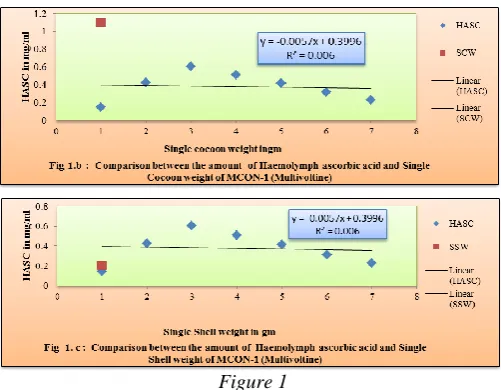
Ascorbic acid in the haemolymph of the fifth instar larvae of three races of Bombyx mori.L was studied. The result had shown a progressive increment in the ascorbic acid content up to the third day of the fifth instar larvae in all the races as in Table-1 and Fig- 1. Thereafter, there was a gradual decline of ascorbic acid content till the end of the fifth instar larvae in all the races is a common phenomena observed as in Table:-1 and Fig-1.The data were subjected to statistical analysis. There was a significant increment in the ascorbic acid content of the Haemolymph during the feeding phase (1st ~3rd day) of 5th instar larvae of all the races as in Table- 1 and Table-2. However, there was a gradual decrement in the ascorbic acid content from the 4th day onwards.
The data were also subjected to ANOVA test and coefficient of correlation. The result showed a significant variation in the quantity of ascorbic acid among different races of Bombyx mori.L.
Highest recorded value of the ascorbic acid was found in MCON-1 among the multivoltine races as in Table-1 & 2. However, the amount of ascorbic acid decreased from the fourth days of fifth instar period might be due to the utilization of ascorbic acid for its exponential growth in the synthetic phase.
Variation in the quantity of ascorbic acid are exists among races may be due to their magnitude of consumption and assimilation of mulberry leaves.
Nutrition plays an important role in improving the growth and development of the silkworm, Bombyx mori like other organisms. Legay (1958) stated that silk production is dependent on the larval nutrition which plays a very effective role in producing good quality cocoons. One of the most important micronutrient necessary for the growth and development is ascorbic acid. It plays a vital role in metabolism, participating in various metabolic functions of the body. There is an absolute requirement of ascorbic acid for collagen synthesis. Sengupta et al (1972) showed that the silkworm requires certain essential sugars, proteins, amino acids and vitamins for its normal growth, survival and enhancement of the silk production. It is generally accepted that all insects require vitamins, especially water soluble vitamins, such as ascorbic acid, thiamin, riboflavin, pantothenic acid, biotin, folic acid (Chapman, 1988). Growth retardation caused by lack of each one of these vitamins is rather small, but better growth is obtained by adding these vitamins to their diet (Horie and Ito, 1965; Ito, 1978; Horie, 1995).
Therefore, the necessity of ascorbic acid in the diet of herbivorous insect for feeding requirement and antioxidant activity has been confirmed by many authors (Felton and Summers, 1993 and 1995).
Figure 1
Micronutrients are essential component for the growth and development of silkworm races. Ito (1978) determined that vitamins present in the mulberry leaves satisfy minimum needs of silkworm. The effect of vitamin supplementation on the growth of Bombyx mori have been investigated by many researchers (Majumdar and Medda 1975; Bhattacharyya and Medda, 1981; Das and Medda, 1988; Faruki, 1990, 1998, 2005; Babu et al, 1992; Faruki et al., 1992; Khan and Saha,1996; Nirwani and Kaliwal,1996, 1998; Mosallanejad, 2002; Etebari et al, 2004; Rajabi et al., 2006 a,b). Ascorbic acid has many important functions in the animal body. It is a powerful antioxidant, protecting against oxidative damage to DNA, membrane lipid and protein. Antioxidant activity of ascorbic acid decreases reactive oxygen species and oxidative pressure. So, that the absorption of nutritious substances in the midgut would increase (Felton and Summers, 1993). Ascorbic acid has always been regarded as indispensable for the growth and development of Bombyx mori. In fact ascorbic acid is present in large amount in mulberry leaves, the exclusive food for the silkworm, and insects are incapable of synthesizing it.
Ito (1961) recorded the interrelationship between ascorbic acid supplementation and growth of silk worm. Babu et.al.,(1992) observed that the 1st and 2nd instar larvae reared on 1.5% ascorbic acid enriched mulberry leaves resulted in higher silk filament length, weight and denier values. Chauhan and Singh, 1992 showed that 1% concentration of ascorbic acid could increase in the number of eggs in the silkworm. Many workers established that ascorbic acid enhances the silk yield of the mulberry silkworm Bombyx mori. (A.EI-karaksy and M.I.Idriss, 1990).
Page 127 www.ijiras.com | Email: [email protected] obtained Y = 0.305X + 0.083. Only 18.5% of correlation were
exist between the two variables like ascorbic acid content and body mass of fifth instar period as in Fig-1.a up to 1. i that indicates only 18.5% of the data is in a interreciprocal influence of both characters. From the data it was evident that if (R2 = 0.004) would increased in the ascorbic acid content, it was explained that the body weight also increased in the same direction.
When a correlationship was established with ascorbic acid content and cocoon weight and shell weight , which should a very low positive correlation (R2 = 0.004) and the regression line obtained Y= 0.008X + 0.537 as in Fig-1. Such types of correlationship were found in all the races. From the result it was evident that ascorbic acid have a positive effect on the body mass but no such direct effect on the economic parameters like cocoon weight ,shell weight.
From the observation it may conclude that MCON-1, race might have better nutrigenetic trait than the MCON-4 and M6DPC of the multivoltine races (Table-1) basing upon their
ascorbic acid content. Presently, nutrigenetic trait analysis is a prime factor while selecting breeds for rearing performances. Therefore, the amount of ascorbic acid present in the larvae might play a crucial role in growth, development, moulting and survivability of mulberry silkworm Bombyx mori.L. The amount of ascorbic acid in the fifth instar larval period might have taken as one of the important criteria for selecting
Bombyx mori.L. race for germplasm rearing.
However, considering the quantity of ascorbic acid among
Bombyx mori races. It may assumed that MCON-1performed
the best. Therefore, the MCON-1 race might have considered to be a better phago-stimulant efficient growth promoter silk worm races. If the mulberry diet is added with ascorbic acid, it is possible to show improvement in sericulture industry. It has already an established fact that ascorbic acid has great role on the growth promoter as well as booster of silk production.(Ito, 1961, Javed and Gondal, 2002; Hussain and Javed., 2002 ; Pravakar,2004 ; Etabari et.al ., 2004).
Basing on the amount of ascorbic acid it may be assumed that MCON-1 race is a better nutrigenetic trait. However from the present study explore the possible interrelationship between growth and development with the ascorbic acid content in the haemolymph. Considering many good effects and importance of ascorbic acid as suggested by many authors, it may assumed that amount of ascorbic acid present in the larvae might play a crucial role in growth, development, moulting and survivability of mulberry silk worm Bombyx mori.L. Therefore, quantification of ascorbic acid is highly essential for the selection processes.
VI. CONCLUSION
In the present study the amount of the haemolymph Ascorbic acid in fifth instar period from four bivoltine races were recorded to establish a profile of silkworm haemolymph Ascorbic acid. The present data also gave an insight into a comprehensive understanding of silkworm metamorphosis.
ACKNOWLEDGEMENT
The authors thank the authorities of Berhampur University, Odisha, for providing necessary laboratory facilities.
REFERENCES
[1] Babu, M.; Swamy, M.T.; Rao, P.K. and Rao, M.S. (1992): Effect of ascorbic acid – enriched mulberry leaves on rearing of Bombyx mori L. Indian J. Seric. 31(2): 111-114.
[2] Chapman, R.F. (1998): The Insect Structure and Function, Cambridge University Press, Cambridge
[3] Chippendale, G.M. (1975): Ascorbic acid an essential for plant feeding insect, Diatraea grandiosella Vol.105:4. pp.499-507.
[4] El-karaksy, I.R. and Idriss, M. (1990): Ascorbic acid enhances the silk yield of the mulberry silkworm Bombyx mori L. J. Appl. Entomol. 109: 81-86.
[5] Etebari, K. and Matindoost, L. (2004): Effects of hypervitaminosis of vitamin B3 on silkworm biology. J. Biosci. 29:417-422.
Page 128 www.ijiras.com | Email: [email protected] economical characteristics of the silkworm Bombyx mori
L. International J. Indust. Entomol 8: 81-87.
[7] Felton, G.W. and C.B. Summers, (1993): Potential role of ascorbic oxidase as a plant defense protein against insect herbivory. J. Chem. Ecol. 19:1553-1568.
[8] Felton, G. W. and C. B. Summers (1995): Antioxidant systems in insects. Arch. Insect Biochem. Physiol. 29, 187-197.
[9] Florkin and Jeuniax (1974): Haemolymph composition. In the Physiology of Insect (Ed by Rockstein, M) Academic Press, New York, 5: pp. 255-307.
[10]Florkin, M. & Jeuniaux, C. (1974):The physiology of Insecta. V. Ed. Rockstein Academic Press.
[11]Horie, Y; Watanabe, K. and Shinohara, E. (1971): Effects of diets on body weight, silk gland weight and blood composition in the silkworm Sansi Kenkyu (Acta Sericologia), 78: 44-50.
[12]Ito, T. (1961): Effect of dietary ascorbic acid on the silkworm Bombyx mori L. Nature, 192: 951-952.
[13]Ito, T. (1978): Silkworm nutrition; In the Silkworm an Important Laboratory Tool. Tazima, Y. (Ed.), pp. 121-157, Kodansha Ltd, Tokyo.
[14]Ito, T. and Arai (1965): Nutrition of silkworm Bombyx mori L. IX. Further studies on the nutritive effects of ascorbic acid. Bull.Seric. Expt. Statn., 20: 1-19.
[15]Ito, T. and Horie, Y., (1959): Carbohydrate metabolism of the midgut of the silkworm, Bombyx mori. L. Archives of biochemistry & biophysics, 80, pp 174-176.
[16]Ito, T. and Mukayama, F. (1970): Relationship between protein content of artificial diet and cocoon quality in the silkworm. Sansi Kenkyu (Acta Sericologia), 77. pp. 76-81.
[17]Ito, T and Tanaka, M. (1962): Nutrition of the silkworm, Bombyx mori. L.VI. Effect of Concentration of sugar and protein added in artificial diet. Seri.Exp.Stn.Japan.18: 1-34.
[18]Legay, J.M. (1958): Recent advances in silkworm nutrition. Ann. Rev. Ent., 3:75- 124
[19]Majumdar, A.C. and Medda, A.K. (1975): Studies on the thyroxine and vitamin B12 induced changes in the life cycles of silkworms. Indian J. Physiol. Appl. Sci. 29:199-203.
[20]Sarkar, A.; Haque, M.; Rab. M. and Absar, N. (1995): Effect of feeding mulberry (Morus sp.) leaves supplemented with different nutrients to silkworm, (Bombyx mori L.). Curr. Sci. 69(2): 185-188
[21]Suresh Kumar N, Yamamoto T, Basavaraja HK, Datta RK (2001): Studies on the effect of high temperature on F1 hynrids between Polyvoltine and bivoltine silkworm races of Bombyx mori .L. International Journal of Industrial Entomology2, 123-127.