Original Research Article.
Bacteriological Profile and Their Antibiotic Susceptibility of Isolates of
Surgical Site Infection at Tertiary Care Hospital
Ashwini Verma
1, Ashok Kumar Sharma
2*, Manoj Kumar
3, Amber Prashad
4, Kumari Seema
51Junior Resident, 2*Associate Professor, 3Professor & HOD, 4Assistant Professor, 5Senior Research Scientist, Department of Microbiology, Rajendra Institute of Medical Sciences, Ranchi, Jharkhand, India.
ABSTRACT
Introduction: Surgical site infections (SSI) constitute a major public health problem worldwide and are the commonest nosocomial infection after urinary tract infection (UTI). They are responsible for increasing the treatment cost, length of hospital stay and significant morbidity and mortality.
Objective: To determine the incidence of SSIs and the bacteriological profile with antimicrobial susceptibility patterns of the isolates.
Materials and Methods: The present study was carried out in the Department of Microbiology, RIMS, Ranchi from January 2017 to Nov 2017. Total of 3442 surgeries were performed in the Department of Surgery during this period. The identification of the infecting organism was done by staining, and culture and antibiotic susceptibility by Disc Diffusion method.
Results: Among the 3442 cases with surgical wounds, 206 cases (5.98%) were suspected to be clinically infected. Out of 206 clinically infected wounds, 178 were culture positive and were considered definite cases of surgical site infection. Thus the overall incidence of infection of SSI was 5.17%. Staphylococcus aureus was the most common pathogen isolated followed by Escherichia coli, Pseudomonas spp., Klebsiella spp.
Conclusion: Although surgical site infections cannot be completely eliminated, a reduction in the infection rate to a minimum level could have significant benefits, by reducing postoperative morbidity and mortality and wastage of health care resources.
Keywords: Surgical Site Infections (SSI), Nosocomial
Infections, Disc Diffusion Method.
*Correspondence to:
Dr. Ashok Kumar Sharma, Associate Professor, Department of Microbiology,
Rajendra Institute of Medical Sciences, Ranchi, Jharkhand, India.
Article History:
Received: 03-05-2018, Revised: 29-05-2018, Accepted: 15-06-2018 Access this article online
Website:
www.ijmrp.com
Quick Response code
DOI:
10.21276/ijmrp.2018.4.4.017
INTRODUCTION
The United States Centres for Disease Control and Prevention (CDC) has developed criteria that define surgical site infection (SSI) as infection related to an operative procedure that occurs at or near the surgical incision within 30 days of the procedure or within 90 days if prosthetic material is implanted at surgery.1
These infections may be superficial or deep incisional infections, or infections involving organs or body spaces.2
SSI are commonest nosocomial infections after urinary tract infection (UTI) and are responsible for increasing cost, substantial morbidity and occasional mortality related to surgical operations and continue to be a major problem even in hospital with most modern facilities and standard protocols of preoperative preparation and antibiotics prophylaxis.3,4 A recent prevalence
study found that SSIs were the most common healthcare associated infection, accounting for 31% of all HAIs among hospitalizes patient.5 The rate of SSI varies greatly worldwide and
from hospital to hospital. The rate of SSI varies from 2.5% to 41.9% as per different studies.6 Infection rates in the 4 surgical
classifications (clean, clean-contaminated, contaminated and dirty wounds) have been published in many studies but most literature refers to the work of Cruse and Foord as a benchmark for infection rates.7,8 The CDC’s National Nosocomial Infection
Surveillance (NNIS) system established in 1970 has developed standardized surveillance criteria for defining SSIs. By these criteria, SSIs are classified as being either incisional or organ/space. Incisional SSIs are further divided into those involving only skin and subcutaneous tissue (superficial incisional SSI) and those involving deeper soft tissues of the incision (deep incisional SSI). Organ/space SSIs involve any part of the anatomy (e.g. organ or space) other than incised body wall layers, which was opened or manipulated during an operation.9 Incisional
infections are the most common; they account for 60% to 80% of all SSIs and have a better prognosis than organ/space -related SSIs do.10-12 In most SSIs, the responsible pathogens originate
from the patient’s endogenous flora.2 The most commonly isolated
Enterococcus spp. and Escherichia coli. In addition to the patient’s
endogenous flora, SSI pathogens may originate from exogenous sources such as members of the surgical team, the operating theatre environment, and instruments and materials brought within the sterile field during the procedure. Such pathogens are predominantly aerobes, particularly Gram-positive organisms such as staphylococci and streptococci.2
Widespread and indiscriminate use of antibacterial agents in hospital has led to the progressive development of resistance to penicillin and many of the other antibiotic agents, by a large variety of important bacteria concentrated in the hospital environment. These virulent organisms have shown the potential to become pathogenic in patients weakened by disease, injury, metabolic conditions, surgery and other debilitating factors.11,12
MATERIAL AND METHODS
The present study bacteriology of surgical site infections was carried out in the Department of Microbiology, Rajendra Institute of Medical Sciences, Ranchi from January 2017 to November 2017.
Inclusion Criteria
➢ Clean and Clean contaminated surgeries.
Exclusion Criteria
➢ Procedures in which healthy skin was not incised, such as opening of an abscess.
➢ Burn injuries and donor sites of split skin grafts.
➢ Contaminated and Dirty surgeries.
Table 1: Incidence of SSI
Wounds examined 3442 _
Clinically suspected SSI 206 5.98%
Culture positive SSI 178 5.17%
1636
1806
40 138
CLEAN CLEAN CONTAMINATED
Fig 1: Incidence According To Wound Class
NO OF SURGERIES NO OF SSIs
33.69%
23.53% 20.32%
13.37%
4.81% 2.14% 2.14%
Fig 2: Organisms Isolated In SSI
S.aureus E. coli Pseudomonas sp. Klebsiella sp.
Table 2: Antibiotic Susceptibility of Staphylococcus aureus.
Antibiotics Isolates Sensitive Isolates Resistant
No. % No. %
Amikacin 54 85.71 9 14.28
Amoxycillin-Clavulanic Acid 41 65.08 22 34.92
Erythromycin 37 58.73 26 41.27
Levofloxacin 50 79.33 13 20.63
Linezolid 63 100 0 0
Gentamicin 47 74.60 16 25.40
Oxacillin 39 61.90 24 38.10
Vancomycin 60 95.24 3 4.76
(n=63)
Table 3: Antibiotic Susceptibility Of Gram Negative Organisms. (Except Pseudomonas spp.)
Antibiotics Isolates Sensitive Isolates Resistant
No. % No. %
Amikacin 59 80.82 14 19.18
Amoxycillin-Clavulanic Acid 44 60.27 29 39.73
Ampicillin 35 47.95 38 52.05
Cefotaxime 43 58.90 30 41.10
Ceftriaxone 51 69.86 22 30.14
Levofloxacin 62 84.93 11 15.07
Gentamicin 52 71.23 21 28.77
Imipenem 69 94.52 4 5.48
Piperacillin-tazobactum 64 87.67 9 12.33
(n=73)
Table 4: Antibiotic Susceptibility of Escherichia coli
Antibiotics Isolates Sensitive Isolates Resistant
No. % No. %
Amikacin 36 81.82 8 18.18
Amoxycillin-Clavulanic Acid 28 63.64 16 36.36
Ampicillin 21 47.73 23 52.27
Cefotaxime 28 63.63 16 36.36
Ceftriaxone 33 75 11 25.00
Levofloxacin 38 86.36 6 13.64
Gentamicin 33 75 11 25.00
Imipenem 43 97.73 1 2.27
Piperacillin-Tazobactum 40 90.91 4 9.09
(n=44)
Table 5: Antibiotic Susceptibility of Pseudomonas spp.
Antibiotics Isolates Sensitive Isolates Resistant
No. % No. %
Amikacin 32 84.21 6 15.79
Ceftazidime 27 71.05 11 28.95
Gentamicin 25 65.79 13 34.21
Levofloxacin 29 76.32 9 23.68
Imipenem 38 100 0 0
Piperacillin-Tazobactum 31 81.58 7 18.42
Tobramycin 30 78.95 8 21.05
RESULTS
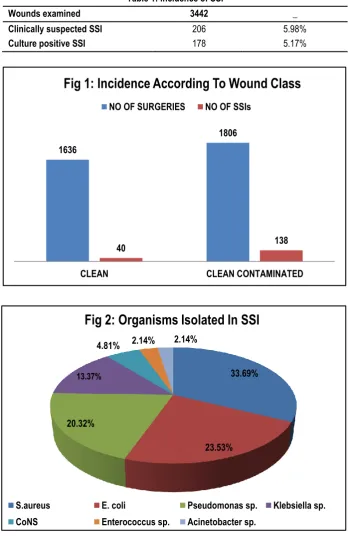
Among the 3442 cases with surgical wounds, 206 cases (5.98%) were suspected to be clinically infected. Out of 206infected wounds studied, 178 were culture positive and were considered definite cases of surgical site infection. Thus the overall incidence of infection of SSI was 5.17% (Table 1).
In the present study, out of the 1636 operations included in the Clean wound category, 40 cases (2.44%) were infected. The incidence of wound infection was significantly high in the Clean contaminated wounds which formed the majority of the cases, with 138 cases (7.64%) being infected in 1806 surgeries performed (Fig 1).
The figure 2 below shows the organisms isolated from infection sites. Among all Staphylococcus aureus was the most common pathogen isolated 33.69% (63/187), followed by Escherichia coli 23.53% (44/187), Pseudomonas spp. 20.32% (38/187), Klebsiella spp. 13.37 % (25/187) and CoNS 4.81% (09/187). Acinetobacter spp. (2.14%) was isolated with least frequency.
Table 2 shows sensitivity pattern of Staphyloccus aureus. All strains were sensitive to linezolid. The isolates were also highly sensitive to vancomycin (95.24). 38.10% (24/63) of the isolates were methicillin resistant. Maximum resistance with 26 of the 63 (41.17%) isolates being resistant, was seen against erythromycin. 34.92% of the Staphyloccus aureus isolates were also resistant to amoxycillin-clavulanic acid.
Table 3 shows the highest sensitivity among gram negative organisms was seen for imipenem (94.52%). 87.67% of the isolates were sensitive to piperacillin-tazobactum while 84.93% were sensitive to levofloxacin. More than 50% of the isolated organisms were resistant to ampicillin. Next in the list of resistant drugs were amoxicillin-clavulanic acid and cefotaxim both of which had resistant rate of 39.73% & 41.10% respectively.
Table 4 shows Escherichia coli isolates were most sensitive to imipenem showing 97.73% sensitivity followed by piperacillin-tazobactum (90.91%). They also showed good sensitivity to levofloxacin (86.36%) and amikacin (81.82%). Among the cephalosporins, the isolates were more sensitive to ceftriaxone (75%) than cefotaxime (63.63%). Resistance was maximum with ampicillin (52.27%).
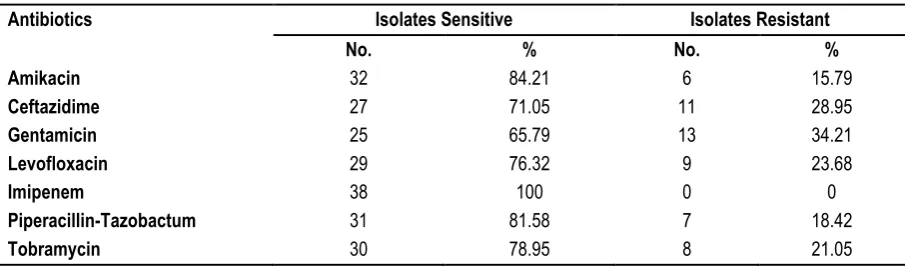
Table 5 shows Pseudomonas strains were 100% sensitive to imipenem. Out of the 38isolates 32 (84.21%) were sensitive to amikacin and 31 (81.58%) showed sensitivity to piperacillin-tazobactum. The highest resistance was seen for gentamicin (34.21%). The isolates also showed resistance to the cephalosporin ceftazidime (28.95%).
DISCUSSION
Surgical site infections have a significant impact on physical, economical and emotional wellbeing of an individual, apart from being a major problem to the surgical team. In the present study, an attempt has been made to know the various pathogens associated with surgical site infections, their antibiogram and the relationship of risk factors with incidence of SSI.
Out of 3442 cases, 206 cases were diagnosed clinically. 178 Surgical Site infections were confirmed by bacteriological study, so the overall infection rate was 5.17%. The incidence rate of 5.17% of the study is well within the infection rates of 0.6% to 32% seen in other studies. Among Indian studies Anvikar et al had an almost identical figure (6.09%) while Lilani P.et al had a slightly
higher infection rate of 8.95%.13,14 Bhatiani A. et al (2016) reported
the lowest incidence rate of 1.8% which was lower than that observed in some developed countries.15 Mundhada S. et al
reported a very high incidence rate (32%) from a study in Maharashtra, India.16
Wound contamination class is an important factor influencing the incidence of post-operative wound infections. Among the Clean wounds, which accounted for 47.53% cases, the rate of infection was 2.44%. But in Clean contaminated cases, the rate of infection almost tripled to 7.64% probably because of profound influence of endogenous contamination. In the present study infection rate of 2.44% in Clean category is very similar to findings seen in other studies in India (Suljagic´V et al 2.5%). In Clean contaminated procedures the rate increased two and a half times (10.04% from 4.04%) in a study by Anvikar et al, while in a similar study by Lilani S et al, the rate increased sevenfold (22.41% from 3.03%).13,14
Suljagic´ V et al (2006) reported a two fold increase as the category changed from Clean to Clean contaminated.17 In
Mundhada S. et al study, the incidence rates by wound class ranged from 17.65% in the clean category to 39.39% in the clean contaminated category.16
In the present study Staphylococcus aureus was the commonest organism isolated in 63 cases (33.69%). The next common organisms were Escherichia coli in 44 cases (23.53%), Pseudomonas spp. in 38 cases (20.32%), Klebsiella spp. in 25 cases (13.37%) and Coagulase negative staphylococcus in 09 cases (4.81%). Acinetobacter spp (2.14%) and Enterococcus spp. (2.14%) were isolated with least frequency. The antibiogram pattern of Staphylococcus aureus shows that it was most sensitive to linezolid (100%), vancomycin (96.05%) and amikacin (86.84%). Maximum resistance was seen with erythromycin (40.79%), while 38.10% of the isolates were methicillin resistant. Wassef M. A et al (2010) reported a similar finding in which seventeen out of thirty two (53.12%) strains of Staphylococcus aureus were methicillin-resistant but none of the strains were methicillin-resistant to vancomycin.18 In
a similar study, Shriyan A et al (2010) found that Staphylococcus aureus was generally sensitive to vancomycin (100%), teicoplanin (100%) andlinezolid (100%).19
As Escherichia coli was the most common pathogen among the gram negative isolates its antibiogram was also evaluated. Imipenem (97.73%) was the most effective drug against Escherichia coli isolates followed by piperacillin-tazobactum (90.91%). Majority of the strains were also found to be susceptible to levofloxacin (86.36%) and amikacin (81.82%). Cefotaxime and amoxicillin-clavulanic acid showed identical sensitivity pattern with 63.63% isolates being sensitive to them. Resistance was highest for ampicillin, accounting for 52.27% of cases. Suchitra J. B. et al (2005) found 90% of their Escherichia coli sensitive to amikacin and gentamicin which is slightly higher than that observed in this study. Among the cephalosporins maximum sensitivity was seen with cefotaxime (70%). Maximum resistance was seen to cefazolin (70%) and cefadroxyl (70%).20 Malik S. et al (2010) also reported
a similar sensitivity pattern. In their study Escherichia coli isolates showed maximum susceptibility to imipenem and cefoperazone-sulbactum (93.10%). Ampicillin (44.83%) was the most resistant drug in their study as well.21
isolates were resistant. 23.68% of the isolates were resistant to levofloxacin. Suchitra J. B. et al (2005) found 91% of their Pseudomonas strains to be sensitive to amikacin while 82% were sensitive in the present study. 15% of their strains were resistant to gentamicin while almost the double (31.71%) were found to be resistant in the present study.20
Wassef M. A et al (2010) found 3.6% of carbapenems, 9.7% of amikacin, 16.5% of fluoroquinolones and 21.4% of gentamicin were not effective against the Pseudomonas sp. detected by them.18
Malik S. et al (2010) in their study reported that 72.22% of their Pseudomonas strains were sensitive to ceftazidime and 83.3% to amikacin which is pretty similar to that observed in this study. They also found that 88.89% of the isolated Pseudomonas strains were sensitive to imipenem which was not the case in this study as all the isolates were sensitive to imipenem. Maximum resistance to gentamicin (27.8%) was also reported by them.21
CONCLUSION
The present study has given us an idea about the incidence of Surgical Site Infection in our hospital. It also highlights the variation in the incidence rate of infection in Clean and Clean contaminated wounds.
SSIs are significantly related to duration of surgery, type of operation and the age of the patient, showing increased infection rate in all of them. Although surgical site infections cannot be completely eliminated, a reduction in the infection rate to a minimum level could have significant benefits, by reducing postoperative morbidity and mortality and wastage of health care resources.
REFERENCES
1. CDC/NHSN Protocol Corrections, Clarification, and Additions. http://www.cdc.gov/nhsn/PDFs/pscManual/9pscSSIcurrent. pdf (Accessed on July 10, 2013).
2. Mangram AJ, Horan TC, Pearson ML, Silver LC, Jarvis WR; Hospital Infection Control Practice Advisory Committee. Guideline for prevention of surgical site infection, 1999. Infect Control Hosp Epidemiol1999;20:247-278.
3. Lilani SP, Jangale N, Chowdhary A, Daver GB. Surgical site infection in clean and clean-contaminated cases. Indian J Medical Microbiology 2005; 23(4):249-252.
4. Anvikar A.R., Deshmukh A.B., Karyakarte R.P., Damle A.S., Patwardhan N.S., Malik A.K., et al. A one year prospective study of 3280 surgical wounds. Indian J Medical Microbiology 1999; 17(3):129-132.
5. Magill, S.S., et al. Prevalence of healthcare-associated infections in acute care hospitals in Jacksonville, Florida. Infection Control Hospital Epidemiology, 33(3):(2012): 283-91.
6. Ronald Lee Nicholos: Preventing surgical site infection, clinical medicine & research, Vol -22(2): 115-118.
7. Ananthnarayan & Panikar`s Text Book Of Microbiology 9th edition 624-62.
8. Scott’s Diagnostic microbiology 13th edition.
9. Horan TC, Gaynes RP, Martone WJ, Jarvis WR, Emori TG. CDC definitions of nosocomial surgical site infections, 1992: a modification of CDC definitions of surgical wound infections. Infect Control Hosp Epidemiol 1992; 13(10):606-8.
10. Alexander JW, Fischer JE, Boyajian M, et al: The influence of hair-removal methods on wound infections. Arch Surg 1983; 118:347-352.
11. Altemeier. W.A., Burke J.F. et al, Manual on control of infection in surgical patients, second edn., Philadelphia, J.B. Lippincott 1984: 29.
12. Durmaz. B, Durmaz. R, Sahin. K., ‘Methicillin resistance
among Turkish isolates of Staphylococcus aureusstrains from nosocomial and community infections and their resistance
patterns using various antimicrobial agents’ J. Hosp. Inf. 1988
Dec: 37 (4): 325-329.
13. Anvikar AR, Deshmukh AB, Karyakarte RP, et al. A one year prospective study of 3,280 surgical wounds. Indian J Med Microbiol 1999; 17:129-32.
14. SP Lilani, N Jangale, A Chowdhary, GB Daver, Year : 2005 | Volume : 23 | Issue : 4 | Page : 249-252.
15. Ambika Bhatiani, Vikas Mishra, Nidhi Pal, Ashish Chandna, J. Evolution Med. Dent. Sci/ eISSN- 2278-4802/Vol. 5/Issue 82/ Oct. 13, 2016.
16. Aniruddha S. Mundhada, Sunita Tenpe, Indian Journal of Pathology and Microbiology – 58(2), April-June 2015.
17. Vesna Suljagic´, Miodrag Jevtic, Boban Djordjevic, and Aleksandra Jovelic; Surg Today (2010) 40:763–771.
18. Wassef M. A., Hussein A., Abdul Rahman E. M. and El-Sherif R. H.; African Journal of Microbiology Research Vol. 6(12), pp. 3072-3078, 30 March, 2012.
19. Amrita Shriyan, Sheetal R, NarendraNayak,Aerobic micro-organisms in post-operative wound infections and their antimicrobial susceptibility patterns. Journal of Clinical and Diagnostic Research: December 2010; 4(6), 3392-99.
20. Suchitra Joyce B. and Lakshmidevi N. African Journal of Microbiology Research Vol. 3 (4) pp. 175-179 April, 2009. 21. Shruti Malik, Alok Gupta, K.P. Singh, Jyotsna Agarwal, Mastan Singh, J Infect Dis Antimicrob Agents 2011;28:45-51.
Source of Support: Nil. Conflict of Interest: None Declared.
Copyright: © the author(s) and publisher. IJMRP is an official publication of Ibn Sina Academy of Medieval Medicine & Sciences, registered in 2001 under Indian Trusts Act, 1882. This is an open access article distributed under the terms of the Creative Commons Attribution Non-commercial License, which permits unrestricted non-commercial use, distribution, and reproduction in any medium, provided the original work is properly cited.