An Improved Priority Based VM Placement
Approach for the Cloud Environment
1
Prafulla Chakankar, 2 Nishchol Mishra, 3 Sanjeev Sharma
1, 2, 3
School of Information Technology, RGPV, Bhopal
Abstract - Virtualization is the core technology in the cloud. The biggest benefit of using the virtualization in cloud is the ability to assign the computing resources flexibly. Since load on the virtual machine (VM) is change frequently. Due to this reason it is still a challenge to schedule the VM properly to meet multi-objective, like power and QoS constraints, provider profit etc. Cloud is a totally commercial model where provider wants to increase their profit with the client satisfaction. This paper proposed a VM scheduling approach which assign the priority for each VM based on their cost and then place the VM first that has the highest priority. To create the cloud environment for measuring the performance of the proposed approach CloudSim simulator is use and compare with the existing VM scheduling approach. Experiments result shows that proposed approach minimize the energy consumption and simulation time.
Keywords - Cloud Computing, Virtual Machine, Physical Machine, Energy Consumption, Total Simulation Time, Active Server, CloudSim.
1.
Introduction
Cloud computing is one of the fastest growing technology in the field of computer science and it is so popular in very short time due to its features like easy to use, universal access etc [1, 2]. It provide three types of services named software as a service, platform as a service, and infrastructure as a service and it can be implemented in three different way i.e., private, public and hybrid [3, 4].
Virtualization [5, 6] is the core technology in the cloud. The biggest benefit of using the virtualization in cloud is the ability to assign the computing resources flexibly. It enable the provider to divides the physical resources and makes “pay-as-use” model possible. It creates the VM and assign to the user to execute the user task. Since resource requirement of the task change with the time which results in load on the VM is change frequently [7]. Cloud is a totally commercial model where provider wants to increase their profit with the client satisfaction. Virtualization helps to the provider to increase their profit by scheduling the multiple VM to the single physical machine (PM). During the study of cloud
computing it is found that VM scheduling is way by which cloud provider can increase their profit by increasing the resource utilization and reducing the number of running server. Cloud datacenter has the limited capability so they can serve the limited number of users. So one other way to increase the provider profit is to assign the computing resources first which gives more profit to the provider. Our proposed work is based on this concept. This paper proposed a VM scheduling approach which assign the priority for each VM based on their cost and then place the VM first that has the highest priority. Hence, increase the provider profit.
This paper organized as follow. Section 2 represent the related work, section 3 represent the proposed work. This section 3 introduces the VM scheduling approach. Section 4 represents the graphical comparison of the proposed and competitive approach. This section also described the simulator and environment used in the proposed approach. Section 5 concludes the work.
2.
Literature Review
In this paper [8], they proposed a load balancing approach using VM migration. This approach set the value of lower and upper threshold is 10 and 90. When the PM is overloaded higher utilize VM is select for the migration and place to the PM where load is less than 50 percentage of their capacity. Main objective of this approach is to minimize the energy consumption. For this purpose they place the selected VM to the PM where the energy consumption is smallest. This approach minimized the energy consumption but increase the total migration time.
211
function is use to assign priority to each VM and then place VM randomly to any PM. Problem with this approach is that it may have starvation. Higher priority VM is assign to the PM first, so if higher priority process comes regularly then lower priority VM is in starvation.
In this paper [10], they proposed aim of load balancing as “to remove overload of any of the resources, maximize throughput, and minimize response time”. According to G. Shobana et al. for achieving these we need to do load balancing properly. In the paper they introduced the preemptive task scheduling algorithm that almost abbreviate make span which observe honeybee’s foraging behavior. Aim of this algorithm is to maximize throughput and minimize latency by priority of the tasks. In this paper [11], author proposed an load balancing approach for the cloud. According to this approach important role of algorithm to provide useful mechanisms for appointing the client’s request to usable cloud nodes. These way wish to increase the cloud performance and bring efficient services for cloud user. In this paper they investigate dissolve issue of different load balancing algorithm and task scheduling in cloud computing. They hash out and comparison these algorithm to offer an overview of the latest approaches in this field.
In this paper [12], author proposed a VM scheduling approach for the cloud which distribute the load equally among all the host. This approach proposed cost effective solution for the VM placement. Since time and cost are the two important parameter for the cloud provider and users, so algorithm which has lowest time and more throughput is the best. It is compare with round robin (RR) and throttle algorithm.
In this paper [13], author proposed VM placement approach based on the genetic algorithm [13]. Genetic approach is suffered by the starvation, so to avoid the starvation problem they prioritize the VM and then use the genetic approach to place the VM. To prioritize the VM they are using Logarithmic Least Squares Method which first find the comparison matrix of all VM then multiply each row to find the value of fitness function. Then assign the priority of each VM according to the fitness value. VM with higher fitness value will have higher priority. Following equation is use to find the fitness value for each VM.
ζ= w1* α(NIC ÷ MIPS) + w2* L
Where,
W1 and w2 are the weighting coefficient
NIC is the number of instruction in cloudlet
MIPS Million instruction per second requested by the VM
α is the cost of instruction execution
L is the delay cost
After assigning the priority to each VM, they use genetic algorithm for placing the VM, which randomly select the PM for placing the VM. Main problem with approach is that, they are not focusing on the energy consumption. VM placement play an important role in managing the energy consumption, hence energy consumption will be increase.
3.
Proposed Work
VM scheduling is the prime concern for the cloud provider because the performance of the cloud system is mainly depends on the effective VM scheduling approach. Most of the existing work on the VM scheduling mainly target to increase the resource utilizations. For this purpose cloud provider virtualizes their datacenter and enabled the sharing of physical resource. In cloud, when the user demands for the resources provider assign the resources into the PM available in the datacenter. Since each PM have a limited amount of capacity, so it can serve limited number of users. If the scheduler assigned all the available resources to the lower profit VM then it will minimize the cloud provider profit. This situation can be avoided by schedule the higher profit VM first. M. S. Pilavare and A. Desai [13], proposed an VM scheduling approach that assign the higher priority to the higher profit VM and then place the VM according to the priority. This proposed increase the provider profit by serve all higher priority VM but may create the starvation situations for the lower profit VM and increase the number of running server by placing the VM randomly. Propose approach gives the solution for the above issues. To avoid the starvation we use the concept of aging where the priority of the VM is increase by one in every chance when it is not scheduled in any VM.
In proposed approach VM scheduling process are divide into two steps. In the first steps assign the priority to each VM. For this purpose cost of the each VM is calculated which depends on the size and execution time of the VM. VM whose configuration is high and use resources for the more time will give the more profit to the provider. Hence higher priority is assign to these types of VM. After assigning the priority to each VM, VM placement procedure is started and first select the PM which having the higher capacity. When all the higher capacity PM is full then we select the immediate lower capacity PMs.
Figure 1: Flow Diagram
Proposed VM scheduling approach is divided into two part.
a. Assign Priority to the VM b. Select PM for the VM placement
a) Assign Priority to the VM
In proposed approach cost is the main metrics for the scheduling the VM. So VM place on the basic of cost i.e., amount paid by the user to the provider. Based on this cost priority is assign to each VM. In the proposed approach CPU, memory and bandwidth are the three metrics use for the VM placement. Bill paid by the user is depends on the amount of resources and the time for which VM use these resources. If time required by the VM to execute the application running on it is Ta. Then
Ta =
MIPS
It is seen that VM utilizing only 70% of their full capacity. This will introduce some delay. Now if time required by the VM to execute the application running on it is Tb. Then
Tb=
cloudlet
∗.
Hence,
delay = Tb - Ta
Now, Total time required to execute the application is
T = Ta + delay
Here, T is time for which user use the cloud resource.
Now assume the cost of the CPU and memory and bandwidth are x. y and z respectively. Now we us the comparison matrix to find the bill amount paid by the user. If VM1, VM2, VM3, and VM4 are the four VM with
different configurations then
Table 1: Comparison Matrix to Measure VM Cost
VM C COST M COST B COST COST (X)
VM1 L1=T1*x1 M1=T1*y1 N1=T1*z1 X1=L1*M1*N1
VM2 L2=T2*x2 M2=T2*y2 N2=T2*z2 X2=L2*M2*N2
VM3 L3=T3*x3 M3=T3*y3 N3=T3*z3 X3=L3*M3*N3
VM4 L4=T4*x4 M4=T4*y4 N4=T4*z4 X4=L4*M4*N4
Where X1, X2, X3, and X4, are the final bill amount which is paid by the users. Now we assign the priority to each VM based on these values.
b) Select PM for the VM Placement
VM schedulers arrange all VM into the decreasing order of their X value and select the first VM for the placement. Now for placing the VM scheduler select the PM which produce less energy incensement before and after the placement. Following algorithm is use to place the VM.
Algorithm for the VM Scheduling
If n is the total number of PM and m is the total number of VM that need to be placed.
1) VMList ← List of all VM
2) Calculate the comparison matrix for each VM and find the cost X for each VM
3) Assign the priority for each VM according to the value of cost X
4) Sort all VM according to the priority
5) for each VM in the VMList do
6) sort all PM into the descending order of their capacity
7) for each PM in the PMList do
8) if ((PMCPU>VMCPU && PMRAM>VMRAM )&&
213
9) Add PM to the PMList-
10) end if
11) end for
12) for all PM in the PMList-2
13) P1← {Power before VM allocation}
14) P2← {Power after VM allocation}
15) diff ← P2 - P1
16) Add diff into the diffList
17) end for
18) Arrange all PM into the PMList-2 in ascending order according to their diff value
19) Assign VM to the first PM
20) PMCPU ←PMCPU + VMCPU
21) PMRAM ←PMRAM + VMRAM
22) PMBW ←PMBW + VMBW
23) end for
4.
Simulation Result
In this approach CloudSim simulator is use to build cloud environment. CloudSim simulator is Java based simulator and highly use to evaluate the performance of the cloud based approach. To measure the performance of the proposed approach we compare our proposed approach with the existing VM scheduling approach.
In our used environment we create number of VM with the following configurations. MIPs of the VM are (250, 5000, 750, 1000), RAM of the VM is 128 MB and bandwidth of the each VM is 2500 bits/sec. Ten PM is created during the experiment with the following environment. MIPS of the PM is (100, 2000, 3000), RAM of the PM is 10000 MB and bandwidth of the each VM is 100000 bits/sec.
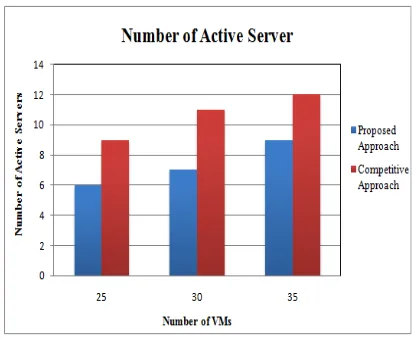
Since, proposed approach is assign the priority on the basis of cost, so here we assume some cost for the each resources. Now we compared the number of active server, total simulation time and energy consumed by the datacenter.
Figure 2: Number of Active Servers
Figure 3: Energy Consume by the Datacenter
Figure 4: Total Simulation Time
Figure 2, figure 3 and figure 4 shows the number of active server, energy consumed by the datacenter and total simulation time respectively. Experiment says that proposed approach gives better result as compare to the base approach.
0 0.05 0.1 0.15 0.2 0.25 0.3 0.35
25 30 35
E
n
e
rg
y
C
o
n
su
m
p
ti
o
n
i
n
K
w
h
Number of VMs Energy Consumption
Proposed Approach Competitive Approach
1175 1180 1185 1190 1195 1200 1205 1210 1215 1220
25 30 35
S
im
u
la
ti
io
n
T
im
e
i
n
S
e
c
Number of VMs
Total Simulation Time
Proposed Approach
5.
Conclusion
VM placement is the core function of any cloud based system. Since cloud is the cooperate model, which provide the computing resources to the client on the rent basic, so profit is the prime concern of the cloud provider that can be achieve by utilizing the computing resources effectively. This paper proposed an alternative solution for increasing the cloud provider profit. In this approach we first service the VM first which gives more to the cloud provider. Proposed approach is implemented in CloudSim simulator and experiment result says that proposed approach gives better result.
References
[1] R. Buyya, Chee Shin Yeo, Srikumar Venugopal, James Broberg, and Ivona Brandic “Cloud Computing and Emerging IT Platforms: Vision, Hype, and Reality for Delivering Computing as the 5th Utility", Future Generation Computer Systems, 2011.
[2] P. Mell, and T. Grance "The NIST Definition of Cloud Computing”, NIST Special Publication, 2011. [3] R. K. Gupta, and R. K, Pateriya “A Complete Theoretical Review on Virtual Machine Migration in Cloud Environment”, International Journal of Cloud Computing and Services Science (IJ-CLOSER), Vol.3, No.3, June 2014, pp. 172-178.
[4] Barrie Sosinsky. "Cloud Computing Bible”, Wiley Publishing Inc 2012.
[5] Christopher Clark, Keir Fraser, Steven Hand, Jacob Gorm Hansen, Eric Jul, Christian Limpach, Ian Pratt, and Andrew Warfield. “Live migration of virtual machines,” in Proceeding NS DI’05 Proceedings of the 2nd conference on Symposium on Networked Systems Design & Implementation, vol. 2, pp. 273– 286, 2010.
[6] Paul Barham, Boris Dragovic, Keir Farser, Steven Hand, Tim Harris, Alex Ho, Rofl Neugebauer, Ian Patt and Andrew Warfield. "Xen and the art of Virtualization,” in Proceedings of the nineteenth ACM symposium on Operating systems principles, ACM, pp. 164 –177, 2003.
[7] Gaochao Xu, Junjie Pang, and Xiaodong Fu. "A Load Balancing Model Based on Cloud Partitioning for the Public Cloud", Journal of Tsinghua Science and Technology (IEEE), Volume 18, Issue 1, pp. 34-39, 2013.
[8] Rabiatul Addawiyah Mat Razali, Ruhani Ab Rahman, Norliza Zaini, and Mustaffa Samad. "Virtual Machine Migration Implementation in Load Balancing for Cloud Computing", 5th IEEE international conference, 2014
[9] Kousik Dasgupta, Brototi Mandal, Paramaratha Dutta, Jyotsna kumar Mondal and Santanu Dam. " A Genetic Algorithm (GA) based Load Balancing Strategy for Cloud Computing", First International Conference on Computational Intelligence: Modeling Techniques and Applications (CIMTA) (Elsevier), pp. 337-340, 2013.
[10] G. Shobana, M. Geetha and Dr. R.C. Suganthe “Nature Inspired Preemptive Task Scheduling for Load Balancing in Cloud Datacenter” proceeding of the IEEE International Conference on Information Communication and Embedded Systems (ICICES), Feb. 2014, pp. 1-6.
[11] Klaithem Al Nuaimi, Nader Mohamed, Mariam Al Nuaimi and Jameela Al-Jaroodi “A Survey of Load Balancing in Cloud Computing: Challenges and Algorithms”, 2012 IEEE Second Symposium on Network Cloud Computing and Applications. [12] Nitin kumar Mishra and Nishchol Mishra," CELBT:
An Algorithm for Efficient Cost based Load Balancing in Cloud Environment", International Journal of Computer Applications (IJCA), Volume 134 – No.1, pp. 8-11, January 2016.
[13] Mayur S. Pilavare and Amish Desai, " A Novel Approach Towards Improving Performance of Load Balancing Using Genetic Algorithm in Cloud Computing", IEEE Sponsored 2nd International Conference on Innovations in Information Embedded and Communication Systems ICIIECS’15, pp. 1-4 , March 2015.
Author Profile
Prafulla Chakankar - He received Bachelor of Engineering in Computer Science & Engineering from Gwalior Engineering College, Gwalior. He is Pursuing M. Tech. in Cyber Forensics from School of Information Technology, RGPV (State Technological University of Madhya Pradesh, India), Bhopal. His research interest include Cloud Computing, Data Security.
Nishchol Mishra - He received Ph.D. in Computer Science & Enginering. HIs research interest include Mining over Social Media Data. Currently working as Assistant Professor in School of Information Technology, RGPV (Bhopal), India.