Abstract—The electro-hydraulic systems are commonly used in the motion control applications. This paper represents an implementation of robust control for an electro- hydraulic system of CVT. The robust PI controlled system for speed ratio electro-hydraulic system of CVT is designed for adjusting speed ratio of CVT by using MATLAB environment. The objective of this study was to design the controller of an electro-hydraulic system using the robust PI control system which is to maintain guarantee of the speed ratio electro-hydraulic system performance in spite of model inaccuracies and alteration. The Mathematical modeling of the electro-hydraulic system of CVT is presented in terms of equations. The robustness and tracking ability of the designed controller were demonstrated through simulations. According to the results, the robust PI controlled system for speed ratio electro-hydraulic system of CVT gives the good performance, such as rise time, settling time, overshooting.
Index Terms—Electro-hydraulic, CVT, Simulation, Robust PI controller.
I. INTRODUCTION
In recent years, electro-hydraulic servo (EHS) system has attracted a great interest in industrial engineering as an actuator for high performance and precision positioning applications. With a compact size and design, EHS system capable to generate high forces in fast response time and produced great durability in particular for heavy engineering system [1]. Due to the electro-hydraulic systems are used in several control applications for industry systems. Therefore the controlling of the performance characteristics of electro–hydraulic system is important.
To develop an unmanned automatic excavator system the control performance of hydraulic actuators should be guaranteed. However, hydraulic actuators with single rod cylinder have inherently severe nonlinearities that significantly affect to the command following performance of end-effect. PID control system widely used in industries is not proper to compensate the nonlinearities and it is difficult to cancel the unexpected disturbance. In this work, the robust control scheme to compensate an nonlinearity of hydraulic actuator and cancel an unexpected disturbance is proposed. The proposed control system is designed based on
Manuscript received April 5, 2013; revised May 28, 2013. This work was supported by Beijing Institute of Technology.
The authors are with the Mechatronic Center, Mechanical Engineering Beijing Institute of Technology, Beijing, 100081 China (e-mail: [email protected], [email protected], [email protected], [email protected]).
back-stepping controller with sliding model control system. To evaluate the performance of the proposed control system, step responses were compared with a conventional SMC in low pressure area. Also, the performance of disturbance cancellation was compared applying the impact at the end of hydraulic cylinder. Through the experiments it is found that the proposed control has a better performance against parameter uncertainty and unexpected disturbance [2].
The current belt type CVT cars are mostly equipped with electro-hydraulic system. Combination of engine and continuously variable transmission (CVT) can potentially reduce fuel consumption and emissions by improving engine efficiency.
The hydraulic system of CVT model and fuzzy logic controllers are established. Two valves are introduced and analyzed corresponding of application PWM in hydraulic system. The simulation result of the complete system is good [3].
In this paper, the design of robust PID-controlled system for speed ratio an electro hydraulic system in CVT of modeling is designed by using MATLAB/Simulink.
The rest of the paper is organized as follows. In Section II, the modeling of system dynamics for the electro- hydraulic system is presented and linearized. In Section III, the design of robust control of the electro hydraulic system of speed ratio for CVT is established then implemented in MATLAB/Simulink. Section IV presents analysis of parameters control used in simulations. Simulation results for the controller Simulink models are discussed in section V. The concluding remarks are given in Section VI.
II. MODELING OF HYDRAULIC DYNAMICS SYSTEM IN STATE SPACE
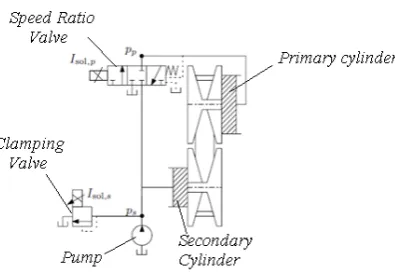
Hydraulic primary cylinder of CVT is operated through flow and pressure control of speed ratio control valve (SRV) which is manipulated by electrical current of solenoid valve Isol,p. The oil flowing in primary cylinder is supplied by a
secondary hydraulic pressure ps that is manipulated by
electrical current of solenoid valve Isol,s. Also it’s assumed
constant high supply pressure. The hydraulic actuation system of CVT is shown in Fig. 1.
In Fig. 2, the hydraulic primary circuit of CVT is shown which can be considered as a single rod hydraulic cylinder system. The motion xv of the speed ratio valve controls the
amount flow of oil to or from the primary cylinder.
To design PID robust controller the modeling of simple single rod hydraulic actuator system will be presented later
Control Speed Ratio Electro-Hydraulic System of
Continuously Variable Transmission (CVT) by Robust PI
Controller
based on Fig. 2.
Fig. 1. Schematic of the hydraulic actuation system of CVT.
Fig. 2. The electro-hydraulic actuation system of primary pulley [4].
A mathematical model of electro-hydraulic primary pulley system is composed of the dynamics of the primary pulley system disturbed by an external load from secondary pressure Psvia push-belt and the dynamics of a servo valve of shifting
(speed ratio valve). The linearized differential equations that describe the primary pulley-valve dynamics are described as follow:
A. Valve Dynamics
According to the equation of motion of spool and the low natural frequency of valve compared to the natural frequency of primary pulley can consider the linear relation, as obtained:
) ( )
(s K I s xv = vΔ
Δ
(1) where Kv the gain of speed ratio valve.
B. Primary cylinder dynamics
The flow through the valve can be described by: p wx C p x Q
QL= v Δ = q v Δ
ρ
2 )
,
( (2)
From Fig. 2 flows Qp can be induced by Bernoulli's
equation as follows:
) (
2
1 q v s p
p C wx p p
Q = −
ρ xv≥0 (3)
) ( 2
2 q v p t
p Cwx p p
Q = −
ρ xv<0 (4)
where Cq and w are flow coefficient and area gradient, xv is
distance of spool, Ps , Pp and Pt are secondary (supply),
primary cylinder and drain pressures respectively and ρ is density of hydraulic fluid.
The linearized equation describing the valve flow QL
becomes: L L L v v L
L p p
Q x x Q Q Δ ∂ ∂ + Δ ∂ ∂ =
Δ (5)
where v L
x
Q
∂
∂
and L Lp
Q
∂
∂
are valve flow gain and valve flow–pressure coefficient can be described by:
) ( 2 p s q q v
L K C w p p
x Q − = = ∂ ∂
ρ
(6)) ( 2 0 0 p s v q c L L p p wx C K p Q − = = ∂ ∂
ρ
(7)L c v q
L K x K p
Q = Δ + Δ
Δ (8) The pressure dynamics for primary cylinder is given by:
dt dp V P C dt dx A Q p e p p p l p p p
β
+ + =Δ , (9)
where Cl,p and βe are internal leakage coefficient and effective
bulk modulus, Ap and Vp are area and volume of primary
cylinder distance, Pp is the pressure inside the primary
cylinder,
let
Δ
Q
p=
Δ
Q
Lso:
{
q v c lp p p p}
p e
p
K
x
K
c
P
A
x
V
p
=
β
−
(
+
,)
−
(10)
The linearized and laplace –transformed of force equation applied on the primary pulley will be written as
p p p P p p s p
P
P
F
M
x
B
x
k
x
A
Δ
−
=
+
+
(11)The kp =0 so this lead to:
)
(
1
s p P p P pp
B
x
A
P
F
M
x
=
−
+
Δ
−
(12)The state-space model of the electro-hydraulic servo system can be shown in the following equations:
⎥
⎥
⎥
⎥
⎥
⎥
⎥
⎦
⎤
⎢
⎢
⎢
⎢
⎢
⎢
⎢
⎣
⎡
−
=
0
1
0
0
0
p q e
p
V
K
M
B
β
(15)
⎥
⎦
⎤
⎢
⎣
⎡
=
1
0
0
1
C
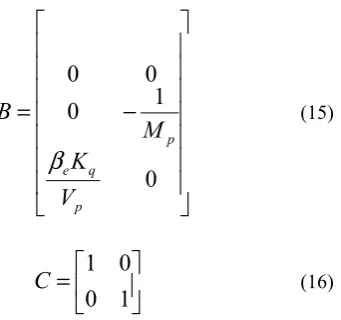
(16)As seen in the above mentioned dynamic, the system is MIMO system the state variables are xp, ẋp and Pp ,which has
2 outputs, Pp – primary pulley pressure and xp – position of
primary pulley , and 2 inputs (u), xv – input servo valve of the
position control system, and Ps– input servo valve of the
secondary pressure control system.
III. ROBUST CONTROL DESIGN
The design of control systems in the presence of significant uncertainty requires the designer to seek a robust system. A system is robust when the system has acceptable changes in performance due to model changes or inaccuracies.
A system structure that incorporates potential system uncertainties is shown in Fig. 3. This model contains the sensor noise N(s), the unpredicted disturbance input Td(s),
and a process G(s) with potentially unmodeled dynamics or parameters changes [5].
A control system is robust when (1) it has low sensitivities; (2) it is stable over the range of parameters variations, and (3) the performance continuous to meet the specifications in the presence of a set of changes in the system parameters.
Fig. 3. Block diagram of Closed-loop control system.
The design of robust control systems is based on two tasks: determine the structure of the controller and adjusting the controller parameters to give an optimal system performance. This design process is normally done with “assumed complete knowledge” of the process. Furthermore, the process is normally described by a linear time –invariant continuous model. The structure of the controller is chosen such that system response can meet certain performance criteria [4].
The design specifications include:
•The settling time (Ts), less than 2 s, and
•An optimum ITAE performance for a step input.
PID controller
The PID controller has a transfer function:
K
s
s
K
K
s
G
I Dp
c
(
)
=
+
+
(17)The controller provides a proportional term (Kp), an
integration term(KI), and a deviation term (KD).
The popularity of PID controllers can be attributed partly to their good performance in a wide range of operating conditions and partly to their functional simplicity, which allows engineers to operate them in a simple, straightforward manner [4].
In order to solve the control problem using modern robust control techniques, the frequency domain characterization of the system must be known. So, The bode diagram of open loop system, closed loop without controller and the e Nyquist chart is shown in Fig. 4 and Fig. 5 respectively. From bode diagram of open loop and closed loop and the Nyquist chart its clear the system need to be controlled. Using PI controller, the ITAE design and the requirement so that:
s
K
K
s
G
Ip
c
(
)
=
+
(18)We obtain Ki= 2, KP=5 , the examine the performance of
system with varying the Ki and Kp will explained in the next
section.
-80 -60 -40 -20 0 20
M
agni
tude
(d
B
)
10-1 100 101 102 103
-180 0 180 360
P
h
ase (d
eg
)
Bode Diagram
Frequency (rad/s)
Open-loop Closed-loop
Fig. 4. The bode diagram of Open-loop (- -) and Closed-loop (…) without control system.
-1 -0.5 0 0.5 1 1.5
-0.8 -0.6 -0.4 -0.2 0 0.2 0.4 0.6
0 dB
-20 dB -10 dB
-6 dB -4 dB
-2 dB
20 dB 10 dB 6 dB
4 dB 2 dB
Nyquist Diagram of closed loop system
Real Axis
Im
agi
na
ry
A
xi
s
IV. SIMULATION RESULTS AND DISCUSSION To validate the proposed Robust PID controller scheme, the electro-hydraulic speed ratio of CVT system is simulated based on MATLAB. The parameters that required for simulation are shown in Table I.
TABLE I: THE PARAMETER OF ELECTRO HYDRAULIC SYSTEM OF CVT Channels Group 1 Group 2 Group c Ap 301.92e-4[m2] ρ 890[kg/m3]
xp - [m] Kq 0.02[m3/As]
Vp 10-4[m3] Kc 1.1x10⁻¹¹
β e 1e9[Pa] mp 2 [kg]
Cq 0.62[-] Kv 0.234[-]
w 0.003[m] B
p 1.25e6[Ns/m] Cl,p 3.4e-12[m3/Pa s]
First, several simulations for the proposed controller system with different value KP, Ki are done and analyzed e for
step amplitudes. Fig. 6 and Fig. 7 show the simulation results, it’s clear the robust PI controller satisfied the requirements, the best performance its achieved at KP =5, Ki=2.
0 1 2 3 4 5 6 7 8
0 0.5 1 1.5
Time [s]
S
tep respons
e
Ki=1 Ki=2 Ki=3 Ki=4 Ki=5
Fig. 6. The step response for different KP at Ki=2.
0 1 2 3 4 5 6 7 8
0 0.2 0.4 0.6 0.8 1 1.2 1.4
Time{s]
S
tep res
pon
se
Ki=0.5 Ki=1 Ki=1.5 Ki=2
Fig. 7. The step response for different Ki at Kp= 5.
Second, the robustness of the controller can be demonstrated by applying the controller to the system in the case of erroneous parameter estimation.
The resulting bode diagrams of open loop, closed loop, closed loop with PI controller electro hydraulic system of CVT were shown in Fig. 8.
Fig. 8 also shows the proposed controller system magnitude margin, 2dB and system phase margin, 300. Obviously the proposed controlled system is robustly stable for the electro hydraulic complete CVT ratio range relative
stability of the closed loop system is good. The obtained bandwidth is 1−3 [Hz] for the speed controller.
-100 -50 0 50
Magn
itud
e (dB
)
10-2 100 102 104
-90 0 90 180 270 360
P
hase
(
deg
)
Bode Diagram
Frequency (rad/s)
Closed loop with PI Closed loop Open loop
Fig. 8. The bode diagram of open loop (-), closed loop (-.-) and closed loop with PI controller (---).
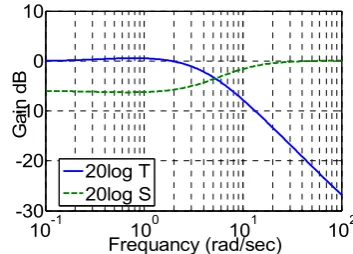
Last, the resulting bode diagram of closed loop with PI controller electro hydraulic system of CVT and sensitivity is shown in Fig. 9. Also, the Bode plot of 20log T(s) and 20logS(s) is shown in Fig.10.
From Fig. 9 and Fig. 10, we obtained the proposed control is robust and the system is low sensitive to changes.
So, the Robust PI controller for the electro hydraulic system of CVT system is give good performance and robustness.
-30 -20 -10 0 10
M
agn
itud
e (
dB
)
10-1 100 101 102
0 90 180 270 360
P
ha
se (d
eg)
Bode Diagram
Frequency (rad/s)
closed loop Sensitivity
Fig. 9. The bode diagram for electro hydraulic system of CVT T(s), S(s) sensitivity.
10-1 100 101 102 -30
-20 -10 0 10
Frequancy (rad/sec)
Ga
in
d
B
20log T 20log S
V. CONCLUSION
The design of robust PID controller for electro-hydraulic system has been presented in this paper. The three coefficients of the PID controller were designed in order to minimize the ITAE performance index, which generate an adequate transient response to a step.
Primary pulley dynamics and electro-hydraulic models, including servo valve models were employed and described by a set of integrated system equations.
The robustness and effectiveness of the designed controllers were verified through computer simulations.
The simulation results show that the proposed robust PID controller has a good effect and robust control performance. Simulations of system with step input were presented and a good performance of the controller was obtained. Furthermore, this result is a significant enhancement of the control performance of the electro - hydraulic system.
Various robust control methods can be implemented for speed ratio electro hydraulic system of CVT such as H∞
synthesis, μ synthesis, etc.
REFERENCES
[1] H. E. Merrit, Hydraulic control systems, John Wiley & Sons, Inc., New York, 1967.
[2] J. Choi, “Robust control of hydraulic actuator using back-stepping sliding mode controller,” in Proc. the 28th ISARC, Seoul, Korea, pp.1261-1266, 2011.
[3] J. S. Tian and J. Su, “Hydraulic system simulation of CVT with fuzzy logic controllers,” in Proc. 2004 First International Conference on Power Electronics Systems and Applications, Shanghai, pp. 136 – 141, 2004.
[4] K-E Rydberg. Hydraulic Servo Systems. [Online]. Available: www.iei.liu.se/flumes/tmhp51/filearchive/coursematerial/1.105708/H ydServoSystems_part1.pdf, 2008.
[5] R. C. Dorf and R. H. Bishop, Modern Control Systems, 11th ed., 2009.
Sameh Bdran was born in Egypt, Cairo City, in 1972. He received the B.S. and M.S. degrees in automotive engineering from the Military Technical College, Cairo, respectively in 1996 and 2004. He is currently pursuing the Ph.D. degree in mechanical engineering at Beijing Institute of Technology, Beijing, China.