e-ISSN: 2278-067X, p-ISSN: 2278-800X, www.ijerd.com
Volume 3, Issue 8 (September 2012), PP. 44-51
Information Technology Based Knowledge Management
Intervention in Engineering Institutions
Bhusry Mamta
1, Ranjan Jayanthi
21
Research Scholar Singhania University, Pacheri Bari, Jhunjhunu, Rajasthan, India
2Institute of Management Technology, Ghaziabad, India
Abstract––Knowledge management (KM) is an essential consideration in engineering education to ensure that institutional knowledge flows efficiently between the stakeholders. Engineering institutions are a nested system of various processes and functions grouped into functional domains. The functional domains are dominated by performance indicators that impact the performance of engineering institutions. The performance indicators constitute the knowledge elements in the functional domains. The paper focuses on the importance of performance indicators and proposes an information technology based KM framework for the acquisition, capture, transformation, storage, dissemination and application of the institutional knowledge. The implementation of the framework will provide institutions with opportunities of cross functional knowledge sharing, collaborative problem solving, enhanced decision making, shorter development cycles and building of a competitive advantage
Keywords––Knowledge management, knowledge repository, knowledge acquisition, knowledge capture, knowledge transformation, knowledge dissemination, knowledge application
I.
INTRODUCTION
Knowledge is widely perceived as a strategic asset in improving the organizational performance and knowledge management (KM) has received widespread attention in recent years. Recent times have seen KM as a fundamental management strategy to enhance the efficiency, performance and competitiveness in organizations.
Companies and academics have highlighted the importance of knowledge as the basis for competitive advantage [22]. This has made it important to better acquire, transfer and utilize knowledge. [23] defines knowledge as “the insights, understandings and the practical know-how that we all possess”. [21] proposed that knowledge management is the process of identifying, growing and effectively applying an organization’s existing knowledge in order to achieve the organization’s goals, while creating an organizational culture that permits further knowledge creation. Essentially, KM needs to ensure that the right knowledge gets to the right people at the right time, and to help people share and put knowledge into action in ways that strive to improve organizational performance [11]. To meet these objectives, knowledge must be created, transformed and eventually disseminated and shared [20]. From these and other definitions, it is inferred that knowledge management is the management of organizational information and knowledge by applying skills, experience, innovation and intelligence.
Large number of organizations have implemented KM principles and methods in their routine activities for enhanced collaboration of knowledge on inter and intra organizational platforms. However educational institutions have not taken much interest in introducing KM approaches even though from the academic learning point of view KM by its nature is essential for educational institutions [15]. Today educational institutions behave like educational markets. They have to adjust themselves and develop strategies to respond rapidly to the increasing demands of stakeholders and market pressures. To be able to effectively manage their knowledge resources, educational institutions need to have appropriate KM processes in place [13]. A KM approach is a conscious integration of all human resources and academic and administrative processes for the acquisition, structuring and sharing of institutional knowledge.
Today the challenge faced by most institutions is the lack of ability to integrate the capture and transfer of actionable, articulated and explicit knowledge. Knowledge management intervention (KMI) will focus on the integrated acquisition of knowledge from all aspects of the institution and its deployment in the form as required by the various users. It offers opportunities to the organization to move towards a cross functional and cross organizational knowledge sharing culture. By using KM, the same knowledge can be projected in different forms for a wide variety of decision making and planning.
The study is a modest attempt to generate KM services in engineering institutions (EIs) through the reuse and sharing of institutional knowledge towards process improvement, performance enhancement and decision making. The study aims to identify the generic functional domains in EIs and the performance indicators that impact the performance of institutions in the functional domains. The KM framework is developed based on the integration of the functional domains and the corresponding performance indicators.
II.
RELATED
WORK
research, curriculum development, student and alumni services, administrative services and strategic planning. According to [15], in order to build and develop a robust and thriving knowledge environment the institutions need to look beyond technology and develop the overall culture of accessing, sharing and managing knowledge. A study conducted by [7] showed that IT based KM interventions seem to be promising techno-management tools to help cast an impact over all the vital areas of education system viz. institutional planning, curriculum development, research and development activities and thus provide a quantum leap in the “Quality of Service (QoS)”. [8] concluded that in order to apply KM , knowledge and expertise must be readily accessible, understandable and retrievable. [19] concluded that to create a KM system in educational institutions it is necessary to point out the valuable knowledge, to create a methodology for receiving, transforming and consolidating knowledge, to activate and optimize the process of knowledge formation, transmission and evaluation, to perform spread of knowledge among the staff and students, to constantly perform knowledge monitoring and make decisions accordingly and to generate new knowledge and new technologies for knowledge transmission. [17] said that KM challenges lie in the creation of a knowledge environment and the recognition of knowledge as intellectual capital. Effective KM in higher education requires significant change in the culture and values, organizational structures and reward systems. Research on the implications of KM in higher learning institutions [3] proposed a KM framework for education comprising of three main sections – knowledge acquiring process, knowledge distribution and segregation process and strategic planning process using the knowledge.
Most research literature emphasizes the need for KM in educational institutions, the factors that impact KM, the KM processes and the benefits that can be derived from KM in educational institutions. Further, most existing frameworks appear to have been derived from the experiences and considerations of business organizations, rather than of higher educational institutions. This paves the way for an urgent need for a holistic KM solution for educational institutions.
III.
RESEARCH
APPROACH
AND
METHODOLOGY
A. Aim of the Research
The approach to this research is broadly classified as : (1) Study of the perception of academia on IT based KMI in various FDs in engineering colleges, (2) Development of an IT based KMI architecture in engineering institutions and its implementation.
B. Identification of Functional Domains and Performance Indicators
The operations of engineering institutions involve a number of processes that can be broadly grouped into functional domains (FDs) based upon the functionalities performed. Further each functional domain is governed by a number of variables or parameters that impact the outcomes of the processes and the performance in the functional domains. Such variables have been termed as performance indicators (PIs) in the study. During the implementation of the processes in the functional domains, the performance indicators bear different values which are the outputs of the processes. The values that the performance indicators hold are indicative of the performance in the domains and are a major contributor to the institutional knowledge.
The authors identified the generic functional domains in engineering institutions and the performance indicators that support the effectiveness of KM in the domains via an interview and group discussion based study as well as professional experience in educational institutions. Inputs were also gathered from work already accomplished in the field of KM in higher education [7], [15]. Group and individual interviews with the faculty, heads of departments and deans and observations of the procedures and processes yielded useful information on functional domains and performance indicators. The data collected was analyzed using the content analysis technique. Content analysis consists of analyzing the contents of documentary materials (books, magazines, newspapers) and verbal materials (interviews, group discussions) for the identification of certain characteristics that can be measured or counted.
The content analysis resulted in the identification of the FDs in the institutions and the PIs for KM intervention. The major domains were identified as institutional planning and development, research and consultancy, administrative services, purchase and procurement, finance and accounts, teaching and learning process, examination process, admission process, placements, faculty recruitment, faculty performance evaluation and student affairs.
C. Study of Importance of Performance Indicators
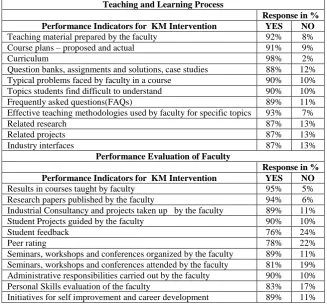
A study with the objective to identify the perceived importance attributed by faculty to IT based KMI in engineering institutions was conducted in the form of a survey. The survey questionnaire consisted of a brief introduction on the purpose of the research specifying the authors’ interest in the participants’ perception of the impact on KM intervention in engineering institutions. The questionnaire was designed to be simple, easy to fill, less time consuming and focused and consisted of the list of identified performance indicators in the functional domains to be evaluated by the faculty for KM intervention.
process and faculty performance evaluation. The results of the study assert the opinion that KM initiatives can play an important role in enhancing the performance and effectiveness of engineering institutions in various functional domains.
Table I : Importance of Performance Indicators in Functional Domains
Teaching and Learning Process
Response in % Performance Indicators for KM Intervention YES NO
Teaching material prepared by the faculty 92% 8%
Course plans – proposed and actual 91% 9%
Curriculum 98% 2%
Question banks, assignments and solutions, case studies 88% 12%
Typical problems faced by faculty in a course 90% 10%
Topics students find difficult to understand 90% 10%
Frequently asked questions(FAQs) 89% 11%
Effective teaching methodologies used by faculty for specific topics 93% 7%
Related research 87% 13%
Related projects 87% 13%
Industry interfaces 87% 13%
Performance Evaluation of Faculty
Response in % Performance Indicators for KM Intervention YES NO
Results in courses taught by faculty 95% 5%
Research papers published by the faculty 94% 6%
Industrial Consultancy and projects taken up by the faculty 89% 11%
Student Projects guided by the faculty 90% 10%
Student feedback 76% 24%
Peer rating 78% 22%
Seminars, workshops and conferences organized by the faculty 89% 11% Seminars, workshops and conferences attended by the faculty 81% 19% Administrative responsibilities carried out by the faculty 90% 10%
Personal Skills evaluation of the faculty 83% 17%
Initiatives for self improvement and career development 89% 11%
In support of the results, the authors proposed a framework and corresponding architecture for IT based KMI in engineering institutions. The implementation of the architecture has been completed for the teaching and learning domain and is in use in test engineering college (TEC), the name of the institution has been masked to hide its identity. A similar implementation is in process for the faculty evaluation domain and implementation can be achieved for all the domains.
IV.
CONCEPTUAL
FRAMEWORK
FOR
IT
BASED
KM
INTERVENTION
IN
ENGINEERING
INSTITUTIONS
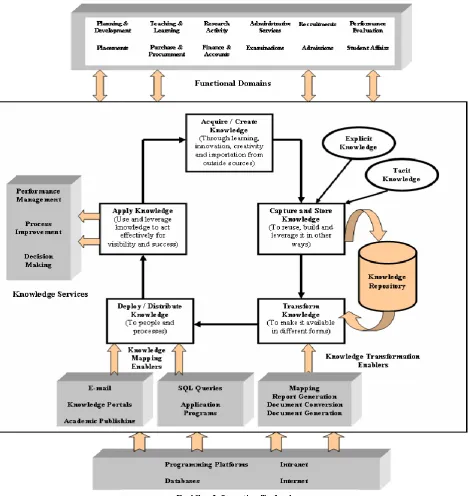
In order to facilitate the sharing and utilization of the knowledge generated in functional domains of engineering institutions in the appropriate forms, a conceptual framework (Fig. 4.1) has been developed to establish an IT based KMI. The framework focuses on the integrated acquisition of knowledge from all aspects of the organization and its deployment in the form as required by the knowledge users. The framework is an integration of the listed activities and the level of integration between the activities determines the performance of the whole system and the quality of services provided to the users.
o Acquisition of knowledge generated in the institution as a result of the interactions between people and processes
o Capture of the institutional knowledge, which includes both explicit and tacit knowledge
o Storage of the knowledge as a central institutional resource to make it available to anyone, anytime
o Transformation of the stored knowledge into appropriate forms required by the users.
o Deployment of the knowledge for use by people and processes.
o Application of knowledge for decision making, process improvement and performance enhancement. The application and use of the knowledge in turn creates new knowledge for acquisition and this iterative process results into a holistic knowledge management system in the institution
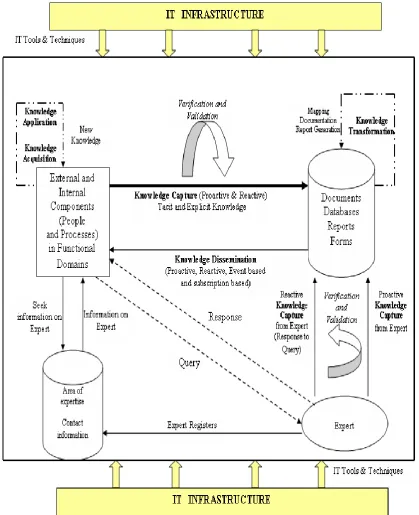
The conceptual framework is implemented into a KM architecture as illustrated in fig. 4.2
combination (codifying explicit knowledge; explicit to explicit knowledge conversion) and internalization (acquiring tacit knowledge in the form of explicit codified knowledge; explicit to tacit knowledge).
Fig. 1 : KM Framework for Engineering Institutions
Fig. 2 : KM Architecture for Engineering Institutions
Knowledge capture contains obtaining the institutional knowledge from both internal and external sources and storing it for appropriate treatment and future use. Deriving the entire knowledge generated in the engineering institutions involves reactive as well as proactive knowledge capture. Reactive knowledge capture refers to obtaining knowledge in response to queries posed by knowledge seekers; request for knowledge from those who possess it and automated capture of knowledge during the course of processes and activities. Proactive knowledge capture refers to obtaining knowledge as a result of contribution of knowledge, both explicit and tacit, by the institutional members who possess the knowledge and proactive contribution of knowledge from experts in various domains. The proactive contribution of knowledge is of more significance in the case of tacit knowledge which is not easily available in documented form
authentication of the source of knowledge; grant of permissions for knowledge update and layered screening for specified contents.
Further, the validated and verified knowledge has to be encoded to a form which can be stored. The encoding of the knowledge into relevant forms can be achieved in the following ways: converting the documents into standard MS Word, pdf or any other format; creating links to the documents; developing application modules posting, transforming and mapping the information; creating databases to store the information contents; creating databases for the contributors of knowledge and linking them to the appropriate content; creating databases of users of knowledge and granting appropriate permissions and creating references to the knowledge contents. Knowledge capture is achieved through the use of automated tools and methods : SQL queries, application programs, e-mails and blogs.
The captured knowledge is stored for transformation and further dissemination to those who require it. Knowledge storage requires a structured storage capability that reflects in a quick search for information [14]. Knowledge storage refers to storing the captured knowledge in properly indexed and interlinked knowledge repositories [16]. This is achieved in the form of a knowledge repository. A knowledge repository is a structured collection of the knowledge generated in an organization. The knowledge repository describes a set of knowledge resources that have been carefully collected, assembled, catalogued, described and stored to be made available for reuse by others. A knowledge repository will contain the knowledge itself and the information on knowledge. The knowledge repository ensures the availability of related knowledge quickly and efficiently at the same place. [5] discussed that storing knowledge in a central repository ensures the maintenance of shared context, ease of access, ease of transfer to and fro from the stakeholders and processes, enhanced validity of knowledge and easy identification of the source of knowledge
According to [9], the primary requirement of the knowledge repository is to prevent the loss of knowledge and enhance accessibility to organizational knowledge in the form of a centralized well structured resource. Knowledge may be created and acquired, but if not organized and structured, the organization will not be able to take action on that knowledge or actualize all of its potential value [12]. This will result into limited use of the institutional knowledge and its impact on the institution. Knowledge has to be structured into a form which can be used directly in the institutional processes and functions to “fit” into the institution’s way of doing things. The form to which knowledge is converted is critical to the ability to use the knowledge.
Knowledge transformation refers to adding more capabilities to the available knowledge by focusing on mapping the existing knowledge to produce new knowledge[16]. It consists of a number of activities : codification of knowledge into various forms facilitated by the conversion of documents into specific file types, conversion of tacit knowledge into documents and storage of explicit as well as tacit knowledge into databases; classification and cataloging of knowledge by “putting the content at the right place”; integration and inter connection of content by linking the knowledge to its context and requirement.; selection of knowledge by assessing the value of the available knowledge and filtering it to obtain knowledge that is most useful; interpretation and analysis of knowledge by means of deriving conclusions from the available knowledge for the purpose of decision making, solving problems and performing tasks and services and packaging and archiving of knowledge by combining the related knowledge into objects for ready access. Various mechanisms such as indexing, filtering, aggregation and association in databases; building file folders; creating links to contents and application programs are applied to achieve knowledge transformation. The transformation phase results into the organization and structuring of knowledge in forms that can be disseminated to the users according to their requirement as the requirements of the various users for the same knowledge content will vary.
The stored knowledge, if not transferred for further use within the organization, leads to wastage of organizational resources [4]. According to [18], knowledge dissemination constitutes the capability to supply the right knowledge to the right people at the right time. It involves retrieval of the knowledge from the knowledge repository and its deployment to the points of use – people, processes, practices, technology, products and services. [1] outline two primary objectives for knowledge dissemination : making it easy for people to find what they are looking for and encouraging the use and reuse of knowledge.
Knowledge distribution can be broadly classified into : proactive distribution, reactive distribution, event based distribution and subscription based distribution. Proactive dissemination of knowledge refers to a “targeted push mechanism” for knowledge distribution where chunks of knowledge are sent to the users periodically based on their job profile and usage history. Reactive distribution of knowledge is the distribution of knowledge in response to user queries. Subscription based dissemination of knowledge refers to the periodic distribution of knowledge to the user as desired and subscribed for. Event based knowledge dissemination is the deployment of knowledge to the user in the event of an action taking place. Event based knowledge deployment can be a proactive deployment or a subscription based deployment. The dissemination of knowledge to the points-of-use is supported by application programs, results of queries on databases, e-mails and postings on blogs.
Knowledge application refers to using the knowledge that has been acquired, captured, stored, transformed and disseminated to produce products and services and perform tasks such as problem solving and decision making. The knowledge is utilized and leveraged to act effectively for viability and success. Knowledge application leads to innovation and creation of new knowledge [2]. The new knowledge that is created is acquired by the people and processes and the phases of knowledge capture, knowledge storage, knowledge transformation, knowledge dissemination and knowledge application follow. Knowledge management intervention in educational institutions is an iterative process that involves the utilization of institutional knowledge effectively to the benefit of the institution and in turn generating new valuable knowledge.
V.
IMPLEMENTATION
model of software development and supported by use of ASP.NET which is built on the Common Language Runtime(CLR), allowing code to be written using any supported .NET language. It permits a true object oriented design for programming pages and controls. The implementation uses Microsoft SQL server to provide data storage. The implementation is running in the Computer Science and Engineering Department of TEC and the users are the faculty and students of the department. It has the following features :
o The system is intranet based; to be extended to the Internet
o User authentication; users being administrator, faculty and students
o Upload facility : All file uploads are converted to pdf format for view
o Query facility : Query is facilitated through e-mail as well as a query page. All responses to queries are posted on the query page as well as posted to the database for retrieval anytime
o Database construction : The database is constructed on the basis of courses, faculty engaging the course and topics in a course. Further, each topic is supported with links to handouts, assignments, question banks, research literature, project work, frequently asked questions(FAQs) etc. Links are provided to access any of these.
VI.
CONCLUSION
There has been indeed a paradigm shift in the engineering education. The new breed of personnel from academia need to be efficient to tackle problems from cross functional, cultural and ethical perspectives and equipped with skills to benchmark for global leadership positions. The authors believe that a holistic KM approach will yield more benefits to increase the quality of knowledge learning. A KM approach will enable institutions to quickly respond to their goals and objectives and in some cases preempt staff, faculty and student needs.
The proposed KM framework can be used as a guide to develop institutional knowledge management models based on the institutional goals and objectives, functional domains and the performance indicators that will impact KM initiatives. With respect to IT, the framework is a significant knowledge enabler. This can be explained in terms of the potential of IT infrastructure in facilitating KM processes by providing a platform for knowledge storage and sharing. Information technology can be successfully used to facilitate knowledge acquisition, capture, transformation, dissemination and application.
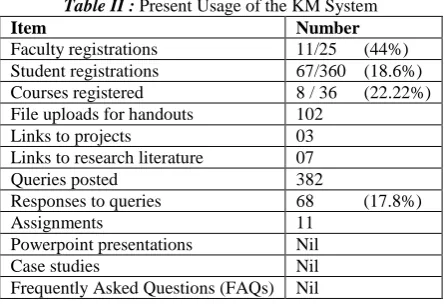
The KM system, under testing, is used by the faculty and students of TEC.
Table II : Present Usage of the KM System
Item Number
Faculty registrations 11/25 (44%) Student registrations 67/360 (18.6%)
Courses registered 8 / 36 (22.22%)
File uploads for handouts 102
Links to projects 03
Links to research literature 07
Queries posted 382
Responses to queries 68 (17.8%)
Assignments 11
Powerpoint presentations Nil
Case studies Nil
Frequently Asked Questions (FAQs) Nil
An important observation from the usage figures is that the % usage of the sysem is not very encouraging. The implication is that the success of IT based KM intervention in engineering colleges is not determined by technology alone. Other factors like human nature and organizational structure also contribute towards successful implementation. These factors were not considered as part of this research and further effort is required to be made to generate the desire and willingness to share knowledge, support KMI through organizational policies and reward systems and ensure commitment at all levels.
REFERENCES
[1]. Apostolou, D., Mentaz, G., 1999, “Managing Corporate Knowledge: A Comparative Analysis of Experiences in Consulting Firms Part I”, John Wiley and Sond Ltd. and Cornwallis Emmanuel Ltd.
[2]. Heisig, P., Mertins, K., Vorbeck J., 2001, “Knowledge Management : Concepts and Best practices in Europe”,
Second edition. ISBN 3-540-00490-4. Springer-Verlog. Berlin Heidelberg. New York, 2001.
[3]. Ismail, A.M., Yang, L.C., 2007, “Implication of Knowledge Management in Higher Learning Institution” , available at http://www. kmtalk.net/KM%20in%20HLI.doc
[4]. Jasimuddin, S.M., 2005, “An Integration of Knowledge Transfer and Knowledge Storage : An Holistic
approach”,GESTS International Transactions of Computer Science and Engineering, Vol. 18, No.1 pp.37-48 [5]. Kevin, C.D., Evaristo, J.B., 2004, “Managing Knowledge in Distributed Projects”, Communications of the ACM,
Vol. 47, No. 4 pp. 87-91
[6]. Kidwell,J.,J., et al., 2000, “Applying Corporate Knowledge Management Practices in Higher Education”,
[7]. Kumar, A., Kumar, A., 2006, “IT Based KM in Indian Higher Education System : Addressing Quality Concerns
and Setting the Priorities Right”,Journal of Knowledge Management Practice, Vol. 7, No. 3, September 2006 Oxford University Press
[8]. Nagad, W., Amin, G., 2006, “Higher Education in Sudan and Knowledge Management Applications”, IEEE 0-7803-9521-2/06, pp. 60-65
[9]. Natali, A.C., Falbo, R.A., “Knowledge Management in Software Engineering Environments”,available at <http:/www.citeseerx.ist.psu.edu/viewdoc/download?doi=10.1.1.86>
[10]. Nonaka, I., 1994, “A Dynamic Theory of Organizational Knowledge Creation”, Organization Science, 5(1), 14-37, Feb. 1994.
[11]. O’Dell, C., Grayson, C.J., 1998, “If Only We Knew What We Know”, Free Press
[12]. O’Leary, D.E., “Technologies for Knowledge Assimilation”, available at
http://www.academic.research.microsoft.com/Publication/6928388/technologies-for-knowledge-assilimation [13]. Omona, W., Weide, T., Lubega, J., 2010, “Using ICT to enhance Knowledge Management in Higher Education : A
Conceptual Framework and research agenda”, International Journal of Education and Development using Information and Communication Technology (IJEDICT), 2010, Vol. 6, Issue 4, pp. 83-101
[14]. Probst, G., et al., 2002, “Managing Knowledge, Building Blocks for Success”, ISBN 0-471-99768-4. Wiley. West Sussex, England
[15]. Ranjan, J., Khalil, S., 2007, “Application of Knowledge Management In Management Education : A Conceptual Framework”, Journal of Theoretical and Applied Information Technology, 207, pp. 15-25
[16]. Rastogi, P. N., 2000, “Knowledge Management and Intellectual Capital - The new virtuous reality of Competitiveness”, Human Systems Management, . 2000.
[17]. Rowley, J., 2000, “Is Higher Education Ready for Knowledge Management”, The International Journal of
Educational Management, Vol. 14, No. 7, pp. 325-333
[18]. Schwartz, D.G., Divitini, M., Brashethvik, T., 2000, “ Internet Based Organizational Memory and Knowledge Management”, Idea Group Publishing, Hershey, PA.
[19]. Sedziuviene, N., Vveinhardt, J., 2009, “The Paradigm of Knowledge Management in Higher Educational Institutions”, Engineering Economics (5), ISSN 1392, pp. 79 - 90
[20]. Smith, L.C., 2001, “Knowledge Discovery, Capture and Creation”, Bulletin of American Society for Information Science”, Vol. 26, No. 2, pp. 11-12
[21]. Sunassee, N.N., Sewry, D.A., 2002, “A Theoretical Framework for Knowledge Management Implementation”, Proceedings of SAICSIT 2002, pp. 235-245
[22]. Teece, D. J. ,1998, “ Research Directions for Knowledge Management”, California Management Review, 40(3),
289-292.