2107
FACTORS AFFECTING ONLINE CONSUMER BEHAVIOR
ON THE LEADING E-MARKETPLACE IN INDONESIA
1SUTJAHYO, 2TOGAR ALAM NAPITUPULU
Information Systems Management Department,
BINUS Graduate Program-Master of Information Systems Management, Bina Nusantara University,
Jakarta Indonesia
1[email protected], 2[email protected]
ABSTRACT
The research objective is to analyze the factors that influence online consumer behavior in e-marketplace in Indonesia and its priorities. Questionnaires were distributed to 384 respondents who were users of one of the top five e-marketplaces in Indonesia. Data were analyzed using Structural Equation Modeling (SEM) and processed using SmartPLS. This research model describes 80.50% of online consumer behavior, where there are several factors, namely seller's reputation, trust in market-maker, perceived ease of use, perceived usefulness, perceived risk, after sales services, customer services, trust in the seller, and product quality. It can be concluded that the seller's reputation factor is a factor that must be prioritized in increasing online consumer behavior.
Keywords: Online Consumer Behavior, E-Marketplace, SEM, SmartPLS, Indonesia
1. INTRODUCTION 1.1 Background
The growth of internet users in Indonesia reaches 51% within a year, which far exceeds the average growth of internet users globally by 10% in 2017, the high growth of internet users is a good potential for the advancement of Indonesia's digital economy, which is marked with an increase in e-commerce businesses and other online businesses, such as Lazada, Blibli, Tokopedia, Bukalapak, Elevenia, Rakuten and others [1], with a growth value of 97-201% [2], even in 2016 Tokopedia claimed the number of visitors reached 10 million and sell around 2 million products every month [3]. The 2017 data states that the top five online consumer goods retailers in Indonesia are occupied by e-marketplaces such as Lazada, Blibli, Tokopedia, Elevenia, and MatahariMall [2].
E-marketplace operates as an intermediary with a combination of internet, IT, services, procedures, and regulations to facilitate exchanges between consumers, the intended customers are sellers and buyers. E-marketplace also has a reputation system to assist buyers in making transaction decisions[4].
Along with the growth of the number of sellers in e-marketplace, especially in C2C e-marketplace, of course, there will be different levels of seller's reputation depending on customer services, after-sales services, and quality of products [5] from each
seller. However, there have been no studies that discuss how a seller's reputation mediates the three factors mentioned above with online consumer behavior in C2C e-marketplace, especially in Indonesia. In addition, this study also examines other factors that can mediate Seller’s Reputation with Online Consumer Behavior based on previous research, namely Trust in Market Maker and Trust in Seller [6] [7] [8][4][9] [10] [11], Perceived Risk [8] [4][12][13] [10], Perceived Ease of Use [6] [7] [14] [15] [10] dan Perceived Usefulness [6] [7] [14] [15] [10].
Online Consumer Behavior is important to discuss because it is directly related to the decision making process of buyers in search, purchase, and repurchase, which is different from traditional consumer behavior, where online consumer behavior is very complex and shaped by many interdependent factors such as environmental factors where online transactions occur [16] [17], characteristics of consumers, product / service, market-maker / medium, merchant / intermediary [17], and other factors that come from various
disciplines such as information systems,
2108 1.2 Research Problem
Based on the background and problems described above, the research problem will be formulated as follows:
1) Do Customer Services, After Sales Services, Product Quality have an influence on Seller's Reputation on C2C e-marketplace in Indonesia?
2) Does the Seller’s Reputation have an influence on Online Consumer Behavior on C2C e-marketplace in Indonesia?
3) How big are the influence of Seller's Reputation factor and other factors on Online Consumer Behavior on C2C e-marketplace in Indonesia?
1.3 Scope of The Research
The scope of this research focuses on, as follows:
1) The population of data collection will be carried out on users of the top five C2C e-marketplaces in Indonesia, namely Lazada, Blibli, Tokopedia, Elevenia, and MatahariMall. 2) This study focuses on Customer Services, After Sales Services, Product Quality factors on Seller's Reputation, then Seller's Reputation, Trust in Market Maker, Trust in Seller, Perceived Risk, Perceived Ease of Use,
Perceived Usefulness towards Online
Consumer Behavior in the top five C2C e-marketplace in Indonesia, Lazada, Blibli, Tokopedia, Elevenia and MatahariMall.
1.4 Research Objectives
The objectives of this research are as follows: 1) Expanding knowledge to the market-maker and
seller on the C2C e-marketplace about what factors influence Online Consumer Behavior on buyers.
2) Providing information that can help the market-maker and seller to increase their value to buyers.
3) Provide an overview and be a reference for future similar research in the future.
2. THEORETICAL FRAMEWORK AND HYPOTHESIS DEVELOPMENT
2.1 E-Marketplace
The marketplace is a location where sellers and buyers meet to conduct a transaction, in a broader sense for the world of economy is a place that supports the activities of sellers and buyers to conduct transactions, then from the strength of
supply and demand will be determined the price and allocation of resources. While the E-Marketplace itself has the same meaning as the marketplace, however, sellers and buyers do not meet face to face directly but through internet media [4]. This research focuses on E-Marketplace.
The focus of this research is e-marketplace which is characterized by online, many-to-many, C2C, and operates as a third party (market maker). E-marketplace like this uses the internet and a combination of various IT service services, procedures and regulations to facilitate meetings and exchanges between consumers, the consumers in question are sellers and buyers.
2.2 Seller’s Reputation
Reputation is the main indicator of trust, therefore trust can be manipulated through the seller's reputation on the basis of user feedback. Feedback mechanisms play a role in forming a trustworthy reputation, sellers who have a good reputation will be considered reluctant to damage their reputation. In other words, the seller's reputation has an influence on the buyer's trust. The seller with a high reputation will be more trusted by the buyer [12].
Reputation is broadly defined as the perception of the seller's past actions and future prospects. The seller's reputation is usually measured by the value of feedback from previous buyers, and from that value will build buyer confidence in the seller. Reputation also has an important role in predicting sales performance of sellers in e-marketplace [19].
In online commerce, the buyer does not directly assess the product and believes in the product description that the seller lists, the reputation of the seller and other information that affects the interest of buyer to pay [20]. Then in his research found that the seller's reputation has a positive influence on the desire or interest of buyers to pay.
Reputation plays a major role in shaping cooperation, and trust, in other studies also found that reputation is determined by concentration, price and above all the quality of products and services [21].
Reputation is considered a measure,
conceptualizing the buyer's perception of the seller's reputation. Where reputation is defined as the extent to which buyers trust sellers as honest and concerned with their customers, so reputation is a valuable asset that requires long-term investment [22].
2109 Fuzzy-AHP framework and distributed to 11 sellers in the three largest e-marketplaces in Indonesia. It was found that the three main factors to improve the seller's reputation were customer services, after sales services, quality of products [5].
2.3 Customer Services
Customer service is a system consisting of several activities to support customers, receive complaints, speed in handling complaints, ease of reporting complaints and hospitality when receiving complaints. Satisfied customers can be determined based on the evaluation of services received from a particular brand [23].
When customer complaints are not handled properly, then customers will start looking for other brands. That happens because the customer service center cannot handle complaints properly according to the customer's wishes, customers don't want to wait too long until they finally lose their satisfaction with certain brands [24].
Previous research states that customer service is very important because with good customer service will improve product quality, foster competitive advantage, grow profitable opportunities and the end result will increase sales and revenue [25].
2.4 Product Quality
Product quality is related to customer satisfaction in the long run where customers will be satisfied when buying a good quality product, so customers will always be interested in buying it. Then in his research also found that the quality of products with customer service and prices affected customer satisfaction [26].
In addition, first, the reputation of a company or individual seller is determined based on the quality of the product produced by the company or individual in the past. Second, reputation is determined collectively based on the quality of the company's products or individuals in a group that sells the same product [27].
2.5 After Sales Services
Customer satisfaction can be influenced by product quality, service quality, after sales service and others. After sales service itself is defined as a function that provides services after sales activities are completed. After sales service is an important factor in forming good relationships with customers. Then in his research also found that after-sales service had a strong influence on customer satisfaction [28].
The main purpose of online sellers is to get good reviews from buyers. Therefore they pay more
attention to product appearance, seller attitude, logistical speed and so on without caring about the after sales service which makes it difficult for customers to get their rights which causes buyers not to buy, this causes the seller to improve product quality and after their sales service. After sales service has also been proven as a way to continuously improve product quality and design [29].
2.6 Trust
Trust is defined as a matter of behavior, a state of mind, consisting of more than one belief, hope or confidence that has consequences on behavior, willingness to depend, which can be seen as a combination of the first two meanings or a combination of two or more elements above [4].
Online trust has become an important precursor factor before the use of e-commerce [14]. Online trust is defined to the extent that buyers believe that their personal and financial information will be safe in the hands of service providers.
Online trust is more about buyers' confidence in sellers, formal control mechanisms, procedures, laws, contracts, infrastructure technology. The success of internet commerce relies heavily on trust, both trust in the seller and trust in the service provider [4].
Trust in e-commerce is defined as a person's willingness to make transactions with other parties, even though the other party can easily do something harmful, besides that trust is also important in influencing someone's behavior where the person can be more proactive when trusting someone or a particular community [30].
2.7 Trust in Market-Maker
Market makers are the key to success of an e-marketplace, market-makers must be able to build trust because internet users are not easy to want to do online transactions with partners they do not know [31].
The main role of a market maker is to build trust between the seller and the buyer and reduce the uncertainty of the transaction. Sellers and buyers need to believe that market makers act honestly, are competent and believe that market makers can benefit them. The dimensions that are most often used for trust in market-makers are competence, virtue, and integrity [32].
2110 the market-maker has prepared and always applies fair rules, procedures, penalties in online transactions, they will trust the seller who will behave according to the rules applied by the market-maker, if not the seller will experience serious consequences such as fines in the form of money, dismissed as a seller, and until legal action [9].
2.8 Trust in Seller
Trust is the most important factor in stimulating purchases through the internet, especially in the early stages of commercial development of an online store. It took a long time to realize that the biggest obstacle to online marketing is the lack of trust of buyers, both trust in the honesty of the seller and the competency of the seller [22].
Trust in the seller reflects the perception of trust in the transaction partner, this type of trust has been found to be the most important factor in purchasing both offline and online. There are three dimensions of trust in C2C e-marketplace, namely reliability, dependability, and honesty. Reliability refers to buyers who believe that the seller will be fully committed, Dependability means the buyer is sure that the seller will help and support when needed with full responsibility, Honesty refers to the buyer's confidence that the seller is open, honest and sincere [4].
2.9 Perceived Risk
Trust is related to risk because both are based on perception, although some levels of risk really need trust, and trust becomes the hope that the seller will not behave fraudulently. Therefore, one consequence of high trust is reducing the risk perception of the seller's fraudulent behavior. Risk perception refers to the buyer's confidence in the possibility of a profit or loss when transacting with a seller [22].
The unfamiliarity between sellers and buyers, as well as the uncertainty of transactions through the internet, leads to the emergence of risks in commerce elements. Perception of risk in C2C e-marketplace is defined as a subjective belief that there is a possibility of suffering losses when making transactions in an e-marketplace. Therefore, the risk is not only for sellers and buyers but also risks associated with the function of the market-maker itself [32].
Risk perception is an important factor influencing consumer behavior, especially in C2C e-marketplaces where sellers have the opportunity to cheat. However, in the process of C2C
e-marketplace transactions are not only influenced by the behavior of sellers but also brokers who run the transaction platform, so that the individual purchase behavior is usually influenced by perceptions of risks associated with sellers and intermediaries [4].
2.10 Perceived Ease of Use, Perceived Usefulness Determinants for measuring computer use. The model he made was perceived usefulness and perceived ease of use affect the attitude toward use which influences behavioral intention and then affects actual usage [33].
Perceived ease of use in an e-marketplace is defined as the extent to which sellers and buyers believe that using an e-marketplace can be done easily. Perceived usefulness in an e-marketplace is defined where buyers and sellers believe that using e-marketplace can improve their performance in conducting online transactions[32].
Perceived usefulness and perceived ease of use are very closely related to trust where trust is very important in B2B, C2C, and B2C transactions. Many studies have found that the preceding factor before e-commerce usage is trust[14].
2.11 Online Consumer Behavior
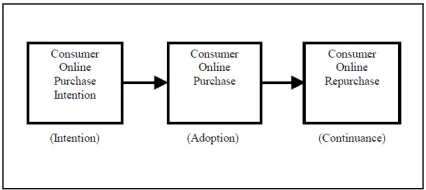
[image:4.612.314.527.441.536.2]There are three stages in online consumer behavior, namely purchase intention, purchase, and repurchase [17] with the model in Figure 2.1.
Figure 2.1 Model Online Consumer Behavior
2.12 Purchase Intention
Factors that influence purchase intention such as attitudes, subjective norms, perceptions of behavioral control. Perceived ease of use and perceived usefulness in TAM models also have an influence on purchase intention. Trusts and perceived risks have been widely studied as important factors in purchase intention [17].
2111 vendor [11].
Purchase intention in e-marketplace can be seen as a complex IT system which does not only consist of hardware and software but is also supported by services, rules, and procedures. Other factors such as trust, perceived risks, WOM quality, perceived service quality and much more also affect purchase intention [32].
2.13 Purchase
Factors affecting purchase have similarities with purchase intention, namely attitudes, subjective norms, perceptions of behavioral control, perceived ease of use, perceived usefulness, trust, and perceived risk. However, it has been further investigated that there are five other categories that influence it, namely demographics, age, gender, income, and education. In addition, trust in brokers for security and privacy also has an influence on purchase [17].
2.14 Repurchase
Repurchase in the online context is defined as the reuse of online channels to buy products from retailers that have been done before [34].
The repurchase is influenced by psychological factors such as satisfaction, confirmation and loyalty incentives. But in some studies trust in sellers and brokers also has an influence on repurchase [17]
In a repurchase situation, the mechanism of an online vendor can reduce the perception of risk from the buyer, for example online customers can suffer losses through theft of credit card data if they transact using public internet infrastructure, but if the transaction uses an independent vendor, the customer will take the risk to make a decision repurchase, through high trust and low-risk perception [11].
2.5 Related Work
Previous research that adopted perceived usefulness and perceived ease of use from the TAM model. Data collection was conducted with a survey conducted on buyers and sellers in the largest e-marketplace in China (Taobao), obtained 110 respondents and 133 sellers. Data analysis with PLS and modeling techniques with SEM techniques. It was found that, first, institution-based trust has an influence on the desires of seller transactions, second, perceived risk has an influence on the desires of transactions both sellers and buyers, thirdly, trust in market-makers have an influence on institution-based trust, fourth, perceived usefulness has affected the desires of
transactions only on buyers while perceived ease of use has an influence on the desires of the transaction only to the seller.[32]
Previous research proposed a trust model for e-commerce, with the aim of research to measure the effect of party trust, control trust on risk perception and exchange behavior on B2B e-marketplace. The model was tested on 82 companies that had conducted transactions in B2B e-marketplace, the data were analyzed using PLS. It was found that party trust negatively affected perceived risk, and control trust positively affected information sharing, perceived risk negatively affected information sharing and information sharing to positively affect transactions. Information sharing functions as a mediator between trusts and transactions [35].
Predecessor factors of purchase intention such as online seller reputation, product category, and surcharge. In his research, he used five experimental designs to obtain seller reputation, product category and surcharge effects on Internet shopping. The author chooses one seller with a small reputation and one seller with a great reputation and then analyzes using ANOVA, it is found that first, a seller with a high reputation can provide a high surcharge to increase the total price to be paid by the buyer; second, a separate price will reduce purchase intention to low-reputable sellers, thirdly, consumers will need longer time to make purchasing decisions when buying goods with sellers with low reputations, fourth, the level of surcharge applied by sellers with low reputation will weaken increasing consumer doubts [12].
In previous studies with the aim of testing the level of e-commerce participation and attitudes of older people in America towards e-commerce. The questionnaire was distributed to the retired community in Pennsylvania, obtained 110 respondents aged 52 to 87. It was obtained by 59% making online purchases in the last six months. Usefulness and trust are found to have a direct positive influence on usage. Ease of use has a significant influence on usefulness and trust has a significant influence on ease of use and usefulness [14].
2112 influence in the repurchase behavior. His research also found PEEIM positively moderated the relationship between customer satisfaction and trust, so that past transaction experience had an influence on trust. PEEIM does not directly affect trust or repurchase intention [11].
In research that aims to analyze several factors that form a trust that influences the desire to transact on a C2C e-commerce website. The suspected factor is structural assurance, familiarity, perceived similarity, perceived reputation, and perceived risk. Data were collected through questionnaires from 109 respondents in the kaskus.com buying and selling forum and the data were analyzed using SEM, it was found that perceived reputation had a positive effect on trusts and trusts having a positive effect on participation [30].
Research that has conducted an investigation of online customer repurchase intention on C2C e-marketplace in Indonesia, the aim of the research is to find out the factors that influence online repurchase intention on customers who use e-commerce platforms. The research model is an extension of the TAM model. Data were obtained from 476 respondents and it was found that e-service quality affected repurchase intention [34].
This research has proposed a model in which social relations facilitation mechanisms and trust development processes when transacting in the online marketplace. When C2C transactions are very risky, social relationships between sellers and buyers become more important for buyers in making transactions. Data were obtained from 104 buyers at TaoBao.com and it was found that it was confirmed that social mechanisms effectively influence the building of trusts and social relationships in the online marketplace by being moderated by risk factors [9].
Research that has integrated trust market-makers and trust sellers in the e-marketplace. Surveys collected from 692 respondents and have been found that market maker characteristics and sellers characteristics have an important role in building buyer trust in market-makers and sellers and trust market-makers positively influence trust in sellers [36].
Previous research has examined the influence and reputation of an online store on trust in store, risk perception and the desire to use the store. Experimental surveys were carried out and obtained from undergraduate and MBA student groups in Australia with participants of 184. Data analysis with CFA with AMOS and found that perceived store size and perceived reputation affect trust
differently depending on the type of store, the effect of perceived store size on trust may be influenced by what items consumers want to buy [22].
The research aims to find the influence of seller trust, intermediary trust, seller risk, and intermediary risk on attitude towards purchasing in C2C e-marketplace. The questionnaire was distributed to 3000 registered users in the eBay.com e-mail newsletter, as many as 450 respondents (15%) responded to the questionnaire. Then the data is analyzed by multiple regression which previously has been tested for validity and reliability. It was found that broadly the influence of seller trust and seller risk on attitude can be categorized strongly, while the effect of intermediary trust and intermediary risk on attitude is lower so there are differences in the concept of perception between intermediary and seller [4].
In the model of one study with the aim to determine the effect of trust in online store and perceived risk on consumer online purchase intention. This study involved 180 internet users who had visited online shopping sites in Indonesia. It was found that trust in the online store had a negative effect on perceived risk, and trust had a positive effect on online purchase intention, then it was found that trust rates for women were greater than men [37].
Previous research which aims to measure how much influence perceived ease of use and usefulness on attitudes toward usability to confirm previous research. Data collection is done using a questionnaire and distributed to consumers who have accessed the internet. Data were analyzed using SEM models, and it was found that perceived usefulness influenced attitudes toward usability more strongly than perceived ease of use and trust [15].
In research with the aim of studying consumer behavior online in e-marketplace, by introducing a framework that integrates findings in previous studies, which where online consumer behavior can be influenced by changes in perception of usefulness, ease of use, trust and shopping enjoyment [6].
In one of the research models carried out with the aim of analyzing how the model of trust formation between sellers and buyers in e-marketplace, this study shows that buyer trust in market-makers positively influences the length of buyer relations with market-makers. For the seller's trust in the market-maker has a positive influence on the reputation of the market-maker [31].
2113 sellers by being moderated by previous customer transaction experience, this study showed that customer trust in market-makers and sellers was moderated by previous transaction experience, in
addition, characteristics of market-makers
(reputation, website's usability, security) and the characteristics of the seller (expertise) have an important role in building buyer trust [38].
3. METHODOLOGY
3.1 Research Model
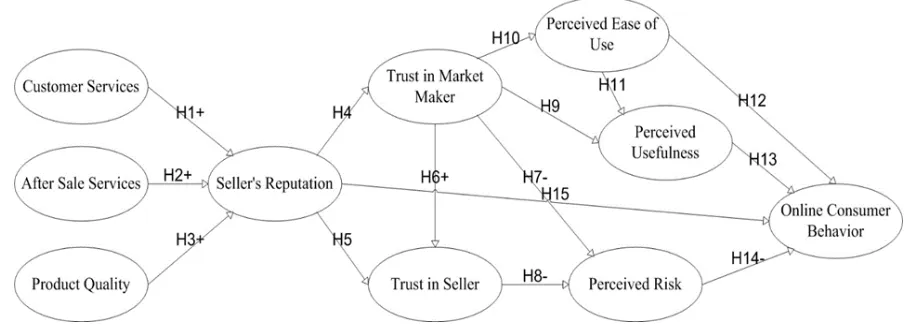
[image:7.612.119.571.237.401.2]Based on the theoretical foundation and previous research in the previous section, the research model can be formed as follows in Figure 3.1:
Figure 3.1 Online Consumer Behavior Model
The research model in Figure 3.1 focuses on purchase intention, purchase and repurchase, these three factors are grouped into online consumer behavior because all three have similar predecessor factors [17].
Perceived risk is an important factor in online transactions because the sellers and buyers do not know which causes sellers to easily cheat, so perceived risk is one of the preceding factors of the online consumer behavior. The main precursor factor of perceived risk is trust, wherein e-marketplace itself there are two types of trust, namely: trust in market maker, the extent to which the buyer is sure of the competency, virtue, and integrity of the market maker; and trust in seller, the extent to which the buyer believes in the reliability, dependability and honesty of the seller. Trust in market maker is also a precursor of a trust in the seller, because when a buyer believes and believes in a particular e-marketplace, the buyer will also trust and believe in the seller in the e-marketplace. Both trusts in market makers and trust in sellers can be manipulated by the seller's reputation because when the sellers who are in a certain e-marketplace
have a good reputation, the buyer can directly trust the e-marketplace, the trust in the seller is also determined by the seller's reputation from the seller himself.
Perceived ease of use as a factor that illustrates the extent to which buyers believe that e-marketplace can be used easily if the buyer has that belief, then there is a possibility the buyer has the intention to find and buy goods in the e-marketplace.
2114 launched by e-marketplace it can be directly believed to be easy to use and useful for buyers.
Seller's reputation is an indicator or main measure of the trust that has been given by other buyers. Therefore, reputation can be a direct factor that influences a person's purchasing decisions. Seller's reputation has three main factors, namely customer services, after-sales services and product quality [4].
3.2Hypotheses
Based on the model of research formed, it can be put forward the following hypothesis:
H1: Customer Services has a significant positive effect on Seller’s Reputation.
H2: After Sales Services has a significant positive effect on Seller's Reputation.
H3: Product Quality has a significant positive effect on Seller's Reputation.
H4: Seller's Reputation has a significant effect on Trust in Market-Maker.
H5: Seller's Reputation has a significant positive effect on Trust in Seller.
H6: Trust in Market-Maker has a significant positive effect on Trust in Seller.
H7: Trust in Market-Maker has a significant negative effect on Perceived Risk.
H8: Trust in Seller has a significant negative effect on Perceived Risk.
H9: Trust in Market-Maker has a significant effect on Perceived Usefulness.
H10: Trust in Market-Maker has a significant effect on the Perceived Ease of Use.
H11: Perceived Ease of Use has a significant effect on Perceived Usefulness.
H12: Perceived Ease of Use has a significant effect on Online Consumer Behavior.
H13: Perceived Usefulness has a significant effect on Online Consumer Behavior.
H14: Perceived Risk has a significant negative effect on Online Consumer Behavior
H15: Seller's Reputation has a significant effect on Online Consumer Behavior.
3.3 Population and Data Collection Technique The population is the object of research as a whole, the population used in this study are C2C marketplace users, especially the top five C2C e-marketplaces in Indonesia namely Lazada, Blibli, Tokopedia, Elevenia, and MatahariMall.
While the sample is part of the population, the calculation of the number of samples in this study using the following formula [39]:
n = = 384
The sampling technique used is probability sampling, which provides equal opportunities for each member of the population to be selected as part of the sample. Based on the above calculations, the number of samples obtained is 384 which already represents the population and also not too large because it uses a safe proportion (p) value that is equal to 0.5. In addition, this number has far exceeded the rule of thumb, which is 10 times the highest number of structural paths that lead to latent variables [40] or 10 times the highest number of indicators in one latent variable [41].
Data collection by distributing questionnaires to consumers or users in one of the top five C2C e-marketplaces in Indonesia, namely Lazada, Blibli,
Tokopedia, Elevenia, and MatahariMall.
Questionnaires will be collected using Google Form, and distributed through the online buying and selling community both forums and social media such as Facebook, besides the questionnaire will also be disseminated through instant messaging such as WhatsApp and Line. Questionnaire questions using a Likert Scale and distributed by random sampling technique. The purpose of collecting data using a questionnaire is to obtain quantitative data from independent variables and dependent variables which will then be analyzed to answer the research questions.
4. RESULT AND DISCUSSION
4.1 Respondent Demographics
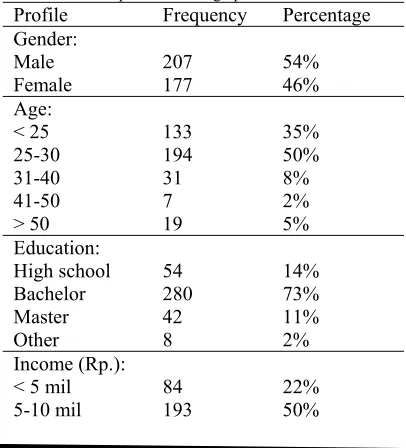
[image:8.612.316.519.520.744.2]Table 4.1 is a demographic of 384 respondents based on questionnaires that have been distributed.
Table 4.1 Respondent Demographics
Profile Frequency Percentage
Gender:
Male 207 54%
Female 177 46%
Age:
< 25 133 35%
25-30 194 50%
31-40 31 8%
41-50 7 2%
> 50 19 5%
Education:
High school 54 14%
Bachelor 280 73%
Master 42 11%
Other 8 2%
Income (Rp.):
< 5 mil 84 22%
2115
10-15 mil 46 12 %
> 15 mil 61 16%
Frequency visit:
Everyday 49 13%
> 3 per week 96 26%
< 3 per week 142 37 %
> 5 per month 21 6%
< 5 per month 76 19%
Brand visit:
Blibli 31 8%
Tokopedia 267 70%
Lazada 32 8 %
Elevenia 23 6%
MatahariMall 31 8%
In Table 4.1, there is no significant difference between the number of male and female respondents.
Based on these data, the highest age group of respondents is the age group of 25 to 30 years. This happens because the age group is a millennial generation, where most of these generations must have been aware of information and internet technology [42].
The majority of respondents have a bachelor degree in education, this can be due to the demand for information technology and the internet [43].
The majority of respondents have income between 5 to 10 million rupiahs as many as 193 people or 50%, this is in line with the education level of a bachelor degree [44].
4.3 Regression Analysis
Table 4.2 Summary Results of Regression Analysis
Origin al Sampl e (O)
Sampl e Mean (M)
Standar d Deviati on (STDE V)
T Statisti cs (|O/ST DEV|)
P Value
s Decisions
AS -> SR 0.382 0.386 0.043 8.893 0.000 H2 supported
CS -> SR 0.257 0.259 0.056 4.594 0.000 H1 supported
PEOU ->
OCB 0.155 0.155 0.053 2.920 0.004 H12 supported
PEOU ->
PU 0.755 0.754 0.035 21.880 0.000 H11 supported
PQ_ ->
SR 0.196 0.193 0.046 4.268 0.000 H3 supported
PR ->
OCB -0.260 -0.258 0.036 7.150 0.000 H14 supported
PU ->
OCB 0.475 0.476 0.047 10.100 0.000 H13 supported
SR ->
OCB 0.132 0.133 0.037 3.575 0.000 H15 supported
SR -> TM 0.653 0.656 0.030 21.820 0.000 H4 supported
SR -> TS 0.491 0.492 0.027 17.920 0.000 H5 supported
TM ->
PEOU 0.669 0.671 0.037 18.150 0.000 H10 supported
TM -> PR -0.298 -0.302 0.056 5.358 0.000 H7 supported
TM -> PU 0.140 0.142 0.041 3.383 0.001 H9 supported
TM -> TS 0.522 0.521 0.028 18.540 0.000 H6 supported
TS -> PR -0.558 -0.553 0.052 10.790 0.000 H8 supported
Based on Table 4.2 and with a significant level of α = 5%, the hypothesis can be explained as follows:
Hypothesis 1
The value of the coefficient parameter from the Customer Services to Seller Reputation is 0.257 with P-value <0.05 (5%), it can be concluded that Customer Services has a significant positive effect on Seller's Reputation.
These findings are in accordance with previous research, where customer service is one of the main factors forming the seller's reputation [5], so the better the seller's service level, the higher the seller's reputation in the eyes of the buyer. With good customer service such as supporting customers, receiving complaints, speed and ease of complaining will make buyers feel satisfied [23] [24] which causes the seller's reputation to be higher in the eyes of the buyer. For e-marketplaces in Indonesia, on average, they already have this customer service feature, buyers can receive service support from sellers through the seller's chat feature and from market-makers through the feature, contact us.
Hypothesis 2
The coefficient parameter value After Sales Services to Seller's Reputation is 0.382 with P-value <0.05 (5%), it can be concluded that After Sales Services has a significant positive effect on Seller's Reputation.
These findings are in accordance with previous research, where after-sales service is one of the main factors forming the seller's reputation [5], so the better the level of after-sales service, the higher the seller's reputation in the eyes of the buyer. Good after-sales service will cause easy buyers to get their rights and will grow a sense of wanting to repurchase [29] to the same seller. e-marketplace in Indonesia also has several after-service features such as return and warranty features when the product received by the buyer is not in accordance with what was promised by the seller.
Hypothesis 3
2116 <0.05 (5%), so it can be concluded that Product Quality has a significant positive effect on Seller's Reputation.
These findings are in accordance with previous research, where product quality is one of the main factors forming the seller's reputation [5], so the better the level of product quality, the higher the seller's reputation in the eyes of the buyer. The seller's reputation in the eyes of the buyer is determined based on the quality of the product he has bought in the past, the seller's reputation can also be determined collectively based on the quality of similar products sold by other sellers [27].
Hypothesis 4
The coefficient parameter value of Seller's Reputation to Trust in Market-Maker is 0.653 with P-value <0.05 (5%), so it can be concluded that Seller's Reputation has a significant effect on Trust in Market-Maker.
These findings are in accordance with previous research, where the higher the reputation of sellers in an e-marketplace, the higher the buyer's trust in an e-marketplace[22] [36].
Hypothesis 5
The coefficient parameter value of Seller 's Reputation to Trust in Seller is 0.491 with P - value <0.05 (5%), so it can be concluded that Seller' s Reputation has a significant positive effect on Trust in Seller.
These findings are in accordance with previous research, where the seller's reputation is higher, the higher the level of trust the buyer will have towards the seller himself [36] [38] [11] because reputation is actually an indicator of trust. [12].
Hypothesis 6
The coefficient parameter value of the Trust in Market-Maker to Trust in Seller is 0.522 with P-value <0.05 (5%), it can be concluded that Trust in Market-Maker has a significant positive effect on Trust in Seller.
These findings are in accordance with previous research, where the higher the trust in e-marketplace, the higher the trust in the seller will be. So when the buyer is accustomed to and believes in using a particular e-marketplace, the buyer will also trust the sellers in the e-marketplace [9] [36] [38].
Hypothesis 7
The coefficient parameter value of the Trust in Market-Maker to Perceived Risk is -0.298 with P-value <0.05 (5%), it can be concluded that Trust in
Market-Maker has a significant negative effect on Perceived Risk.
These findings are in accordance with previous research, where if the buyer already believes in an e-marketplace, the perceived risk of the buyer will be small [31] [14]. In addition, the findings are also in line with the previous model of trust [22] [36] [35] [32][37].
Hypothesis 8
The coefficient parameter value of the Trust in Seller to Perceived Risk is -0.558 with P-value <0.05 (5%), it can be concluded that Trust in Seller has a significant negative effect on Perceived Risk.
These findings are in accordance with previous research, where if the buyer has trusted the seller in an e-marketplace, the perceived risk perception will be small [32] [30]. In addition, the findings are also in line with the previous model of trust [22] [36] [35] [32][37].
Hypothesis 9
The coefficient parameter value of the Trust in Market-Maker to Perceived Usefulness is 0.140 with P-value <0.05 (5%), it can be concluded that Trust in Market-Maker has a significant effect on Perceived Usefulness.
These findings are in accordance with previous research, where when buyers believe in an e-marketplace, the buyer will have a high perception of usefulness in terms of the rules, terms, and features applied by the e-marketplace [32] [14].
Hypothesis 10
The coefficient parameter value of the Trust in Market-Maker to Perceived Ease of Use is 0.669 with P-value <0.05 (5%), it can be concluded that the Trust in Market-Maker has a significant effect on Perceived Ease of Use.
These findings are in accordance with previous research, where when a buyer believes in an e-marketplace, the buyer will have a high perception of ease of use both in terms of the rules, terms, and features applied by the e-marketplace [32] [14]
Hypothesis 11
The coefficient parameter value of Perceived Ease of Use to Perceived Usefulness is 0.755 with P-value <0.05 (5%), it can be concluded that Perceived Ease of Use has a significant effect on Perceived Usefulness.
2117 [14] [18] [32], buyers will also find it useful looking for and buying the items he wants.
Hypothesis 12
The coefficient parameter value of the Perceived Ease of Use to Online Consumer Behavior is 0.155 with P-value <0.05 (5%), it can be concluded that Perceived Ease of Use has a significant effect on Online Consumer Behavior.
These findings are in accordance with previous research, where the perception of ease of use influences online consumer behavior, when buyers feel e-marketplace is easy to use, the buyer will have the intention to purchase, make purchases and repurchases through the e-marketplace [6] [17] [14] [18] [15][32] [34] .
Hypothesis 13
The coefficient parameter value of Perceived Usefulness to Online Consumer Behavior is 0.475 with P-value <0.05 (5%), it can be concluded that Perceived Usefulness has a significant effect on Online Consumer Behavior.
These findings are in accordance with previous research, where the perception of usability affects online consumer behavior, when the buyer feels the e-marketplace is useful for him, then the buyer will have the intention to purchase, make purchases and repurchases through the e-marketplace [6] [17] [14] [18] [15][32] [34].
Hypothesis 14
The coefficient parameter value of Perceived Risk to Online Consumer Behavior is -0.260 with P-value <0.05 (5%), it can be concluded that Perceived Risk has a significant negative effect on Online Consumer Behavior.
These findings are in accordance with previous research, where the higher the risk perception of buyers, the lower the intention to buy, to buy and repurchase through the e-marketplace [22] [36] [31] [4] [9] [35] [32][37] [30].
Hypothesis 15
The coefficient parameter value of the Seller's Reputation to Online Consumer Behavior is 0.132 with P-value <0.05 (5%), so it can be concluded that Seller's Reputation has a significant effect on Online Consumer Behavior.
These findings are consistent with the expectations of researchers with reference to previous research [12], where the seller's reputation in an e-marketplace has a direct influence on purchase intentions, making purchases and repurchases through the e-marketplace, this can
occur because when the buyer does search for goods in an e-marketplace that has a reputable seller, it is likely that buyers will be interested in making transactions in the e-marketplace, basically reputation is a leading indicator of trust, where trust has proven to influence online consumer behavior in many previous studies[22] [6] [36] [14] [31] [38] [4] [9] [35] [15] [32] [11] [30] [34] [37] .
[image:11.612.335.478.225.409.2]4.4 Direct, Indirect dan Total Effect
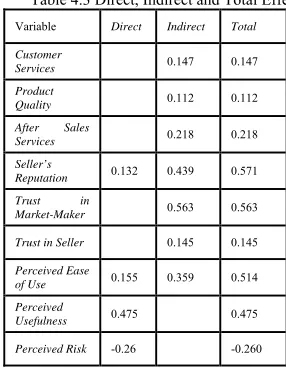
Table 4.3 Direct, Indirect and Total Effect
Variable Direct Indirect Total
Customer
Services 0.147 0.147
Product
Quality 0.112 0.112
After Sales
Services 0.218 0.218
Seller’s
Reputation 0.132 0.439 0.571 Trust in
Market-Maker 0.563 0.563
Trust in Seller 0.145 0.145
Perceived Ease
of Use 0.155 0.359 0.514
Perceived
Usefulness 0.475 0.475
Perceived Risk -0.26 -0.260
Based on direct, indirect and total effect analysis in Table 4.3, it can be concluded that the factor that most influences Online Consumer Behavior in e-marketplace is Seller's Reputation, which is then followed by Trust in Market-Maker, Perceived Ease of Use, Perceived Usefulness, Perceived Risk, After Sales Services, Customer Services, Trust in Seller, and Product Quality.
Seen in Table 4.3, that Seller's Reputation has an indirect effect that is stronger than the direct effect on Online Consumer Behavior, it indicates that Online Consumer Behavior buyers are not directly manipulated by Seller's Reputation itself, but there are other factors that increase the Seller's Reputation value, such as Trust in Market Maker, Trust in Seller, Perceived Risk, Perceived Ease of Use and Perceived Usefulness. This proves that Online Consumer Behavior is a complex variable and is formed by many interdependent factors [16] [17].
4.5 Coefficient of Determination
2118 of the Online Consumer Behavior variable will be shown in Table 4.4 below.
Table 4.4 RSquared Online Consumer Behavior
Based on Table 4.4 above, it can be concluded that the Online Consumer Behavior variable can be explained by Seller's Reputation variable, Trust in Market-Maker, Perceived Ease of Use, Perceived Usefulness, Perceived Risk, After Sales Services, Customer Services, Trust in Seller, and Product Quality is 80.50%, while 19.50% is explained by other variables not examined in this study.
5CONCLUSIONANDRECOMMENDATION
5.1 Conclusion
Based on the results of the research in the previous chapter, it can be concluded as follows: 1. Customer Services, After Sales Services,
Product Quality has an influence on Seller's Reputation on C2C e-marketplace in Indonesia. 2. Seller's Reputation has an influence on Online Consumer Behavior in C2C e-marketplace in Indonesia. In addition, Seller Reputation also has an indirect influence on Online Consumer Behavior, namely through Trust in Market-Maker, Trust in Seller, Perceived Ease of Use, Perceived Usefulness, and Perceived Risk. 3. Priority based on the influence of Seller's
Reputation factors and other factors on Online Consumer Behavior in C2C e-marketplace in Indonesia in the sequence is Seller's Reputation, Trust in Market-Maker, Perceived Ease of Use, Perceived Usefulness, Perceived Risk, After Sales Services, Customer Services, Trust in Seller, and Product Quality. Online Consumer Behavior cannot be formed by independent factors, but there are many interdependent factors that are interrelated in shaping the value of Online Consumer Behavior.
Based on the results of the above conclusions, then several factors that must be considered by the market-maker and seller in e-marketplace in improving the buyer's Online Consumer Behavior are as follows:
The e-marketplace must provide an assessment team that evaluates the sellers, this is done to maintain the reputation value of sellers in the e-marketplace, besides that the e-marketplace can impose sanctions on sellers who obtain a value
below the predetermined value standard
Assessment must include customer services, after-sales services, and product quality.
The e-marketplace must continue to use the buyer orientation in developing their applications, both in terms of rules in transactions and application features, this is done in order to improve the ease and usefulness of e-marketplace for buyers in finding, purchasing and repurchasing.
The e-marketplace must maintain the integrity of the rules and improve the security of their applications, which is useful in reducing the perception of risks and trust of buyers when making transactions. If there is a security breach, then as much as possible the e-marketplace keeps the issue from spreading.
The seller must improve customer service, after-sales service and the quality of their products, this is aimed at keeping buyers from buying repeatedly. Some things that sellers can do to ensure these three things are always active and fast in responding to buyers, ensuring product quality before being sent, and being willing to accept returns and complaints when there are problems in shipping.
5.2 Recommendation
It is hoped that future research can develop factors that influence buyers' Online Consumer Behavior in C2C e-marketplace, especially on factors not discussed in this study, such as gender, age, education, income, culture, region, ethnicity, race and religion factors so that this research model become more comprehensive and deep.
This research focuses on buyers, the next research is expected to be able to form a research model that focuses on online behavior from sellers in C2C e-marketplace.
6LIMITATIOSANDASSUMPTIONS
This research is limited to e-marketplace in Indonesia as the object of research and all respondents are Indonesian. In addition, there are several other factors not discussed in this study such as gender, age, education, income, culture, region, ethnicity, race and religion. So that in this study has the assumption that other factors other than those discussed in this study have no influence on Online Consumer Behavior.
Original Sample (O)
2119 REFERENCES
[1] Faisal Basri, “Pertumbuhan Pengguna
Internet, Indonesia Nomor 1 di Dunia,” Katadata.Co.Id, 2017. [Online]. Available: https://databoks.katadata.co.id/datapublish/ 2017/05/22/pertumbuhan-pengguna-internet-indonesia-nomor-1-di-dunia. [Accessed: 12-Oct-2017].
[2] A. Librianty, “Ini 10 Toko Online Terbaik di Indonesia,” Tekno.Liputan6.Com, 2017.
[Online]. Available:
http://tekno.liputan6.com/read/3068210/ini-10-toko-online-terbaik-di-indonesia. [Accessed: 12-Oct-2017].
[3] A. Katadata, T. Enter, and T. P. Katadata, “INFOGRAFIK : Indonesia, Pusat E-commerce ASEAN,” Katadata.Co.Id, 2017.
[Online]. Available:
http://katadata.co.id/infografik/2016/01/04/i ndonesia-pusat-e-commerce-asean. [Accessed: 12-Oct-2017].
[4] S. Meents, “The influence of sellers and the intermediary on buyers’ trust in C2C electronic marketplaces,” p. 316, 2009. [5] N. K. Fajar and P. I. Sandhyaduhita,
“Supporting factors of sellers’ reputation in e-marketplace: A case of Indonesia,” in 2016 International Conference on Advanced Computer Science and Information Systems, ICACSIS 2016, 2017, pp. 215–220.
[6] K. A. Saeed, Y. Hwang, and M. Y. Yi, “Toward an Integrative Framework for Online Consumer Behavior Research,” J. Organ. End User Comput., vol. 15, no. 4, pp. 1–26, 2003.
[7] K. D. B. Dijkstra, J. Kipping, and N. Mézière, “Sixty new dragonfly and damselfly species from Africa (Odonata),” Odonatologica, vol. 44, no. 4, pp. 447–678, 2015.
[8] D. J. Kim, D. L. Ferrin, and H. R. Rao, “A
trust-based consumer decision-making
model in electronic commerce: The role of trust, perceived risk, and their antecedents,” Decis. Support Syst., vol. 44, no. 2, pp. 544–564, 2008.
[9] C. X. J. Ou, W. P. Wong, and R. M. Davison, “Beyond institution-based trust: Building effective online marketplaces with
social mechanisms,” ICIS 2010 Proc., pp. 1–10, 2010.
[10] S. Cummins, J. W. Peltier, J. A.
Schibrowsky, and A. Nill, “Consumer behavior in the online context,” J. Res. Interact. Mark., vol. 8, no. 3, pp. 169–202, 2014.
[11] Y. Fang, I. Qureshi, H. Sun, P. McCole, E. Ramsey, and K. H. Lim, “Trust, Satisfaction, and Online Repurchase Intention: The Moderating Role of Perceived Effectiveness of E-Commerce Institutional Mechanisms,” MIS Q., vol. 38, no. 2, pp. 407–427, 2014.
[12] M. Pan, C. Kuo, C. Pan, and W. Tu, “Antecedent of purchase intention: online seller reputation, product category, and surcharge,” Internet Res., vol. 23, no. 4, pp. 507–522, 2013.
[13] J. Kim and S. J. Lennon, “Effects of reputation and website quality on online consumers’ emotion, perceived risk and purchase intention,” J. Res. Interact. Mark., vol. 7, no. 1, pp. 33–56, 2013.
[14] D. W. McCloskey, “The Importance of Ease of Use, Usefulness, and Trust to
Online Consumers,” J. Organ. End User
Comput., vol. 18, no. 3, pp. 47–65, 2006. [15] Renny, S. Guritno, and H. Siringoringo,
“Perceived Usefulness, Ease of Use, and
Attitude Towards Online Shopping
Usefulness Towards Online Airlines Ticket Purchase,” Procedia - Soc. Behav. Sci., vol. 81, pp. 212–216, 2013.
[16] S. Standaert, Willem; Muylle, “The Use of Procedural Fairness in Electronic Reverse Auctions to Enhance Relationship Quality,” Psychol. Mark., vol. 33, no. 4, pp. 283–296, 2016.
[17] G. Chan, C. Cheung, T. Kwong, M.
Limayem, and L. Zhu, “Online consumer behavior: a review and agenda for future
research,” 16th Bled eCommerce Conf.
eTransformation Bled, Slov. June 9 - 11, 2003, no. Fishbein 1967, pp. 194–218, 2003.
2120 Liang, “Are all signals equal? Investigating the differential effects of online signals on the sales performance of e-marketplace sellers,” Inf. Technol. People, vol. 28, no. 3, pp. 699–723, 2015.
[20] M. I. Melnik and J. Alm, “Seller
Reputation, Information Signals, and Prices for Heterogeneous Coins on eBay.,” South. Econ. J., vol. 72, no. 2, pp. 305–328, 2005. [21] A. Fedele and P. Tedeschi, “Reputation and
competition in a hidden action model,” PLoS One, vol. 9, no. 10, pp. 1–12, 2014.
[22] S. L. Jarvenpaa and N. Tractinsky,
“Consumer trust in an Internet store: A cross cultural validation,” J. Comput. Mediat. Commun., vol. 5, no. 2, pp. 1–5, 1999.
[23] H. A. R. Hanif, Muzammil. and Sehrish, “Factors Affecting Customer Satisfaction,” Int. Resour. J. Financ. Econ., vol. 60, no. 60, pp. 44–52, 2010.
[24] J. H. Ahn, S. P. Han, and Y. S. Lee,
“Customer churn analysis: Churn
determinants and mediation effects of partial defection in the Korean mobile telecommunications service industry,” Telecomm. Policy, vol. 30, no. 10–11, pp. 552–568, 2006.
[25] K. Jahanshahi, A. A., Gashti, M. A. H., Mirdamadi, S. A., Nawaser, “Study of the effects of customer service and product quality on customer satisfaction and loyalty,” no. March 2016, 2011.
[26] P. Suchánek, J. Richter, and M. Králová, “Customer Satisfaction, Product Quality and Performance of Companies,” Rev. Econ. Perspect., vol. 14, no. 4, pp. 329– 344, 2015.
[27] S. Landon and C. E. Smith, “Quality expectations, reputation, and price,” South. Econ. J., pp. 628–647, 1998.
[28] S. Sharma, V. Sharma, M. A. Khan, and R. K. Srivastava, “Employing the Modified Cab (Cognition, Affect, Behaviour ) Model To Assess and Analyze the Customer Satisfaction Level : a Comparative Study of Two,” vol. 09, no. 02, pp. 265–292, 2016. [29] T. Shen, Q. Dai, R. Wang, and Q. Gou,
“The Impact of Online Additional Reviews on Consumer’s Purchase Process,” Int. J. Inf. Syst. Soc. Chang., vol. 6, no. 1, pp. 24–
40, 2015.
[30] W. Windarsyah, H. Hendrik, and T.
Dirgahayu, “Analisis Pengaruh
Faktor-Faktor Pembangun Trust Terhadap
Partisipasi Pengguna Pada C2C E-Commerce Studi Kasus: Forum Jual Beli Kaskus,” J. Teknoin, vol. 19, no. 1, 2016.
[31] M.-S. Kim and J. H. Ahn, “Comparison of
trust sources of an online market-maker in the e-marketplace: Buyer’s and seller’s perspectives,” J. Comput. Inf. Syst., vol. 47, no. 1, p. 84, 2006.
[32] K. Wei, Y. Zha, and H. Sun, “A
Comparative Study of Buyers’ and Sellers’ Transaction Intentions In
Consumer-to-Consumer E-Marketplaces,” PACIS 2014
Proc., no. Paper 103, 2014.
[33] F. Davis, R. Bagozzi, and W. W., “User acceptance of computer technology: A comparison of two theoretical models,” Manage. Sci., vol. 35, no. 8, pp. 982–1003, 1989.
[34] A. Rahmayanti and H. Wandebori, “The Effects of E-service Quality on Customer Online Repurchase Intention Towards E-commerce Marketplace C2C in Indonesia,” vol. 2016, pp. 35–40, 2016.
[35] Y.-W. Shih, “Influence of Transaction Trust in B2B e-Marketplaces: An Investigation of Tan and Thoen’s Views,” Int. J. Innov. Manag. Technol., vol. 4, no. 4, pp. 397–405, 2013.
[36] M.-S. Kim and J.-H. Ahn, “A model for buyer’s trust in the e-marketplace,” Proc. 7th Int. Conf. Electron. Commer. - ICEC ’05, no. August 2005, p. 195, 2005.
[37] R. Anwar and W. Adidarma, “Pengaruh Kepercayaan dan Risiko Pada Minat Beli
Belanja Online,” J. Manaj. Dan Bisnis
Sriwij., vol. 14, no. 2, pp. 155–168, 2016.
[38] M. S. Kim and J. H. Ahn, “Management of
trust in the e-marketplace: The role of the buyer’s experience in building trust,” J. Inf. Technol., vol. 22, no. 2, pp. 119–132, 2007. [39] S. Lemeshow, D. W. Hosmer Jr, J. Klar,
and S. K. Lwanga, “Sample Size in Health Study,” World Heal. Organ., 1997.
2121 [41] D. Gefen, D. Straub, and M.-C. Boudreau,
“Structural equation modeling and
regression: Guidelines for research
practice,” Commun. Assoc. Inf. Syst., vol. 4, no. 1, p. 7, 2000.
[42] A. Lenhart, K. Purcell, A. Smith, and K. Zickuhr, “Social Media & Mobile Internet Use among Teens and Young Adults. Millennials.,” Pew internet Am. life Proj., 2010.
[43] N. D. Parkhurst, T. Morris, E. Tahy, and K. Mossberger, “The digital reality: e-government and access to technology and internet for American Indian and Alaska Native populations,” in Proceedings of the 16th Annual International Conference on Digital Government Research, 2015, pp. 217–229.
[44] Badan Pusat Statistik, “Rata-rata Upah/Gaji
Bersih Sebulan (rupiah)
Buruh/Karyawan/Pegawai Menurut
Pendidikan Tertinggi yang Ditamatkan dan
Jenis Pekerjaan Utama, 2017,”
www.bps.go.id, 2018. [Online]. Available: https://www.bps.go.id/statictable/2018/03/1 3/1991/rata-rata-upah-gaji-bersih-sebulan- buruh-karyawan-pegawai-menurut- pendidikan-tertinggi-yang-ditamatkan-dan-jenis-pekerjaan-utama-2017.html.