foundation is happens through the employed structural system. It is not sufficient to understand the transfer of structural load on sub soil, there also roll of depth at which the footing is resting on soil. The periphery of the structure has an important part in case of lateral loading due to wind and earthquake. Flexibility and rigidity of structure plays an important part in response of suture in earthquake and is depend on the system of structure and the depth of structure below ground. The property and profile of periphery of structure below have an impact over the response of structure.
In this paper the research and work done pertaining to the participation of the various parameters of the part of structure below ground tried to present.
key words: basement depth of foundation soil surrounding structure
I.INTRODUCTION
In this new era the structures made up in various fashions as to full fill the new upcoming requirements. Also there is the added factor of urge of making different from others and older ones. The demands of matching esthetic with its pattern of use is in demand. The growth of population of the world is increasing day by day pressuring the architects and developers to optimize the use of land. It compels the developers and architect for development below the ground level. The most probable use of the part below ground is parking, godawns etc. In high rise buildings the floor story below ground for parking purpose for residents above is most common accommodation in high rise building. Additionally in big cities to avoid wastage of construction cost of rods by road side parking may avoided by parking lots. Again providing the parking lots at ground level consume land. The parking lots must located near by the markets and business centers as to approach them easily after parking. It again draws in consumption of costly land . To avoid this the multistoried parking structures are in trend. To optimize the consumption of land the combination of structure below and above the ground is preferred. The structure having partially buried under ground or may say with basement may called as semi-buried structures. Before designing the semi buried structures it is must to understand the effect of semi-buried part over the whole structure. There much of the research work done over this area of analysis. Here we are trying to understand the essential to know the effect of this buried part over the analysis of structure with respect to previous research work.
II.LITERATUREREVIEW
Chao Maa. B , Dechun Lua,, Xiuli Dua,, Chengzi Qib., “Dynamic Behaviour Of Structures With Embedded Foundations”[1] A study of the dynamics of building-soil interaction is presented that includes embedding of the foundation and material damping. The two models generated for study one did not consider embedment of the foundation beneath the surface of the ground resting on the surface of a flexible soil, modeled by a homogeneous, isotropic, elastic half-space. The energy losses from internal friction in the soil, factors which may affect significantly the stiffness and damping derived from the soil may not considered as no interaction with soil.
Fig. 1 Model of building-foundation system
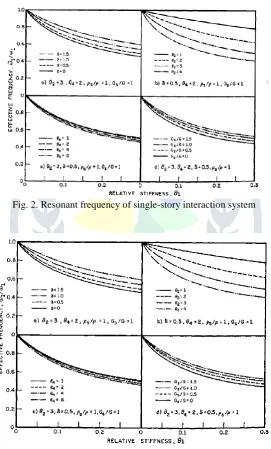
Fig. 2. Resonant frequency of single-story interaction system
Fig. 3. Resonant frequency of single-story interaction system
base level gives economical design. Also in case the basement beams and columns were buried in the peripheral basement wall so as to provide sufficient stiffness, had little effect on the base level of the studied soil–structure system.
Fig.4. Base level in a building with basement
Fig.5. Base level below the basement wall openings
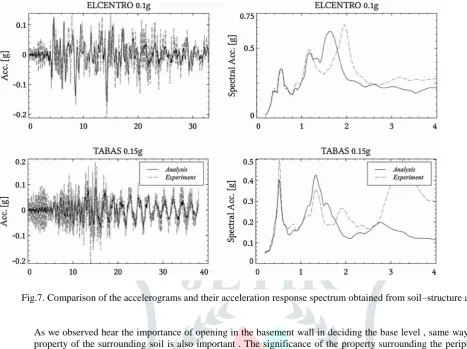
Fig.7. Comparison of the accelerograms and their acceleration response spectrum obtained from soil–structure analysis
As we observed hear the importance of opening in the basement wall in deciding the base level , same way the property of the surrounding soil is also important . The significance of the property surrounding the periphery wall explained in next paper.
Mohammad Sadegh Barkhordari , Mohsen Tehranizadeh “The Effect of Soil around the Basement Walls on the Base Level of Braced Framed Tube System”[3] For the building with basement it is better to consider the base level in the story level which is most close to the ground level. To confirm the base level at near the ground level the soil surrounding the structure must be dense, well compacted, so as to formulate the transformation of the seismic force to the building take place throughout the height of basement wall. According to ASCE the soil surrounding the structure should not have liquefaction property in the maximum possible earthquake. In this study aims at deriving the effect of change of soil property surrounding the structure.
For this five models of 20, 25, 30, 35, 40 stories with beams and columns of basement are buried in perimeter walls along with the soil around the structure. The peripheral basement wall modelled using the fibre and to define the beam column that is biaxial elements the Kent-Scott-Park concrete is to form concrete and steel is modelled with uniaxial Giuffre-Menegotto-Pinto steel material [8,9].
The soil is modelled direct method out of a) Direct method and b) Sub-structure method . The Pressure Independ Multi Yield material has been used to model the soil. This material has linear-elastic volumetric stress-strain response independent of deviatoric response.
Fig.8. Comparison of accelerograph obtained from analysis and testing of soil-structure interaction and their acceleration response spectrum
Fig.9. Diagram of the relative displacement between soil and buried section of the 20-storey structure
Fig.11. Diagram of shear changes of stories of the 20-storey structure
The other diagrams for 25, 35 and 40 storied building are given in the paper. After studying this diagrams it may concluded that the change in properties of the surrounding soil does not affect the location of the base level. the rigidity of basement walls buried inside the frame has an influence on the relative displacement between soil and structure. The presence of basement wall have more effect than the surrounding soil. The absence of basement wall shows increase in the relative displacement, drift and shear.
III.CONCLUSION
The study of above papers shows the significance of depth of foundation, effect of basement wall, opening in basement wall and property of soil surrounding the structure. They may be summarized as,
1. The depth of the foundation that is the depth of embedment of the structure in ground affects the seismic response. The more the depth of embedment higher the natural frequency and damping.
2. In case of structure with basement, the seamless embedment of sear walls in peripheral basement walls imparts the stiffness to the structure.
3. The location of base level is influenced by basement periphery wall, it always located at top of periphery wall if there is no opening in wall.
4. For opening in the periphery wall, up to 37% opening there will not any effect on base level but as it increase up to 50%, the base level moves down by one story.
5. The property of the soil surrounding the basement wall have no effect on base level.
REFERENCES
1. Chao Maa, b, Dechun Lua,, Xiuli Dua,, Chengzi Qib., 1975 . Dynamic Behaviour of Structures With Embedded Foundations. Earthquake engineering and structural dynamics, vol. 3, 259-274
2. Mohsen Tehranizadeh1 Mohammad Sadegh Barkhordari., Effect of peripheral wall openings in basement and number of basement floors on the base level of braced framed tube systhroughem. InternationalJournal of Civil Engineering https://doi.org/10.1007/s40999-017-0270-z
3. Mohammad Sadegh Barkhordari , Mohsen Tehranizadeh 2018 . The Effect of Soil around the Basement Walls on the Base Level of Braced Framed Tube System” Civil Engineering Journal, Vol. 4, No. 9,
September, www.CivileJournal.org
4. Y. 0. Beredugo and M. Novak, 1972. Coupled horizontal and rocking vibration of embedded footings’, Canadian Ceotechnical J. 9, 477-497.
5. M. Novak, 1974. Effect of soil on structural response to wind and earthquake. Znt. J. Earthq. Engng. Struct. Dynam., 3,79-96
6. J. M. Roesset, R. V. Whitman and R. Dobry, 1973, Modal analysis for structures with foundation interaction , J.
Srrucr. Div., ASCE, 99, 399-416.