1. Introduction
Along with the increasingly dynamic and uncertain business development, the Company is required to always maintain and improve the quality of products including service to customers to survive in the competition. Fulfillment of customer expectations is an important aspect of strengthening industrial competitiveness. Referred to Zairi on [1] Fulfillment of customer expectations does not only about fulfilling product specifications but also whether the product is marketable. This means, another important to increase sales profit to fulfill customer needs. What's more, the paradigm of we knew best what the customer wants, changes to let's hear the voice of the customer.
Corresponding author
E-mail address: [email protected] DOI: 10.22105/jarie.2019.192932.1095
Increase Service Selling of Formaldehyde Products By
Implementing Quality Function Deployment (QFD)
Ganjar Sidik Gandara, Riko Muri, Humiras Hardi Purba
Department of Industrial Engineering, Mercu Buana University, Jakarta, Indonesia.
A B S T R A C T P A P E R I N F O
The purpose of this research is to make the right design in improving the service of selling formaldehyde products in the Chemical Industry according to customer requirements by implementing Quality Function Deployment. Complying on customer satisfaction is important in the competitive global market, which can be realized by innovation and quality fulfillment. Innovation and quality are not only about fulfilling product specifications, but also whether the product is marketable. Furthermore, as the show of average sales formaldehyde product in the last 3 years is 71.6% of a target whereas the formaldehyde market share is very large. It is important to develop sales services of products to meet customer needs. Quality Function Deployment (QFD) is a tool that can translate the customer needs to obtain a technical response in complying with the customer’s satisfaction. Method of this research uses customer satisfaction survey form, the data was collected through a field survey with questionnaires. The market survey generates 9 critical points of the services in selling products. House of quality (HOQ) was developed and analyzed to describe the relationship between customer expectations and technical responses. The overall analysis suggests three priorities of technical responses of a design concept to take into account in the service development. Priority as an action plan is additional hunting line for customer - Marketing and Sales (23%), provide schedule regular meeting with customer - include related department (15%), and shipment schedule to increase On-Time Delivery (OTD) from 80% to 95% through collaborating with external transportation company (14%). Finally, Quality Function Deployment (QFD) is implementing for increasing sales formaldehyde products through customer satisfaction.
Chronicle: Received: 06 May 2019 Revised: 16 August 2019
Accepted:19 September 2019
Keywords:
Quality Function Deployment. Formaldehyde.
Customer Satisfaction.
Journal of Applied Research on Industrial
Engineering
This research was conducted at Chemical Industry which produced formaldehyde products. The market share of this product is very large due to many industries use it. Formaldehyde solution is used as a raw material in a broad range of industries and applications including molded articles, high-pressure laminates, adhesives for plywood, particleboard and other types of wood panels, coatings, varnishes and enamels, foundry core and shell binders, glass and mineral wool insulation and fertilizers. Technically, formaldehyde (HS code: 2912.11.00.00) is a colorless solution with a very sharp odor. Formaldehyde product contains about 37% formaldehyde in water as a solvent. Usually in formaldehyde have additional ingredients, namely methanol up to 15% as preservatives. Directorate General of Domestic Trade at the Ministry of Trade Republic Indonesia, Ardiansyah Parman, said that formaldehyde imports had been arranged according to Decree of the Minister of Industry and Trade Number: 254/MPP/Kep./7/2000 dated July 4, 2000, concerning Import Trading and Circulation of Certain Hazardous Materials through appointment as Registered Importer (IT-B2) and Recognition as Producer Importer (IP-B2) from the General Director of Foreign Trade. Imports of formaldehyde product have been only carried out by 2 IP-B2 and 1 IT-B2 so that import formalin is very limited in Indonesia due to the importer has determined. The production capacity of formaldehyde products in Indonesia, said Ardiansyah, reaches 800,000 tons per year, but its utilization is only around 40% or around 350,000 tons per year [2], this shows the market share of formaldehyde product in the domestic market is very large.
It can be said, there is no product development in the formaldehyde industry due to Formaldehyde solution is a common product’s commonly marketed with concentrations 37%-42%, thus the development of services is more likely to increase sales of products. To increase sales of formaldehyde products at PT. X where the research was conducted, the QFD was chosen due to the main focus of QFD is to involve customers in product development as early as possible. The underlying philosophy is that customers will not be satisfied with a product even though a product that is produced is perfect. QFD is a methodology used by companies to anticipate and prioritize the needs and desires of consumers, and combine the needs and desires of consumers in the products and services provided to consumers. Based on the customer satisfaction survey, there is still a gap between customer needs and the given valuation, including a customer assessment of competitors. For this reason, the Company needs to make efforts to increase the fulfillment of customer expectations through the analysis of the results of customer satisfaction with the QFD (Quality Function Deployment) method. The need for the implementation QFD is also based on achievement sales of formaldehyde products at PT.X in the last 3 years, the average is 71.6% of target, as follows:
Fig. 1. Sales Qty formaldehyde product (Period 2016 – 2018). 79.74%
59.85%
75.22%
2016 2017 2018
2. Literature Review
The following are some definitions of QFD which include. QFD is a methodology for translating consumer needs and desires into a product design that has certain technical requirements and quality characteristics, referred to Akao on [3]. QFD is a structured methodology used in the planning and product development process to determine the specifications of the needs and desires of consumers and systematically evaluate the capabilities of a product or service in fulfillment of the needs and desires of consumers [3]. According to Oakland on [3], QFD is a system for designing a product or service based on customer demand, by involving the participation of functions contained in a particular organization. QFD can also be interpreted as the distribution of functions related to product development and service with quality that meets customer satisfaction, referred to Revelle et al. on [3]. By definition, QFD is the practice of designing a process in response to customer needs. QFD translates what the customer needs into what is produced by the organization. QFD enables organizations to prioritize customer needs, find innovative responses to those needs and improve processes to achieve maximum effectiveness. QFD is also a practice toward improving processes that can enable organizations to exceed customer expectations [3]. QFD has been proving to be a powerful tool that can be used for translating the voice of customers into technical languages [4]. To lead an increased awareness of a complex multiple-customer concept, traceability of the improvement strategies in a more structured way and the formation of a new process organization can use the application of QFD [5].
3. Research Methods
The study was conducted through the Customer Satisfaction Survey that is sent to all customers. The type of questionnaire used consists of closed questions and open questions. The closed question questionnaire consists of 6 questions by scoring degrees of importance, company service satisfaction, and satisfaction of service competitors. The open question questionnaire identifies customer needs that are not covered in closed questionnaires.
A closed questionnaire, consisting of 6 questions, as follows:
Delivered goods in a proper package (drum/tank).
The delivered product is by following specifications.
On-time delivery.
Handling customer complaints in fast response.
Easy to contact the sales department.
After-sales/satisfying service.
Open questionnaires identified 3 other customer needs, as follow:
Competitive prices.
Amount of shipment according to order.
Low acid content.
each technical requirement for service improvement based on planned customer satisfaction ratings and existing customer satisfaction ratings. Next step, analyze and select priority items for the technical or House of Quality (HOQ) matrix that was created. The first matrix of the QFD process usually takes VOC by scientifically rating the importance of these wants, needs, and desires and technical links. Each way is defined by sizes and metrics for measuring success [5]. Base on Mahesh on [6] The main planning tool used in QFD is House of Quality. House of Quality translates the voice of customers into design requirements that meet certain target values and adjust them to organizations or companies that will design the design requirements.
To improve sales services, customer needs must be considered, also the applicable regulatory standards and requirements related to formaldehyde products must be identified by Management. The evaluation will be done by comparing the results with the main competitor’s results, with the identified characteristics using competitive technical evaluation. It is used to compare new products with competitors’ products. It is to find if technical requirements are better or worse than competitors. The results of all the items that have been analyzed can help in identifying the important product requirements and assisting trade-off decisions to make a process [7].
4. Results and Discussion
Quality Function Deployment (QFD) can explain the needs and interests of the consumers (WHATs) as well as how to fulfill them both (HOWs). HOQ can describe the relationship between consumer desires and the company's internal technical factors and evaluate the company's ability to competitors in terms of fulfillment of customer satisfaction [6].
The focus of QFD is to involve customers in the product development process as early as possible, such as needs and desires. The application of the QFD methodology in the process of designing products/services begins with the formation of a product/service planning matrix, called house of quality [3]. To identify consumer needs that connect between technical characteristics of the product QFD is used. The focus of the problem faced by the company is the technical characteristics of products that have the highest value shows that these technical characteristics are, while the attributes of consumer needs that have the highest value are things that should be fixed to address existing problems [6].
The essence of QFD is a large matrix that will connect what the customer needs (What) and how the product/service will be designed and produced to meet customer expectations [8]. Meanwhile, Rajesh on [9]. Adapted implementation of QFD to services in supplier selection based on AHP QFD methodology. QFD was generated and the product specifications were obtained to meet the requirement [1]. QFD is a method of continuous product improvement with concern to impact on organizational learning on innovation. This method is one of the improvement tools that help companies to achieve their high quality, especially on new product development. To achieve the goal of the new products, they must be observed and developed for reflecting the companies’ culture and management’s vision [10].
is to find out what consumers want from consumers. HOQ serves as a good match between the customer requirements and the engineering variables. The house of quality (HOQ) method involves collecting and analyzing customer needs for a product or service, customers’ perceptions on the relative importance of these needs and the producing company’s relative performance in relation to its main competitors [11].
QFD is described as a tool to translate VOC to technical language. It has eight steps. The first step is identifying of VOC. identify consumer desires for service of formaldehyde products by using Customer Survey Satisfaction as follow:
Delivered goods in a proper package (drum/tank).
The delivered product is by following specifications.
On-time delivery.
Handling customer complaints in fast response.
Easy to contact the sales department.
After-Sales/Satisfying service.
Competitive prices.
Amount of shipment according to order.
Low acid content.
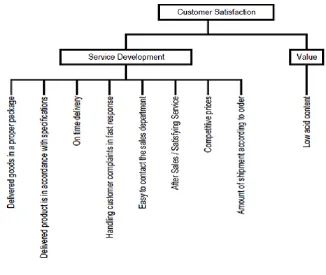
In the second step, make a tree diagram to describe the issue from the first step. The result can be seen in Fig. 2.
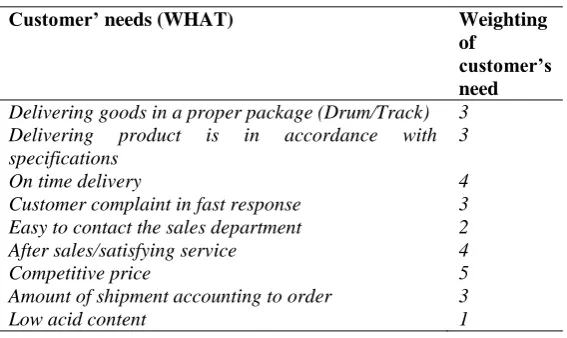
The third step, decide on weight customer needs. It is to know the level of importance of customer needs. The weighting process is decided by team members. The scale of weighting is 1-5 with 5 as the highest priority. The result is in Table 1.
Table 1. Customer’s Needs (WHAT’s) & Weighting
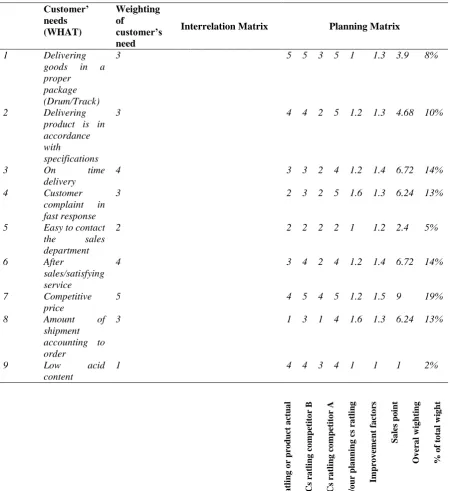
Fourth step, competitive benchmark with data customer survey satisfaction, the result is to see the position of product at the company. By using a scale of 1-5, the researchers brainstorm the identification score for each item in the planning matrix. Based on percentage of total weight, it is decided that the priority from VOC is competitive price, on-time delivery, and after-sales/satisfying service with range score of 14-19. The second priority is customer complaint in fast response, amount of shipment according to order, delivered product is in accordance with specifications with range score of 10-13. Then, the third priority is delivered goods in a proper package, easy to contact the Sales Department and low acid content with a range of scores 2-8. The result is in Table 2.
For the planning matrix calculation, the company service of selling product positions must first set with competitors. With a 1-5 rating scale, based on the brainstorming method, obtained a scores for our company & competitor. Furthermore, with the same method, namely brainstorming, a company plan is determined to outperform the competitor set with a certain score.
The term QFD is a popular tool used for new products/services. The calculation of QFD using improvement factor. It is calculated as follows:
Improve Factor = {(Planned CS Rating – Existing CS Rating)0,2}+1 (1)
CS is Customer Satisfaction. Value 0.2 and 1 are constants from the formula of the improvement factor. To calculate the number of improvement factors of competitive price, see the number of our planning CS rating with number 5 then reduced by CS our product rating of 4 then multiplied by 0.2 the result of the calculation is then added to the number 1. The result of the calculation is 1.5. This calculation also applies to the calculation of other items from the specified customer needs. Detail of calculation method shown at the below:
Improvement factor = ((5 – 4) × 0.2) + 1 = 1.2
Customer’ needs (WHAT) Weighting
of
customer’s need
Delivering goods in a proper package (Drum/Track) 3
Delivering product is in accordance with
specifications
3
On time delivery 4
Customer complaint in fast response 3
Easy to contact the sales department 2
After sales/satisfying service 4
Competitive price 5
Amount of shipment accounting to order 3
Then, strategic marketing or sales point factor is placed in the planning matrix. Several sales point about 1 to 1,5 is used to emphasize on the customers’ needs. It estimates the marketing importance of the need to promote the new product. It is used along with improvement factors and customer importance in the calculation for overall weighting of the customers’ needs. The calculation of overall
weighting is based on the improvement factors, customer importance, and sales point. The equation is as follows:
Overall weighting = customer importance*improvement factor*sales point. (2)
The weighting of customer importance from competitive price, the researchers have to follow the row of competitive price and stop in column customer importance. Score 5 will be obtained. It is the same with the improvement factor and sales point. The researchers need to follow the same procedure in column improvement factor and sales point. Then, score 1.2 and 1.5 will be found. In calculating overall weighting from competitive price, the result will be as follows:
Overall Weighting = 5 × 1.2 × 1.5 = 9
After that, it converts the overall weighting to percentage. And understand how much of the design or improvement that should be done in each of the customers’ needs [12].
% of total weighting = (Overall Weighting/Sum of Overall Weighting)*100% (3)
Total Overall Weighting is summary overall weighting for all items of customer needs, follow the row and stop in column overall weighting. For example, competitive price score of 9 is obtained.
To calculate of % of total weight can be seen as follows:
% of Total Weight of rapid freezing time = ((9/ 3.9+4.68+6.72+ 6.24+2.4+6.72+9+6.24+1)) ×100 = 19
Table 2. Competitive benchmark.
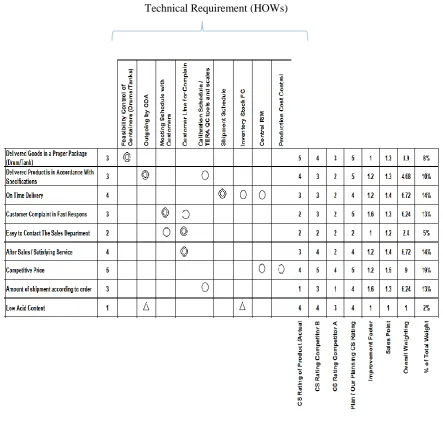
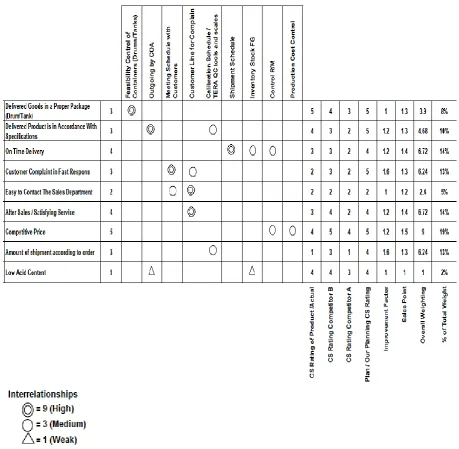
The fifth step, technical requirements (HOW) is to determine the technical aspect of service/product specification to meet customers’ needs. In this step, the team and researchers identify some technical requirements to achieve customers’ needs. There is Feasibility Control of Containers (Drums/Tanks), Outgoing by COA, Meeting Schedule with Customers, Customer Line for Complain, Calibration Schedule / TERA QC tools and scales, Shipment Schedule, Inventory Stock FG, Control R/M and Production Cost Control. The result of the technical requirement (HOW) applied to the HOQ is in Fig. 3. Customer’ needs (WHAT) Weighting of customer’s need
Interrelation Matrix Planning Matrix
1 Delivering
goods in a
proper package (Drum/Track)
3 5 5 3 5 1 1.3 3.9 8%
2 Delivering
product is in accordance with
specifications
3 4 4 2 5 1.2 1.3 4.68 10%
3 On time
delivery
4 3 3 2 4 1.2 1.4 6.72 14%
4 Customer
complaint in
fast response
3 2 3 2 5 1.6 1.3 6.24 13%
5 Easy to contact
the sales
department
2 2 2 2 2 1 1.2 2.4 5%
6 After
sales/satisfying service
4 3 4 2 4 1.2 1.4 6.72 14%
7 Competitive
price
5 4 5 4 5 1.2 1.5 9 19%
8 Amount of
shipment accounting to order
3 1 3 1 4 1.6 1.3 6.24 13%
9 Low acid
content
1 4 4 3 4 1 1 1 2%
Technical Requirement (HOWs)
Fig. 3. Technical requirement (How).
Fig. 4. Interrelationship matrix.
The seventh step, Identify current performance and set new target reach customer requirements. Example of technical requirement Feasibility Control of Containers (Drums/Tanks), score of our product is 5, competitor A is 6, competitor B is 7 and the researcher decided design target is 8. For other examples technical requirements, Meeting Schedules with Customers, the score of our product is NO due to in current condition service of our product do not have the scheduled meeting with the customers and the researcher decided to target is YES for schedule meetings with the customer.
Fig. 3 shows how to determine priority technical requirements. In QFD, the researchers can multiply each interrelationship rating of the technical requirement. There is a weak relationships with score 1, medium relationship with score 3, or high relationship with score 9 from the interrelationship matrix with overall weighting and sum the column. For the percentage of total priority, the researchers can divide individual technical priorities value by sum of all technical priorities value, and multiply it by 100.
Example (1) to calculate Technical Priorities for Feasibility Control of Containers (Drum/Tank), just need to see column airflow type. There is 1 strong relationship (score 9). After that, the value of strong relationship (9) is multiplied by the overall weighting of the customer needs row Delivered Goods in a Proper Package (Drum/Tank) switch a score (3.9) will get a technical priority value of 35.1. This calculation method applies equally to other technical priorities, namely Outgoing by COA, Meeting Schedule with Customers, Customer Line for Complaint, Calibration Schedule / TERA QC tools and scales, Shipment Schedule, Inventory Stock FG, Control R/M and Production Cost Control.
Technical Priorities of Feasibility Control of Containers = (Interrelationship between Feasibility Control of Containers with Feasibility Control of Containers multiply with Delivered Goods in a Proper Package).
Technical Priorities of Feasibility Control of Containers = (9×3.9) = 35.1
To calculate the equation of percentage total priorities as follow:
% of Total Priorities Feasibility Control of Containers = (Technical Priorities Feasibility Control of Containers / Sum Score of Technical Priorities) × 100
%Total Priorities Feasibility Control of Containers =
((35.1/(35.1+43.12+63.36+100.8+32.76+60.48+21.16+47.16+27)) x 100 = 8%
The complete HOQ increase sales service of formaldehyde product shows at Fig. 5.
Fig. 5. The complete HOQ of sales service formaldehyde product.
5. Conclusions
for customer-Marketing and Sales (23%), provide schedule regular meeting with customer-include related department (15%), and shipment schedule to increase On-Time Delivery (OTD) from 80% to 95% through collaborating with external transportation company (14%). Improvements for the Company are sales service by improving communication and increase on-time delivery, it is expected to assist companies in the development of quality service of products following the needs of customers. With the improving of sales services and customer satisfaction will have an impact to the number of incoming orders so that it will increase sales of formaldehyde products which of course has an impact on corporate profits?
5.1. Research Limitation
The research findings are limited to several customers that send back the questionnaire and perception of people who filled it, where it can affect the studied variables in this research and causing some changes in results.
5.2. Future Studies
Implementing QFD by clustering various groups of customers based on application formaldehyde solution have a set of different needs. Under these conditions, we may cluster customers and perform a separate HOQ for every group of customers.
To identified QFD effect in improving the level of satisfaction of the customer, the level of satisfaction of customers one may measure the level of customer satisfaction before and after implementing QFD also to verify the number of sales formaldehyde product
References
[1] Kosasih, W., Soenandi, I. A., & Celsia, E. (2013). Aplikasi QFD untuk pengembangan produk wafer (Studi Kasus: PT Indo Sari Abadi). Teknik dan ilmu komputer, 2(7).
[2] Suwandi, J. (2006). Penyalahgunaan formalin, media industri. Retrieved 20 September, 2019 from https://kemenperin.go.id/download/36. (In Indonesia)
[3] Hadi, H. A., Purba, H. H., Indarto, K. S., Simarmata, R. G. P., Putra, G. P., Ghazali, D., & Aisyah, S. (2017). The implementation of quality function deployment (QFD) in Tire industry. ComTech: computer, mathematics and engineering applications, 8(4), 223-228.
[4] Sivasamy, K., Arumugam, C., Devadasan, S. R., Murugesh, R., & Thilak, V. M. M. (2016). Advanced models of quality function deployment: a literature review. Quality & quantity, 50(3), 1399-1414. [5] Gremyr, I., & Raharjo, H. (2013). Quality function deployment in healthcare: a literature review and case
study. International journal of health care quality assurance, 26(2), 135-146.
[6] Ardani, F., Ginting, R., & Ishak, A. (2014). Design of spring bed product design using quality function deployment method. Jurnal teknik industri USU, 5(1). (In Indonesia)
[7] Krstić, J. (2014). Using possibility of QFD method for development of the" ready-to-go" package. Acta graphica: znanstveni časopis za tiskarstvo i grafičke komunikacije, 25(1-2), 37-46.
[8] Asadabadi, M. (2014). A hybrid QFD-based approach in addressing supplier selection problem in product improvement process. International journal of industrial engineering computations, 5(4), 543-560. [9] Rizlan, W., Purba, H. H., & Sudiyono, S. (2018). Performance maintenance analysis using qfd method: a
case study in Fabrication Company in Indonesia. ComTech: computer, mathematics and engineering applications, 9(1), 25-35.
[10] Darmawan, H., Purba, H., Rezeki, R., Hidayat, N., Siregar, A., Retna, F., & Aisyah, A. (2017). Product development strategy with quality function deployment approach: A case study in automotive battery. Management science letters, 7(12), 601-610.
[11] Rahman, Z., & Qureshi, M. N. (2008). Developing new services using fuzzy QFD: a LIFENET case study. International journal of health care quality assurance, 21(7), 638-658.