2019 | VOLUME 15 |233 © ARCHIVES OF BUDO | SCIENCE OF MARTIAL ARTS
Post-exercise changes in the selected features of
feet structure in capoeira adepts with advanced
training experience
Ewa Puszczałowska-Lizis
1ABCD, Jarosław Omorczyk
2ABCDE, Tadeusz Ambroży
2ABCD1
University of Rzeszów, Medical College, Institute of Health Sciences, Rzeszów, Poland
2
University of Physical Education in Kraków, Faculty of Physical Education and Sport, Institute of Sport, Kraków, Poland
Received:
03 September 2019;
Accepted:
16 September 2019;
Published online:
23 September 2019
AoBID:
12945
Abstract
Background and Study Aim: Practicing capoeira requires improving movement, defense and attack techniques (kicks, transitions, dodge, takedowns) as well as develops agility, coordination, praxis and co-contraction. Due to the specificity of the training process, it can be assumed that physical exercises used in the training of athletes are a factor strongly modeling their feet, which are the distal part of the musculoskeletal system. The aim of this research was the post-exercise changes in the values defining selected features of foot structure in capoeira adepts advanced in training experience.
Material and Methods: We examined 30 capoeira adepts with advanced training experience, aged 20-25 years, attending “UNICAR” Capoeira Academy in Rzeszów. The study relied on the CQ-ST podoscope for pertinent measurements. The following foot features and indices were measured: foot length and width, Clarke’s angle, heel angle (γ), hal-lux valgus angle (α), and the V toe varus deformity angle (β). The data were analyzed based on the Student t test and Wilcoxon test.
Results: There was a statistically significant increase in the value of foot width (p = 0.000) and Clarke’s angle of the right (p = 0.001) and left (p = 0.000) foot under the influence of 1.5 hours of training, as well as an increase in the values of the heel angle (γ) of the left foot (p = 0.000), hallux valgus (α) of the left foot (p = 0.028) and varus angle of the Vth toe (β) of the left foot (p = 0.000).
Conclusions: Mechanical stimuli used during capoeira training improve the longitudinal arch of the foot. After 1.5 hour train-ing the feet widen, the transverse arch of the left foot decreases, as well as the increase in hallux valgus and the Vth toe deformity of the left foot in adepts with advanced training experience. This indicates the need for skillful dosing of exercises and combat elements excessively straining the forefoot in order to minimize per-manent, adverse changes within the anterior support zone.
Key words: combat sports • foot morphology • martial arts • performance • technique • training load
Copyright: © 2019, the Authors. Published by Archives of Budo
Conflict of interest: Authors have declared that no competing interest exists
Ethical approval: The research was approved by the local Bioethics Review Committee
Provenance & peer review: Not commissioned; externally peer-reviewed
Source of support: This publication is supported under the “Regional Initiative of Excellence” programme established by the Polish Ministry of Science and Higher Education, for the yrs 2019-2022 (project no 022/RID/2018/19)
Author’s address: Ewa Puszczałowska-Lizis, University of Rzeszów, Rejtana 16c Av., 35-959 Rzeszów, Poland; e-mail: ewalizis@ poczta.onet.pl
Authors’ Contribution: A Study Design
B Data Collection
C Statistical Analysis
D Manuscript Preparation
INTRODUCTION
The efficiency of the feet depends on their con-struction and, above all, on the correct shape of the longitudinal and transverse arches. From a biomechanical point of view, the foot acts as a lever during rebound and absorbs the rotation of individual segments of the lower limb during the load phase. Its arching acts as a shock absorber, protecting the human body against micro-injuries during movement [1-3].
Topics related to the feet construction were dis-cussed in various scientific reports. The negative impact of type and work seniority on the condi-tion of these parts of the locomotor system was often noted. Data indicate that foot deformities increase with age and cause disturbances within other parts of the kinematic chain [4, 5]. On the other hand, issues related to the shape of the feet of people practicing various sports do not find enough reports. Few scientific papers pres-ent the problems of feet capacity in relation to training experience in a rather vague way [6-12]. Analysis of the literature related to the discussed subject shows that most authors focused only on assessing the shape of the longitudinal arch of the foot. In addition, it should be emphasized that the research results obtained in different popula-tions are often incomparable due to the authors’ use of different measuring methods and tech-niques. An interesting issue is the post-workout changes in foot building in athletes, although this topic was discussed sporadically. For this reason, every scientific report on changes in the shape of the foot and its fitness after exercise can enrich the knowledge of this topic and provide a valu-able tip for trainers informing how to dose train-ing loads to avoid overloadtrain-ing the feet in people practicing combat sports.
Practicing capoeira – which is a martial art derived from the ritual dances of African tribes and the Brazilian tradition – requires mastering the basics of movement (ginga – to swing in Portuguese) and the techniques of defense and attack, as well as proper fitness preparation and well-developed coordination, praxis and co-contraction. Therefore, strength, speed, flexibility exercises with acro-batics, sensorimotor and coordination elements are used in training. It is important to learn and improve capoeira techniques, in particular kicks, transitions, dodges and undercuts. Systematic training allows to master the adaptation of the body to the requirements of the environment and the use of upper and lower limbs in combat [13].
Due to the specificity of the training process, it can be assumed that physical exercises used in the training of athletes are a factor strongly modeling this part of the musculoskeletal system. The aim of this research was the post-exercise changes in the values defining selected features of foot structure in capoeira adepts advanced in training experience.
MATERIAL AND METHODS
Participants
The study covered 30 capoeira adepts with advanced training experience, aged 20-25 years, attending “UNICAR” Capoeira Academy in Rzeszów.
The selected group was subsequently verified in terms of its compliance with pertinent inclusion and exclusion criteria:
• inclusion criteria: lack of any diseases and/or injuries of the musculoskeletal system; feet with no previous surgical interventions, including lower limbs; no genetically-dependent hallux valgus, as confirmed through an interview; age range of 20-25 years, minimum 10-year training experience and systematic attendance at classes, twice a week, dominating right hand and right lower limb deter-mined on the basis of the Waterloo Handedness and Footedness Questionnaire – Revised [14].
• exclusion criteria: undertaking activities in other sports sections; refusal to participate in the trial.
The examinations were conducted before and after 1.5 hours long physical training session. The train-ing took place in the morntrain-ing, in the gym, under the guidance of qualified instructors. The athletes practiced in Abady trousers and T-shirts, barefoot. The training unit consisted of a 15-minute intro-ductory part (greeting, presentation of the topic and purpose of the classes, mental preparation of the participants to participate in the training, warm-up), then the main part lasting 1 hour (improvement of defense and attack techniques such as kicks, transitions, dodges, work on speed and strength, improvement of acrobatic figures in the position on the head, on the arms and in the air, exercises of combat movement, the use of known techniques in confrontation with other adepts, so-called sparring), the 15-minute final part (stretching exercises in the lying and sitting positions), falls, loosening exercises (massage, breathing exercises in the supine posi-tion), summary of classes, good bye.
Capoeira – noun a martial art and dance form, originally from Brazil, that is used to promote physical fitness and grace of movement [22].
Kinematics – noun the scientific study of motion [22].
Technique– noun a way of performing an action [22].
Fitness – noun the fact of being strong and healthy [22].
Training load – “A simple mathematical model of training load can be defined as the product of qualitative and quantitative factor. This reasoning may became unclear whenever the quantitative factor is called ‘workload volume’ or ‘training volume’ interchangeably with ‘volume of physical activity’. Various units have been adopted as measures i.e. the number of repetitions, kilometres, tons, kilocalories, etc. as well as various units of time (seconds, minutes, hours) (…) As in the real world nothing happens beyond the time, the basic procedure of improvement of workload measurement should logically start with separation of the time factor from the set of phenomena so far classified together as ‘workload volume’. (…) Due to the fact that the heart rate (HR) is commonly accepted as the universal measure of workload intensity, the product of effort duration and HR seems to be the general indicator of training load defined as the amount of workload. It is useful in analyses with a high level of generality. (…) In current research and training practice the product of effort duration and HR was referred to as conventional units’ or further calculations have been made to convert it into points.” [23, p. 238].
Flexibility – noun 1. the amount or extent to which something can be bent 2. the extent to which something can change or respond to a variety of conditions or situations flexibility training [22].
Speed training – noun training that uses exercises designed to improve reaction times [22].
Strength – noun the fact of being strong [22].
Strength training – noun
Examination protocol
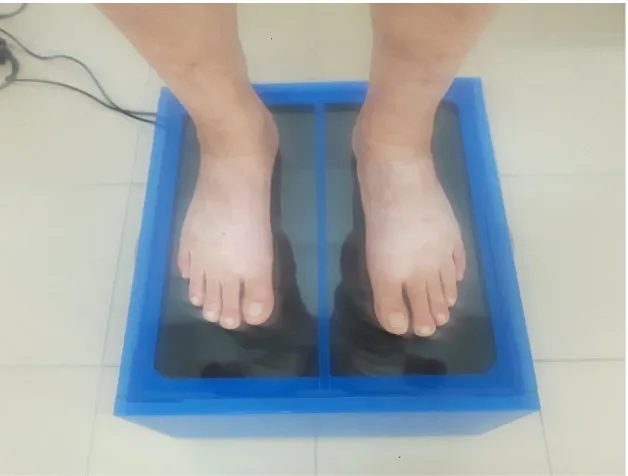
The CQ-ST podoscope (manufactured by Electronic System) was applied as the research tool of choice.
The study protocol entailed the measuring of the plantar feet surfaces in a relaxed stance, with the upper limbs hanging down freely along the body. Both feet were subjected to an assessment simul-taneously. The width and foot angle were natural, unforced (Figure 1).
The calculations comprised the following foot features and indices:
Foot features:
• foot length [cm] – the line connecting the most distal point of the forefoot (on the pad of the lon-gest toe) with the farthest point within the hindfoot;
• foot width [cm] – the line connecting the most medially located point on the head of the first metatarsal bone (metatarsale tibiale, mtt) with the point located most laterally on the head of the Vth metatarsal bone (metatarsale fibulare, mtf).
Foot indices:
• Clarke’s angle [°] – is calculated by drawing a tangent to the medial edge of the foot and the line joining the point of the largest recess of the footprint with the mtt point;
• heel angle γ [°] – is comprised between the tangents to the medial and lateral edge of the foot which cross over the heel;
• hallux valgus angle (α) [°] – the angle between the tangent line to the medial edge of the foot and the tangent to the pad of the big toe, derived from the mtt point;
• the angle of the varus deformity of the fifth toe (β) [°] – the angle between the tangent line to the lateral edge of the foot and the tangent to the pad of the fifth toe, derived from the mtf point.
Additionally, anthropometric measurements of the body mass and height were taken. The body mass was measured with electronic scales, deter-mined to the nearest 0.1 kg. The body height was measured to the nearest 0.1 cm using a Martin-type anthropometer. The obtained data were used to calculate BMI index.
In order to ensure overall integrity of the research process, all tests were carried out using the same measuring instrument operated by the authors. Men wore their gym uniforms, and were bare-footed. All study protocol procedures were pursued in full compliance with the Helsinki Declaration. All participants received detailed information regard-ing the study aims and attendant methods to be applied. The study was approved and endorsed by the Bioethics Review Committee.
Competition training – noun athletic training that specifically prepares the athlete for the competition situation [22].
Competitive adjective
1. involving competition 2. tending to want to do something better than others or achieve more than others [22].
Performance – noun the level at which a player or athlete is carrying out their activity, either in relation to others or in relation to personal goals or standards [22].
Statistical analysis
Based on the data collected, the descriptive statistical calculations were made: arithmeti-cal mean value; standard deviation (SD or ±); maximum value; minimum value. Consistency of pertinent variables with reference values in normal distribution was verified by means of the Shapiro-Wilk test. In order to evalu-ate post-exercise changes in the selected fea-tures of feet structure we used the Student’s t test for dependent samples or alternatively, the Wilcoxon test. The results were consid-ered statistically significant, if the probability level of the test was lower than the predeter-mined significance level of p<0.05. The Stat Soft STATISTICA application (version 13.1) was used to process all test results.
RESULTS
Table 1 presents the characteristics of selected bodily features of the examined capoeira adepts.
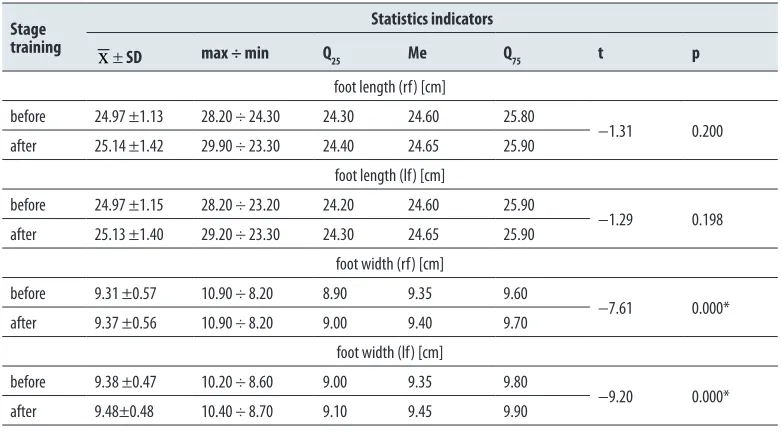
No statistically significant differences in the values of the right and left foot lengths recorded before and after training. Statistically significant differ-ences occurred in the case of right (p = 0.000) and left (p = 0.000) foot width (Table 2).
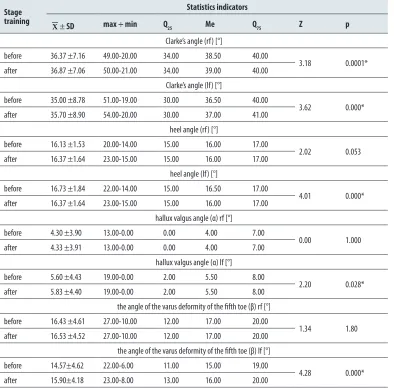
A mean Clarke’s angles reached lower values compared to the lower limit of the norm pro-posed by Lizis [15] , the mean heel angle (γ) and valgus angle (α) corresponded to physiological norms for adults [16], while the mean varus angle of the V toe (β) were above the upper limit of the norm, for which the variation range from 0º to 9º was assumed [16]. There was a statistically
Stage training
Statistics indicators
x
± SD max ÷ min Q25 Me Q75 t pfoot length (rf) [cm]
before 24.97 ±1.13 28.20 ÷ 24.30 24.30 24.60 25.80
−1.31 0.200
after 25.14 ±1.42 29.90 ÷ 23.30 24.40 24.65 25.90
foot length (lf) [cm]
before 24.97 ±1.15 28.20 ÷ 23.20 24.20 24.60 25.90
−1.29 0.198
after 25.13 ±1.40 29.20 ÷ 23.30 24.30 24.65 25.90
foot width (rf) [cm]
before 9.31 ±0.57 10.90 ÷ 8.20 8.90 9.35 9.60
−7.61 0.000*
after 9.37 ±0.56 10.90 ÷ 8.20 9.00 9.40 9.70
foot width (lf) [cm]
before 9.38 ±0.47 10.20 ÷ 8.60 9.00 9.35 9.80
−9.20 0.000*
after 9.48±0.48 10.40 ÷ 8.70 9.10 9.45 9.90
Table 2. Comparison of foot length and width in capoeira adepts before and after 1.5 hour training.
rf right foot; lf left foot;
x
arithmetical mean value; SD (±) standard deviation; max maximum value; min minimum value; Q25 lower quartile; Me median; Q75 upper quartile; t value of the Student t test; p probability value; *p<0.05Feature Statistics indicators
x
± SD max ÷ min Q25 Me Q75Body weight [kg] 76.93 ±10.62 99.00 ÷ 65.00 69.00 73.00 84.00
Body height [cm] 174.65 ±7.95 196.00 ÷ 160.00 169.00 173.00 178.00
BMI [kg/m2] 25.07 ±2.48 31.25 ÷ 20.07 23.57 24.53 26.88
Table 1. Somatic features of the study subjects.
x
arithmetical mean value; SD (±) standard deviation; max maximum value; min minimum value; Q25 lower quartile;significant increase in the value of Clarke’s angle of the right (p = 0.001) and left (p = 0.000) foot under the influence of 1.5 hours of training, as well as an increase in the values of the heel angle (γ) of the left foot (p = 0.000), hallux valgus (α) of the left foot (p = 0.028) and varus angle of the Vth toe (β) of the left foot: p = 0.000 (Table 3).
DISCUSSION
Few studies on the impact of sports and martial arts on foot formation show that they can have different effects on foot structure. According to Nowak [17], wrestling sport models a massive foot with a widened forefoot. In turn, Zvonar et
al. [18] analyzed the shape of the longitudinal arch and the effect of the type of exercise ground on the distribution of foot pressure forces in 16 men aged from 18 to 40 years of which 8 regu-larly perform karate on solid floorboards, and 8 karatekas who exercise on tatami. The authors found differences in the formation of longitudi-nal and transverse arches of the feet in competi-tors qualified for both groups. These results led to the thought that these are premises indicating a positive impact of activity on hard surfaces on the correct position of the foot.
Our research found statistically significant dif-ferences in Clarke’s angle values before and after training, which indicates that 1.5-hour effort in the
rf right foot; lf left foot;
x
arithmetical mean value; SD (±) standard deviation; max maximum value; min minimum value; Q25lower quartile; Me median; Q75 upper quartile; Z value of the Wilcoxon test; p probability value; *p<0.05Stage training
Statistics indicators
x
± SD max ÷ min Q25 Me Q75 Z pClarke’s angle (rf) [°]
before 36.37 ±7.16 49.00-20.00 34.00 38.50 40.00
3.18 0.0001*
after 36.87 ±7.06 50.00-21.00 34.00 39.00 40.00
Clarke’s angle (lf) [°]
before 35.00 ±8.78 51.00-19.00 30.00 36.50 40.00
3.62 0.000*
after 35.70 ±8.90 54.00-20.00 30.00 37.00 41.00
heel angle (rf) [°]
before 16.13 ±1.53 20.00-14.00 15.00 16.00 17.00
2.02 0.053
after 16.37 ±1.64 23.00-15.00 15.00 16.00 17.00
heel angle (lf) [°]
before 16.73 ±1.84 22.00-14.00 15.00 16.50 17.00
4.01 0.000*
after 16.37 ±1.64 23.00-15.00 15.00 16.00 17.00
hallux valgus angle (α) rf [°]
before 4.30 ±3.90 13.00-0.00 0.00 4.00 7.00
0.00 1.000
after 4.33 ±3.91 13.00-0.00 0.00 4.00 7.00
hallux valgus angle (α) lf [°]
before 5.60 ±4.43 19.00-0.00 2.00 5.50 8.00
2.20 0.028*
after 5.83 ±4.40 19.00-0.00 2.00 5.50 8.00
the angle of the varus deformity of the fifth toe (β) rf [°]
before 16.43 ±4.61 27.00-10.00 12.00 17.00 20.00
1.34 1.80
after 16.53 ±4.52 27.00-10.00 12.00 17.00 20.00
the angle of the varus deformity of the fifth toe (β) lf [°]
before 14.57±4.62 22.00-6.00 11.00 15.00 19.00
4.28 0.000*
after 15.90±4.18 23.00-8.00 13.00 16.00 20.00
studied capoeira adepts has a positive effect on the longitudinal arch of the foot. This tendency may be due to strong active stabilizers of the longitudinal arch of the foot and suggest a beneficial effect of mechanical stimuli stimulating the muscles and the capsule-ligament system of athletes’ feet. However, it is worth emphasizing that mean Clarke’s angles both before and after training reached values lower than the lower limit normal for adults, for which the variation range from 40 º to 51º [15] was assumed. Demczuk-Włodarczyk and Bieć [19] based on the research of a group of 28 students with an average age of 21 stated that the training typical of mar-tial arts does not interfere with the architecture of the longitudinal arch, however, it changes the distri-bution of compressive forces in the forefoot. They recognized that these athletes’ feet were suscepti-ble to transverse arches and anterior support zone disorders. According to the authors, greater pres-sures under the heads of the IVth and Vth meta-tarsal bones and on the plantar side of the IVth and Vth toes indicate a tendency to formation of Vth toe valgus deformity.
Similarly, our results showed the impact of capoeira training on the worsening of the transverse arch of the left foot, which was measured by the heel angle. Our research data also showed a statisti-cally significant increase in the valgus angle of hal-lux (α) and the varus angle of the Vth toe (β) of the left foot after 1.5 hour training. It should be noted that the mean values of the β angle significantly exceeded the upper limit of the norm, which may be due to the increased load on the lateral side of the foot due to the specific work of the lower limbs in the training process. It is worth emphasiz-ing here that for clarity of results, right-handed and right-footed athletes were selected for the tests. Research by Sterkowicz et al. [20] and Sogabe et al. [21] on adult men and women practicing judo have shown that handedness and footedness signif-icantly correlate with the choice of preferred attack directions in combat situations. The results of our research and analysis of available literature indi-cate that in martial arts the dominant lower limb performs a pedipulatory (kicking) function, and the left one is for support. Hence the lower transverse arch of the left foot is noticeably lower immedi-ately after the training. This indicates the relation-ship between the domination of the limbs and the direction of the movements performed, and thus the tendency to load one of the limbs. It seems log-ical, because the essence of martial arts is to win and therefore in competitive sports training (com-petition training), special emphasis is placed on
effective asymmetrical fighting techniques, per-fected by repeatedly replaying the sequence of the same movements. Trainers starting from the initial stages of training try to improve the innate motor predispositions observed in the athletes (usually these are asymmetrical movements), which make the later master unique. From the point of view of overloads, in the case of capoeira training, rotary kicks are particularly dangerous for the feet, for example rabo de Arraia (Portugese: stingray tail), during which the axis of rotation runs in the fore-foot. Therefore, frequent performance of this type of elements causes stretching of soft structures, especially in the area of the anterior support zone.
This work is an attempt at a comprehensive analy-sis of the shape of the feet of capoeira adepts with advanced training experience. Obtained results indicate that instructors in the training process should skillfully dose exercises and elements of combat excessively overloading the forefoot in order to minimize permanent, adverse changes in the musculoskeletal system, resulting from signifi-cant training loads. The presented results and their analysis indicate the need for further scientific research, e.g. in an annual training cycle, which, having a continuous nature, could help in verify-ing the results of cross-sectional studies included in this study. The authors are convinced that every report on the issues raised in this work is a valu-able contribution supplementing few publications on the formation of feet under the influence of techniques and training loads used in martial arts.
CONCLUSIONS
Mechanical stimuli used during capoeira training improve the longitudinal arch of the foot. After 1.5 hour training the feet widen, the transverse arch of the left foot decreases, as well as the increase in hallux valgus and the Vth toe defor-mity of the left foot in adepts with advanced training experience. This indicates the need for skillful dosing of exercises and combat elements excessively straining the forefoot in order to min-imize permanent, adverse changes within the anterior support zone.
ACKNOWLEDGEMENTS
1. Ukoha UU, Egwu OA, Ezeani M-Z et al. Estimation of stature using footprints in an adult student population in Nigeria. Int J of Biomed Adv Res 2013; 11(4): 827-833 2. Lalande X, Vie B, Weber JP et al. Normal
val-ues of pressures and foot areas measured in the static condition. J Am Podiatr Med Assoc 2016; 106(4): 265-272
3. Nagano K, Okuyama R, Taniguchi N et al. Gender difference in factors affecting the medial longitudinal arch height of the foot in healthy young adults. J Phys Ther Sci 2018; 30(5): 675-679
4. Paiva de Castro A, Rebelatto JR, Aurichio TR. The effect of gender on foot anthropomet-rics in older people. J Sport Rehabil 2011; 20(3): 277-286
5. Puszczałowska-Lizis E. The main research directions of the foot structure and function and their evolution - literature review. Prz Med Uniw Rzesz Inst Leków 2011; 9(4): 407-415 6. Cain LE, Nicholson LL, Adams RD et al. Foot
morphology and foot/ankle injury in indoor football. J Sci Med Sport 2007; 10(5): 311-319 7. Grabara M. Influence of football training on
alignment of the lower limbs and shaping of the feet. Hum Mov 2008; 9(1): 46-50 8. Walaszek R, Mucha T, Dworak D et al.
Comparision of arch of foot between women
sprinters and non-training women. In: Šanta L, Rybárová L, editors. Medicínsko-ošetrovateľské listy Sariša. Presov: University of Presov; 2008 9. Chang YW, Hung W, Wu HW et al.
Measurements of foot arch in standing, level walking, vertical jump and sprint start. Int J Sport Exerc Sci 2010; 2(2): 31-38
10. Carson DE, Myer GD, Hewett TE et al. Increased plantar force and impulse in American foot-ball players with high arch compared to nor-mal arch. Epub 2012; 22(4): 310-314 11. Lee SY, Hertel J. Arch height and maximum
rearfoot eversion during jogging in 2 static neu-tral positions. J Athl Train 2012; 47(1): 83-90 12. Lichota M, Plandowska M, Mil P. The arches
of the feet of competitors in selected sport-ing disciplines. Pol. J. Sport Tourism 2013; 20: 135-146
13. Puszczałowska-Lizis E, Bujas P, Omorczyk J et al. Feet structure in young capoeira athletes versus untrained peers. Arch Budo 2017; 13: 93-100 14. Perrin P, Deviterne D, Hugel F et al. Judo, better
than dance, develops sensorimotor adaptabil-ities involved in balance control. Gait Posture 2002; 15(2): 187-194
15. Lizis P. Formation of longitudinal arch of the foot and problems of flat foot correction in children and adolescents at developmental age. AWF, Kraków; 2000
16. Kasperczyk T. Defects of body posture. Kraków: Kasper; 2004
17. Nowak K. Differentiation of foot arch in men performing athletics competitively. [PhD thesis]. Katowice: Akademia Wychowania Fizycznego; 2010
18. Zvonar M, Lutonska K, Reguli Z et al. Influence of combative sports on state of plantar pressure. J Martial Arts Anthropol 2012; 12(1): 30-35 19. Demczuk-Włodarczyk E, Bieć E. Foot
struc-ture of the competitors practicing martial arts. Physiother 2002; 10(3-4): 45-56
20. Sterkowicz S, Lech G, Blecharz J. Effects of laterality on the technical/tactical behavior in view of the results of judo fights. Arch Budo 2010; 6(4): 173-177
21. Sogabe A, Sterkowicz-Przybycień K, Maehara K et al. Effect of preferred body stance side on the performance of Special Judo Fitness Test in Japanese judo athletes. Arch Budo 2015; 11: 1-6 22. Dictionary of Sport and Exercise Science.
Over 5,000 Terms Clearly Defined. London: A & B Black; 2006
23. Kalina RM. Methodology of measurement, documentation and programming optimal workload continuous with variable inten-sity – applications in sports medicine, phys-iotherapy, geriatrics, health-related training, sport for all. Arch Budo 2012; 8(4): 235-249