Published online August 30, 2013 (http://www.sciencepublishinggroup.com/j/ijema) doi: 10.11648/j.ijema.20130104.18
Physicochemical characterization of waste oils and
analysis of the residues in contaminated soil
Sébastien Koffi Ouffoue
*, Laure Oura, Kicho Denis YAPO, Antoine Ahibo Coffy
Laboratoire de Chimie Organique Biologique, Université Félix Houphouët Boigny (UFHB), Abidjan, Côte d’Ivoire
Email address:
[email protected] (S. K. Ouffoue)
To cite this article:
Sébastien Koffi Ouffoue, Laure Oura, Kicho Denis YAPO, Antoine Ahibo Coffy. Physicochemical Characterization of Waste Oils and Analysis of the Residues in Contaminated Soil. International Journal of Environmental Monitoring and Analysis.
Vol. 1, No. 4, 2013, pp. 162-166. doi:10.11648/j.ijema.20130104.18
Abstract:
Waste oils are oils from mineral which were already used (used oil). The results shows in the waste oil 0.15% of H2O and 0.05% in new oil (fuel, gasoil and Fresh lubricating oil).The physicochemical analysis made it possible to indicate the presence of minerals and metals in worn oils in relatively high concentration (30 times higher) compared to pure lubricating oils with sensitively equivalent calorific values. The chemical analysis, by the semi-quantitative colorimetric method using Dräger reactive tubes, made it possible to selectively detect volatile hydrocarbons present in these oils and in contaminated grounds. By comparing the data at 25°C, it appears the concentrations of volatile hydrocarbons (20 ppm) in waste oil are in the same order of magnitude of those normal oils (25 ppm). L2000DX analyzer method by the electrochemical probe confirmed the presence of organ chlorinated compounds like PCBs. The organochlorined fluctuate noticeably (10 -287 ppm) and are highly superior to new oils. Hydrocarbons were detected in the soil sample between 0.1 to 100 ppm.Keywords:
Waste Oils, Calorific Value, Colorimetric, Dräger, Hydrocarbons, Metals, Soil Contaminated, Organochlorined1. Introduction
Over the last decades, the development of industry, agriculture and transport (maritime, railways and airways) have generated amounts of liquid, solid and gaseous wastes around the world [1-3]. Ignorance of its nature and mismanagement of these wastes are the main factor of hazard for human beings and its environment. According to their hazardousness, the nature of their constituency and origin, it is obvious that different classifications enable specialists to better manage wastes. However, many cases of pollution have noted either accidentally or in chronic way these years. In 2006, 523 m3 of highly hazardous volatile and liquid waste were dumped from Probo Koala vessel in Abidjan, Côte d’Ivoire. This situation has mobilized all the national and international scientific community. Researches and investigations have confirmed the nature of the waste. It was question of oil based products that emit a strong garlic-like odor mainly composed of: H2S, mercaptans, paraffin hydrocarbons, aromatic hydrocarbons and heavy metals. This explains the interest to do research on pollution in general and waste
pollution in particular. Since waste nomenclature is wide [4, 5], we are interested in waste oil (used oils). Used oils play an important role in the industrial activity of developing countries and in Côte d’Ivoire. Used oils are liquid wastes from oil product. They are complex and variable mixtures of oil products mainly consisting of hydrocarbons. It is not surprising to find into waste oil major constituents of oil product that are hydrocarbons to which are added divers processed products and specific additive to each type of soil [6, 7].
Petroleum hydrocarbons constitute the most important fraction of waste oils and represent 65 to 95% of the mixture. They are classified in 4 main families present in varying proportions.
reducing solar radiation and oxygen. At the level of health, studies have shown carcinogenic, toxic, mutagenic and neurological effects.
We are interested in this study with the objective to bring a contribution to waste oil(used oil) characterization and detect potential organic pollutants contained or hidden in these oils.
2. Material and Methods
2.1. Sampling
In this study, the sampling was based on the parameters for analysis, origin of petroleum waste, site historic and characteristic, localization of samples and parameters for analysis [12]. Three types of sample have been studied:
- Waste Oils or used oil from vessels berthing at Port Autonome d’Abidjan: they are waste oils featuring among liquid wastes shipped by vessels from developed countries to poor’s. Since “Probo Koala” episode, special attention is paid to oil wastes controlling.
A total of 140 oil sampling is taken from the vessel. These samples were divided into groups of 14. 10 batches of sample were obtained, numbered from L1 to L10and submitted for analysis.
- Unused lubricating pure oils: these oils, bought in certified gas station, served as reference to our study.
- Contaminated soils by oils dumped on some site: the study area is the site of treatment and recycling of used oil that covers 1.472 m2. Soil samples were taken from five stations:
- 3 stations: S1, S2, S3, within the grounds of site - 2 stations: S4, S5 outside site walls
- One station S5, considered as reference sit or background
On each station, soil samplings are obtained with the help of an auger with 3 level of depth: surface, middle zone, bottom at respectively 0.05m, 0.2 m and 0.4 m. 15 samples of soil were obtained, which the color and odor intensity were noted on.
2.2. Parameters
There are many characteristic specifications to assess the nature of wastes. For the oils studied, we are interested in common indicators to define “a specific signature” of waste.
- Physical state parameters:
The parameters we have measured are density, viscosity, sulphur content, ash content, water content (homogeneity), calorific value, flashpoint of samples to which we have added qualitative description about color and odor.
- Chemical parameters composition
It is about qualitative and quantitative measure of three types of volatile substances (aliphatic hydrocarbons, H2S and R-SH mercaptan) on one hand, and organic chlorine which is a dissolved substance on the other.
2.3. Analysis and Measure
Each liquid sample was analyzed in accordance with standardized methods and validated in accordance with quality control assurance process, suitable for oil-based product characterization and soil analysis.
2.3.1. Physical Parameters
- Water content (%) : the protocol is based on oil distillation. It is estimated using ASTM 95 method
- Oil samples density was directly read according to ASTM 4052 standard norms with the help of a portable digital densimeter Anton Paar DMA calibrated.
- Sulphur content in the used oil samples analyzed is determined with the help of an electronic device calibrated; the Lab-X placed under an X-ray source by excitation: ASTM 4294 method.
- Sulphated ashes represent remaining residue after the sample has been carbonized, then treated by sulphuric acid and incinerated until constant mass. ASTM 482 method.
- Calorific value is measured by ASTM 4868 method - Pour point, flash point, viscosity are measured with viscometer using ASTM 94 method.
2.3.2. Chemical Parameters
- Volatile hydrocarbons, H2S, mercaptans were analyzed by Dräger semi-quantitative colorimetric methods in order to find toxic constituents and thus dangerous for health [13]. - PCBs organochlorine compounds were analyzed by digestion is made by direct electrochemical L200DX calibrated probe that permits to read C1 ions concentration [14].
3. Results and Discussion
3.1. Waste Oils Characterization
3.1.1. Water Content (%)
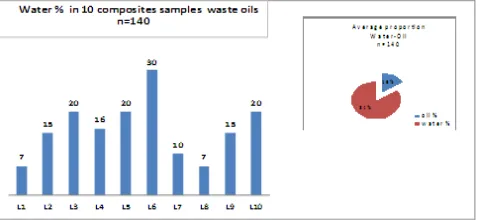
Waste oils from vessels have the form of a water-oil emulsion. The results (Fig1) presents water content results of different samples analyzed (n = 140). Results indicate that water content of the oil used by ships is between 7% (minimum) and 30% (maximum) with 16% overall of the lots. The presence of water and its wide range percentage indicates its origin: it’s probably water used to clean ship holds.
3.1.2. Water Content (%)
Observations results indicate that used oils emit specific odors similar to hydrocarbon with variable intensity. This intensity varies depending on water proportion. It also appears that used oils color present a blackish aspect. This confirms the deteriorated nature of oils from motors and combustion process.
3.1.3. Physicochemical Parameters
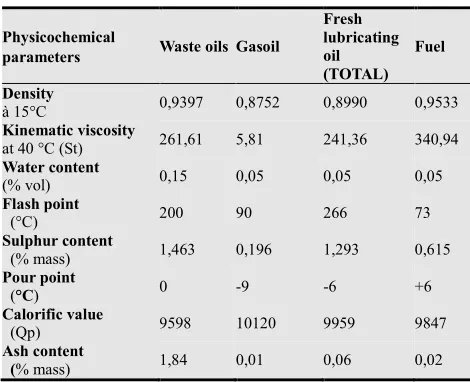
This analysis (Table 1) was conducted on organic fraction of grouped used oils composite samples (n=140). By comparison, a similar study was conducted on diesel, fresh oil (TOTAL) and fuel. Different parameters such as density at 15°C, kinematic viscosity at 40°C (ST), water content (Vol%), flashpoint (°C), sulphur content (mass%), pour point (°C), calorific value (Qp), ash content (mass%) were analyzed in accordance with ASTM protocol of analysis.
- Density: the density measured is 0.94 which is slightly higher than that of gasoil (0.8) and fresh oil (0.90). However, it is closer to that of fuel (0.95).
Table 1. Results of physicochemical analysis
Physicochemical
parameters Waste oils Gasoil
Fresh lubricating oil (TOTAL) Fuel Density
à 15°C 0,9397 0,8752 0,8990 0,9533
Kinematic viscosity
at 40 °C (St) 261,61 5,81 241,36 340,94
Water content
(% vol) 0,15 0,05 0,05 0,05
Flash point
(°C) 200 90 266 73
Sulphur content
(% mass) 1,463 0,196 1,293 0,615
Pour point
(°C) 0 -9 -6 +6
Calorific value
(Qp) 9598 10120 9959 9847
Ash content
(% mass) 1,84 0,01 0,06 0,02
- Viscosity (in St): the viscosity measured is equal to 261.61 ; this value is closed to that of fresh oil (241.36). It is much higher than that of gasoil estimated at 5.81 and inferior to that of fuel (340.94).
- Content of trace water (%vol): after aqueous phase elimination, residual water trace content measured on used oil sample is 0.15%. Though weak, it is three times higher than fresh oil (0.05%)
- Flash point (°C): the flashpoint measured (200) is in the same order of magnitude with fresh oil (266) but much higher than that of gasoil (90) and fuel (73).
- Sulphur content (mass %): used oil has a 1.46 sulphur content in same order of magnitude of fresh oil (1.29) but much higher than that of gasoil and fuel which contents are respectively 0.19 and 0.61.
- Pour point (°C): pour point is zero. It is negative for diesel (-9) and fresh oil (-6). On the contrary, it is positive for fuel (+6).
- Calorific value (Qp): the calorific value measured is 9598 and is in same order of magnitude of fresh oil, diesel and fuel that are respectively 0.06 and 0.02.
3.1.4. Organic Pollutants
- Volatile hydrocarbons: The levels (Table 2) vary from 5 to 73 ppm with 20 ppm average. The composite sample (L8) tends to get the highest concentration (73 ppm).
- Sulphide hydrogen (H2S) and mercaptans: all the measurements by the method described are zero values. That means the sensitivity of the methods is not enable to highlight sulphur compound [15].
- Dissolved organic chlorine: all the samples tested contain dissolved organic chlorine. Globally the concentrations vary between 10 and 287 ppm with an average of 96 ppm. Organic chlorine measured comes essentially from polychlorinated biphenyls that are heat carrier substances added to mineral oil.
By comparing used oils (volatile hydrocarbons, sulphur compounds and organic chlorine) and fresh oil data at 25°C, it appears that used oils volatile hydrocarbons (20 ppm) contents are in the same order of magnitude of those normal oils (25 ppm). However, a high value (73 ppm) and low values (5 ppm) were noted in used oil. Contents in dissolved chlorine fluctuate noticeably (min= 10; max= 287) and are highly superior to normal oils.
These tests indicate that waste oils are characterized by high organic chlorine and a proportion of volatile hydrocarbons comparable to those of normal oil.
Table 2. Organic pollutants analysis results
Samples Volatile hydrocarbons (ppm) H2S (ppm) Mercaptan (ppm) Organic chlorine (ppm) Waste Oils (n=140) Min <LI=0.5 Moy = 20 Max= 73
Min < LI=0.5 Moy < LI=0.5 Max < LI=0.5
Min < LI=0.5 Moy < LI=0.5 Max < LI=0.5
Min=10 Moy =96 Max =287 Fresh lubricating oil (n=3)
25 0 0 <5
LI= Inferior Limit; LS= Superior Limit
3.2. Waste Oils Residues Assessment and Dynamic Transfer in Soil by Volatile Compound Analysis
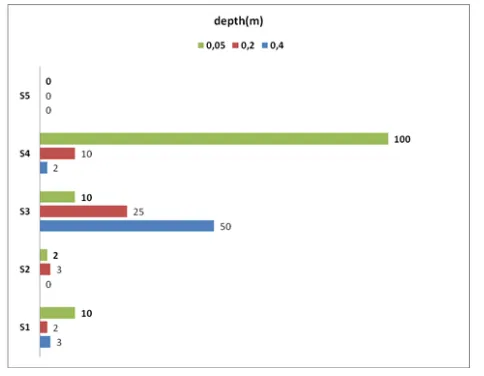
Analysis conducted on soil samples in the 5 stations (Fig 2) show the presence of hydrocarbons residue in soils. Hydrocarbons were detected in 11 samples out of 15 analyzed using Dräger tubes, almost 73% with varying contents from LI = 0.1 to 100 ppm. On the opposite, in H2S and mercaptans, Dräger tubes measures were inferior to LI = 0.5 ppm. In fact two hypotheses are probable. Either sulfur compounds are not present in soil samples or the Dräger method used is not enough sensitive. In this case, the method used would be inappropriate for the level of concentration sought.
indicates the presence of organic compounds at the surface probably due to liquid waste spillage by tanker trucks.
-Station S2 and S3, located within used oils treatment and recycling site show an increase of in-depth volatile hydrocarbons content. This could be explained by organic compound sequestration in the soil.
Concerning station S3, hydrocarbons content grows with depth of soil. This station is close to the oil storage place. It regularly suffers contamination by accidental spillage of hydrocarbons during tanker trucks unloading.
-Heavy fractions infiltration in the soil after evaporation of light fractions smoothes out tar balls (bitumen) that could be at the origin of high content of hydrocarbons noticed in depth.
Figure 2. Hydrocarbons (ppm) in soil.
3. Results and Discussion
Physicochemical analysis made it possible to indicate that waste oil from ships was not always homogeneous. It takes the form of a water-oil emulsion. Organic phase study indicates that oil samples from vessels are complex mixture of hydrocarbons from C12 to C40 (fresh oil and fuel) confirming petroleum origin of product are hydrocarbons to which are added divers processed product and additives.
The chemical analysis of the same samples of waste oils, by semi-quantitative colorimetric method using Dräger reactive tubes highlighted the characteristic parameters of hydrocarbons family compounds tested. The results confirm the presence of volatile hydrocarbons and organochlorinated compounds in oils from vessels with concentration higher than normal level.
The abnormally high level of volatile hydrocarbons and organic chlorine confirms that organochlorinated products (particularly PCB) were added to waste oil.
Waste oils, as all oil products are dangerous for human being and environment. The volatiles and non volatile compounds can be found in air, soil and water.
The presences of organochlorinated such as PCB indicate the dangerous nature of waste oils. Sulphured compounds have not been detected because either they are missing by
volatilization or the method used is not enough sensitive [16].
The chemical analysis carried out on soil samples collected on the site of Company’s treatment of waste oils indicated the presence of organic compounds to a depth of 0.05, 0.2 and 0.4 m. These compounds come from hydrocarbon accidental spilling by tanker trucks. Hence the necessity to increase monitoring of the different sites where they used or produced mineral oils: garage, refinery and used oils treatment site) that are soil pollution hotspots.
These persistent compounds present in the soil could represent a threat to groundwater [17]. Waste oils mismanagement and anarchical spillage en dangers environment and human beings [18,]. The appreciable calorific value of these oils (9598 Qp) could open up perspectives on valorization and recycling for used oils, that have to be handled with care.
References
[1] EEP, L’Europe aux prises avec ses déchets, Mini Guide des expériences Européennes, European – Environmental- Press, 31 P (2000).
[2] PNUE/GEF, regionally based. Assessment of persistent toxic, substances, Region IV Mediterranen - draft 2 (2001).
[3] Adepojug Onibokun, La gestion des déchets urbains, des solutions pour l’Afrique. Edition KARTHACA: ISBN: 2-84586-147-8243 P (2001).
[4] CE , Décision de la Commission Européenne du 16 janvier 2001 modifiant la décision 2000/532/CE en ce qui concerne la liste des déchets (2001). Journal Officiel des Communautés Européennes, P.31.
[5] CCIP, Les nouvelles règles applicables aux transferts des déchets suivant la réglementation 10/3/(2006). www.environment.cup.fr.
[6] Fabrice Ville : Pollution solide des surfaces. Mémoire Thèse de Doctorat soutenue le 16 novembre 1998 au Laboratoire Mécanique de Contact de INSA, Lyon (1998).
[7] Douglas M. Considine, De Van Nostrand’s, Scientific encyclopedia eighth edition j-2, 2381-2402 PP 3455 (1995).
[8] Elliott, J.D, Maximize distillate liquid products, hydrocarbon processing p. 75 (1992).
[9] Verschueren K., Handbook of environmental data on organic chemicals. Second edition copyright 1983 by Van No strand Reinhold, New York (1983).
[10] UAA: Rapport de l’Atelier international relatif à la gestion des déchetsménagers en Afrique de l’Ouest, » Université d’Abobo Adjamé, Abidjan Mars (2008).
[11] PNUE : Rapport de l’Atelier technique relatif à l’inventaire des déchets toxiques dans le district d’Abidjan, Abidjan 18 sept (2008).
[13] PNUE/ IEPF/PNUD : Atelier National de sensibilisation, de formation et d’élaboration des projets éligibles aux mécanismes de développement propre, Abidjan, 10 au 13 avril (2007).
[14] CE : Décision de la Commission Européenne du 16 janvier 2001 modifiant la décision 2000/532/CE en ce qui concerne la liste des déchets (2001).
[15] Kaplan Christopher W., and Christopher L. Kitts, Bacterial succession in petroleum hand treatment unit “applied and Environmental Microbiology, Vol 70 (3) pp 1777-1786 (2004).
[16] Marie G. Dreger, Yarow M. Nelson and Christopher L. Kitts, Weathering effects on biodegradation and toxicity of hydrocarbons in ground water. Published in Proceedings of the 8th International Conference on In Situ and On-Site Bioremediation: Baltimore, MD, June 6, 2005. 7 Pages. http://www.battelle.org.
[17] Furno P., Millot N., Pour une gestion régulière des déchets chimiques dangereux dans les laboratoires, SPECTRA ANALYSE N° 183 Mars-Avril (1995) P. 20-22.