Published online December 19, 2014 (http://www.sciencepublishinggroup.com/j/ijnfs) doi: 10.11648/j.ijnfs.20140306.26
ISSN: 2327-2694 (Print); ISSN: 2327-2716 (Online)
A review on: Antioxidant and its impact during the bread
making process
Emad Mohamed Ali Karrar
1
School of Food Science and Technology, Jiangnan University, Wuxi, 214122, China 2
Laboratory of Baking Science and Ingredient Functionality Research, Jiangnan University, Wuxi, 214122, China 3
Department of Food Science and Technology, Faculty of Engineering and Technology, University of Gezira, Wad Medani, P.O. Box 20, Sudan
Email address:
To cite this article:
Emad Mohamed Ali Karrar. A Review on: Antioxidant and Its Impact during the Bread Making Process. International Journal of Nutrition
and Food Sciences. Vol. 3, No. 6, 2014, pp. 592-596. doi: 10.11648/j.ijnfs.20140306.26
Abstract:
Antioxidant compounds in food play an important role as a health protecting factor. Major sources of naturally occurring antioxidants are fruits, vegetables and whole grains. This review is focused on the classification, characteristics and mechanism of antioxidant and methodology were reported. Bread and bakery products have an important role in human nutrition. This review is focused also on Changes in antioxidant activity during the bread making process (mixing or dough, fermentation, and baking) and also antioxidant properties in the sourdough. The effects of heat on the antioxidant activity during bread making were reported. The addition of phenols-rich materials with wheat bread is an effective technique to improve the antioxidant potential of the final product.Keywords:
Antioxidant, Classification, Characteristics, Mechanism, Changes during the Bread Making1. Introduction
Antioxidants are our first line of defense against free radical damage, and are critical for maintaining optimum health and wellbeing and Antioxidant compounds in food play an important role as a health protecting factor. major sources of naturally occurring antioxidants are fruits , vegetables and whole grains, . Free radical damage may lead to cancer. However, fruits and vegetables contain many different antioxidant components [24] Examples of antioxidants include beta-carotene, lycopene, vitamins C, E, A , phenolic acids, phytate and phytoestrogens [6][25]. Most of the antioxidant compounds in a typical diet are derived from plant sources and belong to various classes of compounds with a wide variety of physical and chemical properties. Some compounds, such as gallates, have strong antioxidant activity, while others, such as the mono-phenols are weak antioxidants [1].The main characteristic of an antioxidant is its ability to trap free radicals. Highly reactive free radicals and oxygen species are present in biological systems from a wide variety of sources. Antioxidant compounds like phenolic acids, polyphenols and flavonoids
2. Classification of Natural Antioxidants
The antioxidants in food systems may be classified by using diverse indicators. Depending on the origin and the methods of production, food antioxidants may be synthetic or natural. The natural antioxidants they are the chain breaking antioxidants which react with lipid radicals and convert them into more stable products. Antioxidants of this group are mainly phenolic in structures and include Antioxidants minerals for examples (selenium, copper, iron, zinc and manganese), Anti-oxidants vitamins for example (vitamin C, vitamin E, vitamin B), Phytochemicals for example (Flavonoids, Catechins, Carotenoids, Beta carotene, Lycopene, Herbs and spices-source) [6]. The synthetic antioxidants these are phenolic compounds that perform the function of capturing free radicals and stopping the chain reactions for example butylatedhydroxyanisole (BHA), but ylatedhydroxytoluene (BHT) and tertiary butyl hydroquinone (TBHQ) [2][6].
3. Characteristics of Antioxidants
The major antioxidants presently used in foods are monohydroxy or polyhydroxy phenol compounds with various ring substitutions. These compounds have low activation energy to donate hydrogen. Hence, the resulting antioxidants radical does not initiate another free radical due to the stabilization of the delocalized radical electron. Publishing and initiation of free radicals chain reaction can be delayed or minimized by the donation of hydrogen from the antioxidants and metal chelating agent. The resulting antioxidant free-radical is not subject to rapid oxidation due to its stability. Antioxidants free-radicals can also react with lipid free radicals to form a stable complex compound thereby preventing some of their damages [6].
4. Mechanism of Antioxidants
In food system, the most effective antioxidant functions by interrupting the free radical chain mechanism. Antioxidants have been broadly described as “all substances that inhibited oxidation reactions, regardless of the mechanism,” and narrowly as “those compounds that interrupt the free-radical chain reaction involved in food oxidation and those that scavenge singlet oxygen [6][3]. The biological term antioxidant refers to “any substance that when present at low concentrations compared with those of an oxidizable substrate, significantly delays or prevents oxidation of that substrate [6][3]. In order to fully understand the mechanism of action of antioxidants, one must understand the mechanism of chemical oxidation. Oxidation, in the broadest sense, is simply the removal of an electron from an atom or molecule. This is paired with a reduction reaction in which the electron or electrons involved are added to another atom or molecule. In biological, and food systems, oxidation reactions can generate a reactive species and initiate a free radical chain reaction. An example of this is illustrated
Initiation: R2RN2R → 2R
●
P + N2
R●P + OR2R → ROOP●
ROOP ●P + LH → ROOH + LP ● Propagation
L●P P + OR2R → LOOP ● LOOP ● P + LH → LOOH + LP ●
Inhibition
LOO●P P + AH → LOOH + A●P Termination
AP ● P + (n – 1) LOOP ● P → non radical products LOOP ● P + LOOP ● P → non radical products
4.1. Antioxidant Activity Using (DPPH) Radical Scavenging
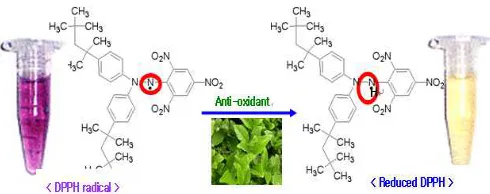
The principle of this assay is based on the measurement of the scavenging ability of the antioxidants towards the stable radical. The free radical DPPH is reduced to the corresponding hydrazine, when it reacts with hydrogen donors, this stability is evaluated by decolorizing assay, which evaluates the decrease in absorbance at 517 nm produced by the addition of antioxidant to DPPH solution in ethanol. The scavenging reaction between (DPPH) and an antioxidant (H-A) can be written as:
The color turns from purple to yellow as the molar absorptivity of the DPPH radical at 517 nm. The degree of discoloration indicates the scavenging potential of the antioxidant compounds or extracts in terms of hydrogen donating ability [4].Antioxidants react with DPPH, which is a stable free radical and is reduced to the DPPH- H and as a consequence the absorbance’s decreased from the DPPH radical to the DPPH-H.
Fig. 1. 2, 2'-diphenyl-1-picrylhydrazyl, 2, 2'-diphenyl-picrylhydrazine.
4.2. Antioxidant Activity Using β Carotene Bleaching Assay
Fig. 2. Antioxidant interaction (BCB).
4.3. Antioxidant Activity Using Reducing Power
The reducing power of a compound may serve as an indicator of it antioxidant activity. The presence of reductants such as antioxidant substances causes the reduction of Fe3+/ferricyanide complex to fe2+/ ferrous form. Therefore, the reducing power of the sample could be monitored by measuring the formation of Perl’s Prussian blue at 700nm [23].
In this analysis, the presence of antioxidants caused the reduction of the Fe3+/ferricyanide complex to the ferrous form and the yellow color of the test solution changed to various shades of green and blue depending on the reducing power of each compound.
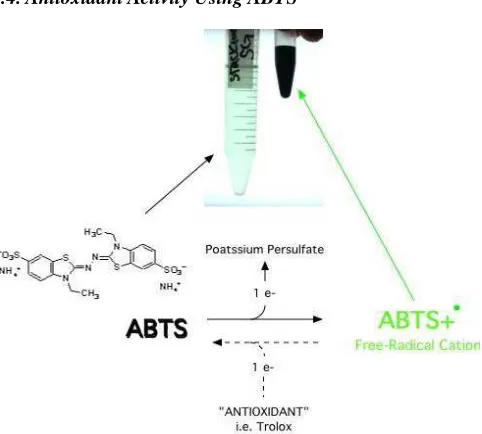
4.4. Antioxidant Activity Using ABTS
Fig. 3. ABTS (2, 2’-azino-bis (3ethylbenzthiazoline-6 sulphonic acid).
ABTS is chemical compound used to observe the reaction kinetics of specific enzymes. A common use for it is in the enzyme-linked immunosorbentassay (ELISA) to detect for binding of molecules to each other. ABTS is converted to its radical cation by addition of sodium per sulfate. This radical cation is blue in color and absorbs light at 734 nm [4]. The ABTS radical cation is reactive towards most antioxidants
including phenolic, thiols and Vitamin C [5]. During this reaction, the blue ABTS radical cation is converted back to its colorless neutral form. The reaction may be monitored spectrophotometrically. This assay is often referred to as the Trolox equivalent antioxidant capacity (TEAC) assay. The reactivity of the various antioxidants tested is compared to that of Trolox, which is a water-soluble analog of vitamin E.
4.5. Changes in Antioxidant Activity during the Bread Making Process
The processing of bread can be divided into three basic operations: mixing or dough, fermentation, and baking. Optimum baking processing depends on the type of bread to be baked and the desired bread characteristics [26]. It has been found that the antioxidant potential in bakery products is strongly dependent on manufacturing conditions and recipes [11][26] showed that antioxidant activity and free phenolic acid levels were reduced by mixing, but recovered after fermentation and baking. They explained this increase by the fact that bonds with antioxidants are hydrolysedduring fermentation, releasing antioxidants. Phenolic acid recovery after baking was 74-80%.In the Comparison to baker’s yeast wheat bread, sourdough wheat (durum and Kamut) offered more antioxidant protection[12].The aim of another study was to investigate the fermentation behavior (spontaneous fermentation for 18 h at 30 and 40 C), antioxidant activity and rheological behavior of sourdoughs prepared with Lactobacillus helveticusand Kluyveromycesmarxianus. The type of fermentation and the metabolic activity of LAB influenced the levels of bioactive compounds enabling the increase of the phenolic content of the sourdough [9][13]. The antioxidant properties of the sourdoughs are correlated with the metabolic activity of the microorganisms, the DPPH radical scavenging activity being higher for the optimum conditions of L. Helveticus growth. The antioxidant properties of the sourdough were highly influenced by the metabolic activity of the lactic acid bacteria and yeasts used for fermentation. The antioxidant activity of the controls (sourdough prepared without starter culture) was lower compared to samples fermented with L. helveticusand K. marxianus, regardless of flour type, fermentation temperature or dough yield [14].
samples when compared in original seeds. They showed that, in the case of wheat bread 40% replaced with barley flour, the amount of free phenolic decreased by up to 23.5% during the baking process, while the amount of bound phenolic increased [18][22]. At the same time, the measured antioxidant activities were relatively stable during the baking process. The addition of phenols-rich materials with wheat bread is an effective technique to improve the antioxidant potential of the final product [20] [26]. Wholegrain buckwheat flour is a good source of phenols and possessed good antioxidant activity [21]. Buckwheat bread had a highest content of phenolic compounds [8] [16]. The addition of buckwheat flour to wheat flour can increase total phenols concentration and improve antioxidant status of bread. Baking temperature influenced significantly more the loss of total phenols in wheat flour than in buckwheat flour and increase of antioxidative activity in bread samples by the formation of products of Maillard's reaction [7]. These interactions between added phenolic and bread proteins, and starch influenced the antioxidant capacity, protein and starch digestibility or functional properties of fortified Bread. The thermal processing exerts a significant effect on the antioxidant activity of cell-free systems [19]. It is possible that thermal processing can increase the bioavailability of phenolic, and increase antioxidant activities [26]. Thus, further experimental clarification is needed.
5. Conclusion
This review is focused on classification, characteristics and mechanism of antioxidant and methods of antioxidant evaluation and Changes in antioxidant activity during the bread making process (mixing or dough, fermentation, and baking) and effect antioxidant activity during bread making. The addition of phenols-rich materials with wheat bread is an effective technique to improve the antioxidant potential of the final product.
References
[1] Aruna Prakash, Fred Rigelh of and Eugene MIller. Antioxidant Activity. Medallion Laboratories, ANALYTICAL PROGRESS.
[2] A. A. El Bedawey, E. H. Mansour, M. S. Zakyand Amal A. Hassan.Characteristics of Antioxidant Isolated from Some Plant Sources. Food and Nutrition Sciences, 2010, 1, 5-12.
[3] M.S. Brewer. Natural Antioxidants: Sources, Compounds, Mechanisms of Action, and Potential Applications. Comprehensive Reviews in Food Science and Food Safety .( 2011).
[4] Kriengsak Thaipong, Unaroj Boonprakob, Kevin Crosby, Luis Cisneros-Zevallos and David Hawkins Byrne. Comparison of ABTS, DPPH, FRAP, and ORAC assays for estimating antioxidant activity from guava fruit extracts. Journal of Food Composition and Analysis 19 (2006) 669–675.
[5] http://en.wikipedia.org/wiki/ABTS.
[6] A. A. Hamid, O. O. Aiyelaagb, L. A. Usman, O. M. Ameen and A. Lawal. Antioxidants: Its medicinal and pharmacological Applications. African Journal of Pure and Applied Chemistry Vol. 4(8), pp. 142-151, August 2010.
[7] A. Selimović, Dijana Miličević, M. Jašić, Đurđica Ačkar, Tijana Pešić. The effect of baking temperature and buckwheat flour addition on the selected properties of wheat bread. Croat. J. Food Sci. Technol. (2014) 6 (1) 43-50.
[8] Joanna Chlopicka, PawelPasko , ShelaGorinstein, AnetaJedryas and PawelZagrodzki.Total phenolic and totalflavonoid content, antioxidant activity and sensory evaluation of pseudocereal breads. Food Science and Technology 46 (2012) 548-555.
[9] Iuliana Banu, Ina Vasileanand Iuliana Aprodu. Effect of Select Parameters of the Sourdough Rye Fermentation on the Activity of Some Mixed Starter Cultures. Food Biotechnology, 25:275–291. (2011).
[10] Anna Michalska, Miryam Amigo-Benavent , Henryk Zielinski and Maria Dolores del Castillob,. Effect of bread making on formation of Maillard reaction products contributing to the overall antioxidant activity of rye bread.
[11] Han, H.-M., &Koh, B.-K.. Antioxidant activity of hard wheat flour, dough and bread prepared using various processes with the addition of different phenolic acids. Journal of the Science of Food and Agriculture, 91, 604-608. (2011).
[12] Gianotti, A., Danesi, F., Verardo, V., Serrazanetti, D., Valli, V., Russo, A. Role of cereal type and processing in whole grain in vivo protection from oxidative stress.Frontiers in Bioscience, 16, 1609-1618.2011.
[13] Rizzello, C. G., Cassone, A., Coda, R., &Gobbetti, M. Antifungal activity of sourdough wheat germ used as an ingredient for bread making. Cereal Chemistry, 127, 952-959. (2011).
[14] Banu, I., &Aprodu, I. Studies concerning the use of Lactobacillus helveticus and Kluyveromycesmarxianus for rye sourdough fermentation. European Food Research and Technology, 234, 769-777. (2012).
[15] Lindhauer, M. G., Haase, N. U., Neumann, H., & Jansen, M. Antioxidant capacity of bread as a function of recipe and baking. Getreidetechnologie, 63, 62-71. (2009).
[16] Vogrincic, M., Timoracka, M., Melichacova, S., Vollmannova, A., &Kreft, I. Degradation of rutin and polyphenols during the preparation of tartary buckwheat bread.Journal of Agricultural and Food Chemistry, 58, 4883-4887. (2010).
[17] Alvarez-Jubete, L., Wijngaard, H. H., Arendt, E. K., & Gallagher, E. Polyphenol composition and in-vitro antioxidant activity of amaranth, quinoa and buckwheat as affected by sprouting and bread baking.Food Chemistry, 119, 770-778. (2010).
[18] Holtekjolen, A. K., Baevre, A. B., Rodbotten, M., Berg, H., &Knutsen, S. H. Antioxidant properties and sensory profiles of breads containing barley flour.Food Chemistry, 110, 414-421. (2008).
[20] Swieca, M., Gawlik-Dziki, U., Dziki, D., Baraniak, B., &Czy_ z, J. The influence of protein-flavonoid interactions on protein digestibility in vitro and the antioxidant quality of breads enriched with onion skin.Food Chemistry, 141, 451-458. (2013).
[21] Swieca, M., Se˛czyk,q., Gawlik-Dziki, U., &Dziki, D. Bread enriched with quinoa leaveseThe influence of proteinephenolics interactions on the nutritional and antioxidant quality. Food Chemistry, 162, 54-62. (2014).
[22] Mateo Anson, N., Aura, A. M., Selinheimo, E., Mattila, I., Poutanen, K., van den, B. R. Bioprocessing of wheat bran in whole wheat bread increases the bioavailability of phenolic acids in men and exerts anti-inflammatory effectsex vivo.Journal of Nutrition, 141, 137-143. (2011).
[23] Manian, R., Anusuya, N., Siddhuraju, P., Manian, S. The antioxidant activity and free radical scavenging potential of two different solventextracts of Camellia sinensis (L.) O.
Kuntz, Ficusbengalensis L. and Ficusracemosa L. Food Chem., 107: 1000 -1007.( 2008).
[24] Hong Wang, Guohua Caoand Ronald L. Prior.Total Antioxidant Capacity of Fruits.J. Agric. Food Chem.1996, 44,701−705.
[25] Anne Pouillot,Luigi L. Polla ,Philippe Tacchini ,Alice Neequaye ,Ada Polla andBarbara Polla.Natural Antioxidants and their effects on the skin.( 2011).
[26] Dariusz Dziki, Renata R o zy1o, Urszula Gawlik-Dziki andMicha1Swieca.Current trends inthe enhancement of antioxidant activity of wheat bread by theaddition of plantmaterials rich in phenolic compounds.Trends in Food Science & Technology 40 (2014) 48-61.