United Kingdom Vol. VI, Issue 1, January 2018
Licensed under Creative Common Page 205
http://ijecm.co.uk/
ISSN 2348 0386
CHINA-ZAMBIA ECONOMIC RELATIONS: CURRENT
DEVELOPMENTS, CHALLENGES AND FUTURE
PROSPECTS
FOR REGIONAL INTEGRATIONS
Mulundano Comfort Lubinda
Department of International Trade and Business,
Hebei University of Economics and Business, Shijiazhuang, People's Republic of China [email protected]
Cheng Jian
Department of International Trade and Business,
Hebei University of Economics and Business, Shijiazhuang, People's Republic of China [email protected]
Abstract
This paper analyses Sino-Zambia relationship: current developments, challenges and future
prospects for regional integration. Our focus is on how this relationship manifests itself in
investments. The research questions are: first, how has the relationship changed over time and
secondly, considering current developments from Zambian perspective, has this relationship
been beneficial? Finally, are there any shortcomings that have been affecting Sino-Zambia
economic relation, if any, what measures should be put by the two countries in order to
adequately address that challenges? Our analysis shows that although china and Zambia have
strong geo-political and strategic relations over the decades but the establishment of FOCAC in
2000 deepened the relationship, as this can be realized through a mix of aid, special
concessions, debt relief, scholarships, the provision of educational and medical training
personnel and infrastructural investment projects. This represents a stark departure from the
past under Mao Zedong, when the relationship was guided by the ideological conflict of the Cold
War and especially Beijing’s attempts to dislodge Moscow’s influence in the Third World. By
analyzing various current Chinese development projects in Zambia, the paper has reviewed that
Licensed under Creative Common Page 206
the spillover of this knowledge is very minimal because of certain inherent features of these
investments, inadequate policy direction from the Zambian government and the limited
absorptive capacity of the Zambian entrepreneurs. Therefore, this article highlights these
challenges as issues that need to be corrected in order to maximize the benefits of Chinese
investments in Zambia and enhance regional integration.
Keywords: Forum on China-Africa Co-operation (FOCAC); Economic Development;
Investments; Regional Integration
INTRODUCTION
China‘s impressive economic growth rate of more than 9% in the past three decades (it has declined to over 7% since 2013), its growing foreign direct investment and its ability to lift more than 500 million Chinese from poverty (measured by the World Bank poverty threshold of $1.25 day) has made China both a significant economic player and an economic development icon for Zambia and Africa at large. In 2013, China‘s outbound direct investment stock in Zambia
reached US$2.2 billion up from US$144 million in 2003. In the same year, direct trade between China and Zambia reached $3.1 billion, up from US$10 million in 2003. Chinese capital in Zambia has contributed to the creation of thousands of jobs in Zambia. Further, Chinese capital has been used to build valuable infrastructures in Zambia, such as roads, bridges, hospitals, schools and stadiums in Zambia. Due to the launch of these numerous massive programs and rapid growth of trade, china is enjoying unprecedented influence in Zambia today. Zambia‘s
trade volume with China has increased from US$100 million at the beginning of the 21ST century to more than US$3 billion in recent years, making the China-Zambia cooperation mode exemplary.
China is further taking Zambia as her important energy and raw material supply source while opening up new markets for her products. For that, China is attaching progressively greater importance to the development of China-Zambia relations. On the other hand, Zambia is also increasingly focusing on how the continuous growth of China-Zambia ties may help enhance the legal and regulatory framework, which is not only conducive to pushing for revitalization of the long sluggish manufacturing sector but also internal trade in Zambia and Africa as a whole, a goal many expert have been pursuing.
Licensed under Creative Common Page 207 Regional Financial Cooperation at Lusaka, capital of Zambia. The signing of the deal is a concrete step in implementing the China-Africa 10 Cooperation Plans Program and China-Africa Capacity Cooperation taken by the trio, which agreed to enter into a ―finance + industry‖ partnership in Mid-South Africa to further boost the mature domestic technologies, advanced equipment and smelting capacities‘ ―Outreach‖ drive.
Representatives of the three companies announced that they would, centering on the important partners like Zambia and the Democratic Republic of the Congo, venture into all-out cooperation in mineral resources development, cooperation-park construction and external project contracting on the basis of the ―13th Five-Year Plan‖ and Mid-South Africa Regional Development Strategy of each. Leveraging combined and coordinated strengths in investment and loan making, respectively, the CDB and AFDF will offer all-inclusive financial services ranging from bank advance, equity investment, bond underwriting to financial consultation to the CNMC.
Yang Youming, Chinese Ambassador to Zambia, said in a speech that, ―with a broad prospect for development shared between China and Zambia, it was hoped that, through cooperation between the (Chinese) financial institutions and leading industrial players in Zambia and leveraging the integrated industry-finance edge, the China-Africa Comprehensive Strategic Partnership will be enhanced, China-Zambia economic and trade cooperation further promoted and China-Zambia friendship elevated.‖
HISTORICAL BACKGROUND OF ZAMBIA-CHINA RELATIONSHIP
Sino-Zambia relations have evolved over time dating back to pre-independence era when China provided active support to the Zambian government in its efforts to consolidate political independence and struggle against western colonialist control. The diplomatic relation was however officially established on October 29, 1964 (Mwanawina 2008). Bilateral relations between the two countries have gradually evolved to modern times covering a wide spectrum of issues such as political, trade relations and economic and technical cooperation, as well as exchanges in the fields of culture, education and health. Reinforcing this relation is the monumental construction of the Tanzania-Zambia Railway (TAZARA) with Chinese assistance, which has become a cornerstone of Sino-Zambia Relations. In the past four decades, China‘s growing economy has caused it to take a greater interest in Zambia‘s economy. Zambia was first to establish diplomatic relations with China in Southern Africa just after independence.
Historically, as Mwanawina (2008) reports, ―modern Sino-Zambia relations start from the Bandung Summit of 1955 and CCP policy guided by Mao‘s theory of the Third World‖. The main
Licensed under Creative Common Page 208 guideline was the foundation of China‘s foreign policy towards Zambia, and later on, the discourse of Sino-Zambia brotherhood and friendship based on shared colonial history against the West was repeatedly invoked in mutual diplomatic activities. It is argued that this relation in some way was reciprocal; China assisting Zambia with liberation and independent political movements while Zambia supported the newly founded People‘s Republic of China with its diplomatic endeavors. For example, when China assisted Zambia with a loan to construct the monumental railway line, Zambia supported China in the UN Security Council accession bid.
Over the years, this focus on political alliance began shifting toward economic cooperation based on ―mutual economic benefits and common development‖ after the 1980s and 90s. This relation is often portrayed to be based on ―reliable friendship, non-interference and sovereign equality‖ (Mwanawina 2008). However, this relation is often conditioned to the ―One China Policy‖.
In the recent past, current Sino-Zambia/African Relations have been manifested in the Forum on China-Africa Cooperation (FOCAC) with the recent one held in South Africa, December of 2015. This represents the new positioning of China-Zambia relations, with parties agreeing to upgrade from a new strategic partnership to a comprehensive strategic partnership. Over the years, massive developments in the area of cooperation, trade, cultural and educational exchanges have been achieved.
Under this forum, China has given Zambia special trading arrangements in the quest to promote Zambia exports to China. China has also provided favorable loans and investments without conditions, a major departure from the conventional western aid, loans and investments.
In his recent article, Ambassador Tian XueJian reports this ―China exempted the tariff on 97 percent of the commodities exported to China from the 31 least developed African countries, and Zambia is among these countries‖. Furthermore, Chinese enterprises were encouraged and supported to construct more than 20 economic and trade cooperation zones in Africa and this is driven by the measures of FOCAC. China-Africa economic and trade cooperation has witnessed rapid growth. In 2014, China-Africa trade volume reached US$ 222 billion, 21 times of that in 2000. China‘s stock investment in Africa was over US$ 30 billion, more than 60 times of that in
2000. At the same time, the field of cooperation has expanded, and the structure has been optimized. The manufacturing industry, finance, tourism, telecommunication, aviation, broadcasting and TV have become new highlights of economic and trade cooperation. Working together, China and Africa have achieved win-win development.‖ This is how far Sino-African
relations have evolved.
Licensed under Creative Common Page 209 relations as well as the ‗experimental region‘ of new Chinese diplomatic policies in Africa. First of all, Zambia is one of the African countries which have the longest-standing diplomatic relations with the People‘s Republic of China.‖ Wu further reports that, the Tanzania-Zambia railway construction in the 1960s and 70s has been the most significant Chinese project in Africa, taking more than ten years from planning to completion and involved around 12,000 workers in total. As Wu argues, ―we conjecture that this symbol makes Zambia a well-known
and popular African country at the grassroots level in China and attracts more migrants in because of the image of Zambia, promoted by Chinese government, as a ‗safe, politically stable and friendly‘ country.‖ Because of this historically close relation between the two countries Zambia has the most dependent relation with China. It has also always been chosen as the experimental region to trial new Chinese-African policy.
CHINA-ZAMBIA PROJECT INVESTMENTS
Chinese firms have invested heavily in mining and other sectors in Zambia over the last 10 years with investment exceeding $3 billion in 2014, according to latest Chinese embassy estimates. This was revealed by the then Chinese Ambassador to Zambia Mr. Yang Youming during the commemoration of the 65th anniversary of the People‘s Republic of China. Further,
he stated that there were over 550 Chinese businesses operating in Zambia by October 2014. In 2015, a group of 30 Chinese companies were reported to invest a colossal sum of US$1 billion in a manufacturing hub to be called ‗One Belt and One Road Industrial Park‘. This was revealed in November (2015) when twenty executives representing the companies from China visited Zambia to look at the sectors of the Zambian economy in which to invest in. This industrial park is spearheaded by International Physical Distribution Group and the Zhongrum Investment Development Group Corporation Limited (Zambia) and it is envisaged to stand on a sprawling 700 hectares of land. It will host over 20 high-tech firms engaged in bicycle and water pump assembling, environmental refuse disposal management, construction, concrete processing, municipal engineering, and petrochemical manufacturing and packaging. The companies will also be involved in advanced medical materials, illumination, plastic material, physical distribution management, packaging, agriculture and tourism. Zambia Overseas Chinese Association chairman Zhang Jian said the first phase of the US$1 billion investment would gobble US$300 million while the remainder will be invested in the later phases. This huge investment reflects the confidence private Chinese businesses have in Zambia‘s economy,
Licensed under Creative Common Page 210
Energy
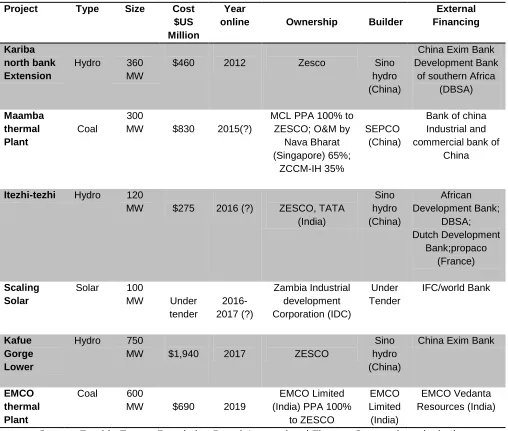
FDI from china in energy sector has been raised after FOCAC, china is investing in many energy projects in Zambia as shown below, especially, hydro and coal power. Energy priority project will expected to add output in national energy sector earlier, which could be helpful for Zambia minimize its energy short fall.
Table 1; Recent and Planned Large (>50 MW) Power Projects in Zambia
Project Type Size Cost
$US Million
Year
online Ownership Builder
External Financing
Kariba north bank Extension
Hydro 360 MW
$460 2012 Zesco Sino
hydro (China)
China Exim Bank Development Bank
of southern Africa (DBSA) Maamba thermal Plant Coal 300
MW $830 2015(?)
MCL PPA 100% to ZESCO; O&M by
Nava Bharat (Singapore) 65%;
ZCCM-IH 35%
SEPCO (China)
Bank of china Industrial and commercial bank of
China
Itezhi-tezhi Hydro 120
MW $275 2016 (?) ZESCO, TATA (India) Sino hydro (China) African Development Bank; DBSA; Dutch Development Bank;propaco (France) Scaling Solar
Solar 100
MW Under tender 2016-2017 (?) Zambia Industrial development Corporation (IDC) Under Tender IFC/world Bank Kafue Gorge Lower
Hydro 750
MW $1,940 2017 ZESCO
Sino hydro (China)
China Exim Bank
EMCO thermal Plant
Coal 600
MW $690 2019
EMCO Limited (India) PPA 100%
to ZESCO EMCO Limited (India) EMCO Vedanta Resources (India)
Source: Zambia Energy Regulation Board; International Finance Corporation; sinohydro
Licensed under Creative Common Page 211
Transport Infrastructure
Rail line
Between 1968 and 1976 china helped Zambia to construct a rail line called TAZARA railway. The 1,860 km long project was built with financial and technical assistance from China, amounting to well over US$400m, in the form of a long-term interest-free loan. TAZARA was conceived to provide the critical outlet to the sea that landlocked Zambia needed in order to break free from its dependency on Rhodesian, Angolan and South African rails and ports.
However, recently, Tazara has been facing a lot of challenges and drowned in debt, as a result, its operation have been severely curtailed. To avert the total collapse of the rail authority, in 2012, china committed to chip in; and prior to this, the country provided US$5m to rehabilitate 90 wagons. The agreement was signed by Tazara MD Akashambatwa Mbikusita-Lewanika and the chief representative of the economic and commercial representation of the people‘s republic of China in Tanzania, Lin Zhiyong.
Mbikusita-Lewanika said Chinese assistance provided under 15 protocols signed over the decades had averted the total collapse of the rail authority. ―Whilst we acknowledge that the
support funds under the protocols are provided as interest-free loans to the Tanzanian and Zambian governments, we are also grateful to the government and the people of China for the continuing positive association with Tazara‖.
As if the construction of TAZARA was not enough, in 2009, China pledged that they will finance another $2.26 billion rail line in Zambia as part of a larger Investment in Africa‘s Infrastructure. Chinastruck this deal with Zambian Government to build a new Railway connecting two cities in the Eastern part of the country. China civil engineering construction corp, (CRCC), a subsidiary of the state-owned China Railway Construction, Corp. Ltd, signed the agreement with the Zambian Ministry of Transport, works, Supply and Communications to build the railway.
The single-track will stretch 240 miles from Chipata to Serenje, allowing passengers train to travel at speeds of up to 75mph and cargo freight up to 50mph.
Licensed under Creative Common Page 212 Figure 1; Map of railway network connecting Zambia to East coast of Africa
via the port of Nacala in Mozambique
Source: http://allafrica.com/stories/201008190010.html
Infrastructural projects like road and railways are very important for linkages of both countries. It is the reason that working on these projects is quite faster than other projects. Moreover, Shipment and travel through railways is considered as cheaper and safer, hence development of railways infrastructure will reduce transport cost and delivery time which in turn reduce the overall trade cost.
Road Infrastructure
Licensed under Creative Common Page 213 There has been significant Chinese involvement in Road infrastructure in Zambia.In 2012, the then president of Zambia, president Michael Sata Initiated Link Zambia 8000 road Project also known as Accelerated National Roads Construction Programme. Out of the total 23 work contracts for Link Zambia 8,000, 16 were contracted to Chinese companies, 85% financed by a China Exim Bank loan, (Lusakatimes.com).
Showing the trust Zambian government has in Chinese companies, the government has been awarding a lot of big projects especially in construction sector to Chinese, for example, in 2013, and Zambia‘s Road Development Agency (RDA) awarded a US$108 million contract
to Sino-Hydro Zambia Limited for the construction of a 45.5 kilometre dual carriageway from Kitwe to Chingola.The Kitwe-Chingola road is a vital road that forms part of the regional trunk road network and is an important link on the North-South corridor. ―The route carries a lot of
international traffic and links the Copperbelt and north-western Zambia to the rest of the country and beyond borders,
Furthermore, in 2015, The Zambian Road Development Agency (RDA) awarded a US$207mn contract to the China Henan International Corporation for the construction and design of the Mansa-Luwingu road. RDA chief executive officer Bernard Chiwala said ―The construction of the Mansa to Luwingu Road will provide the shortest route from Mansa to Kasama and provide a shorter link between the Copperbelt and Luapula provinces,‖( Lusaka times.com ).
After completion of these projects the road infrastructure in Zambia will develop more, which would be helpful for faster communication and supply chain system which in turn reduce the transport cost and easier the market access in all regions of the country. Moreover, Infrastructure is one of the key factors of investment environment; development of infrastructure in Zambia could make the country more attractive for FDI inflows from other countries.
Manufacturing and Special Economic Zones
Licensed under Creative Common Page 214
Zambia-China Trade and Economic Cooperation Zone
China Nonferrous Mining Co. (CNMC Group) began planning the Zambia‐China Economic and Trade Cooperation Zone in 2003 in Chambishi, about 420 km north of the capital of Lusaka. CNMC‘s decision to open a zone for mineral processing and related industries allowed the company to make full use of the 41km² surface area of its Chambishi copper mine. In 2006, CNMC won official support from MOFCOM for the Chambishi zone. In a sign of the political importance of this initiative, in February 2007, China‘s president HuJintao presided at the
opening ceremony of the zone.
The Chambishi Zone focuses on the value chain of copper and cobalt: mining, processing, recycling, machinery and service (Table 2). It aims to attract 50‐60 enterprises, create some 6,000 jobs for Zambians, and reach an annual output of over US$ 1,500m by 2011. By July 2009, eleven enterprises had been established in the zone, including the Chambishi copper mine, copper smelters, a sulfuric acid plant, and a foundry, for a total investment of US$ 760m.
China Nonferrous Mining Co. (CNMC Group)‘s Lusaka sub‐zone project, adjacent to the
Lusaka airport, was launched, at least symbolically, in January 2009. The zone has an area of about 5 km2. CNMC indicated a wish to focus on services (hotels, a conference center) as well as light industries such as food and tobacco processing, assembly of home appliances and electronics.
The strategic purpose of the Lusaka sub‐zone may be to diversify out of resource‐intensive investment as well as to accommodate the Zambian government‘s desire for urban employment opportunities. China Development Bank set up a Zambia team to provide funding support for the zones and CNMC activities in Zambia.
Licensed under Creative Common Page 215 Table 2. Special Economic Zones in Zambia
Zone Launch
Year
Developer Developer’s
Country
Zone focus
Chambishi 2006 China non-ferrors metal
corporation
China Mineral processing
Lusaka East 2009 China nonferrous metal
corporation
China Light manufacturing
activities and services
Lusaka South 2010 Japanese international
corporation Agency and the Malaysian Kulip
High-tech park
Japan and Malaysia
High-tech industries, research and development
Lumwana 2010 Light and heavy
Industries
Roma Industrial Park 2010 Interspan sales
corporation
South Africa Light Industries and retail park
Sub-Saharan
Gemstone Exchange
(Industrial park)
2010 Gemstone related
business and mineral processing
business Source: Ministry of Commerce, Trade and Industry of Zambia;
OECD Investment Policy Review of Zambia
Agriculture and Farm Blocks
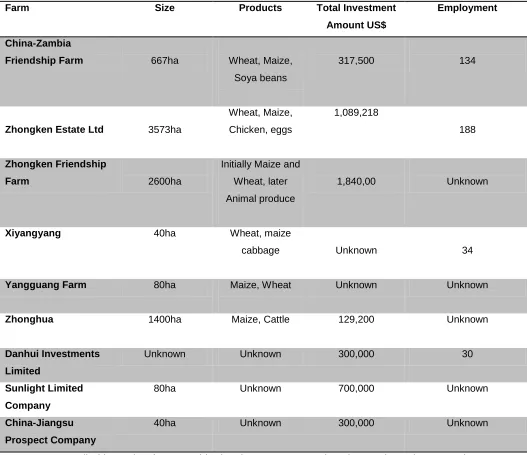
Licensed under Creative Common Page 216 approximately 30 private Chinese farms. The more recent, smaller investors are diverse and independent.
Table 3. China-Zambia agriculture sector projects
Farm Size Products Total Investment
Amount US$
Employment
China-Zambia
Friendship Farm 667ha Wheat, Maize,
Soya beans
317,500 134
Zhongken Estate Ltd 3573ha
Wheat, Maize, Chicken, eggs
1,089,218
188
Zhongken Friendship
Farm 2600ha
Initially Maize and Wheat, later Animal produce
1,840,00 Unknown
Xiyangyang 40ha Wheat, maize
cabbage Unknown 34
Yangguang Farm 80ha Maize, Wheat Unknown Unknown
Zhonghua 1400ha Maize, Cattle 129,200 Unknown
Danhui Investments
Limited
Unknown Unknown 300,000 30
Sunlight Limited
Company
80ha Unknown 700,000 Unknown
China-Jiangsu
Prospect Company
40ha Unknown 300,000 Unknown
Sources: Compiled by author from Zambia development Agency (ZDA), Brautigam (2009: 254), Braütigam and Xiaoyang (2009: 696), Hairong and Sautman (2010: 315-318), Li et al. (2012: 248-249)
Licensed under Creative Common Page 217 of students they have trained since the opening in April, this seems very feasible. The Center has programs in vegetables, mushrooms, maize, soya and wheat, as well as classes in how to operate the machinery. In the future they also want to have programs in computers and soil testing for the UNZA students, (Chileshe C 2010).
Table 4. China Agriculture Technology Demonstration Centre in Zambia China’s
Responsible
Agency
Date of
Construction
Date of
Completion
Focus Areas Contents of
Construction
Jilin Agricultural
University
November 2009 April 2012 Farming techniques, high
yield crops, operating machinery (in the future: soil testing,
computer programs)
Training centre buildings, offices,
laboratories, computer lab,
production demonstration area, equipment
and agricultural machinery Source: Policy brief from the Ministry of Agriculture and Li et al., 2012: 235.
The Ministry of Agriculture (2012) claimed that through their practices ―the Centre will contribute to national food security through improved agricultural productivity thereby improving the welfare of farmers‖. In 2011, then Zambian president Rupiah Banda was very positive of the Center
saying that it would increase agricultural production and contribute to economic growth (Zambia Daily Mail, 2011). In his opinion the Center would provide small-scale farmers with more knowledge that could translate into increased production and in the end also poverty reduction, since there would be more food in rural areas. The Center would expose small-scale farmers to new and high-yielding crop varieties and Zambia could possibly record more bumper harvests (ibid).
CHALLENGES
While there is strong evidence that China‘s investment in Zambia has benefited the Zambian economy and that China‘s approach to fight poverty and promote development might serve as a
Licensed under Creative Common Page 218 partnership in the interest of the Zambian peoples, at least, the majority of local Zambians. It should be noted that the suitability of China‘s development approach for African countries is still
debated, partly because some fundamental factors such as infrastructure, capital, large market and growing neighbouring economies which played important roles in China‘s extraordinary economic growth rate, are lacking in most African economies.
In 2011, Zambia Human Rights Watch released a report detailing extensive labour abuse, union busting and ‗poverty wages‘ paid by some Chinese mining companies to their Zambian employees, including subsidiaries of China Non-Ferrous Metal Mining Company (CNMC) a State-owned enterprise (SOE). According to the report, there was extensive evidence suggesting that wages paid by CNMCs subsidiaries in Zambia were among the lowest wages paid by foreign mining companies operating in Zambia. Further, the report argues that some Chinese employers in Zambia refused to allow their employees to join any trade union. More distressing details were revealed of the appalling working conditions, long working hours with no rest, no paid holidays, and no retirement benefits to some Zambian employees in Nonferrous China Africa (NFCA) a subsidiary of CNMC, (Human Rights Watch, 2001.)
Although these actions do not represent the activities of all Chinese companies in Zambia, they however indicate some of the shortcomings of Chinese capital in Zambia and call into question the widely held belief that Chinese investment in Zambia is a ―win-win‖ for economic cooperation. For example, in 2005, 51 Zambian copper miners were killed while working in a Chinese explosive factory in Zambia. In 2010, two Chinese mine managers, Xiao Li Shan and Wu Jiu Hua, were charged with attempted murder for shooting 11 Zambian workers who were protesting over poor pay and work conditions at the Collum coal mine in the southern town of Sinazongwe.
It is evident that Chinese mining companies are not the only foreign mining companies operating in Zambia with records of appalling occupational health and safety standards, low wages, and poor environmental records. A number of western mining companies operating in Zambia have also been accused, with sufficient evidence, of undertaking mining activities with deleterious impact on the local environment, of evading taxes, and in some cases hiring high amount of employees on an informal basis with no social security benefits.
Licensed under Creative Common Page 219 stakeholders to rethink: to what extent is Chinese capital in Zambia an economic win-win, new and in the interest of local Zambians? And what can be done to mitigate the negativities associated with some Chinese capital, in order to establish sincere and economic win cooperation.
There is evidence that efforts are been made by Chinese and Zambian governments to ensure that Chinese companies operating in Zambia comply with local labour and environmental regulations and that some companies are changing their labour relations with local employees. In 2007, NFCA arrived at an agreement with its employees to transfer the majority of its casual workforce to permanent contract basis. Further, in 2009, CNMC released a statement indicating that it would outsource 75% of its non-vital works to local Zambian contractors. These efforts are indicative of arguments that Chinese firms in Africa, including those in Zambia, are undergoing a gradual learning process to improve their relations with local stakeholders. Notwithstanding, more work still has to take place in the interest of local Zambians.
Furthermore, environmental pollution is also a major challenge, of which the failure to mitigate the occurrence of environmental pollution and labour abuses in some Chinese companies in Zambia might deprive local Zambian workers of their workers‘ rights and might
prevent local communities from benefiting from Chinese investment. It might also undermine the ability of the Zambian government to be the ‗responsible sovereign‘ actor, that is, to protect the
rights of its citizens and provide for their basic welfare. Further, this might negatively impact on China‘s image and interest as in Zambia, (Zambia development Agency, 2012.)
It is therefore important that the Chinese government, Chinese companies and the Zambian government collaborate to adequately address these shortcomings. In a keynote address in Sanya, President Lungu told the audience that Chinese firms in Zambia should respect local Zambian laws, and should use local labourers and local contractors in order to ensure that China-Zambian relations is in the interest of both countries. To what extent his comments will be implemented to improve on previous positive actions from Chinese companies in Zambia is still to be seen.
Licensed under Creative Common Page 220
PROSPECTS FOR REGIONAL INTEGRATION
The historical experiences the two countries share cannot be disputed. Over the years, bilateral trade and economic cooperation have grown rapidly. This relation is based on FOCAC which is guided by the principles of ―sincerity, equality and mutual benefit and solidarity and common development.‖
From the economic point of view, the fact that China, in its China Africa Policy, encourages and pledges support to Chinese enterprises willing to invest in Zambia/Africa and the explicit willingness to negotiate Free Trade Agreements with African Countries makes us to infer that China is seeking access to Zambian Market. Further, the underlying intuition under the ―resource cooperation‖ is access to the abundant natural resources Zambia is endowed with.
We stress that the terms of trade for the Zambian raw commodities often turn against her as they (terms of trade) are volatile. In this regard, we see the maintenance of the status quo; Zambia riddled with the ―natural resource curse‖ as this relation perpetuates the old
phenomenon which relegated Zambia into underdevelopment. However, we stress this point with caution, for indeed, in many ways China has proved to be different from the old colonialists. Arguably, China has lived its principles of non-interference, sovereign equality and mutual benefit. Zambia has hugely benefited from Chinese investments in various sectors, providing employments to thousands and promoting development in Zambia.
As of the of 2016, http://www.focac.org/eng/jlydh/sjzs/t1351357.htm access on 15/04/2016: 3:58pm in a recent interview (it was noted from the Chinese ambassador to Zambia that Xi Jinping‘s proposal of ―Ten Cooperation Plans‖ and the consequent establishment of a cross-department called ―China Cooperation Council‖ had already submitted a plan for China-Zambia Priority Cooperation Areas, expressing the hope to develop cooperation with China in the fields of infrastructure construction, agriculture, energy, tourism and training of human resources. He also said that China-Zambia trade has been growing rapidly since the beginning of the new century, with their trade jumping from US$100 million in 2000 to US$3.8 billion in 2014
Furthermore, Bilateral relation between China and Zambia has been growing rapidly both in scope and eminence often seen in the increased trade (both in volume and value), investment and cooperation between them. It is further argued that, even though the Sino-Zambia relation is based on ―win-win cooperation‖, the current pattern favors China more and that China‘s impetus in engaging with Zambia and Africa as a whole is driven by the need to
Licensed under Creative Common Page 221 on a ―win-win‖ platform. While on the Zambian perspective, engagement with China gives them access to, contrary to conventional Western style, unconditional aid, FDI and development in form of infrastructure and others.
The most significant aspect in the progress of the Sino-Zambia relationship regards its transition from a linear or single-dimension relationship to a multi-dimension relationship, with the support of institutionalization efforts (particularly FOCAC). This development facilitates the current transition and also is of great importance to its sustainable development.
As Kaplinsky, R. and Morris M. (2006) puts it clear that, Sino-Zambia transition includes the following three aspects. First, the Sino-Zambia relationship is shifting from one based emotional/ideological intimacy to one based on economic interests. The historical emotional/ideological intimacy is fading due to various developments, including the passing away of the older generation of leaders that share the experiences of national liberation movements with older Chinese leaders, the rising number of new western-educated and the growing number of people-to-people exchanges that have both positive and negative impacts on mutual understanding between two peoples. With considerations of economic interests rising and emotional/ideological intimacy fading, economic indicators have gradually become the main criteria for measuring bilateral relations.
The second transition regards the natural consequence of the growing importance of economic consideration— the change from economic interest promotion to economic interest
protection. The Going Global Strategy has had tremendous achievements and needs to plan for sustainable development, which requires attending to a lot of issues
While the first two transitions have begun to take place, the third transition in Sino-Zambia relations will take place in the next few years or decade. This transition regards the change from asymmetrical to symmetrical interdependence. The current Sino-Zambia relationship is an asymmetrically interdependent, as China depends more on Zambia natural resources and Zambia depends more on opportunities associated with China‘s rising and
Sino-Zambia relation development. Several developments have potential for undermine the current interdependence between China and Zambia.
Aware of these developments and the challenges that they potentially pose for Sino-Zambia relations, the Chinese government has adopted some counter-measures. First, to enhance the Sino-Zambia emotional intimacy, China is shifting its development assistance for Zambia from ‗hard‘ to ‗soft‘ infrastructure assistance.
Licensed under Creative Common Page 222
CONCLUSION
China's support to Zambia structural transformation is part of its "win-win" policy, under which both Zambia and China benefit from enlarging business opportunities. At the same time, it provides the opportunity for Chinese companies to secure resources and expand their operations overseas. This is why China is encouraging investments in Zambia through the "Going Global" strategy under which Chinese companies can receive financial support from a range of institutions, like the China Development Bank, the Export-Import (EXIM) Bank of China and the Ministry of Commerce. Moreover, the China-Africa Development Fund (CADF) has been specifically set up to promote business partnerships between African and Chinese entrepreneurs, and invested over USD 500 million of its own resources while promoting investment of more than USD 20 billion by Chinese companies.
China is not only supporting structural transformation at the macro-level through large- scale infrastructure investment projects, which often attract media attention, but also at the micro-level by sharing development and production know-how with Zambia. For example, China has set up a network of Chinese agricultural research centres in Zambia, with the aim of promoting food security and increasing agricultural productivity. Chinese small- and medium-sized enterprises (SMEs) are taking advantage of the many commercial opportunities in Zambia and are contributing to structural transformation by investing in many sectors, ranging from retail shops and restaurants to small companies that produce for the local African market.
Finally, while the relationship has maneuvered well through this trend, there is still an urgent need for longer-term strategic planning to steer and sustain the future development of Sino-China relations.
First, China needs to build a stronger social basis for Sino-African relations. Lacking a non-governmental capability, current people-to-people exchanges have more negative than positive contributions. China should strengthen NGOs and civil society groups to nurture these relations, create better platforms for public diplomacy and diversify diplomatic skills and stakeholders.
China must also pave way for future symmetrical interdependence between China and Zambia. China needs to adapt, strengthen and protect its relationship, and learn how to build a real friendship between a would-be ‗developed‘ country (China) and a real ‗developing‘ country
(Zambia), how to consolidate the global South and how to be a reliable friend and partner for developing countries. The future is bright, but there is still long way to go.
Licensed under Creative Common Page 223 them.‖ China is source of the much needed capital which in partnership with Zambia might very well turn the tables of development in Zambia. Chinese own development is phenomenal. It is the only country that has reduced poverty by the largest of margins in recent times. To countries in the West worried about Chinese intrusion into what was once primarily ‗theirs‘, I would say, it
is now too late. Africa has discovered the best kept secret in the world and is poised to take full advantage of that discovery.
REFERENCES
Africa Development Bank Group (2011), China‘s trade and FDIs in Africa http://www. Afdb.org/file admin/upload/afdb/ Documents/publication/working percent2026.pdf.
Brautigan .D (2009), the dragon‘s Gift; the real story of China in Africa, New york, the oxford University press.
Chileshe C (2010), Chinese Debt, aid and Trade; opportunity or threat for Zambia. South Africa Institute of international affairs.
CNMC (2007), master plan for the Zambia-China Economic and cooperation zone, China association of Development Zones.
Human Rights Watch, (2001), ―you will be fired if you refuse‖ labour abuse in Zambia Chinese state owned Copper Mines.
http://www.hrw.org/sites/default/files/reports/Zambia1111 for web apload.pdf.
Kaplinsky, R. and Morris M. (2006) -Dangling by a Thread: How sharp are the Chinese Scissors?- Institute of Development Studies.
Linderg, D (2009), Chinese Construction Industry in Africa; the case of Zambia, Stockholm School of Economics.
Lusaka times.com, 16 April, 2010, quoting minister of Finance and National planning, Situmbeko Musokotwane‘s response to questions about the real Benefit of Chinese Investments to Zambia.
Moss, T. and Rose, S.(2006) -China Exim Bank and Africa: New Lending, New Challenges - Centre for Global Investments
Mwanawina, Inyambo, 2007, an assessment of Chinese development Assistance in Africa-the case of Zambia.
UNCTAD, (2002b): World Investment Report, United Nations, New York&Geneva.
UNCTAD, (2005), Economic Development in Africa; Rethinking the role of foreign Direct Investment, United Nations, New York& Geneva.
Zambia development Agency, (2012). Foreign Private Investments and Investors‘ Perceptions in Zambia- Lusaka.