IJSRR, 7(4) Oct. – Dec., 2018 Page 2182
Research article
Available online www.ijsrr.org
ISSN: 2279–0543
International Journal of Scientific Research and Reviews
A comparative Study of Concept and Practice of Personal
Hygiene
Zinia Parvin and Kumar Saha Samir*
West Bengal State University, Department of Zoology, Berunanpukuria, PO Malikapur,Kolkata-700126,West Bengal, India
*West Bengal State University, Department of Zoology, Berunanpukuria, PO Malikapur, Kolkata-700126, West Bengal, India
Tel: (+91 033) 25241975/1976, Fax: (+91 033) 2524 1977 E-mail: [email protected]
ABSTRACT:
Background:
Poor menstrual hygiene often leads to reproductive tract infections. Menstruation and menstrual practices are still unhygienic and supported by taboos and socio-cultural restrictions resulting in ignorance of the scientific facts and hygienic health practices, which sometimes result into adverse health problems in adolescent girls.
Objectives:
(i) To find out the beliefs, conception and source of information regarding menstruation among the study population.
(ii)To find out the status of menstrual hygiene among study population.
(iii)To compare the perceptions and practice of menstrual hygiene between adolescent girls of rural, transition and urban areas.
Materials and Methods:
A descriptive, questionnaire-based study was conducted among 341 females from February 2018 to May 2018 in urban and rural and in between rural and urban area (transition) of North 24, Paraganas, West Bengal with the help of a pre-designed questionnaire. Data were analyzed statistically by simple proportions.
Results:
IJSRR, 7(4) Oct. – Dec., 2018 Page 2183
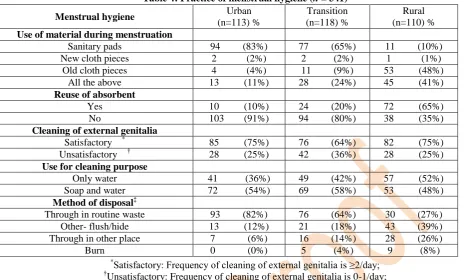
process but while in rural area only 21% had this idea. 47% rural girls thought that the menstruation was a curse of god while 19% girls in transition area and only 8% urban girls had this thought. 83% girls in the urban area used sanitary pads, while in transition area 65% girls used sanitary pads while only 10% girls in the rural area used sanitary pads during menstruation and regarding reused the same in the subsequent period the 10% urban girls, 20% transition girls reused the absorbent while 65% rural girls reused the same. There was a significant difference also in method of dispersal of absorbent in three different regions. Disposed off the absorbent through routine waste was practiced by 82% urban, 64% transition girls but only 27% rural girls. This study found differences in hygienic practices followed by adolescent girls in urban, transition and rural areas.
Conclusions:
Unsafe menstrual practice, common for adolescent girls, leads to reproductive tract infections. Hygienic practices during menstruation were unsatisfactory in the rural area as compared to the urban area. There must be proper education for menstruation and proper personal hygiene practice for adolescent girls as well as bring them out of traditional beliefs, misconceptions, and restrictions regarding menstruation. Mother, trained health personnel, school teachers and media should play a very important role in transmitting the vital message of correct menstrual hygiene to the adolescent girls.
KEYWORDS:
Menstrual perception, personal hygiene, sanitary pad*Corresponding author
Samir Kumar Saha*
Assistant Professor West Bengal State University, Department of Zoology,
Berunanpukuria, PO Malikapur, Kolkata-700126, West Bengal,India
IJSRR, 7(4) Oct. – Dec., 2018 Page 2184
INTRODUCTION:
Menstruation is a very common unique phenomenon to every female. The onset of menstruation is one of the most important changes occurring among the girls during the adolescent years. Menstruation is still regarded as something unclean or dirty in Indian society. Insufficient, incorrect information regarding menstruation is often a cause of unnecessary restrictions in the daily normal activities of the menstruating girls creating various psychological issues. The reaction to menstruation depends upon awareness and knowledge about the subject. The manner in which a girl learns about menstruation and its associated changes may have an impact on her response to the event of menarche. Although menstruation is a natural process, it is linked with several misconceptions and practices, which sometimes result into adverse health outcomes.
Hygiene-related practices of women during menstruation are of considerable importance, as it has a health impact in terms of increased vulnerability to reproductive tract infections (RTI). The interplay of socio-economic status, menstrual hygiene practices and RTI are noticeable. Today millions of women are sufferers of RTI and its complications and often the infection is transmitted to the offspring of the pregnant mother.
Women having better knowledge regarding menstrual hygiene and safe practices are less vulnerable to RTI and its consequences. Therefore, increased knowledge about menstruation right from childhood may escalate safe practices and may help in mitigating the suffering of millions of women.
Currently millions of women sufferers from RTI and infection are transmitted to the offspring. Women having knowledge regarding menstrual hygiene are less vulnerable to RTI and its consequences. Therefore, increased knowledge about menstruation from adolescent help in decreased suffering of millions of women. Various studies indicate that a huge information gap exists among rural and urban adolescent girls regarding menstrual hygiene. [1, 2] With the above background, this study was undertaken with the following objectives:
1. To study the perception of different aspects of menstruation and menstrual hygiene.
2. To find out the beliefs, conception and source of information regarding menstruation among the study population of urban, transition and rural areas.
3. To find out the status of menstrual hygiene among women in different areas.
MATERIALS AND METHODS:
Type of study: Community-based cross-sectional observational study.
IJSRR, 7(4) Oct. – Dec., 2018 Page 2185
37, Park Road, Cantonment Barrackpore, 24 pgs(N), two places of rural area, one at Kalikapur, Haroa, North 24 pgs and another one at Serampore, Rammohan-II, Hooghly, two places of transition area, one at Nandagarh, Barasat, 24 pgs (N) and another one at Kazipara, 2 No Rail Gate, Barasat, 24 Pgs(N). An urban college “Sarojini Naidu College for Women”, 30, Jessore Road, Kolkata, was also selected for study. Some samples were also taken by online form mainly for the urban and transition areas.
Duration of study: Five month, February-May, 2018.
Study population: One hundred and sixty girls from the above-mentioned secondary school of one class (class IX) were selected. It had four sections and one section was covered every week and one hundred eighty one women from three different areas. Total study population was three hundred forty one (341).
Study tool: A pre-designed, pre-tested questionnaire.
Methodology: After taking permission from the school authority, the class teachers of the four sections of class IX were explained the purpose of the study and rapport was built up with the girl students and verbal consent was obtained from them. Briefing was done to the students regarding the questionnaire provided to them. This pre-designed, pre-tested and structured questionnaire included topics relating to awareness about menstruation; source of information regarding menstruation, hygiene practiced during menstruation and restricted activities practiced during menstruation. At the end of the study, after collection of the questionnaire from the students, all their queries were answered satisfactorily by the research worker.
Statistical analysis: Data obtained were collated and analyzed statistically by simple proportions.
RESULTS:
Table 1 presents demographic characteristics of the study population. Among 341 respondents in the present study, 242 (71%) were Hindus, whereas only 97 (28%) girls were Muslims (Table 1). Table 2 shows that the age of menarche ranged from 7 to 15 years with a maximum number of girls being between 12 and 13 years of age group experienced their first bleeding observed commonly in three areas. In the present study, the mean age of menarche of the respondents was 12.2 years.
Table 1: Demographic characteristics of the study population (n = 341)
Information Urban
(n=113) %
Transition (n=118) %
Rural (n=110) %
Religion
Hindu 96 (85%) 85 (72%) 61 (55%)
Muslim 16 (14%) 32 (27%) 49 (45%)
IJSRR, 7(4) Oct. – Dec., 2018 Page 2186
Table 2 shows the reaction during first menarche and first source of information about menstruation. Significant difference was observed during first bleeding (menarche). Normal reaction was observed during first menarche in 65% urban, 56% transition while only 37% in rural areas whereas 24% urban, 35% transition and a fairly high 43% rural girls scared during first menarche. There was no significant difference regarding awareness of the first source of information about menstruation. It was observed mother was the first source, common in three areas (Table 2).
Table 2: Information about menarche (n = 341)
Regarding different beliefs and conception about menstruation among the respondent significant differences was observed. 88% urban girls and 63% girls in transition area knew that menstruation is a physiological process but while in rural area only 21% had an idea about menstruation is a physiological process. 47% rural girls thought that the menstruation was a curse of god while 19% girls in transition area and only 8% urban girls had that idea. None of the urban girls thought that it was neither caused by a sin nor a disease but 3% in transition and 4% in rural girls had that thought it was caused by a sin and 5% transition and 10% rural girls thought that it was a
Information Urban
(n=113) %
Transition (n=118) %
Rural (n=110) %
Age of menarche (years)
7 nil 1 (1%) nil
8 nil nil nil
9 nil nil 1 (1%)
10 13 (11%) 13 (11%) 10 (9%) 11 17 (15%) 25 (21%) 14 (13%) 12 43 (38%) 40 (34%) 33 (30%) 13 24 (21%) 21 (18%) 36 (33%) 14 12 (12%) 13 (11%) 10 (9%) 15 4 (4%) 5 (4%) 6 (6%)
Reaction during menarche
Normal 65 (57%) 52 (44%) 41 (37%) Scared 27 (24%) 42 (35%) 47 (43%) Depressed 16 (14%) 19 (16%) 11 (10%) Others 1 (1%) 1 (1%) 0 (0%)
Nil 4 (4%) 5 (4%) 11 (1%)
Awareness about menstruation during
menarche
Source of Information before menarche
Mother 74 (65%) 66 (56%) 56 (51%) Relative 15 (13%) 14 (12%) 21 (19%) Friend 20 (18%) 27 (23%) 13 (12%) Others 1 (1%) 2 (2%) 4 (4%)
IJSRR, 7(4) Oct. – Dec., 2018 Page 2187
disease. 92% urban and 66% rural girls knew that the blood comes from the uterus while only 10% rural girls had that idea about where from blood comes. Whereas 99% rural girls had no idea where from the blood came while percentage was low in case of transition and urban girls, 34% and 19% respectively (Table 3).
Table 3: Perception about menstruation (n = 341)
Table 4 depicting the practices during menstruation shows that 83% urban, 65% transition girls used sanitary pads during menstruation while 10% rural girls used sanitary napkin as absorbent during menstruation. 53% rural girls used old cloth piece as absorbent whereas use of old cloth used as absorbent was fairly low in transition and urban girls comparative to rural area, percentage was 9% and 4% respectively. Regarding the reuse of absorbent 10% urban, 20% transition girls reused absorbent, whereas in rural area 65% girls reused absorbent. 91% urban girls didn’t reused absorbent, in case of transition and rural area the percentage was 80% and 35% respectively. Regarding cleaning of external genitalia no significant differences was found, but practice in method of dispersal of absorbent there was a significant difference in urban and rural areas. 82% urban, 64% transition whereas only 27% rural girls disposed off the used absorbent through routine waste.
Beliefs/conception Urban
(n=113) %
Transition (n=118) %
Rural (n=110) %
What is the cause of menstruation?
It is a physiological process 100 (88%) 74 (63%) 23 (21%)
It is a curse of God 9 (8%) 23 (19%) 52 (47%)
It is caused by a sin 0 (0%) 3 (3%) 4 (4%)
It is caused by a disease 0 (0%) 5 (4%) 10 (9%)
Don’t know 4 (4%) 13 (11%) 21 (19%)
From which organ does the menstrual blood come? Uterus 92 (92%) 79 (66%) 11 (10%)
IJSRR, 7(4) Oct. – Dec., 2018 Page 2188 Table 4: Practice of menstrual hygiene (n = 341)
*Satisfactory: Frequency of cleaning of external genitalia is ≥2/day; †Unsatisfactory: Frequency of cleaning of external genitalia is 0-1/day;
‡
Multiple responses
Table 5 about restriction practiced during menstruation. It was observed that there was no difference in restriction practiced during menstruation. 81% urban, 91% transition and 98% rural girls practiced different restriction during menstruation period. 22% urban, 9% transition while only 2% girls in rural area not practiced any restriction during menstruation. It was also observed that maximum percentage of restriction practiced by girls was practiced in religious occasion which was common in three areas.
Table 5 Restrictions practiced during menstruation (n = 341)
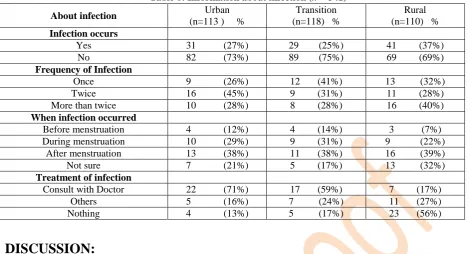
Table 6 about the infection occurred during menstruation. It was observed from this study that there was no difference in chance of occurring in infection in urban or rural areas. Both girls from urban or rural area got infected during or after menstruation but differences were there in case of consult to doctor. In urban area where 71% girls went to doctor for treatment when there was infection but 59% transition and only 17% rural girls consulted with doctor during infection.
Menstrual hygiene Urban
(n=113) %
Transition (n=118) %
Rural (n=110) %
Use of material during menstruation
Sanitary pads 94 (83%) 77 (65%) 11 (10%)
New cloth pieces 2 (2%) 2 (2%) 1 (1%)
Old cloth pieces 4 (4%) 11 (9%) 53 (48%)
All the above 13 (11%) 28 (24%) 45 (41%)
Reuse of absorbent
Yes 10 (10%) 24 (20%) 72 (65%)
No 103 (91%) 94 (80%) 38 (35%)
Cleaning of external genitalia
Satisfactory * 85 (75%) 76 (64%) 82 (75%)
Unsatisfactory † 28 (25%) 42 (36%) 28 (25%)
Use for cleaning purpose
Only water 41 (36%) 49 (42%) 57 (52%)
Soap and water 72 (54%) 69 (58%) 53 (48%)
Method of disposal‡
Through in routine waste 93 (82%) 76 (64%) 30 (27%)
Other- flush/hide 13 (12%) 21 (18%) 43 (39%)
Through in other place 7 (6%) 16 (14%) 28 (26%)
Burn 0 (0%) 5 (4%) 9 (8%)
Restrictions Urban
(n=113) %
Transition (n=118) %
Rural (n=110) %
Not practiced 22 (19%) 11 (9%) 2 (2%)
Practiced for* 91 (81%) 107 (91%) 108 (98%)
Any religious occasion 84 (66%) 94 (60%) 103 (47%)
Playing 10 (8%) 19 (12%) 32 (15%)
School 7 (5%) 3 (4%) 18 (8%)
Household work 2 (2%) 4 (3%) 11 (5%)
Certain food 19 (15%) 22 (14%) 36 (17%)
Marriage 4 (3%) 9 (6%) 13 (6%)
IJSRR, 7(4) Oct. – Dec., 2018 Page 2189 Table 6: Information about infection (n = 341)
DISCUSSION:
This study shows that of total 341 respondents 58% of girls were aware of menstruation before menarche of which 100 (88%) girls were urban, 74 (63%) girls were transition and 23 (21%) were rural. In the study conducted by Deo et al., [3] it was reported that 40 (42.5%) rural and 41 (55.4%) urban girls were aware about menstruation prior to attainment of menarche. Similar study conducted in Nagpur by Patle et al. [4] found that 63.38% girls in urban area were aware of menstruation before menarche as compared to 47.57% girls in rural area. Gupta et al. [5] found that 68% of adolescent girls were not aware about menses before menarche.
This study shows that the age of menstruating girls ranged from 7 to 15 years with maximum number of girls between 12 and 13 years of age. Study conducted by Deo et al. [3] reported that the age of menstruating girls ranged from 12 to 17 years with maximum number of girls between 13 and 15 years of age. In the present study, the mean age of menarche of the respondents was 12.2 years, whereas in a study by Khanna et al. [6] reveals that the mean age at menarche was found to be 13.2 years.
Ideally a mother should be the main informant about the menarche at this age. However, mother was the first informant observed in this study also. Mother was the main source of information about menstruation in 74 (65%) urban, 66 (56%) transition and 56 (51%) rural girls. In all respondents mother was the first source of information for 52% girls, other sources of information were friends 55 (16%) and relatives 44 (13%). Study done in Nagpur supported the present study's findings where mothers were the first informants for 71.33% of the girls.[1] On the contrary, a study conducted among schoolgirls in Egypt by El-Gilany et al. observed mass media were the main source of information about menstrual hygiene, followed by mothers.[7].
About infection Urban
(n=113 ) %
Transition (n=118) %
Rural (n=110) %
Infection occurs
Yes 31 (27%) 29 (25%) 41 (37%)
No 82 (73%) 89 (75%) 69 (69%)
Frequency of Infection Once 9 (26%) 12 (41%) 13 (32%)
Twice 16 (45%) 9 (31%) 11 (28%)
More than twice 10 (28%) 8 (28%) 16 (40%)
When infection occurred Before menstruation 4 (12%) 4 (14%) 3 (7%)
During menstruation 10 (29%) 9 (31%) 9 (22%)
After menstruation 13 (38%) 11 (38%) 16 (39%)
Not sure 7 (21%) 5 (17%) 13 (32%)
Treatment of infection Consult with Doctor 22 (71%) 17 (59%) 7 (17%)
Others 5 (16%) 7 (24%) 11 (27%)
IJSRR, 7(4) Oct. – Dec., 2018 Page 2190
This gap might be due to poor literacy and socio-economic status of mothers, which have fuelled the inhibitions a mother has to talk to her daughter regarding the significance, hygienic practices and a healthy attitude towards menstruation. The latter will play a long way in maintaining a healthy reproductive tract for each and every girl child who, after she becomes a mother, percolates the healthy message to her female offspring. In a study conducted among 664 schoolgirls aged 14-18 in Mansoura, Egypt by El-Gilany et al. [ 7], mass media were the main source of information about menstrual hygiene, followed by mothers. Another study conducted by Deo et al. [3]reported that 40 (42.5%) urban and 41 (55.4%) rural girls were aware about menstruation prior to attainment of menarche. In urban girls, mother was the main source of information about menstruation (27.5%), whereas it was teacher in the rural counterparts (27.01%). Other sources of information were friends, relatives and books. In a study conducted in Rajasthan by Khanna et al. [6], nearly 92% of the girls were not aware about the natural phenomenon of menstruation during menarche among women and most of the girls got first information about menstruation from their mothers with other major informants being sisters and friends.
This study observed that 197 (58%) girls believed menstruation as a physiological process. Another study by Subhas et al. [1] where 18.35% of the adolescent girls opined menstruation as normal phenomenon. Opposite picture seen in the study conducted in Rajasthan by Khanna et al. [6] where 86.25% girls believed it to be a physiological process and Dasgupta et al. [2] observed that 86.25% girls believed it to be a physiological process. This study's observations might be due to poor educational status of mothers or the absence of health education and awareness programmes in school.
It was observed in this study that 87 out of 110 (79%) girls in rural areas don’t know the actual cause of menstruation,whereas in a similar study conducted in Rajasthan by Khanna et al. [6], nearly 70% believed that menstruation was not a natural process. It was very sad to observe in the present study that most of the girls did not know about the source of menstrual bleeding and more than half of the girls were ignorant about the use of sanitary pads during menstruation. The above observations might be due to poor literacy level of mothers or absence of proper health education programmes in school, which should focus on menstrual hygiene among girls.
IJSRR, 7(4) Oct. – Dec., 2018 Page 2191
This study shows that 4 (4%) urban, 11 (9%) transition girls and 53 (48%) girls in the rural area were using old cloth piece as absorbent pads and 10 (10%) urban, 24 (20%) transition and 72 (65%) rural girls reused the same in the subsequent period which almost corroborates studies in Nepal by Adhikari et al., [10] in India Dasgupta et al., Narayan et al., [2, 8] and Khanna et al.[6] Nair et al.[11] found 74.8% of the girls used homemade sanitary pads and 24% used ready-made sanitary pads. So in this study, the use of sanitary pads was higher than those observed in other studies. The more availability of sanitary pads now-a-days might be the reason for this finding. This study shows that majority of the rural girls preferred cloth pieces rather than sanitary pads as menstrual absorbent. Only 10% rural girls used sanitary pads during menstruation. Poverty and to some extent ignorance might be an obstacle from using the menstrual absorbents available in the market.
Cleaning of external genitalia was two times per day in 85 (75%) of the urban, 76 (64%) transition and 82 (75%) of the rural girls, which was satisfactory according to the criteria set in this study. 28 (25%) of the urban, 42 (36%) and 28 (25%) of the rural girls cleaned genitalia only once, which was unsatisfactory according to the criteria set in this study. It was also found in the study done by Patle et al [4] that hygienic practice is more satisfactory in the urban area (62.03%) as compared to the rural (43.40%). This study found that hygienic practices are satisfactory in three different areas.
IJSRR, 7(4) Oct. – Dec., 2018 Page 2192
by most of the girls in the present study, possibly due to their ignorance and false perceptions regarding menstruation.
This study revealed different types of restrictions practiced during menstruation. 81% of urban and 91% of transition and 98% rural girls practiced different restrictions during menstruation.
Among them 84 (66%) urban, 94 (60%) transition and 103 (47%) rural girls did not attend any religious occasion during menstruation. Shubhas et al. [1] showed that 73.64% and Dasgupta et al. [2] found that (85%) girls practised different restrictions during menstruation.
No difference observed in chance of occurring in infection in three study areas, but differences were there in case of consult to doctor. Urban girls consulted to doctor, when infected, more than rural girls.
CONCLUSIONS AND RECOMMENDATION:
Perception and practice regarding menstruation was more in urban girls as compared to transition and rural areas. Significantly more number of girls in the urban area was using sanitary pads as compared to the rural girls. However Hygienic practices during menstruation were satisfactory in three different urban, transition and rural areas.
Girls should be educated about the facts of menstruation, physiological implications, significance of menstruation, and proper hygienic practices during menstruation. It is also required to bring them out of traditional beliefs, taboos, misconceptions, and restrictions. This can be achieved with the help of media, sex education in school curriculum, and focused group discussions. All mothers should be encouraged to break their inhibitions about discussing with their daughters regarding menstruation and menstrual hygiene. Universalized use of sanitary pads can be advocated to every girl by social marketing.
ACKNOWLEDGMENTS:
Authors are thankful to Honourable Vice-Chancellor and to the Department of Zoology, West Bengal State University, India for encouragement. The authors also like to thank Mrs. Khadija khatun , Mrs. Manju Banerjee and Mrs. Mala Basu, for helping during survey work in school and college campus.
Contribution of Authors: S K Saha: Concept and study design; Critical appraisal of the study; preparation of draft, Z Parvin: Collection, analysis and interpretation of data; Critical revision of the draft.
SOURCE OF SUPPORT:
NilIJSRR, 7(4) Oct. – Dec., 2018 Page 2193
REFERENCES:
1. Thakre SB, Thakre SS, Reddy M, Rathi N, Pathak K, Ughade S. Menstrual hygiene: Knowledge and practice among adolescent school girls of Saoner, Nagpur district. J Clin Diagn Res. 2011;5:1027-33
2. Dasgupta A, Sarkar M. Menstrual hygiene: How hygienic is the adolescent girl? Indian J Community Med. 2008;33:77-80.
3. Deo DS, Ghattargi CH. Perceptions and practices regarding menstruation: a comparative study in urban and rural adolescent girls. Indian J Community Med. 2005;30:33-4
4. Patle R, Kubde S. Comparative study on menstrual hygiene in rural and urban adolescent girls. Int J Med Sci Public Health. 2014;3:129-32.
5. Gupta J, Gupta H. Adolescence and menstruation. J Family Welfare. 2001;47:1-13.
6. Khanna A, Goyal RS, Bhawsar R. Menstrual practices and reproductive problems: a study of adolescent girls in Rajasthan. J Health Manag. 2005;7:91-107.
7. El-Gilany AH, Badwi K, El-Fedawy S. Menstrual hygiene among adolescent schoolgirls in Mansoura, Egypt. Reprod Health Matters. 2005;13:147-52.
8. Narayan KA, Srinivasa DK, Pelto PJ, Veerammal S. Puberty rituals, reproductive knowledge and health of adolescent schoolgirls insouth India. Asia Pac Popul J. 2001;16:225-38.
9. Drakshayani Devi K, Venkata Ramaiah P. A study on menstrual hygiene among rural adolescent girls. Indian J Med Sci. 1 99;;48:139-43.
10.Adhikari P, Kadel B, Dhungel SI, Mandal A. Knowledge and practice regarding menstrual hygiene in rural adolescent girls of Nepal. Kathmandu Univ Med J (KUMJ) 2007;5:382-6. 11.Nair P, Grover VL, Kannan AT. Awareness and practices of menstruation and pubertal