www.technology.matthey.com
JOHNSON MATTHEY
TECHNOLOGY REVIEW
Lithium Battery Discussions – Electrode Materials
Recent advancements in negative electrode materials
Reviewed by Iona Moog* and Sarah Ball
Johnson Matthey Technology Centre, Blounts Court, Sonning Common, Reading RG4 9NH, UK
*Email: [email protected]
1. Introduction
2015 may prove to be a pivotal point in managing the world’s climate following the United Nations Conference of Parties (COP21) in Paris (1). The gathering of nearly 200 countries to tackle climate change and their determination to limit global temperature rises to below 2ºC by the end of the century was highly signifi cant. However, to meet these ambitious aims requires corresponding energy strategies.
In this context, secondary or rechargeable batteries represent a tool or an alternative to existing and more polluting technologies. Capable of being repeatedly charged and discharged, they hold interest for their energy storage capabilities (coupled to renewable technologies, for example solar power or wind) and supplementing the internal combustion engine. Although gaining momentum since the 1990s, metal-ion battery technologies have yet to meet all of the prerequisites of the automotive industry in terms of cost and range (2, 3). Extensive research is taking place globally at all levels: electrode and electrolyte materials, cell and battery design, pack management and optimisation. The ultimate target is to deliver the
battery of tomorrow, that is long-lasting, affordable, safe and with greater energy and power performance.
Every two years, the Lithium Battery Discussion (LiBD) hosts leading scientists in Arcachon, France. In 2015 LiBD was held between 21st and 26th June, and approximately 200 scientists attended the conference, with 9 invited lectures, 61 oral communications and over 130 poster presentations. This was divided into 11 plenary sessions, centred on positive and negative electrode materials beyond lithium-ion technologies (Li-air and Li-sulfur) and transverse discussions on interfaces and characterisation (4).
In this short review, the focus will be on negative electrode (anode) materials, covered both during plenary talks and within the poster presentations. Both industrial and academic contributors reported the latest results related to negative materials for Li or sodium secondary batteries, with a substantial number devoted to high capacity silicon-containing electrodes.
2. A Brief Overview of the Type of Anodes
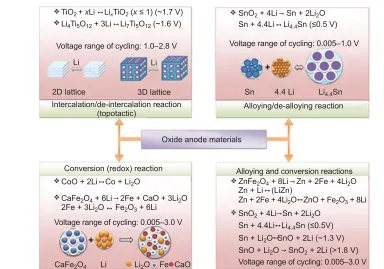
higher gravimetric or volumetric capacities using this class of material. The fi nal family of materials involves the storage of Li via conversion or a combination of alloying and conversion reactions. These materials (for example CaFe2O4 CaO + Fe + Li2O) present
intermediate values in terms of energy storage but usually have low stability and coulombic effi ciency.
3. Graphite and Carbons
3.1 Graphite
The fi rst commercial use of graphite in a Li-ion battery dates back 20 years and since then the system has been extensively characterised and has been the subject of many reviews (6–8). The Li cation can be intercalated between the graphene sheets, with a ratio of one Li per carbon atom. Graphite, made of an abundant element, carbon, is relatively low cost with an acceptably low volume expansion upon lithiation. Coupled with a low potential versus Li, a high electrical conductivity and good Li diffusivity, it is unsurprising that graphite has conquered the market since the beginning of the century. Interestingly, there were no scientifi c talks on graphite at the conference, which may be due to the maturity of the technology.
Despite all of the qualities of graphite, considerable research is ongoing to fi nd a substitute. This is mostly
due to the relatively low theoretical capacity of the material, 372 mAh g–1. Negative electrodes with
higher capacities will need to be developed to take full advantage of the latest positive electrode improvements (9). It is also worth noting that graphite mines and factories are not environmentally benign and can have an adverse impact on clean air (10). Some examples of alternative technologies being investigated are highlighted below.
3.2 Hard and Soft Carbons
Unlike graphite, hard and soft carbons have limited crystallinity and can be described as glassy carbons. Because of inter and intra-layer disorders, Li is stored in the structure differently to that of graphite, with published gravimetric capacities of 200 to 330 mAh g–1. There was
signifi cant academic interest in these materials during the conference especially as negative electrodes in Na-ion batteries where pure Na electrodes cannot be used due to safety issues and graphite presents limited Na insertion (11). However, these carbons suffer from a low tap density and high irreversible capacities.
Virginie Simone (Université Grenoble Alpes, France) discussed the control of porosity and microstructures
via different post treatment temperatures to promote interstitial storage of Na. A poster presentation by Damien Saurel (CIC Energigune, Spain) examines
TiO2 + xLi LixTiO2 (x≤ 1) (~1.7 V)
Li4Ti5O12 + 3Li Li7Ti5O12 (~1.6 V)
Voltage range of cycling: 1.0–2.8 V
Li Li
2D lattice 3D lattice Intercalation/de-intercalation reaction
(topotactic)
SnO2 + 4Li Sn + 2Li2O
Sn + 4.4Li Li4.4Sn (≤0.5 V)
Voltage range of cycling: 0.005–1.0 V
Sn 4.4 Li Li4.4Sn
Alloying/de-alloying reaction
Oxide anode materials
Conversion (redox) reaction CoO + 2Li Co + Li2O
CaFe2O4 + 6Li 2Fe + CaO + 3Li2O
2Fe + 3Li2O Fe2O3 + 6Li
CaFe2O4 Li Li2O Fe CaO
Alloying and conversion reactions ZnFe2O4 + 8Li Zn + 2Fe + 4Li2O
Zn + Li (LiZn)
Zn + 2Fe + 4Li2O ZnO + Fe2O3 + 8Li
SnO2 + 4Li Sn + 2Li2O
Sn + 4.4Li Li4.4Sn (≤0.5V)
Sn + Li2O SnO + 2Li (~1.3 V)
SnO + Li2O SnO2 + 2Li (>1.8 V)
Voltage range of cycling: 0.005–3.0 V
Fig. 1. Different anode materials based on their mode of storage (Reprinted with permission from (5). Copyright (2013) American Chemical Society)
disordered carbons as negative electrode materials in Na-ion batteries. Some studies have also emerged combining hard carbons and graphite. Alexandre Ponrouch (Institut de Ciéncia de Materials de Barcelona, Spain) explained that hard carbons are less susceptible to exfoliation and complex core-shell systems, such as graphite@hard carbon, could be interesting despite the high irreversible losses of hard carbons.
4. Beyond Lithium-ion Materials: Short, Medium and Long Term
4.1 Titanium-based Materials for Lithium-ion: Titania and Lithium Titanate
Spinel-based Li4Ti5O12 (LTO) has been extensively
researched since it was fi rst reported as an anode material. LTO crystallises in the Fd3m space group and can store up to three Li cations in the structure
via intercalation. It is often referred to as a ‘zero-strain’ material due to the negligible volume change upon Li insertion. Based on the stability and three-dimensional (3D) intercalation process, LTO is a very good candidate especially for long life and higher power density applications. It has a relatively high operating voltage, 1.55 V vs. Li, which is a signifi cant benefi t; no electrolyte decomposition can occur at the surface, with no solid electrolyte interphase (SEI) formation (12). This enables greater cell lifetimes as the capacity decay is limited. However, the higher voltage means that LTO needs to be coupled with a high voltage cathode material to maintain a good electromotive force overall. Other disadvantages of LTO are its low gravimetric capacity, 175 mAh g–1 and the additional
costs associated with titanium.
At LiBD, LTO was the object of two poster presentations and one talk. A poster presentation by Marlena Uitz (Graz University of Technology, Austria) described the different syntheses to induce porosity in the materials and control their morphologies, in particular nanorods. Katia Guérin (Institut de Chimie de Clermont-Ferrand, France) examined the plans to substitute oxygen by fl uorine leading to titanium oxyfl uoride (TiOF2) which provides higher gravimetric
capacities in a collaborative project with the Centre National d’Etudes Spatiales (CNES), France. Incorporation of fl uorine in any materials, however, is associated with often costly, potentially hazardous processes and further research on size, porosity and morphologies will be needed before a possible penetration of LTO into the market.
4.2 Silicon
There is currently considerable industrial and academic interest in using Si as an anode material in Li-ion batteries. Of all the ‘post-graphite’ technologies, Si-containing electrodes seem the closest to commercialisation. Through alloying reactions, Si is able to store up to 4.4 Li per Si, leading to the highest known gravimetric capacity (apart from Li) of all negative materials, at 4200 mAh g–1. However, the
lithiation (delithiation) process is linked with dramatic volume changes causing the pulverisation of the electrodes, loss of contact between active material and collector, and a subsequent increase in cell resistance (9). The working voltage of Si is low, around 400 mV
vs. Li and is therefore vulnerable to SEI formation through electrolyte degradation. Coupled with the volume expansion upon lithiation, this SEI is likely to crack at each cycle and be unstable. High irreversible losses and fast cycle decays are currently holding back the technology. Different strategies (going nanometric helps alleviate the stress, it is also common in the literature to use morphology-controlled particles such as nanorods (volume changed in just one direction) and/or to add additives to the electrolyte to form a better SEI) are used to atone for the impact of the volume expansion and SEI. Panasonic uses, among others, graphite-silicon composites. Indeed, the latest Tesla pack (made by Panasonic) contains Si and the business plan is to incrementally increase the amount of Si (13). “This is just sort of a baby step in the direction of using Si in the anode”, Elon Musk (CEO – Tesla Motors, USA).
At LiBD, Si electrodes were the object of a plenary session of fi ve talks and fourteen posters:
• Arnaud Bordes (Chimie ParisTech, France), Tahar Azib (Institut de Chimie et de Matériaux Paris Est, France), Dragoljub Vrankovic (Technische Universität Darmstadt, Germany) and Kristof Van Havenbergh (University of Antwerp, Belgium) explored new morphologies and structures (thin
fi lms, core shells) in order to minimise the impact of the volume change by promoting growth in one or two controlled direction(s)
• Mark Obrovac (Dalhousie University, Canada) and David Duveau (Institut Charles Gerhardt, France) presented the use of Si/NiSn/Al/C, GeSi, Ni as anchors and inactive phase
• Andreas Gonser (Technische Universität Chemnitz, Germany) presented a poster on electrolyte additives, to promote the durable formation of a SEI. This study shows that fl uorethylene carbonate (FEC) is one of the best candidates in terms of stability. However, with constant consumption at the surface, electrolyte depletion is likely to happen. Most of these strategies are well known in the literature (14, 15) and provide a good fundamental understanding of the chemistry of the alloy, electrodes and electrochemistry. This is helpful considering the increasing commercial interest in Si-based anode technology.
4.3 Polyanions Involving Conversion Reactions
Polyanions involve conversion reactions following redox reaction between Li+ and the host, most often lithium
oxide (Li2O) which is formed along with metallic particles.
More than one Li cation can be stored per formula unit depending on the materials and the valence states of its elements leading to a higher capacity than graphite. Conversion materials involve breaking and forming chemical bonds. This feature coupled with the presence of (possibly inert) Li2O is associated with large hysteresis
during cycling and high irreversible losses (5).
Conversion materials were the subject of four posters. Geethu Balachandran (Karlsruhe Institute of Technology (KIT), Germany) presented a poster on ferrites MFe2O4 (with M = Zn, Fe, Co, Ni) which are
relatively low cost materials with capacities between 750 and 1000 mAh g–1, more than double the capacity
of graphite. Samantha Bourrioux (Commissariat à l’énergie atomique et aux énergies alternatives (CEA), France; and National Center for Scientifi c Research (CNRS), France) presented a poster on the synthesis of ZnFe2O4 nanoparticles by laser pyrolysis. Most
of the presentations aimed at understanding the complex intermediate phases and crystallographic rearrangements during charge and discharge.
5. Conclusions
Mainly focused on materials and characterisation techniques, LiBD was an interesting conference related to European secondary battery research within both industry and academia. Researchers from a number of major automotive companies attended, confi rming the interest in developing new battery technologies for transport applications. It is also worth noting that Li metallic electrodes were absent in the talks and
poster presentations. Despite better understanding of dendrite formation (16), current technologies have not yet managed to solve this 50 year challenge.
Research on negative materials has long been less intensive than on their positive counterparts but the emergence of novel positive electrodes has recently intensifi ed the search for a graphite substitute. The recent inclusion of Si in commercial cells may well catalyse the more widespread industrial adoption of these, up-to-now, next generation materials.
6. Acknowledgements
The reviewer acknowledges and thanks James Cookson (Johnson Matthey Technology Centre, Sonning Common, UK) for fruitful corrections and discussions.
References
1. COP21 special report: http://www. climateactionprogramme.org/cop21 (Accessed on 27th May 2016)
2. O. Gröger, H. A. Gasteiger and J.-P. Suchsland, J. Electrochem. Soc., 2015, 162, (14), A2605
3. J. B. Goodenough and K.-S. Park, J. Am. Chem. Soc., 2013, 135, (4), 1167
4. LIBD 2015 Lithium Battery Discussions: http:// libd2015.sciencesconf.org/ (Accessed on 27th May 2016)
5. M. V. Reddy, G. V. Subba Rao and B. V. R. Chowdari, Chem. Rev., 2013, 113, (7), 5364
6. D. Aurbach, E. Zinigrad, Y. Cohen and H. Teller, Solid State Ionics, 2002, 148, (3–4), 405
7. D. Aurbach, B. Markovsky, I. Weissman, E. Levi and Y. Ein-Eli, Electrochim. Acta, 1999, 45, (1–2),
67
8. “Principles and Applications of Lithium Secondary Batteries”, ed. J.-K. Park, Wiley VCH Verlag & Co KGaA, Weinheim, Germany, 2012
9. U. Kasavajjula, C. Wang and A. J. Appleby, J. Power Sources, 2007, 163, (2), 1003
10. E. Behrmann, “Green Batteries’ Graphite Adds to China Pollution”, Bloomberg, 2014: http://www. bloomberg.com/news/articles/2014-03-14/teslas-in-california-help-bring-dirty-rain-to-china (Accessed on 27th May 2016)
11. V. Palomares, M. Casas-Cabanas, E. Castillo-Martínez, M. H. Han and T. Rojo, Energy Environ. Sci., 2013, 6, (8), 2312
13. K. Korosec, “This is Tesla’s Plan for a Cheaper Car”, Fortune, 2015: http://fortune.com/2015/07/22/teslas-cheaper-car/ (Accessed on 27th May 2016)
14. F. Luo, B. Liu, J. Zheng, G. Chu, K. Zhong, H. Li, X. Huang and L. Chen, J. Electrochem. Soc., 2015, 162,
(14), A2509
15. X. Su, Q. Wu, J. Li, X. Xiao, A. Lott, W. Lu, B. W. Sheldon and J. Wu, Adv. Energy. Mater., 2014, 4, (1), 1300882
16. K. J. Harry, D. T. Hallinan, D. Y. Parkinson, A. A. MacDowell and N. P. Balsara, Nature Mater., 2014,
13, (1), 69
The Reviewers
Iona Moog is a Senior Scientist at the Johnson Matthey Technology Centre, Sonning Common, UK. In the last three years, she has been involved in work on lithium-ion, lithium-sulfur and sodium-ion batteries. She specialises in Material Sciences and processes structure-properties-performances relationships.