Research article Available online www.ijsrr.org ISSN: 2279–0543
International Journal of Scientific Research and Reviews
Polymorphic Characteristics of Terrestrial Snails Trachea Vittata in
Semi Arid Micro Habitat
I. Malaichelvi1 and M. Chandran2*
*2
Associate Professor, Dept. of Zoology, Thiruvalluvar University, Serkkadu-115.
1
Dr. Ambedkar Government Arts College, Chennai- 600039.
ABSTRACT
Polymorphism shown in snail is a classic example for the evolutionary drive through natural selection on gene frequency in a population. In the present study, a trial has been taken up to understand the variability of colour and banding pattern on poorly known terrestrial snail species, Trachea vittata. By collecting 20 specimens from a semi arid microhabitat, the banding pattern, colour variability on shells and its relating microhabitat have been recorded and analysed. Result showed that variation both in number (0 to 9) and thickness of the band is evident and played a significant role in adaptation and found to be disassociated to the microhabitat choice. Findings confirmed that high degree of colour and banding pattern of T. vittatashown adaptive significance in order to escape from the pressure exerted by avian predators.
Key words: Trachea vittata, Gastropod, microhabitat, active adaptation.
*Corresponding author:
M. Chandran2*
INTRODUCTION
Land snails constitute about six per cent of the total species on1. A large part of
molluscan fauna in many tropical regions of the world is still poorly known. They are
considered to be the prey base for a number of small mammals and birds2 Trachea
vittatadisplays a high degree of phenotypic polymorphism in shell pattern and colour, but
this is poorly researched.
The genetic basis of banding pattern has been worked out in detail for Cepaea
nemoralis 3. In their work, banding pattern and colour were classified as follows. It is shown
that several banding patterns (e.g. 12300, 02300, 00340, 003300, 00305) should be classified
as 00300. The presence or absence of extra (satellite-) bands seems to be multifactorial
controlled. Pale is recessive to dark body colour. The latter occurs in several shades which
are multifactorial controlled. Reddish body colour is recessive to yellowish, and the gene
concerned is linked with that for shell colour. Variation in the expression of dominance was
found at the loci for 00300, 00345, 10345, reddish body colour and pale body colour. The
presence or absence of band 3 in banded snails does not seem to be genetically
determined4.Supergene influence and habitat preference must have evolved in different
species land snails5.
Investigation into the mechanisms behind the maintenance of phenotypic
polymorphism on poorly known species T.vittata is still unclear. The expression of banding
pattern of T.vittata was varied from Cepaea nemoralis but not yet studied.Therefore an
attempt has been taken up to identify the banding pattern and its relation with microhabitat
and its unique polymorphic characteristics have been analysed in T. vittata.
MATERIALS AND METHODS
Data collection
A field survey has been carried out during July 2017 to November 2017 in a stretch
starting from Thirumangalam ( 9. 812°N , 77.997 °E) of Madurai district along the road sides
towards south about 6 km length .The study site covering diverse plants including Morinda
coreia, Azadirachta indica and Prosopis juliflora are predominantly occur. The specimens
spontaneously developing for over 60 years.There are also vegetation such as grasses,
Pongamia pinnata, Acacia auriculiformis (about 20% of the site area) with dwarf Mimusops
elengi diversified by shrubs including blackthorn. Therefore, our chosen study area was
dominated by dark, shaded habitats that were composed mainly of shrubs and young trees. In
the present study, about 200 aestivating T.vittata were collected manually by hand picked
carefully with a skilled person, after recording the microhabitat for each specimen. The
colour and banding pattern on the shells were observed with the help of a hand lens and
grouped in to umbilical, middle and sutural based on the location of the band. Based on the
banding pattern, collected specimens were grouped into 20 according to the similarity. The
thickness and length of each band on every shell was also recorded and analysis was carried
out.
RESULT AND DISCUSSION
The shells of T.vittata are whitish in nature with unique band pattern. The collected
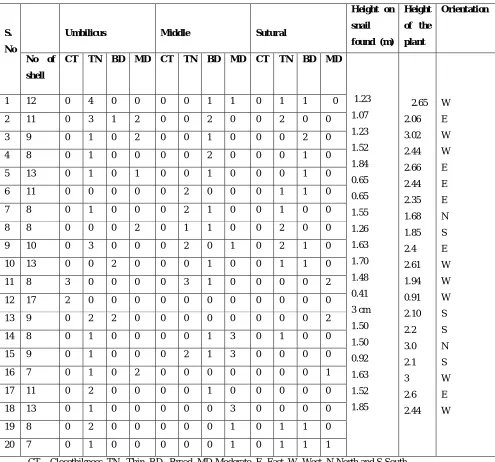
shells of T.vittata showed a varying degree of brown bands.( Table 1) The numbers of brands
(0 to 9) and thickness were varied. The thickness of brand was recorded as the range from
thin (c0.1 mm) to broad (>2 mm). The bands are broad at the base and near the margin of the
mouth or operculum and gradually tapering towards the apex of the shell. Few snails were
found to be pale in colour exposed to bright sunlight Result also showed that no correlation
between bands and thickness of the shell to the microhabitat.(Table -1 )
Allen (2004) demonstrated that terrestrial gastropods are often polymorphic for
colouration and the commonest morph is usually the one with best match to the colouration
of the background 6,7,8,9,10,11,12.
Direct evidence that habitat morph frequencies are caused by visual hunters removing
conspicuous animals come from comparisons of the frequencies of morph with morph
frequencies in the population. In contrast, our study revealed that banded pattern in snails
T.vittata seem to have no relation to the microhabitat choice. The genetically controlled
banding patterns of the shell play a relative role of chance in the evolution of land snail13.
influenced by natural selection. Pale colouration in shells is suggestive that an adoptive
variation as in Theba pisana14,15.
Table - 1 showing polymorphic characteristics of T.vittata (Muller) in relating to microhabitat
S. No
Umbilicus Middle Sutural
Height on snail found (m)
Height of the plant
Orientation
No of shell
CT TN BD MD CT TN BD MD CT TN BD MD
1.23 1.07 1.23 1.52 1.84 0.65 0.65 1.55 1.26 1.63 1.70 1.48 0.41 3 cm 1.50 1.50 0.92 1.63 1.52 1.85 2.65 2.06 3.02 2.44 2.66 2.44 2.35 1.68 1.85 2.4 2.61 1.94 0.91 2.10 2.2 3.0 2.1 3 2.6 2.44 W E W W E E E N S E W W W S S N S W E W
1 12 0 4 0 0 0 0 1 1 0 1 1 0
2 11 0 3 1 2 0 0 2 0 0 2 0 0
3 9 0 1 0 2 0 0 1 0 0 0 2 0
4 8 0 1 0 0 0 0 2 0 0 0 1 0
5 13 0 1 0 1 0 0 1 0 0 0 1 0
6 11 0 0 0 0 0 2 0 0 0 1 1 0
7 8 0 1 0 0 0 2 1 0 0 1 0 0
8 8 0 0 0 2 0 1 1 0 0 2 0 0
9 10 0 3 0 0 0 2 0 1 0 2 1 0
10 13 0 0 2 0 0 0 1 0 0 1 1 0
11 8 3 0 0 0 0 3 1 0 0 0 0 2
12 17 2 0 0 0 0 0 0 0 0 0 0 0
13 9 0 2 2 0 0 0 0 0 0 0 0 2
14 8 0 1 0 0 0 0 1 3 0 1 0 0
15 9 0 1 0 0 0 2 1 3 0 0 0 0
16 7 0 1 0 2 0 0 0 0 0 0 0 1
17 11 0 2 0 0 0 0 1 0 0 0 0 0
18 13 0 1 0 0 0 0 0 3 0 0 0 0
19 8 0 2 0 0 0 0 0 1 0 1 1 0
20 7 0 1 0 0 0 0 0 1 0 1 1 1
CT -Closethikness, TN –Thin, BD –Broad, MD-Moderate, E- East, W- West, N-North and S-South
An unpublished report by Chandran et al.,revealed that predatory pressure exerted on
T.vittata was shown least percent than C.numeralis. This banding pattern in T.vittata is an
adaptive role to avoid predation using its polymorphic nature as they were all found in equal
height and same at microhabitat. Furthermore, it was observed that variation in banding is
.
CONCLUSION
Polymorphism is a means of survival during the evolutionary drive by using isolating
mechanism over a long period of time. The present study has been focussed on the banding
patterns of poorly known species, T.vittata in its microhabitat. It reveals that banding pattern
of this species is unique and exhibit adaptive role in succeeding from the predator by
camouflaging to its surrounding. The mechanism of variation in banding variability on
genetic basis is a thrust area for future research to this taxa.
REFERENCES
1. Clark, JA May, RM. Taxonomic bias in Conservation Research. Science.2002; 297:
191–192.
2. Deepak, VK Vasudevan, B Pandav. Preliminary observation on the diet of the cane
turtle (Vijayachelys silvatica). Hamdaryad.2010;34: 166–168.
3. Cain, AJ Currey, JD. Area effects in Cepaea. Philosophical Transactions of the Royal
Society Series B.1963; 246 :1-81.
4. Wolda. H. Genetics of Polymorphism in the land snail Cepaea nemoralis , Genetica.
1969; 40:475-502 .
5. Hazel,WN Johnson MS .Microhabitat choice and Polymorphism in the land snail
Theba pisana (Mullar). Heredity.1990;65 : 449-454.
6. Allen, JA.Avian and mammalian predators of terrestrial gastropods. In:Natural
enemies of terrestrial molluscs (ed). CABI Publishing:New Zeeland;2004.
7. Cain, AJ Sheppard, PM. Natural selection in Cepaea. Genetics. 1954 ; 39: 89–116
8. Clarke, B. Divergent effects of natural selection on two closely related polymorphics
snails..Heredity.1960; 14: 423 -443.
9. Jones, JS Leith, BH Rawlings,P. Polymorphism in Capaea: A problem with too many
solutions? A. Rev. Eco!. Syst. 1977; 8: 109-143.
10.Lewis,G. Shell polymorphism in the snail Cochlicella acuta ( Muller) and some data
on its genetics. Biological journal of the Linnean Society.1975; 7: 147-160.
11.Lewis,G. Polymorphism and selection in Cochlicella acuta. Philosophical
Transactions of the Royal Society, Series B, Biological Sciences. 1977; 276:399-451.
13.Shelton, PR. Natural selection on the colour polymorphism of Trichia hispida
(L.).Heredity.1984; 53:649-653.
14.Chiba, S. Character displacement, frequency -dependent selection, and divergence of
shell colour in lands snails Mandarina (Pulmonata). Biological journal of the Linnean
Society.1999; 66: 465-479.
15.Cain, A. Genetics of some morphs in the land snail Theba pisana. Malacologia. 1984;
25: 381-411.
16.Cowie, RH. Microhabitat choice and high temperature tolerance in the land snail