Original citation:
The Pelvic floor Society, National Institute for Health Research: Chronic Constipation
Treatment Pathway (Including: Mercer-Jones, M., Grossi, U., Pares, D., Vollebregt, P. F.,
Mason, James and Knowles, C. H.). (2017) Surgery for constipation : systematic review and
practice recommendations : Results III: Rectal wall excisional procedures (Rectal Excision).
Colorectal Disease, 19 (S3). pp. 49-72.
Permanent WRAP URL:
http://wrap.warwick.ac.uk/92944
Copyright and reuse:
The Warwick Research Archive Portal (WRAP) makes this work of researchers of the
University of Warwick available open access under the following conditions.
This article is made available under the Creative Commons Attribution 4.0 International
license (CC BY 4.0) and may be reused according to the conditions of the license. For more
details see:
http://creativecommons.org/licenses/by/4.0/
A note on versions:
The version presented in WRAP is the published version, or, version of record, and may be
cited as it appears here.
Surgery for constipation: systematic review and practice
recommendations
Results III: Rectal wall excisional procedures (Rectal Excision)
M. Mercer-Jones*, U. Grossi†, D. Pares‡, P. F. Vollebregt†, J. Mason§, C. H. Knowles†, on behalf of the NIHR CapaCiTY working group¶and the Pelvic floor Society**
*Queen Elizabeth Hospital, Gateshead NHS Trust, Gateshead, UK,†National Bowel Research Centre, Blizard Institute, Queen Mary, University London, London, UK,‡Hospital Germans Trıas i Pujol, Barcelona, Spain,§University of Warwick, Coventry, UK,¶National Institute for Health Research: Chronic Constipation Treatment Pathway, London, UK and **Affiliate section of the Association of Coloproctology of Great Britain and Ireland
Abstract
AimTo assess the outcomes of rectal excisional proce-dures in adults with chronic constipation.
MethodStandardised methods and reporting of bene-fits and harms were used for all CapaCiTY reviews that closely adhered to PRISMA 2016 guidance. Main con-clusions were presented as summary evidence statements with a summative Oxford Centre for Evidence-Based Medicine (2009) level.
ResultsForty-seven studies were identified, providing data on outcomes in 8340 patients. Average length of procedures was 44 min and length of stay (LOS) was 3 days. There was inadequate evidence to determine vari-ations in procedural duration or LOS by type of proce-dure. Overall morbidity rate was 16.9% (0–61%), with lower rates observed after Contour Transtar procedure (8.9%). No mortality was reported after any procedures in a total of 5896 patients. Although inconsistently
reported, good or satisfactory outcome occurred in 73– 80% of patients; a reduction of 53–91% in Longo scoring system for obstructive defecation syndrome (ODS) occurred in about 68–76% of patients. The most common long-term adverse outcome is faecal urgency, typically occurring in up to 10% of patients. Recurrent prolapse occurred in 4.3% of patients. Patients with at least 3 ODS symptoms together with a rectocoele with or without an intussusception, who have failed conservative manage-ment, may benefit from a rectal excisional procedure.
ConclusionRectal excisional procedures are safe with little major morbidity. It is not possible to advise which excisional technique is superior from the point of view of efficacy, peri-operative variables, or harms. Future study is required.
Keywords surgery, constipation, rectal excision, STARR, TRANSTAR
Introduction
Background and procedural variations
Chronic constipation is related to an inability to evacu-ate the rectum in over half of all adults presenting for specialist advice. This phenomenon, which may be vari-ably described as obstructed defaecation or rectal evacu-ation disorder (and many other terms) is characterized by excessive straining, the feeling of incomplete evacua-tion, post-defaecatory seepage and often mucous dis-charge and pelvic pain [1]. In some of these patients, there is clinical and radiological (usually proctographic) evidence of a dynamic structural abnormality, leading
to physical impediment to emptying during defaecation. The most common abnormalities are rectocoele and/or intussusception. Theoretically, these anatomical variants could lead to the features of obstructed defaecation by a process of loss of force vector (ballooning of the rec-tum into a rectocoele or invagination of the recrec-tum into an intussusception, rather than evacuation of stool on straining) or mucosal obstruction (in the case of an intussusception) [1]. Correction of these variants can be carried out by surgically excising the redundant rec-tal wall, i.e. that ballooning out or prolapsing in, thus restoring ‘normal’ anatomy.
Techniques
The stapled transanal rectal resection (STARR) proce-dure uses two circular procedure for prolapsing
Correspondence to:Mr Mark Mercer-Jones, Queen Elizabeth Hospital, NE9 6SX Gateshead NHS Trust, Gateshead, UK.
haemorrhoids (PPH)01 stapling devices (Ethicon Endo-surgery, INC., Cincinnati, Ohio, USA), or at times, two circular PPH03 devices. They are used sequentially to remove the anterior rectal wall prolapse and then the posterior rectal wall prolapse. These full thickness rectal wall excisions result in defects that are anastomosed with staples contained within the device. The STARR procedure was derived from the technique of stapled haemorrhoidopexy and was introduced into clinical practice by Antonio Longo using the PPH01 device [2]. Initially, most STARR procedures were performed with PPH01; however, subsequently the PPH03 device was developed, essentially for haemorrhoidopexies, to reduce intra-operative staple line bleeding. The two devices, PPH01 and PPH03, differ only with respect to the closed staple height, which varies between 1– 2.5 mm and 0.75–1.5 mm, respectively. The PPH03 device is no longer licensed for use for STARR because of concerns that the staple line height was insufficient for the thickness of tissue that was resected and anasto-mosed. As with all new techniques, in order to ensure that safety and efficacy concerns were addressed, a num-ber of initiatives were put in place by the manufacturer. The procedure could only be performed by trained sur-geons who then mentored other sursur-geons. In the UK, the PPH01 device is no longer used for haemor-rhoidopexies, and consequently Ethicon will only per-mit the sale of this device to institutions with surgeons trained in the STARR technique. The European STARR registry was established through collaboration between Ethicon Endosurgery and the colorectal soci-eties in the UK, France, Germany and Italy. Outcomes from this registry have been published and, in response, the National Institute for Health and Care Excellence (NICE) issued interventional procedure guidance in 2010. The NICE guidance concluded that ‘the current evidence on safety and efficacy of stapled transanal rec-tal resection (STARR) for obstructed defaecation syn-drome (ODS) is adequate . . . the procedure may therefore be used with normal arrangements for clinical governance, consent and audit.’ [www.nice.org.uk/ ipg351].
Despite its proven safety and efficacy, the STARR procedure still had limitations. These were primarily related to the stapling device itself. The two biggest concerns were that the rectal resection was performed ‘blind’ within the low rectum and that the volume of the resected tissue was entirely dependent upon the capacity of the stapling device housing, rather than the extent of the prolapse. As such, the surgeon was unable to modify the extent of resection in relation to the size of the prolapse. Consequently, a new stapling device, the Contour Transtar curved cutter stapler
(Ethicon Endosurgery, INC.), was introduced [3] in order to allow a tailored correction of the prolapse by removing more tissue. It would also allow this resec-tion to be performed under direct vision. The Contour Transtar stapler utilises replaceable staple cartridges allowing multiple firings with a single device.
Although STARR has been heavily popularized, it is not the first procedure to use of rectal excision as a means of treating prolapse. Edward Delorme originally described his procedure for full-thickness external rectal prolapse in 1900 [4]. There have been several modifica-tions, one being an intra-anal Delorme’s procedure for the treatment of recto-anal intussusception [5]. Unlike STARR and Contour Transtar, there is no full-thickness rectal wall excision and only the redundant mucosa is excised. The mucosa is stripped cephalad, and the underlying muscle is plicated together with sutures to concertina the prolapse.
Scope
The purpose of this review was to assess the efficacy and harms of rectal excisional procedures for internal prolapse and/or rectocoele in adults. Procedures con-sidered beyond the scope of systematic review included: (i) those where ‘tightening’ is effected without excision (covered in rectovaginal reinforcement systematic review); (ii) those where only mucosa is excised (muco-sectomy) and there is no plication of the muscular wall; (iii) those where a mucosectomy and plication are lim-ited to the anterior wall (covered in rectovaginal rein-forcement systematic review); (iv) those where the whole rectum is resected rather than a component of the wall, i.e. as occasionally performed for megarectum [6]. Studies where outcomes could not be segregated by eligible procedure were also excluded, due to a mixed patient population with internal and external rec-tal prolapse, mixed indications, including numerous pel-vic floor abnormalities or limited postoperative outcomes, transanal endocopic microsurgery proce-dures, technical reports, or cost analyses only.
Previous reviews
One previous meta-analysis including 26 studies [7] addressed the outcome of rectal excisional procedures for constipation.
Summary of search results and study
quality
2000 and 2014 contributed to the systematic review, providing data on outcomes in a total of 8340 patients (range 20–2224 patients per study) (Table 1). Specific exclusions after full-text review (and after exclusion of non-English language publications) included nine stud-ies where the population sample was confirmed to be
<20 patients, eight where follow-up was<12 months; five studies with out of scope procedures [8–11], three studies where data were considered duplicate [12,13], and three where outcomes could not be segregated by eligible procedure. Other exclusion criteria were: indica-tion not constipaindica-tion (n=1) and lack of extractable outcome data (n=5).
The quality of studies varied. The 47 included stud-ies (Table 1) included 42 observational studstud-ies and five randomised controlled trials (RCTs). The latter included three good quality RCTs (level IB) with low levels of predicted bias, and two with less well described methodology (level IIB). The remaining 42 observa-tional studies encompassed several good quality prospective cohort studies with low levels of bias includ-ing four prospectively maintained funded registries (level IIB). Other studies were a mix of prospective and retrospective case series. Mean study follow-up was
1.9 years (range 1.0–5.5 years); 36 studies originated from European centres, three from the USA and eight from other countries.
Perioperative data
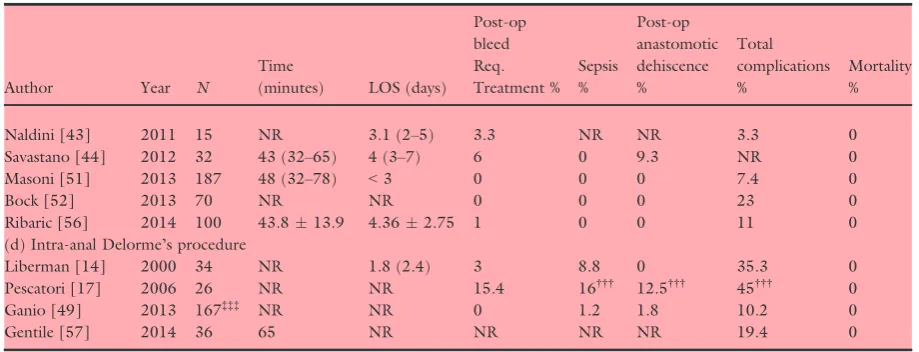
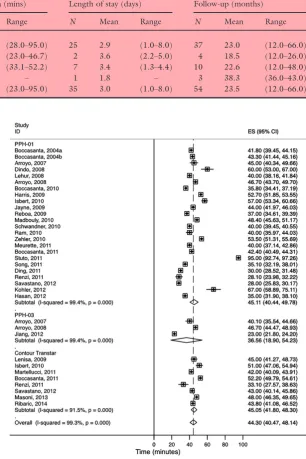
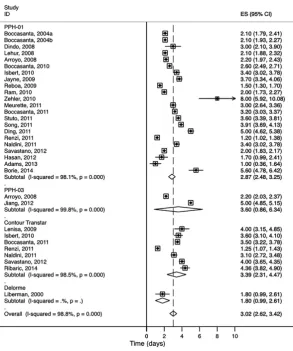
[image:4.595.55.514.82.359.2]Perioperative data were reported by 47 studies reporting 55 procedures (Tables 2 and 3). Measures of variation of continuous measures included ranges or standard deviations but were inconsistently reported. Average procedural duration and length of stay (LOS) varied between procedures but design heterogeneity, small numbers of studies and large range of values precluded any clear conclusions (Table 3). The overall average duration of procedures reported by cohorts was 44 (range 23–95) min, and the overall average LOS was 3.0 (range 1.0–8.0) days (Figs 2 and 3). In one RCT of 100 patients (STARR vs Contour Transtar) [37], Contour Transtar took significantly longer to perform (52.2vs42.4 minutes P=0.008). However this reduc-tion was not apparent more broadly within the pooled findings (Fig. 2). While LOS for intra-anal Delorme’s procedure was shorter (2 days) this was based on only one study reporting this outcome in 34 patients.
Table 1All studies included in systematic review.
Author Year Centre Country TotalN FU* Design Level†
Liberman [14] 2000 Omaha USA 34 43 RCS IV
Boccasanta [15] 2004 Milan Italy 50 23 RCT IB
Boccasanta [16] 2004 Milan Italy 90 16 PCH IIB
Pescatori [17] 2006 Rome Italy 26 36 RCS IV
Arroyo [18] 2007 Elche Spain 37 24 PCH IIB
Gagliardi [19] 2008 Multicentre Italy 85‡ 17 RCS IV
Dindo [20] 2008 Zurich Switzerland 24 18 PCH IIB
Lehur [21] 2008 Multicentre France, Italy, UK 119 12 RCT IIB Arroyo [22] 2008 Multicentre Spain 104 26 PCH IIB
Lenisa [3] 2009 Multicentre Europe 75 12 PCH IIB
Harris [23] 2009 Orlando USA 75 12 RCH IV
Jayne [24] 2009 Multicentre UK, Germany, Italy 2224§ 12 PCH IIB
Reboa [25] 2009 Genoa Italy 33 18 PCH IIB
Boccasanta [26] 2010 Milan Italy 142 24 PCH IIB
Isbert [27] 2010 Nuremberg Germany 150 12 RCH IIB
Zhang [28] 2010 Beijing China 50 12 PCH IIB
Madbouly [29] 2010 Alexandria Egypt 46 42 PCH IIB Schwandner [30] 2010 Regensburg Germany 379 12 PCH IIB
Ram [31] 2010 Ramat Aviv Israel 30 26 PCS IV
Zehler [32] 2010 Hamburg Germany 20 66 PCS IV
Goede [33] 2011 Bristol UK 344 12 PCS IV
Meurette [34] 2011 Nantes France 30 48 PCS IV
Martellucci [35] 2011 Siena Italy 133 19 PCS IV
Patel [36] 2011 Houston Texas 37 20 PCH IIB
Boccasanta [37] 2011 Milan Italy 100 36 RCT IB
Stuto [38] 2011 Pordenone Italy 2171 12 PCH IIB
Song [39] 2011 Seoul South Korea 58 34 RCH IV
Ding [40] 2011 Beijing China 86 12 PCH IIB
Renzi [41] 2011 Naples Italy 61 24 RCT IB
Reibetanz [42] 2011 Wuerzburg Germany 170 18 RCH IIB
Naldini [43] 2011 Pisa Italy 30 24 PCH IIB
Biviano [8] 2011 Rome Italy 60 38 PCH IIB
Savastano [44] 2012 Vicenza Italy 64 27 PCH IIB
Jiang [45] 2012 Wuhan China 43 12 RCS IV
Boenicke [46] 2012 Wuerzburg Germany 181 19 PCH IIB
Kohler [47] 2012 Dresden Germany 80 39 PCS IV
Hasan [48] 2012 Cairo Egypt 40 12 PCH IIB
Ganio [49] 2013 Vercelli Italy 167 36 RCS IV
Adams [50] 2013 London UK 37 13 RCS IV
Masoni [51] 2013 Rome Italy 187 12 RCS IV
Bock [52] 2013 St Gallen Switzerland 70 48 RCS IV
Zhang [53] 2013 Beijing China 75 30 PCH IIB
Panicucci [54] 2014 Pisa Italy 54 12 PCH IIB
Borie [55] 2014 Nimes France 52 18 RCH IV
Ribaric [56] 2014 Multicenter Europe 100 12 PCH IIB
Gentile [57] 2014 Naples Italy 66 12 RCT IIB
Leardi [58] 2014 L’Aquila Italy 51 36 PCS IV
RCS, retrospective cohort study; PCS, prospective case series; RCT, randomised controlled trial; PCH, prospective cohort study. *Mean follow up in months.
†Oxford CEBM [13].
‡Report on 123 patients, but only 85 operated on.
Table 2 Perioperative data by procedure.
Author Year N
Time
(minutes) LOS (days)
Post-op bleed Req. Treatment %
Sepsis %
Post-op anastomotic dehiscence %
Total complications %
Mortality %
(a) PPH-01
Boccasanta [15] 2004 25 41.86 2.10.8 4 0 0 40 0 Boccasanta [16] 2004 90 43.39 2.10.8 4.4 0 0 16.5 0
Arroyo [18] 2007 17 45.9 (9.8) NR 6 0 0 NR 0
Gagliardi [19] 2008 85† NR NR 2.3 3 0 18 0
Dindo [20] 2008 24 60 (40–110) 3 (1–10) 4.1 0 0 25 0 Lehur [21] 2008 119 40 (15–56) 2.1 (1–6) 1.8 1.8 0 15 0 Arroyo [22] 2008 37‡‡ 46.7 (9.3) 2.2 (0.7) 2.8 0 0 NR 0 Boccasanta [26] 2010 74 35.86.1 2.60.5 4 0 0 28.3 0 Harris [23] 2009 36 52.7 2.6 19.4§§ 2.8 0 61.1¶¶ 0 Isbert [27] 2010 68 5715.4 3.41.6 3 0 2 7.3 0 Jayne [24] 2009 2224‡ 44 (15–210) 3.7 (1–36) 5 4.4 3.5* 36 0
Reboa [25] 2009 33 377 1.50.6 0 0 0 15.1 0
Zhang [28] 2010 50 28 NR 0 0 0 NR 0
Madbouly [29] 2010 46 48.49.6 1 0 0 0 15.2 0
Schwandner [30] 2010 379 40 5.5 2.9 1.6 7.1* 21.2 0 Ram [31] 2010 30 40 (35–80) 2 (1–4) 0 0 NR 36.7 0 Zehler [32] 2010 20 53.5 (45–65) 8 (3–22) 15 0 0 20 0
Goede [33] 2011 344 NR NR 2.7 NR NR 16.3 0
Meurette [34] 2011 30 408 31 NR NR NR 27 0
Patel [36] 2011 37 NR 1 0 NR NR 35.1 0
Boccasanta [37] 2011 50 42.4 (6.9) 3.2 (0.6) 2 0 0 4 0 Stuto [38] 2011 2171¶ 95 (15–230) 3.6 (1–21) NR NR NR NR NR Song [39] 2011 58 35.111.3 3.910.84 4 0 NR NR 0
Ding [40] 2011 86 307 51.8 0 0 0 NR 0
Renzi [41] 2011 30 28.1 (11.5) 1.2 (0.5) 6.6 0 NR NR 0
Reibetanz [42] 2011 170§ NR NR 0 0 0.6 7 0
Naldini [43] 2011 15 NR 3.4 (3–6) 0 NR NR 0 0
Biviano [8] 2011 30 NR NR 0 0 0 6 0
Savastano [44] 2012 32 28 (20–45) 2 (1–3) 13 0 0 NR 0
Boenicke [46] 2012 181** NR NR 1 0 0.5 8.2 0
Kohler [47] 2012 80 67 (34–182) NR 6 1 1 22.5 0
Hasan [48] 2012 40 3510 1.72.3 0 0 0 NR 0
Adams [50] 2013 37 NR 1 (0–8) 5.4 2.7 0 32 0
Zhang [53] 2013 75 NR NR 0 0 0 NR 0
Panicucci [54] 2014 54†† NR NR NR NR NR NR NR
Borie [55] 2014 25 NR 5.62.1 0 0 0 24 0
Leardi [58] 2014 51 NR 3 2 0 0 2 0
(b) PPH03
Arroyo [18] 2007 20 40.1 (10.4) NR 0 0 0 NR 0
Arroyo [22] 2008 67*** 46.7 (9.3) 2.2 (0.7) 2.8 0 0 NR 0
Jiang [45] 2012 43 234 5 (4–6) 0 0 0 NR 0
Gentile [57] 2014 30 40 NR NR NR NR 20 NR
(c) Contour Transtar
Summary evidence statements: perioperative data
1 The average duration of procedures was 44 min, although this ranged widely between studies from 23 to 95 min (level II).
2 The average length of stay was 3 days although this ranged widely between studies from 1 to 8 days (level II).
3 There was inadequate evidence to determine varia-tions in procedural duration or length of stay by type of procedure (level IV).
Harms
Perioperative complications
Five measures of perioperative harm were reported by a majority of studies within the review. In general, there was considerable heterogeneity between cohort findings. This heterogeneity may have reflected (for example) differing inclusion, procedural content, context of care, or thresh-olds or conventions for recording complications.
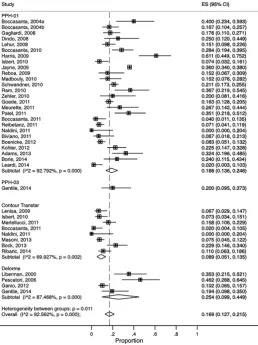
Overall procedural complication rates varied between cohorts from 0% to 61% Fig. 4. Random effects meta-analysis found the overall complication rate to be 16.9% (95% CI: 12.7–21.5%),I2=93%. The Contour Transtar procedure reported a lower overall complication rate of 8.9% (95% CI: 5.1–13.5%), I2=70%, although cohort
findings within this category were heterogeneous and non-comparative. The two RCTs (IB) comparing STARR to Contour Transtar reported no difference in periopera-tive complication rates [37,41], although these included only 161 patients in total and six events. A more general-isable estimate of the overall complication rate may come from the European STARR registry which reported an overall morbidity rate of 36% from 2838 patients [24]. The inclusion criteria for morbidity in this registry incor-porated urgency (20%), but this was not universally applied in most other studies, explaining its discrepancy from the pooled findings.
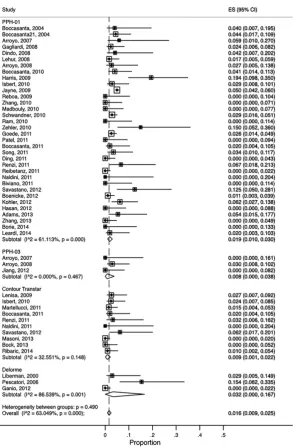
[image:7.595.79.539.87.263.2]Rates of post-operative bleeding requiring treatment varied between cohorts from 0% to 19% (Fig. 5). Ran-dom effects meta-analysis found the pooled bleed rate to be 1.6% (95% CI: 0.9–2.5%), I2=63%. Regarding
Table 2(Continued).
Author Year N
Time
(minutes) LOS (days)
Post-op bleed Req. Treatment %
Sepsis %
Post-op anastomotic dehiscence %
Total complications %
Mortality %
Naldini [43] 2011 15 NR 3.1 (2–5) 3.3 NR NR 3.3 0 Savastano [44] 2012 32 43 (32–65) 4 (3–7) 6 0 9.3 NR 0 Masoni [51] 2013 187 48 (32–78) <3 0 0 0 7.4 0
Bock [52] 2013 70 NR NR 0 0 0 23 0
Ribaric [56] 2014 100 43.813.9 4.362.75 1 0 0 11 0 (d) Intra-anal Delorme’s procedure
Liberman [14] 2000 34 NR 1.8 (2.4) 3 8.8 0 35.3 0 Pescatori [17] 2006 26 NR NR 15.4 16††† 12.5††† 45††† 0
Ganio [49] 2013 167‡‡‡ NR NR 0 1.2 1.8 10.2 0
Gentile [57] 2014 36 65 NR NR NR NR 19.4 0
NR, not recorded.
All PPH03, except Jiang [45] translinear stapler.
*Reported as staple line complications, including dehiscence.
†Report on 123 patients, but only 85 operated on.
‡Report on 2838 patients for complications, 2224 reached 12 months follow-up. §101 patients had Countour Transtar.
¶208 patients had Contour Transtar. **Some patients had Contour Transtar.
††18 patients had Contour Transtar.
‡‡Complications are reported for 104 patients (67 had PPH03).
§§It is uncertain if this required intervention as recorded as ‘rectal bleeding’.
¶¶Total complications included tenesmus, diarrhoea, faecal incontinence, and pruritis ani. ***Complications are reported for 104 patients (37 had PPH01); NR: not recorded.
†††These percentages are based upon analysis of 40 patients (14 patients having had PPH01 or PPH01 with manual mucosectomy).
intra-operative bleeding from staple lines, results from one prospective cohort study (IIB) showed that less intraoperative staple line sutures were required with PPH03 compared with PPH01 [18]. Details of treat-ments provided (e.g. transfusion or re-operation) were unclear in many instances.
Sepsis rates varied from 0% to 16%, but were consis-tently low, occurring in no patients in 78% of cohorts reported. Random effects meta-analysis found the sepsis rate to be 0.2% (95% CI: 0.0–0.7%), I2=63%. Septic complications were mostly related to urinary tract
[image:8.595.207.514.96.556.2]infections, C. difficile infection, or more rarely, pneu-monia. Sepsis rates for Delorme’s procedure appeared high at 6.2% (95% CI: 0.0–19.4%),I2=82%, but find-ings from the three studies were highly heterogeneous and the only moderately large study [49] reported a 1.2% sepsis rate. The rate of post-operative anastomotic dehiscence (wound rupture) varied between cohorts from 0% to 13% but was consistently low, occurring in no patients in 76% of cohorts reported. Random effects meta-analysis found the pooled rate of anastomotic dehiscence to be 0.3% (95% CI: 0.0–0.8%), I2=62%.
Table 3Procedural data.
Procedure
Procedure duration (mins) Length of stay (days) Follow-up (months)
N Mean Range N Mean Range N Mean Range
PPH-01 25 44.6 (28.0–95.0) 25 2.9 (1.0–8.0) 37 23.0 (12.0–66.0) PPH-03 4 37.5 (23.0–46.7) 2 3.6 (2.2–5.0) 4 18.5 (12.0–26.0) Contour Transtar 8 44.8 (33.1–52.2) 7 3.4 (1.3–4.4) 10 22.6 (12.0–48.0)
Delorme’s 1 65.0 – 1 1.8 – 3 38.3 (36.0–43.0)
Total 37 43.8 (23.0–95.0) 35 3.0 (1.0–8.0) 54 23.5 (12.0–66.0)
There was inadequate evidence to select between proce-dures on the basis of individual complications.
No deaths were reported in any cohort of patients reporting mortality, which included a total of 5896 patients (Table 3). Incidences of serious complications were reported but these were rare. These included: one case of sepsis with retropneumoperitoneum [19], two cases of intra-operatively recognized rectal perforation requiring diverting colostomy [32,35], one case of rec-tovaginal abscess requiring diversion [50], one case of suture line disruption requiring diversion [30], and one case of rectal necrosis requiring a colostomy [24]. There were no cases of inadvertent small bowel injury as a result of peritoneal inclusion with anterior rectal wall excision and enterocoele excision. This is despite the fact that in one study [42], 84 of 101 patients who had Contour Transtar, and 14 of 69 patients who had PPH01, had peritoneum present in the resected tissue.
Long-term adverse outcomes
Although obstructed defecation is a benign condition, it may have a significant impact on a patient’s quality
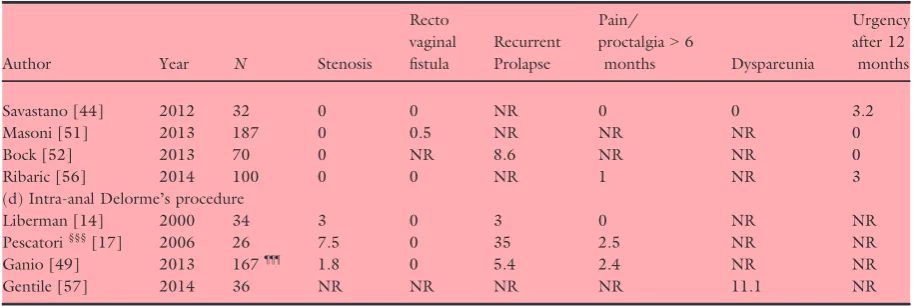
of life. Studies have consistently reported a number of long-term conditions and symptoms occurring after stapled rectal excision procedures that may have a fur-ther negative impact upon quality of life. Measures reported by more than half of cohorts include: rectal stenosis (83% of cohorts), recto-vaginal fistula (76%), pain/proctalgia (70%), and urgency after defaecation (72%); those less consistently reported include recur-rent prolapse (46%) and dyspareunia (33%) (Table 4).
Random effects meta-analysis found that reported rectal stenosis rates were 0.2% (95% CI: 0.0–0.6%),
I2=30%, although individual cohorts varied from 0.0%
to 7.4%, with no stenosis reported in 67% of cohorts. Recto-vaginal fistula was a very rare outcome, occurring in just 3 of 4851 patients (0.062%) studied. Rectal pain or proctalgia lasting >6 months post-procedure was reported by 0.7% of patients (95% CI: 0.1–1.6%),
I2=79%, although individual cohorts varied from 0% to 17%, with no proctalgia reported in 53% of cohorts. Similarly to pooled findings, there was no difference in pain comparing STARR and Contour Transtar in the two level 1B RCTs [37,41]; at 36 months, the inci-dence of pain was significantly less compared with
[image:9.595.82.376.73.425.2]operative values in both groups [37]. The two studies with the highest reported incidence of proctalgia were both PCHs (IIB). At 3818 months post-STARR (n=30), 17% complained of intermittent anal pain, however despite the fact that pre-operative Cleveland Clinic Constipation scores were recorded, there was no analysis about de novo pain [8]. At 12 months post-STARR (n=2838), 7.1% complained of persistent pain [24]. Again there was no analysis regarding thede novo
nature of this pain.
Urgency of defecation, at least one year post-proce-dure, was reported by 5.2% of patients (95% CI: 2.7– 8.2%),I2=92%, although findings were heterogeneous and individual cohorts varied from 0% to 34% (Fig. 6). The European STARR registry reported higher urgency rates of 20% at 12 months [24] and the German STARR registry reported rates of 25% at 12 months [30]. Both groups of authors pointed to poor record-ing of pre-operative urgency symptoms, relyrecord-ing on the subset scores from patients’ Symptom Severity Score (SSS). Schwander et al.[30] suggest that this high
[image:10.595.252.511.76.422.2]incidence reflected numbers with new onset urgency with a score of >1 in SSS, 5.5% had score>3, and 8% of patients observed a reduction in urgency com-pared with pre-op. Jayneet al. [24] acknowledged in a subsequent reply to an invited expert’s analysis of their paper, that de novo urgency was not recorded in their registry but 20% of patients reported this as a compli-cation. Analysis of the subset question in their SSS suggested that 39.9% of patients experienced urgency pre-operatively and this fell to 26.8% at 12 months post-STARR. The highest reported incidence of urgency came from an RCT (IB) comparing STARR/ PPH01 (34% at 3 years) with Contour Transtar (14% at 3 years) (P=0.035) [37]. Urgency was reported as being de novo in both groups. However, the text in the results reports that the symptoms resolved in all but one patient (it is probable that this refers to tenes-mus which is reported for one patient post-op). The other RCT (level IB) comparing STARR/PPH01 with Contour Transtar showed no difference in urgency rates after 24 months [41].
Summary evidence statements: harms
1 Evidence is largely drawn from observational stud-ies and comparisons. Findings were heteroge-neous, making estimates tentative and imprecise (level IV).
2 Overall procedural complication rates ranged from 0% to 61%. However, these complications may typically occur in about 13–22% of procedures (level II).
3 The Contour Transtar procedure may feature a lower overall complication rate although this needs to be confirmed with better research (level IV).
4 Post-operative bleeding requiring treatment may typically occur in 1–3% of patients (level II).
5 Post-operative sepsis and anastomotic dehiscence are rare complications rare typically occurring in less than 1% of patients (level II).
6 Serious acute post-operative complications are very rare occurring in about one in a thousand patients (level II).
7 In the longer term (12 months or more), rectal stenosis is a rare complication typically occurring in less than 1% of patients (level II).
8 The most common longer term adverse outcome is urgency of defaecation, typically occurring in up to 10% of patients (level II).
[image:11.595.84.378.71.519.2]9 Longer term pain is experienced typically by less than 2% of patients (level II).
Table 4Long-term adverse outcomes after rectal excisional procedures.
Author Year N Stenosis
Recto vaginal fistula
Recurrent Prolapse
Pain/ proctalgia>6
months Dyspareunia
Urgency after 12
months
(a) PPH01
Boccasanta [15] 2004 25 4 0 0 0 0 0
Boccasanta [16] 2004 90 3.3 0 0 0 0 1.1
Arroyo [18] 2007 17 6 0 6 0 NR 0
Gagliardi [19] 2008 85* 0 0 9.4 1.1 1.1 8.2
Dindo [20] 2008 24 0 0 NR 4.1 0 NR
Lehur [21] 2008 119 0 0 NR 1.8 0 NR
Arroyo [22] 2008 37†† 0 0 5.7 0.9 NR 5.8
Harris [23] 2009 36 0 0 2.7 2.7 10.5 16.7E
Jayne [24] 2009 2224† 0.6 0.04 NR 7.1 0.1 20
Reboa [25] 2009 33 0 0 NR 0 NR 6
Boccasanta [26] 2010 74 1.3 0 0 0 0 2.7
Isbert [27] 2010 68 0 0 2.9 3 NR 4.4
Zhang [28] 2010 50 0 0 2 2 0 2
Madbouly [29] 2010 46 6.5 0 NR 0 NR 0
Schwandner [30] 2010 379 2.1 NR NR 0.5 NR 25.3§§
Ram [31] 2010 30 NR NR NR 0 NR NR
Zehler [32] 2010 20 0 0 NR NR NR NR
Goede [33] 2011 344 2.9 NR NR NR NR 11.5***
Meurette [34] 2011 30 NS NR NR 0 NR 6.8
Patel [36] 2011 37 2.7 NR NR NR 5.4 NR
Boccasanta [37] 2011 50 0 0 12 0 NR 34¶¶
Stuto [38] 2011 2171§ NR NR NR NR NR NR
Song [39] 2011 58 1.7 NR NR 0 NR 0
Ding [40] 2011 86 0 0 NR 0 NR 0
Renzi [41] 2011 30 NR 0 NR NR 3.3 10
Reibetanz [42] 2011 170‡ 0 0 NR 0 NR NR
Naldini [43] 2011 15 NR NR NR NR NR 20
Biviano [8] 2011 30 0 0 3 17 0 6
Savastano [44] 2012 32 6.25 0 NR 0 0 0
Boenicke [46] 2012 181¶ 0 0 NR 0 NR NR
Kohler [47] 2012 80 0 0 5 0 NR 12.5
Hasan [48] 2012 40 0 0 0 2.5 NR 2.5
Adams [50] 2013 37 2.7 0 5.4 NR NR NR
Zhang [53] 2013 75 0 0 4 NR NR 1.3†††
Panicucci [54] 2014 54** NR NR NR NR NR 7.4
Borie [55] 2014 25 0 0 NR NR 12‡‡ NR
Leardi [58] 2014 51 0 0 2 NR NR 0
(b) PPH03
Arroyo [18] 2007 20 0 0 5 0 NR 0
Arroyo [22] 2008 67‡‡‡ 0 0 5.7 0.9 NR 5.8
Jiang [45] 2012 43 0 0 NR 2 NR NR
Gentile [57] 2014 30 NR NR NR NR 16.6 NR
(c) Contour Transtar
Lenisa [3] 2009 75 0 0 NR 0 NR 13
Isbert [27] 2010 82 0 0 0 3 NR 4.8
Martellucci [35] 2011 133 0 0.8 NR 1.5 NR 6.8
Boccasanta [37] 2011 50 0 0 0 0 0 14
Renzi [41] 2011 31 NR NR NR NR 0 9.6
10 Rectovaginal fistula is a very rare longer term complication, occurring in about one in about one in every one thousand six hundred patients (level II).
11 There was insufficient evidence to establish whether specific post-operative or longer term complications varied between procedures (level IV).
12 In all studies where mortality was recorded, there were no deaths in a total of 5896 patients studied (level II).
Efficacy
Measurement of clinical outcome was consistently recorded in many studies using a variety of the available subjective summative scoring instruments for constipa-tion symptoms (Table 6). These included the Cleveland Clinic Constipation Score (21 studies), obstructed defe-cation syndrome (ODS) score (30 studies), Symptom Severity Score (SSS) (eight studies).
[image:13.595.80.537.88.241.2]The Longo scoring system for ODS was reported for 56% of cohorts. Reduction in ODS occurred in 72.2% of patients (95% CI: 68.5–75.8%), I2=83% (Fig. 7). There was considerable heterogeneity between findings, which varied from 53–91% and may reflect multiple causes. Although findings are imprecise, there was no robust evidence that one procedure produced greater score reductions than another. Improvement in consti-pation was reported in all studies where it was recorded. In many publications regarding surgical treatment of constipation, success has been defined as >50% improvement in objective scores. A total of 18/21 stud-ies reported >50% improvement in CCS; all studies (30/30) reported >50% improvement in ODS; 5/8 studies reported>50% improvement in SSS. Significant improvement in ODS was seen in both arms of the two RCTs (IB) comparing STARR (PPH01) and Contour Transtar [37,41] and in the other level IB RCT com-paring STARR with PPH01 and mucosectomy (with PPH01) together with levatoroplasty [15]. Whilst this
Table 4(Continued).
Author Year N Stenosis
Recto vaginal fistula
Recurrent Prolapse
Pain/ proctalgia>6
months Dyspareunia
Urgency after 12
months
Savastano [44] 2012 32 0 0 NR 0 0 3.2
Masoni [51] 2013 187 0 0.5 NR NR NR 0
Bock [52] 2013 70 0 NR 8.6 NR NR 0
Ribaric [56] 2014 100 0 0 NR 1 NR 3
(d) Intra-anal Delorme’s procedure
Liberman [14] 2000 34 3 0 3 0 NR NR
Pescatori§§§[17] 2006 26 7.5 0 35 2.5 NR NR
Ganio [49] 2013 167¶¶¶ 1.8 0 5.4 2.4 NR NR
Gentile [57] 2014 36 NR NR NR NR 11.1 NR
NR, not recorded.
All PPH03, except Jiang [45] translinear stapler. *Report on 123 patients, but only 85 operated on.
†Report on 2838 patients for complications, 2224 reached 12 months follow-up.
‡101 patients had Countour Transtar. §208 patients had Contour Transtar ¶Some patients had Contour Transtar **18 patients had Contour Transtar.
††Complications are reported for 104 patients (67 had PPH03).
‡‡Not stated if de novo.
§§This reflects numbers with score of>1 in Symptom Severity score, 5.5% had score>3, and 8% of patients observed a reduction in urgency compared with pre-op.
¶¶Table refers to this incidence at 3 years, however text reports that all urgency resolved in all but one patient.
***Authors report that 74% of patients had pre-op urgency.
†††Uncertain if this is de novo.
‡‡‡Complications are reported for 104 patients (37 had PPH01).
§§§These percentages are based upon analysis of 40 patients (14 patients having had PPH01 or PPH01 with manual mucosec-tomy).
improvement was maintained at three years, without difference between procedures in one trial [37], in the other at 24 months the improvement was maintained in the Contour Transtar group but not in the STARR group and there was a significant difference in scores between the two groups [41]. In the other two RCTs of lesser quality (IIB), STARR (PPH01) was shown to be significantly better for functional outcome compared with biofeedback (although there was >50% attrition rate in the biofeedback group) [21], and STARR (PPH01) was shown to give similar functional results compared with Intra-anal Delorme’s with levatoroplasty [57]. In other non-randomised (level IIB) comparisons of STARR (PPH01) vs Contour Transtar [8,27,43] there was no difference in functional outcome. One prospective cohort study (level IIB) compared PPH01 with PPH03 [18] and showed no difference in func-tional outcome, and a further compared STARR with macrogol therapy [8]. There was no difference in out-come when looking at response rates, however it was
unclear if groups were matched and no report on differ-ent laxative use was included in inclusion criteria. One would normally assume that macrogol or other medical management would have been tried before selecting a patient for a rectal excisional procedure.
The effect of time post-procedure and efficacy was examined in the four level I/IIB studies with a follow-up of>30 months [8,37,53,57]. Three studies showed greater than 75% reduction in subjective scores [8,37,57] and the other greater than 50% reduction, regardless of the procedure provided.
[image:14.595.216.515.74.447.2]Global ‘success’ or ‘satisfaction’ ratings (GSR) were obtained via a variety of methods in 28 of 55 cohorts (Table 5), where ‘satisfied’ or ‘very satisfied’, ‘good’, ‘very good’ and ‘excellent’ were interpreted as positive outcomes. Further studies also reported individual symptoms. No study reported acquiring data objectively using personnel not involved in the surgical care of the patient or data collection blind to intervention status. Most reports assert that the majority of patients
undergoing PPH01, PPH03, Contour Transtar, and intra-anal Delorme’s procedure were satisfied. Random effects meta-analysis found the global satisfaction rating to be 76.3% (95% CI: 72.8–79.5%),I2=59% (Fig. 8).
There was considerable heterogeneity between findings, which varied from 51% to 90% and may reflect multiple causes. Although findings are imprecise there was no evidence that one procedure produced higher levels of satisfaction than another.
Disease-specific and generic QoL scoring instruments were used less often including PAC QoL (11 studies, data not shown), EQ-VAS (six studies, data not
shown), EQ-5D (two studies, data not shown), FIQL (one study, data not shown). Using such instruments, improvements in QoL were associated with symptom improvements in most studies except for Ribaric et al.
[56] who showed non-significant improvements in EQ-5D and EQ VAS in 100 patients 12 months after Con-tour Transtar and Madbouly et al.[29] who, reporting on 46 patients after PPH01, showed significant improvements in PAC QoL at 18 months but not at 42 months.
The aim of rectal excision procedures is to enable normal evacuation and assessment of constipation symp-toms is therefore the most important outcome. How-ever, many patients also suffer from incontinence, either as a result of neurogenic/traumatic sphincter patholo-gies or from the effects of a high grade recto-anal intus-susception. Instrumented excisional procedures are postulated to increase the risk of faecal incontinence by their very nature. Indeed one of the exclusion criteria in many studies was greater than minor faecal incontinence (Table S1). Objective scores (Wexner or St Marks incontinence score, FISI) when reported (Table 6) showed either no change or reduction in scores other than in one study where an increase was reported [47]. In this study after PPH01, the median Wexner inconti-nence score rose from 3.3 to 5.5 after 2–3 years. It was reported that a third of patients developed incontinence symptoms 1–4 years after the procedure.
While anatomical outcome is necessarily only a surro-gate of clinical outcomes, recurrent prolapse was reported for less than half of cohorts and occurred in 4.3% of patients (95% CI: 2.0–7.3%), I2=78%. Again findings were heterogeneous and there was no robust evidence that one procedure was associated with higher long term adverse outcomes than another. One RCT comparing STARR with Contour Transtar reported that at three years post-procedure 12% of STARR patients had a clinical recurrence compared with none of the Contour Transtar patients (P=0.035) [37]. The weight of resected tissue was significantly greater in the Transtar group.
Summary evidence statements: efficacy
1 Data on efficacy were inconsistently measured and findings heterogeneous, making estimates tentative and imprecise (level IV).
2 Although inconsistent, patient global satisfaction rat-ings typically suggest (at least) satisfactory outcome in about 73–80% of patients (level II).
[image:15.595.82.298.102.491.2]3 Although inconsistent, a reduction of 53–91% in Longo scoring system for obstructive defecation syn-drome occurred in about 68–76% of patients (level II).
Table 5Percentage success based on global satisfaction ratings (GSR).
Author Year N FU mean GSR %*
(a) PPH01
Boccasanta [15] 2004 25 23 88 Boccasanta [16] 2004 90 16 90 Dindo [20] 2008 24 18 83 Isbert [27] 2010 68 12 80 Reboa [25] 2009 33 18 75.7 Zehler [32] 2010 20 66 80 Goede [33] 2011 344 12 81 Patel [36] 2011 37 20 71.9 Boccasanta [37] 2011 50 36 66 Song [39] 2011 58 34 63.4 Renzi [41] 2011 30 36 60 Biviano [8] 2011 30 38 60 Kohler [47] 2012 80 39 77.5 Hasan [48] 2012 40 12 75 Adams [50] 2013 37 13 50 Zhang [53] 2013 75 30 64 Panicucci [54] 2014 54† 12 87 Borie [55] 2014 25 18 84 Leardi [58] 2014 51 36 81 (b) PPH03
Jiang [45] 2012 43‡ 12 72 Gentile [57] 2014 30 12 73§ (c) Contour Transtar
Lenisa [3] 2009 75 12 77.3 Isbert [27] 2010 82 12 81.5 Martellucci [35] 2011 133 19 69.8 Bock [52] 2013 70 48 87 (d) Intra-anal Delorme’s procedure
Liberman [14] 2000 34 43 76.4 Ganio [49] 2013 167 36 78.2¶ Gentile [57] 2014 36 12 73**
*Proportion good or excellent.
†18 patients had Contour Transtar.
‡linear stapler.
§GSR is based on 66 patients (36 had intra-anal Delorme’s). ¶91 patients also had levatoroplasty.
Table 6Functional outcomes by procedure.
Author Year N FU‡‡
% reduction in CCS
% reduction in Longo/ ODS score
% reduction in SSS score
Any significant increase or decrease in FI scores
(a) PPH01
Boccasanta [15] 2004 25 23 68.6 \ \ N
Boccasanta [16] 2004 90 16 65.3 \ \ N
Arroyo [18] 2007 17 24 \ \ 68 \
Gagliardi [19] 2008 85 * 17 \ \ \ \
Dindo [20] 2008 24 18 54.5 \ \ \
Lehur [21] 2008 119 12 \ 71 \ \
Arroyo [22] 2008 37†† 26 62.3 \ \ \
Boccasanta [26] 2010 74 24 \ 88.4 \ \
Harris [23] 2009 36 12 \ 88 \ \
Isbert [27] 2010 68 12 46.8 65.5 \ N
Jayne [24] 2009 2224† 12 \ 67.3 76.1 Decrease
Reboa [25] 2009 33 18 72.4 \ \ \
Zhang [28] 2010 50 12 63.5 66.3 70.3 \
Madbouly [29] 2010 46 42 \ 75.3 \ \
Schwandner [30] 2010 379 12 \ \ 49.4 N
Ram [31] 2010 30 26 \ \ \ \
Zehler [32] 2010 20 66 \ 65 40 Decrease
Goede [33] 2011 344 12 \ 89 \ Decrease
Meurette [34] 2011 30 48 \ 58.6 \ N
Patel [36] 2011 37 20 \ 58.6 \ \
Boccasanta [37] 2011 50 20 \ 83 \ N
Stuto [38] 2011 2171§ 12 \ 70 \ Decrease
Song [39] 2011 58 34 58.5 \ \ \
Ding [40] 2011 86 12 \ 60.5 \ N
Renzi [41] 2011 30 36 \ 59.6 \ \
Reibetanz [42] 2011 170‡ 18 47 \ \ \
Naldini [43] 2011 15 24 \ 73.4 \ \
Biviano [8] 2011 30 38 76.1 \ \ \
Savastano [44] 2012 32 27 \ 87 \ \
Boenicke [46] 2012 181¶ 19 58.9 \ \ N
Kohler [47] 2012 80 39 54.8 \ \ Increase
Hasan [48] 2012 40 12 83.8 \ \ \
Adams [50] 2013 37 13 \ \ \ \
Zhang [53] 2013 75 30 54.6 53.5 \ N
Panicucci [54] 2014 54 ** 12 68.5 74.4 \ \
Borie [55] 2014 25 18 \ 59 \ \
Leardi [58] 2014 51 36 \ 76 \ Decrease
(b) PPH03
Arroyo [18] 2007 20 24 \ \ 68 \
Arroyo [22] 2008 67R 26 62.3 \ \ \
Jiang [45] 2012 43 12 62.9 \ \ \
Gentile [57] 2014 30 12 \ \ \ \
(c) Contour Transtar
Lenisa [3] 2009 75 12 \ 83 50.2 N
Isbert [27] 2010 82 12 50 68 \ N
Martellucci [35] 2011 133 19 48 \ \ \
Boccasanta [37] 2011 50 36 \ 85 \ N
4 Evidence for longer term benefits persisting from procedures is sparse but suggests improvements may be maintained (level II).
5 Findings from efficacy measures provided insufficient evidence to recommend one type of procedure over another (level IV).
6 The use of Contour Transtar increases the amount of resected tissue and may reduce recurrence rates although this requires further study (level IV).
7 There is no evidence that rectal excisional procedures contribute towards post-operative faecal incontinence (level II).
8 Recurrent prolapse occurred in 4.3% of patients con-sidering all studies (level IV); rates were lower (1.7%) in higher quality studies (level II).
Variation in outcomes by level of evidence
Meta-analytic findings are reported for each of the out-comes reported, subdivided by level of evidence (Table 7). Recurrent prolapse was the only adverse out-come where findings varied by grade of evidence: grade IB/IIB: 1.7% of patients (95% CI: 0.4–3.7%),I2=54%,
and grade IV: 9.2% of patients (95% CI: 4.1–15.9%),
I2=78%.
Patient selection
Patient selection is generally perceived to be essential when choosing a surgical approach. Whilst rectal exci-sion procedures may be efficient at correcting normal anatomy, there may be many underlying functional and organic pathologies that mean surgery is unsuccessful at ‘curing’ the patient [59]. It is advised when contem-plating a surgical approach to exhaust first all forms of conservative or medical management. Forty-one out of 55 cohorts studied highlight the fact that all patients had undergone a period of conservative management (Table 7).
[image:17.595.83.539.87.264.2]Many of the current studies reference inclusion and exclusion criteria based upon a previous consensus con-ference [60], namely that patients should be selected on the basis of recognized symptoms of ODS with evi-dence of anatomical defects on defaecography (recto-coele and/or internal rectal prolapse) and adequate anal sphincter function (at least assessed by digital rectal
Table 6(Continued).
Author Year N FU‡‡
% reduction in CCS
% reduction in Longo/ ODS score
% reduction in SSS score
Any significant increase or decrease in FI scores
Naldini [43] 2011 15 24 \ 69.9 \ \
Savastano [44] 2012 32 27 \ 90.3 \ \
Masoni [51] 2013 187 12 67 \ \ \
Bock [52] 2013 70 48 \ 56.3 46.7 N
Ribaric [56] 2014 100 12 \ 64.7 \ N
(d) Intra-anal Delorme’s procedure
Liberman [14] 2000 34 43 \¶¶ \ \ N
Pescatori [17] 2006 26 36 \ \ \ \
Ganio [49] 2013 167 *** 36 66.7 63.5 \ N
Gentile [57] 2014 36 12 \ \ \ \
N, no change; \, not recorded; FI, faecal incontinence. All PPH03, except Jiang [45] translinear stapler. *Report on 123 patients, but only 85 operated on.
†Report on 2838 patients, but 2224 reached 12 months follow-up; complete data for ODS score (41%), complete data for SSS (57%).
‡101 patients had Countour Transtar.
§208 patients had Contour Transtar, 1485 patients completed 12 months follow-up. ¶Some patients had Contour Transtar.
**18 patients had Contour Transtar.
††Complications are reported for 104 patients (67 had PPH03).
‡‡Mean follow-up in months.
§§This study also showed a significant improvement in the Knowles-Eccersley-Scott-Symptom (KESS) score. ¶¶67–93% of patients showed improvement in 4 of CCS domains.
examination). In 42 out of the 55 cohorts studied, patients had at least 3 ODS symptoms (Table 8). In general when selecting patients for functional surgery it has also been advised to select patients with a high symptom load [61]. A criticism made to the authors of the European STARR Registry (n=2224) was that the median ODS score was low (15.7 out of a possible 40) and that the range was high (1–31) [24]. The two level I RCTs reported inclusion criteria of an ODS score
>12 in one [41] and 15 in the other [37]. The major-ity of studies reported an inclusion criterion of rectal intussusception and/or rectocoele, (38 out of 55 study groups). Thirty-two out of the 55 study groups reported a rectocoele>2 cm, and in 26 of these, more than 75% of patients had a rectocele >2 cm. Thirty-seven out of the 55 study groups reported on recto-rec-tal or recto-anal intussusception, and in 28 of these more than 60% of patients had an intussusception. Mul-tiple classifications were used for diagnosing an intussus-ception including Pescatori [62], Shorvon [63], and
Oxford [64]. Other studies stated that inclusion required a rectal intussusception greater than 10 mm [41] or recto-anal intussusception >10 mm [31]. One study reported on outcome at five years following PPH01 for patients with a symptomatic rectocoele when the authors specifically excluded intussusception [32]. This study found an 80% satisfaction rate at one year, which remained at five years. It was not possible to draw conclusions regarding efficacy according to either the presence of an intussusception (whichever grade/stage) or rectocoele size.
[image:18.595.213.512.77.439.2]It is pertinent to discuss exclusion criteria as this may influence the surgeon in their choice of procedure (rein-forcement/suspension/excision). Reference was again made in many studies to the consensus statement [60] and a decision making algorithm for STARR [65] when defining exclusion criteria. Specifically, external rectal prolapse, solitary rectal ulcer syndrome (SRUS), anatomical enterocele, and ‘significant gynaecological pelvic floor abnormality requiring treatment’ were
stated as exclusions. Less than 50% of the reviewed studies excluded external rectal prolapse or other pelvic organ prolapse, and no study excluded SRUS (Table S1). Only one study graded pelvic organ pro-lapse (rectocoele, cystocoele, vault, uterine) with a stan-dardized grading system e.g. POP-Q (data not shown) [26]. Whilst it is sensible to exclude patients with exter-nal rectal prolapse, no conclusion can be made regard-ing excludregard-ing patients with SRUS, or concomitant pelvic organ prolapse.
Anatomical enterocoele is generally regarded as a contraindication to an anterior rectal wall excision [60,65], however many studies did not exclude this (Table S1). Irrespective of this, there were no cases of iatrogenic small bowel injury reported. One study examined the outcome with respect to harms in patients with a functional enterocoele, and those with-out [42]. All patients had either PPH01 or Contour Transtar and outcomes with respect to harms were similar.
Summary evidence statements: patient selection
1 Patient selection, although perceived as vital in pre-dicting outcome, is inconsistently documented and poorly informed by current evidence (level IV).
2 Patients with at least three ODS symptoms together with a rectocoele with or without an intussusception, who have failed conservative management may bene-fit from a rectal excisional procedure (level II).
3 It is not possible to advise on excluding patients with concomitant pelvic organ prolapse or SRUS when considering a rectal excisional procedure (level IV).
Conclusions
[image:19.595.81.381.74.440.2]A systematic review of evidence for the perioperative and long term benefits and harms of rectal excisional procedures identified a modest number of high quality studies together with a larger number of observational lesser quality studies. Whilst the evidence is superior to the level of evidence for other procedures for
constipation it is still rather poor in the field of medi-cine systematic reviews. Notwithstanding this, certain conclusions can be drawn:
1 In the presence of a rectocoele with or without an intussusception, together with at least three symp-toms of ODS, a rectal excisional procedure may ben-efit the patient after all conservative measures have been exhausted.
2 Reliance on proving efficacy using GSR and unvali-dated scoring systems (Longo) is not satisfactory and greater emphasis should be placed in future studies on the use of disease-specific and generic QoL scor-ing instruments.
3 It is not possible to advise which excisional technique is superior from the point of view of efficacy, peri-operative variables, or harms (peri-peri-operative or long term adverse outcomes). Future study is required.
4 Both short- and long-term harms may have been exaggerated in previous reports. Rectal excisional procedures appear to be safe with little major mor-bidity. Rectal urgency appears to be a problem, but findings are inconsistent because of poor reporting.
5 Despite evidence of mixed grade (IB, IIB and IV) being available for rectal excision procedures, there was little evidence that outcomes varied by grade of evidence. Recurrent prolapse was the only adverse outcome where findings varied by grade of evidence and thus may be a chance finding in the absence of any systematic pattern across outcomes.
Acknowledgements
[image:20.595.59.518.90.340.2]We would like to acknowledge the following people in relation to the NIHR CapaCiTY working group: Mr Steven Brown, Sheffield Teaching Hospitals NHS Foundation Trust; Mr Kenneth Campbell, The Univer-sity of Dundee, NHS Education for Scotland; Mr Mark Chapman, Heart of England NHS Trust; Mr Andrew Clarke, Poole Hospital NHS Foundation Trust; Mr Neil Cruickshank, Sandwell and West Birmingham Hospitals NHS Trust; Mr Anthony Dixon, University of Bristol, Bristol, UK; Dr Christopher Emmett, County Durham and Darlington NHS Foundation Trust; Mr Ugo Grossi, Queen Mary University of London; Dr Richard Hooper, PCTU, Queen Mary University of London; Miss Emma Horrocks, University Hospital Southamp-ton NHS Foundation Trust; Professor Charles Knowles, Queen Mary University of London; Mr Jon Lacy-Col-son, Shrewsbury and Telford Hospital NHS Trust; Mr Ian Lindsey, Oxford University Hospitals NHS Trust; Professor James Mason, University of Warwick, Coven-try; Mr Mark Mercer-Jones, Gateshead Health NHS Foundation Trust; Mr Andrew Miller, University Hospitals of Leicester NHS Trust; Mr David Pares, Hospital Germans Trias i Pujol, Barcelona, Spain; Miss Sophie Pilkington, University Hospital Southampton NHS Foundation Trust; Mr Neil Smart, Royal Devon & Exeter NHS Foundation Trust; Ms Natasha Stevens, PCTU, Queen Mary University of London; Professor
Table 7Outcomes by level of evidence.
IB/IIB IV Combined
IB/IIB
vsIV Effect size (95%CI), I2 Effect size (95%CI), I2 Effect size (95%CI), I2 p
Perioperative data
Procedure duration (mins) 44.3 (39.9–48.7), 99.2% 44.4 (35.4–53.5), 99.5% 44.3 (40.5–48.1), 99.5% 0.98 Length of stay (days) 2.8 (2.5–3.2), 98.1% 3.6 (2.5–4.7), 98.7% 3.0 (2.6–3.4), 98.8% 0.18 Total complication rate (%) 13.5% (8.3–19.6%), 94.0% 22.0% (15.9–28.7%), 85.5% 16.9% (12.7–21.5%), 92.6% 0.052 Perioperative harm
Bleeding rate (%) 1.5% (0.7–2.4%), 52.7% 2.2% (0.6–4.3%), 72.4% 1.6% (0.9–2.5%), 63.0% 0.56 Sepsis rate (%) 0.0% (0.0–0.5%), 67.1% 0.8% (0.0–2.2%), 48.8% 0.2% (0.0–0.7%), 62.6% 0.090 Anastomotic
dehiscence rate (%)
0.2% (0.0–0.9%), 67.3% 0.2% (0.0–0.9%), 11.2% 0.3% (0.0–0.8%), 61.6% 0.98
Long term adverse outcomes
Rectal stenosis (%) 0.1% (0.0–0.5%), 24.4% 0.4% (0.0–1.2%), 36.4% 0.2% (0.0–0.6%), 30.3% 0.52 Rectal pain (%) 0.6% (0.0–1.9%), 83.6% 0.8% (0.1–1.8%), 0.0% 0.7% (0.1–1.6%), 78.7% 0.76 Rectal urgency (%) 5.6% (2.7–9.3%), 90.7% 4.2% (0.9–9.2%), 89.1% 5.2% (2.7–8.2%), 91.8% 0.51 Rectal prolapse (%) 1.7% (0.4–3.7%), 53.9% 9.2% (4.1–15.9%), 82.0% 4.3% (2.0–7.3%), 78.7% 0.006 Efficacy
Global satisfaction rating (%)
76.4% (71.3–81.1%), 59.0% 76.0% (71.1–80.7%), 62.4% 76.3% (72.8–79.5%), 59.0% 0.94
Table 8Inclusion criteria for procedures.
Author Year N
Rectocele >2 cm %
Recto-rectal / Recto-anal Intussusception %
Rectocele+ Intussusception %
Failure of conservative RX
At least 3 ODS symptoms
(a) PPH01
Boccasanta [15] 2004 25 100 100 100 Yes Yes
Boccasanta [16] 2004 90 97 100 97 Yes Yes
Arroyo [18] 2007 17 92 27 NR Yes Yes
Gagliardi [19] 2008 85* 80 93 73 Yes Yes
Dindo [20] 2008 24 79 83 NR Yes Yes
Lehur [21] 2008 119 92 61 NR No Yes
Arroyo [22] 2008 37†† NR NR NR Yes Yes
Boccasanta [26] 2010 74 100 100 100 Yes Yes
Harris [23] 2009 36 81 39 39 No Yes
Isbert [27] 2010 68 100 80 80 Yes Yes
Jayne [24] 2009 2224† 99 80 NR Yes Yes
Reboa [25] 2009 33 67 97 NR Yes Yes
Zhang [28] 2010 50 NR NR NR No No
Madbouly [29] 2010 46 59 41 NR Yes Yes
Schwandner [30] 2010 379 NR NR NR No Yes
Ram [31] 2010 30 67 13 67 No Yes
Zehler [32] 2010 20 100 0 0 Yes Yes
Goede [33] 2011 344 NR 100 NR No Yes
Meurette [34] 2011 30 100 100 100 Yes No
Patel [36] 2011 37 100 81 81 Yes Yes
Boccasanta [37] 2011 50 100 100 100 No Yes
Stuto [38] 2011 2171§ 82 95 NR No Yes
Song [39] 2011 58 62 80 NR Yes Yes
Ding [40] 2011 86 90 94 77 Yes Yes
Renzi [41] 2011 30 NR NR NR Yes Yes
Reibetanz [42] 2011 170‡ NR NR NR No No
Naldini [43] 2011 15 NR NR NR Yes Yes
Biviano [8] 2011 30 77 50 NR Yes Yes
Savastano [44] 2012 32 NR NR NR No No
Boenicke [46] 2012 181¶ NR NR 100 Yes Yes
Kohler [47] 2012 80 100 100 NR No Yes
Hasan [48] 2012 40 90 55 NR Yes Yes
Adams [50] 2013 37 NR NR NR Yes Yes
Zhang [53] 2013 75 NR 87 NR Yes No
Panicucci [54] 2014 54 ** NR NR NR Yes Yes
Borie [55] 2014 25 100 65 65 Yes Yes
Leardi [58] 2014 51 43 57 0 Yes No
(b) PPH03
Arroyo [18] 2007 20 92 27 NR Yes Yes
Arroyo [22] 2008 67§§ NR NR NR Yes Yes
Jiang [45] 2012 43 100 56 56 Yes Yes
Gentile [57] 2014 30 NR NR NR Yes No
(c) Contour Transtar
Lenisa [3] 2009 75 NR NR NR Yes Yes
Isbert [27] 2010 82 100 65 65 Yes Yes
Martellucci [35] 2011 133 NR NR NR Yes Yes
Boccasanta [37] 2011 50 100 100 100 No Yes
Douglas Tincello, University Hospitals of Leicester NHS Trust; Miss Karen Telford, South Manchester NHS Foundation Trust; Mr Paul Vollebregt, Queen Mary University of London; Mr Andrew Williams, Guy’s and Thomas’ NHS Foundation Trust; Professor Yan Yiannakou, County Durham and Darlington NHS Foundation Trust.
Funding
This project was funded by the National Institute for Health Research (NIHR) Programme Grant for Applied Research (RP-PG-0612-20001). The views and opin-ions expressed in this report are those of the authors and are not those of the PGfAR Programme, NIHR, the UK National Health Service, or the UK Depart-ment of Health.
Conflicts of interest
M Mercer-Jones has no conflict of interest in relation to the content of the manuscript. In the last 2 years he has received fees as a preceptor for Medtronic Inc. C.H.Knowles has no conflict of interest in relation to the content of the manuscript. In the last 2 years he
has recieved speaker fees and consultancy payments from Medtronic Inc. remaining authors no conflict.
References
1 D’Hoore A, Penninckx F. Obstructed defecation.Colorectal Dis2003;5:280–7.
2 Longo A. Treatment of hemorrhoids disease by reduction of mucosa and hemorrhoidal prolapse with a circular sutur-ing device: a new procedure. 6th World Congress of Endo-scopic Surgery, Pts 1 and 2. 1998. Pp. 777–84.
3 Lenisa L, Schwandner O, Stuto Aet al.STARR with Con-tour Transtar: prospective multicentre European study.
Colorectal Dis2009;11:821–7.
4 Delorme R. Sur le traitment des prolapses du rectum totaux pour l’excision de la muscueuse rectale ou rectocol-ique.Bull Mem Soc Chir Paris1900;26:499–518. 5 Dippolito A, Esser S, Reed J 3rd. Anterior modification of
Delorme procedure provides equivalent results to Delorme procedure in treatment of rectal outlet obstruction. Curr Surg2005;62:609–12.
6 Gladman MA, Scott SM, Lunniss PJ, Williams NS. System-atic review of surgical options for idiopathic megarectum and megacolon.Ann Surg2005;241:562–74.
7 Van Geluwe B, Stuto A, Da Pozzo F et al. Relief of obstructed defecation syndrome after Stapled Transanal Rectal Resection (STARR): a meta-analysis.Acta Chir Belg
[image:22.595.60.518.88.258.2]2014;114:189–97.
Table 8(Continued).
Author Year N
Rectocele >2 cm %
Recto-rectal / Recto-anal Intussusception %
Rectocele+ Intussusception %
Failure of conservative RX
At least 3 ODS symptoms
Naldini [43] 2011 15 NR NR NR Yes Yes
Savastano [44] 2012 32 NR NR NR No No
Masoni [51] 2013 187 84 97 NR Yes Yes
Bock [52] 2013 70 NR NR NR Yes No
Ribaric [56] 2014 100 80 73 NR Yes No
(d) Intra-anal Delorme’s procedure
Liberman [14] 2000 34 NR 100 70.6 Yes Yes
Pescatori [17] 2006 26 NR 100 37.5*** No No
Ganio [49] 2013 167 NR 77.2 66.5 Yes No
Gentile [57] 2014 36 NR NR NR Yes No
NR, not recorded.
All PPH03, except Jiang [45] translinear stapler. *Report on 123 patients, but only 85 operated on.
†Report on 2838 patients for complications, 2224 reached 12 months follow-up.
‡101 patients had Countour Transtar. §208 patients had Contour Transtar. ¶Some patients had Contour Transtar. **18 patients had Contour Transtar.
††Inclusions are reported for 104 patients (67 had PPH03). §§Reported for 104 patients (37 had PPH01).
8 Biviano I, Badiali D, Candeloro Let al.Comparative out-come of stapled trans-anal rectal resection and macrogol in the treatment of defecation disorders.World J Gastroenterol
2011;17:4199–205.
9 Hirst GR, Hughes RJ, Morgan AR, Carr ND, Patel B, Beynon J. The role of rectocele repair in targeted patients with obstructed defaecation.Colorectal Dis2005; 7:159– 63.
10 Portier G, Ghouti L, Kirzin S, Chauffour M, Lazorthes F. Malone antegrade colonic irrigation: ileal neoappendicos-tomy is the preferred procedure in adults.Int J Colorectal Dis2006;21:458–60.
11 Sabbagh R, Mandron E, Piussan J, Brychaert PE, le Tu M. Long-term anatomical and functional results of laparo-scopic promontofixation for pelvic organ prolapse.BJU Int
2010;106:861–6.
12 Johnson E, Carlsen E, Mjaland O, Drolsum A. Resection rectopexy for internal rectal intussusception reduces consti-pation and incomplete evacuation of stool. Eur J Surg
2003;588:51–6.
13 Evans C, Ong E, Jones OM, Cunningham C, Lindsey I. Laparoscopic ventral rectopexy is effective for solitary rectal ulcer syndrome when associated with rectal prolapse.
Colorectal Dis2014;16:O112–6.
14 Liberman H, Hughes C, Dippolito A. Evaluation and out-come of the delorme procedure in the treatment of rectal outlet obstruction.Dis Colon Rectum2000;43:188–92. 15 Boccasanta P, Venturi M, Salamina G, Cesana BM,
Ber-nasconi F, Roviaro G. New trends in the surgical treatment of outlet obstruction: clinical and functional results of two novel transanal stapled techniques from a randomised con-trolled trial.Int J Colorectal Dis2004;19:359–69. 16 Boccasanta P, Venturi M, Stuto Aet al.Stapled transanal
rectal resection for outlet obstruction: a prospective, multi-center trial - The authors reply. Dis Colon Rectum 2004; 47:1296–7.
17 Pescatori M, Boffi F, Russo A, Zbar AP. Complications and recurrence after excision of rectal internal mucosal pro-lapse for obstructed defaecation.Int J Colorectal Dis2006; 21:160–5.
18 Arroyo A, Perez-Vicente F, Serrano Pet al.Evaluation of the stapled transanal rectal resection technique with two staplers in the treatment of obstructive defecation syn-drome.J Am Coll Surg2007;204:56–63.
19 Gagliardi G, Pescatori M, Altomare DFet al.Results, out-come predictors, and complications after stapled transanal rectal resection for obstructed defecation. Dis Colon Rec-tum2008;51:186–95.
20 Dindo D, Weishaupt D, Lehmann K, Hetzer FH, Clavien PA, Hahnloser D. Clinical and morphologic correlation after stapled transanal rectal resection for obstructed defe-cation syndrome.Dis Colon Rectum2008;51:1768–74. 21 Lehur PA, Stuto A, Fantoli Met al.Outcomes of stapled
transanal rectal resection vs. biofeedback for the treatment of outlet obstruction associated with rectal intussusception and rectocele: a multicenter, randomized, controlled trial.
Dis Colon Rectum2008;51:1611–8.
22 Arroyo A, Gonzalez-Argente FX, Garcia-Domingo Met al.
Prospective multicentre clinical trial of stapled transanal rectal resection for obstructive defaecation syndrome.Br J Surg2008;95:1521–7.
23 Harris MA, Ferrara A, Gallagher J, DeJesus S, Williamson P, Larach S. Stapled transanal rectal resection vs. transvagi-nal rectocele repair for treatment of obstructive defecation syndrome.Dis Colon Rectum2009;52:592–7.
24 Jayne DG, Schwandner O, Stuto A. Stapled transanal rectal resection for obstructed defecation syndrome: one-year results of the European STARR Registry REPLY.Dis Colon Rectum2009;52:1213–4.
25 Reboa G, Gipponi M, Logorio M, Marino P, Lantieri F. The impact of stapled transanal rectal resection on anorec-tal function in patients with obstructed defecation syn-drome.Dis Colon Rectum2009;52:1598–604.
26 Boccasanta P, Venturi M, Spennacchio M, Buonaguidi A, Airoldi A, Roviaro G. Prospective clinical and functional results of combined rectal and urogynecologic surgery in complex pelvic floor disorders. Am J Surg 2010; 199: 144–53.
27 Isbert C, Reibetanz J, Jayne DG, Kim M, Germer CT, Boenicke L. Comparative study of contour transtar and STARR procedure for the treatment of obstructed defeca-tion syndrome (ODS) – feasibility, morbidity and early functional results.Colorectal Dis2010;12:901–8. 28 Zhang B, Ding JH, Yin SH, Zhang M, Zhao K. Stapled
transanal rectal resection for obstructed defecation syn-drome associated with rectocele and rectal intussusception.
World J Gastroenterol2010;16:2542–8.
29 Madbouly KM, Abbas KS, Hussein AM. Disappointing long-term outcomes after stapled transanal rectal resection for obstructed defecation.World J Surg 2010;34:2191– 6.
30 Schwandner O, Furst A, Grp GSRS. Assessing the safety, effectiveness, and quality of life after the STARR procedure for obstructed defecation: results of the German STARR registry.Langenbecks Arch Surg2010;395:505–13. 31 Ram E, Alper D, Atar E, Tsitman I, Dreznik Z. Stapled
transanal rectal resection: a new surgical treatment for obstructed defecation syndrome.Isr Med Assoc J2010;12: 74–7.
32 Zehler O, Vashist YK, Bogoevski D et al. Quo vadis STARR? A prospective long-term follow-up of stapled transanal rectal resection for obstructed defecation syn-drome.J Gastrointest Surg2010;14:1349–54.
33 Goede AC, Glancy D, Carter H, Mills A, Mabey K, Dixon AR. Medium-term results of stapled transanal rectal resec-tion (STARR) for obstructed defecaresec-tion and symptomatic rectal-anal intussusception.Colorectal Dis2011;13:1052– 7.
34 Meurette G, Wong M, Frampas E, Regenet N, Lehur PA. Anatomical and functional results after stapled transanal rectal resection (STARR) for obstructed defaecation syn-drome.Colorectal Dis2011;13:e6–11.
Contour(R) Transtar device. Colorectal Dis 2011; 13: 1428–31.
36 Patel CB, Ragupathi M, Bhoot NH, Pickron TB, Haas EM. Patient satisfaction and symptomatic outcomes follow-ing stapled transanal rectal resection for obstructed defeca-tion syndrome.J Surg Res2011;165:e15–21.
37 Boccasanta P, Venturi M, Roviaro G. What Is the Benefit of a New Stapler Device in the Surgical Treatment of Obstructed Defecation? Three-Year Outcomes from a Ran-domized Controlled Trial. Dis Colon Rectum 2011; 54: 77–84.
38 Stuto A, Renzi A, Carriero Aet al.Stapled trans-anal rectal resection (STARR) in the surgical treatment of the obstructed defecation syndrome: results of STARR Italian Registry.Surg Innov2011;18:248–53.
39 Song KH, Lee DS, Shin JKet al.Clinical outcomes of sta-pled transanal rectal resection (STARR) for obstructed defecation syndrome (ODS): a single institution experience in South Korea.Int J Colorectal Dis2011;26:693–8. 40 Ding JH, Zhang B, Bi LX, Yin SH, Zhao K. Functional
and morphologic outcome after stapled transanal rectal resection for obstructed defecation syndrome. Dis Colon Rectum2011;54:418–24.
41 Renzi A, Brillantino A, Di Sarno G, Izzo D, D’Aniello F, Falato A. Improved clinical outcomes with a new contour-curved stapler in the surgical treatment of obstructed defe-cation syndrome: a mid-term randomized controlled trial.
Dis Colon Rectum2011;54:736–42.
42 Reibetanz J, Boenicke L, Kim M, Germer CT, Isbert C. Enterocele is not a contraindication to stapled transanal surgery for outlet obstruction: an analysis of 170 patients.
Colorectal Dis2011;13:E131–6.
43 Naldini G, Cerullo G, Menconi Cet al.Resected specimen evaluation, anorectal manometry, endoanal ultrasonography and clinical follow-up after STARR procedures. World J Gastroenterol2011;17:2411–6.
44 Savastano S, Valenti G, Cavallin F, Missaglia C. STARR with PPH-01 and CCS30 contour Transtar for obstructed defecation syndrome.Surg Innov2012;19:171–4. 45 Jiang C, Ding Z, Wang M et al. A transanal procedure
using an endoscopic linear stapler for obstructed defecation syndrome: the first Chinese experience. Tech Coloproctol
2012;16:21–7.
46 Boenicke L, Reibetanz J, Kim M, Schlegel N, Germer CT, Isbert C. Predictive factors for postoperative constipation and continence after stapled transanal rectal resection.Br J Surg2012;99:416–22.
47 Kohler K, Stelzner S, Hellmich G et al. Results in the long-term course after stapled transanal rectal resection (STARR).Langenbecks Arch Surg2012;397:771–8. 48 Hasan HM, Hasan HM. Stapled transanal rectal resection
for the surgical treatment of obstructed defecation syn-drome associated with rectocele and rectal intussusception.
ISRN Surg2012;2012:652345.
49 Ganio E, Martina S, Novelli E et al. Internal Delorme’s procedure for rectal outlet obstruction. Colorectal Dis
2013;15:e144–50.
50 Adams K, Papagrigoriadis S. Stapled transanal rectal resec-tion (STARR) for obstructive defaecation syndrome: patients with previous pelvic floor surgery have poorer long-term outcome.Colorectal Dis2013;15:477–80. 51 Masoni L, Mari FS, Favi F et al. Stapled transanal rectal
resection with contour transtar for obstructed defecation syndrome: lessons learned after more than 3 years of sin-gle-center activity.Dis Colon Rectum2013; 56:113–9. 52 Bock S, Wolff K, Marti L, Schmied BM, Hetzer FH.
Long-term outcome after transanal rectal resection in patients with obstructed defecation syndrome. Dis Colon Rectum2013;56:246–52.
53 Zhang B, Ding JH, Zhao YJ et al. Midterm outcome of stapled transanal rectal resection for obstructed defecation syndrome: a single-institution experience in China.World J Gastroenterol2013;19:6472–8.
54 Panicucci S, Martellucci J, Menconi C, Toniolo G, Naldini G. Correlation between outcome and instrumental findings after stapled transanal rectal resection for obstructed defe-cation syndrome.Surg Innov2014;21:469–75.
55 Borie F, Bigourdan JM, Pissas MH, Guillon F. Laparo-scopic ventral rectopexy for the treatment of outlet obstruction associated with recto-anal intussusception and rectocele: a valid alternative to STARR procedure in patients with anal sphincter weakness. Clin Res Hepatol Gastroenterol2014;38:528–34.
56 Ribaric G, D’Hoore A, Schiffhorst G, Hempel E, Grp TRS. STARR with CONTOURA (R) TRANSTAR (TM) device for obstructed defecation syndrome: one-year real-world outcomes of the European TRANSTAR registry.Int J Colorectal Dis2014;29:611–22.
57 Gentile M, De Rosa M, Cestaro G, Vitiello C, Sivero L. Internal Delorme vs. STARR procedure for correction of obstructed defecation from rectocele and rectal intussuscep-tion.Ann Ital Chir2014;85:177–83.
58 Leardi S, De Santis G, Lancione L, Sista F, Schietroma M, Pietroletti R. Quality of life after treatment of rectal intus-susception or rectocele by means of STARR.Ann Ital Chir
2014;85:347–51.
59 Pescatori M, Spyrou M, Pulvirenti d’Urso A. A prospec-tive evaluation of occult disorders in obstructed defecation using the ‘iceberg diagram’.Colorectal Dis2006;8:785– 9.
60 Corman ML, Carriero A, Hager Tet al.Consensus confer-ence on the stapled transanal rectal resection (STARR) for disordered defaecation.Colorectal Dis2006;8:98–101. 61 Mercer-Jones MA, D’Hoore A, Dixon ARet al.Consensus
on ventral rectopexy: report of a panel of experts. Colorec-tal Dis2014;16:82–8.
62 Pescatori M, Quondamcarlo C. A new grading of rectal internal mucosal prolapse and its correlation with diagnosis and treatment.Int J Colorectal Dis1999;14:245–9. 63 Shorvon PJ, McHugh S, Diamant NE, Somers S,
Steven-son GW. Defecography in normal volunteers: results and implications.Gut1989;30:1737–49.
findings of a proctographic study.Colorectal Dis2009;11: 77–83.
65 Schwandner O, Stuto A, Jayne D et al. Decision-making algorithm for the STARR procedure in obstructed defeca-tion syndrome: posidefeca-tion statement of the group of STARR Pioneers.Surg Innov2008;15:105–9.
Supporting Information
Additional Supporting Information may be found in the online version of this article:
Figure S1.Forest plot showing rates of sepsis by opera-tion type.
Figure S2. Forest plot showing rates of anastomotic dehiscence by operation type.