THE MENTAL DATABASE
Ken Brown
The Mental Database
Abstract
This article uses database and bio-physics considerations to suggest how the mind stores and processes its data. Its principal innovations lie in:-
- The comparison between the capabilities of the mind to those of a modern relational database while conserving phenomenality. The strong structural similarity of the two systems leads to the conclusion that the mind may be profitably described as being a mental database. The need for bidirectional material-to-mental bridging and addressing indexes is discussed.
- The consideration of what neural correlates of consciousness (NCC) between sensorimotor data and instrumented observation one can hope to obtain using current physics. What emerges is that the various brain scanning methods reflect only the current activity transactions which update and interrogate the mind, but not the contents of the integrated mental database which constitutes the mind itself. This approach gives reasons why there is much neural activity in an area to which a function is ascribed (e.g. the anterior cingulate cortex is associated with pain), yet there is no visible activity that can be definitely identified as phenomenal. The conclusion arrived at is that no clear NCC at the molecular level can be identified using current physics. Figure 2 gives an overall view of the reasoning.
This concept of the mind is then situated in a Penrosian expanded physical environment requiring evolutionary continuity, modularity and phenomenality. The concept is then used to give further insights into the mind/brain, particularly its Darwinian advantages.
Acknowledgement
The Mental Database
1.
Types of Data and Databases
Two types of brain data are identified:-The first is used to convey normal neurochemical data between the mind and the body. An example is the movement of pain data from the epidermis to the brain. This is well understood through the actions of calcium ions, readiness potentials and so on. This type corresponds to the computer’s raw input data. It also corresponds to the brain’s output data conveying instructions to the body, among other categories.
The second type is the structured mental data (both access and phenomenal, in Ned Block’s well-known terms 1), used by the mind in general and consciousness in particular. At this point the apparent consequence of Chalmer’s2 Hard Problem may be taken to mean that there is no visible form of mental data in the material world as it is currently defined by Science. This article attempts to show that this is in fact the case at this time, implying that the second type of data exists in a separate mental domain. It is maintained that, except for phenomenality, almost all of the mental domain’s characteristics can already be identified by comparing them to those of a computer’s database, which is conceived as a knowledge engine for use by the human mind. Hopefully, the mental domain will prove more accessible some time in the future using the methodology of Science.
The following operations are effected in transforming the data from type 1 to type 2:-
- The creation of connecting pointer indexes, relating the different data elements, whether it is in a brain or in a computer. Data is fundamentally useless without some form of interconnecting indexes. Obviously the axons and dendrites are materially necessary in this context.
- The bridging between the type 1 material form and the type 2 mental form.
All the data of the second type is in the mental form in which almost all memories and procedures are stored, accessed, executed and coordinated. The method by which this type of data yields consciousness is unknown. This constitutes the “Hard Problem”. The data’s indexes must be highly structured in order to answer queries since this requires the interrelating of many different data elements from many lists. In other words, the mind’s data is held in a database form. Neurons are interconnected by dendrites, axons, neurotransmitters and so on, but the simple existence of point-to-point connections wouldn’t furnish the brain with the necessary complex index structures corresponding to those in a computer’s database, for which counterparts must exist in the brain. Thus, as in the IT world, one of the first things to happen to the incoming sensory data is its translation into an appropriate mental form, constructing pointers to relate the new data to existing data and supplying phenomenal capability where needed.
The positioning and structure of the bridge where the first type of data is transformed into the second is not known. It is known that the appropriate emotion isn’t produced immediately the data enters the brain. Fear isn’t excited unless the input data reaches the amygdala and pleasure isn’t felt unless data reaches the putamen.
An example is the selection by touch of the warmer of two objects. Touching the first object permits the brain to memorize its warmth in the mental database, building the appropriate indexes. The detail concerning the touching of the second is as follows:-
- The sensory data (type 1) flows up from the finger to the brain.
- Bridging in the brain translates this data into the mental form (type 2). Simultaneously, the indexes necessary to relate the temperature of the new objects to those of the old are built and/or modified.
- The conscious mind executes the mental procedures which access the warmth data through its indexes.
- The two warmth data are consciously compared and the warmer is selected.
Expressed in IT terms, the sensory data must be uploaded into suitably structured mental databases in the brain, thus permitting mental processing such as conscious thinking to begin.
The Mental Database
The two types of data must present significant differences which would be visible to us if we knew what they were and possessed the technical means to perceive them.
At this point, two options are open to those who are physicalists:- A) The “Current Physics” Approach
It is assumed that the mental type of data can be better understood using the physical world as it is currently known – that is, as it is expressed through current physics and all other branches of accepted science, such as psychology and neurochemistry. Physics is the most important since all other branches, such as biochemistry, are dependent on it for explanations at the fundamental level.
B) The “Expanded Physics” Approach
Because of the necessity of accommodating the phenomenal characteristics of the mind Penrose proposes an expansion of physics3, permitting the co-existence of phenomenal and physical worlds. Penrose does not believe that either a purely mathematical or a “current physics” approach can even simulate consciousness. As he is one of the world’s foremost mathematicians and mathematical physicists, his opinion is not to be lightly disregarded4. He sees consciousness as uniting the mental (“qualian”) and the physical worlds. Libet, for his part, refers to the expansion as a Conscious Mental Field5. These approaches mean that the mental type is available only to a physics as yet unknown to us, although it may be suspected that it will eventually appear from fundamental research now under way.
Other arguments supporting the choice “B” approach include Searle’s Chinese Room6 which indicates the phenomenal aspect of the mind’s calculating. Penrose maintains a similar position.
As Searle points out, even a trivial conscious computation carries a mental (and therefore phenomenal) aspect, so our brains do not use only computationally oriented consciousness (Block’s “access consciousness”) while computing. Therefore in this article the Hard Problem is affronted from the start, declaring that the mental database must support computation as well as sentience.
Again following Penrose, functional consciousness is to be considered as computational because, as it can be simulated on a computer, it can be embedded in a computer controlling a robot7. In this view, ‘Property Dualism’ and ‘Grand Illusion’ viewpoints are considered as computational or eliminational.
So this paper is written using Approach “B”. However, much of it remains applicable to Approach “A”, since the brain must possess databases and the format distinction between database and non-database data must still apply.
2.
Definitions and Vocabulary
2.1.
Physical, Material, Mind
The terms “physicalism” and “materialism” are usually looked on as synonyms8, with the former being used perhaps in a more widely inclusive context. Sir Arthur Eddington, for example, distinguished between the two terms9. John Searle inveighs vigorously against dualism’s separation of “physical” and “mental”10. To him the “mental” is part of the “physical”, the latter being all-inclusive. This document takes the same monist approach, also used by almost all those quoted above. Put simply:-
Material + Mental = Brain, including mind
The Mental Database
Further analysis of the contemporary view of the term “physical” has been given by Barbara Montero in the Journal of Consciousness Studies11.
Thus type 1 (non-database) activity is material as its operation can be explained using current physics. Type 2, (database) activity is mental and requires the expanded version of physics. In this document, physicalism is viewed as a completed materialism describing the whole of our universe to the extent that it can be incorporated into a unified physics including all forms of consciousness. The completion may implicate matters not normally perceived as being physical, as happened with Quantum Theory, Darwin’s Evolution and Galileo’s observations.
This differentiation between the terms “material” and “physical” is necessary for the purposes of this paper. It has the further advantage of avoiding unproductive discussion concerning personal beliefs, religious or other. Taking things to the extreme, there is nothing in principle preventing the incorporation of either a religious fundamentalist’s or an atheist’s view into this overall concept of the physical, as long as the view itself is consistent internally and with the world as we know it.
The view that the term “physical” has historically varied in meaning is not unconventional. Besides those cited above, the Oxford Dictionary of Philosophy12 (Simon Blackburn, 1994) remarks on the impossibility of satisfactorily defining it. The concept of ‘physical’ has been expanding in scope since the time when the mind/body was first clearly expressed by Montaigne in the sixteenth century, several decades before Descartes13. A century ago, no respectable physicist would have entertained the weird consequences of quantum physics as suitable for a physical universe.
The term “mind” is equivalent to “mental”. It includes both “procedures” and mental “memory”. A procedure normally has more than one “process”.
2.2.
Brain, Mental, Information, Phenomenal, Format, Meaning
In this document, the term “mental” applies to all the types of processing and memory associated with consciousness and unconsciousness. This includes access, phenomenal, procedural, declarative, episodic, intrinsic and other forms of consciousness. The mental is treated as being inherently semantic. It is a term taken to be valid and useful in expanded physics. The brain itself taken as possessing both material and mental components.
The term “phenomenal” may be said to correspond to the neologism “qualian”, the standard example being the “redness” of a red object, impossible to generate in a computer. It implicitly evokes Chalmer’s “Hard Problem” (HP).
By the definition used by this paper, computers deal in units of material information (as defined by Shannon et al.), whereas the mental deals in meaning. By this I mean that there is always a semantic aspect to what the mind performs, and that it is absent from computers, as argued famously by Searle14 and Penrose15. The semantic itself is looked on as always possessing a phenomenal aspect. This means that access consciousness can coexist with phenomenal consciousness, a position which Block himself entertains.
The context in which these definitions have been determined is given below in the “concept outline” section of this paper. Fig. 2 offers an overall structural view in a visual context.
For the needs of this article, the basic IT concepts of procedure and data lend themselves to a simpler, more general and more accessible and meaningful categorization than do the same neuroscientific terms. The former are used unless otherwise specified. I have sometimes simplified the meanings of the terms using IT terminology.
The Mental Database
3.
Brain/Database Functional Comparison
3.1.
Justification for the Use of Database Terms
Knowledge Engines and ProceduresThe computer contains a data management system which is referred to as a database. Obviously one cannot directly compare a database’s functions with those of a brain, but certain fundamental capabilities must be present in both, since they are both knowledge engines. Furthermore, given that the database’s structure was built for the manipulation of data by the human mind, it isn’t surprising that the structures of the two are so similar.
In computing terms, a procedure (or a process or a routine) is a suite of instructions which operates on data to produce a required result. In the case of a computerized robot an external action may ensue. The mind can also be considered as dealing in procedures/processes and data, though of a semantic, rather than a material nature. It is not meant that the brain is just a kind of stored program executor, as is a digital computer.
Neuroscience limits its use of the term “procedural memory” to that containing skills, such as bicycle riding. In this document the term “procedure” refers to all those procedures/ processes/ routines which are inherently held in some area of memory. For example, mental processing takes place when incoming visual data of a red object is transformed into the corresponding quale (see Fig. 2). This processing is referred to here as a procedure. The procedural steps of which a material procedure is composed are, typically, the successive generation and propagation of action potentials, ions and so on, as one neuron processes data and passes it on to the next.
Transactions
Transactions are the data changes which effect changes in the state of the database itself. A transaction may be described as a group of processes which operates on data, moving it from state S0 to state S1. Thus, when, say, depolarization opens sodium ion channels in the neural membrane and Na+ ions are allowed to flow into the neuron, yielding its next state, one may say that this occurs through a succession of material processes, as happens when a row of dominos progressively collapses. In this case the transaction is constituted by the group of processes. The data on which it acts is constituted by the initial state S0 of the neuron.
Interesting Similarities between a Computer and a Brain
John Searle has remarked any material system can be described as a computer. Agreeing with Block, Searle quotes him as writing that “the irrelevance of hardware realization as to computational description”16. Even a window shutter, blown backwards and forwards is a computer computing wind speeds and turbulence, if one so chooses. Anything material is a digital computer, depending on how it is viewed. But not everything expresses qualia, so there is the mystery of a mind not present in a computer.
A digital computer can be looked on as an analog device or vice versa as one chooses. A computer can be in the von Neumann “step-by-step” form or in the “continuous analog” form, depending on the framing of the question being asked. Of course, almost all the useful questions asked by humans of a computer are framed digitally, but only because that is the best way for us to obtain comprehensible and accurate answers to pertinent questions. As mentioned above, I do not for a moment believe that the brain is only a digital computer. It is used because the computer’s database metaphor is as an illuminating mode of expression, possessing so many of the same capabilities and features and sometimes even methods as are found in the brain, as shown in the table below.
The Mental Database
3.2.
Capability Correspondences
The perceived capability correspondences are as follows:-
TERM COMPUTER MIND/BRAIN
Database The structure required to
memorize, relate, retrieve and process data. It contains data, indexes and procedures
The mental database structure required to memorize, relate, retrieve and process mental data of all types.
There are probably also purely material databases, of less interest.
Unformatted Data Raw input/output data (e.g. ASCII) not in a database
Material raw data, not in a database
(e.g. incoming/outgoing sensorimotor data).
Data e.g. Oracle data tables Mental database data (e.g. stored
qualia) Suites of Instructions Procedures
As they are held in memory, these are also considered as data.
Procedures in general, such as those associated with motor skills, thinking and feeling, which operate on data.
Since they must be held
somewhere in memory, they also constitute a form of data, whether material or mental.
Optimized Procedures Compiled procedures These are general procedures which have been optimized to effect a particular skill, such as riding a bike. Neuroscience usually reserves the term “procedures” for this type of case only.
Pointers indicating the locations of data related to that currently being processed
Data indexes, the structure of which gives the structure of the database itself (see Hebbian activity chapter 5.5).
Neural or mental pointers, linking different data elements.
The nerves connecting the neurons partially fulfill this role in the material domain and serve as a supporting and bridging platform for indexes in the mental domain (see Hebbian activity chapter 5.5). Data Conversion Procedures Interfaces Bridging facilities, transporting
data from one domain to the other, changing data and index formats from material to mental, or the reverse, as required. Data Denormalisation: The
multiple storage
location/aggregation of the same data, improving access time.
Occurs frequently, especially in large “Data Warehouses”
Occurs frequently, especially between the conscious and unconscious.
For example, riding a bike is conscious during the
The Mental Database
Notes:
a) To continue to exist when not used, procedures must be stored in memory and so constitute data in this sense. Phenomenal (i.e. mental) procedures require semantic storage space.
b) The phenomenal notion of “feeling” is included in the concept of procedure as it interprets sensory data.
Denormalisation:-
Denormalisation is defined as the holding of the same data in more than one area. Denormalisation is necessary where access time must be short. This is achieved by holding multiple copies of the data different formats and/or accumulations. An example of its use in the brain’s databases is seen in “blindsight”. The conscious region has been deprived of its normal access to certain data, but indirect conscious access still exists in another, unconscious, region where some of the same data is stored. Some of the same visual data has followed both ventral and dorsal paths.
Another example is shown in tennis through the ability of the brain’s unconscious perceptual ability to beat the Libet delay of consciousness of about half a second17 when executing a reaction tennis volley in response to a fast passing shot. All good volleyers watch the ball onto the racquet face, turning their heads to follow the ball. Given that the ball has moved several feet during the half second, the player cannot consciously see the ball onto the strings, but the “grooved” mental procedure executing the volley does receive the visual data where it is used unconsciously. If this were not so there would be no point in the player turning his head.
The fact that some denormalisation (i.e. data duplication) is found in the mind/brain in both consciousness and unconsciousness areas shows how earnest was evolution’s search for mental processing speed and improved capabilities, as was so valuable to the evolving animal.
3.3.
The Computer’s Database Index
Since the relational database is not necessarily an expertise of those concerned with neuroscience and the mind/body problem, a brief description of its basics is given below. Anyone at all familiar with database structures is invited to skip this section. The following paragraphs illustrate how such a database works and where the mind must employ similar capabilities, although, of course, not by the same means.
The raison d’être of an index is to enable the computing engine concerned to quickly locate and update the required data. It is basically a pointer from one element of data in one list to another element in the same or another list representing the same argument and its value. This pointer itself is, in fact, built from many structured levels of sub-pointers whose organization it is not necessary to describe in this document.
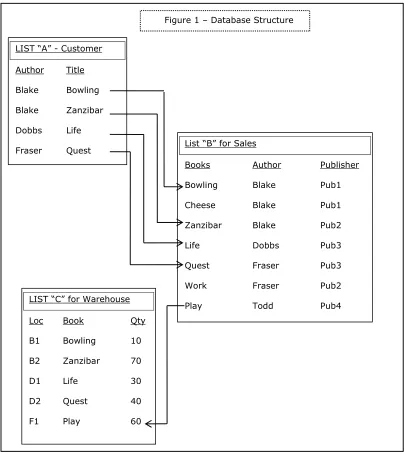
To proceed with an example, imagine that your online bookstore (such as Amazon) wishes you to buy more books of the three authors whose books you have previously purchased. Three lists exist in their computer. List “A” contains the names of your favorite authors and those of their Overall Coordination and
Integration, which can be described as “Binding”.
Operating Systems, controlling input/output, priorities and communication and other resource assignment. e.g. UNIX, Windows XP
Consciousness.
A similar role as in a computer is adopted by the various types of consciousness, with the enormous that phenomenality is integrated.
“Housekeeping” Database optimization, done while the computer is not busy on a user request or at night.
Sleep, which rids the brain of unneeded indexes and data while structurally re-optimizing those remaining.
Working Storage Holds intermediate data
Working Storage Working Storage
The fact that this is used also by computers supports the notion that the brain handles procedures in a way similar to that of
The Mental Database
books which you have already obtained from the bookstore. List “B” contains the titles of all their available books and the names of their authors. The necessary computer program must identify the books by your authors which you haven’t yet bought. It then recommends these books to you the next time you visit to their site. List “C” is used by the bookstore’s warehouse to control stock. A data/index diagram of the example is given on the next page. The indexes (or pointers) are indicated by arrows. They effectively give the address of related data and take up considerable storage space and processing resources. The structure of the indexes (rather than the data) essentially represents that of the database itself. The example is, of course, only schematic. To make the figure easy to relate to the above system description, the lists are not normalized.
LIST “A” - Customer Author Title Blake Bowling Blake Zanzibar Dobbs Life
Fraser Quest List “B” for Sales
Books Author Publisher Bowling Blake Pub1
Cheese Blake Pub1
Zanzibar Blake Pub2
Life Dobbs Pub3
Quest Fraser Pub3
Work Fraser Pub2
Play Todd Pub4
LIST “C” for Warehouse Loc Book Qty
B1 Bowling 10
B2 Zanzibar 70
D1 Life 30
D2 Quest 40
F1 Play 60
The Mental Database
The values of a short selection of data is shown in the list columns. The existence of the lowest List “A” pointer enables the computer program to deduce that Fraser’s “Quest” book is not to be recommended because it is already possessed by the customer. The absence of a pointer on Fraser’s book “Work” in List “B” enables the program to deduce that this book should be recommended because it is not possessed. The lowest arrow, pointing to List “C”, illustrates one value of another index which will let the Sales Department know that there are 60 copies of the book “Play” in stock and that they are in warehouse location F1. Other values for indexes from List “B” to list “C” are not included in order to avoid overloading the diagram.
When the reader is sent the ordered books, the data and indexes of all three lists are updated. When a new book comes on the market it is added to the sales List “B”, with its index. Since it must be stocked, its addition must generate an indexed entry in List “C”. This means that the data and indexes on Lists “A” and “C” must be updated to reflect changes in the data.
The example shows that data is useless without indexes. As mentioned above, indexes occupy memory space to store the addresses of the desired data in its master list and in the other lists containing the data elements referred to. Although in the figure an index is represented by a single arrow, in reality there are many layers of index accompanied by much code in order for the indexes to function. In a large enquiry “database warehouse” the indexes will frequently take up more space than the data itself. Also, the greater part of the structure of a database is represented by the structure of the indexes, not that of the data itself.
There must be a mind/brain equivalent to the index which relates the mind’s data lists, intrinsically representing its structure.
3.4.
Distributed Databases
In an IT environment, there may be several different databases of the same or different types working in parallel within a network of computers or even in a single computer. This is obviously the case for the brain. Presumably there is a database sub-type for each sense and mental type.
3.5.
Necessity for a Mental Relational Database
It is clear that the mind finds the relational methodology an illuminating efficient and way in which to model the external world – deprived of it we would be incapable of reasoning in our sense of the term. Perhaps there are other ways of visualizing and reasoning which we don’t know but if true that just shows that theses ways are not our ways and that such modeling is not innate to the brain. No computational evolutionary model of the mind has produced a relational database. This in itself suggests that computational models are subject to severe limitations in comparison with the mind.
4.
The Mental Domain Hypothesis
4.1.
Concept Outline
As mentioned above in the “Vocabulary” section, the term “mental” in this document always implies a content which is to be looked on as both “semantic” (and thus ”meaningful”) and “phenomenal". In his seminal paper on the subject18, Block himself suggests that the two types of consciousness may be active at the same time. For the purposes of this article there is always a phenomenal component associated with access consciousness. In effect, phenomenal consciousness may be phenomenal only, as when one is assaulted by an unexpected violent pain, whereas access consciousness requires a phenomenal component to provide the mental data in the format in which it operates.
“Access consciousness” pertains to thinking (as distinct from feeling) and is generally agreed to imply a semantic context. Most people will agree that there is something phenomenal in being in a state of access consciousness, as indicated by Searle’s Chinese Room and Block’s definition of the two terms.
“Phenomenal consciousness” is associated with the feeling of sensations. One may say that pain and pleasure are meaningful (i.e. semantic) as a consequence of being phenomenal.
The Mental Database
To illustrate the existence of phenomenality, use is made of Jackson’s famous Knowledge Argument (1982), whereby a scientist learns all there is to learn all of the known material scientific knowledge concerning color without ever seeing a red object and is then exposed to one for the first time. The question is “Does she learn anything from this new experience? The answer in most people’s opinion is “Yes”, thus confirming the existence and importance of phenomenal views.
Many persons go on to state that Mary knew all the physical facts concerning human color vision before her release, so what she learns on seeing red is a non-physical fact. Using the terminology of this paper a non-physical “red” does not appear, because the term “physical” comprises all science including that which is true even though as yet unknown. In the present terminology, seeing red is a non-material fact. This is of no concern to my thesis, because the material (current physics) is known to be incomplete and, in particular, doesn’t explain qualia.
Many workers go on to say that this confirms that Mary didn’t know all the physical facts about red. According to the definition used in this paper, this is a confusing use of the term “physical”. The term “material” could be used instead, but the term “material” represents an incomplete physics, so the result whereby Mary learns something is unsurprising.
The implication for this paper is that the term “phenomenal” is used to identify both:- a) one type of consciousness (phenomenal)
b) an aspect of the other type of consciousness (access)
but I can’t find a better way to formulate my arguments using the current vocabulary.
As there is nothing semantic about the robotic material world, all semantic data must be stored in a mental domain. Thus relatively little data, as distinct from indexes, is stored in the mind’s material domain. Destroying neurons will in all probability destroy all or much of the relevant mental domain. However, it is indicated below that the “unexpected stability” of memory, is adduced to suggest that mental data may be resistant to material trauma.
It is likely that intra-mental indexes also exist. Mental data isn’t visible to current brain scanning methods such as fMRI. This poses no problem to the hypothesis of a mental domain since the neural unit itself contains material and mental domains which are seamlessly conjoined. In this context it is remarked that in computers the first and last operations on data transactions concern the data’s indexes, not the data itself.
The following “Principle of Semantic Consistency” is now enunciated in support of the hypothesis:-
“Semantic data and semantic procedures require a semantic mental domain in which to operate”.
It is worth noting that even if phenomenality could be explained in a material context (as suggested above in Option “A”), the semantic sub-domain would remain conceptually necessary; in this case its activity is, of course, visible on brain scans.
In writing of separate mental and material domains, I am making a distinction appropriate for human understanding, but of no importance to Nature itself. At the time of the appearance of consciousness, physics operated under the same laws as it does now. Humans perceive a difference because it is only recently that it has become significant to science as it always has been to philosophy.
I don’t hazard an opinion on whether the unit of the mental domain relates to the sub-atomic, molecular, coalition, sub-Planck or any other level. For the purposes of this paper, the mental domain is simply where mental data and stored procedures (e.g. episodic, procedural) are held and where the various types of consciousness exercise their capabilities.
Taken together, the two hypotheses posit that functions are divided between the domains as follows:-
4.1.1. Material Domain
- the interface relaying data to and from the mental domain.
The Mental Database
- the indexes pointing to the addresses of the required data/procedures stored in the semantic mental domain.
- support platform for the mental, supplying energy and other facilities.
4.1.2. Mental Domain
- the complement to the material interface, relaying data from and to the material domain. - the storing of memories: short term/long term, declarative, procedural, episodic, etc.
- running the procedures relating to emotions, decisions, consciousness and unconsciousness, etc.
The originality of the hypotheses depend on the proposition that all of the semantic data is held and processed in a mental domain. This purports to explain why there are no clear signs in the material domain of either phenomenality or of comprehensible memory encoding and processing algorithms, nor any concrete prospect of finding them.
I surmise that the connections between neurons carry the indexes for both mental and material data (see section below on “Nerves Joining Neurons”).
The diagram below shows the overall structure of the body/brain/mind/ and the flow of data and processing of a visual transaction. Visualisation is an appropriate example, since it is naturally “transactional” in nature, because about 25-30 separate sequential “photos” are taken by the eye every second. Each “photo” is considered as a transaction.
The Mental Database
Quale (Seeing by Subject)
Body Actions - Move Limbs - Secrete Adrenaline - Etc.
Generate Instructions to
Body (Mental Format) MATERIAL Section of INDEXING BRIDGE
MENTAL Section of INDEXING BRIDGE
Extract Related Data (Objects, Previous Contexts, Emotions,
etc.) Eye
Visual System (Mat’l Part)
Material Domain
Mental Domain
Measuring Instruments (Scanning, TMS,
etc.)
Material Activity Supporting Mental Database
Platform (e.g. Energy)
Forward Instructions to Body (Material Format) Object
Viewed by Subject
Mental Database Platform Support
(e.g. Energy)
MENTAL DATABASES
(Conscious and Unconscious)
Material Domain
Reporting by Subject to Experimental Team Visual System
(Mental Part) Scanning
Activity
Using Consciousness, Determine Results,
Update Mental Databases (data
The Mental Database
Assuming it is correct, fig. 2 shows that we can never see direct neural correlates to consciousness using instruments which function by current physics. The experimental team and instruments receive only the following material data:-
- The material part of the indexes giving access to the mental data. This constitutes the greater part of the scanning activity visible on the measuring instruments. Indexing continues throughout the duration of the visual transaction (just as in a computer database).
- Visual input data.
- Database material needs (such as energy) while it is being updated by the visual transactions.
- Output material instructions to the body, resulting from conscious consideration of the visual input
- Reports concerning the experienced qualia, expressed by the subject himself.
According to the hypotheses, there is currently no way of directly comparing the mental and material formats. For example, there is no direct view of the mental emotional activity on our instruments. Of course we see the corresponding quale through the interpretation of images but we see nothing on the measuring instruments in the mental format, nor do we see anything of the mental processing that updates the mental databases (i.e. our mind including our memory). In IT terms, we see the database transaction but we don’t see the database state itself. If the transaction adds $500 to one’s current mental bank account which contains $2,000, only the material side of the $500 transaction will be visible to the instruments. The instruments detect nothing of the $2,000, nor of the resultant $2,500, nor even of the mental part of the $500 transaction, unless it is expressed it in some material form by saying it out loud. Of course there will be some visible material index updating, but the amount itself which is indexed (i.e. the data) won’t be visible or correlatable. Hopefully, the above statements will constitute some sort of testable of the hypotheses when scanning gains sufficiently detail. Either the $2,000 will be visible or they won’t.
Even if it is believed that Option “A” is the correct one (i.e. that the mental database is material; see paragraph 1), one still can’t see clearly what is in the database using current instrumentation because we don’t know the database coding, and the data must be in some form of database. On a computer, to obtain a simple data listing of a database field, one must use a piece of software adapted to the database format and structure in question. Using a low level machine language program would yield gibberish, intelligible only to the compiler/database writers, with perhaps now and again the odd chunk of data visibly part of the input.
Returning to Approach B (i.e. the database is mental), the correlation between the instruments measuring the “Material Indexing Bridge” activity and the “Reporting by Subject” is the most direct to which access can be obtained. The visible correlation with what is happening in the mental database itself will be low. There will be no one-to-one data item correspondence. Fig. 2 above illustrates the distance between these two correlated elements, showing how much goes on in between.
Let us take the case where a person whose right hand, on touching a warm surface, causes her brain to feel a mild discomfort and causes the withdrawal of the hand in consequence. There will be a certain neural coding/format train for the feeling of heat sent up to the brain and another neural coding/format for the train corresponding to the muscle movements effecting the removal of the hand concerned. For obvious reasons (one is sensory and the other motor), it cannot be expected that the two events will code the term “hand” in the same way. At least at this point in the development of neuroscience, we won’t be able to compare the two codings/formats for “hand”, although we may well see an increased activity and more spikes in the neural activities of the two sets of connected brain regions concerned; this may be said to constitute only a weak correlation. In a computerized robot the correlation would be perfect. In a human being the notion of “hand” exists only in the mental domain.
The Mental Database
adapted to the database format and structure in question. A simple list using a low level machine language program yields gibberish with perhaps now and again the odd chunk of code visibly part of the input data.
4.2.
Reasons for a Separate Mental Domain
One may not agree with all the points made below, but if a clear majority of them are judged acceptable then the probability is that a non-material mental domain exists. Up till recently it was generally accepted that consciousness couldn’t go very far down the evolutionary scale and was limited to the higher mammals at most. Now one sees it accepted in respectable contexts, though not everywhere. Christof Koch writes: “Perhaps they too (bees, squids, fruit flies and even roundworms) … can experience pain, pleasure, and see”19. An article was written in early 2002 proposing that consciousness was almost certainly present in all mammals and in groups such as saurians and birds, and may well go back to the chordates (primitive creatures with the beginning of a backbone). The idea of such early consciousness was widely refused at the time. Perhaps the same will happen in the relatively near future with respect to the concept of a separate mental domain.
4.2.1. The Impossibility of Epiphenomenality
Since epiphenomenalism invalidates my thesis, I will now attempt to rebut it.
The following argument was advanced by William James20: Put briefly, if consciousness were epiphenomenal there would be no reason why the emotion should match the action required by the situation. For example, hunger matches a need to eat, fear matches flight, anger matches attack. One does not feel mildly amused while struggling to free oneself from the constricting coils of a python. Also, if epiphenomenalism were operating than there would be much more genetic drift concerning emotion since it would have no survival value, but such drift isn’t seen when examining the genome or animal behavior. The drift would occur in both new and existing species. It seems strange that the these unnecessarily appropriate feelings such as hunger and sexual desire should be passed on, attached to the appropriate action, essentially unchanged in the thousands of evolved animal species in which we see them.
Another reason for refusing the epiphenomenal option is that calling something an epiphenomenon doesn’t absolve one from the obligation to explain it - it merely says that the something is not important in the current context. This is impermissible if the context is the explicating of the something itself - in this case, consciousness. Referring to Huxley’s classical example, the train’s whistle can be looked as an epiphenomenon with respect to the stationary train’s acceleration away from the platform, but not if the subject of enquiry is train whistles.
The property dualism option seems to me to be unnecessarily nomological (i.e. arbitrarily lawlike), in effect maintaining that consciousness is a brute fact dependent on the material configuration of the brain and can’t be explained further. If any reasonable explanatory proposition, even incomplete, is put forward, then the deus ex machina of property dualism (and substance dualism itself) may seem unnecessary.
If consciousness is not epiphenomenal, it must be useful to the animal that possesses it; otherwise Darwinian evolution would not have selected it and incorporated it into the species genome. This is tantamount to saying that it is causally efficacious. See below under “Evolutionary Advantages of Consciousness” for suggestions on this matter.
Genetic drift occurs spontaneously when there is no particular evolutionary need pushing genes one way or another. There are many useless “junk genes” in the genome. If consciousness were epiphenomenal, we would observe different sounds and sights diverging from a primeval standard. For example, hearing might become part of sight, as happens in subjects suffering from synesthesia. Where this mixture of senses becomes significant it is felt as a Darwinian disadvantage. The fact that it has not happened in the millions of years available means that there is no drift.
The Mental Database
4.2.2. The Impossibility of a Complete Set of Material NCC
The goal of many neuroscientists is to find the complete set of Neural Correlates of Consciousness (NCC) which match all mental activity to corresponding neural activity, visible on brain scans and elsewhere. However, the consequence of the above arguments is that we do not see anything that really merits the title of NCC. What we may see is the neural correlates between the different material inputs to, and material outputs from, the Material-Mental Indexing Bridge (see fig. 2), assuming that any exist.
According to the “Complete Set of NCC” viewpoint, all neural activity forms part of a closed material causal chain. Thus emotion is supposedly completely dependent on material events and is physically predetermined. This view leads inevitably to an epiphenomenal consciousness. Identity theories follow on. However, since consciousness has been shown not to be epiphenomenal, the complete set of NCC can’t exist. Moreover, since the advent of Quantum Mechanics, physics does not support the notion of a predetermined universe because of the way in which the wave function is collapsed. Physics has been said for several decades through quantum theory to support the concept of a fundamentally random universe21 but this statement is agreed to be open to modification by future discoveries.
It is perhaps worth mentioning in this context that we may already isolated a neuronal biochemical sequence which is actually an example of an NCC substrate, without having identified it as such, because the mental database part of the correlate is invisible. This would happen if the animal concerned can’t or doesn’t communicate a quale large enough to be visible when the substrate is activated. At the molecular level, minuscule qualia will not be visible and these are the types of result to be expected in experiments with only a few neurons, typical of those used to pinpoint neurochemical effects, although there accompanying indexing events may sometimes be visible.
4.2.3. Likelihood of Expanded Physics and New Dimensions
New fields, dimensions and forces are being discovered regularly. For instance the strong and weak nuclear forces were discovered within the last sixty years. String theories and their extensions are suggesting several more dimensions of space. These theories are not yet sufficiently developed for inclusion in the “current physical world”. The fact that we feel a pain in a particular region of body space suggests that perhaps there exist at least three dimensions of phenomenal space. If the proposed advanced physics implies further fundamental spatial dimensions in our universe, it seems unlikely that they have no perceptible effect on us.
The whole concept of the “physical world” is evolving. No respectable Victorian physicist would have entertained the weird consequences of quantum physics, such as the multiverse hypothesis and “spooky action at a distance” as referring to a physical universe.
The “LMT physical dimension” problem:-
Note that the dimensions treated below don’t represent the same concept as those mentioned above in proposing a multi-dimensional mental domain. These so-called “physical dimensions” give the dimensions of measurement intrinsically present in all equations referring to the material world.
“Physical Dimensions”
The term “Physical Dimensions” refers to a related but different concept to that used in talking of ordinary “dimensions”. It is used in physics as follows:-
Typical physical dimensions are L (length), M (mass), T(time) and Q (electric charge). Nowhere in physics does one find a physical dimension which is even faintly semantic. All the equations in physics must have the same combination of physical dimensions on each side of the equation, e.g. velocity, measured in miles per hour has the dimensions of L divided by T, so v (velocity) = LT-1. Volume has the physical dimensions of L3.
The Mental Database
Personally, phenomenality seems to me conceptually much further from the material than E is from M, both of which are material. I suggest that phenomenality is like, say, Q, which can’t be reduced to any of M, L or T.
Emergence
Most people, including scientists, when asked how they expect the consciousness question to be resolved, reply that this will come about through “emergence”. These persons expect that the current version of physics will suffice as a base. For them the advance will come through further in-depth examination of the high complexity of the brain. To give this statement some sort of base on which to judge, I suggest that emergence implies that the current physical dimensions will suffice. This, in turn, presumably means that consciousness is not “irreducible” and encourages the emergence proponents to make a suggestion in which dimensions will be involved.
Certainly new facts concerning consciousness will continue from the continuing advances in neuroscience. I believe it will be confined to indicators of which direction in which to aim subsequent research. Examples of such target indicators are the neural correlates of consciousness and the “observer/observed”22 phenomenon, whereby the observer and the observed interact. This is impossible from a “common sense” point of view.
4.2.4. The Absence of Phenomenality in Computers
The ability of the human mind to experience phenomenality is fundamental to its nature, but no verifiable proposition for materially-based phenomenality has been produced, even as a reasonable thought experiment. Various computerized neural nets purporting to achieve the same material results have been advanced but none contain a phenomenal component. All computers, however massively parallel and interconnected, running software however sophisticated, are nevertheless subject to the restrictions applying to all Turing machines, which are void of any phenomenal or semantic content. No-one pretends to have cracked the brain’s material-to-mental bridging code, nor that of phenomenal processing itself. This is understandable if the code depends on a domain not yet handled by physics. The useful work done on computers is limited to the material domain, where, for example, neural circuits round the eye or in the visual center correspond to different data shapes and colors, but not identified as objects in contexts.
There is as yet no case where the perceived neural activity can be mapped precisely to the mental event. It is therefore reasonable to suppose that it may take place elsewhere than in the material domain. In the case of the index we see only the material part.
4.2.5. The Incompleteness of the Material World
The current version of physics is agreed by mainstream physicists to be insufficient to describe our universe. It is therefore impossible to consider it as truly representing a causally closed universe, although a future version of physics may possibly do so.
4.2.6. The Early Appearance of Consciousness
The Mental Database
Since evolution advances micro-step by micro-step through mutation, there exists a strong continuity between evolutionary steps27, as mentioned above. A phenomenal semantic database must have a very different molecular structure to that of a purely computational one, making continuity between the two difficult to envisage. Taken together, these two facts imply that consciousness can’t have initially been a product of mere computational sophistication. Even in early times, consciousness was presumably dependent on that same extraordinary convocation of biomolecules, that same substrate as the present day to produce and support the mental domain. It is difficult to imagine a sudden huge discontinuous leap in the evolution of a brain organ such as the putamen (associated with the sensation of pleasure), which would imply that it went from a non-conscious state of a certain structure, function and utility to a conscious state, fulfilling much the same roles as before without an accompanying hugely discontinuous, and therefore forbidden, gap in evolution.
4.2.7. Nature’s Pre-existing Evolutionary Sense Nodes
Attempts to simulate evolution through computational simulation evolving towards a living organism have not been successful. However, the mental domain possesses strong advantages in the form of several neatly separated nodes around which it can progress in a modular fashion. The nodes are constituted by the various types of qualia, such as sight, taste, audition and other senses. Such pre-existing, independent nodes don’t easily interfere with one another and the very fact of their pre-existence means that only access to them has to be evolved, not the whole senses themselves. This means that less new code is needed to advance and that it is incorporated into a proven context.
4.2.8. Richness of the Atomic Level
For the computational approach, the atomic level is that of the basic bit stream, which in itself is devoid of interest or meaning. Binary code is trivial in content. For matter itself, the situation is the complete reverse. From the atomic level on down below the Planck limits, physics descends into the mysteries of quantum, superstring, twistor and other theories whose implications are as yet unknown and who leave plenty of room for consciousness.
4.2.9. The Binding Question
No single region has been found in the brain where all the senses are brought together, enabling their inter-relation. Thus touch may confirm the nature of an object which is being seen and smelt. No-one has had damage to a binding organ which would confirm its material existence. Personally I’m not sure it is needed. We can hit a tennis ball using both consciousness and unconsciousness simultaneously yet they differ in time by about half a second, during which the ball moves several yards without it being noticed by the player. But, if binding is needed, it is likely to take place in the mental domain where all qualia co-exist.
4.2.10.The Non-Identification of a Material Feeling Region
It is well-known that pain involves many brain sites including the thalamus. Pain impulses (action potentials) being conveyed from the area in which pain is felt (e.g. a toe) up to the brain may be said to be in the material non-conscious format as it is understood by current science and doesn’t cause pain on its own. The pulse train continues to proceed through different areas in the brain, notably the thalamus and anterior cingulate cortex. Eventually pain is felt. But nowhere along the line can a particular pulse train, or other material situation, be said to be the substrate possessing the property P, directly causing pain. P may be expressed in pulse timing and length, voltage, ions, neurotransmitters or whatever. We know to some depth many of the possible regions in material terms. This would seem to indicate that when pain is caused by the necessary convocation of particular molecules in the required particular state, the causal influence is likely to be invisible to us on our current range of instruments and thus cannot be identified by us as being the essential substrate. If this continues to be true for all sensations as neuroscience continues its rapid progress, then the experiential percept and its cause become more and more likely to take place in another domain.
The Mental Database
be generating fear. It would seem not impossible that the conveying of fear is invisible to current means of observation.
4.2.11.Conclusion
The above points converge to indicate the existence of a semantic mental domain, whose nature will hopefully be more clearly visible to a future version of physics.
5.
The Neural Index
The concept of the material/mental index has been explained above. Further detail is to be found below.
It seems probable that non-material internal mental indexes exist as well, relating evanescent mental data to other evanescent mental data.
5.1.
The First Stage for Incoming Data
As mentioned above, in computer systems in general, before becoming available for interrogation and sophisticated processing, incoming data must be uploaded into a database. In doing so, the data must be appropriately indexed. In the brain, as the incoming data is sensory, it is presumably material in nature. To become part of a semantic database, it follows that the first stage must be a material-to-mental bridging and indexing operation.
5.2.
The Evolutionary Role of Emotion
The very fact that emotion was chosen by evolution to implement decisions demonstrates that in some respects it is more efficient than reasoning without emotion, otherwise natural selection would not have chosen it to do so. These advantages come partly from a short response time in making an appropriate and coordinated response, thanks to the parallel processing in the separate material and mental domains, facilitating the rapid coordination of several different decisions and actions.
Due to a brain injury or deficiency in a part of the brain used in emotional processing, certain patients suffer from an incompatibility between their prudent reasoned evaluation and their subsequent inappropriate, emotion-less actions. Damasio’s well-known patient EVR28 underwent an operation removing tissue from the ventromedial region of the frontal lobes, causing him to lose the normal harmonious match between emotion and reason. Although his IQ remained high and he could draw clear rational deductions as to what the likely consequences of an action, he invariably yielded to unprofitable temptation when confronted in a situation requiring a short-term decision. For example, when choosing a card from a deck, he would always choose the one which could give the most spectacular reward in the short term, while knowing that it was guaranteed to be unprofitable in the medium term. Considered with similar results from damage to other regions of emotion in other patients, this indicates that emotion is the most efficient means that evolution has found for responding to demanding situations in which reflexes are too limited and reasoning takes too long.
It seems that rational evaluation plus instinct plus learnt behavior contribute to the generation over time of an emotion appropriate to the situation. Emotion’s value is that in complicated cases it reacts more quickly than reason. There is a solid experimental base for showing that fear is initiated and experienced before the subject is conscious of the reason for it. The amygdala is a brain region which is a base for fear processing. Naccache29 of Salpêtrière Hospital in Paris has shown that if an emotionally loaded word such as “murderer” is fleetingly inserted into a neutral text, the amygdala reacts strongly as is seen via the electrodes implanted in the brain. A twinge of fear is felt, even though the brevity of the display of the loaded word prevents the word itself from being consciously seen, identified or remembered.
5.3.
Steps Associated with Olfactory Sensation
The Mental Database
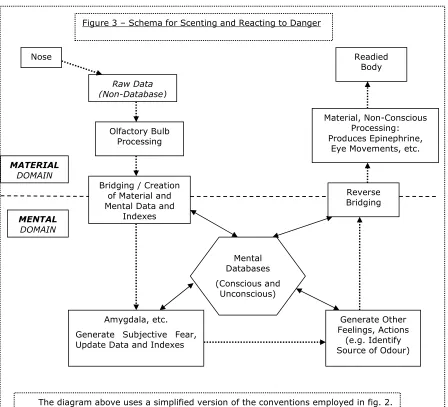
• The odor activates the nose’s olfactory receptors. • Nerve impulses are passed to the brain’s olfactory bulb • The olfactory bulb produces the:-
- material substances such as epinephrine to prepare the body for attack. - mental data necessary to react appropriately (e.g. fight or flight), which will
produce a further group of material substances.
• Appropriate biochemical/electro-magnetic signals are relayed from the olfactory bulb to the amygdala. Whether or not they already possess a mental component is unknown.
• The amygdala uses the bridging indexing capability to locate the appropriate “addresses” in the mental domain and passes data up to the appropriate mental regions.
• Swift mental domain processing takes place, in the form of emotional activity which takes into account the known dangers associated with the odor and the manner to avoid them. The manner may be instinctual or have been consciously learnt and grooved, so becoming largely unconscious.
• Interface signals are generated which pass back from the mental to the material domain through the reverse interface.
• These signals activate appropriate neurotransmitters in the material domain.
(The last four steps are perceived as a single step in the material world of brain scanning. It could be expressed as: “processing in the amygdala and associated areas causes the activation of appropriate neurotransmitters”).
• Material domain neurotransmitters activate epinephrine (adrenalin) production, motor response and other immediately appropriate activities involving both mental and material processing.
• The corresponding material brain areas are activated and the actions taken recorded in episodic memory, requiring activity in both domains and their databases.
The Mental Database
Bridging / Creation of Material and Mental Data and
Indexes Olfactory Bulb
Processing Nose
MATERIAL
DOMAIN
MENTAL
DOMAIN
Mental Databases (Conscious and
Unconscious)
Amygdala, etc. Generate Subjective Fear, Update Data and Indexes
Generate Other Feelings, Actions
(e.g. Identify Source of Odour)
Reverse Bridging
Material, Non-Conscious Processing: Produces Epinephrine,
Eye Movements, etc. Readied
Body
Raw Data (Non-Database)
Figure 3 – Schema for Scenting and Reacting to Danger
The Mental Database
If epinephrine (adrenaline) is directly injected into the bloodstream in the absence of a fear stimulus, the body will prepare the material and mental processing needed for a fight/flight reaction. In this case, obviously the olfactory data and fear of something specific will be missing.
The material database (if indeed it exists in a true database form) is simple. It acts as a kind of buffer where mentally generated decision instructions are held in the material domain prior to action, minimizing the reaction time required. For example when comfortable in a warm bed on a cold morning but aware of the necessity to get up in time, one suddenly finds one’s self standing up without having been conscious of implementing the decision to do so – in fact it had been taken some time ago and the body has been readied to take the action at the moment of its choice. This faculty of early preparation would have been critical to survival on the savannah as it gains a vital fraction of a second with respect to the predator or prey (who may also possess it of course).
5.4.
The Effect of an Antidepressant
The following describes the expected effect of serotonin. This neurotransmitter occurs naturally in the brain and affects the biochemical processes taking place at synapses. In depressed persons there is apparently a deficiency of serotonin. Neurologists have expressed puzzlement that serotonin takes several days at least to produce any effect. This means that serotonin itself is not the “holder” of serenity. A frequent treatment for depression consists in supplying a daily supplement of serotonin, which helps about half of the patients. According to the Neural Index hypothesis, this has the effect of changing the state of the interfaces, progressively orienting new data towards areas associated with serenity in the mental domain through the progressive modification of the appropriate indexes. These areas color the perception of the depressed subject in general and progressively change her whole attitude towards her environment. Ensuing mental processing will be different from that which it was before. The globality, durability and integration of the overall change implies that many brain indexes have to be changed materially. The usual explanation for the mechanism of antidepressants has been that changes at the synapses mediate the mood, although it has been suggested recently that it is connected with the observation that certain neurons grow during the few weeks that it takes for the antidepressant to begin to have an effect. It is perhaps worth noting that the improvement due to a tranquilizer is transitory and diminishes certain faculties, so large scale neuronal changes are not needed, whereas an antidepressant must update the whole system in a harmonious manner and so takes longer.
5.5.
Hebbian Activity
Hebbian activity of neurons involves the following properties and results from their repeated stimulation:-
• the reinforcement of neuron firing
• the extended branching and thickening of its dendrites.
This is how one would expect dynamic indexes to behave. Repeated access to existing data and the incorporation of new data generate faster access through the improvement of existing paths to data and the creation of new ones.
The tree-like structure of database indexes is sometimes referred to as an “arborescence”. The structure of the neuronal assemblies known as dendrites is also tree-like. However, there is nothing evident in the visible structure, obtained through the scanning of neural coalitions, indicating the presence of phenomenality.
When a small area of the brain is damaged, this normally degrades rather than eliminates the capability concerned. Again, this is what we would expect of indexes but not of data. The damage forces the brain to take a longer path, or to build a new one, to the data.
5.6.
Multiple Object Referrals and Primary/Secondary Indexes
Researchers have remarked that the same object may be referred to in neurons belonging to different brain regions. This is also what one would expect from relational indexes.
The Mental Database
title. An example of a secondary key would be the data element “author”, since the system often needs to find out which books were written by a particular author. The primary key is the data element best identifying the list concerned. It possesses its own type of index. It usually constitutes the most efficient index for accessing the data. The point here is that the mind shows a similar behavior. Detectable neuronal activity seems to be at its most intense in the neurons associated primarily with the principal data element concerned, a lesser secondary activity being detected elsewhere. An example of this is found in the behavior of place cells.
5.7.
Nerves Joining Neurons
As was mentioned above, changes in the index of one list will frequently cause indexes in other lists to be updated. Since the primary indexes are partly material in nature, they participate materially in their mutual updating through the use of the nerves which join the relevant neurons. This is one of the types of activity seen on brain scans. The other main types are those interfacing with the material body and those acting as a support for mental domain activity.
Material neuronal stimulation is seen through scanning to occur early on in thought processing, even predating it, as maintained by Libet30. The fact that electromagnetic neural activity occurs before consciousness of the scene is consistent with the Neural Index hypothesis, because:-
- Mental activity occurs first and is invisible to current scanning.
- Indexes (material and/or mental) must be activated beforehand in order for the data itself to be retrieved, inserted or updated. Also, as mentioned elsewhere, optimally prepared rapid action requires preparation in the material domain which is closest to the body’s muscles, endocrine systems and other material participants in the action.
- I suggest that Libet is not necessarily measuring only Reaction Times (RTs). He seems to be implicitly including the additional time it takes to be conscious of the fact that one is conscious of moving a wrist. This isn’t a trivial remark since many mainstream neuroscientists say that animals other than ourselves are not conscious of being conscious (e.g. Joseph Le Doux31).
- I also suggest the possibility that we are conscious of an event within the first few ms, but that the memorizing capability comes into operation only after 500 ms, so we don’t remember that we were aware of the event. This would have a Darwinian advantage in that consciousness could be used right away. This may be said to occur when one flings one’s self into a ditch to escape an oncoming car and then, when questioned, says “I don’t remember how I got here”. If there had been a wall instead of a ditch one would have tried some other escape route, so more than instinct is in play.
5.8.
Types of Visible Activity in Material Brain Regions
Some parts of the brain seem to accomplish processing of data. They may well also need to store the intermediate working data. For example, the cerebellum is associated with the skill necessary to ride a bicycle. It presumably holds the working positional and balancing data which must be present somewhere in the brain, both mental and material. Another procedural area is the parietal lobe, responsible for the spatial reasoning which determines where things are and how their positions relate to each other. Again the need for closely associated working storage presents itself. The inferotemporal cortex has the complementary job of determining what things are. That these regions and others present activity associated with processing is clearly shown through the various material brain scanning methods. This activity can sometimes be seen as low frequency synchronized brainwaves of the type seen on EEGs. Brainwaves associated with attention are visible. It is therefore clear that data routing (i.e. indexing and bridging) is not the only activity of the material brain.