Vascular Health and Risk Management
Rationale and design of XAMOS:
noninterventional study of rivaroxaban
for prophylaxis of venous thromboembolism
after major hip and knee surgery
Alexander GG Turpie1 André C Schmidt2 Reinhold Kreutz3 Michael R Lassen4 Waheed Jamal2 Lorenzo Mantovani5 Sylvia Haas6
1Department of Medicine, Hamilton
Health Sciences, General Division, Ontario, Canada; 2Bayer Healthcare
Pharmaceuticals, Global Development, Berlin, Germany; 3Institut für Klinische
Pharmakologie und Toxikologie, Charité-Universitätsmedizin Berlin, Campus Mitte, Berlin, Germany;
4Department of Orthopaedics, Spine
Clinic, Clinical Trial Unit, Hørsholm Hospital, University of Copenhagen, Hørsholm, Denmark; 5Faculty of
Pharmacy, Federico II University of Naples, Naples, Italy; 6Institut
für Experimentelle Onkologie und Therapieforschung, TU München, Germany
Correspondence: Alexander GG Turpie Department of Medicine, Hamilton Health Sciences, General Division, 237 Barton Street East, Hamilton, Ontario, Canada L8L 2X Tel +1 905 929 4385 Fax +1 905 628 9505 Email [email protected]
Abstract: Venous thromboembolism is a frequent and potentially life-threatening complication of orthopedic surgery. Rivaroxaban is an oral direct factor Xa inhibitor, which was shown to be effective for the prevention of venous thromboembolism after elective hip and knee arthroplasty in the RECORD study program. Rivaroxaban has the potential to overcome the limitations of the current standards of care in the prevention of venous thromboembolism. XAMOS (Xarelto® in the prophylaxis of post-surgical venous thromboembolism after elective major orthopedic surgery of hip or knee) is an international, noninterventional, parallel-group study to gain insight into the safety (major bleeding, side effects) and effectiveness (prevention of symptomatic thromboembolic events) of rivaroxaban in daily clinical practice. XAMOS will follow 15,000 patients after major orthopedic surgery in approximately 200 centers worldwide, with about 7500 patients receiving rivaroxaban and about 7500 standard of care. XAMOS will supplement the clinical data obtained in the Phase III RECORD 1, 2, 3, and 4 trials in which rivaroxaban was shown to be superior for the primary efficacy endpoints, and with a safety profile similar to that of enoxaparin after hip or knee replacement surgery. XAMOS was started in 2009 and will complete recruitment and follow-up in 2011.
Keywords: rivaroxaban, venous thromboembolism, effectiveness, oral anticoagulation
Background
Venous thromboembolism is a frequent and potentially fatal complication in patients undergoing major hip or knee surgery. Without prophylaxis, patients have a 40%–60% risk of deep vein thrombosis detected by screening and a 1%–30% risk of pulmonary embolism (0.1%–7.5% fatal), depending on expositional and dispositional risks.1
However, with routine use of thromboprophylaxis, fatal pulmonary embolism is uncommon, and symptomatic venous thromboembolism is reported in 1.3%–10% of patients within 3 months after surgery.1 Most symptomatic venous thromboembolism
occurs after discharge from hospital and the risk continues for at least 2 months and is the most common cause for readmission of postsurgical patients to the hospital.2,3
Contemporary prophylaxis
For pharmacologic prophylaxis of venous thromboembolism in patients with total hip replacement, total knee replacement, and hip fracture surgery, three treatments are recommended in the current American College of Chest Physicians guidelines,4
Dove
press
M E T H O D O L O G y
open access to scientific and medical research
Open Access Full Text Article
Vascular Health and Risk Management downloaded from https://www.dovepress.com/ by 118.70.13.36 on 27-Aug-2020
For personal use only.
Number of times this article has been viewed
This article was published in the following Dove Press journal: Vascular Health and Risk Management
ie, low molecular weight heparins, fondaparinux, and adjusted-dose vitamin K antagonists. Prophylaxis is recom-mended to continue for at least 10 days but, because of the prolonged risk, it may be extended for up to 35 days.4,5
While the parenteral agents, ie, low molecular weight heparin and fondaparinux, are effective, their use is limited by the requirement for subcutaneous injection. This may be regarded as desirable in the initial phase after surgery, because administration by health professionals ensures com-plete coverage of the perioperative period without reliance on patient compliance. However, hesitance to self-inject (fearing the needle stick) and the potential negative impact on patient compliance have to be considered when patients are discharged from hospital. Because current hospitalization in many countries averages #4 days, this not only becomes important for extended prophylaxis but also for the manda-tory initial phase of anticoagulation (1–10 days). A further concern in the use of low molecular weight heparins and likely also with fondaparinux is the potential for heparin-induced thrombocytopenia. With low molecular weight heparin, heparin-induced thrombocytopenia is 10 times less frequent compared with unfractionated heparins, for which an incidence of 3% has been reported in patients following hip replacement surgery.6–8 The potential of fondaparinux to
evoke heparin-induced thrombocytopenia is controversial,6,9
and patients with potential heparin-induced thrombocytopenia have been successfully switched from unfractionated heparin or low molecular weight heparin to fondaparinux.10
Vitamin K antagonists are recommended by the guidelines based on a 44% reduction of deep vein thrombosis and 77% reduction of pulmonary embolism versus placebo.11 Vitamin
K antagonists are considered to be less effective than low molecular weight heparin (relative risk 1.51 for total and proximal deep vein thrombosis)11 and fondaparinux in
pre-venting asymptomatic and symptomatic inhospital venous thromboembolism, with a slight but nonsignificant increase in surgical bleeding and wound hematoma. However, they are often used during the ambulatory phase of anticoagulation because their oral administration is perceived less of a barrier to use. Accordingly, for total hip replacement, adjusted-dose oral vitamin K antagonists with warfarin is a common form of thromboprophylaxis in North America.12 On the other hand,
vitamin K antagonists are limited by a delayed onset of action, which in some cases makes bridging for 2–3 days into full anticoagulation with low molecular weight heparin necessary, and are also limited by the fact that vitamin K antagonists have a high interindividual variability, which is in part influenced by genetic polymorphism.13 In addition, they exhibit a high
propensity for drug–drug and drug–food interactions, mak-ing close supervision (International Normalized Ratio [INR] monitoring) with frequent dose adjustments necessary. While these prerequisites are generally met in clinical trials, where a considerable portion of patients are reported to be in the desir-able INR range,11,14 clinical practice data have shown that the
actual average proportion of patients in the desired INR range may be as low as 19%, despite using dosing nomograms.15
Rivaroxaban
Rivaroxaban (Xarelto®) is an oral direct factor Xa inhibitor.
The oral bioavailability of rivaroxaban 10 mg is .90%, and peak plasma concentrations are achieved within 2.5 to 4 hours.16,17 The clinical efficacy and safety of rivaroxaban
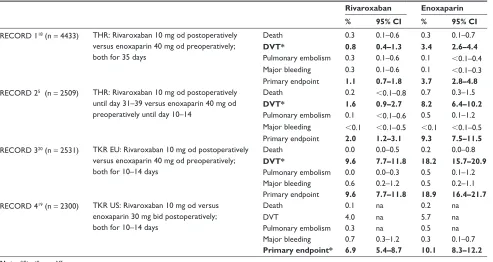
10 mg once daily 6–8 hours postoperatively for the preven-tion of venous thromboembolism after elective hip and knee arthroplasty has been established in the four random-ized controlled trials of the REgulation of Coagulation in ORthopedic Surgery to Prevent DVT and PE (RECORD) study program (Table 1).5,18–20 In these studies, rivaroxaban
was either compared with enoxaparin 40 mg once daily5,18,20
or with 30 mg twice daily.19 Rivaroxaban was more
effec-tive for the prevention of venous thromboembolism in all individual RECORD studies with no significant differences in major bleeding. A pooled analysis of data from RECORD 1–3 (n = 9581) showed that rivaroxaban was more effective than enoxaparin in reducing the incidence of the composite of symptomatic venous thromboembolism and all-cause mortality at two weeks (0.4% versus 0.8%, respectively, odds ratio [OR] 0.44; 95% confidence interval [CI] 0.23–0.79;
P= 0.005), and at the end of the planned treatment period (0.5% versus 1.3%, respectively; OR 0.38; 95% CI 0.22–0.62;
P, 0.001).21 Based on these results, rivaroxaban is currently
approved for the prophylaxis of venous thromboembolism in patients undergoing hip or knee arthroplasty in more than 100 countries worldwide, and with a broad label for major orthopedic surgery to the lower limbs in some countries.
Rivaroxaban has the potential to overcome the limitation of current prophylaxis regimens for venous thromboembolism. It is orally available (resulting in a potential increase in compliance), has no propensity for development of heparin-induced thrombocytopenia, comes as a fixed dose independent of bodyweight, age, or gender, and has a broad therapeutic window. It should be used with caution in patients with severe impairment of renal function (creatinine clearance 15–30 mL/minute) and is not recommended in patients with a creatinine clearance below 15 mL/minute. With rivaroxaban, no routine monitoring of coagulation
Dovepress
Turpie et al
Vascular Health and Risk Management downloaded from https://www.dovepress.com/ by 118.70.13.36 on 27-Aug-2020
factors or platelet counts is necessary. A perceived limitation of the new oral anticoagulants is the lack of specific antidotes. In a recent study in healthy volunteers, prothrom-bin complex concentrate has been shown to reverse the anti-coagulant effect of rivaroxaban immediately and completely after application,22 but as promising as the results of this
study are, the utility of prothrombin complex concentrate to reverse the action of rivaroxaban in the clinical setting will need to be evaluated in future studies in patients who are at risk of bleeding.
Study design
XAMOS (Xarelto® in the prophylaxis of post-surgical
venous thromboembolism after elective major orthopedic surgery of hip or knee) is an international, noninterventional, open-label, controlled cohort study to document the effec-tiveness and safety of rivaroxaban in daily clinical practice, involving approximately 7500 patients treated with rivaroxa-ban and approximately 7500 using current standards in the prophylaxis of venous thromboembolism (low molecular weight heparins, fondaparinux, and vitamin K antagonists). The study will be done in accordance with Good Epidemio-logic Practice guidance. It was registered with clinicaltrials. gov and received the identifier NCT00831714. The study was approved by the appropriate ethics committees prior to commencement in all countries, where an independent ethics
committee or an independent review board was required. XAMOS is part of a risk management plan, agreed upon with the European Medicines Agency (EMA).
Objectives
The main objectives of this study are to collect real-life data on uncommon adverse events, bleeding events, symptomatic thromboembolic events, and all-cause mortality in patients treated with rivaroxaban or standard therapy. Further measures to be evaluated are treatment convenience, patient compliance, health care resource use, use in special patient populations, such as renal impairment, and the use of certain concomitant medications, eg, cytochrome P450 (CYP) 3A4-metabolized drugs and or inducers of CYP 3A4 or P-glycoprotein. In countries where the labeling is for major orthopedic surgery, data on patients receiving rivaroxaban for prophylaxis after hip fracture surgery will also be collected.
Physician and patient selection
Approximately 250 centers where more than 80 total hip or knee replacement surgeries per year are performed were invited to participate. The conduct of the study is supervised by an independent steering committee. Consecutive patients of either gender being at least 18 years old undergoing hip or knee arthroplasty (or hip fracture surgery where appropriate) and in whom a decision on pharmacologic
Table 1 Results of the RECORD study program on hip and knee arthroplasty
Rivaroxaban Enoxaparin
% 95% CI % 95% CI
RECORD 118 (n = 4433) THR: Rivaroxaban 10 mg od postoperatively
versus enoxaparin 40 mg od preoperatively; both for 35 days
Death 0.3 0.1–0.6 0.3 0.1–0.7
DVT* 0.8 0.4–1.3 3.4 2.6–4.4
Pulmonary embolism 0.3 0.1–0.6 0.1 ,0.1–0.4 Major bleeding 0.3 0.1–0.6 0.1 ,0.1–0.3 Primary endpoint 1.1 0.7–1.8 3.7 2.8–4.8 RECORD 25 (n = 2509) THR: Rivaroxaban 10 mg od postoperatively
until day 31–39 versus enoxaparin 40 mg od preoperatively until day 10–14
Death 0.2 ,0.1–0.8 0.7 0.3–1.5
DVT* 1.6 0.9–2.7 8.2 6.4–10.2
Pulmonary embolism 0.1 ,0.1–0.6 0.5 0.1–1.2 Major bleeding ,0.1 ,0.1–0.5 ,0.1 ,0.1–0.5 Primary endpoint 2.0 1.2–3.1 9.3 7.5–11.5 RECORD 320 (n = 2531) TKR EU: Rivaroxaban 10 mg od postoperatively
versus enoxaparin 40 mg od preoperatively; both for 10–14 days
Death 0.0 0.0–0.5 0.2 0.0–0.8
DVT* 9.6 7.7–11.8 18.2 15.7–20.9 Pulmonary embolism 0.0 0.0–0.3 0.5 0.1–1.2 Major bleeding 0.6 0.2–1.2 0.5 0.2–1.1 Primary endpoint 9.6 7.7–11.8 18.9 16.4–21.7 RECORD 419 (n = 2300) TKR US: Rivaroxaban 10 mg od versus
enoxaparin 30 mg bid postoperatively; both for 10–14 days
Death 0.1 na 0.2 na
DVT 4.0 na 5.7 na
Pulmonary embolism 0.3 na 0.5 na Major bleeding 0.7 0.3–1.2 0.3 0.1–0.7 Primary endpoint* 6.9 5.4–8.7 10.1 8.3–12.2
Note: *Significant differences.
Abbreviations: DVT, deep vein thrombosis; EU, European Union; THR, total hip replacement; TKR, total knee replacement; na, not available; od, once daily; bid, twice daily.
Dovepress Rationale and design of XAMOS
Vascular Health and Risk Management downloaded from https://www.dovepress.com/ by 118.70.13.36 on 27-Aug-2020
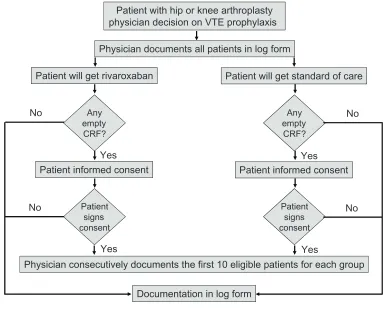
venous thromboembolism prophylaxis has already been made will be documented. Patients have to provide written informed consent where necessary. To assess the representativeness of patients enrolled against the total population with hip or knee arthroplasty, a patient log will be completed by the surgeon that documents all patients receiving venous thromboembolism prophylaxis at that site and their study status (eg, enrolled, declined participation, or excluded). Basic information will be collected in case of nonparticipation (Figure 1).
Drug administration and initiation
Because this is a noninterventional study, the decision on the type, duration, and dose of drug used for venous thromboem-bolism prophylaxis is solely at the discretion of the attending physician, and the specific prophylaxis is determined before patients enter the study.
Data acquisition
Data will be collected at the start of the venous throm-boembolism prophylaxis, at hospital discharge, one week after completion of venous thromboembolism prophylaxis, and 3 months after surgery (see Table 2). Serious adverse
events will be followed up until a final outcome is available. The participating centers collect the information using an electronic data capture system or a paper case report form collected by fax or mail. At collection, paper-based case report forms will be checked for completeness and missing information requested of the participating physician. After data entry, missing or implausible data will be queried and 5% of sites will be monitored in accordance with local regulatory provisions.
Statistical considerations
The main analysis is the comparison of the incidence rates of uncommon adverse events, bleeding events, symptomatic thromboembolic events, and all-cause mortality between the rivaroxaban group and the standard of care group comprising all nonrivaroxaban prophylactic venous thromboembolism drug regimens. A secondary analysis is a comparison between the rivaroxaban group and patients receiving low molecular weight heparins. For all adverse events and for each out-come of interest, crude cumulative incidence rates will be calculated, together with 95% CI. Study subjects taking at least one dose of a venous thromboembolism prophylactic drug will be included in the safety analysis. This study
Patient with hip or knee arthroplasty physician decision on VTE prophylaxis
Physician documents all patients in log form
Patient will get rivaroxaban Patient will get standard of care
Any empty
CRF?
Any empty
CRF?
Patient informed consent Patient informed consent
Patient signs consent
Patient signs consent
Physician consecutively documents the first 10 eligible patients for each group
Documentation in log form
No No
No No
Yes Yes
Yes Yes
Figure 1 Study design of XAMOS.
Abbreviations: VTE,venous thromboembolism; CRF, case report form.
Dovepress
Turpie et al
Vascular Health and Risk Management downloaded from https://www.dovepress.com/ by 118.70.13.36 on 27-Aug-2020
population also includes patients treated with a prophylactic drug for venous thromboembolism but where surgery was cancelled after enrolment of the patient.
Sample size calculation
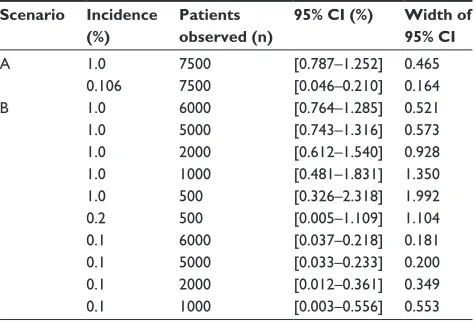
For the evaluation of the incidence of uncommon adverse events (which implies incidence rates between 0.1% and 1%) the corresponding 95% CI range from 0.164 to 0.465 percent points for 7500 patients (scenario A in Table 3). These values mark the minimum and maximum precisions which can be achieved. They are deemed to be sufficiently small to describe the incidence of uncommon adverse events in the study population. For subgroup analyses, the CI broaden because subgroups comprise fewer patients. However, for the expected subgroup sizes and incidences between 0.1% and 1%, the corresponding 95% CI are also considered as reason-ably narrow (scenario B in Table 3). In addition, the planned number of patients allows the detection with 95% power of a two-fold (or greater) increase of adverse event incidence
in the rivaroxaban group compared with the standard of care drug therapy group of 0.55% (or higher) if the incidence rate is 0.55% (or higher) in the standard of care group. Uncommon adverse events with an incidence rate between 0.1% and 1% can be described with a 95% CI ranging from 0.164 to 0.465. This precision appears reasonably narrow, both in the overall study group, as well as in subgroup analyses.
Handling of confounders
In addition to reporting crude estimates, measures will be adjusted for baseline characteristics, such as age, gender, weight, smoking, alcohol use, and others. In addition, covariate adjustment using propensity score analysis will be performed.23 The propensity score will be computed for
each subject by means of a logistic regression model, with treatment group as the dependent variable and all pretreat-ment baseline characteristics as independent variables by type of intervention, ie, elective major surgery of hip or knee. Propensity scores are usually estimated using a large number of measured pretreatment covariates in a multivariate logistic regression model to predict exposure. The resulting summary of each study subject’s pretreatment covariates yields the expected individual’s propensity score, ie, the probability of receiving rivaroxaban or reference exposure. However, propensity scores can only be generated on covari-ates collected. Although the study will collect some relevant pretreatment information, it will not be sufficient to provide risk estimates without confounding in association with the exposure of interest.
Outcomes assessment
All adverse events, including symptomatic thromboem-bolic and bleeding events will be reported on the adverse event report form and coded using the latest release of the standardized Medical Dictionary for Regulatory Activities.
Table 2 Scheduled procedures
Enrolment Surgery Hospital discharge
One week after end of therapy
Three months after surgery
Demographic data ×
Medical history ×
Surgical procedure
Antithrombotic therapy × × ×
Other venous thromboembolism prophylaxis ×
Health care resource questions × ×
Patient compliance ×
Assessment of therapy × ×
Concomitant medication × × × × ×
Adverse events × × × ×
Table 3 Width of 95% confidence intervals in relation to incidence rate
Scenario Incidence (%)
Patients observed (n)
95% CI (%) Width of 95% CI
A 1.0 7500 [0.787–1.252] 0.465
0.106 7500 [0.046–0.210] 0.164
B 1.0 6000 [0.764–1.285] 0.521
1.0 5000 [0.743–1.316] 0.573
1.0 2000 [0.612–1.540] 0.928
1.0 1000 [0.481–1.831] 1.350
1.0 500 [0.326–2.318] 1.992
0.2 500 [0.005–1.109] 1.104
0.1 6000 [0.037–0.218] 0.181
0.1 5000 [0.033–0.233] 0.200
0.1 2000 [0.012–0.361] 0.349
0.1 1000 [0.003–0.556] 0.553
Note: Computation of CI based on Pearson–Clopper formula.
Abbreviation: CI, confidence interval.
Dovepress Rationale and design of XAMOS
Vascular Health and Risk Management downloaded from https://www.dovepress.com/ by 118.70.13.36 on 27-Aug-2020
An adverse event is considered as treatment-emergent when it starts on or after the day of the first dose of a venous throm-boembolism prophylactic drug and up to two days after the last dose. In case of a switch of the venous thromboembolism prophylactic treatment during the study course, any adverse event occurring within two days after the switch will be counted towards the previous treatment.
Thromboembolic events
Symptomatic thromboembolic events are identified using the Maintenance and Support Services Organization (MSSO) Standardized MedDRA Queries (SMQ) “thrombotic and embolic events.” For additional analyses, the events will be grouped into venous and arterial events. Given the noninter-ventional nature of this study, no additional diagnostic mea-sures for the detection or confirmation of thromboembolic events are mandated by the protocol.
Bleeding events
If a bleeding event occurs, an additional bleeding question-naire for each reported event will be completed. Based on the data provided in the case report form and in the bleeding questionnaire the events will be adjudicated and differentiated as major and nonmajor bleeding events using the same adjudi-cation rules used within the RECORD program. Additionally, bleeding events will be adjudicated according to the European Medicines Agency guideline on clinical investigations of medicinal products for prophylaxis of high intraoperative and postoperative venous thromboembolic risk.24
Discussion
XAMOS is a large noninterventional, open-label, observa-tional study to document the real-life use of rivaroxaban in daily clinical practice in patients undergoing hip and knee arthroplasty. The choice of the noninterventional study design was based on several factors related to the specific aims of this study. First, rivaroxaban has been compared exclusively with enoxaparin, a current standard of care, in four large Phase III clinical trials (RECORD).5,18–20 Thus, the
clinical efficacy of rivaroxaban and the positive benefit-risk ratio in comparison with enoxaparin is well established. Although having recruited more than 12,000 patients into the RECORD study program, the clinical experience is still limited compared with the established prophylaxis modalities. Randomized controlled trials use strict inclusion and exclusion criteria, which narrow the population that can be studied in those trials, influencing the generalizability of the study results to the real world. Observational studies like
XAMOS are specifically designed to be representative of the broad patient population treated in everyday care.
Furthermore, reporting of adverse events is highly reliable in clinical trials but, is less so in clinical practice, making an organized and well structured gathering of information neces-sary to obtain further information on the clinical relevance of potential drug–drug interactions with regard to adverse events. Lastly, measuring compliance in Phase III clinical trials is usually misleading due to the tight nature of the study protocol and frequent monitoring. Vitamin K antagonists are a good example of how INR adjustments and bleeding com-plications may differ from clinical trials to daily practice.25
With this respect, the noninterventional study type used for XAMOS is suited to obtain data in practice on the actual use, dose regimen used, duration of use, and effectiveness and number of complications in routine care.
Limitations of study design
Because of the noninterventional, open-label study design and limitations inherent to observational studies,26 this study
will not generate unbiased relative risk estimates or absolute incidence rates. It is acknowledged that biases of channeling and confounding by indication are present in observational studies, due to the lack of randomization and the open-label design, despite more advanced study designs and analytical methods, such as propensity score matching or adjustment for multiple covariates associated with drug use and the clini-cal outcome.27 Propensity scores are estimated using a large
number of measured pretreatment covariates in a multivariate logistic regression model to predict exposure. The resulting summary of each study subject’s pretreatment covariates yields the expected individual’s propensity score, ie, the probability of receiving rivaroxaban or reference exposure. Propensity score pairs suggest that pairs of, eg, rivaroxaban and low molecular weight heparin, mimic a randomized trial. Although the study will collect relevant pretreatment information, it will be insufficient to provide risk estimates without confounding in association with the exposure of interest. Furthermore, the number of different outcomes cannot be anticipated. Even though propensity score can bal-ance observed baseline covariates between exposure groups, they do nothing to balance unmeasured characteristics and confounders. Therefore, as with all observational, noninter-ventional studies, and unlike randomized controlled trials, propensity score analyses have the limitation that remaining unmeasured confounding may still be present.
Another important factor that must be considered is the so called “Weber effect.” This effect was first defined in 1984
Dovepress
Turpie et al
Vascular Health and Risk Management downloaded from https://www.dovepress.com/ by 118.70.13.36 on 27-Aug-2020
by Weber,28 describing an increased adverse event reporting
rate within the first 12–24 months after the introduction of a new drug to the market, due to increasing patient exposure and higher interest in the new drug, followed by a later fall in reporting when physicians become familiar with the new compound and the respective adverse event profile. A com-parison of a new drug, like rivaroxaban, with older drugs with stable reporting and physicians who are experienced with their use in an open-label study might be misleading.
Conclusion
XAMOS is a large international, noninterventional study on the effectiveness, safety, and tolerability of rivaroxaban in daily clinical practice. This real-life data will be a valuable supplement to the data obtained during the four large Phase III trials in the RECORD program in which rivaroxaban has been shown to be superior to enoxaparin. The study was started in early 2009 and completed recruitment at the end of 2011. First results of this study will be available in 2012.
Acknowledgments
Participants in this study were from different locations in Australia, Austria, Belgium, Bosnia and Herzegovina, Canada, China, Colombia, Cyprus, Czech Republic, Denmark, Finland, France, Germany, Greece, Hong Kong, Hungary, Italy, Korea, Lebanon, Lithuania, Republic of Macedonia, Netherlands, Norway, Philippines, Portugal, Serbia, Singapore, Slovakia, Spain, Sweden, Switzerland, United Arab Emirates, United Kingdom, and Venezuela. The information contained in this paper is presented on behalf of the XAMOS investigators.
Disclosure
This study is funded by Bayer Healthcare and Johnson and Johnson Pharmaceutical Research and Development. ACS and WJ are employees of Bayer Healthcare.
References
1. Geerts WH, Pineo GF, Heit JA, et al. Prevention of venous throm-boembolism: the Seventh ACCP Conference on Antithrombotic and Thrombolytic Therapy. Chest. 2004;126(3 Suppl):338S–400S. 2. Bjornara BT, Gudmundsen TE, Dahl OE. Frequency and timing of
clinical venous thromboembolism after major joint surgery. J Bone Joint Surg Br. 2006;88(3):386–391.
3. Seagroatt V, Tan HS, Goldacre M, Bulstrode C, Nugent I, Gill L. Elective total hip replacement: incidence, emergency readmission rate, and postoperative mortality. BMJ. 1991;303(6815):1431–1435. 4. Geerts WH, Bergqvist D, Pineo GF, et al. Prevention of venous
throm-boembolism: American College of Chest Physicians Evidence-Based Clinical Practice Guidelines (8th Edition). Chest. 2008;133(6 Suppl): 381S–453S.
5. Kakkar AK, Brenner B, Dahl OE, et al. Extended duration rivaroxaban versus short-term enoxaparin for the prevention of venous throm-boembolism after total hip arthroplasty: a double-blind, randomised controlled trial. Lancet. 2008;372(9632):31–39.
6. Warkentin TE, Maurer BT, Aster RH. Heparin-induced thrombocy-topenia associated with fondaparinux. N Engl J Med. 2007;356(25): 2653–2655.
7. Warkentin TE, Chong BH, Greinacher A. Heparin-induced thrombo-cytopenia: towards consensus. Thromb Haemost. 1998;79(1):1–7. 8. Warkentin TE, Levine MN, Hirsh J, et al. Heparin-induced
thrombo-cytopenia in patients treated with low-molecular-weight heparin or unfractionated heparin. N Engl J Med. 1995;332(20):1330–1335. 9. Elalamy I, Tribout B. Can heparin-induced thrombocytopenia be
associated with fondaparinux use? A rebuttal. J Thromb Haemost. 2008;6(7):1242–1243.
10. Spyropoulos AC, Magnuson S, Koh SK. The use of fondaparinux for the treatment of venous thromboembolism in a patient with heparin-induced thombocytopenia and thrombosis caused by heparin flushes.
Ther Clin Risk Manag. 2008;4(3):653–657.
11. Mismetti P, Laporte S, Zufferey P, Epinat M, Decousus H, Cucherat M. Prevention of venous thromboembolism in orthopedic surgery with vitamin K antagonists: a meta-analysis. J Thromb Haemost. 2004;2(7): 1058–1070.
12. Mesko JW, Brand RA, Iorio R, et al. Venous thromboembolic disease management patterns in total hip arthroplasty and total knee arthro-plasty patients: a survey of the AAHKS membership. J Arthroplasty. 2001;16(6):679–688.
13. Gage BF, Eby C, Johnson JA, et al. Use of pharmacogenetic and clinical factors to predict the therapeutic dose of warfarin. Clin Pharmacol Ther. 2008;84(3):326–331.
14. Freedman KB, Brookenthal KR, Fitzgerald RH Jr, Williams S, Lonner JH. A meta-analysis of thromboembolic prophylaxis following elective total hip arthroplasty. J Bone Joint Surg Am. 2000;82-A(7):929–938. 15. Asnis PD, Gardner MJ, Ranawat A, Leitzes AH, Peterson MG, Bass AR.
The effectiveness of warfarin dosing from a nomogram compared with house staff dosing. J Arthroplasty. 2007;22(2):213–218.
16. Kubitza D, Becka M, Voith B, Zuehlsdorf M, Wensing G. Safety, pharmacodynamics, and pharmacokinetics of single doses of BAY 59-7939, an oral, direct factor Xa inhibitor. Clin Pharmacol Ther. 2005;78(4):412–421.
17. Kubitza D, Becka M, Wensing G, Voith B, Zuehlsdorf M. Safety, phar-macodynamics, and pharmacokinetics of BAY 59-7939 – an oral, direct Factor Xa inhibitor – after multiple dosing in healthy male subjects.
Eur J Clin Pharmacol. 2005;61(12):873–880.
18. Eriksson BI, Borris LC, Friedman RJ, et al. Rivaroxaban versus enox-aparin for thromboprophylaxis after hip arthroplasty. N Engl J Med. 2008;358(26):2765–2775.
19. Turpie AG, Lassen MR, Davidson BL, et al. Rivaroxaban versus enox-aparin for thromboprophylaxis after total knee arthroplasty (RECORD 4): a randomised trial. Lancet. 2009;373(9676):1673–1680.
20. Lassen MR, Ageno W, Borris LC, et al. Rivaroxaban versus enoxaparin for thromboprophylaxis after total knee arthroplasty. N Engl J Med. 2008;358(26):2776–2786.
21. Eriksson BI, Kakkar AK, Turpie AG, et al. Oral rivaroxaban for the prevention of symptomatic venous thromboembolism after elective hip and knee replacement. J Bone Joint Surg Br. 2009;91(5):636–644. 22. Eerenberg ES, Kamphuisen PW, Sijpkens MK, Meijers JC, Buller HR,
Levi M. Reversal of rivaroxaban and dabigatran by prothrombin complex concentrate: a randomized, placebo-controlled, crossover study in healthy subjects. Circulation. 2011;124(14):1573–1579. 23. D’Agostino RB Jr. Propensity score methods for bias reduction in the
comparison of a treatment to a non-randomized control group. Stat Med. 1998;17(19):2265–2281.
24. EMEA. Guideline on clinical investigation of medicinal products for prophylaxis of high intra- and postoperative venous thromboembolic risk. 2007. Available from: http://www.emea.europa.eu/pdfs/human/ ewp/70798en_fin.pdf. Accessed May 26, 2009.
Dovepress Rationale and design of XAMOS
Vascular Health and Risk Management downloaded from https://www.dovepress.com/ by 118.70.13.36 on 27-Aug-2020
Vascular Health and Risk Management
Publish your work in this journal
Submit your manuscript here: http://www.dovepress.com/vascular-health-and-risk-management-journal Vascular Health and Risk Management is an international,
peer-reviewed journal of therapeutics and risk management, focusing on concise rapid reporting of clinical studies on the processes involved in the maintenance of vascular health; the monitoring, prevention and treatment of vascular disease and its sequelae; and the involvement of
metabolic disorders, particularly diabetes. This journal is indexed on PubMed Central and MedLine. The manuscript management system is completely online and includes a very quick and fair peer-review system, which is all easy to use. Visit http://www.dovepress.com/ testimonials.php to read real quotes from published authors. 25. Samsa GP, Matchar DB, Goldstein LB, et al. Quality of
anticoagula-tion management among patients with atrial fibrillaanticoagula-tion: results of a review of medical records from 2 communities. Arch Intern Med. 2000;160(7):967–973.
26. Brown ML, Gersh BJ, Holmes DR, Bailey KR, Sundt TM III. From randomized trials to registry studies: translating data into clinical information. Nat Clin Pract Cardiovasc Med. 2008;5(10):613–620.
27. Schneeweiss S. Developments in post-marketing comparative effectiveness research. Clin Pharmacol Ther. 2007;82(2):143–156. 28. Weber JCP. Epidemiology of adverse reactions to nonsteroidal
antiinflammatory drugs. New York: Raven Press; 1984.
Dovepress
Dove
press
Turpie et al
Vascular Health and Risk Management downloaded from https://www.dovepress.com/ by 118.70.13.36 on 27-Aug-2020