Themed Section: Science and Technology
Removal of Reactive Scarlet Dye and COD Using Cylindrical Iron
Rod Anodes In A Semi-Continuous Reactor
Ersin Aytac1*, Umran Tezcan Un2
1Department of Environmental Engineering, Zonguldak Bülent Ecevit University, Zonguldak, Turkey 2Department of Environmental Engineering, Eskisehir Technical University, Eskişehir, Turkey
ABSTRACT
The cylindrical iron electrochemical reactor for electrocoagulation (EC) of reactive scarlet dye was studied. In the study, 0.5 L synthetic wastewaters with a dye concentration of 200 mg/L and chemical oxygen demand of 620 mg/L (COD) prepared in laboratuary treated for 90 minutes of EC. The effects of operational parameters such as current density (10 - 30 mA/cm2), initial pH (5 - 9), flow rate (100 - 400 mL/min) and the supporting electrolyte concentration (0.05 - 0.2 M Na2SO4) were investigated. For each operation parameter, dye stuff concentration and chemical oxygen demand has been measured for removal efficiencies after treatment duration. To estimate the operating cost, the electrical energy consumption was calculated. It has been observed that current density has positive effect on removal efficiencies. Moreover adequate dye stuff removals has been achieved in short process time and low current efficiencies. When effect of the initial pH value of the wastewater was examined, it was observed that the optimum pH value was 7.1. When investigating the influence of flow rate it was found that higher flow rates has ngative effect by breaking up the aggregates. The lowest electrical energy consumptions has been established in 0.2 M Na2SO4 concentration for the effect of supporting electrolyte concentration. Effluent COD concentration of 22 mg/L with a removal efficiency of 96.5% and effluent dye concentration of 1.08 mg/L with a removal efficiency of 99.46% was obtained with an electrical energy consumption of 4.28x10⁻⁴ kWh/mg CODremoved. Additionally, the sludge produced at electrocoagulation was characterized and maghemite (Fe2O3) was found as most common species.
Keywords : COD Removal, Decolorization, Electrochemical Treatment, Iron Electrode, Reactive
I.
INTRODUCTIONIncreasing population and industrialization can affect human life and the environment either positively or negatively. Engineering science is able to formulate the necessary precautions to ensure a sustainable environment and natural life. In the last few decades, new developments in treatment technologies have been seen. Development in wastewater treatment is essential for lessening the harmful effects of industrial waste on the environment. Electrocoagulation (EC), in conjunction with wastewater treatment processes, has become prominent in recent years. EC is an
electro-chemical process in which electrically oxidized metals have the ability to form coagulants by combining with electrolyzed water, in situ. In fact, in EC, not only do metal hydroxides form as coagulants, but other mechanisms also occur. Floating and electro-chemical reactions are amongst these treatment mechanisms. Aluminum and iron electrodes are mostly used in EC because of their cost of effectiveness, availability and effectiveness in the formation of coagulants.
The ion charge of oxidized metal can be different depending on the voltage applied. Reactions occurring with iron electrodes are shown below [1];
At anode:
4Fe(s) 4Fe2+(aq) + 8e- (1)
At cathode:
8H+(aq) + 8e- 4H2(g) (2)
In Solution:
4Fe2+(aq) + 10H2O(l)+O2(g)4Fe(OH)3(s) + 8H+(aq) (3) Mechanism II
At anode:
Fe(s) Fe2+(aq) + 2e- (4)
At cathode:
2H2O(l) + 2e- H2(g) + 2(OH)-(aq) (5)
In solution:
Fe2+(aq) + 2OH-(aq) Fe(OH)2(s) (6)
The formation of metal hydroxides may vary due to the pH of the wastewater. Fe(H2O)63+, Fe(H2O)5(OH2)+,
Fe(H2O)4(OH)2+, Fe2(H2O)8(OH)24+ and
Fe2(H2O)6(OH4)4+ in EC reference to pH [2]. Also,
certain by products, such as hematite (α-Fe2O3),
maghemite (γ-Fe2O3), magnetite (Fe3O4), lepidocrocite
(γ-FeOOH) and goethite (α-FeOOH) may be formed [3].
Dyes are used widely in the textile industry for dyeing and screwing processes [4]. Dyes are complex organic compounds and have resistance to biological degradation. Textile industry dyes are accepted as hazardous waste [5]. Biological, physical and chemical treatment can be applied to wastewater containing dyes. Also, certain neo-advanced treatment techniques have been tried out to treat this kind of wastewater in order to reduce operating costs and for more efficient removal of pollutants. At this point, electrocoagulation shows its worth proving that it is a cost-effective technology for the treatment of dye containing wastewater and textile industry wastewater. In the literature, electrocoagulation treatment has been successfully applied for the treatment of synthetic wastewater prepared using
different dyes. The electrocoagulation of dye using two parallel plate electrodes has been studied for the removal of acid yellow 220 [6], acid green 50 [7], basic red 46 and basic blue 3 [8], acid red 14 [9], and reactive red 141 [10]. Six parallel plate electrodes were also used for the removal of direct red 81 [11]. Though several researchers have evaluated electrocoagulation of dye in the literature, the majority have used a similar electrode configuration albeit with different sizes and materials .
The main dissimilarity of this study from those reported in the literature is the use of a tube type iron electrochemical reactor with cylindrical rod anodes for dye removal. The aim of this study is to determine the performance of this reactor and to obtain direct dischargeable effluent. For these purposes, several operational parameters, such as initial pH, current density and supporting electrolyte concentration have been investigated and their effects on the removal efficiency of reactive scarlet dye and COD were determined using this unique reactor. Additionally, electrical energy consumption was calculated in order to estimate the operating cost. The sludge produced at electrocoagulation was also characterized.
II.
METHODS AND MATERIALA. Wastewater
0.5 L model wastewater was prepared using reactive scarlet dye and distilled water. The reactive scarlet was obtained from a local textile factory, in Eskisehir Turkey, is a mix of reactive dyes. The wastewater contains a dye concentration of 200 mg/L and has a Chemical Oxygen Demand (COD) of 620 mg/L, pH of 7.1 and a conductivity of 441 μS/cm. To obtain a higher conductivity, Na2SO4 as a supporting
electrolyte, was added to wastewater. The initial pH of the solution was adjusted using 0.1 M H2SO4 or 0.1 M
NaOH.
B. Experimental Setup
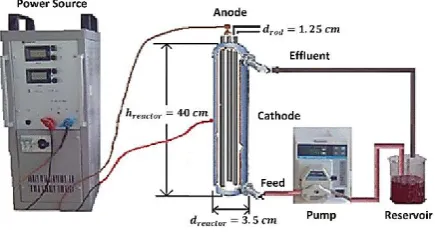
3.5 cm in diameter and was used as a cathode. The anode was three iron rods with a height of 34 cm and a diameter of 1.25 cm. It was located triangularly in the center of the reactor. The experimental setup is shown in Fig.1. At the start of the experiment, a sample solution was fed into the reactor from a reservoir which contained 0.5 L of wastewater via a peristaltic pump. The experiments were carried out in a semi-continuous mode. A power supply was connected to the electrodes, and a constant current was applied for 90 min for each run.
Figure 1. Experimental Setup C. Analyses
At the beginning, and at certain intervals, samples were taken from the solutions and centrifuged to remove floc using a centrifuge (Hettich EBA 20). The supernatant was analyzed to determine the residual COD and dyestuff. The samples’ pH and the conductivity were monitored during the process using a pH meter (Hanna 301) and a conductometer (Radiometer Pioneer 30), but were not controlled. The absorbance values of the effluent were determined using a by the double beam spectrophotometer (Shimadzu UV 1700). Dye stuff concentrations were determined using a calibration curve prepared at a wavelength of 510 nm with a high correlation coefficient (R2 = 0.9996). A COD analysis was carried
out by a close reflux method, which includes the use of potassium dichromate, sulfuric acid and mercuric sulfate and an incubation process at 150 oC in a COD
reactor (Lovibond ET 125 SC) for 120 min.
The iron ion concentration in the treated wastewater was determined using an Atomic Absorption
Spectrophotometer (Varian Spectra A250 Plus). The sludge produced during the electrocoagulation process was dried in an oven at 80 °C to eliminate moisture. Careful sampling and homogenizing were employed to assure a reasonable consistency in the sludge. The chemical composition of the sludge was determined using an X-Ray Fluorescence Spectrometer (XRF) (RIGAKU, Rix 2000). The phases present in the sludge were determined using an X-Ray Diffractometer (XRD) (RIGAKU, D/Max-IIIC) with Ni-filtered, Cu K radiation with a goniometer speed of 1°/sec.
D. Calculations
Calculation of specific electrical energy consumption (SEEC) is as follows;
𝑆𝐸𝐸𝐶 = (𝐶𝑈 𝐼 𝑡 −𝐶) 𝑉 (7)
Where; U is Average voltage (V), t is Retention time (min), V is Volume of the sample (mL).
III.
RESULTS AND DISCUSSION A. Effect of Current DensityCurrent density is the applied current per unit area of the anode. It is the most important parameter in EC because it directly controls the production of coagulants and also proves the further economic value of EC due to its optimum electricity-coagulant production value. The effect of current density was determined using current densities of 10, 20 and 30 mA/cm2 with an original pH of 7.1 and Na2SO4
Figure 2. Variation of effluent COD and dye concentrations with time at different current densities. (pH: 7.1, Na2SO4 conc.:0.1 M, flow rate:200
mL/min)
The initial COD concentration of 620 mg/L was reduced to 133, 54 and 22 mg/L with removal efficiencies of 78.5, 91.3 and 96.5% at the current densities of 10, 20 and 30 mA/cm2, respectively. The
discharge standards of the COD for the cotton textiles industry is 250 mg/L for 2 hours composite sample according to Turkish National Legislation [14]. As a result of the experiments, the requirements were met after 60, 50 and 20 minutes of EC at 10mA/cm2, 20
mA/cm2 and 30 mA/cm2 respectively. As can be seen
from Fig. 2, the greater portion of dye was removed during the first 10 min. After further electrocoagulation of the wastewater to 90 min. initial dye concentration of 200 mg/L was reduced to 1.6, 1.3 and 1.1 mg/L with removal efficiencies of 99.19 %, 99.33 % and 99.46 % at current densities of 10, 20 and 30 mA/cm2, respectively. It can be concluded that dye
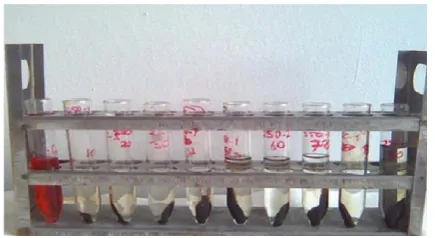
removal can be achieved easily even through a high current density value is not used. Removal of dye from wastewater can also be observed by naked eye as seen from Fig. 3.
Figure 3. Dye stuff removal
The electrical energy consumption calculated using Eq. 1 is shown in Fig. 4(a). Although the calculated electrical energy consumption after 90 min EC was 0.65x10⁻⁴, 2.13x10⁻⁴ and 4.28x10⁻⁴ kWh/mg CODremoved
respectively, the applied energy consumption will be lower because the national standard COD values were obtained earlier than 90 min.
Figure 4. Effect of current density on electrical energy consumption (pH: 7.1, Na2SO4 conc.: 0.1 M,flow rate:
200 mL/min) (b) The effect of pH on electrical energy consumption. (i: 30 mA/cm2, flow rate: 200 mL/min,
Na2SO4 conc.: 0.1 M) (c) The effect of flow rate on
electrical energy consumption (i: 30 mA/cm2, Na2SO4
conc.: 0.1 M and pH: 7.1) (d) Effect of supporting electrolyte (Na2SO4) concentrations on electrical
energy consumption. (i: 30 mA/cm2, flow rate: 200
mL/min and pH: 7.1)
B. Effect of Initial pH
In the EC process, pH is considered as a significant parameter, because pH decides the formation of coagulants which will be the main removal mechanism in the electrochemical process. The effect of initial pH was investigated using a current density of 30 mA/cm2, a flow rate of 200 mL/min and a Na2SO4
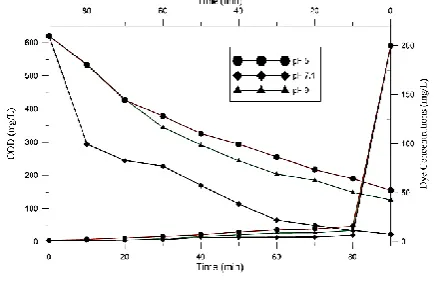
treatment of Cr (VI) containing synthetic wastewater [15]. Other results give more efficient removal efficiency values of between 5.5 - 8.5 for basic red 46 and basic blue 3 contaminated wastewater [8], while other researchers [16] obtained maximum removal efficiencies with a more acidic medium for wastewater containing Cr(IV). However, contrary to these research projects, El-Ashtoukhyand Amin [7] found no significant influence of the initial pH on the color removal of acid green containing wastewater, so the effect of the initial pH on EC depends on the type of wastewater. As shown in Fig. 5, a maximum COD reduction was obtained at pH 7.1. A final COD concentration reached 155 mg/L for pH 5, 22 mg/L for pH 7.l and 126 mg/L for pH 9. In all the initial pH trials, dye concentrations had similar abatement and decreased by almost 100% as shown in Fig. 5. This may be due to the different species formed at different pH levels. Fe(OH)2+, Fe(OH)2+ and Fe(OH)3 can occur
in an acidic medium, whereas in alkaline conditions Fe(OH)6- and Fe(OH)4- may present [2]. The original
pH of the wastewater has the most appropriate COD removal and dye concentration reduction. The electrical energy consumption was calculated and is shown in Fig 4(b). These were 4.46 kWh/mg for pH 5, 4.28 kWh/mg for pH 7.1 and 5.61 kWh/mg for pH 9.
Figure 5. Variation of effluent COD and dye concentrations with time at different pH’s. (i: 30 mA/cm2, flow rate: 200 mL/min, Na2SO4 conc.: 0.1 M)
C. Effect of Flow Rate
In this section of the study, wastewater was fed into a
reactor with flow rates of 100, 200 and 400 mL/min to determine the effects at fixed operational parameters: 30 mA/cm2, 0.1 M Na2SO4 and pH 7.1. The results can
be seen in Fig. 6 and 4(c) for the COD reduction, and energy consumption respectively. After 90 minutes of EC, the COD values were measured as 78 mg/L for 100 mL/min, 22 mg/L for 200 mL/min and 194 mg/L for 400 mL/min flow rates. The dye concentration decreased to 0.66, 1.08 and 3.40 mg/L respectively. A 200 mL/min flow rate had the most appropriate treatment efficiency with 96.45% COD removal. Increasing the flow rate from 100 to 200 mL/min had a positive effect because of the reduction of the anode passivation which is a major issue in electrocoagulation. Electrode passivation is the formation of an inhibiting layer, usually an oxide, on the electrode surface which prevents metal dissolution and electron transfer, thereby limiting coagulant formation in solution [17]. However a further increase in the wastewater flow rate to 400 mL/min had a negative effect on the removal efficiency. Higher wastewater flow rates can cause the breakup of aggregates formed through the turbulence of wastewater. When these issues are taken into account, 200 mL/min seems to be the optimum level for the wastewater flow rate. The calculated electrical energy consumption was 1.75x10⁻⁴, 4.28x10⁻⁴ and
3.18x10⁻⁴ kWh/mg CODremoved for the wastewater flow
rates of 100, 200 and 400 mL/min respectively.
Figure 6. Variation of effluent COD concentration with time at different flow rates. (i: 30 mA/cm2,
D. Effect of Supporting Electrolyte (Na2SO4)
Concentration
Adding a support electrolyte to the solution increases the conductivity of the wastewater which has the effect of decreasing the voltage and thus lowering electrical energy consumption. Many types of salts, such as NaCl [18], NaNO3 [19] and Na2SO4 can be used
as a supporting electrolyte in the EC process. It should also be noted that, to decrease the costs of EC, low cost chemicals should be used as supporting electrolytes. Although several authors have demonstrated that using NaCl as a supporting electrolyte causes an increase in removal efficiency due to the participation of active chlorine, in the form of chlorine, hypochlorous acid and hypochlorite, regenerated on the anode surface. However chlorinated by-products, which are a major health concern because of their carcinogenic properties, were observed by Solana et al. [20] when using chloride ions as an electrolyte.
In this study, Na2SO4 was selected as a supporting
electrolyte and 0.05, 0.1 and 0.2 M Na2SO4
concentrations were experienced at a current density of 30 mA/cm2, and a wastewater flow rate of 200
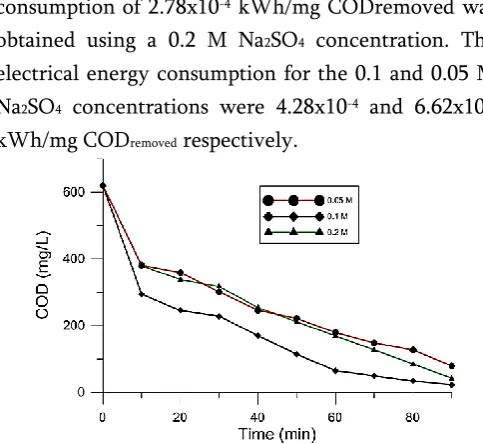
mL/min and pH of 7.1. The results obtained can be seen in Figs.6 and 4(d). The COD values after 90 minutes of EC for 0.05, 0.1 and 0.2 M Na2SO4
concentrations were 79, 22 and 42 mg/L respectively. The dye stuff removal was greater than 99 % for all the Na2SO4 concentrations which corresponded to
concentrations smaller than 1.5 mg/L. The maximum removal of the COD and dye were found in a 0.1 M supporting electrolyte concentration. Increasing the supporting electrolyte concentration to 0.2 M may cause an increase in the passivation of the electrode. On the other hand, a lower supporting electrolyte concentration may not support the transportation of ions because of insufficient conductivity which effects the EC process adversely. In order to reduce the cell voltage and consequently energy consumption, the conductivity of the wastewater should be sufficiently high. Therefore, a minimum electrical energy
consumption of 2.78x10⁻⁴ kWh/mg CODremoved was
obtained using a 0.2 M Na2SO4 concentration. The
electrical energy consumption for the 0.1 and 0.05 M Na2SO4 concentrations were 4.28x10⁻⁴ and 6.62x10⁻⁴
kWh/mg CODremoved respectively.
Figure 6. Variation of effluent COD concentration with time at different supporting electrolyte (Na2SO4)
concentrations. (i: 30 mA/cm2, flow rate: 200 mL/min
and pH: 7.1)
E. Waste Sludge Characterization
The amount and character of sludge is an important issue for its handling. EC is a more preferred technology among other advanced treatment processes because it produces small amounts of sludge [21] which are easily settable. The characterization of sludge also gives us an idea about the main mechanism which takes place in the electrocoagulation process. The sludge produced at 30 mA/cm2, pH 7.1, 0.05 M
Na2SO4 and a flow rate of 200 mL/min was collected,
dried and analyzed using an X-ray florescence spectrophotometer (XRF, Rigaku ZSX Primus). Table 1 shows the composition of sludge. As seen from Table 1, the main component of the sludge was Fe2O3
with a weight percentage of 94.65 %.
Table 1 Waste sludge composition Component Percent (%wt)
Na2O 1.9043
MgO 0.0941
Al2O3 0.1108
SO3 1.5153
CaO 0.1090
Cr2O3 0.1246
MnO 0.6662
Fe2O3 94.6491
NiO 0.1017
CuO 0.1868
Further analysis was performed to determine the phase diversity of the waste sludge produced for the same experiment using an X-ray defractometer (RigakuRint 2200). In the EC process, ferric and ferrous hydroxides formed according to equations 3-6, and these hydroxides further reacted to form electrocoagulation by-products : Hematite (α-Fe2O3),
maghemite (γ-Fe2O3), rust, magnetite (Fe3O4),
lepidocrocite (γ-FeOOH) and goethite (α-FeOOH) according to the reactions shown below [22]:
2Fe(OH)3→ Fe2O3 + 3H2O (hematite, maghemite)
(8)
Fe(OH)2→ FeO + H2O (9)
2Fe(OH)3 + Fe(OH)2→Fe3O4+4H2O (magnetite) (10)
Fe(OH)3 → FeO(OH) + H2O (goethite,
lepidocrocite) (11)
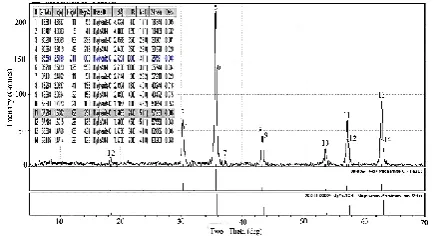
The result for phase diversity shows us that the peak of 100% (peak no:5) and all the other peaks (peaks 1, 3, 5, 7, 8, 10, 11, 13) belong to the maghemite (Fe2O3)
as seen from Fig. 7. It can be deduced from the result that, in our reactor, ferric hydroxide was formed according to mechanism I (Eq. 1-3) and then further reacted to form maghemite (Eq. 10).
Figure 7. X-ray defractometer results for waste sludge
F. Residual Iron Concentration In Treated Wastewater
In the EC process, iron ions dissolved from the anode react to form iron hydroxides in the solution and then hydroxide precipitates are formed which leave the system. However, certain iron ions may possibility not form complexes thereby becoming a secondary pollutant. To determine the residual iron concentration in the solution a number of iron analyses were performed using a flame atomic adsorption spectrophotometer (ICP ; Varian Spectra A 250 Plus) at a current density of 30 mA/cm2, a
supporting electrolyte concentration of 0.05 M Na2SO4, wastewater flow rate of 200 mL/min and a pH
of 7.1. From the analyses, no iron ion concentration was found in the solution after 90 minutes of EC, while the COD was reduced from 620 to 79 mg/L.
IV.
CONCLUSION• COD removal is directly proportional to current density. The initial COD concentration of 620 mg/L was reduced to 22 mg/L with removal efficiencies of 96.5% and an electrical energy consumption of 4.28x10⁻⁴ kWh/mg CODremoved at a
current density of 30 mA/cm2 after 90 min EC
• In the evaluation of the effect of pH, a pH of 7.1, which is the natural pH of wastewater, was found to be the most appropriate pH for the removal of COD and dye. The removal efficiencies were decreased when the initial pH became more acidic or basic.
• The presence of the supporting electrolyte also affected the removal efficiency. The maximum removal of the, COD and dye was found in 0.1M of Na2SO4 supporting electrolyte concentration.
Adding support electrolyte to the solution decreased the electrical energy consumption. • According to the results, the discharge standards
of the COD of 250 mg/L for the cotton textiles industry, based on Turkish national legislation [14], was met after 60, 50 and 20 minutes of EC at 10 mA/cm2, 20 mA/cm2 and 30 mA/cm2
respectively. A high dye removal efficiency, such as 99.46% at the current densities of 30 mA/cm2,
was also obtained.
• The character of the sludge was determined and its main component was found to be Fe2O3, with a
weight percentage of 94.65 % and a phase diversity belonging to the maghemite (Fe2O3).
V.
REFERENCES[1]. Tezcan, U. U., et al., Hybrid processes for the treatment of cattle-slaugterhouse wastewater using aluminum and iron electrodes. Journal of Hazardous Materials, 2009. 164: p. 580 – 586. [2]. Babu, R. R., et al., Treatment of tannery
wastewater by electrocoagulation. Journal of the University of Chemical Technology and Metallurgy, 2007. 42: p. 201-206.
[3]. Parga J. R., et al., Arsenic removal via electrocoagulation from heavy metal contaminated groundwater in La Comarca Lagunera Mexico. Journal of Hazardous Materials, 2005. B124: p. 247-254.
[4]. Gokkus, O., Dispers boyar madde iceren tekstil atiksularinda renk giderimi (Color removal of textile wastewaters containing disperse dye). Master's Thesis, Cumhuriyet University, Graduate School of Sciences, Sivas, 2006.
[5]. Zodi S., et al., Treatment of the textile wastewater by electrocoagulation: effect of
operating parameters on the sludge settling characteristics. Separation and Purification Technology, 2009. 69: p. 29 -36.
[6]. Pajootan E., et al., Binary system dye removal by electrocoagulation from synthetic and real colored wastewater. Journal of the Taiwan Institute of Chemical Engineers 2012. 43: p. 282-290.
[7]. El-Ashtoukhy E-S. Z. & Amin N. K., Removal of acid green dye 50 from wastewater by anodic oxidation and electrocoagulation - a comparative study.Journal of Hazardous Materials, 2010. 179: p. 113-119.
[8]. Daneshvar N., et al., Decolorization of basic dye solutions by electrocoagulation: an investigation of the effect of operational parameters. Journal of Hazardous Materials, 2006. B129: p. 116-122. [9]. Aloboyeh, A., et al., Optimization of c.i. acid red
14 azo dye removal by electrocoagulation batch process with response surface methodology. Chemical Engineering and Processing, 2008. 47: p. 827-832.
[10]. Zidane F., et al., Decolourization of dye-containing effluent using mineral coagulants produced by electrocoagulation. Journal of Hazardous Materials, 2008. 155: p. 153-163. [11]. Zodi S., et al., Direct red 81 dye removal by a
continuous flow electrocoagulation/flotation reactor. Separation and Purification Technology, 2013. 108: p. 215-222.
[12]. Timmes T. C., et al., Electrocoagulation pretreatment of seawater prior to ultrafiltration: pilot-scale applications for military water purification systems. Desalination, 2010. 250: p. 6-13.
[14]. Turkish National Water Pollution Control Legislation [SKKY], 2004 Table 10: Discharge Limits for Textile Industry Wastewater, Turkey. [15]. Aber S., et al., Removal of cr (vi) from polluted
solutions by electrocoagulation : modeling of experimental results using artificial neural network. Journal of Hazardous Materials, 2006. 171: p. 484-490.
[16]. Keshmirizadeh E., et al., An investigation on the new operational parameter effective in cr (vi) removal efficiency : a study on electrocoagulation by altering pulse current. Journal of Hazardous Materials, 2011. 190: p. 119-124.
[17]. Holt P. K., et al., The future for electrocoagulation as a localised water treatment technology. Chemosphere, 2005. 59: p. 355-367. [18]. Golder A. K., et al., Removal of trivalent
chromium by electrocoagulation. Separation and Purification Technology, 2007. 53: p. 33-41. [19]. Phalakhornkule C., et al., Pretreatment of palm
oil mill effluent by electrocoagulation and coagulation. Scienceasia, 2010. 36: p. 142-149. [20]. Solano A. M. S., et al., Decontamination of real
textile industrial effluent by strong oxidant species electrogenerated on diamond electrode: viability and disadvantages of this electrochemical technology. Applied Catalysis B: Environmental, 2013. 130-131: p. 112-120. [21]. Ilhan F., Kurt U., et al., Treatment of leachate by
electrocoagulation using aluminum and iron electrodes. Journal of Hazardous Materials, 2008. 154: p. 381-389.