Tailoring The Conducting Polymers (PPY And
PANI) With Ionic Liquid [BMIM][Br] For Enhanced
Electrochromic Properties
Barkat Ul-ain, Saadia Aftab, Asima Siddiqa, Safeer Ahmed, Sara QaisarAbstract: Conservation of energy is the biggest need of the hour for developing countries. Smart windows with electrochromic characteristics can be one of the solutions for power shortfall. In this study ionic liquid [BMIM][Br] is successfully synthesized by the reflux method. Ionogels comprising of ionic liquid and polymers (Polyaniline and Polypyrrol) were electrochemically deposited by galvanostatic methods. These films are structurally characterized by XRD and SEM. Concentration of monomer and ionic liquid was changed in order to study the effect on electrochemical and electrochromic properties. The electrochromic character was analyzed by optical studies and colour change was evident at different potentials. To further investigate the electron transport properties, electrical conductivity studies were carried out. In a nutshell different parameters are studied with respect to concentration and temperature, so that best material could be obtained showing high optical contrast and stability. Taking these studies in account an effective electrochromic device can be fabricated.
Index Terms: Ionic liquid, Polyaniline, Polypyrrol, ionogel, electrochromic, transmission, conductivity
————————————————————
1
I
NTRODUCTIONELECTROCHROMIC materials show a reversible change in their optical properties in response to the applied voltage. These materials are actively used to form electrochromic devices (ECDs). ECDs have been the focus of interest for decades because of their potential applications in a vast range of areas such as optical, communication, automobile and the military industry [1]. However they have limited commercial applications because of drawbacks such as long switching times, instability of the constituting elements and insufficient cyclability. As ECDs are fabricated by placing the redox sensitive material between the two electrodes in presence of electrolyte, so the choice of appropriate constituting elements plays a key role in the performance of the device. Research indicates that aqueous electrolytes have narrow potential stability window while the most investigated electrodes in ECDs (particularly WO3 and V2O5) are not stable in aqueous media [2]. In addition, the use of WO3 is limited due to the expensive processing [3]. On the other hand an organic electrolyte system is susceptible to evaporation and thus limits the device life time. In addition the liquid electrolytes have stability problems and are susceptible to volatility, flammability and toxicity of the system [4]. In order to overcome these problems improved electrolytes are needed that simultaneously satisfy the requirements of high ionic conductivity (>10-4 Scm-1) and large electrochemical windows. Keeping these problems in view a careful research is required to be done in order to identify the electrolytes with shorter switching times, no leakage problem and having a wide potential stability window. Ionic liquids meet all of these requirements and are considered as good electrolytes for polymeric systems [5].
Ionic liquids are known to be ―green solvents‖ and they are highly desirous nowadays due to their high chemical and thermal stability, low vapor pressure and high ionic conductivities. In addition the high polarity and the ability to dissolve a wide range of organic and inorganic compounds to a greater extent make them a potential candidate as an attractive solvent for many reactions including polymerization. This unique property of ionic liquid makes them a key material for development of many functional materials of emerging technology. As the liquid nature of electrolyte poses problems of volatility, inflammability and toxicity in ECDS, so the solid state electrolytes using polymers with different admixed salts were introduced. The discovery of conducting polymers (CPs) in middle 1970s fascinated scientists to use organic materials in ECDs [6]. CPs are important electrochromic materials due to their exceptional benefits over inorganic compounds such as good processibility, low cost, flexibility for large-area application and color tailor-ability for varying coloration region [7]. Based on these fact research get focused on solid-state ECDs on incorporating CPs with the electrolyte. But again the performance was compromised due to the long switching times as polymers have sluggish kinetics [8]. In order to overcome the leakage of liquid electrolyte from ECDs, solidification of imidazolium-based ILs was attempted either by encapsulating them in various polymers or by electrochemically depositing polymer in ILs, forming the ionic gels (ionogels) [9]. A recent study has been conducted in which the properties of ionic liquid and polymers were combined by in-situ polymerization of imidazolium based ionic liquid functionalized by triethoxysilane groups. The resulting ECD has optical modulation of up to 50% transmittance [10]. It is reported that π conjugated polymers that are electrochemically polymerized in ionic liquids have increased lifetimes without failure (up to 1 million cycles) and fast cycle switching speeds (100 ms) [11]. Further, the concentration of ionic liquid has pronounced effect on electrical properties of polymer–ionic liquid composites [12]. In this work, the ionic liquid [BMIM][Br] (1-butyl, 3- methyl imidazolium bromide) was synthesized successfully and used as a supporting electrolyte as well as dopant for polymeric films. A stable electrochromic polypyrrole (PPy) and polyaniline (PANI) film was deposited on FTO (Fluorine Doped Tin Oxide) through the electrochemical method (Galvanostatic method). Li et al. investigated that the ________________________
Barkat Ul-ain, Saadia Aftab, Asima Siddiqa, Safeer Ahmed, Sara Qaisar
NanoScience and Technology Department, National Centre for Physics, Islamabad, Pakistan Email:
galvanostatic deposition method provides higher electrochemical activity for the polymer films [13]. Earlier Lu et al fabricated the electrochemical device using ionic liquid [BMIM][BF4] with different conducting polymers synthesized electrochemically and chemically [14]. They observed high stable electroactivity of PANI in wide potential range. In this study we explored the applications of ionogels based on ionic liquids and conducting polymers for prospective application as ECDs. The electrochemically synthesized films have been thoroughly investigated and compared for their electrochromic, optical and electrical properties. Moreover, the effect of monomer and ionic liquid concentration on properties of the ionogel has also been investigated so as to identify the best composition for the electrochromic device fabrication. The ionogel exhibiting the best electrochromic response may be used in the fabrication of an electrochromic device. By carefully tailoring the concentration parameter along with thickness of film, electrochromic device can be fabricated which can be used for various energy conservation applications.
2
M
ATERIALS ANDM
ETHODS2.1 Synthesis of Ionic Liquid
Analytical grade Methylimidazole (99%, Sigma Aldrich), 1-Bromobutane (99%, Sigma Aldrich), Aniline (99%, Merck), Pyrrol (99%, Merck), HCl (37%, Scharlau), N, N Dimethyl Formamide (99%, Sigma Aldrich) and Cyclohexane (99.5%, Sigma Aldrich) were purchased. To 0.018M 1-Methylimidazole, in a round bottom flask, 10 mL of cyclohexane was added and reflux assembly was setup in an inert atmosphere. When the temperature reached to 80ºC, 0.018M 1-Bromobutane was added dropwise through a syringe. The mixture was refluxed under vacuum at 80ºC for 8-36 hrs. The product of reaction phase separated and settled at the bottom of the flask as a clear viscous liquid [BMIM] [Br]. The unreacted reagents were decanted and the hot product was washed ten times with ethyl acetate. The final product was dried at 70 ºC under vacuum for 24 hrs.
2.2 Characterization Techniques
A double beam UV-Visible-NIR spectrometer (Specord 200) was used. To determine the transmittance spectra of the deposited polymer samples software Aspect plus Version 7.0 was employed. The measurements were recorded in the range of 300 to 800 nm. The data were used to calculate bang gap energies of the FTO coated conducting polymer films. XRD analysis was done by using Panalytical 3040/60 X` pert PRO diffractometer using Cu (Kα) source at 45kV and 40mA. The XRD spectra of the deposited samples were recorded in the range of 10º to 80º with a scan rate of 0.04 and step time of 1s/step. The morphology and porosity of IL-Polymer films on the FTO substrate was done using SEM (Quanta 600F Scanning Electron Microscope). The formation of synthesized ionic liquid (1-butyl, 3–methyl imidazolium bromide) was confirmed by NMR. Cyclic voltammetry and galvanostatic techniques were performed by Echo Chemie Autolab PGSTAT 302 potentiostat/galvanostat (Utrecht, The Netherlands) using software version GPES 4.9. A double walled electrochemical cell was used (Model K-64 PARC) for all the galvanostatic and cyclic voltammetric experiments with the conventional three electrode electrochemical cell. A silver wire served as a
and the material coated on a piece of FTO as the working electrode. Ionic conductivities of the prepared films were measured by means of an impedance analyzer (Solatron Model 1260).
3
R
ESULTS ANDD
ISCUSSION3.1 Characterization of Ionic liquid [BMIM][Br]
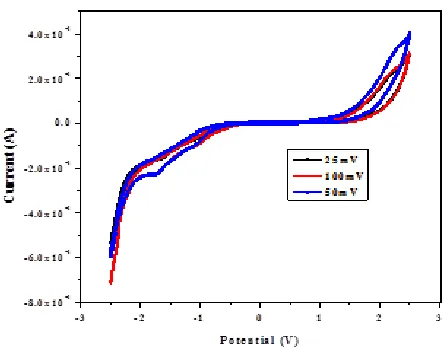
The purity of synthesized ionic liquid [BMIM][Br] was analyzed by 1H-NMR and 13C-NMR. 1H-NMR of the liquid sample in CDCl3 contains peaks at δ (ppm): 9.96 (s), 7.59(d), 4.45(t), 4.12(s), 3.46(s), 1.95(p), 1.45(q) and 0.96(t). The room temperature density of [BMIM][Br] measured was 1.32g.cm-3 while the viscosity measured was 1214.32 mPa.s both of which are in close agreement with the reported values [15]. The main property of interest was electrochemical activity of [BMIM][Br], so the electrochemical characterization of synthesized ionic liquid was carried out. In order to be a good electrolyte the potential window of the liquid should be wide with no oxidation or reduction peaks [16]. Ionic liquids are ideal supporting electrolytes because of their excellent oxidative and reductive stability which in turn are attributed to the presence of a large number of cations and anions.
Figure 1: Cyclic Voltammogram of Ionic Liquid [BMIM][Br]
3.2 Electrochemical Synthesis of Ionogel
Figure 2: Galvanostatic deposition of ionogel a)pyrrol+ionic liquid b)aniline+ionic liquid
The advantage of electrochemical synthesis is that no solvent or any other salt is required in the polymerization process. The substrate chosen for the deposition of the conducting polymer was FTO-coated electrode. The deposition was carried out electrochemically by the galvanostatic method. FTO electrode was ultrasonically cleansed in deionized water. An optimized concentration of pyrrol was dissolved in the ionic liquid and a current (0.5 A) was applied for 300 seconds until a brown colored thin film of polypyrrol was deposited on FTO. A similar method was adopted for the deposition of polyaniline using the aniline monomer and current (0.1 A) applied was for 60 sec. In case of polyaniline 2M organic acid (CF3COOH) was used so as to ensure the exclusion of water. No deposition was observed in aqueous media. Monomer concentrations were varied in order to study the effect of concentration on the deposited films and the resultant electrochromic activity. Fig. 2 shows the variation of current with time after deposition of polymer films. It shows that current increases sharply and stabilizes after some minutes. At this stage the working electrode surface became covered by brown and green films for polypyrrol and polyaniline respectively. The properties of conducting polymers are very sensitive to deposition conditions and the type of preparation technique used [17].
Figure 3: XRD profile of a) Polypyrrol ionogel deposited on
FTO b) Polyaniline ionogel deposited on FTO
Furthermore, electrochemical methods of deposition have the advantage of easy control of morphology, electrical properties and electrochemical characters as compared to the conventional methods. Therefore different experimental conditions were tried in order to optimize the conditions for best deposition of films.
3.2.1Morphological characterization of polymer films The phase study of deposited films was conducted by XRD. Fig 3a shows the XRD pattern of FTO and polypyrrol deposited. Polypyrrol films are amorphous in nature which is clearly demonstrated by the XRD pattern. The FTO peaks were also masked by the amorphous polypyrrol. However, a broad peak is observed around 43º which is typical for conducting amorphous polymer polypyrrol [18, 19].
Figure 4: SEM micrographs a) Polypyrrol ionogel at
magnification 4000X b) Polypyrrol ionogel at magnification 16000X c) Polyaniline ionogel at magnification 4000X d)
Fig. 3b shows the XRD patterns of polyaniline films with different monomer concentration. The main peaks observed were at 2θ= 27º, 38º, 52º, 62º and 66º which are well in accordance with the XRD of FTO and no individual peak for polyaniline was observed. However the intensity of the peaks decreased with increasing monomer concentration which indicates the deposition of polyaniline films. The surface morphology of deposited films was studied by SEM. Fig 4a and b shows the surface morphology of polypyrrol film deposited on FTO. It clearly demonstrates deposition of the amorphous film as also supported by the XRD of the films. In case of polyaniline a well-defined film with a dendritic structure is formed (Fig 4c and 4d). The surface of film doesn’t appear to be smooth and contains the macro-granular structure formed by the aggregation of small globular structures. The porous nature of polyaniline films may be attributed to the high potential range used to deposit the PANI film on FTO.
3.2 Electrochemical Activity Of Conducting Polymers In Ionic Liquid
3.3.1 Polypyrrol films (PPy)
The synthesized conducting polymers (PANI and PPy) were investigated for electrochemical activity in presence of ionic liquid [BMIM][Br] and the results were rationalized based on their electrochemical behavior. PANI and PPy belong to the class of conducting polymers exhibiting electrochromic properties as well. Cyclic voltammetric measurements were carried out in a pyrex beaker type cell. A saturated calomel electrode (SCE) served as reference electrode and platinum electrode was used as counter electrode. Fig. 5 shows the full scan of PPy deposited on FTO at different scan rates.
Figure 5: Electrochemical behavior of Polypyrrol ionogel at
different scan rates
It shows that as scan rate increases the peak becomes more prominent, however 50mV/s was selected as the scan rate for further studies. The peak current increased linearly with an increasing scan rate which suggested that these peaks are due to the electrochemical reactions of film itself [20]. This figure shows that PPy exhibited redox peaks in the negative potential range. Two peaks were observed, however, the cathodic peaks were more prominent as compared to anodic peaks. This means that PPy thin films show quasi-reversible behavior. The first peak appeared as shoulder at -0.6 V while
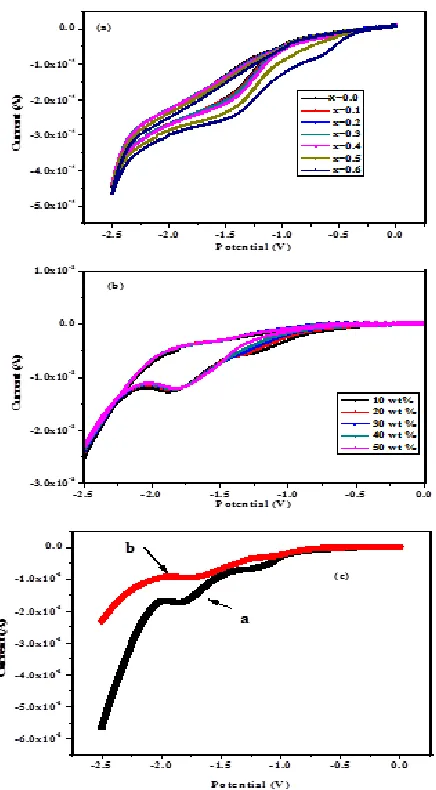
Figure 6: a) Electrochemical behavior of PPy Ionogel with varying monomer (pyrrol) concentration, b) Electrochemical
behavior of PPy ionogel with varying ionic liquid [BMIM][Br] concentration, c) Linear Sweep Voltammetry of PPy ionogel with a) pyrrol x=0.6 and [BMIM][Br] =10 wt % b) Pyrrol x= 0.6
and [BMIM][Br] = 50 wt %
Figure 7: Stability runs for PPy ionogel by repeating cycles at the interval of 10 min
This shows that the synthesized films do not remain stable for an indefinite number of cycles. However, the presence of peaks even though less intense is a clear indication that some electrochemical activity is retained even after an indefinite number of cycles.
3.3.1PolyAniline films (PANI)
Figure 8: Electrochemical behavior of a) PANI ionogel with varying monomer (aniline) concentration, b) PANI ionogel with
varying [BMIM][Br] concentration, c) stability runs of PANI ionogel for various cyclic scans
The effect of increasing the ionic liquid concentration on the electrochemical activity (Fig. 8b) was similar to the behavior observed in case of increasing monomer concentration i.e. peak current rose as the ionic liquid concentration increased, thus implying that the addition of ionic liquid enhanced the electrochemical activity of PANI films. In order to investigate the electrochemical stability of synthesized films various cyclic scans were performed at intervals of 10 min (Fig. 8c). PANI films retained the electrochemical stability and no degradation was observed even after multiple numbers of cycles. This
characteristic of PANI in ionic liquid and thus offers the potential for successful application in electrochemical devices.
3.4 Electrochromic Study Of PPy And PANI Films By Optical Properties
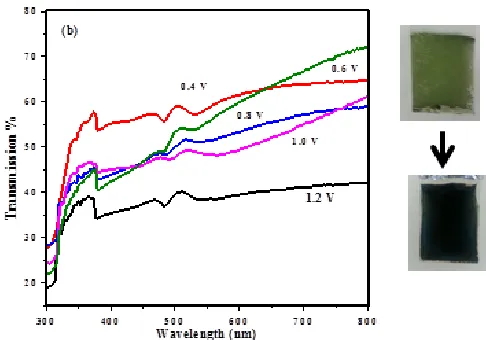
The electrochromic behavior of PPy and PANI films was studied by observing the visual color change and the transmission spectra recorded in the range of 300 to 800 nm. The PPy films change their color from light yellow to brownish black. Fig. 9a shows the transmittance behavior of PPy films at various potentials. PPy is cathodically coloring polymer [26] which shows the dark color in reduced state rather than oxidized state [27]. Fig. 9a shows that PPy is in its fully reduced state at -1.4 V and it showed the dark brownish black color. Peaks at lower wavelength (350 nm) were observed which are attributed to the transition of electrons from highest occupied molecular orbital (HOMO) to lowest unoccupied molecular orbital (LUMO) and correspond to the π→π* transitions. The transmittance increased as the potential and polymer oxidation level increased. The color of PPy changed from dark brownish black to transmissive light yellow as the potential increased. There is another peak observed around 530 nm which is assigned to polaron and bipolaron band transitions for polypyrrol [28, 29, 30]. These peaks shifted towards the lower wavelength which may be an indication of a larger band gap. Fig. 9b shows the transmission behavior of PANI film at different potentials. PANI is anodically coloring polymer and hence it showed the increase in absorption as the potential and oxidation level increased. Since PANI exists in different oxidation states during the entire redox cycle, so a variety of colors was observed. At lower potential (0.4 V) it is in fully reduced form (leusoemeraldine) which is very light green in color. The low wavelength spectra band at 375 nm can be attributed to the aromatic π→π* transitions. The small peak at 480 nm can be due to the extent of conjugation between the adjacent rings in the polymer chain or radical cations formed in the polymer matrix. The prominent peak at 520 nm can be attributed to bipolaron band transitions [31]. It is reported that as the potential increases another peak can be observed at wavelength ˃800 nm which indicates the formation of conducting state of polymer and is known as broad free carrier electron band [32, 33]. The spectral bands shift slightly towards the higher wavelength as the potential is increased, thus may indicate a decrease in the bandgap.
Figure 9b: Electrochromic behavior of PANI films at varying potentials
The color of PANI films changed as follows
Transparent light green (0.4 V) [leucoemeraldine] → light green (0.6V) [emeraldine] → dark green (0.8V) [emeraldine] → light blue (1.0V) [pernigraniline] → blue (1.2V) [pernigraniline] This wide coloration range of PANI films can be of great significance in electrochromic devices requiring high contrast ratios and wide coloring contrasts. The band gaps of these polymers were calculated with the help of transmission spectra by the Tauc relation as [34]
αhʋ =A (hʋ−Eg)n (1)
where `hʋ` is the photons energy, `α` is the absorption co-efficient `Eg` is the energy bandgap in eV, A is the constant and `n` depends on the type of transition which may have the values 0.5 , 2 and 3 etc., corresponding to allowed direct transition, allowed indirect and forbidden indirect transitions. Where α is obtained through the following eq.
𝛼=𝐴𝑑 (𝑛𝑚) (2)
Where `d` is the films thickness in nm and `A` is the absorbance of thin films. All the bandgap values are tabulated in Table 1 for PANI and PPY films with different monomer and ionic liquid concentrations. In case of PANI, addition of aniline monomer and ionic liquid slightly decreased the band gap which is in correlation with the electrochemical and transmission spectra results. This decrease in band gap is indicative of the increased conductivity of the synthesized films. According to Davis and Mott model [35] of density of states, the width of localized states near the mobility edge depends on the defects and degree of disorder present in amorphous structure. It is well known that along with saturated bonds some unsaturated bonds are also produced as a result of some insufficient number of atoms deposited in the amorphous material. The higher concentration of these localized states is responsible for the lower values of band gaps. The increased concentration of monomer and ionic liquid leads to the increase of unsaturated bonds and defects which ultimately increases the density of localized states in band structure and hence decreasing band gap. Not much change was observed in the band gap values of PPy films with different monomer and ionic liquid concentrations.
3.4 Conductivity Study Of PPy And PANI Films
the electrical conductivities. It is also suggested earlier [47, 48, 49] that the thermal curling affects the chain alignment of polymer, thus increasing the conjugation length and hence the conductivity.
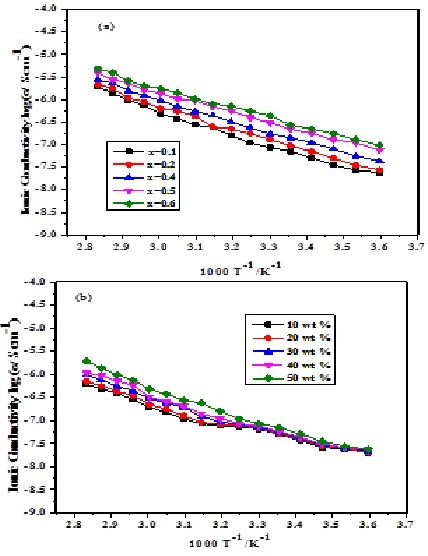
Figure 10: Arrhenius type plot for conductivity measurements
a) PPy films with varying monomer (pyrrol) concentration, b) PPy films with varying [BMIM][Br] concentration
Figure 11: Arrhenius type plot for conductivity measurements
a) PANI films with varying monomer (aniline) concentration, b) PANI films with varying [BMIM][Br] concentration.
TABLE
Band Gap Values of PPy and PANI films with Different Monomer and Ionic Liquid
4
C
ONCLUSIONPPy and PANI ionogel films were synthesized electrochemically by the galvanostatic method. XRD and SEM micrographs showed that the synthesized films are amorphous and porous in nature. Concentration of monomers and ionic liquid was varied in order to study their effect on the electrochemical, optical and electrical properties. PPy films were active in the cathodic region and showed two well defined reduction peaks for different concentration of pyrrol monomer and [BMIM][Br]. However, PANI films exhibited a clear redox behavior between different oxidation states. Increasing monomer (aniline) and ionic liquid concentration enhanced the current density of the peaks. Electrochromic behavior was investigated by UV-Vis, observing the variation in colors. PANI showed wider variation in colors corresponding to different oxidation states. Conductivity measurements show that with an increase in temperature, monomer concentration and ionic liquid concentration the conductivity rises. PANI films showed higher conductivities as compared to PPy films. Band gap values complement the conductivity results. This study shows that PANI films possess a higher color contrast and conductivity and are also more stable as compared to PPy films. Optimizing the concentration of monomer and ionic liquid will help form a stable ionogel films having the potential to be successfully used in electrochromic devices for various applications.
R
EFERENCES[1] Mortimer R J, Rosseinsky D R, Monk P M S. ―Electrochromic Materials and Devices‖ Wiley VCH Verlag GmbH & Co., Germany, 2015
[2] Pantaloni S, Passerini S, Scrosati B. J Electrochem Soc, 1987, 134 (3): 753
[3] Brazier A, Appetecchi G B, Passerini S, Surca Vuk A, Orel B, Donsanti F, Decker F. Electrochim Acta, 2007, 52 (14): 4792
[4] Passerini S, Tipton A, Smyrl W. Sol Energ Mat Sol Cells, 1995, 39(2): 167
[5] Park M J, Choi I, Hong J, Kim O. J Appl Polym Sci, 2013, 129(5): 2363
[6] Shirakawa H, Louis E J, MacDiarmid A G, Chiang C K, Heeger A J. J Chem Soc, Chem Commun, 1977: 578
[7] Mortimer R J. Chem Soc Rev, 1997, 26(3): 147
No PPy Films PANI films
Py. Con c. (x)
B.G (eV)
IL (wt %)
B.G (eV)
An. (x)
B.G (eV)
IL (wt %)
B.G (eV)
[8] Wixwat W, Stevens J R, Andersson A M, Granqvist G C. Proceedings of the Second International Symposium on Polymer Electrolytes. Siena, Italy, June, 1989
[9] Duluard S, Litas I, Jung H, Campet G, Delville M H. Ionic Liquid Based Liquid and Polymer Electrolytes: Electrochromic Behavior of PEDOT and Prussian Blue (PB) Films and Complete Devices, Abstract Book of 7th International Meeting on Electrochromism, September 3-7, Istanbul, 2006
[10]Surca Vuk A, Jovanovski V, Pollet-Villard A, Jerman I, Orel B. Sol Energ Mat Sol Cells, 2008, 92(2): 126
[11]Lu W, Fadeev A G, Qi B, Smela E, Mattes B R, Ding J, Spinks G M, Mazurkiewicz J, Zhou D, Wallace G G, MacFarlane D R, Forsyth S A, Forsyt M. Science, 2002, 297(5583): 983
[12]Mu S. Electrochim Acta, 2007, 52(28): 7827
[13]Li C M, Sun C Q, Chen W, Pan L. Surf Coat Tech, 2005, 198(1): 474
[14]Lu W, Fadeev A G, Qi B, Mattes R. J Electrochem Soc, 2004, 151(2): H33
[15]Tshibangu P N, Ndwandwe S N, Dikio E D. Int J Electrochem Sci, 2011, 6: 2201
[16]Lu J, Yan F, Texter J. Prog Polym Sci, 2009, 34: 431
[17]Yoon H. Nanomaterials, 2013, 3: 524
[18]Wang J P, Xu Y L, Wang J, Du X F, Xiao F, Li J. Synth Met, 2010, 160: 1826
[19]Sakthivel S, Boopathi A. J Chem Chemi Sci, 2014, 4 (3): 144
[20]Bard A J, Faulkner L R. Electrochemical Method, John Wiley & Sons, Inc., NewYork, 1980, 522
[21]Kuwabata S, Yoneyama H, Tamura H. Bull Chem Soc Jpn, 1984, 57: 2247
[22]Molapo K M, Ndangili P M, Ajayi R F, Mbambisa G, Mailu S M, Njomo N, Masikini M, Baker P, Iwuoha E I. Int J Electrochem Soc, 2012, 7: 11859
[23]Rajapakse R, Perera A C, Premasiri H. J Nation Sci Found of Sri Lanka, 2000, 28(4): 277
[24]Huang W S, Humphrey B D, MacDiarmid A G. J Chem Soc, Faraday Trans 1, 1986, 82: 2385
[25]Genies E M, Tsintavis C. J Electroanal Chem, 1986, 200: 127
[26]Argun A A, Aubert P H, Thompson B C, Schwendeman I, Gaupp C L, Hwang J, Pinto N J, Tanner D B, MacDiarmid A G, Reynolds J R. Chem Mater, 2004, 16: 4401
[27]Camurlu P. RSC Adv, 2014, 4: 55832
[28]Sakthivel S, Boopathi A. J Chem Chem Sci, 2014, 4 (3): 150
[29]Bilal S, Sohail M, Shah A A. J Chem Soc Pak, 2014, 36(6): 976
[30]Chougulea, M A, Pawara S G, Godsea P R, Mulika R N, Senb S, Patil V B. Soft Nanosci Lett, 2011, 1: 6
[31]Yin W, Ruckenstein E. Synth Met, 2000, 108: 39
[32]Stejskal J, Kratochvil P, Radhakrishnan N. Synth Met, 1993, 61: 225
[33]Vivekanandan J, Ponnusamy V, Mahudeswaran A, Vijayanand P S. Arch Appl Sci Res, 2011, 3(6): 147
[34]Alenson M, Venn J. ―Physics‖, 2nd edition, John Wiley, 1971
[35]Mott N F, Davis E A. ―Electronics Processes in Non-Crystalline Materials‖, Clarendon, Oxford, UK, 1979
[36]Shumaila G B., Lakshmi V S, Alam M, Siddiqui A M, Zulfequar M, Husain M. Curr Appl Phys, 2010, 11(2): 217
[37]Gosh M, Barman A, Meikap A K, De S K, Chatterjee S. Phys Lett A, 1999, 260: 138
[38]Bocchi V, Gardini G P. J Chem Soc Commun, 1986: 148
[39]De S, Dey A, Dea S K. Eur Phys J, 2005, 46: 355
[40]Heeger A J, Kivelson S, Schrieffer J R, Su W P. Rev Mod Phys, 1988, 60(3): 781
[41]Abed M Y, Youssif M A, Aziz H A, Shenashen M A. Egypt J Petrol, 2014, 23(3): 271
[42]Dutta P, Biswas S, Ghosh M, De S K, Chatterjee S. Synth Met, 2001, 122(2): 45
[43]Tokuda H, Hayamizu K, Ishii K, Abu Bin Hasan Susan M, Watanabe M. J Phys Chem B, 2005, 109: 6103
[44]Zhang S, Sun N, He X, Lu X, Zhang X. J Phys Chem Ref Data, 2006, 35(4): 1475
[45]Stegemmann H, Rhode A, Reiche A. Electrochim Acta, 1992, 37:379
[46]Seddon K R. J Chem Technol Biotechnol, 1997, 68:351
[47]Abdulla H S, Abbo A I. Int J Electrochem Sci, 2012, 7: 10666
[48]Husain J, Sridhar C B, Prasad M V N A. Int J Engg Res Appl, 2014, 4(9): 198
![Figure 1: Cyclic Voltammogram of Ionic Liquid [BMIM][Br]](https://thumb-us.123doks.com/thumbv2/123dok_us/8985000.1436565/2.612.320.540.317.472/figure-cyclic-voltammogram-of-ionic-liquid-bmim-br.webp)

![Figure 8: varying monomer (aniline) concentration, b) PANI ionogel with Electrochemical behavior of a) PANI ionogel with varying [BMIM][Br] concentration, c) stability runs of PANI ionogel for various cyclic scans](https://thumb-us.123doks.com/thumbv2/123dok_us/8985000.1436565/6.612.47.267.61.558/figure-concentration-electrochemical-behavior-ionogel-concentration-stability-various.webp)