IJEDR1703003
International Journal of Engineering Development and Research (www.ijedr.org)
17
PAPR Reduction in OFDM using SQRT and Mu-Law
Companding Techniques
1V.Tejaswini, 2K.Upendra Chowdary 1Student M.Tech, 2Asst. Professor
1 Department of Electronics and Communication Engineering 1RVR & JC College of Engineering, Guntur, India
___________________________________________________________________________________________________________________
Abstract— Orthogonal Frequency Division Multiplexing (OFDM) is considered to be a promising technique against the multipath fading channel for wireless communications. OFDM is well known Technique for transmitting large data Over Radio waves. It has several advantages such as high number of orthogonal sub-carriers, no Inter-Symbol Interference, high spectral efficiency, tolerance in multipath delay spread, power efficiency, frequency selective fading immunity etc. Its main disadvantage is PAPR (Peak to Average Power Ratio) nothing but several sinusoidal leads that are a major drawback of multicarrier transmission system which leads to power inefficiency in RF section of the transmitter. These high peaks produce signal excursions into non-linear region of operation of the Power Amplifier (PA) at the transmitter, thereby leading to non-linear distortions and spectral spreading. In fact, PAPR in OFDM system is the most detrimental aspect which degrades power and spectral spreading. This paper presents Reduction of PAPR using mu-law and square root companding techniques. These Proposed techniques show better performance for reduction in PAPR.
Index Terms—Orthogonal Frequency Division Multiplexing (OFDM), Peak-to-Average Power Ratio (PAPR), Bit Error Rate (BER) Square Root Companding Technique (SQRT), mu-law
___________________________________________________________________________________________________________________
I.INTRODUCTION (OFDM)
Orthogonal Frequency Division Multiplexing (OFDM) is combination of modulation and multiplexing access technique for Transmitting Large data over Radio waves. Due to its several advantages it becomes most luring technique for 4G wireless mobile communication. Next mobile Generation system is expected to provide high data rate to meet the requirement for future multimedia application. Minimum data rate required for the 4G System is 10-20Mbps & at least 2Mbps in moving vehicles [1].
OFDM is vastly used in Digital Audio Broadcasting (DAB), Digital Video Broadcasting-Terrestrial (DVB-T), Mobile Multimedia Access Communication (MMAC), IEEE802.11a, IEEE802.16 and IEEE802.20 [2]. OFDM is bandwidth efficient technique that decomposes the high rate data stream which has bandwidth (w) into n number of lower rate data streams and then transmit them over large number of individual subcarriers. These individual subcarriers have bandwidth (w/n) which is narrower than the coherence bandwidth of channel (Bc). These subcarriers are overlapped with each other. Peak value of independently modulated sub-carriers in OFDM system is very high compared to average value. The ratio of this value is called Peak-To-Average Power Ratio (PAPR). Though OFDM has many advantages like high spectral efficiency, robustness to channel fading, immunity to impulse interference, capacity to handle very strong echoes and less non-linear distortion it also has disadvantage of high PAPR. It becomes very necessary to mitigate high PAPR otherwise it limits the system performance and require high power amplifier with large dynamic range which is bulky and costlier.
OFDM also increases system capacity so as to provide a reliable transmission [3]. OFDM uses the principles of Frequency Division Multiplexing (FDM) [3] but in much more controlled manner, allowing an improved spectral efficiency [3]. Inter Symbol Interference (ISI) is eliminated almost completely by introducing a guard time in every OFDM symbol. OFDM faces several challenges. The key challenges are ISI due to multipath-use guard interval, large peak to average ratio due to non-linearity of amplifier; phase noise problems of oscillator, need frequency offset correction in the receiver. Large peak-to-average power (PAP) ratio which distorts the signal if the transmitter contains nonlinear components such as Power Amplifiers (PAs). The nonlinear effects on the transmitted OFDM symbols are spectral spreading, inter modulation and changing the signal constellation. In other words, the nonlinear distortion causes both in-band and out-of-band interference to signals. Therefore the PAs requires a back off which is approximately equal to the PAPR for distortion-less transmission. This decreases the efficiency for amplifiers.
II.PAPR and BER Problem in OFDM Systems
IJEDR1703003
International Journal of Engineering Development and Research (www.ijedr.org)
18
power so ultimately its efficiency will get reduced. So if the peak envelope power is subject to a design or regulatory limit, then this has the effect of reducing the mean envelope power allowed under OFDM, relative to that allowed under constant envelope modulation. It can be told that battery back-up is major important factor. So if PAPR is reduced strong battery back-up can be provided. So PAPR is basically defined as the ratio of maximum power occurring in the OFDM transmission to the average power of the OFDM transmission. [4] So mathematically it can be expressed as given below
PAPR = 𝑃𝑝𝑒𝑎𝑘 𝑃𝑎𝑣𝑒𝑟𝑎𝑔𝑒 =
max[|𝑥𝑛|2]
𝐸[|𝑥𝑛|2] …eq (1) Where, Ppeak= Peak power of the OFDM system,
Paverage = average power of the OFDM system. E [・] is the expectation operator [5]. So the device which is used to measure the ratio of the peak power level to the time-averaged power level is known as peak-to-average ratio meter (Par meter).
OFDM is one of the many multicarrier modulation techniques, which provides high spectral efficiency, low implementation complexity. Due to these advantages of the OFDM system, it is widely used in various communication systems. But the major problem that faces while implementing this system is the high PAPR of this system. A large PAPR *1 increases the complexity of the A/D and D/A converter and reduces the efficiency of the radio frequency (RF) *2 power amplifier. PAPR means randomly sinusoidal leads occurred during transmission of the OFDM signal.
PAPR is defined as the ratio of maximum value of power and the average value of power of a given signal.
Peak to Average Power Ratio (PAPR) = (maximum power of a signal) ∕ (Average power of a signal) … eq (2) PAPR can be defined in db.
PAPR (in dB) = (10 log 10) * (maximum power of a signal) / (Average power of a signal) … eq (3)
The number of bit errors in digital transmission is the number of received bits of a data stream over a communication channel that has been altered due to noise, interference, distortion or bit synchronization errors.
Bit error rate BER is a parameter which gives an excellent indication of the performance of wireless channel. When data is transmitted over a channel, there is a possibility of errors being introduced into the system. The integrity of the system may be compromised if errors are introduced into the data. As a result, it is necessary for the performance of the system, bit error rate, provides an ideal way in which this can be achieved [6].
The Bit Error Rate or Bit Error Ratio (BER) is the rate at which errors occur in transmission system. The definition of bit error rate can be translated into a simple formula
BER = No of errors/ Total no of bits send … eq (4)
Bit Error Rate assesses the full end to end performance of a system including the transmitter, receiver and the channel between the two. Main reason for the degradation of a data transmitted through channel is noise and changes to the propagation path of radio signal. Signal to Noise Ratio (SNR) is parameter that is more associated with radio links and radio communications systems [7, 8]. SNR can also define BER in terms of the probability of error.
III. PAPR REDUCTION IN OFDM
1. Mu-law
Mu-law is the standard codec (compression/decompression) algorithm for pulse code modulation (PCM) for the CCIT (Consultative Committee for International Telephone and Telegraph). A companding (compression/ expanding) method, mu-law makes it possible to improve the signal-to-noise ratio without requiring the addition of more data. The µ-law algorithm (sometimes written "mu-law") is a companding algorithm, primarily used in 8bit PCM digital telecommunication systems. Companding algorithms reduce the dynamic range of an audio signal. In analog systems, this can increase the signal-to-noise ratio (SNR) achieved during transmission; in the digital domain, it can reduce the quantization error (hence increasing signal to quantization noise ratio). These SNR increases can be traded instead for reduced bandwidth for equivalent SNR. The U.S. and Japan use µ-law companding. Limiting sample values to 13 magnitude bits, the µ-law compression portion of this standard is defined mathematically by the continuous equation.
There are two forms of this algorithm—an analog version, and a quantized digital version [9]. For a given input x, the equation for μ-law encoding is
IJEDR1703003
International Journal of Engineering Development and Research (www.ijedr.org)
19
Where µ is the compression parameter (µ=255 for the U.S. and Japan), and x is the normalized integer to be compressed. μ-law expansion is then given by the inverse equation:𝐹−1(y) = sgn(y)(1/ 𝜇)((1 + 𝜇|𝑦|) -1) , -1≤y≤1 ….eq (6)
The equations are culled from Cisco's Waveform Coding Techniques.
2.Square Rooting Compounding Technique (SQRT)
In numerical analysis, a branch of mathematics, there are several square root algorithms or methods of computing the principal square root of a non-negative real number. For the square roots of a negative or complex number,
The SQRT –OFDM signals XSQRT is processed by
𝑋𝑆𝑄𝑅𝑇= √|𝑥(𝑛) exp(jΦn), 0≤ n ≤ N-1 …. eq (7) Where,
X (n) is the nth OFDM Output signal. XSQRT is the nth SQRT- OFDM output signal. Øn is the phase of X (n)
In SQRT process, the real and imaginary part of Xn is denoted by Re{XSQRT} & Im{XSQRT}, are independent & identically distributed Gaussian random variable with zero mean & a common variance. According to central limit theorem, so the amplitude (or) modulus of OFDM signal Xn is given by large number of input samples, the imaginary and real parts of IFFT outputs will follow Gaussian distributions [9].
|𝑋𝑆𝑄𝑅𝑇| =√𝑅𝑒2{𝑋𝑎} + 𝐼𝑚2{𝑋𝑎} … eq (8)
The power of OFDM signal can be expressed as,
||𝑋𝑆𝑄𝑅𝑇|2 = 1/ 𝑁∑𝑁−1𝑚=0𝑥(𝑚)∑𝑁−1𝑘=0𝑥(𝑘) exp [𝑗(2𝜋(𝑚−𝑘))𝑛
𝑁 ] …eq (9)
Where, |XSQRT| denotes the power value of SQRT-OFDM output symbol.
The relationship between the above two equations are random variables is reciprocal, Hence we could easily convert between the two by applying square operation of their samples (or) square rooting for opposite conversion. In SQRT-OFDM system, the phase of the OFDM output signals are kept unchanged while only the amplitudes of the OFDM signals are considered and changed. The impact of this SQRT operation on the average power is higher than that on the peak power value, which is always, leads to reduction in the PAPR value [9].
IV. RESULTS
IJEDR1703003
International Journal of Engineering Development and Research (www.ijedr.org)
20
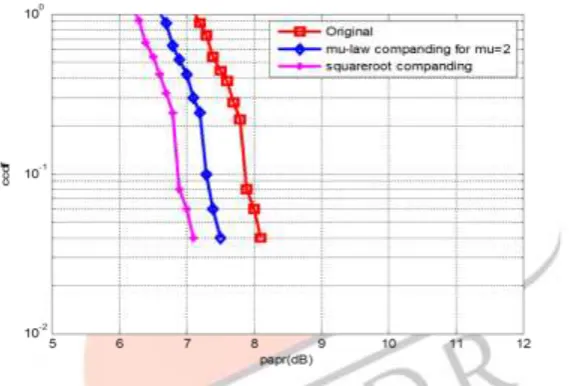
Figure 1: CCDF performance of OFDM system for different subcarriersFigure 2: CCDF performance of mu-law and SQRT companding on 64-ary QAM-OFDM system
IJEDR1703003
International Journal of Engineering Development and Research (www.ijedr.org)
21
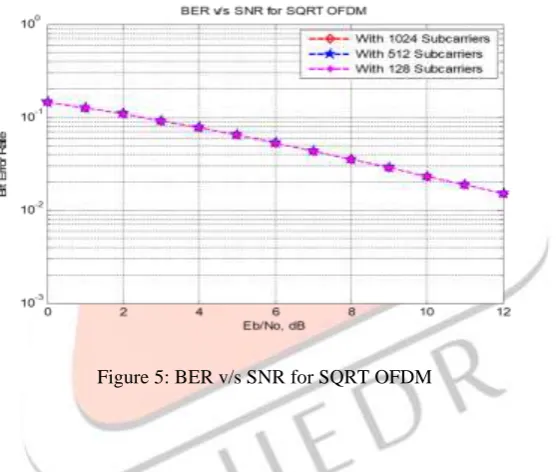
Figure 4: BER v/s SNR for SQRT OFDMFigure 5: BER v/s SNR for SQRT OFDM
V. CONCLUSION
In this paper, OFDM system performance based on mu- law companding and square rooting companding techniques are analyzed with CCDF characteristics and BER Performances.
As the simulation results show that the SQRT OFDM System is an effective technique in reducing PAPR and improved BER performance than OFDM system with mu-law companding transform. Simulation results also prove that by modulating a signal at a fixed subcarriers for different modulation technique, the error in the transmitted data increases rapidly whereas in case of fixed modulation techniques, increasing the number of subcarriers the PAPR increases at the transmitter whereas the BER in the transmitted data is constant and varies by a small fraction. Therefore the number of bits in modulation technique should be kept constant sacrificing the higher data rate.
VI. ACKNOWLEDGMENT
The author would like to thank her family and friends for their unconditional support and reviewers for their fruitful comments.
REFERENCES
[1] Malhar Chauhan, Saurabh patel, Hardik patel,” Different Techniques to Reduce the PAPR in OFDM System”, International Journal of Engineering Research and Applications (IJERA), Vol. 2, Issue 3, May-Jun 2012.
IJEDR1703003
International Journal of Engineering Development and Research (www.ijedr.org)
22
[4] Malhar Chauhan, Prof.Abhishek Chobey, “PAPR Reduction in OFDM system Using Ton Reservation Technique,” International Journal of Computer Technology and Electronics Engineering (IJCTEE) Volume 2, Issue 4, August 2012.[5] Kanchan Choubey, Prashant Jain, “PAPR Reduction using Companding and FEC Coding in OFDM System” International Journal of Scientific & Engineering Research, Volume 5, Issue 1, January-2014 2150 ISSN 2229-5518.
[6] J. Armstrong, “Peak-to-Average Power Reduction for OFDM by Repeated Clipping and Frequency Domain Filtering,” IEEE Electronic Letter, vol. 38, no. 8, pp. 246-247, Feb. 2002.
[7] B. S. Krongold and D. L. Jones, “An Active Set Approach for OFDM PAR Reduction via Tone Reservation,” IEEE Transaction Signal Processing Letter, vol. 52, no. 2, pp. 495-509, Feb. 2004.
[8] H. Ochiai and H. Imai,“Performance of the deliberate clipping with adaptive symbol selection for strictly band limited OFDM system,” IEEE Journal on selected areas in communications, vol. 18, no. 11, pp. 2270–2277, Nov. 2000.