292
Migration To Cloud Computing - Changing
Paradigm In Indian IT Sector
Arash Bahrami, Dr. S Harish Babu
Abstract : The emergence of cloud computing has provided various opportunities not explored or unknown in the world of IT in its fullest capacity; whereas Knowledge Management is a field which identifies, develops, stores, embodies or disseminates knowledge along with existing technologies, tools and methodologies desired by an organization for its progress. In most of the cases, maintenance and implementation costs play a vital role in the migration to cloud computing. With an aim to successfully execute cloud computing, all-inclusive knowledge and its management in a skillful manner is a mandate. Such strategies, guidelines, and structures are needed to be adopted in enterprises, whether business or service, that execute the same in an effective manner. Different features like effect of cloud computing on knowledge management, Knowledge Management and its advantages and factors that restrict migration or moving to the cloud in an organization.
Index Terms : Cloud Adoption, Cloud Computing, Cloud Deployment Models, Cloud Migration, Information Security systems, Information Technology, Knowledge Creation and Knowledge Management
—————————— ——————————
1
INTRODUCTION
The definition of cloud computing provided by National institute of standard and technology (NIST) has gained significant traction within the IT industry. According to this definition: ―Cloud computing is a model for enabling ubiquitous convenient, on-demand network access to a shared pool of configurable computing resources (e.g., networks, servers, storage, applications and services) that can be rapidly provisioned and released with minimal management effort or service provider interaction. This cloud model is composed of five essential characteristics, three service models, and four deployment models‖. Cloud computing has facilitated various ways which were unknown or not explored in the optimal directions in the world of Information Technology (IT). As cloud computing is found to have an impact on Knowledge management, it is one such field that has not been utilized in its full capacity. In order to recognize, develop, store, embody or distribute knowledge, the tools that exist and methodologies have been unable to help enterprises achieve desired growth. Cloud technologies are employed to support knowledge sharing due to increased developments in internet technologies and its prevalent popularity. Cloud computing, being combination of various existing technologies is not just a single technology. Fundamentals of cloud computing may bear a resemblance to previous computing eras, but developments in storage, connectivity, virtualization and power of processing are merging to develop a technological ecosystem for cloud computing. The results of this combination are a different phenomenon. After cloud computing was adopted, utilization of IT services has advanced to a new level. But costs like required infrastructure and maintenance of the said infrastructure for the long run has led to enterprises not migrating to cloud. This paper hence studies the factors dissuading migration into cloud. Usage of Cloud based technologies at a huge scale in any enterprise is the elemental advantage of adoption and implementation of Cloud computing. Since a lot of significance has been gained by
Knowledge Management, there is a need for enterprises to re-evaluate and modernize their strategies related to Knowledge Management in line with advancements in technological sector. In the red to scenic knowledge and content within firms, it is important to note that the control of content and its monitoring works out to be difficult and costly to the firms.
2
KNOWLEDGE
MANAGEMENT
Knowledge management (KM) is defined as an organized process for obtaining, utilizing, shaping, sharing, maintaining and reproducing overt knowledge which will improve the firms‘ performance increasing adaptability in the enterprise, adding value to the products and services of the organization and develop products that are knowledge-intensive. If knowledge in an organization is not effectively shared, the value limitation increases manifold. The capacity to integrate and implement is the main challenge in all organizations if they want to gain competitive advantage. The enterprises that have configured ways to develop knowledge are sharing and applying knowledge to achieve organizational objectives to the maximum and to build value in the organization. Knowledge Management is a scientific process that starts its functions by collecting knowledge (both tacit and explicit), selecting the knowledge required, structuring or restructuring it, storing and then disseminating it. The dissemination process of the stored knowledge can be done in the way as follows:
1. The approach to knowledge is accurate and easy. 2. The approached knowledge supports sufficiently in
decision making, and
3. The accessible knowledge makes possible in conception or creation of knowledge.
4. Four important areas are catered to by successful strategies of knowledge management:
5. As a core focus and competency,
6. Flexible structure for knowledge creation and dissemination,
7. Skilled knowledgeable workers, and 8. Technology and processes.
Knowledge management adds transparency to an generally opaque backdrop of the issues including cloud computing because it provides the solution to the problems of the misrepresentation, deficiency and insufficiency of data. The need for knowledge management also arises because the processes, tools & technologies involved and adopted ought to ___________________
Arash Bahrami is a Research Scholar in the Department of Management Studies, University of Mysore, Mysuru, Ph: 8884440444 , E-mail id : [email protected]
293 be developed and refined keeping in view the opportunities
that cloud computing is offering.
Cloud Computing and Knowledge Management: The Intersecting Issues
The need for a definitive knowledge management is increasing as technology is advancing. Knowledge Management becomes more important with the increase in adoption of cloud computing, mobile devices, and virtual workplace. The employment modalities of cloud ought to be perceived as just setting of 'interior' versus 'exterior' since they identify with the corporeal location of assets, information and resources; yet additionally who are devoured by; and who is accountable for security, administration and conformity with standards and policies.
The threat for knowledge management-as-a-service is based on:
The kinds of resources, assets and data management How is it managed?
Who manages it?
How are controls selected and integrated Issues with compliance.
Issues with respect to security of data lifecycle in the cloud in indication to knowledge management-as-a-service encompass the below:
Data security: Integrity, Confidentiality, Authenticity, Availability, Non-Repudiation, Authentication and Authorization.
Location of the data: An assurance regarding data, backup of data and its copies, is stored only in geographic locations allowed by contract, SLA, and/or regulation.
Data remanance or persistence: Effective techniques for locating data in the cloud, destroying/erasing data, and guaranteeing that the data has been completely removed or caused to be unrecoverable must be accessible and used when needed.
Data backup and recovery schemes for recovery and restoration: There must be effective schemes for backup and recovery of data so that loss can be prevented from destruction and overwriting of unwanted data.
Data discovery: Owners of data will be required to concentrate on data discovery and affirming to the regulatory and legal authorities that the data is retrieved because the legal system focuses on cloud service providers and electronic discovery of data. Data aggregation and inference: To protect data from
‗breach‘, required steps must be taken by data owner and data stakeholders because when data is aggregated, protected information is not revealed. Impact of Cloud Computing on Knowledge Management
The reasons that knowledge management is used in cloud services presently because:
Development of technology in association with internet connectivity
Reduction in costs of storage of data
The proliferation of smart devices across the globe These variables have aided in satisfying the
pre-imperative of financially savvy, basic and adaptable data. The utilization of advanced mobiles and tablets exhibits the capability of cloud computing to engage the
clients with refined and powerful yet simple-to-utilize PC applications and data, which was generally not all that simple to access.
Today is uncommon to have a user who doesn't know about Google and the information and data that lays just a couple of clicks away. Looked with this regularly developing knowledge repository, firms‘ battle to give optimal solutions to clients quicker than they can discover it on the Internet. A couple of parts of the Google-effect can make associations vulnerable. The wellspring of data found on the Internet must be deliberately assessed by the client to guarantee that it can bolster decision-making. Delivering corporate knowledge is moderate and regularly does not address the issues of the clients. It is significant for companies to build knowledge management strategy that reacts to client needs in an opportune and effective way – that takes data and information in the right circumstance from a convicted source.
Advantages of Cloud Computing with perspective of Knowledge Management
With regard to process of knowledge management, the following pre-requisites can be catered to optimally with cloud computing:
Technology related costs are significantly reduced by Cloud computing. Synergies are created through decrease in computing time and modeling process. The requirements of storage for the purposes of preserving systems of knowledge management can be proficient by the efficient utilization of models of cloud storage. Access to variety of services to the users are easy
through cloud computing.
Opportunities for knowledge users increases manifold which could be previously unknown to them.
The knowledge can be successfully streamlined and be made available readily.
It speeds up the advancement and compliance of the abilities of knowledge functions in any business. It enlarges the usage of shared developments and
open-source services around the world.
It lessens the costs and activities in association with infrastructure management.
Paradigm shift India:
294 technology, it sets for having intensity of cloud with the
accommodation of portability. This model is as of now coming into picture with applications. Future of cloud computing lies in making the cloud model goes totally on pay as going on premise for big business applications as well as for applications in handheld gadgets.
TOTAL ITEND-USER SPENDING FORECAST,INDIA,2014-2017 (US$MILLIONS)
Segment 2014 2015 2016 2017 Devices 23,504 26,644 31,118 34,108 Data Center
Systems 2,492 2,668 2,825 2,973 Software 4,109 4,667 5,293 6,014 IT Services 11,235 13,037 15,137 17,608 Telecommunica
tions Services 30,006 30,728 31,545 32,277 Grand Total 71,347 77,744 85,917 92,980 Source: https://www.statista.com/statistics/431553/india-it-spending-forecast
3
REVIEW
OF
LITERATURE
Irshad, Gapar, Johar, Naleer (2015) investigated on the review on Cloud Computing Adoption: An Exploratory Analysis. This examination paper tried to accomplish the supplementary goals. In order to distinguish the varying ideas in respect with cloud computing, to identify the an assortment of partners with the cloud computing services, to acclaim the elementary advances behind the cloud, differentiate the issues, to deliberate on the selection status of cloud computing, and finally to suggest future research areas in cloud computing. The paper focused on the definition of cloud computing, hidden advancements, attributes, cloud sending model, diverse cloud administrations, points of interest and impediments of computing, issues related to adoption and implementation of computing, selection status of distributed computing, and probable research areas for future. Tarmidia, et al. (2014) studied the awareness of Cloud computing and its adoption among Malaysian accounting practitioners. The main aim of the study was to investigate the awareness level and adoption of cloud computing in Small and Medium Enterprises (SMEs) in Malaysia. The data were gathered by structured survey questionnaires and the study was exploratory in nature. Deploying accounting practitioners from both commercial and audit fields, the study determined if the organizations were aware of the emerging cloud technology, the range of utilization and explicit reasons for not adopting the technology. Two-third of the respondents were not found to be aware of cloud computing. Only 7% of the respondents claimed that they knew about cloud computing. The adoption level was restrained to various applications, such as Dropbox and Google Apps Engine. Time saving and costs were mentioned as the main reasons for adoption, while dearth of benefits and security were the main reasons why organizations did not adopt cloud. More involvement was expected from the government as cloud computing had various benefits to offer to SMEs. Al-Jabri (2014) studied the behavior and preferences of adopters and non- adopters of cloud computing: application of technology- organization- environment. Technology-Organization-Environment (TOE) framework was used in this study to determine the IT staff‘s perceptions towards adoption
of cloud computing. Compatibility, relative advantage, top management support, complexity, competitive pressure, readiness of the organization and pressure from business partners were found to be the explicit factors in the TOE framework. Data was collected through an online-based survey from IT consultants, IT managers and IT professionals who were employed in organizations in Saudi. Higher perceptions in adopters were found rather than those of non-adopters, excluding complexity. Better understanding of factors through findings was offered to cloud computing service providers and organizations when decisions were to be made regarding adoption of cloud computing. Tan, Lin, Tan (2012) studied on exploring organizational adoption of cloud computing in Singapore. This study tired to investigate the extent to which companies in Singapore adopted cloud computing and how perceived characteristics of cloud computing and environmental factors affect the process of adoption. Various companies were analyzed based on an online survey and the factors which facilitate implementation of cloud computing. It was found through the study that cloud computing was in its nascent stage when the survey was being conducted in Singapore organizations. It was also found in this study that a positive impact on adoption was found on factors such as perceived relative advantage, organizational technology sensing capability and perceived industry pressure; rather they were found to be anticipators of adoption of cloud computing. Kristina Bogataj (2012) in his study titled ‗Business model factors influencing cloud computing adoption‘ concentrated on recognition of business model elements of the provider that has a significant impact on the implementation of cloud computing. Osterwalder´s (2004) business model definitions and business model factors were the research framework of the study called as E-Factors: A Thematic Network and E-Business Models (E-Factors Consortium, 2003). The study thus aimed to integrate the knowledge procured from various theories of technology adoption and previous research studies in the field of business model development with an aim to elucidate perspective of business that could persuade adoption of cloud computing technologies at a large scale.
4
SCOPE
OF
THE
STUDY
It is a known fact that cloud computing is extensively accepted as one of the most significant strategic technology opportunities for business which can aid the adopters in many ways. To cater to the pertinent changes required by present day markets, the adoption of cloud computing through knowledge management route will help firms gain rapidity in regard with Information Technology. Along with empowering the enterprises, key participants also shall be benefitted. Hence, this study tried to show different aspects like reasons for under-utilization of organizational knowledge, impact of cloud computing on knowledge management, the intersecting issues of cloud computing and knowledge management, benefits of Knowledge Management-as-a-service and major players in market providing Knowledge Management-as-a-service.
Objectives of the Study
1. To understand the impact of Cloud Computing and Knowledge Management.
295 3. To determine the factors restricting migration or moving
to cloud in an organization. Hypothesis of the Study
H0: The factors that restrict migration do not significantly impact the adoption of cloud computing in organizations. H1: The factors that restrict migration significantly impact the adoption of cloud computing in organizations.
5
RESEARCH
METHODOLOGY
Population and sampling
The population of the study consisted of 447 respondents from various IT companies situated in Bangalore, India.
Data collection
The study was mainly based on primary data. Data was collected through Questionnaire which was comprised of close ended questions based on a five-point Likert scale.
Tools used for Analysis of Data
The responses gathered using questionnaire was analyzed using statistical means: Cronbach‘s Alpha, Correlation and ANOVA. The data was analyzed using the SPSS software.
Data Analysis and Interpretation
The study assessed the factors which the organizations opined restricted them to migrate to cloud computing. The data was analyzed and desired results were obtained. Reliability Cronbach‘s alpha test, Correlation test and Kaiser-Meyer-Olkin test were deployed to test the factors which led to adoption and migration or restricted migration to cloud.
Reliability Cronbach’s alpha test
Internal consistency is measured by Cronbach‘s alpha which means the association amongst set of items in group is tested by this measure. Cronbach‘s alpha is regarded as a scale reliability measure and the value is denoted by alpha. The measure being uni-dimensional is not implied by a higher
value of alpha. Along with measuring internal consistency, a need to prove uni-dimensional measure arises, analyses such as exploratory factor analysis can be performed.
TABLE 2:
RELIABILITY CRONBACH’S ALPHA TEST
Category No. of Questions
Alpha Value
Internal consistency
1 15 0.786 Very Good
2 13 0.753 Very Good
3 9 0.746 Very Good
4 5 0.799 Very Good
5 12 0.731 Very Good
TABLE 3:
DECISION LEVEL AT WHICH MIGRATION TO CLOUD COMPUTING IS MADE
Level
Yes No
Total Frequ
ency
Percent Frequency Percent Strategic
Level
145 32.4% 302 67.5% 447
(100%) Tactical
Level
66 14.7% 381 85.2% 447
(100%) Operatio
nal Level
326 72.9% 121 27.0% 447
(100%)
Don‘t know
90 20.2% 357 79.8% 447
(100%)
As seen in above Table 3, Majority of the respondents 72.9% (326) were of the opinion that in their organization the decision regarding of migrating to cloud computing was made at the operational level. Only 32.4% (145) agreed that migrating to the cloud decision was taken at the strategic level. Some of the respondents 14.7% (66) said that in their organization the decision of migrating to the cloud were taken at the Tactical level. 20.2% (90) were of the opinion that they were not aware at which level decision of migrating to the cloud was taken.
TABLE 4:
RESPONSE TO MAIN CONCERNS IN THE ORGANIZATION’S APPROACH TO CLOUD COMPUTING
Not very important
Not important
Medium
importance Important Very important
Privacy - - - 69 (15.4%) 378 (84.5%)
Availability of services and/or data 42 (9.3%) 98 (21.9%) 307 (68.6%)
Integrity of services and/or data 34(7.7%) 135(30.2%) 278(62.1%)
Confidentiality of corporate data 68(15.5%) 378(84.5%)
Repudiation 22(4.9%) 48(10.7%) 8 (1.7%) 143(31.9%) 226(50.5%)
Loss of control of services and/or data] 50 (11.1%) 82 (18.3%) 315 (70.4%) Lack of liability of providers in case of security incidents] 157(35.2%) 290(64.8%) Inconsistency between trans national laws and regulations 17 (4.8%) 17 (4.6%) 124(31.7%) 289 (59.0%)
Unclear scheme in the pay per use approach 98(22.0%) 112(25.0%) 237(53.0%)
Uncontrolled variable cost 32(5.5%) 98(25.9%) 64(12.0%) 253(56.6%)
Cost and difficulty of migration to the cloud (legacy software
etc...) 52 (19.2%) 126 (29.7%) 269 (51.1%)
Intra-clouds (vendor lock-in) migration 32 (5.5%) 47 (7.2%) 173(41.7%) 195 (45.6%)
The above Table 4 shows the response to the main concern of the companies approach to Cloud computing. Majority of the respondents 84.5% (378) felt that privacy was a major concern. As in some cases the data was stored in a public cloud it was accessible by many users. Availability of various cloud based services or data, integrity of data, confidentiality of corporate were also a major concern in adopting cloud
296 that it was not easy for migration to the cloud due to the cost
involved in acquiring the legacy software; there was also a vendor lock-in to allow intra-vendor migration. Thus it may be
concluded that there were several concerns associated with the adoption of cloud computing or migration of companies to cloud computing.
TABLE 5:
RESPONSES TO REASONS FOR MOVING TO CLOUD COMPUTING IN THE ORGANIZATION
Reasons unimportant Least Unimportant Neither important or unimportant Important Very important
Reduce Information Technology(IT) costs - 75(16.7%) 96(21.4%) 276(61.7%)
Ensure high availability of the service 96(18.0%) 9(3.6%) 342(78.4%)
Get on-demand service 27(4.8%) 86(16.3%) 334(78.9%)
Improve security 7(1.7%) 6(1.3%) 120(26.8%) 314(70.2%)
Outsource IT services and focus on core
competencies 19(4.3%) 76(17.0%) 106(23.7%) 246(55.0%)
Get reliable IT service 39(9.0%) 11(2.4%) 84(18.7%) 87 (19.4%) 226(50.5%)
Lack of internal IT resources 9(2.2%) 97(23.0%) 169(37.8%) 172(38.4%)
Scalability 60(13.5%) 387(86.5%)
Increase efficiency 7(1.0%) 52(14.1%) 72(11.5%) 316(73.4%)
As seen from the responses in the Table 5, most of the respondents rated the reasons for moving to the cloud computing as very important for the organization. The reasons stated were that moving to the cloud helped in reducing IT costs, availability of service all throughout, improved security. Outsourcing of It services helped in focusing on core competencies and helped in growth of the business and increased efficiency.
Factor Analysis: Factors that restrict migration or moving to cloud in the organization
Factor analysis was used to identify prominent factors that restrict the migration or moving to cloud in the organization. Simple iterated factor analysis was carried out to find out the influencing factors that influenced the migration or moving to cloud in the organization. To ascertain the factors needed to be procured, both data and theory was used for analyzing and most interpretable results were obtained.
Test for correlation between the items and factor analysis to identify the prominent factors was carried out. Data reduction through factor analysis can be done using the following: The factors are assigned the following numbers
1. Data Security 2. Availability of service 3. Cost of services
4. Loss of control over resources 5. Loss of IT expertise
6. Data location 7. Vendor lock-in Regulation compliance
8. Interoperability with existing systems Trust in cloud service providers
9. Difficulty of migrating existing system to cloud 10. No familiarity regarding cloud computing 11. Absence of government regulations on cloud computing
TABLE 6:
RESPONSE TO FACTORS WHICH MIGHT RESTRICT MIGRATION FOR MOVING TO CLOUD IN THE ORGANIZATION
Reasons Least
unimportant Unimportant
Neither important or
unimportant Important
Very important
Data Security 23(5.3%) 66(14.7%) 32(7.1%) 326(72.9%)
Availability of service 73(16.4%) 14(3.1%) 26(5.8%) 334(74.7%)
Cost of services 37(16.3%) 81(19.9%) 329(63.8%)
Loss of control over resources 76(14.1%) 38(3.6%) 141(34.3%) 192(48.0%)
Loss of IT expertise 20(8.9%) 162(34.1%) 265(57.1%)
Data location 24(5.3%) 194(43.4%) 83(18.5%) 146(32.6%)
Vendor lock-in 289(64.7%) 158(35.3%)
Regulation compliance 20(4.4%) 122(27.2%) 143(31.9%) 162(36.2%)
Interoperability with existing systems 25(5.5%) 123(27.5%) 123(27.5%) 176(39.3%)
Trust in cloud service providers 101(22.6%) 346(77.4%)
Difficulty of migrating existing system to cloud 24(5.3%) 34(7.6%) 135(30.2%) 254(56.8%)
Lack of knowledge about cloud computing 140(31.4%) 307(68.6%)
Absence of government regulations on cloud computing] 35(7.8%) 144(32.2%) 268(59.9%)
From Table 6, the analysis of the response to the factors which might restrict migration for moving to cloud in the organization is summarized as follows. Data security, availability of services, cost of the services, regulation compliance were considered as the most important factors and rated 5 by more than 75% of the respondents. However Data location was not considered as an important factor. Lack of knowledge about cloud computing, difficulty in migrating to the existing system of cloud and trust in cloud service are considered as important factors which restricted migration to the cloud.
TABLE 7:
CROSS TABULATION –RESPONSE TO ‘DOES YOUR ORGANIZATION PLAN TO MIGRATE SERVICES AND DATA TO CLOUD COMPUTING?’
Does your organization plan to migrate services and data to
cloud computing?
Total Yes
It is already migrated to the
cloud
Don't know The
organization
5 years or less 36 72 12 125
297 was
established:
More than 10
years 58 53 76 187
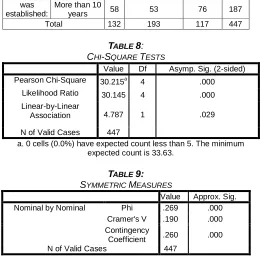
Total 132 193 117 447
TABLE 8: CHI-SQUARE TESTS
Value Df Asymp. Sig. (2-sided) Pearson Chi-Square 30.215a
4 .000
Likelihood Ratio 30.145 4 .000 Linear-by-Linear
Association 4.787 1 .029
N of Valid Cases 447
a. 0 cells (0.0%) have expected count less than 5. The minimum expected count is 33.63.
TABLE 9: SYMMETRIC MEASURES
Value Approx. Sig. Nominal by Nominal Phi .269 .000
Cramer's V .190 .000 Contingency
Coefficient .260 .000 N of Valid Cases 447
GRAPH 1:RESPONSE TO ‘DOES YOUR ORGANIZATION PLAN TO
MIGRATE SERVICES AND DATA TO CLOUD COMPUTING?’
Interpretation:
Table 7 above illustrates the distribution of enterprises according to its status as shown in Table 8, the chi-square test x2(6) =30.215, p=0.000 shows that there is statistically significant impact of enterprise status on cloud adoption. However, Table 7 shows that most of the enterprises have already migrated to the cloud (161) and 101 plan to migrate to the cloud. Some of the enterprises 98 are not sure whether they want to migrate to the cloud or not as they have just been established and sure the about the requirement of cloud migration for various purposes. Phi and Cramer's V values in Table 9 are both tests of the strength of association. We can see that the strength of association between the variables is strong with values of 0.269 and 0.190. Hence the null hypothesis is rejected and alternate hypothesis that there is statistically significant impact of enterprise status on cloud adoption is accepted.
TABLE 10: CORRELATION MATRIX
Correlation Matrix
Correlation 1 2 3 4 5 6 7 8 9 10 11 12 13
1 1.00 .885 .748 .729 .126 .311 .153 .363 .247 -.359 -.272 -.353 .142 2 .885 1.00 .826 .856 .254 .361 .322 .411 .359 -.349 -.319 -.344 -.100 3 .748 .826 1.00 .853 .544 .187 .285 .268 .455 -.057 -.173 -.254 -.202 4 .729 .856 .853 1.00 .502 .283 .540 .271 .425 .144 -.259 -.256 -.217 5 .126 .254 .544 .502 1.00 .264 .496 .093 .433 .511 .061 .046 -.010 6 .311 .361 .187 .283 .264 1.00 .400 .180 .014 -.105 .156 -.336 .261 7 .153 .322 .285 .540 .496 .400 1.00 .127 .211 .379 .085 -.241 -.210 8 .363 .411 .268 .271 .093 .180 .127 1.00 .830 -.302 .038 .097 .223 9 .247 .359 .455 .425 .433 .014 .211 .830 1.00 .038 -.102 .107 .024 10 -.359 -.349 -.057 .144 .511 -.105 .379 -.302 .038 1.00 .099 .190 .002 11 -.272 -.319 -.173 -.259 .061 .156 .085 .038 -.102 .099 1.00 .304 .019 12 -.353 -.344 -.254 -.256 .046 -.336 -.241 .097 .107 .190 .304 1.00 .090 13 .142 -.100 -.202 -.217 -.010 .261 -.210 .223 .024 .002 .019 .090 1.000
The above Table 10 shows the correlation among the various factors. A high positive correlation was observed between Data Security and Availability of service (0.885), cost of services (0.826), Loss of control over resources (0.853), and Interoperability with existing systems (0.830). However, Data Security and Vendor lock-in (-0.1272) were
in-298 house (0.649). Keep control of data and resource in-house
and Data location showed a strong positive correlation (0.790).
Test for correlation between the items and factor analysis to identify the prominent factors was carried out. The steps involved in data reduction through factor analysis are indicated below:
Step 1: Pre-checking sample adequacy through KMO and Barlette‘s test of sphericity.
TABLE 11:
KMO AND BARTLETT'S TEST
Kaiser-Meyer-Olkin Measure of Sampling Adequacy. .678 Bartlett's Test of Sphericity Approx. Chi-Square 5960.444
Df 78
Sig. .000
Table 11 shows that the Kaiser-Meyer-Olkin test was conducted to ensure the adequacy of sample size for the factor analysis. As per the decision criteria if it is above 0.6 then the sampling size is adequate. Kaiser-Meyer- Olkin measure of sampling adequacy = 0.678> 0.6 and p = 0.000< 0.005 for Bartlett's Test indicates the test was significant at 5% levels. Three hundred and sixty (360) samples were sufficient to run factor analysis.
TABLE 12: TOTAL VARIANCE EXPLAINED
Compo nent
Initial Eigen values
Rotation Sums of Squared Loadings Total % of
Variance
Cumulativ
e % Total
% of Variance
Cumulati ve % 1 4.618 35.525 35.525 4.024 30.954 30.954 2 2.139 16.453 51.979 2.398 18.449 49.404 3 1.762 13.554 65.533 2.047 15.742 65.146 4 1.418 10.907 76.440 1.468 11.294 76.440 5 .993 7.637 84.077
6 .821 6.315 90.392 7 .477 3.673 94.065 8 .404 3.108 97.173 9 .219 1.681 98.854 10 .060 .460 99.314 11 .056 .427 99.741 12 .027 .208 99.950 13 .007 .050 100.000
Extraction Method: Principal Component Analysis. In the above table variance, extracted components, rotated components and Eigen values are displayed. In the initial solution the number of variables and components are equal. However, Eigen Values greater than I are to be extracted. The second part of the table shows the components that have been extracted. It is seen that there is 76.6% variability in the original 13 variables and the complexity of the data set can be reduced with only a 14.3% loss of information. The large changes in the individual totals suggest that the rotated component is a better solution than the unrotated matrix. The above table 12 illustrates the total variance. Component Analysis table gives the factors that are responsible for selection of the cloud deployment model. Out of 13 items considered, only four factors with Eigen values greater than 1 were extracted and total variance explained by these 4 factors was 76.6%.
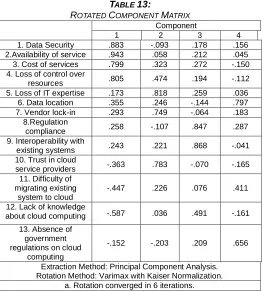
TABLE 13:
ROTATED COMPONENT MATRIX
Component
1 2 3 4
1. Data Security .883 -.093 .178 .156 2.Availability of service .943 .058 .212 .045 3. Cost of services .799 .323 .272 -.150 4. Loss of control over
resources .805 .474 .194 -.112
5. Loss of IT expertise .173 .818 .259 .036 6. Data location .355 .246 -.144 .797 7. Vendor lock-in .293 .749 -.064 .183
8.Regulation
compliance .258 -.107 .847 .287 9. Interoperability with
existing systems .243 .221 .868 -.041 10. Trust in cloud
service providers -.363 .783 -.070 -.165 11. Difficulty of
migrating existing system to cloud
-.447 .226 .076 .411 12. Lack of knowledge
about cloud computing -.587 .036 .491 -.161 13. Absence of
government regulations on cloud
computing
-.152 -.203 .209 .656
Extraction Method: Principal Component Analysis. Rotation Method: Varimax with Kaiser Normalization.
a. Rotation converged in 6 iterations.
From the above Table 13, the rotated component matrix helps to determine what the components represent. The first component is most highly correlated with Data Security and Availability of service. The second component is most highly correlated with Loss of IT expertise, Vendor lock-in and Trust in cloud service providers. The third component is highly correlated with Regulation compliance and Interoperability with existing systems. The fourth component id highly correlated with Data location and Absence of government regulations on cloud computing.
6
CONCLUSION:
Cloud computing adoption using knowledge management will help enterprises to develop in the field of IT and to advance in conformity with changing market requirements. This move will help both key participants and enterprises in enhancing their business operations. This can be achieved by developing an intensified knowledge management system to persuade needs and wants of the organizations. In order to convince the customers to migrate to cloud, assurance must be provided that the information security systems provided are reliable and authentic. This will build the trust as their primary and secondary requirements are being preserved and catered to. Upgradation and expansion is essential for cloud computing because this advancement if done for even a single customer will be beneficial to others to migrate to cloud without any constraints.
REFERENCES
299 Global Conference on Internet and Information Systems,
Taipei, December 8-12.
[2] Irshad et al. (2015), ―A Review on Cloud Computing Adoption: An Exploratory Analysis‖, International Journal of Advanced Research in Computer Science and Software Engineering, Volume 5, Issue 1
[3] Mohr J. L. (2012), ―Knowledge Management as a Strategy: Driving a Competitive Edge Through Knowled ge‖, Mind the IT Gap, LLC, Available online at: http://www.servicemanagementfusion.com/conference/~/me dia/HDIConf/2012/Files/White%20Papers/Julie_Mo hr_KM_Strategy.pdf
[4] Habjan K.B. and Pucihar A. (2012), ―Cloud Computing Adoption Business Model Factors: Does Enterprise Size Matter?‖, Inzinerine Ekonomika-Engineering Economics, 28(3), 253–261
[5] Dave M. and Shishodia Y.S. (2012), ―Knowledge Management and Organizational Competencies: A Harmonic Collaboration‖, International Journal of Advanced Research in Computer Science and Software Engineering (IJARCSSE), Vol. 2, No. 12, pp. 45-50.
[6] Tarmidia, Mahlindayu et al. (2014), ―Cloud computing awareness and adoption among accounting practitioners in Malaysia‖, Procedia - Social and Behavioral Sciences 164, 569 – 574
[7] Tan, Margaret and Trisha T. C. Lin (2012), ―Exploring Organizational Adoption of Cloud Computing in Singapore‖, Conference Paper, Proceedings of 2012 International Telecommunication Society, Bangkok, Thailand
[8] Neto R. C., et al. (2008), ―Strategic knowledge management: In search of a knowledge-based organizational model‖, Comportamento Organizacional E Gestão, Vol. 14, No. 2, pp. 247– 256.
[9] Articles/Discussion
[10] ―Cloud Computing: Issues and Impacts‖ (2011), Global Technology Industry Discussion Series, Ernst & Young,
Available online at:
http://www.ey.com/Publication/vwLUAssets/Cloud_computin g_issues,_impacts_and_insights/$File/Cloud%20
computing%20issues%20and%20impacts_14Apr11.pdf [11] ―Cloud, smart computing to drive tech sector growth‖ (2010),
Forrester, Business Line (The Hindu), via Dow Jones
Factiva, Available online at:
http://www.thehindubusinessline.in/2010/12/16/stories/2 010121653090700.htm
[12] ―Igloo Software: The new digital workplace‖, Available at: http://www.getapp.com/igloo-software-application
[13] ―Knowledge Management Tools that Work the Way You Do‖, Available online at: http://www.salesforce.com/crm/customer-servicesupport/knowledge-base-system/
[14] ―Knowledge Management Solutions: Create and share IT know-how‖, Available online at: http://www.bmc.com/products/offering/KnowledgeManageme nt.html
[15] ―Microsoft Office 365 and SharePoint Online‖, Available online at: http://www.microsoft.com/enin/office365/sharepoint-online.aspx
[16] ―Springcm Resources‖, Available at: http://www.springcm.com/services
[17] ―Security Guidance for Critical Areas of Focus in Cloud Computing V2.1‖ (2009), Cloud Security Alliance, Available
online at: