A Study On Iot And Data Analytics In Healthcare
Systems
S. Arulananda Jothi, J. Abdul Samath, K. Anandharaj
Abstract: The development of tremendous IoT devices has generated large amounts of data over the past decades. Such types of data are not beneficial without any analytic power. The analytical solutions of massive amounts of data have helped people gain valuable view about data generated by IoT devices. However, these solutions are still in their infancy, and there is no detailed survey of the domain. This paper examines the research efforts that lead to Big IoT data analytics and explains the overview of IoT, Big data and data analytics. Furthermore the various types of existing big IoT data analytics are discussed. Moreover, the association between IoT and data analytics is explained. The need of data analytics is also explained. Finally, several challenges and privacy issues brought by IoTdata analytics in the Healthcare industry are presented.
Index Terms: IoT, Data Analytics, Smart Health care, Big-Data, Analytics Methods, Privacy Issues, Challenges. —————————— ——————————
1.
INTRODUCTION
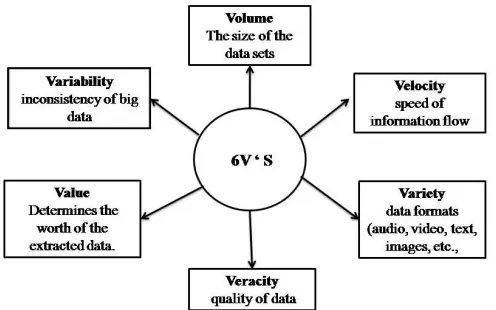
The new trend in the modern world is that all the devices or objects are connected with the Internet and the objective is to share the information without any human interaction and improving the quality of our daily lives, this is termed as Internet of Things (IoT) [1], [2]. The growth of Internet-enabled devices has increased in a tremendous rate. According to the survey of CISCO there will be more than 50 billion devices/objects that are expected to be connected with the Internet by 2020. IoT is a good and intelligent technique that reduces human effort and facilitates easy access to physical devices. The Internet of Things (IoT) has involved in several applications such as smart farming, smart healthcare, smart city etc. The voluminous data collected through these IoT devices with various format like structure and unstructured are continuously increasing day to day. Data formation occurs at a record rate [3], where it is referred to as big data and has emerged in a widespread trend. Big data are characterized into three main aspects: (a) data are voluminous (high volume), (b) Data cannot be classified like typical relational databases (high variety), and (c) data are produced, captured, and processed rapidly (high velocity). An important area of interest in this article is the application of IoT in healthcare. Healthcare industry plays a major role in generating more data because the number of patients is increasing day by day. The volume, variety and velocity of health data is collected and stored dynamically. Moreover it is difficult to retrieve these data and it is very critical to analyze it. The analyzed data helps physicians to make decisions on patients. The big data analytics(BDA) is needed in IoT based health care system due to the following types of data occurring: The nature of health data in both structured and unstructured format such as Structured sensors data and EHR data, Unstructured Clinical report, clinical image, DNA samples, find out the behavioral data by multiple sensors (ECG sensor, Body temperature sensor, SpO2 sensors, moisture sensors, Force sensor, heart beat rate sensors etc., will explode data from millions of patients continually)which is elaborated in this paper with
various social interactions and communications. There are various analytical tools that are utilized for processing these data [4]. The uses of IoT devices in healthcare industry help doctors in monitoring patient activities, better treatment and provide suggestion about patient‘s health with the decision tools and automation technologies. Recent papers on the IoT technologies in healthcare have concentrated on the issues, challenges and barriers for automatic processing in health care. Some key issues are addressed that requires business models, security and privacy, data management and decision making. In this paper, a great review of IoT in health care is carried out. The review contains a survey of published articles, problems with existing solutions. The IoT system for healthcare is discussed with four major components that are IoT devices/sensors/things, communication technologies, internet, data storage and data analysis. It also presents how The IoT Data Analytics is enabling smart healthcare. Furthermore, the issues and challenges, benefits and opportunities are discussed. This paper presents the study IoT and Data analytics in Healthcare System. Primarily, the paper concentrated on the exiting work on IoT based data analytics in healthcare. Secondly, the paper describes the basic concept of IoT and Big Data. Thirdly, the various existing Big IoT data analytics are discussed. Fourthly, the paper explains the relationship between Internet of things and data analytics. Finally, the challenges are exhibited. The Privacy concerns in smart healthcare are discovered.
2 RELATED
WORKS
Eleonora Borgia et al [5] discussed the key features, driving technologies, research challenges and open issues of Internet of Things. In this review, many challenges were highlighted which faced in IoT Architecture, Communication, Addressing, Discovery, Data processing, Data management, Security and Privacy. Moreover, various IoT projects and its data issues were discussed. Marjani et al [6] investigated the research efforts that directed towards IoT data analytics. The detailed explanation about the Relationship among big data analytics and IoT were explained. Various IoT data analytic types were described such as Real-time analytics, Off-line analytics, Memory-level analytics, BI analytics, Massive analytics and methods which used for these analytics also explained like Classification , Prediction , Clustering, Association rule, Time series. Further, several opportunities and challenges of IoT (Privacy, Visualization, Integration, Analysis) brought by data were discussed. Ahmed et al [7] elucidated the recent ————————————————
S. Arulananda Jothi, Research Scholar, Department of Computer
Science, Govt. Arts College, Udumalpet, Tirupur – 642126.
E-mail: [email protected]
J. Abdul Samath, Assistant Professor, Department of Computer
Science, Chikkanna Govt. Arts College, Tirupur – 641602.
K. Anandharaj, Research Scholar, Department of Computer Science,
2822
literature on big data processing and solutions of data analytics for IoT. The requirements which needed for data analytics in IoT Connectivity, Storage, Quality of services, Real-time analytics, Benchmark were discussed. The role of data analytics in IoT applications was highlighted and opportunities for doing effective Big data analytics were described. Some of the open research challenges were identified that must be addressed in the future. Kambatla et al [8] described an overview of big-data analytics was discussed. Recent trends in scaling and application landscape of big-data analytics were focused. The software techniques which were required for data analytics were encountered. In addition, the Current and future trends in hardware that can help in addressing the massive datasets were addressed. Hashem et al [9] presented a review of the rise of big data in cloud computing. The definition of the big data, characteristics, and classification along with some discussions on cloud computing were explained. Explanation of association among big data and cloud computing, big data Storage systems, and Hadoop technology were exhibited. Furthermore, research challenges are investigated such as scalability, availability, data integrity, data transformation, data quality, data heterogeneity, privacy, legal and regulatory issues, and governance and also the discussed open research issue that are Data analysis, Data Staging, Distributed Storage System and Data Security. Elijah et al [10] explored an overview of IoT and data analytics in agricultural field. Several areas like Monitoring, Tracking And Tracing, Agriculture Machinery, Precision Agriculture And Greenhouse Production were briefly explained which are used to the development of IoT in agriculture. Demonstrated the importance of data analytics in agriculture and how Data Analytics can help in insurance, prediction, storage management, decision making, farm management and precision farming. Finally, the Open challenges have been identified and discussed. This study concluded issues which faced in this field were security and cost. KR Kundhavai et al [11] reviewed about IoT and Big data analytics. the challenges of IoT with Big Data were discussed such as Big Data storage , Data Security Issues, Big Data analytics , Impact on Day to day living. The inefficiencies occur in data collection like loss of status, money, time and effort when security was being compromised. Bendre et al [12] reviewed the background and futuristic aspects of big data such as history, background and related technologies. Mainly, this study focused architecture, phases and classes of big data analytics and discussed big data challenges namely heterogeneous sources, privacy and security, accurate decisions within Time, minimize energy consumption. Further, Different applications of big data were explained with some examples – Healthcare, Government, Insurance, Manufacturing, and Retail and customer products, Telecommunication, Agriculture, Transportation and Banking. SK Sharma et al [13] proposed a novel framework for coordinated processing between edge and cloud computing/processing by integrating advantages from both the platforms. Key enables and the challenges of big data analytics in wireless IoT networks have been described. The main distinctions between cloud and edge processing have been presented. Potential key enablers for the proposed collaborative edge-cloud computing framework have been identified and associated key challenges have been presented. Cai, H et al [14] discussed functional framework that identifies the acquisition, management, processing and mining areas of IoT big data. Several associated technical
modules are defined and described that are Data Acquisition and Integration Module, Data Storage Module, Data Management Module, Data Processing Module, Data Mining Module, Application Optimization Module. Moreover, IoT application, challenges, opportunities and some open issues with some examples were defined. Hassanalieragh et al [15] reviewed the current state and future directions for integration of remote health monitoring. This study highlighted several challenges in sensing, analytics, and visualization that need to be addressed before systems can be designed for seamless integration into clinical practice. MM Rathore et al [16] proposed architecture for to defining smart digital city using real time urban data. The Proposed system that can handle huge amount of city data, give guidance to the urban authorities to make their municipalities smarter and digital. The developed architecture comprises various steps including data generation and collection, aggregating, filtration, classification, preprocessing, computing and decision making. Most of the problems that an ordinary citizen faces were solved and also provided facilities to the government to take smart decisions at real-time. The proposed architecture very efficient, scalable, and capable of working at a real-time environment. Lv, Zhihan et al [17] presented a recent research in data types, storage models, privacy, data security, analysis methods, and applications related to network big data. The proposed work discussed challenges and development of big data to predict current and future trends. Finally, concluded machine learning and data security is a potential problem in the era of big dataS. Manogaranet al., [18] proposed a novel framework to analyze and process the massive amount of healthcare data on cloud context based on Hadoop. This paper described the importance of big data which is used to take correct decisions for patients by selecting the right care. Various cryptography techniques were used to secure the framework. Map Reduce technique was used for Health data to improve the performance. Hadoop was used to analyze the massive health data more appropriately.
3 OVERVIEW
OF
BIG
DATA
AND
IOT
Fig. 1. Characteristics of Big Data
3.1IOT (INTERNET OF THINGS)
IoT provide a platform for sensor/things/devices that enables free contact in a smart environment and activates information sharing across sites in a convenient way. The latest adaptation of various wireless technologies uses IoT as the next revolutionary technology and the full opportunity will be given by the Internet technology. IoT has seen its latest adoption in the emerging smart cities with evolving intelligent system namely smart office, smart agriculture, smart retail, smart transportation, smart healthcare, smart water supply and smart energy [22]. In the past few years, IoT has emerged as a new trend that can be used as a data acquisition tool in mobile devices, transport facilities, general utilities and home appliances. All surrounding electronic equipment which makes daily life easier such as vending machines, wrist- watches emergency alarms, and garage doors, as well as home appliances, such as refrigerators, air conditioners, water heaters and microwave ovens are connected to an IOT network and remotely controlled. In IoT paradigm, large numbers of communication devices are embedded into sensors. The Data is collected through sensors and will send this data through embedded communication devices. The continuity of the devices and objects are interconnected with various communication solutions such as ZigBee, Bluetooth, GSM and WiFi. These communications devices exchange data from remote controlled devices and receive commands, allowing direct integration with the world using computers to improve quality of life. Expected to attach more than 50 billion devices such as smart phones, laptops, sensors and game terminals are connected to the Internet with the help of technologies, such as wireless sensor networks and radio frequency identification (RFID). The latest adaptation of various wireless technologies in IoT is the next revolutionary technology by utilizing the full possibilities offered through Internet technology.
3.2BIG DATA ANALYTICS
Big data analytics is the process of searching, mining, and analyzing data sets that are dedicated to improve the performance of decision making [23]. The ability to analyze the large amounts of data can help a company to deal with substantial information that can affect business. Therefore, the major goal of big data analytics is to aid business associations to improve the understanding data in an efficient manner, and make a well-known decision. Big data analytics helps data miners and scientists to explore massive amounts of data that
is not deployed using traditional tools [24]. Big data analytics requires various technologies and tools which can be used to transform a large scale of structured, unstructured and semi-structured data into an understandable data format for analytical processes. These analytical tools often employ algorithms to detect different patterns, trends and interactions at different time intervals in the data. After the data analyzing is done, the analytical tools visualize the findings in the form of tables, graphs and spatial charts for effective decision making. Hence big data analysis is an important challenge in many applications because of the scalability and complexity of data with underlying algorithms that support such processes. Thus the challenge is concentrated on the performance of the present algorithms used in big data analysis with the continual increase of rapid growth in computational sources. Big data analytics processes consume considerable time to provide users feedback and guidance, while some tools can process large data collections within a substantial measurement of processing time. Contradicting to that, most of the remaining tools use complex method such as trial-and-error method to deal with these huge amounts of data sets and data heterogeneity.
BIG DATA ANALYTICS PROCESSING LEVELS
Big Data analysis can be performed in the following four levels;
1. Data collection or processing: In this level data gathering and clarifications are performed.
2. Explore or discover Knowledge: Categorize data from data sources and support observation requirements and challenges.
3. Modeling: Use statistical methods or analytical techniques to create some insights from Big Data.
4. Execute or Implementation: Establish the analytics for more Big Data efforts.
4
VARIOUS TYPES OF EXISTING ANALYTICSMETHODS
Various types of analytics methods are used based on the requirements of IoT applications [25]. The analytic types are real-time, off-line, memory-level, business intelligence (BI) level, and massive level analytics that are described in the following table.
Real-time analytics:
This type of analytics is usually performed on data which is gathered from sensors. In this situation, data is constantly changed, and data analytics techniques are needed to quickly get an analytical effect within a minimum period. Because of this, in the present system, two architectures have been suggested for real-time analysis namely, memory-based computing platforms and parallel processing clusters using traditional relational databases. The examples for real-time analytics architectures are Green plum and Hana.
Off-line analytics
2824 Memory-level analytics
This analytical type is used when the size of data is smaller than a cluster memory to data, the cluster memory level has reached terabyte (TB) level. Therefore, many internal database technologies are needed to improve efficiency of analytical processes. Memory-level analytics is also suitable for real-time analysis. Mongo DB is a sample architecture of this analytics in memory level.
BI analytics
BI analytics is applied when the size of data is excess when compared to the memory level. In this case, data can be imported into BI analysis and BI analytics currently supports Tera byte of data. In addition, BI can help to find the strategic business opportunities from the flood data. Moreover, BI analytics permits easy interpretation of data sets and Identifying new chances. Furthermore, enabling competitive market benefit and long-term stability can be done by implementing efficient strategies.
Massive analytics
Massive analytics is adopted when the data size is greater than the whole capacity of the BI analysis preparation and traditional databases [26]. Massive analytics utilizes the Hadoop technology for storing data and map/reduce of data analysis. Massive analysis aids to develop a business foundation and increases market competitiveness by dividing meaningful information from data. Furthermore, massive analytics gets precise data that affects the risks in decision making and provides effective services.
5
RELATIONSHIP BETWEEN IOT AND BIGDATA
ANALYTICS
[27]
[28]
Big data analytics is growing fast in IoT for effective decision making. One of the most important aspects of IOT is its analysis of "connected things". The Big Data analytics in IOT requires processing of about a large number of data and to store it in various storage technologies. Most of the unstructured data are collected directly from web-enabled ―things‖, so big data implementations are required to take light intelligence analysis with larger queries to get quick insights, quick decisions, and contact with people and other devices. The combinations of sensing and actuating devices have the ability to share information on sites by unified architecture and create a common operating system to enable innovative applications. In general, IoT increases the size of data quantity and category. Hence, it provides opportunity for big data analytics application and development. In addition, the use of big data technologies in IoT accelerates IoT's research developments and business models. The association between IoT and big data is depicted in Figure 2. Here, three steps are involved to handle IoT data. The first step is to manage IoT databases, where interconnected sensors use the applications to communicate with each other. For example, the communication devices of devices such as smart home devices, smart traffic lights and CCTV cameras, produces massive amounts of data sets with various formats. This data will be stored in the cloud storage at low cost. In the second step, data is generated and that is called ``big data,'' depending on their volume, velocity and variety. This large amount of data will be stored in Shared distributed error handler data bases. The final step uses analytics tools like Map Reduce, Spark, Splunk and Skytree, which can analyze
the large IoT data sets. The four levels of analysis begin from training data, and then go to analysis tools, queries and reports.
Fig. 2. Relationship among IoT and Data Analytics
6 THE USE OF BIG DATA ANALYTICS IN SMART
HEALTHCARE
[29]
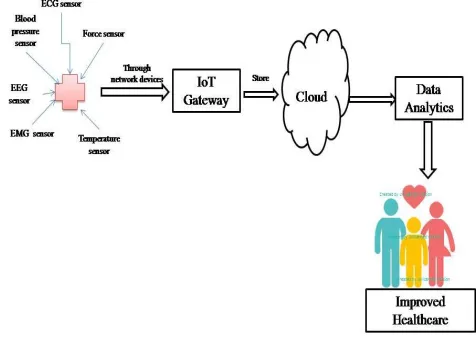
The volume of data size is constantly growing in healthcare industry that comes from various sources, but managing these data over hard or soft copy formats is very difficult. Data digitization can overcome this issue but analyzing these massive data is one of the major tasks. Data analysis is very important while dealing large amount of data because they will be used for making decisions. Big Data Analysis builds a new approach to health care systems that has to estimate the reasonable time for creating sensible discretions organize future views and maximize time value. At the same time, it also helps to provide cognitive information for health institutions about their planning, management and measurements. Finally the estimated results are an aid to increase management's decision-making ability. The figure 3 represents the use of IoT data analytics in healthcare industry.
Fig.3. IoT data analytics in Healthcare
7 CHALLENGES, PRIVACY ISSUES OF BIG
DATA
OVER
IOT
BASED
HEALTHCARE
SYSTEM
Process and Management [30]. The challenges that may occur in Data are called as 4V‘s and 4D‘s that are Volume, Velocity, Veracity, Variety, Data Discovery, Data comprehensiveness, Data Assumptions and Data Scalability. When data is processed, data capture, data arrangement, data transfer, data sampling, and data visualization will occur. Data privacy and security, data governance and moral issues are raised during data management.
7.1CHALLENGES OF BIG DATA IN IOT BASED HEALTHCARE SYSTEM
[31]
1. Analyzing the knowledge about various patients from the sources like hospitals, homes, clinics, office etc.
2. The transcription of unstructured medical data.
3. Handling large volume of clinical data and mining the useful knowledge in effective manner.
4. Everyone needs to be benefited in the health system, namely the provider, patient, payer and management. 6. Examining genetic data is a computational risk task and
combining with standard medical data adds more layers of complexity.
7. Health Data is very intimate so the patients expect more privacy.
8. Patient behavior data is taken through various sensors with various social connections and communications.
7.2PRIVACY ISSUES IN BIG DATA OVER SMART HEALTHCARE SYSTEM The Privacy issues in big data over IoT based healthcare system is classified into two categories namely 1.Institution problems and 2.Systemic problems. Institution problems: Organizational or institution threats would arise because of the incorrect access about patient data from private companies misusing their privileges or external agents misusing the information system responsibilities, such as an employee accessing data without any need or permission to access the data. Systemic problems: These types of issues arise when misuses of expected information by unauthorized.
CONCLUSION
The terrible growth of smart Devices has increased the production of data drastically over the past years. The interaction between IoT and big data is currently at a stage where processing, transforming and analyzing large amounts of data at a high frequency is necessary. This survey is developed for the case Big IoT data analytics. First, the basic concepts of both IoT and Big data analytics were covered and various existing analytics problems were explored. Various analytics techniques were explained which were considered in existing systems and the connectivity between IoT and Big data analytics was also described. Moreover, the need of data analytics in smart health care was explored with architecture. Finally the issues and challenges in healthcare when analyzing the data acquired from IoT devices was discussed. In the future work, more concentration on real-time analytics and its solution will provide valuable insights which are more essential.
REFERENCES
[1] Miorandi, Daniele, Sabrina Sicari, Francesco De Pellegrini, and Imrich Chlamtac, "Internet of things: Vision, applications and research challenges", Ad hoc networks Vol. 10, no. 7, pp. 1497-1516, 2012.
[2] Whitmore, Andrew, Anurag Agarwal, and Li Da Xu, "The Internet of Things - A survey of topics and trends",
Information Systems Frontiers, vol. 17, no. 2, pp. 261-274, 2015.
[3] Yang, Chaowei, Qunying Huang, Zhenlong Li, Kai Liu, and Fei Hu, "Big Data and cloud computing: innovation opportunities and challenges", International Journal of Digital Earth, vol. 10, no. 1, pp. 13-53, 2017.
[4] Chen, Min, Shiwen Mao, and Yunhao Liu, "Big data: A survey." Mobile networks and applications‘‘, Vol. 19, no. 2 pp. 171-209, 2014.
[5] Eleonora Borgia, ―The Internet of Things vision: Key features, applications and open issues‖, Computer Communications, vol. 54, pp. 1-31, 2014.
[6] Marjani, Mohsen, Fariza Nasaruddin, Abdullah Gani, Ahmad Karim, Ibrahim Abaker Targio Hashem, Aisha Siddiqa, and Ibrar Yaqoob, "IEEE Access. Big IoT data analytics: architecture, opportunities, and open research challenges", vol. 5, pp. 5247-5261, 2017.
[7] Ahmed, Ejaz, Ibrar Yaqoob, Ibrahim Abaker Targio Hashem, Imran Khan, Abdelmuttlib Ibrahim Abdalla Ahmed, Muhammad Imran, and Athanasios V. Vasilakos, "The role of big data analytics in Internet of Things" , Computer Networks, vol. 129, pp. 459-471, 2017.
[8] Tsai, Chun-Wei, Chin-Feng Lai, and Athanasios V. Vasilakos, "Future Internet of Things: open issues and challenges", Wireless Networks, IEEE Access, vol. 20, no. 8, pp. 2201-2217, 2014.
[9] Kambatla, Karthik, Giorgos Kollias, Vipin Kumar, and Ananth Grama, "Trends in big data analytics", Journal of Parallel and Distributed Computing, vol. 74, no. 7, pp. 2561-2573, 2014.
[10] Hashem, Ibrahim Abaker Targio, Ibrar Yaqoob, Nor Badrul Anuar, Salimah Mokhtar, Abdullah Gani, and Samee Ullah Khan, "The rise of ‗big data‘ on cloud computing: Review and open research issues", Information systems, vol. 47, pp. 98-115, 2015.
[11] Elijah, Olakunle, Tharek Abdul Rahman, Igbafe Orikumhi, Chee Yen Leow, and MHD Nour Hindia, "An Overview of Internet of Things (IoT) and Data Analytics in Agriculture: Benefits and Challenges", IEEE Internet of Things Journal, vol. 5, no. 5, pp. 3758-3773, 2018.
[12] Nalini, N., and P. Suvithavani, "A Study on Data Analytics: Internet of Things & Health-Care", International Journal of Computer Science and Mobile Computing, Vol. 6, no. 3, pp. 20-27, 2017.
[13] Ahmed, Ejaz, Ibrar Yaqoob, Ibrahim Abaker Targio Hashem, Imran Khan, Abdelmuttlib Ibrahim Abdalla Ahmed, Muhammad Imran, and Athanasios V. Vasilakos, "The role of big data analytics in Internet of Things", Computer Networks, vol. 129, pp. 459-471, 2017.
[14] Sharma, Shree Krishna, and Xianbin Wang, "IEEE Access. Live Data Analytics With Collaborative Edge and Cloud Processing in Wireless IoT Networks", vol. 5, no. 99, pp. 4621-4635, 2017.
[15] Cai, Hongming, Boyi Xu, Lihong Jiang, and Athanasios V. Vasilakos, "IoT-based big data storage systems in cloud computing: Perspectives and challenges", IEEE Internet of Things Journal, vol. 4, no. 1, pp. 75-87, 2017.
[16] Yang, Chaowei, Qunying Huang, Zhenlong Li, Kai Liu, and Fei Hu, "Big Data and cloud computing: innovation opportunities and challenges", International Journal of Digital Earth, vol. 10, no. 1, pp. 13-53, 2017.
2826
"Exploiting IoT and big data analytics: Defining Smart Digital City using real-time urban data", Sustainable cities and society, vol. 40, pp. 600-610, 2018.
[18] Lv, Zhihan, Houbing Song, Pablo Basanta-Val, Anthony Steed, and Minho Jo, "Next-generation big data analytics: State of the art, challenges, and future research topics", IEEE Transactions on Industrial Informatics, vol. 13, no. 4, pp. 1891-1899, 2017.
[19] Manogaran, Gunasekaran, V. Vijayakumar, R. Varatharajan, Priyan Malarvizhi Kumar, Revathi Sundarasekar, and Ching-Hsien Hsu, "Machine learning based big data processing framework for cancer diagnosis using hidden Markov model and GM clustering", Wireless personal communications, vol. 102, no. 3, pp. 2099-2116, 2018.
[20] S. M. R. Islam, D. Kwak, M. H. Kabir, M. Hossain, and K. S. Kwak, ―IEEE Access.The internet of things for health care: A comprehensive survey‖, vol. 3, pp. 678–708, 2015. [21] Rathore, M. Mazhar, Anand Paul, Won-Hwa Hong, HyunCheolSeo, Imtiaz Awan, and Sharjil Saeed, "Exploiting IoT and big data analytics: Defining Smart Digital City using real-time urban data", Sustainable cities and society, vol. 40, pp. 600-610, 2018.
[22] Zanella, N. Bui, A. Castellani, L. Vangelista, and M. Zorzi, ―Internet of things for smart cities‖, IEEE Internet of Things Journal, vol. 1, no. 1, pp. 22–32, 2014.
[23] L. Atzori, A. Iera, and G. Morabito, ―The internet of things: A survey‖, Computer networks, vol. 54, no. 15, pp. 2787– 2805, 2010.
[24] Yaqoob, I.A.T. Hashem, A. Gani, S. Mokhtar, E. Ahmed, N.B. Anuar , A.V. Vasi- lakos , ―Big data: from beginning to future‖, Int. J. Inf. Manage, vol. 36. no. 6, pp. 1231–1247, 2016.
[25] Archenaa J and EA Mary Anita, "A survey of big data analytics in healthcare and government", Procedia Computer Science, vol. 50, pp. 408-413, 2105.
[26] D. Singh and C. K. Reddy, ―A survey on platforms for big data analytics'', J. Big Data, vol. 2, no. 1, pp. 1, 2014. [27] A. Siddiqa, ―A survey of big data management: Taxonomy
and state-of the- art'', Journal of Network and Computer Applications, vol. 71, pp. 151-166, 2016.
[28] C. A. Steed, ―Big data visual analytics for exploratory earth system simulation analysis'', Computers and Geosciences, vol. 61, pp. 71-82, 2013.
[29] S. M. R. Islam, D. Kwak, M. H. Kabir, M. Hossain, and K. S. Kwak, ―The internet of things for health care: A comprehensive survey‖, IEEE Access, vol. 3, pp. 678-708, 2015.
[30] Firouzi, Farshad, Amir M. Rahmani, Kunal Mankodiya, Mustafa Badaroglu, Geoff V. Merrett, P. Wong, and Bahar Farahani, "Internet-of-Things and big data for smarter healthcare: from device to architecture, applications and analytics", Future Generation Computer Systems, vol.78, pp. 583-586, 2018.
[31] Manogaran, Gunasekaran, Ramachandran Varatharajan, Daphne Lopez, Priyan Malarvizhi Kumar, Revathi Sundarasekar, and Chandu Thota, "A new architecture of Internet of Things and big data ecosystem for secured smart healthcare monitoring and alerting system", Future Generation Computer Systems, vol. 82, pp. 375-387, 2018.
[32] Sharma, Sagar, Keke Chen, and Amit Sheth, "Toward practical privacy-preserving analytics for iot and