Published by Oriental Scientific Publishing Company © 2019
This is an Open Access article licensed under a Creative Commons license: Attribution 4.0 International (CC-BY).
Antidiabetic Activity of
Terfeziaclaveryi
;
An
in vitro
and
in vivo
Study
Anas Al-Ahmed1 and Hany Ezzat Khalil1,2*
1Department of Pharmaceutical Sciences, College of Clinical Pharmacy, King Faisal University, Al-Ahsa 31982, Saudi Arabia.
2Department of Pharmacognosy, Faculty of Pharmacy, Minia University, Minia 61519, Egypt. *Corresponding author E-mail: [email protected]
http://dx.doi.org/10.13005/bpj/1680
(Received: 19 May 2019; accepted: 11 June 2019)
The main objective of current study was to investigate the in vitro and in vivo antidiabetic activity of Terfeziaclaveryi methanol extract. In vitro antidiabetic assays such as inhibition of a-amylase enzyme and non-enzymatic glycosylation of hemoglobin were carried out. The results of a- amylase inhibition assay revealed that the inhibitory activity (IC50) of Terfeziaclaveryi methanol extract (38.7µg/ml) is stronger when compared withpositive control (Acarbose IC50 value of 45.3 µg/ml).The inhibition of glycosylation of hemoglobin of Terfeziaclaveryi methanol extract showed almost the same IC50(33.1µg/ml)when compared the positive control, alpha-tocopherol ( 35.4µg/ml ). In vivo antidiabetic study revealed that Terfeziaclaveryi methanol extract possessed good activity at a dose of 200 mg/kg through reducing the fasting plasma glucose level (122.1±3.0 mg/dl) when compared with positive control (Glibenclamide of 79.4±1.4mg/dl) (p < 0.001). The results from this studyindicated that Terfeziaclaveryi methanol extract exhibited considerable in vitro and in vivo antidiabetic activities.These possible activities could be useful to consider Terfeziaclaveryi as therapeutic antidiabetic candidate.
Keywords: Terfezia , antidiabetic, α-amylase,hemoglobin, streptozotocin.
Diabetes is considered one of the world’s largest endocrine disease, that characterized by an increased blood glucose level (hyperglycemia).
Clinically, Diabetes is classified as type-1(T1DM) characterized by insulin deficiency and type-2 (T2DM) characterized by insulin inefficiency.
Uncontrolled diabetes could lead to severe complications to the cardiovascular system
1.Natural products have aided humans since long
ages. They are considered assources of important
activeingredients. In comparison with synthetic drugs, synthetic one may cause many drawbacks
such as vomiting, diarrhea, fluid retention, allergic
reaction2. Recently, the International Diabetes
Federation (IDF) 7th edition of the Diabetes Atlas
specified that 415 million people worldwide is
diabetics3. T2DM represents about 90-95% of
all cases of diabetes4. T2DM is considered one
of the main international health concerns. T2DM affects around 422 million people all over the
world5. Prediabetes and diabetes prevalence and
complications are growing in a bothersome way.
By year of 2035, it is anticipated that about 592 million people will suffer from DM6. The treatment of T2DM is currentlyachieved through the usage of
of diabetes but to some extents still accompanied by some undesirable effects7. The management
of diabetes is considered a global problem and
the search for a definite therapy is still ongoing. Truffle is a fungus, which grows wildly in desert
regions depending on water rainfall 8. In addition, many researches stated that truffle can be used in
many purposes such as source of energy, activation of sex hormones, and as antibiotics against gram positive bacteria including Bacillus subtilis and
Staphylococcus aureus9-11. Terfeziaboudieri
ethanol extract showed anti-hyperglycemic effect on streptozotocin (STZ) induced-diabetic
rats8. Currently, there are no research studies
were conducted to investigate the in vitroand in vivo antidiabetic potential of Terfeziaclaveryiý.
The previously mentioned data provoked us to assess the á-amylase inhibitory activityand effect
on inhibition of glycosylation of hemoglobin as well as in vivo studies in streptozotocin-induced diabetic rats to evaluate and confirm its potential
hypoglycemic effect.
MATERIAL AND METHODS
Plant Material
Terfeziaclaveryi (T. claveryi)was
purchased from a local folk marketin spring
season, Al-Hasa, eastern region of Saudi Arabia. The fungus was subjected to air-drying according
to the standard protocols.T. claveryi was kindly
identified by Dr. MamdouhShokry, director of El-Zohria botanical garden, Giza, Egypt.A
voucher specimen was kept in Department of Pharmaceutical Sciences, College of Clinical
Pharmacy, King Faisal University, Al-Hasa, Saudi Arabia (03-17-Apr-TC).
Extraction and fractionation of different plant organs extracts
The air dried powdered material (500.0g)
was exhaustively extracted three times at room
temperature (for 5 days) using 3lof 70% MeOH/ H2O applying cold maceration technique at
room temperature to protect the potential active
ingredients from being decreased or destroyed. The
solvent mixture was removed through distillation under vacuum using Rota vapor and dried extracts
were directly freeze-dried to give the total methanol extract weighting 60.2g that were kept in -20oC for
the next steps12.
Animals
Male Wistar albino rats having a weight of 150 – 210 g were kept in quarantine for 2 weeks under standard husbandry conditions (27o, Relative humidity 65±10%) for 12 h in dark and light cycle,
respectively, and were given standard food and water ad libitum13. All of the experiments were
done in this study according to the Animal Ethics Committeeof King Faisal University.
Chemicals
Acarbose, glibenclamide, streptozotocin, metformin, gentamycin, a-amylase from porcine pancreas, hemoglobin porcine and alpha-tocopherol were purchased from Sigma Aldrich (ST. Louis. Mo, USA). Solvents used for extraction and assays
were all of analytical grade.
In vitro anti-diabetic models
α-Amylase inhibitory activity
The assay mixture was prepared to contain 0.02M sodium phosphate buffer (200 µl),
a-amylase enzyme (20 µl, 2 unit/ml) ýtogether withdifferent plant extracts in the range of
concentrations20-100ìg/ml.Then, it was incubated for 10 min at room temperature followed by the addition of 200ìl of 1% starch suspension to all the tubes containing reaction mixture. The reaction was later terminated bythe addition of 400 µl of 3, 5 di-nitro salicylic acid (DNSA) color reagent. Then the tubes were kept in boiling water bath for 5 minutes, and later were kept till being cooled at room temperature and diluted with 15 ml of distilled water. The absorbance of each reaction mixture was measured at 540nm. Control mixture
reactions were also prepared accordingly without addition ofextracts of plant under investigation and were compared with the test samples containing
concentration of different plant extracts (20-100µg/ ml) freshly prepared in DMSO. The results were indicated as % of inhibitionof activity using the
following formula:,
where; Abs (control) is the absorbance of the control reaction (containing all reagents except the test sample) and Abs (sample) is the absorbance of different plant extracts14,15.The
IC50 values (inhibitory concentration which will
produce 50% inhibition of the enzyme activity) of
the plant extracts were determined. Acarbose which
treat T2DM, was applied as a positive control in the concentrations rangedfrom 20 to100 µg/ml16.
Experiments were achieved in triplicates
Non-enzymatic glycosylation of hemoglobin assay
Solutions of glucose (2%), hemoglobin (0.06%) and gentamycin (0.02%), were freshly prepared in phosphate buffer (0.01 M, pH 7.4). One ml of each of above mentioned solution was mixed. One ml of each concentration of different plant extracts (20-100µg/ml) was added to the prepared mixture. Then, the test tubes containing
reaction mixture were incubated in dark place at room temperature for three days. After, the degree of glycosylation of hemoglobin was obtained
colorimetrically at 520nm where the percentage
of inhibition was calculated applyingthis formula:,
where; Abs (control) is the absorbance of the control reaction (containing all reagents except the test sample) and Abs (sample) is the
absorbance of different plant extracts.The IC50
values (inhibitory concentration which will produce
50% inhibition of the enzyme activity) of the plant extracts were determined. Alpha-Tocopherol was
used as a standard drug14-16. Experiments were
carried out in triplicates
In vivo anti-diabetic model Acute toxicity testing
Acute toxicity testing was performed for
T. claveryi total methanol extract, were studied
where the rats took ascending oral doses up to 2000 mg/kg of each extract, and signs and symptoms of toxicity were observed for the next 48 h17.
Induction of diabetes
Diabetes was induced by intraperitoneal
(i.p.) injection of streptozotocin (STZ) dissolved in 0.1 M cold citrate buffer (pH=4.4) at a dose of 60 mg/kg body weight. On the third day after STZ injection, fasted blood glucose levels were measured by hand-held glucose monitoring (BAYER Contour). Only rats with serum glucose levels of 190-200 mg/dl were selected and
considered diabetic animals18.
Experimental design
The animals were segregated into five groups of five rats each. Group I served as normal
control rats, administered drinking water and
0.1 M cold citrate buffer (pH=4.4) daily for 12 d; Group II had diabetic control rats, administered drinking water daily for 12 days; Group III
diabetic rats were administered T. claveryi total
methanol extract (200 mg/ kg) for 12 d; and Group
IV diabetic rats were administered standard drug
glibenclamide (0.25 mg/kg) for 12 d.The fasting glucose levels were determined on days 1, 5, and 12 of extractsadministration3, 17, 18.
Statistical analysis
Values were expressed as mean±SE (Standard Error). To analyze the differences
between groups, statistical analysis was performed
by one-way ANOVA followed by post-hocTukey using a computer soft program SPSS v.20. Significance was considered at a p value <0.05.
RESULTS
a-Amylase inhibitory activity
The in vitro a-amylase inhibitory
measurements demonstrated that T. clavery
total methanol extracthas potential of a-amylase
inhibitory possessions. a-amylase inhibitory
activitieswere compared based on the calculated IC50 values (Table 1). The observed a-amylase inhibitory activity of T. claveryi total methanol
extract was (38.7µg/ml). Acarbose was used as the
positive standard. It showed IC50 value of 45.3µg/
mlunder similar conditions.
Non-enzymatic glycosylation of hemoglobin assay
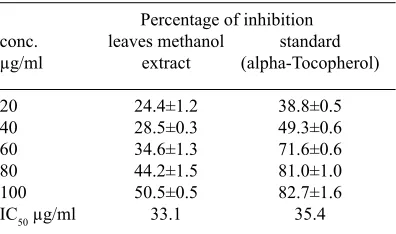
The inhibitory activities of T. claveryi
total methanol extracts were recorded (Table 2). T. claveryi total methanol extract showed almost the same value of IC50 (33.1µg/ml) to the positive control, alpha-tocopherol ( 35.4 µg/ml).
Acute toxicity study
No toxicity or death was observed in the
experimental rats. Hence 200 mg/kg (1/10 of the 2000 mg/kg) was selected as a maximum safety
dose.
In vivo antidiabetic activity
The effect of T. claveryi total methanol extracton fasting blood glucose levels of diabetic ratswas presented in table3.In diabetic rats, as shown in table 3, T. claveryi total methanol extract
and glibenclamide had a significant time dependent
hypoglycemic activity, compared with the diabetic
Table 1. α-amylase inhibitory effect of T. claveryi total methanol extract
Percentage of inhibition
conc. µg/ml T.claveryi standard methanol (Acarbose) extract
20 17.1±0.9 32.2±1.1
40 28.0±1.1 43.8±1.3
60 54.2±1.3 64.9±2.3
80 59.5±1.1 75.5±1.4
100 68.4±1.7 81.1±1.3
IC50 µg/ml 38.7 45.3
Values were expressed as mean ± SE (Standard Error)n=3
independent experiments
Table 2. Non-enzymatic glycosylation of hemoglobin
effect by T. claveryi total methanol extract
Percentage of inhibition conc. leaves methanol standard
µg/ml extract (alpha-Tocopherol)
20 24.4±1.2 38.8±0.5
40 28.5±0.3 49.3±0.6
60 34.6±1.3 71.6±0.6
80 44.2±1.5 81.0±1.0
100 50.5±0.5 82.7±1.6
IC50 µg/ml 33.1 35.4
Values were expressed as mean ± SE (Standard Error, n=3
independent experiments
Table 3. Results of the in vivo study on STZ-induced
diabetic rats by T. claveryitotal methanol extract
Fasting plasma glucose concentration (mg/dl) Groups
Day12 Day5 Day 1
81.6±1.1 80.9±0.8 79.9±1.2 I- Normal control
200.3±2.5 198.18±1.6 196.8±2.4 II- Diabetic control (streptozotocin) (55 mg/kg) 122.1±3.0* 138.6±1.6* 197.9±1.9 III- Diabetic + leaves methanol extract (200 mg/kg) 79.4±1.4* 91.38±1.1* 196.5±1.5 IV- Diabetic + standard glibenclamide (0.25 mg/kg)
Values were expressed as mean ± SE (Standard Error), (n=6), *significantly different from diabetic control (p<0.001).
DISCUSSION
a-Amylase enzyme is one of the enzymes
responsible for the hydrolysis of a-oriented bond
polysaccharides and oligosaccharides such as starch, glycogen and other macromolecules of a-bond linked monosaccharides to disaccharides
and finally to glucose19-22. T. claveryi total methanol
extract ýshowed promising result in a-amylase
inhibition assay, suggesting that T. claveryi might be effective in slowing down hydrolysis of starch to minimized glucose availability.
Invitronon-enzymatic glycosylation of
hemoglobin method is one of important assays
to judge the control of diabetes. The hemoglobin present in RBCs has anaffinity to bind to glucose. The greater the glucose level in blood, more amount of glucose-bound (called glycosylated) hemoglobin
will be formed. Such glucose hemoglobin
association is to some extent stable and staysfor1-2 months (the life-span of red blood corpuscles) 22,
23.Consequently presence of higher concentration
of glycosylated hemoglobin is a sure guide to the higher concentration of glucose in the blood. Normally, the percentage of glycated hemoglobin
should not be exceeding 12%. The current study
demonstrated good activity of T. claveryi total methanol (almost the same that of positive control,
alpha-tocopherol)in preventing such binding of
glucose to surface proteins of erythrocytes.
The fundamental mechanism underlying
elevated blood sugar in diabetes mellitus involves
over-production and decreased utilization of
glucose by the tissues. In the current study, the difference observed between the initial and
final fasting plasma glucose levels of different groups under investigation, revealed a significant
elevation in blood glucose in the diabetic control group as compared to normal animals, at the end
of the twelve-day experimental period. When
T. claveryi total methanol was administered to
diabetic rats, a decrease in plasma glucose level was
reduced plasma glucose (Table 3). During the
study it was found that T. claveryi total methanol
significantly controlled the blood glucose level in Streptozotocin-induced diabetic rats as compared to the diabetic control group (Table 3).
CONCLUSION
The above conducted in vitro examinations depict a substantial a-amylase inhibitory and
percentage of inhibition glycosylation of hemoglobin of T. claveryi total methanol. Which
was further confirmed by in vivo studies that showed T. claveryi total methanol significantly
controlled the blood glucose level diabetic rats. It could be therefore conclude from this study that T. claveryi can serve as a therapeutic agent and can be used as a potential source of new antidiabetic product.
REFERENCES
1. H E Khalil, A G AAlharbi and I M Ibrahim. In
vitro antidiabetic assessment of Ocimumforskolei L growing in Saudi Arabia. Journal of Pharmacognosy and Phytochemistry, 8: 355-357(2019).
2. S S Nair, V Kavrekar and A Mishra. Evaluation
of in vitro antidiabetic activity of selected plant extracts. Int J Pharm PharmSci Invent,2:12-19(2013).
3. S M Ezzat, A Abdel Motaal and S A El Awdan.
In vitro and in vivo antidiabetic potential of ýextracts and a furostanolsaponin from Balanitesaegyptiaca. Pharm Biol, 55 :1931-6(2017).
4. B T Zhao, D D Le, P H Nguyen, M Y Ali, J S Choi and B S. PTP1B, á-glucosidase, and
DPP-IV inhibitory effects for chromene derivatives from the leaves of Smilax china L. Chemico-Biological Interactions, 253:27-37(2016). 5. WHO, 2016. World Health Day 2016: WHO
Calls for Global Action to Halt Rise in and
Improve Care for People with Diabetes. Available
at: http://www.who.int/mediacentre/news/ releases/2016/world-health-day/en/.
6. S H Seong, A Roy, H A Jung, H J Jung and J S Choi. Protein tyrosine phosphatase 1B and á-glucosidase inhibitory activities of Puerarialobata root and its constituents. J Ethnopharmacol, 194:706-16(2016).
7. K S Jyothi, P Hemalatha and S Challa. Evaluation of á-amylase inhibitory potential of ýthree medicinally important traditional wild food
plants of India. Int J Green Pharm, 5:95-9(2011). 8. K A Shakshak, A M Afan, A AAuzi and A M.
Hamrouni.The Hypoglycemic Effect of Libyan Truffle “TerfeziaBoudieri” in Experimentally Induced Diabetic Rats. Tripolitana Medical Journal,3:1-4(2014).
9. Q A Mandeed and AA Al-Laith. Ethnomycological aspects of the desert truffle among native Bahraini and non- Bahraini peoples of the Kingdom of
Bahrain. Journal of Ethnopharmacology, 11 :118-129ý(2007).
10. G Hussain and I M Al-Ruqaie. Occurrence,
chemical composition, and nutritional value of Truffles: an overview. Pakistan Journal of Biological Sciences, 2:510-514(1999).
11. S Janakata and M Nassar. Hepatoprotective activity of desert truffle (Terfeziaclaveryi) in comparison with the effect of Nigella sativa in the rat. Pakistan Journal of Nutrition, 9:52-58(1999). 12. H E Khalil and A Al Ahmed. Phytochemical
Analysis and Free Radical Scavenging Activity of Carthamusoxyacantha growing in Saudi Arabia: A Comparative Study.Int J Pharm Sci Rev Res, 45:51-55(2017).
13. ýM Sobeh, M F Mahmoud, M A Abdelfattah, H A El-Beshbishy, A M El-Shazly and M Wink. ýHepatoprotective and hypoglycemic effects of a
tannin rich extract from Ximeniaamericanaývar. caffra root. Phytomedicine, 33:36-42 (2017). 14. AAMuchandi, ASJadhav, SBPatil,SAPatil and N
BJadhav. Antioxidant and In Vitro ýAntidiabetic
Activity of Methanol Extract of Piper cubeba L.A review. Int J ResAyu Pharm,8:81-87(2017) 15. ýNSanthiya, S Priyanga, S Hemmalakshmi
and K Devaki. Phytochemical analysis, ý
Anti-inflammatory activity, in vitro antidiabetic
activity and GC-MS profile of Erythrinavariegata L. bark. J Appl Pharm Sci, 6:147-55(2016) 16. P Phillips, J Karrasch,R Scott, D Wilson and R
Moses. Acarbose improves glycemic control ýin
overweight type 2 diabetic patients insufficiently
treated with metformin.Diabetes Care, 26 :269-73(2003).
17. U Sharma, R K Sahu, A Roy and D K Golwala.
In vivo antidiabetic and antioxidant ýpotential of ýStephaniahernandifolia in streptozotocin-induced-diabetic rats. J Young Pharm, 2:255-60(2010).
18. ýLSWan, CPChen, ZQXiao, YLWang, QXMin and Y Yue. In vitro and in vivo anti-diabetic ýactivity of Swertiakouitchensis extract. J Ethnopharmacol,147: 622-30 (2013).
19. G Suganya, K P Sampath, B Dheebaand
RSivakumar. In vitro antidiabetic, antioxidant and ýanti-inflammatory activity of Clitoriaternatea.
20. M I IKotowaroo, M F Mahomoodally , A Gurib Fakim and A H Subratty. Screening of ýtraditional antidiabetic medicinal plants of
Mauritius for possible á amylase inhibitory
effects in vitro. Phytother Res, 20:228-31(2006). 21. N Abirami, B Natarajan andE Sagadevan.
Phytochemical investigation and in vitro ýevaluation of hypoglycemic potential of Grewiahirsuta. Int J Pharm Bio Sci, 5: 76-83(2014).
22. S Radhika,K R Senthil,S Sindhu,E Sagadevan
and P Arumugam. Phytochemical ýinvestigation and evaluation of antihyperglycemic potential of Premnaýcorymbosa. Int J Pharm Pharm Sci, 5:
352-356(2013).
23. G U Daksha, K S Chandrashekar and G