Original Research Article
Study of socio-demographic profile and causes of street vending in
urban area, Aurangabad, Maharashtra
Mohan K. Doibale, Seema D. Mohite*, Gautam B. Sawase, Pallavi H. Pagadal
INTRODUCTION
Urbanization refers to the growth of towns and cities, often at the expense of rural areas, as people move to urban centers in search of jobs and what they hope will be a better life. The majority of the people migrated or planning to migrate from rural to urban areas for earning their livelihood, greater variety of educational and recreational facilities, larger and more specialized healthcare facilities. Urban centers are able to provide a
variety of services that small rural centers cannot offer but here one has to struggle a lot if you don’t possess skill, that are required to be in the good job. India is a developing country and stands second in terms of population in the world. India is poised with rapid urbanization.1 Over 94 percent of India's working population is part of the unorganized sector. In local terms, organized sector or formal sector in India refers to licensed organizations, that is, those who are registered and pay sales tax, income tax, etc. These include the publicly traded companies, incorporated or formally
ABSTRACT
Background: Street vending as a profession has been in existence in India since times immemorial. Poverty and lack of gainful employment in the rural areas and in the smaller towns drive large numbers of people to the city. Thus the present study is conducted to study socio-demographic profile, causes, addiction, morbidity pattern among street vendors. The objective of the present study is to study socio-demographic profile of street vendors, causes of street vending, addiction among street vendors, health problems faced by street vendors.
Methods: The study was conducted in Shahagunj, where urban health training centre of Government Medical College Aurangabad is situated, for period of 2 months duration. All street vendors in the Shahagunj were included in the study. The purpose of study was explained to them. The survey was carried out with predesigned pretested questionnaire. The question related to socio-demographic characteristics, causes of street vending, addiction of smoking were asked.
Results: About (29.6%) vendors belongs to age group 30-39, male participants are more in number, illiterate or educated up to primary school. Most of the vendors belongs to nuclear family, 71.25% vendors are migrated from other cities to seek employment, 73.6% vendors works with no holiday in a week. Vendors are addicted of tobacco chewing (27%), pan (6%) and cigarette (6%). Causes to become in informal sector are unable to fulfill requirement of formal sector 54%, only source of income 44% avoid tax is 2%. About 30% vendors are having health issues; maximum was musculoskeletal morbidities contributing 8.8%.
Conclusions: Unable to fulfill requirement of formal sector and no other source of income are the major causes to be in the street vending.
Keywords: Street vendors, Unemployment, Informal sector, Urbanization
Department of Community Medicine, Government Medical College, Aurangabad, Maharashtra, India
Received: 22 June 2019
Accepted: 02 August 2019
*Correspondence:
Dr. Seema D. Mohite,
E-mail: [email protected]
Copyright: © the author(s), publisher and licensee Medip Academy. This is an open-access article distributed under the terms of the Creative Commons Attribution Non-Commercial License, which permits unrestricted non-commercial use, distribution, and reproduction in any medium, provided the original work is properly cited.
registered entities, corporations, factories, shopping malls, hotels, and large businesses. Unorganized sector, also known as informal sector or own account enterprises, refers to all unlicensed, self-employed or unregistered economic activity such as owner manned general stores, handicrafts and handloom workers, rural traders, farmers, etc.4 It was indirectly estimated that the informal sector accounts for more than 50% of agricultural employment and about 30% of non-agricultural domestic product in many countries.5
Globalization started in the mid-1980s. Globalization meant opening up of markets and creation of new employment opportunities. In most developing countries it meant privatization of services that were earlier in the public sector.6 In the era of globalization, the retail sector is the fast growing emerging sector after agriculture in India by providing employment.7 Street vendors are identified as self-employed workers in the informal sector who offer goods and services on the street without having any permanent built-up structure.1-3 As distributors of affordable goods and services, street vendors provide consumers with convenient and accessible retail options and form a vital part of the social and economic life of a city. Street vending as an occupation has existed for hundreds of years, and is considered a cornerstone of many cities’ historical and cultural heritage. In some cities, street traders account for as much as 20% of total employment.
Economic hardship experienced by many young people in India have resulted in the creation of several strategies in search of better livelihoods.8 Effect of an increasing population growth in the era of globalization is compounded by a rapidly accelerating migration from rural areas to the urban centers. These accelerated pace of urbanization has led to employment problems. Urban labor force expands faster than the employment generated in the urban sector of economy e.g., manufacturing and services sector. So urban centers are not able to provide employment to all workforce, in formal jobs, looking forward for opportunities for earning their livelihood, so, they are forced to find other opportunities in informal sector of urban settlement. They contribute significantly to the GDP of an economy, they earn their livelihood through their own meagre financial resources and sweat equity. Street vendors living on low income and no income face most hardship and experience difficulty accessing health care, housing water, sanitation services.9
Objectives
The objectives of the study were to understand socio-demographic profile of street vendors, to study causes of street vending, to know magnitude of addiction of smoking among street vendors and to study health problems faced by street vendors.
In light of the above facts, the present study was conducted among street vendors in Shahagunj area where
Urban Health Training Centre (UHTC) of Government Medical College (GMC) Aurangabad is situated.
METHODS
The present cross sectional study was carried out in the Shahagunj where UHTC of GMC, Aurangabad is located. In city Aurangabad market areas like Gulmandi, Nirala Bazar, Shahagunj, TV centre, Akashwani, Cannught place, Chikhalthana, Gajanan Mandir and Shivajinagar were identified. Based on this, for the present study Shahagunj was selected purposefully as UHTC is situated in the same area. The pilot study was carried out in 40 street vendors to assess feasibility of the study and pretesting of questionnaire and accordingly questionnaire was structured. The vendors during pilot study were not included in present study. The study was conducted for period of 2 months from 1st September 2018 to 31st November 2018. To build rapport between vendors and investigator, vendors were made aware of the study by area leaders. The unit of analysis of the present study is the individual street vendor in Shahagunj, Aurangabad. With the assistance of area leader investigator completed prestructured, questionnaire at vendor’s cart or stall. The study was started with 1st vendor selling fruits right adjacent to gate of UHTC to included whole of the area. The street vendors including men, women, children selling goods of all variety fruits, vegetables, masalas, grocery, house utensils were included in the study. The street vendors who were not willing to participate in the study were excluded. Thus survey was carried out for 2 months period during which information gathered from 125 street vendors. The information gathered was based on pre-designed, pre structured questionnaire. The identity of vendors was not revealed. The questionnaire included questions on socio-demographic information relating to age, sex, religion, education, type of family, family size, migration, causes of street vending, addiction, morbidity profile at the time of survey was collected. Statistical analysis was done by simple proportions and percentages. Data entry and analysis was done in Microsoft excel. Microsoft Excel have been used to generate graphs, tables etc.
RESULTS
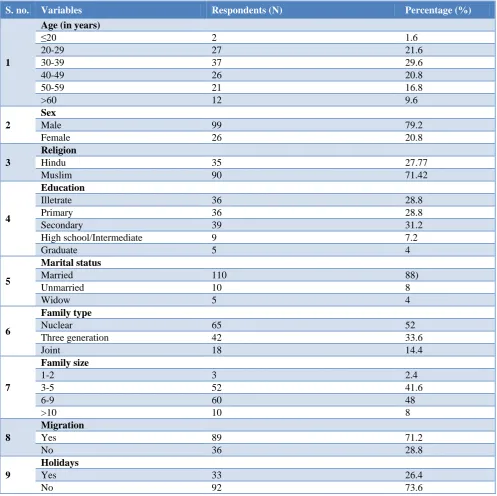
(primary school), 31.2% respondents are studied 6-8th standard (middle school), 7.2% respondents are studied 9-12th standard (high school, intermediate are pulled together) and 4% of the respondents have completed graduation. The panel 5, marriage status of the respondents, majority of the respondents 88% are married, 8% of the respondents are unmarried and 4% of the vendors are widowed. The panel 6 clarify that 14.4% of the respondents are living with joint family, 33.6% respondents living with three generation families and majority (52.2%) of the respondents are living in nuclear family. The panel 7 shows family size are 48% respondents are having family size 6-9, 41.6% are having family size 3-5, very few respondents having family size
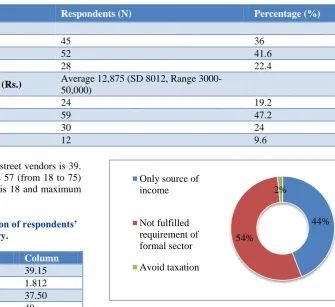
>10, only 3 respondents are having family size 1-2. The panel 8, explain migration status of respondents are 71.2% are migrated and 28.8% are of the same origin. The panel 9 explains the holidays by respondents in week, 73.6% respondents don’t take any holiday and 26.9% are taking holidays once a week. The panel 10 explains status of shelter, 22.4% respondents were having shelter, 36% respondents are non-sheltered and 41.6% respondents are having temporary shelter. The panel 11 shows that monthly income of 19.2% respondents is 6000 or below, 47.2% respondents are earning above 6001 upto 10,000. One fourth of respondents (24%) earn 10,001 to 15,000 and only 9.6% respondents’ income is above 15,001.
Table 1: Vendor demographics (n=125).
S. no. Variables Respondents (N) Percentage (%)
1
Age (in years)
≤20 2 1.6
20-29 27 21.6
30-39 37 29.6
40-49 26 20.8
50-59 21 16.8
>60 12 9.6
2
Sex
Male 99 79.2
Female 26 20.8
3
Religion
Hindu 35 27.77
Muslim 90 71.42
4
Education
Illetrate 36 28.8
Primary 36 28.8
Secondary 39 31.2
High school/Intermediate 9 7.2
Graduate 5 4
5
Marital status
Married 110 88)
Unmarried 10 8
Widow 5 4
6
Family type
Nuclear 65 52
Three generation 42 33.6
Joint 18 14.4
7
Family size
1-2 3 2.4
3-5 52 41.6
6-9 60 48
>10 10 8
8
Migration
Yes 89 71.2
No 36 28.8
9
Holidays
Yes 33 26.4
No 92 73.6
S. no. Variables Respondents (N) Percentage (%)
10
Type of vendors
Non sheltered 45 36
Temporary sheltered 52 41.6
Sheltered 28 22.4
11
Monthly personal income (Rs.) Average 12,875 (SD 8012, Range
3000-50,000)
<6000 24 19.2
6001-10,000 59 47.2
10,001-15,000 30 24
>15,001 12 9.6
Table 2 shows as the average age of street vendors is 39. The age of sampled vendors range is 57 (from 18 to 75) means minimum age of respondents is 18 and maximum is 75.
Table 2: Ungrouped age distribution of respondents’ statistical summary.
Descriptive statistics Column
Mean 39.15
Standard error 1.812
Median 37.50
Mode 40
Standard deviation 12.556
Sample variance 157.669
Range 57
Minimum 18
Maximum 75
Sum 1879
Figure 1 show that the number of vendors decreases when educational level increases.
Figure 1: Educational level of street vendors.
Figure 2 shows percentage distribution of reason for getting involved in street vending: 54% respondents came into street vending as they were unable to fulfil requirement of formal sector. According to 44% respondents street vending was the only source of income. The rest 2% of respondents seek high profit and to avoid tax was the reason why they entered vending.
Figure 2: Percentage of causes of street vending.
Figure 3 shows addiction among vendors, out of 125 respondents 76 (60.8%) respondents are not having any type of addiction, 49 (39.2%) respondents are having addiction, for tobacco 27.2%, followed by cigarette (6.4%), and pan respectively (5.6%).
Figure 3: Addiction among street vendors.
Table 3 shows the health problems in vendors, 95 vendors are not facing any health problem, 30 vendors shows morbidity of which 11 (8.8%) respondents shows musculoskeletal morbidity, followed by hypertension in 6 (4.8%) respondents, respiratory system involvement in 5 (4%) respondents, skin problem in 3 (2.4%) respondents, diabetes in 2 (1.6%) respondents, followed by gastrointestinal, central nervous system and renal each in 1 (0.8%) respondents.
Illetrate Primary Secondary Higher
secondary Graduate Educational level 36 36 39 9 5
0 5 10 15 20 25 30 35 40 45
44% 54%
2% Only source of
income
Not fulfilled requirement of formal sector Avoid taxation
61% 27%
6% 6%
Table 3: Health problems faced by street vendors.
S. no. Variables Vendors %
1 No 95 70
2 Musculoskeletal 11 8.8
3 Hypertension 6 4.8
4 Respiratory 5 4
5 Skin 3 2.4
6 Gastrointestinal 1 0.8
7 Renal 1 0.8
8 Other 1 0.8
DISCUSSION
In the present study majority of respondents belongs to age group 30-39, very few vendors are above 60 i.e., 9.6% and average age of samples vendors is 39 which comparable to study McKay et al conducted in Patna where average age 34, and respondents above 60 are 5.7%.9 Similar results are shown by Bhowmik et al findings of Mumbai city where street vendors are from productive age group of 25-55 years and 5.5% above 57.6 Study by Saha shows maximum respondents from 35-59.3 Study by Panwar et al and Karthikeyan et al shows maximum respondents from age group 31-40.1,8 Study by Varghese shows that majority respondents belonged to the age group 40-60.4 In the present study majority of vendors are male (79.2%) and rest female (20.8%), similar result are showed by Varghese, 75% respondents are male and rest female, and in study by Bhowmik et al.6 Females constitute around 30 per cent in all the cities taken together. Consistent with other vendor studies, Saha, Bhowmik et al, Panwar et al, Karthikeyan et al vendors in this study are with no education or educated up to primary school combine constitute approximately 57% vendors.1,3,6,8 The study also reveals that vendors are working throughout period without taking any holiday unless and until needed, which is comparable with study by Saha which states that vendors running excessively long working hours in a day.3
The present study show that 31.2 % vendors smoke and used to chew tobacco products, whereas according to study by Panwar et al more than and 75% vendors smoke and consume liquor, this can be due to stigma among vendors regarding addiction.1
The study came up with findings that 54% respondents came into street vending as they were unable to fulfil requirement of formal sector, according to 44% respondents street vending was the only source of income, the rest 2% of respondents wants to avoid tax, this is comparable with study by Uddin et al, where 17% respondents replied that lack of jobs, 15% respondents said lack of education had driven them to vending, and about 12% respondents said to avoid taxation.10
Nearly one fourth of vendors (24%) are facing health problems, study by Karthikeyan et al shows that 84% of
respondents were suffering from health problems; this can be due to geographical distribution, sample size variation.8
CONCLUSION
Unable to fulfil requirement of formal sector and no other source of income are the major causes to be in the street vending. Majority vendors are working without taking single holiday in a week. Magnitude of addiction to tobacco, pan and cigarette is quite high and more than one fourth vendors facing health problems of different variety with musculoskeletal illness highest among them.
Recommendations
The further study should focus on:
Relationship between criteria of registration of formal business with reason of informal operators to become in informal sector should be considered.
Health education regarding health problems caused by addiction of tobacco, pan and cigarette should be given to vendors, which will assure to stop its intake.
Counselling of street vendors on importance of regular health check-up should be done. Ask them to utilize nearby healthcare facility like UHTC, GMC, Aurangabad where services are given free of cost
Funding: No funding sources Conflict of interest: None declared
Ethical approval: The study was approved by the Institutional Ethics Committee
REFERENCES
1. Panwar M, Garg V. Issues and challenges faced by vendors on urban streets: a case of Sonipat City, India. IJETMAS. 2015;3(2):71-84.
2. Bhowmik SK. Street vendors in Asia: a review. Economic Political Weekly. 2005: 2256-2264. 3. Saha D. Working life of street vendors in Mumbai.
Indian J Labour Economics. 2011; 54(2):301-25. 4. Varghese A. Socioeconomic conditions of street
vendors. IERJ. 2016;2(11):66-75.
5. A handbook on using the mixed survey for measuring informal employment and the informal sector. Mandaluyong City 1550 Metro Manila, Philippines: Asian Development Bank; 2011. 6. Bhowmik SK, Saha D. Street vending in ten cities in
India. Deonar, Mumbai: National Association of Street Vendors of India; 2012.
7. Saha D. Conditions of decent working life of street vendors in Mumbai. Mumbai: Indian J Labor Economics; 2014.
Nadu, India. Int J Recent Res Appl Stud. 2017;4(8):30-9.
9. McKay FH, Singh A, Singh S, Good S, Osborne RH. Street vendors in Patna, India: understanding the socio-economic profile, livelihood and hygiene practices. food control. 2016. doi: 10.1016/j.foodcont.2016.05.061.
10. Uddin MS. Causes of large labor force: an explanatory study on the informal Sector of Bangladesh. IJSRM. 2017;7(2):32-48.
11. Sakuhuni RC. Causes, benefits and costs of informal economy: evidence from Zimbabve (1980-2013). Res J Commerce. 2014;2(4):1-9.
12. Ray CN. Mishra A. CUE Report. Vendors and informal sector: a case-study of street vendors of Surat City, Centre for Urban Equity (CUE) CEPT University. 2011; Working Paper-15.