Original Research Article
Challenges faced in utilization of social security facilities among
elderly in a rural area of Bangalore
Hemalatha Umashankar*, Sudeepa D., Lalith D. Hiremath, Ratnesh, Nidhi Sharma
INTRODUCTION
As the life expectancy is rising, the population of the aged people is also increasing steadily. This demographic change resulted in change in structure of the population. For the year 2010 the estimates are 8% of total population were above the age 60 years, and is likely to rise to 19% by 2050.1
This profound shift in the proportion of older Indians, taking place in the context of changing family relationships and limited social support system will bring
with it a variety of social, economic and health care policy challenges.1 One direct implication of this would be increase in the prevalence of chronic conditions such as cardio vascular diseases, chronic respiratory diseases, locomotors disorders and mental disorders etc.
Social Security is defined as security that society furnishes through appropriate organization, against certain risks to which its members are exposed” The risks which cover in most countries are sickness, invalidity, maternity, old age and death.1
ABSTRACT
Background: As the life expectancy is rising, there is change in structure of the population. For the year 2018 the estimates are 8% of total population were above the age 60 years, and is likely to rise to 19% by 2050. There is implication of increase in the prevalence of chronic conditions such as cardio vascular diseases, chronic respiratory diseases, locomotor and mental disorders etc. social security is to provide sustenance to people who cannot work and earn their living due to aging. The objectives of the study were to assess the awareness and utilisation of social security facilities among elderly in rural area and to determine the Challenges in utilizing social security facilities among elderly in rural area.
Methods: Descriptive study was done in Muthanallur village, Bangalore. All elders (60 years old and above) were interviewed using a pre-tested semi-structure questionnaire. Results are described in terms of proportions and percentages. The results with p-value less than 0.05 were considered statistically significant.
Results: There were 194 (45.4%) subjects aged 60-69 years. A majority of them were females 244 (57.1%) and males 183 (42.9%). Study subjects residing in joint families were 360 (84.3%) awareness about IGNOAPS and IGNWPS was higher 206 (63%). Awareness among females (76.4%) were significantly more aware of IGNWPS as compared to males (87.9%) (p<0.05).
Conclusions: Awareness and information to approach for utilizing the scheme and ease of administrative procedures should be an integral part of social security scheme.
Keywords: Social security schemes, Elderly, Challenges, IGNOAPS, IGNWPS
Department ofCommunity Medicine, The Oxford Medical College and Research Center, Bangalore, Karnataka, India
Received: 18 September 2018 Revised: 16 October 2018 Accepted: 17 October 2018
*Correspondence:
Dr. Hemalatha Umashankar, E-mail: [email protected]
Copyright: © the author(s), publisher and licensee Medip Academy. This is an open-access article distributed under the terms of the Creative Commons Attribution Non-Commercial License, which permits unrestricted non-commercial use, distribution, and reproduction in any medium, provided the original work is properly cited.
The right to life, recognized as a fundamental right by Article 21 of the Constitution of India, implies the right to live with human dignity. It encompasses not only the security regarding the basic human needs of food, clothing and shelter, but also health security.2
Social security provides workers and their families with access to health care and with protection against loss of income. Unlike other countries in the United States, India does not have a Universal Pension System. There are no comprehensive social security schemes as a whole (Raja and Liebig, 2003). Adopted pension policy is restricted to workers in organized sectors leaving out 90% of worker in unorganized sectors.3
The traditional support structure of the family is increasingly unable to cope with the problem. In a world where the joint family is breaking down, and children are unable to take care of their parents, millions of elderly face destitution.4 The emerging demographic profile and socio-economic scenario of the country needs social security to provide sustenance to those who cannot work and earn their living due to temporary or chronic reasons. Hence there need in understanding the concept of social security and health insurance to bring out health for all in rural area.
Objectives
To assess the awareness and utilization of social security facilities among elderly in rural area
To determine the challenges in utilizing social
security facilities among elderly in rural area.
METHODS
A cross-sectional study was conducted on all elders (60 years old and above) in Muthannallur village who were
interviewed using a pre-tested semi-structure
questionnaire containing the variables such as socio-demographic profile, awareness, utilization and problems faced in availing these services. The study was done from February 2018 to August 2018. Those not willing to participate in the study and not able to communicate due to any disability were excluded in the study. The purpose of the study was explained to them and oral informed consent was obtained. Care was taken to ensure privacy and confidentiality. Sometimes they were called separately and interviewed where he/she could feel comfortable to avoid interference and influence of other family members and neighbors.
The data gathered using the questionnaire and clinical examination were compiled, coded, and entered in Excel Spreadsheets. Statistical analysis was performed using SPSS Version 16 (SPSS, Inc., Chicago, IL, USA). Chi-square test was used to compare categorical variables. P<0.05 was considered to indicate statistical significance.
The study protocol was performed according to the Helsinki declaration and approved by Institutional Ethical
Review Committee. Informed written consent was obtained from Study subjects. Confidentiality about patient information was maintained.
RESULTS
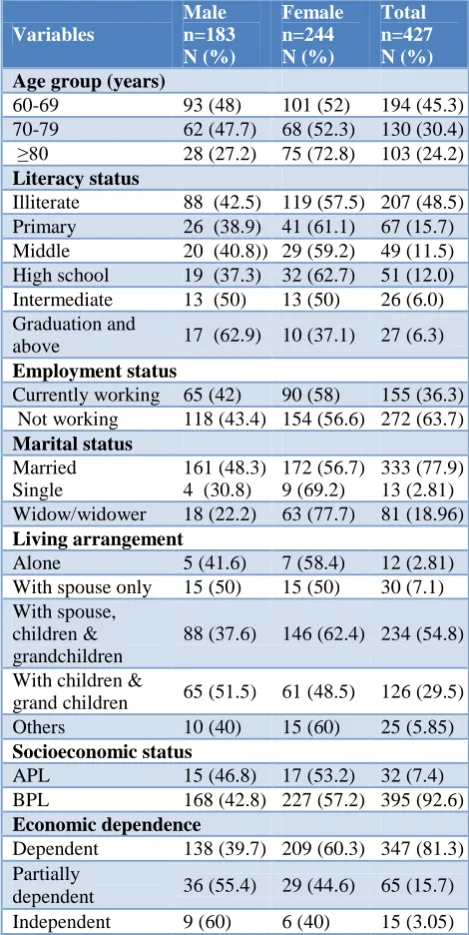
The study sample consisted of 194 (45.4%) subjects aged 60-69 years, 130 (30.5%) and 103 (24.1%) in 75-84 years age group. A majority of study participants were females 244 (57.1%) and 183 (42.9%) were males. Mainly the study samples were married 333 (77.9%) and were not engaged in any occupation (82.8%). Those who were residing in joint families were 360 (84.3%) while 12 (0.4%) subjects were staying alone.
Table 1: Sociodemographic profile.
Variables Male n=183 N (%) Female n=244 N (%) Total n=427 N (%) Age group (years)
60-69 93 (48) 101 (52) 194 (45.3)
70-79 62 (47.7) 68 (52.3) 130 (30.4)
≥80 28 (27.2) 75 (72.8) 103 (24.2)
Literacy status
Illiterate 88 (42.5) 119 (57.5) 207 (48.5)
Primary 26 (38.9) 41 (61.1) 67 (15.7)
Middle 20 (40.8)) 29 (59.2) 49 (11.5)
High school 19 (37.3) 32 (62.7) 51 (12.0)
Intermediate 13 (50) 13 (50) 26 (6.0)
Graduation and
above 17 (62.9) 10 (37.1) 27 (6.3)
Employment status
Currently working 65 (42) 90 (58) 155 (36.3)
Not working 118 (43.4) 154 (56.6) 272 (63.7)
Marital status Married Single
161 (48.3) 4 (30.8)
172 (56.7) 9 (69.2)
333 (77.9) 13 (2.81)
Widow/widower 18 (22.2) 63 (77.7) 81 (18.96)
Living arrangement
Alone 5 (41.6) 7 (58.4) 12 (2.81)
With spouse only 15 (50) 15 (50) 30 (7.1)
With spouse, children & grandchildren
88 (37.6) 146 (62.4) 234 (54.8)
With children &
grand children 65 (51.5) 61 (48.5) 126 (29.5)
Others 10 (40) 15 (60) 25 (5.85)
Socioeconomic status
APL 15 (46.8) 17 (53.2) 32 (7.4)
BPL 168 (42.8) 227 (57.2) 395 (92.6)
Economic dependence
Dependent 138 (39.7) 209 (60.3) 347 (81.3)
Partially
dependent 36 (55.4) 29 (44.6) 65 (15.7)
Independent 9 (60) 6 (40) 15 (3.05)
and (60.6%) of the subjects were aware of this as compared to about half who were aware of Annapurna scheme and only 43 subjects knew about special interest rates. There was significant difference in awareness about
Income tax benefits, special deposits rates, and travel concession rates with gender (p<0.05). Females (76.4%) were significantly more aware about IGNWPS as compared to males (87.9%) (p<0.05).
Table 2: Awareness of social security welfare services among elderly services.
Services
Male (n=183) N (%)
Female (n=244) N (%)
Total
(n=427) P value
Bus travel concession 74 (37) 126 (53) 200 <0.05
Train travel concession 54 (41.5) 76 (58.5) 130 >0.05
Air travel concession 12 (70.5) 5 (29.5) 17 <0.05
High interest rates by bank 86 (57.4) 64 (42.6) 150 <0.05
Income tax benefits 92 (60.9) 59 (39.1) 151 <0.05
NPHCE 78 (64.5) 43 (35.5) 121 <0.05
Special deposits rates 26 (60.5) 17 (39.5) 43 <0.05
Annapurna scheme 74 (46.3) 86 (53.7) 160 <0.5
IGNWPS 120 (36.8) 206 (63.2) 326 <0.05
IGNOAPS 123 (39.4) 194 (60.6) 317 <0.05
Health insurance/benefits 67 (43.5) 87 (56.5) 154 <0.5
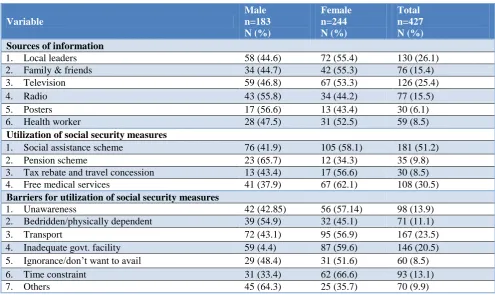
Table 3: Challenges faced by elderly in availing the social security facilities.
Variable
Male n=183 N (%)
Female n=244 N (%)
Total n=427 N (%) Sources of information
1. Local leaders 58 (44.6) 72 (55.4) 130 (26.1)
2. Family & friends 34 (44.7) 42 (55.3) 76 (15.4)
3. Television 59 (46.8) 67 (53.3) 126 (25.4)
4. Radio 43 (55.8) 34 (44.2) 77 (15.5)
5. Posters 17 (56.6) 13 (43.4) 30 (6.1)
6. Health worker 28 (47.5) 31 (52.5) 59 (8.5)
Utilization of social security measures
1. Social assistance scheme 76 (41.9) 105 (58.1) 181 (51.2)
2. Pension scheme 23 (65.7) 12 (34.3) 35 (9.8)
3. Tax rebate and travel concession 13 (43.4) 17 (56.6) 30 (8.5)
4. Free medical services 41 (37.9) 67 (62.1) 108 (30.5)
Barriers for utilization of social security measures
1. Unawareness 42 (42.85) 56 (57.14) 98 (13.9)
2. Bedridden/physically dependent 39 (54.9) 32 (45.1) 71 (11.1)
3. Transport 72 (43.1) 95 (56.9) 167 (23.5)
4. Inadequate govt. facility 59 (4.4) 87 (59.6) 146 (20.5)
5. Ignorance/don’t want to avail 29 (48.4) 31 (51.6) 60 (8.5)
6. Time constraint 31 (33.4) 62 (66.6) 93 (13.1)
7. Others 45 (64.3) 25 (35.7) 70 (9.9)
The source of information regarding social security measures were mainly from television and local leaders, least effort from health care providers and posters. There is no significant association between gender and source of information. 181 (51.2%) were benefitted with social security measures compare with 108 (30.5%) were availing free medical services. 8.5% and 9.8% were utilizing pension scheme and tax rebate. Unawareness
(13.1%) transportation (23.5%) and inadequate
government facility (20.5%) were important challenges faced by elderly in utilizing social security measures.
DISCUSSION
It is observed in this study that illiteracy is higher among females (62%) than males (22.8%). The disparity in literacy status may be attributed to the area being rural. Educating females in those days was not considered as important as establishing a marriage at an early age. More than half of the subjects were illiterate. Similar profile of study subjects were reported by the study of Dhanasekaran carried out in a rural area in Tamil Nadu.5 Similar findings also from Lena et al study done in Udupi taluk Karnataka.6
Almost more than half of the respondents in the study were from joint families (84.3%), while (15.7%) were from a nuclear family. Various studies by Padda et al, Singh et al, and Srivastava et al have brought out similar findings.7-9 The higher prevalence of joint families could be because of the study conducted in the rural area.
The proportion of elderly married account to 72.9%, widowed, or unmarried were found to be very less and similar information was found in the study done by Singh et al.9 Shah reports that 64.3% of elderly women were widows and most of them were dependent. It is indeed true that it is the marital status that determines ones position within the family as well as the status in society in county like India.
A significant proportion of elderly were aware of social security schemes like IGNOAPS, IGNWPS and Annapurna scheme. The other geriatric benefits like bus travel concession, special interest rates, income tax rebate were also higher in males than females subjects in our study. Awareness was significantly higher among those who were BPL. These finding are statistically significant among males than females. These findings were consistent with that reported by Srivastava et al, in their study conducted in district Dehradun and Joseph et al, study done in Mangalore.10,11 Air travel concession were known to very less subjects. The possible reasons could be the literacy rate of subjects in that study and rural urban differentials.
In our study, approximately 36.3% were still working as unskilled workers against those 63.7% were at home. Similar results were seen in a study by Elango et al, in his study, reported that 55.8% were occupied in productive work, 28% in agriculture, 15.1% in labor, and 44.2% were dependent on others.12
The Information about social security services was communicated mainly by Television, and local leaders. Major challenges include transport and physical dependence which had contributed much in social
security services utilization. Inconsistencies in
identification of beneficiaries, political influence and corruption are known factors reported earlier also which poses a serious question on the implementation of this scheme.13,14
Main sources of information were local leaders followed by family and friends. Hence, local leaders should take more steps to raise awareness about social security measures among elders in their areas and to remove barriers wherever possible. Envisioning recreation centers for elders, where they can gather together.
Limitation
The study involved subjects only from rural area. It would have been more representative of the population if elderly from urban area were also involved.
CONCLUSION
The present study highlights important areas of concern in providing social security for elderly population in rural area of Bangalore. The results of this study showed that a major proportion of the elderly were out of the work force, partially or totally dependent on others, and suffering from health problems with a sense of neglect by their family members. Awareness about other measures of social security was low. Major challenges are, transport and inadequate government facilities and stringent administrative procedures and difficulty in identifying where and whom to approach for information regarding social security schemes. It is recommended that local leaders should take more efforts to make elders aware of such measures. The need of elders for more financial security and medical benefits of health Insurance should included in future policies and programs for them. Awareness generation, provision of information on how to approach the concerned authority for utilizing the scheme and ease of administrative procedures should be an integral part of any social security scheme or measure.
Further research, especially qualitative research, is needed to explore the depth of the problems of the elderly.
Funding: No funding sources Conflict of interest: None declared
Ethical approval: The study was approved by the Institutional Ethics Committee
REFERENCES
1. Park K. Textbook of Preventive and Social
Medicine. 24th ed. Jabalpur: Banarsidas Bhanot; 2017: 631-739.
2. Suryakantha AH. Community Medicine with Recent
Advances. 3rd ed. New Delhi: Jaypee Publications; 2014: 738-739.
3. Rajan SI, Liebig PS. An Ageing India: Perspectives,
Prospects, and Policies. J Aging Social Policy. 2003;15(2-3):1-9.
4. Old Age Social and Income Security. First Report
http://www.seniorindian.com/oasis.htm. Accessed on 3 June 2018.
5. Dhanasekaran G. A profile of elderly in rural setting
of Tamil Nadu. Int J Contemporary Res Soc Sci. 2015;2(1):5–10.
6. Lena A, Ashok K, Padma M, Kamath V, Kamath A.
Health and social problems of the elderly: A cross-sectional study in Udupi Taluk, Karnataka. Indian J Community Med. 2009;34:131-4.
7. Nivedita BM, Hemavarneshwari, Mangala S,
Subrahmanyam G. Utilization of social security
schemes among elderly in Kannamangala,
Bengaluru. Int J Sci Study. 2015;3(7):82–5.
8. Padda AS, Mohan V, Singh J, Deepti SS, Singh G,
Dhillon HS. Health profile of aged persons in urban and rural fi eld practice areas of Medical College Amritsar. Indian J Community Med. 1998;23:72-6. 9. Singh C, Mathur JS, Mishra VN, Singh JV, Singh
RB, Garg BS. Social problems of aged in a rural population. Indian J Community Med. 1994;19:23-5.
10. Srivastava AK, Kandpal SD. Awareness and
utilization of social security scheme and other government benefits by the elderly –A study in rural
area of district Dehradun. Ind J Comm Health. 2014;26(4):379–84.
11. Shah B. Rights of the aged. Available at:
http://www.islamset.com/healnews/aged/main.html. Accessed on Aug 15 2014.
12. Joseph N, Nelliyanil M, Nayak SR, Agarwal V,
Kumar A, Yadav H, et al. Assessment of morbidity pattern, quality of life and awareness of government facilities among elderly population in South India. Family Med Prim Care. 2015;4(3):405–10.
13. Elango S. A study of health and health related social problems in the geriatric population in a rural area of Tamil Nadu. Indian J Public Health. 1998;42:7-8.
14. Maroof M, Ahmad A, Khalique N, Ansari MA.
Awareness of geriatric welfare services among rural elderly population. Int J Res In Med Sci. 2016;4(7):2783-7.
Cite this article as: Umashankar H, Sudeepa D,
Hiremath LD, Ratnesh, Sharma N.Challenges faced