Original Research Article
Treatment outcome in tuberculosis patients under DOTS treatment,
tuberculosis unit, Nahan, Himachal Pradesh, 2013-2015: a record
based descriptive study
Rashmi Kashyap, Kamaljit Singh*
INTRODUCTION
Tuberculosis (TB) has existed for millennia and remains a major global health problem. It causes ill-health in millions of people each year and in 2015 was one of the top 10 causes of death worldwide, ranking above HIV/AIDS as one of the leading causes of death from an infectious disease.1 This is despite the fact that with a
timely diagnosis and correct treatment, most people who develop TB disease can be cured.
In 2015, there were an estimated 10.4 million new (incident) TB cases worldwide, of which 5.9 million (56%) were among men, 3.5 million (34%) among women and 1.0 million (10%) among children. Overall, 90% of cases were adults and 10% children, and the ABSTRACT
Background: Tuberculosis (TB) has existed for millennia and remains a major global health problem. There has been significant progress in cure rates achieved in revised national tuberculosis programme (RNTCP), however concerns regarding effectiveness of RNTCP regimens, still exist. These concerns could be addressed through an assessment of treatment outcome. The present study was conducted to ascertain the treatment outcome in tuberculosis patients under DOTS treatment.
Methods: A record based descriptive study was conducted in patients enrolled under directly observed treatment strategy (DOTS). The data included the summary of case findings as new smear positive, new smear negative, new extrapulmonary, new others, relapse, failure, treatment after default, category II. Treatment outcome was assessed as cured, treatment completed, died, loss to follow up, failure and transferred out. Different variables were represented as frequency distribution and percentages. Chi square test was used to observe the association of different variables with the outcome of the disease.
Results: A total of 899 patients were enrolled under DOTs treatment for tuberculosis. Sputum positivity was present in 481 (72.8%) patients. Outcome showed 384 (79.8%) patients as cured, treatment completed in 414 (81.8%) patients and treatment success rate of 798 (89.7%). Treatment failure was observed 9 (1.9%) patients.
Conclusions: Treatment success rate of TB patients in this study was encouraging for TB control through DOTS strategy. However, to reduce poor treatment outcome, patients should be strictly followed by health workers or ASHAs.
Keywords: Pulmonary tuberculosis, Cure rate, Treatment success
Department of Community Medicine, Dr. YSP Govt. Medical College, Nahan, Himachal Pradesh, India
Received: 05 April 2018
Revised: 24 May 2018
Accepted: 25 May 2018
*Correspondence:
Dr. Kamaljit Singh,
E-mail: [email protected]
Copyright: © the author(s), publisher and licensee Medip Academy. This is an open-access article distributed under the terms of the Creative Commons Attribution Non-Commercial License, which permits unrestricted non-commercial use, distribution, and reproduction in any medium, provided the original work is properly cited.
male: female ratio was 1.6:1. People living with HIV accounted for 1.2 million (11%) of all new TB cases.1
Six countries accounted for 60% of the new cases: India, Indonesia, China, Nigeria, Pakistan and South Africa. Global progress depends on major advances in TB prevention and care in these countries. Worldwide, the rate of decline in TB incidence remained at only 1.5% from 2014 to 2015. This needs to accelerate to a 4–5% annual decline by 2020 to reach the first milestones of the End TB Strategy.1
India accounts for one fourth of global TB burden. Each year about 2.2 million people develop TB in India and an estimated 220,000 die from the disease.2 Some estimates calculate the deaths as being twice as high. TB can affect any age, caste or class but cases are mainly poor people. Slum dwellers, tribal populations, prisoners and people already sick with compromised immune systems are over-represented among the cases, compared to their numbers in the population. The economic burden of TB is extremely high. Between 2006 and 2014, TB cost the Indian economy a massive USD 340 billion.2
Directly observed therapy short-course (DOTS) has been used as internationally recommended TB control strategy since 1994 by World Health Organization (WHO) under stop TB strategy components to achieve the TB related millennium development goals (MDGs) by 2015.3 The specific targets of DOTS detailed in the updated Global Plan (2011-2015) were to achieve a case detection rate (CDR) of 84% (for all cases and smear-positive cases specifically) and a Treatment Success Rate (TSR) of 87% by 2015.4
India started RNTCP with the objectives of not less than 85% cure rate of infectious TB cases under DOTS and at least 70% detection of new cases through quality sputum microscopy.5,6
DOTS ensure the best possible results in treatment of TB. Here, an observer watches and assists the patient in swallowing the tablets, thereby ensuring that patient receives the right drugs, in the right doses, at the right intervals and for the right duration. The control of TB in India has shown remarkable progress with the entire country being covered under the RNTCP.5
The Joint TB Monitoring mission (JMM) of the RNTCP (JMM) reviewed National Strategic Plan (NSP) (2012-2017) acknowledged India‟s remarkable achievements in TB control over the previous ten years. This included testing more than 80 million people, detecting and treating 15 million TB patients, and saving millions of lives as a result of the efforts of the RNTCP. However, they also said that overall:
“The implementation of the NSP for 2012–2017 is generally not on track: projected increases in case detection by the RNTCP have not occurred, vital
procurements are delayed and many planned activities have not been implemented. Also, of the recommendations made by the JMM 2012, about two thirds have not been fully implemented.”7
In Himachal Pradesh, tuberculosis is quite wide spread in the poor socio-economic classes and the slum areas where women are the most sufferers. In the state, it occupies the seventh place (3.61%) in the women from the top 10 leading causes of the diseases.8
There has been significant progress in cure rates achieved in RNTCP, however clinicians often raise concerns regarding effectiveness of RNTCP regimens, particularly the outcome with the current treatment regimens. These concerns could be addressed through an assessment of treatment outcome. The aim of the present study was to assess the treatment outcome of TB patients and various factors associated with treatment outcome.
METHODS
A record based descriptive study was conducted in patients enrolled under Directly Observed Treatment Strategy (DOTS) for tuberculosis at Tuberculosis Unit, Nahan during the period from 1st January 2013 to 31st December 2015.
Inclusion criteria were patients diagnosed with tuberculosis and put on DOTS treatment. Exclusion criteria were incomplete record of the patients.
Permission from the Medical Officer Health, Sirmaur was sought prior to the initiation of the study. Source of the data was tuberculosis register, Revised National Tuberculosis Control Programme maintained at Tuberculosis Unit, Nahan. The data included the summary of case findings as New Smear positive, New Smear Negative, New Extrapulmonary, New Others, Relapse, failure, Treatment After Default,Category II others. DOTS summary was recorded as Cured, Treatment Completed, Died, loss to follow up, Failure, Transferred Out and HIV status of the patient.
Definitions of tuberculosis cases and treatment outcome1
New case: A patient with sputum positive pulmonary TB who has never had treatment for TB or has taken anti-TBdrugs for less than 4weeks.
Relapse: A patient who returns smear positive having previously been treated for TB and declared cured afterthe completion of his treatment.
Treatment after default: A patient who returns sputum smear positive, after having left treatment for at least two months.
Transfer in: A patient recorded in another administrative area register and transferred into another area to continue treatment.
Cured: Initially smear positive patient who completed treatment and had negative smear result on at least two occasions one at treatment completion.
Treatment completed: Initially smear negative patient who received full course of treatment, or smear positive who completed treatment, with negative smear at the end of initial phase, but no or only one negative smear during continuation and none at treatment end.
Treatment failed: A patient whose sputum smear or culture is positive at 5 months or later during the treatment.
Died: A Tuberculosis patient who dies for any reason before starting or during the course of treatment
Lost to follow up: A TB patient who did not start treatment or whose treatment was interrupted for two consecutive months or more.
Transfer out: A patient who has been transferred to another area register and treatment results are not known.
Treatment success: The sum of Cured and Treatment Completed.
Any other patients who do not fit in the above mentioned definitions will be categorized as new and retreatment others.
Any patient found to have drug resistant tuberculosis and placed on second line treatment was removed from the drug susceptible TB outcome cohort.
Data analysis
A descriptive analysis for the variables was done based on SPSS version 22. Different variables were represented as frequency distribution and percentages. Chi square test was used to observe the association of different variables with the outcome of the disease. Any correlation between selected parameters and the type of disease was assessed.
Ethical clearance
Data of the patient registered in tuberculosis unit, Nahan from January 2013–December 2015 used for analysis. Confidentiality has been maintained and the information thus obtained has not been used for any other purpose except for academic purposes. Hence no conflict on ethical issues and thus not required. There was no conflict
of interest and no financial help from any source were involved in conduction of this study.
RESULTS
A total of 899 patients were enrolled under DOTs treatment for tuberculosis at tuberculosis unit, Nahan Distt Sirmour (H.P) during the period from January 2013 to December 2015.
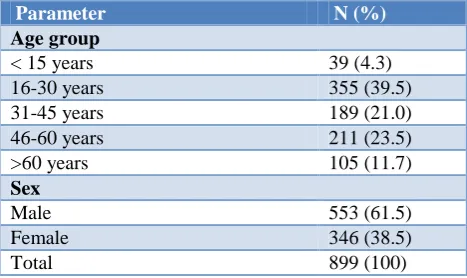
Males accounted for 553 (61.5%) whereas there were 346 (38.5%) females. Sex distribution showed significant difference between males and females (p<0.001).
Table 1: Age and sex distribution.
Parameter N (%)
Age group
< 15 years 39 (4.3)
16-30 years 355 (39.5)
31-45 years 189 (21.0)
46-60 years 211 (23.5)
>60 years 105 (11.7)
Sex
Male 553 (61.5)
Female 346 (38.5)
Total 899 (100)
Majority 355 (39.5%) patients were in the age group of 16 to 30 years followed by 211 (23.5%) patients in the age group of 46-60 years, 189 (21.0%) in the age group of 31-45 years, 39 (4.3%) patients less than 15 years and 105 (11.7%) patients were aged more than 60 years (Table 1).
Table 2: Morbidity profile of the patients under DOTs treatment.
Category N (%) Type N (%)
Category I 686 (76.3) Pulmonary 660 (73.4)
Category II 213 (23.7) Extra
pulmonary 239 (26.6)
Total 899 (100) 899 (100)
Category I or new patients accounted for 686 (76.3%) whereas there were 213 (23.7%) category II patients. Majority of category II patients 134 (62.9%) were relapse cases, retreatment others patients constituted 53 (24.8%), treatment after default in 19 (8.9%) and history of failure was present in 7 (3.2%) patients respectively. Pulmonary tuberculosis was present in 660 (73.4%) patients and extrapulmonary tuberculosis was present in 239 (26.6%) patients (Table 2).
both males and females; 433 (78.3%) in males and 227 (65.6%) in females.
Table 3: Extrapulmonary tuberculosis.
Extrapulmonary TB No. of
patients (%)
Pleural effusion 125 (52.3)
Cervical lymphadenitis 60 (25.1)
Abdominal tuberculosis 21 (8.7)
Granulomatous uveitis 4 (1.6)
Knee joint tuberculosis 5 (2.0)
Supraclavicular lymphadenitis 5 (2.0)
Axillary lymphadenitis 3 (1.2)
Others* 16 (6.6)
Total n(%) 239 (100) *Others included lupus vulgaris, miliary tuberculosis, oro buccal tuberculosis, pericardial effusion, cold abscess, renal tuberculosis, epididimitis, inguinal lymphadenitis, Potts spine.
The association between the sex and type of tuberculosis was insignificant. There was negative correlation between the age groups and extra pulmonary tuberculosis with declining trend in the number of cases with the advancing age (R square=0.032).
Table 4: Outcome of the patients under DOTs treatment (n=890).
Outcome Results (number of
patients)
Cured 79.8% (384/481*)
Treatment completed 81.8% (414/506**)
Treatment Success 89.6% (798/890)
Loss to Follow up 5.0% (45 /890)
Died 3.0% (27 /890)
Failure 1.0%(9 /890)
Transferred out 1.2%(11/890)
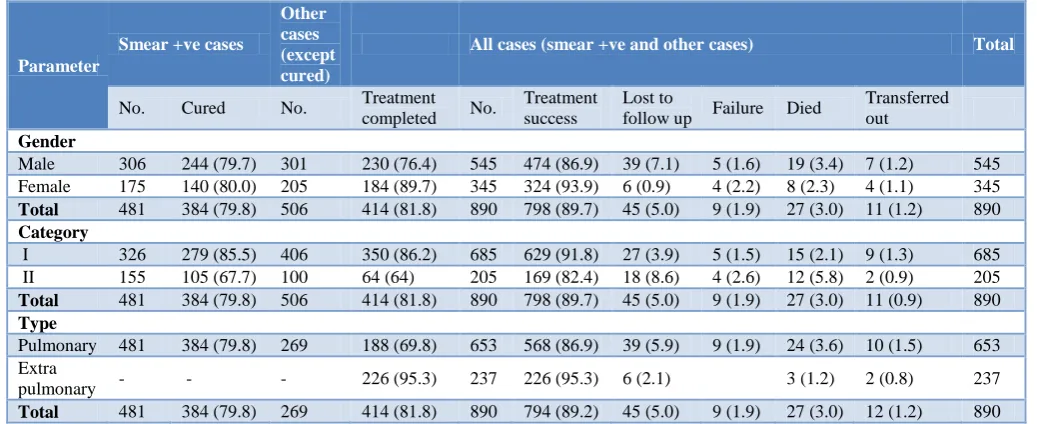
Out of pulmonary tuberculosis patients, sputum positivity was present in 481 (72.8%) patients. As nine patients were placed on second line drug regimen, so these patients were exempted from analysis of the outcome. Outcome showed 384 (79.8%) patients were cured. Treatment completed in 414 (81.8%) patients and treatment success rate of 798 (89.7%) were observed. 45 (5%) patients were not available for follow up and 27 (3.0%) died. Treatment failure was observed 9 (1.9%) patients (Table 4 and 5). However no correlation was observed between the age and outcome.
Type 5: Outcome of the patients based on gender, category and type of tuberculosis.
Parameter
Smear +ve cases
Other cases (except cured)
All cases (smear +ve and other cases) Total
No. Cured No. Treatment
completed No.
Treatment success
Lost to
follow up Failure Died
Transferred out
Gender
Male 306 244 (79.7) 301 230 (76.4) 545 474 (86.9) 39 (7.1) 5 (1.6) 19 (3.4) 7 (1.2) 545 Female 175 140 (80.0) 205 184 (89.7) 345 324 (93.9) 6 (0.9) 4 (2.2) 8 (2.3) 4 (1.1) 345
Total 481 384 (79.8) 506 414 (81.8) 890 798 (89.7) 45 (5.0) 9 (1.9) 27 (3.0) 11 (1.2) 890
Category
I 326 279 (85.5) 406 350 (86.2) 685 629 (91.8) 27 (3.9) 5 (1.5) 15 (2.1) 9 (1.3) 685 II 155 105 (67.7) 100 64 (64) 205 169 (82.4) 18 (8.6) 4 (2.6) 12 (5.8) 2 (0.9) 205
Total 481 384 (79.8) 506 414 (81.8) 890 798 (89.7) 45 (5.0) 9 (1.9) 27 (3.0) 11 (0.9) 890
Type
Pulmonary 481 384 (79.8) 269 188 (69.8) 653 568 (86.9) 39 (5.9) 9 (1.9) 24 (3.6) 10 (1.5) 653 Extra
pulmonary - - - 226 (95.3) 237 226 (95.3) 6 (2.1) 3 (1.2) 2 (0.8) 237
Total 481 384 (79.8) 269 414 (81.8) 890 794 (89.2) 45 (5.0) 9 (1.9) 27 (3.0) 12 (1.2) 890
DISCUSSION
While the central government is targeting to eliminate Tuberculosis by 2025, Himachal Pradesh government has set the target of 2023 so that it becomes the first TB free state in the country. The annual risk of tuberculosis infection is 1.9% in Himachal Pradesh against a national average of 1%.So the sustained efforts are required at the various levels of health department to achieve the target. The delivery of Revised National Tuberculosis Control was started in district Sirmaur in the year 2000.
studies from different parts of India was 27-40 years.14-16 Majority 355 (39.5%) patients were in the age group of 16 to 30 years followed by 211 (23.5%) patients in the age group of 46-60 years. Our study shows an earlier age of presentation in contrast to study by Sharma et al which mentioned 64.6% in the age group of 30-60 years. Majority 660 (73.4%) of the patients had pulmonary tuberculosis.17 Extrapulmonary tuberculosis was present in 239 (26.6%) patients. Study by Tahil et al depicted 768(52%) as chest symptomatic and 557(48%) patients as extrapulmonary tuberculosis.18 Pleural effusion (52.3%), cervical lymphadenitis (25.1%) and abdominal tuberculosis (8.7%) were the leading extrapulmonary manifestations of tuberculosis. Lymph node and pleural TB were the common EPTB cases in the age group of 15–44 years. Pleural TB was the commonest type of presentation in the age group of 45–64 years as well as in the age group of >65 years. Probability of reactivation in pleura may be higher as the age increases.22 Recent studies have suggested that the sites of EPTB may vary according to geographic location, population groups and a wide variety of host factors.23-26
Monitoring of the outcomes of treatment was one of the five elements of TB control emphasized in the DOTS strategy, and remains one of the core elements of the end TB strategy. Hence, evaluating treatment outcome of TB patients and recognizing influential factors underpin TB control strategy. The present study revealed that the treatment success rate was 89.7% for all TB cases (86.9% in pulmonary TB and 95.3% in extrapulmonary TB). However, study conducted in West Bengal revealed overall treatment success rate of 90.2% while it was 84.2% in EPTB patients and 93.8% in all sputum positive PTB patients.31 Treatment success rates varied across the health institutions and geographic area. The higher treatment success rate in this study might be due to active involvement of health workers and robust health infrastructure. The present study revealed treatment failure in 1.9% of patients only which is in agreement with a study from West Bengal reporting an overall treatment failure rate of 1.2%.31 Another study from Lucknow reported treatment failure of 0.6% and 2.6% in new smear positive and retreatment cases respectively.32
Cure rate is an important parameter for assessing the effect of DOTS treatment. The current study noted favourable treatment response (cure rate) of 79.8.% [384/481] as they underwent smear conversion. Studies from various parts of India conducted between 2003 to 2011 documented cure rate between 77.1% to 85%.19-21 Ramachnadran et al study at Chennai revealed cure rate of 79% in smear positive TB patients.28
The cure rate after completion of DOTS treatment was 85.5% (279/326) for category I and 67.7% (105/155) for patients. The cure rates are comparable to a study from Delhi that reported treatment success rate in category I and category II patients as 91.0% and 73.0%, respectively.27 Other study conducted in Gujarat also
revealed higher cure rates in cat I than cat II.29 The reason for high proportion of poor treatment outcome in retreatment cases (cat II) is that the increasing prevalence of MDR TB due to interruption and misuse of anti-TB drugs by patients. Cure rates was found to be equal among females and males unlike other studies which observed that males were at an increased risk of a poor treatment outcome compared to females.29,30
Limitation
Study was a review of records maintained in Tuberculosis unit. Therefore it was not possible to validate the data. However data quality is monitored by trained and dedicated staff in RNTCP. The study district and period was selected purposively based on area of work of investigators and not randomly so raising concerns of generalisation of results. All the 12 districts of the state are similar with respect to many socioeconomic and health indicators. Therefore the results may be generalizable.
CONCLUSION
In summary, treatment success rate (TSR) of TB patients in this study was encouraging for TB control through DOTS strategy. Nevertheless, TB patients with previous history of TB were found to be at risk of poor treatment outcome. Correspondingly the TB patients and those who attend health centers should be encouraged for successful treatment outcome. Generally, to reduce poor treatment outcome, patients should be strictly followed by health workers or ASHAs to reduce unfavourable outcome.
ACKNOWLEDGEMENTS
We thank the local health workers and District health authorities for their support and cooperation.
Funding: No funding sources Conflict of interest: None declared Ethical approval: Not required
REFERENCES
1. TB India 2016 Revised National TB Control Programme Annual Status Report”, New Delhi, 2016 www.tbcindia.nic.in
2. Global Tuberculosis Control 2015, WHO, Geneva, 2015 www.who.int/tb/publications/global_report/ - Available at: http://www.tbfacts.org/tb-statistics-india/#sthash.vo8BFjJC.dpuf.
4. WHO: Global Tuberculosis Report 2016. Available at: http://www.who.int/tb/publications/global_ report/en/. Accessed on 9 May 2017
5. World Health Organization (2006) The Stop TB Strategy: Building on and enhancing DOTS to meet the TB-related Millennium Development Goals (MDGs). Geneva, Switzerland.
6. World Health Organization (2010). The global plan to stop TB, 2011-2015/Stop TB Partnership: Transforming the fight towards elimination of tuberculosis. Geneva, Switzerland.
7. New Delhi: Directorate General of Health Services, Ministry of Health and Family Welfare Nirman Bhavan; 2010. Government of India. Managing the Revised National Tuberculosis Control Programme in your area. A Training Course-modules (1-4)-Central TB Division; 2010: 1.
8. New Delhi: Central TB division, Ministry family of health and family welfare, Nirmal Bhawan; 2009. Mar, TB India 2009, RNTCP status report; 2009: 1– 5.
9. RNTCP- Government of India TB Treatment & Care. Available at: http://www.tbfacts.org/rntcp/ Accessed on 9th May 2017.
10. Directorate of Health. Hyderabad, India: 2006. State TB Control Society, RNTCP Status Report; Annual Report 2006. Available at: http://www.tbcindia.org /documents.asp#. Directorate of Health Services, Department of Health and Family Welfare. Himachal Pradesh, India: Health at a glance; 2005. Accessed on 04 August, 2010.
11. Park K. Epidemiology of communicable diseases. Park‟s textbook of preventive and social medicine. 23rd edition. Jabalpur: Banarsidas Bhanot publishers; 2013: 176-200.
12. Uplekar MW. Attention to gender issues in tuberculosis to control. Int J Tuberc Lung Dis. 2001: 220-224.
13. Sharma A, Kansal D, Katoch K, Sharma PK, Bansal R, Sharma T. Treatment outcome of new smear positive patients of pulmonary tuberculosis treated under directly observed treatment, Short course in a rural tertiary care hospital of a hilly area. Int J Community Med Public Health. 2016:3:2129-32. 14. Sophia V, Balasangameshwara VH, Jaganatha PS,
Kumar P. Initial drug resistance among tuberculosis patients under DOTS programme in Bangalore city. Ind J Tub. 2004;51:17-21.
15. Sharma SK, Kaushik G, Jha B, George N, Arora SK, Gupta D, et al. Prevalence of multidrug tuberculosis among newly diagnosed cases of sputum positive pulmonary tuberculosis. Indian J Med Res. 2011;133:308-11.
16. Mahadev P, Kumar P, Agarwal SP, Chauhan LS, Srikantaramu N, et al. Surveillance of drug resistance to anti tuberculosis drugs in districts of Hoogli in West Bengal and Mayurbhanj in Orissa. Indian J Tuberc. 2005;52:5-10.
17. Sharma A, Kansal D, Sharma PK, Bansal R, Sharma T. Socio-demographic profile of NSP patients of
PTB in tertiary care hospital. India bn J Pharmacy Pharmacol. 2016:3(4);162-4.
18. Tahir M, Sharma SK, Rohrberg DS, Gupta D, Singh UB, Sinha PK. DOTS at a tertiary care centre in northern India: successes, challenges & next steps in tuberculosis Control. Indian J Med Res. 2006.123;702-6.
19. Ahmed J, Chadha VK, Singh S, Venkatachalappa B, Kumar P. Utilization of RNTCP services in Rural area of Bellary district Karnataka by gender, age and distance from health centre. Indian J Tuberc. 2009;56:62-8.
20. Mishra A, Mishra S, Chouksy M, Gautam P, Verma P, Srivastava D, et al. Study of effectiveness of DOTS on tuberculosis patients treated under RNTCP program. NTI Bulletin. 2007;43:47-50. 21. Gaikwad A, Deopujari K. A study of clinical profile
and treatment outcome of DOTS regimen in 250 pulmonary and extrapulmonary tubercular patients in Hamida hospital, Bhopal, 2011. Chest. 2012;142:288-9.
22. Prakasha SR, Suresh G, D‟sa IP, Shetty SS, et al. Mapping the Pattern and trends of Extrapulmonary Tuberculosis. J Glob Infect Dis. 2013;5(2):54–9. 23. Yang Z, Kong Y, Wilson F, Foxman B, Fowler AH,
Marrs CF, et al. Identification of risk factors for extra pulmonary tuberculosis. Clin Infect Dis. 2004;38:199–205.
24. Noertjojo K, Tam CM, Chan SL, Chan-Yeung MM. Extra-pulmonary and pulmonary tuberculosis in Hong Kong. Int J Tuberc Lung Dis. 2002;6:879–86. 25. Musellim B, Erturan S, Sonmez Duman E, Ongen G. Comparison of extra-pulmonary and pulmonary tuberculosis cases: Factors influencing the site of reactivation. Int J Tuberc Lung Dis. 2005;9:1220–3. 26. Ilgazli A, Boyaci H, Basyigit I, Yildiz F. Extra
pulmonary tuberculosis: Clinical and epidemiologic spectrum of 636 cases. Arch Med Res. 2004;35:435–41.
27. Chadha SL, Bhagi RP. Treatment outcome in tuberculosis patients placed under directly observed treatment short course (DOTS): A cohort study. Indian J Tuberc. 2000;47:155–8.
28. Ramachandrana G, Hemanth Kumar AK, Chandrasekaran V, Kannan T, Vijayalakshmi R, Azger Dusthackeer VN, et al. Factors influencing tuberculosis treatment outcome in adult patients 2 treated with thrice- weekly regimens in India. Antimicrob Agents Chemother. 2017;61(5)pii: e02464-16.
29. Piparva KG. Treatment outcome of tuberculosis patients on dots therapy for category 1 and 2 at district tuberculosis centre. Int J Pharm Sci Res 2017;8(1):207-12.
30. Ahmad SR, Velhal GD. Study of treatment outcome of new sputum smears positive TB cases under - strategy. Int J Pharm Bio Sci. 2013;4:1215-22. 31. Saha TK, Chattopadhyay A, Sain S, Boral K,
treated Under „RNTCP‟ in a slum area of Kolkata J Dental Medical Sci. 2013;6(3):63-7.
32. Prasad R, Srivastawa SK, Ratan RK, Srivastawa P. Report on Revised National Tuberculosis Control Programme Urban Project in Lucknow. Indian J Tub. 2000;47:159.