Original Research Article
Infant feeding practices among mothers in rural
Rajamahendravaram, Andhra Pradesh
Suresh Babu Uppiretla
1*, Sushant Kumar Mishra
1, Hari Kumar Rachakulla
2INTRODUCTION
Maternal and child undernutrition remain high and damaging in developing world.1,2 Inadequate nutrition in younger age has long-lasting effects on physical as well as cognitive growth of a child.3,4 Adequate nutrition during infancy and early childhood is essential to ensure the growth, health and development of children to their full potential.5 Hence, improving infant feeding practices should, therefore, be a high global priority.6
World Health Organization (WHO) and United Nations Children’s Fund (UNICEF) set a global strategy for optimal infant and young child feeding (IYCF).7 The strategy recommends the initiation of breastfeeding within one hour of birth, exclusive breastfeeding for the first six months, after which nutritiously appropriate, adequate, and safe complementary foods should be introduced.
All over the world, the infant and young child feeding practices is poor, especially the late initiation of
ABSTRACT
Background: Maternal and child under nutrition remain extensive in low and middle-income population groups. Safe delivery practices and adequate nutrition during infancy is essential to ensure health, growth, and development of a child. Early under nutrition has a long-lasting effect on physical and cognitive growth. So it is essential to assess and promote the healthy child feeding & caring practices in the vulnerable groups.
Methods: Community-based cross-sectional study was conducted to enrol 160 mothers of infants by probability proportional to size (PPS) sampling procedure for 5 months in the field practicing areas of GSL Medical College. Primary data was collected through a validated questionnaire with variables of socio-demography, intra-natal, and infant feeding practices. Secondary data was obtained from MCP cards. The analysis was done using SPSS trial version 18, results were expressed as percentages and proportions and Chi-square test was used to assess the association.
Results: Majorities (90%) of the deliveries are institutional and the proportion of low birth weight was found to be 12.5%. Breastfeeding was initiated within 1st hour after delivery among 75.6% infants and 79.1% of the infants of 6-11m were reportedly exclusively breast fed. Working status and literacy status of mother are significantly associated with infant feeding practices.
Conclusions: In spite of many programmes targeted for promoting safe intra natal and infant feeding practices this study finds a relatively high proportion of faulty practices prevalent in rural areas.
Keywords: Infant feeding practices, Rural areas
1
Department of Community Medicine, GSL Medical College, Andhra Pradesh, India
2
Division of Community Studies, National Institute of Nutrition (ICMR), Hyderabad, Telangana, India
Received: 19 February 2019
Accepted: 29 March 2019
*Correspondence:
Dr. Suresh Babu Uppiretla,
E-mail: [email protected]
Copyright: © the author(s), publisher and licensee Medip Academy. This is an open-access article distributed under the terms of the Creative Commons Attribution Non-Commercial License, which permits unrestricted non-commercial use, distribution, and reproduction in any medium, provided the original work is properly cited.
breastfeeding, pre-lacteal feeding, early or late introduction of optimal complementary foods, giving poor quality, quantity and unhygienic complementary food are the common unhealthy practices in developing countries.8–12
Breastfeeding benefits the mother by helping to improve her health and acts as natural contraception.13 Further, ensuring adequate and timely introduction of supplementary feeding along with continued breastfeeding could benefit the nation in reducing an important nutritional disorder among child, ‘stunting’.14
India rural areas seem to be shaped with community social belief and cultural factors.15 Breastfeeding and a number of infant feeding practices differ amongst religions and communities. Mothers in rural areas get influenced by social, cultural and economic factors.16 Continuous vigilance over infant feeding practices is necessary for timely interventions, to ensure optimal growth and development. Therefore, this study was conducted to assess the pattern of infant feeding practices among rural mothers and to give suitable recommendations for improved healthcare and health education towards better child health.
METHODS
Study design
Community based cross- sectional study. Study setting
Rural field practicing areas under rural health and training centre (RHTC), Department of Community Medicine, GSL Medical College and General Hospital, Rajamahendravaram, Andhra Pradesh.
Study period
February 2018 to June 2018 (5 months). Study population
Mothers of children aged below 12 months (infants) at the time of data collection.
Sample size
Exclusive breast feeding (EBF) is one of the important indicators to evaluate infant feeding practices. National Family Health Survey round 4 (NFHS-4) for the year 2015-16 has reported 72% prevalence of exclusive breast feeding in rural areas of Andhra Pradesh.17 Considering the same in rural field practicing areas of GSL Medical College, with 95% CI and 90% power of the study, sample size was arrived as 155 and final sample size is approximated to 160.
Probability proportional to size (PPS) sampling was adopted in recruiting the study subjects from a total of 32 AWCs in study area.
Mothers of children below 1 year, willing to give consent to participate in study are included.
Study tools
A pre designed and pre-tested structured questionnaire was used for data collection and Infant feeding practices were assessed using eight core and seven optional feeding practice indicators developed by WHO to assess the adequacy of infant and young child feeding (IYCF) practices.18
Definition of variables used in the study
Early initiation of breastfeeding: Children born in the last 12 months and received breast milk within one hour after birth.
Exclusive breastfeeding (EBF): Infants 6-11 months of age received only breast milk and nothing else: no other milk, food, drink, not even water till 6months of age. Introduction of solid, semi-solid or soft foods: Infants 6–8 months of age who received solid, semi-solid or soft foods during the previous day of survey.
Minimum dietary diversity (MDD): Children 6–12 months of age who received foods from four or more food groups during the previous day.
Minimum meal frequency (MMF): Feeding with minimum of three meals/day and four times/day for children aged 6–8 months and 9 months and above respectively during the previous day of survey
Minimum acceptable diet (MAD): Children 6–12 months of age who receive a minimum acceptable diet (apart from breast milk) during the previous day of survey. Approval from Institutional Ethical Review Board of GSL Medical College was obtained and all the selected participants were explained about the nature of study before administering the study tools.
The data was analysed using SPSS trial version 18 and results were expressed in percentages and proportions. Chi square test was used to assess the association of outcome variable with background characteristics and p<0.05 was fixed as significant.
RESULTS
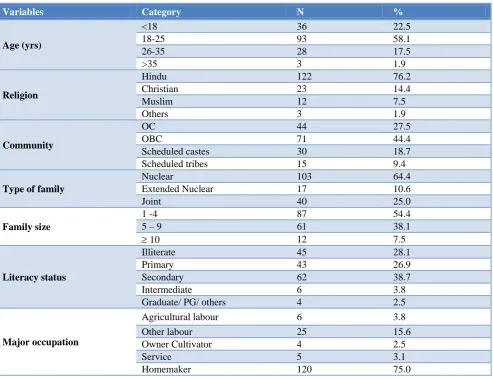
Majority (58.1%) of participants are in 18-25 years of age. About three fourth of them are Hindus and 44.4% belong to OBC category. Illiteracy among mothers is
28.1% and 75% are homemakers while the rest are working women.
Table 1: Socio demographic particulars (n=160).
Variables Category N %
Age (yrs)
<18 36 22.5
18-25 93 58.1
26-35 28 17.5
>35 3 1.9
Religion
Hindu 122 76.2
Christian 23 14.4
Muslim 12 7.5
Others 3 1.9
Community
OC 44 27.5
OBC 71 44.4
Scheduled castes 30 18.7
Scheduled tribes 15 9.4
Type of family
Nuclear 103 64.4
Extended Nuclear 17 10.6
Joint 40 25.0
Family size
1 -4 87 54.4
5 – 9 61 38.1
10 12 7.5
Literacy status
Illiterate 45 28.1
Primary 43 26.9
Secondary 62 38.7
Intermediate 6 3.8
Graduate/ PG/ others 4 2.5
Major occupation
Agricultural labour 6 3.8
Other labour 25 15.6
Owner Cultivator 4 2.5
Service 5 3.1
Homemaker 120 75.0
Table 2: Distribution of infants by age and gender.
Age group (months) Male % Female % Total %
0-5 39 24.4 35 21.9 74 46.3
6-11 52 32.5 34 21.2 86 63.7
Total 91 56.9 69 43.1 160 100
Table 3: Intra- natal care practices (n=160).
Intra- natal care indicators N %
Normal vaginal delivery (NVD) 126 78.8
Institutional delivery 144 90.0
Delivery conducted by trained personnel 152 95.0
Weight recorded on same day 144 90.0
Table 2 depicts the age and sex distribution of infants and it was found that majority fall in the age group of 6-11 months and 56.9% of the mothers have male infants.
Intra-natal care practices
(NVDs). Assessment of intra natal care indicators have shown that still 10% of the deliveries are conducted at home and 5% of deliveries were not attended by trained personnel. In 90%, weight was recorded on same day of delivery.
Infant feeding practices
About three fourth of mothers (75.6%) have initiated breast feeding within one hour of birth. All the infants are fed colostrum and 2.5% were given pre-lacteals before initiation of breast feeding. About 84% of mothers introduced solid, semi-solid or soft foods during six to eight months of age. Other important indicators are depicted in Figure 1. Prevalence of exclusive breast feeding is 79.1% in study area. Only half of 6-11 months children (51.2%) received the recommended minimum
dietary diversity, 87.2% received the recommended minimum meal frequency, and 45.3% received the minimum acceptable diet in the last 24 hrs preceding the survey.
Determinants of infant feeding practices
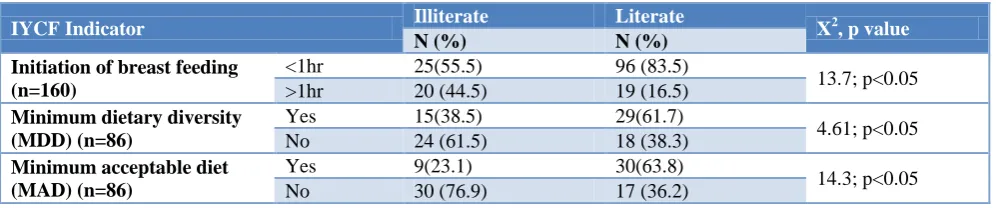
Table 4 and 5 represents the determinants of infant feeding practices in study area. Maternal education is significantly associated with time of initiation of breast feeding (X2=13.7; p<0.05), minimum dietary diversity (X2=4.61; p<0.05) and minimum acceptable diet (X2=14.3; p<0.05). Being a literate mother, major proportion has introduced breast milk at <1 hour after birth. Significantly low proportion of illiterate mothers could provide dietary diversity and minimum acceptable diet to the 6-11 months children (Table 4).
Table 4: Literacy status of mother vs infant feeding practices.
IYCF Indicator Illiterate Literate X2, p value
N (%) N (%)
Initiation of breast feeding (n=160)
<1hr 25(55.5) 96 (83.5)
13.7; p<0.05 >1hr 20 (44.5) 19 (16.5)
Minimum dietary diversity (MDD) (n=86)
Yes 15(38.5) 29(61.7)
4.61; p<0.05 No 24 (61.5) 18 (38.3)
Minimum acceptable diet (MAD) (n=86)
Yes 9(23.1) 30(63.8)
14.3; p<0.05 No 30 (76.9) 17 (36.2)
Table 5: Maternal occupation vs exclusive breast feeding.
Working women (%) Homemaker (%) X2, p value
Exclusive breast feeding (EBF) n =86
Yes 17 (63.0) 51 (86.4)
6.17; p<0.05 No 10 (37.0) 8 (13.6)
Figure 1: Distribution of core IYCF indicators (%) (n=86).
Working status of mothers is significantly associated with prevalence exclusive breast feeding and is high among homemakers (X2=6.17; p<0.05) (Table 5). Other socio demographic variables like age, religion, community, type family are found not significantly associated with the infant feeding practices.
DISCUSSION
The breastfeeding practices prevailing in the community play important role in child’s health. The purpose of this study is to assess the infant feeding practices in rural areas.
The prevalence of exclusive breastfeeding is 79.1% in the present study. It is comparable with the NFHS report round 4 (NFHS-4) AP, which has reported 72% EBF among mothers of rural Andhra Pradesh.17 It is far higher than national prevalence of EBF among rural women (55%) and in a north Indian study by Cacodkar et al carried out among rural women, Goa (64%).19,20 Colostrum, the first breast milk is highly nutritious and possesses antibodies that protect the newborn from many diseases. Delay in the initiation of breastfeeding deprives the child from valuable components of colostrum, and worst still pre-lacteal feeding may cause adverse health effect and also delay in stimulation normally provided by suckling which could lead to decreased lactation.21 Exclusive breast feeding
Minimum diet diversity Minimum meal frequency Minimum acceptable diet
79.1% 51.2%
Majority of the mothers initiated breastfeeding (75.6%) within one hour of delivery in our study. Our figures are much higher than that of national figures reported (41.6%) by (NFHS 4).19 Cacodkar et al in 2016 has reported very low proportions of early initiation of breast feeding (21.6%) among mothers in rural areas of Goa, a north Indian state.20 Breast milk should be initiated as early as possible after delivery.22 The delay in initiation leads to delay in development of oxytocin reflexes, which are very important for the contraction of the uterus and the breast milk reflex. Studies show that the earlier breastfeeding begins a quicker and more effective consolidation process and therefore a better impact on after birth period, which helps in earlier initiation of the secretion of breast milk.
All the mothers fed their children with colostrum, which is an important finding in this study setting. A study conducted by Cacodkar et al found that only 46.2% of infants were given colostrum in rural areas of Goa.20 Very less proportion of (2.5%) mothers have given pre -lacteals to infants in the form of honey and sugar water and this is far less compared to National report (21%) and reported 46.5% in Telangana districts.19,23
Complementary feed has been received by 84% infants at 6-8months of age and these findings are much higher compared to national reports which have stated 42% in rural India and 51.5% in rural Andhra Pradesh.17,19 About 45% children 6-12 months were reported to have received minimally acceptable diet, i.e. children get a variety of at least 4 food groups to ensure nutrient intake e.g. fruits, vegetables, grains, pulses, oils etc. and 87.2% fed with minimal meal frequency. A national survey has reported only 9.2% MDD and MMF among rural populations.19 A multi-country study conducted in five South Asian countries, including India, reported children received the minimum dietary diversity that ranged from a minimum of 15% in India to a maximum of 71% in Sri Lanka.24 This disparity may be related to the accessibility and availability to specific foods such as rice, wheat, potato, and fish or the cultural dependency on food items that are deficient on important nutrients.
Working status of mother found to have a significant association with exclusive breastfeeding which could be due to forced initiation of complementary foods before 6 months of age. Alwala et al also has stated in their study that employment status of the mother is an influencing factor for breastfeeding practices.23
The educational status of the mother is positively associated with time of initiation of breastfeeding, MAD and MDD. This finding is similar with international study findings in Pakistan, Nepal, and Ethiopia which has reported that educated women have appropriated complimentary feeding practice.25-27 This might be due to the fact that educated mothers have a better understanding of nutrition education than mothers without formal education. Additionally, educated mothers
might read books, leaflets, and magazines, and might have a better chance of exposure to nutrition education about IYCF through mass media than their counterparts. In this study, we attempted to assess the determinants of Infant feeding practices and found that literacy status and working status of the mother have a significant role in infant feeding practices among rural mothers of the study area.
Limitations
Due to cross-sectional study design, conclusions on the cause-effect relationship cannot be drawn. This study could not able to include the effect of seasonal variation and cultural practices on food availability and food consumption patterns.
CONCLUSION
Findings from this study suggest that overall infant feeding practices such as early initiation of breastfeeding, exclusive breastfeeding; feeding of colostrum, avoiding pre-lacteals and time of weaning among rural mothers in the study area are relatively good as per the current recommendations. However, appropriate complementary feeding practices such as providing minimum meal frequency, minimum acceptable diet and minimal dietary diversity are relatively poor. Educational status and working status of the mother were independent predictors for infant feeding practice. Hence, there is a need for strengthening the promotion of IYCF practice by health workers during their interaction with the beneficiaries, giving emphasis for complementary feeding practice especially for mothers with lower educational status. Funding: No funding sources
Conflict of interest: None declared
Ethical approval: The study was approved by the Institutional Ethics Committee
REFERENCES
1. Black RE, Allen LH, Bhutta ZA, Caulfield LE. Onis Md, Ezzati M, et al. Maternal and child undernutrition: global and regional exposures and health consequences. Lancet. 2008;371(9608):243– 60.
2. Central Statistical Agency [Ethiopia], ICFInternational. Ethiopia Demographic and Health Survey 2011. Addis Ababa, Ethiopia and Calverton, Maryland, USA: Central Statistical Agency and ICF International; 2012.
3. Ezzati M, Lopez AD, Rodgers A, VanderHoorn S, Murray CJ. Selected major risk factors and global andregional burden of disease. Lancet. 2002;360:1347–60.
consequences for adult health and human capital. Lancet. 2008;371(9609):340–57.
5. UNICEF. Programming guide,infant and young child feeding,nutrition section, programmes, UNICEF. New York. 2012.
6. World Bank. 2006. Repositioning nutrition as central to development : a strategy for large-scale action - overview. Directions in development. Washington, DC: World Bank. Available at: http://documents.worldbank.org/curated/en/
185651468175733998/Repositioning-nutrition-as- central-to-development-astrategy-for-large-scale-action-overview. Accessed on 3 February 2019. 7. WHO and UNICEF. Global strategy for infant and
young child feeding. Geneva: World health organization; 2003.
8. WHO. Infant and young child feeding.model chapter for textbook for medical students and allied health proffesions France: 2009.
9. Caetano MC, Ortiz TT, da Silva SG, de Souza FI, Sarni RO. Complementary feeding: inappropriate practices in infants. J Pediatr. 2010;86(3):196–201. 10. Tagbo B, Ughasoro M. Complementary feeding
pattern of Infants attaining the University of Nigeria Teaching Hospital, Ituku, Ozalla. Enugu Nigerian J Peadiatr. 2009;36(3&4):51–9.
11. Safari JG, Kimambo SC, Lwelamira JE. Feeding practice and nutritional status in Morongo Municipality, Tanzania. Tanzania J Health Res. 2013;15(3):3–7.
12. Muhimbula HS, Issa-Zacharia A. Persistant child malnutrition in Tanzania: Risks associated with traditional complmentary food. Afr J Food Sci. 2010;4(11):679–92.
13. Garje RR, Thitame SK, Somasundaram KV, Gautam L, Gite MS. Infant feeding beliefs and practices among tribal mothers in Nashik district, Maharashtra. Int J Med Sci Public Health. 2016;5:2203-8
14. Gupta A, Dadhich JP, Faridi MMA. Breast feeding and complementary feeding as a public health intervention for child survival in India. Ind J Pediatr. 2010;7(4):412-7.
15. Indicators for assessing infant and young child feeding practices: of a consensus meeting held 6-8 November 2007 in Washington DC, USA. WHO, 2008. Available from: http://whqlibdoc.who.int/ publications/2008/9789241596664_eng.pdf.
Accessed on 22 August 2015.
16. Iskandar MB, Costello C, Nasution Y. Initiation and duration of breast feeding in Indonasia. Asia Pac Popul J. 1990;5:89-112.
17. National Family Health Survey(NFHS-4) India, 2015-16. Mumbai: Available at: http://www. rchiips.org/nfhs. Accessed on 3 February 2019. 18. WHO. Indicators for assessing infant and young
child feeding practices practices part 3: country profiles. 2010.
19. National family health survey (NFHS-4) (2015-16) India report International Institute for Population Sciences (IIPS) Mumbai. Available at: http://rchiips.org/NFHS/NFHS-4Reports/ India.pdf. Accessed on 3 February 2019.
20. Cacodkar J, Joglekar S, Dubhashi A. Breast feeding and infant feeding practices among rural mothers in Goa. Int J Community Med Public Health. 2016;3:184-9.
21. Dakshayani B, Gangadhar MR. Breast feeding practices among the Hakkipikkis: A tribal population of Mysore District, Karnataka. Ethno-Med. 2008;2(2):127-9.
22. 22. UNICEF, Ten steps to promote successful breast feeding, Mother and Child Health Division, Geneva: World Health Organization; 1989.WHO.
23. 23. Alwala RR, Dudala SR, Bolla CR, Patki MB, Kumar BPR. Infant feeding practices of a tribal community in a mandal of Khammam district, Telangana. Int J Community Med Public Health. 2018;5:5077-81.
24. 24. Senarath U, Agho KE, Akram DE, Godakandage SS, Hazir T, Jayawickrama H, et al. Comparisons of complementary feeding indicators and associated factors in children aged 6-23 months across five south Asian countries. Matern Child Nutr. 2012;8:89–106.
25. Hasnain S, Majrooh MA, Anjum R. Knowledge and practices of mothers for complementary feeding in babies visiting pediatrics outpatient department of Jinnah Hospital, Lahore. Biomedica. 2013;29:221– 30.
26. Chapagain RH. Factors affecting complementary feeding practices of Nepali mothers for 6 months to 24 months children. J Nepal Health Res Counc. 2013;11(24):205–7.
27. Tessema M, Belachew T, Ersino G. Feeding patterns and stunting during early childhood in rural communities of Sidama, South Ethiopia. Pan Afr Med J. 2013:14(75).