Original Research Article
A study of awareness on cervical cancer and prevalence of pathological
leucorrhoea among women in rural Chennai
R. Tamilarasi*, Latha Maheshwari, Raghul Siddharth, Sanjeev
INTRODUCTION
The non-communicable diseases are showing increasing trend while majority of the communicable diseases are decreasing in most of the developing countries. NCDs are the leading cause of death globally and were responsible for up to 68% of global deaths in the year 2012. Almost three quarters of all NCD deaths (28 million) occurred in low and middle income countries. India is categorized as a lower middle income country according to the World Bank income groups.1
Cancers are the leading cause of mortality and morbidity second to diabetes and if the current cancer rates remain
unchanged then the estimated incidence of 12.7 million new cancer cases in 20082 will rise to 21.4 million cases by 2030.2,3 Within the lower-middle income countries, the three most common types of cancer among males are of the lung, liver and stomach whereas among the females it is the breast, cervix and lung. Among the cancer deaths, about 2 million cancer cases per year (18% of global cancer burden) are attributable to a few specific chronic infections.4 This fraction is substantially larger among low-income countries (26%), making the prevention of these infections a priority in our nation.
Cervical cancer is the second most important cancer in women, and the first in low-income countries. In too
ABSTRACT
Background: Cancers are the leading cause of mortality and morbidity due to non-communicable diseases second only to diabetes. Cervical cancer is the second most important cancer in women. In India nearly 75,000 women die of cervical cancer every year. In Tamil Nadu, cervical cancer is the second most common cancer to affect women especially in the rural areas. Aims of the study were to study about the level of awareness on cervical cancer and prevalence of pathological leucorrhoea among women residing in rural Chennai.
Methods: This cross sectional study was carried out among randomly selected 295 females aged 15 years and above residing at Alamadhi village and nearby villages in Chennai from March 2016 to September 2016. Pre-tested semi-structured questionnaire was used to collect data.
Results: Among the participants most of the women (55.6%) were belonged to 15-30 years age group. Of all the participants involved in the study about 66.8% (197/295) had No awareness on cervical cancer and among the rest, 27.6% (27/98) had good knowledge and 72.4% (71/98) had inadequate knowledge on cervical cancer. Prevalence of Pathological leucorrhoea is 27.5%.
Conclusions: Though cervical cancer is the leading cancer among women, our study shows a large percentage of rural women are completely ignorant about this disease which when detected in early stages is completely curable. Hence, extensive health education to the public is needed to improve their knowledge with an emphasis on the fact that periodic screening is the new standard in prevention of cervical cancer.
Keywords: Cancer cervix, Awareness, Pathological leucorrhoea
Department ofCommunity Medicine, Government Stanley Medical College, Chennai, India
Received: 15 March 2018
Accepted: 04 April 2018
*Correspondence:
Dr. R. Tamilarasi,
E-mail: [email protected]
Copyright: © the author(s), publisher and licensee Medip Academy. This is an open-access article distributed under the terms of the Creative Commons Attribution Non-Commercial License, which permits unrestricted non-commercial use, distribution, and reproduction in any medium, provided the original work is properly cited.
many cases, cervical cancer is generally diagnosed in an advanced stage.6 New, low-cost HPV screening tests, combined with HPV vaccination, have the potential for a major improvement in cervical cancer control, although the high vaccine price makes this option less affordable option at the present time.7
This high prevalence and burden of cervical cancer is primarily attributed to the lack of awareness among women. In India, cervical cancer kills a woman every seven minutes. Nearly 75,000 women die of cervical cancer every year in India.8 In Tamil Nadu, cervical cancer is the second most common cancer to affect women especially in the rural areas with 80% of women in the low socio-economic strata. Leucorrhoea accounts for more than an estimated of 1/4th of the gynaecologic visits which can be used for screening cancer cervix.9 With this background this study aims at finding the levels of awareness on cervical cancer and prevalence of pathological leucorrhoea among women residing in rural Chennai.
METHODS
This cross sectional study was carried out from March 2016 to September 2016 in Alamadhi and surrounding villages in Chennai. Women aged 15 and above were approached on a house to house basis using systematic random sampling to increase the chances of covering women from different social groups. The calculated sample size was 290 and a total of 295 women were interviewed who voluntarily agreed to participate in the study. The women were interviewed by the investigators on a face to face interview method.
A questionnaire based on literature review and previously published questionnairewas designed in English.10 The questionnaire was translated into Tamil and back into English for quality assurance. The items on the questionnaire: (i) socio-demographic characteristics (ii) awareness and knowledge about risk factors, symptoms, preventive measures (iii) history of leucorrhoea. BG Prasad socio-economic scale was used to categorize the participant’s economic status.
During the interview, further questions on cervical cancer were only asked if they had heard about cancer cervix. The participants were scored based on the questions regarding specific knowledge about cervical cancer symptoms, risk factors and preventive measures. The participants received 1 point for a correct answer and 0 for either wrong answer or when the answer was “I don’t know”. A total of 20 questions were asked and the participants were defined to have some knowledge for <10 correct answers and good knowledge for >10 correct answers.
The participants were also questioned about presence of leucorrhoea. The leucorrhoea was categorized to be physiological or pathological based on the colour,
consistency and odour of discharge and accompanying signs.
Data entry was done in Microsoft Excel and data analysis was done using Epi-info 6 software. Simple frequency tests and chi square test were used to identify the effect of demographic characteristics on the level of knowledge about cervical cancer. For all analyses, a p-value under 0.05 was considered as significant.
RESULTS
The demographic characteristics of the 295 participants from selected villages of this cross sectional study are shown in Table 1.
Table 1: Socio-demographic profile.
Socio-demographic
variable Frequency
Percentage (%) Age
15-30 164 55.6
31-40 58 19.7
41-50 56 19.0
>50 17 5.8
Marital status
Married 292 99.0
Unmarried 3 1.0
Socio- economic class*
Upper class 22 7.5
Upper middle class 88 29.8
Middle class 93 31.5
Lower middle class 58 19.7
Lower class 34 11.5
Socio-economic class according to modified BG Prasad SES.
The majority of the participants in the study belonged to the age group of 15-30 years. The mean age of the participants involved in the study is 32.9 years. Of the interviewed women, 99% were married. The majority of the women i.e. 61.3% (181) belonged to the socio-economic class of upper middle and middle class. Of the participants in the study, 47.2% (139) of the women reported to have given birth to two children and above.
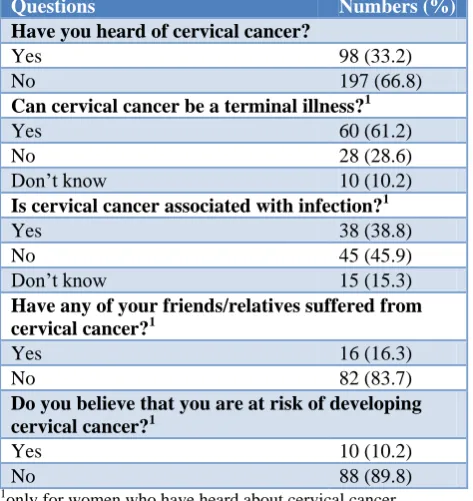
Of the 295 women, 66.8% (197/295) reported to have not heard of cervical cancer previously. Of the women 33.2% (98/295) who had previously heard about cervical cancer, 45.9% (45/98) considered cervical cancer not to be associated with any infection whereas 61.2% (60/98) considered it to be terminal illness. When asked about the possibility of developing cervical cancer, 89.8% (88/98) believed that they had no risk (Table 2).
virus infection and hormonal contraception respectively in 11.2% (11/98) and 22.4% (22/98) of the women as shown in Table 3.
Table 2: Awareness and knowledge of cervical cancer:
Questions Numbers (%)
Have you heard of cervical cancer?
Yes 98 (33.2)
No 197 (66.8)
Can cervical cancer be a terminal illness?1
Yes 60 (61.2)
No 28 (28.6)
Don’t know 10 (10.2)
Is cervical cancer associated with infection?1
Yes 38 (38.8)
No 45 (45.9)
Don’t know 15 (15.3)
Have any of your friends/relatives suffered from cervical cancer?1
Yes 16 (16.3)
No 82 (83.7)
Do you believe that you are at risk of developing cervical cancer?1
Yes 10 (10.2)
No 88 (89.8)
1
only for women who have heard about cervical cancer.
Table 3: Knowledge about risk factors.a
Risk factors Frequency Percentage (%)
Early pregnancy
Genetic factors 33 33.7
Human papilloma
virus infection 11 11.2
Hiv infection 32 32.6
Multiple sexual
partners 60 61.2
Early sexual
initiation 38 38.8
Sexually transmitted diseases
37 37.7
Smoking 60 61.2
Miscarriages and
abortion 43 43.9
Large number of
child births 30 30.6
Hormonal
contraception 22 22.4
a
only in women who have heard about cervical cancer.
Among the symptoms, the most frequently recognized symptoms were bleeding between periods and smelly vaginal discharge respectively in 68.4% (67/98) and 55.1% (54/98). On awareness about the preventive measures, 11.2% (11/98) had heard about PAP smear test
and 27.5% (27/98) of the women were aware that a vaccine was available for cervical cancer prevention.
The answers to the above 20 questions on risk factors, symptoms and awareness were used to create a knowledge score. Analysis revealed that 27.6% (27 /98) of women had good adequate knowledge on cervical cancer (11-20 correct answers) and 72.4% (71 /98) of women had some knowledge (0-10 correct answers).
It was found that participants belonging to the lower socio-economic levels were found to have lesser awareness on cervical cancer when compared to the higher socio-economic classes which was shown by a decreasing trend in cervical cancer awareness as we moved down the socio-economic ladder with higher levels of awareness among participants from upper class and upper middle class whereas the lowest level of awareness found in the lower class of BG Prasad SES.
It was identified that those who had friends or relatives affected by cervical cancer had greater awareness about cervical cancer when compared to the participants who neither had friends or relatives with the disease.
Prevalence of pathological leucorrhea
Of the total of 295 participants in the study, 57.3% (169/295) reported history of leucorrhoea while 42.7% (126/295) reported as no history. Based on the definition, when leucorrhoea was accompanied with abnormal colour, odour, consistency and abnormal signs like itching/ irritation, burning micturition etc. It was considered to be pathological. Among the 169
participants, 27.5% (81/295) participants had
pathological leucorrhoea whereas the rest was classified as physiological. 24.4% (72/295) had abdominal/ pelvic pain, 9.2% (27/295) had burning micturition, 11.9% (35/295) had itching or irritation and 4.4% (13/295) had foul smelling odour as the accompanying symptom. Among the 81 participants who had history of leucorrhoea only 1% (3/295) had tested for sexually transmitted diseases and was found to be positive.
DISCUSSION
involved in the study having heard of the Human Papilloma virus (HPV) one of the principal agents of this disease which was similar to another study conducted among nursing staff in India by Jain et al, but in contrast to the 78% reported in the study by Ali et al.13,14 In the present study, 68.4% and 42.8% of the women knew that menstrual abnormality and post-coital bleeding were symptoms which were consistent with another study conducted in Thailand by Nganwai et al.15 The best knowledge scores were found in women belonging to higher socio-economic classes with similar results found in studies conducted in countries such as Nigeria, Tanzania.16,11 The participants were interested in gaining knowledge about the disease when they were informed that it is one of the diseases with the highest mortality rates. Of the women who had taken part in the study none had undergone screening for cervical cancer. In two other studies conducted on screening for cervical cancer in Dindugul, Tamil Nadu and Osmannabad, Maharashtra, two of 80269 women and eight of 131746 women had
undergone previous cervical cancer screening,
respectively. Lack of knowledge about the risk factors, absence of the concept of preventive behaviour appear to be important factors.17,18
VIA/VILI is more sensitive but less specific than cytology in detecting precancerous lesions of cervix. The high sensitivity of visual inspection aided by acetic acid (VIA) shows that the test could be valuable in detection of precancerous lesions of cervix.19 Tamil Nadu has an excellent cervical cancer screening programme with free testing done to all women above the age of 30 at free of cost at all primary health centers and government medical colleges.20 But the masses need to be educated on the disease so as to improve their attitudes on seeking medical attention in the pre-cancerous stages itself to significantly reduce the mortalities due to cervical cancer.
CONCLUSION
The masses need to be made properly aware of risk factors and preventive measures of cervical cancer in order to increase health-seeking behaviour among women in rural areas and to improve the utilization of the resources in our state in cervical cancer screening. Hence health education services must be strengthened through mass media as significant strides can be made in reducing the prevalence of cervical cancer among women in rural areas. Our study shows that the prevalence of pathological leucorrhoea continues to be a significant problem in rural areas in spite of the various measures adopted by the Indian government to reduce the transmission of RTIs/STIs.
ACKNOWLEDGEMENTS
The authors would like to thank the Project director, Tamil Nadu Health Systems Project (TNHSP) for funding this project. I would also like to extend my gratitude to my colleagues and students for helping in
data collection. We also thank all the participants for their cooperation in this study.
Funding: Tamilnadu health systems project Conflict of interest: None declared
Ethical approval: The study was approved by the Institutional Ethics Committee
REFERENCES
1. Global status report on non-communicable diseases 2014. World Health Organization.
2. Ferlay J, Shin HR, Bray F, Forman D, Mathers C, Parkin DM. Estimates of worldwide burden of cancer in 2008. Int J Cancer. 2010;127:2893-917. 3. Cancer incidence and mortality worldwide: Lyon,
International Agency for Research on Cancer (IARC Cancer Base No.10), 2011.
4. Parkin DM. The global health burden of infection-associated cancers in the year 2002. Int J Cancer. 2006;118:3030-44.
5. Cervix Cancer Screening. Lyon, International
Agency for Research on Cancer (IARC Handbooks of Cancer Prevention, Vol.10), 2005.
6. Ginsberg GM, Edejer TT, Lauer JA, Sepulveda C. Screening, prevention and treatment of cervical cancer –a global and generalized cost-effectiveness analysis. Vaccine. 2009;27:6060-79.
7. Goldie SJ, O'Shea M, Campos NG, Diaz M, Sweet S, Kim SY. Health and economic outcomes of HPV 16, 18 vaccinations in 72 GAVI-eligible countries. Vaccine. 2008;26(32):4080-93.
8. Consolidated Report of the Population Based
Cancer Registries, Incidence and distribution of Cancer; 1990-1996.
9. Sabaratnum, Drukumaran, Sivanesa VR,
Alokananda C. Text book of Adolescent
gynaecology, sexually active adolescent; 1999: 733.
10. Jaglarz K, Tomaszewski KA, Kamzol W,
PuskulluogluM, Krzemieniecki K. Creating and field-testing the questionnaire for the assessment of knowledge about cervical cancer and its prevention among schoolgirls and female students. J Gynecol Oncol. 2014;25(2):81-9.
11. Lyimo FS, Bera TN. Demographic, knowledge,
attitudinal, and accessibility factors associated with uptake of cervical cancer screening among women in a rural district of Tanzania: three public policy implications. BMC Public Health. 2012;12:22. 12. Tebeu PM, Major AL, Rapiti E, Petignat P,
Bouchardy C, Sando Z, et al. The attitude and knowledge of cervical cancer by Cameroonian women; a clinical survey conducted in Maroua, the capital of far North Province of Cameroon. Int J Gynecol Cancer. 2008;18:761-5.
14. Ali SF, Ayub S, Manzoor NF, Azim S, Afif M, Akhtar N, et al. Knowledge and Awareness about Cervical Cancer and Its Prevention amongst Interns and Nursing Staff.
15. In Tertiary Care Hospitals in Karachi, Pakistan. PLoS ONE 5(6): e11059. (One reference two reference numbers)
16. Nganwai P, Truadpon P, Inpa C, Sangpetngam B, Mekjarasnapa M et al. Knowledge, attitudes and practices vis-a-vis cervical cancer among registered nurses at the Faculty of Medicine, Khon Kaen University, Thailand. Asian Pac J Cancer Prev. 2008;9:15–8.
17. Mbamara SU, Ikpeze OC, Okonkwo JE, Onyiaorah
IV, Ukah CO. Knowledge, attitude and practice of cervical cancer screening among women attending gynecology clinics in a tertiary level medical care center in southeastern Nigeria. J Reprod Med. 2011;56:491-6.
18. Sankaranarayanan R, Nene BM, Shastri SS, Jayant K, Muwonge R, Budukh AM, et al. HPV screening
for cervical cancer screening in rural India. N Engl J Med. 2009;360:1385–94.
19. Sankaranarayanan R, Esmy PO, Rajkumar R,
Muwonge R, Swaminathan R, Santhakumari S, et al. Effect of visual screening on cervical cancer incidence and mortality in Tamil Nadu, India: a cluster randomized trial. Lancet. 2007;370:398–406. 20. Sankaranarayanan R, Wesley R, Thara S, Dhakad N, Chandralekha B, Seastian P, et al. Test characteristics of visual inspection with 4% acetic acid (VIA) and Lugol's iodine (VILI) in cervical cancer screening in Kerala, India. Int J Cancer. 2003;106(3):404-8.