38 | P a g e
COMBINATORIAL FACE DETECTION SYSTEM
USINGFEATURE-BASED
ANDAPPEARANCE-BASEDMETHODS WITH VIOLA & JONES FACE
DETECTION ALGORITHM
Mr. Vinit Atul Shevade
1, Mr. Nilesh Shrikant Devekar
2,
Mr. Uday Dhanaji Patil
31, 2, 3
Assistant Professor at Computer Science and Engineering Department,
Dhananjay Mahadik Group of Institutions, Kolhapur (India)
ABSTRACT
Human face detection is preliminary required step of face recognition systems as well as a very important task
in many applications, such as security access control systems, video surveillance, human computer interface
and image database management. This paper intends to combine Viola and Jones face detection method with a
color-based method to propose an improved face detection method. Experimental results show that our method
efficiently decreased false positive rate and subsequently increased accuracy of the face detection system
especially in complex background images. Also our proposed method considerably increased face detection
speed.
Keywords: Face detection, Feature-based, Appearance-based, Skin color classification.
I. INTRODUCTION
Face detection and tracking has been the topics of an extensive research for the several past decades. The
development of robust face detection systems is quite essential in a variety of applications such as robotics,
security systems, intelligent human-computer interfaces, etc. A number of face detection algorithms such as
those using Eigen-faces [5] and neural networks [7], for instance, have been developed. In these algorithms,
however, a large amount of numerical computation is required, making the processing extremely
time-consuming.
There are various algorithms including skin color based algorithms for detecting faces within an image. Color is
an important feature of human faces. Using skin-color as a feature for tracking a face can help to increase
detection rate because color processing is usually much faster than processing other facial features. However,
color-based face detection algorithms have several problems like the color representation of a face obtained by a
camera is influenced by many factors (ambient light, object movement, etc.), different cameras produce
significantly different color values even for the same person under the same lighting conditions and skin color
39 | P a g e
problems, that is, what color-space is better to choose, how exactly the skin color distribution should bemodeled, and finally, what will be the way of processing of color segmentation results for face detection[12].
This paper discuss a pixel-based skin detection methods, that classify each pixel as skin or non-skin
individually, independently from its neighbors and combine it with Viola and Jones based face detection to
improve performance of face detection systems in terms of increasing the face detection speed and decreasing
false positive rate.
II.
APPEARANCE-BASED FACE DETECTION
In general, appearance-based methods rely on techniques from statistical analysis and machine learning to find
the relevant characteristics of face and non-face images. The learned characteristics are in the form of
distribution models or discriminate functions that are consequently used for face detection. Meanwhile,
dimensionality reduction is usually carried out for the sake of computation efficiency and detection efficacy. For
Example, face detection techniques include the AdaBoost algorithm [13][14], the S-AdaBoost algorithm [2] ,
the FloatBoost algorithm [4], neural networks [7][1], Support Vector Machines (SVM) [6][10], and the Bayes
classifier [8][9].
Viola and Jones [13][14] propose a robust AdaBoost face detection algorithm, which can detect faces in a rapid
and robust manner with a high detection rate. Li et al. [4] propose the FloatBoost algorithm, an improved
version of the AdaBoost algorithm, for learning a boosted classifier with minimum error rate. The FloatBoost
algorithm uses a backtracking mechanism to improve the face detection rate after each iteration of the AdaBoost
procedure. However this method is computationally more intensive than the AdaBoost algorithm. Jiang and Loe
[2] propose the S-AdaBoost algorithm, a variant of the AdaBoost algorithm, for handling outliers in pattern
detection and classification. Since the S-AdaBoost algorithm uses different classifiersin different phases of
computation, it suffers from computational inefficiency and lack of accuracy.
Viola and Jones based face detection: The basic principle of the Viola-Jones algorithm is to scan a
sub-window capable of detecting faces across a given input image. The standard image processing approach would
be to rescale the input image to different sizes and then run the fixed size detector through these images. This
approach turns out to be rather time consuming due to the calculation of the different size images. Contrary to
the standard approach Viola-Jones rescale the detector instead of the input image and run the detector many
times through the image – each time with a different size. At first one might suspect both approaches to be
equally time consuming, but Viola-Jones have devised a scale invariant detector that requires the same number
of calculations whatever the size. This detector is constructed using a so-called integral image and some simple
rectangular features reminiscent of Haar wavelets. The next section elaborates on this detector. The first step of
the Viola-Jones face detection algorithm is to turn the input image into an integral image. This is done by
making each pixel equal to the entire sum of all pixels above and to the left of the concerned pixel. This allows
for the calculation of the sum of all pixels inside any given rectangle using only four values. These values are
the pixels in the integral image that coincide with the corners of the rectangle in the input image. This is
40 | P a g e
Sum of grey rectangle = D - (B + C) + A
Fig. 1 Sum Calculation
The Viola-Jones face detector analyzes a given sub-window using features consisting of two or more
rectangles. The different
types of features are shown in Figure 2.Fig. 2 Different types of features
Each feature results in a single value which is calculated by subtracting the sum of the white rectangle(s) from
the sum of the black rectangle(s). Viola and Jones have empirically found that a detector with a base resolution
of 24*24 pixels gives satisfactory results. Viola and Jones used a simple and efficient classifier built from
computationally efficient features using AdaBoost for feature selection. AdaBoost is a machine learning
boosting algorithm capable of constructing a strong classifier through a weighted combination of weak
classifiers. (A weak classifier classifies correctly in only a little bit more than half the cases.) To match this
terminology to the presented theory each feature is considered to be a potential weak classifier. A weak
classifier is mathematically described as:
1 if p
f
(x) > p
Ө
h(
x, f, p, Ө
) =
0 otherwise
Where x is a 24*24 pixel sub-window, f is the applied feature, p the polarity and Өthe threshold that decides
whether x should be classified as a positive (a face) or a negative (a non-face).
The basic principle of the Viola-Jones face detection algorithm is to scan the detector many times through the
same image – each time with a new size. Even if an image should contain one or more faces it is obvious that an
excessive large amount of the evaluated sub-windows would still be negatives (non-faces).This realization leads
to a different formulation of the problem: Instead of finding faces, the algorithm should discard non-faces.
The thought behind this statement is that it is faster to discard a non-face than to find a face. With this in mind a
detector consisting of only one (strong) classifier suddenly seems inefficient since the evaluation time is
constant no matter the input. Hence the need for a cascaded classifier arises. The cascaded classifier is
composed of stages each containing a strong classifier.
The job of each stage is to determine whether a given sub-window is definitely not a face or maybe a face.
When a sub-window is classified to be a non-face by a given stage it is immediately discarded. Conversely a
41 | P a g e
stages a given sub-window passes, the higher the chance the sub-window actually contains a face. The conceptis illustrated with two stages in Figure 3.
Fig.3 The Cascade Classifier
III. FEATURE-BASED FACE DETECTION
In feature-based approaches researchers have been trying to find invariant features of faces for detection. The
underlying assumption is based on the observation that humans can effortlessly detect faces and objects in
different poses and lighting conditions and, so, there must exist properties or features (such as eyebrows, eyes,
nose, mouth, and skin color) which are invariant over these variability’s. Numerous methods have been
proposed to first detect facial features and then to infer the presence of a face. Based on the extracted features, a
statistical model is built to describe their relationships and to verify the existence of a face. In this paper skin
color feature will be discussed and used.
Skin Color Classification: The study on skin color classification has gained increasing attention in recent years
due to the active research in content-based image representation. For instance, the ability to locate image object
as a face can be exploited for image coding, editing, indexing or other user interactivity purposes. Moreover,
face localization also provides a good stepping stone in facial expression studies.
It would be fair to say that the most popular algorithm to face localization is the use of color information,
whereby estimating areas with skin color is often the first vital step of such strategy. Hence, skin color
classification has become an important task. Much of the research in skin color based face localization and
detection is based on RGB, YCbCr and HSI color spaces. This paper uses RGB color space for skin color
classification.
The RGB colorspace is a three-dimensional color space whose components are the red, green, and blue
intensities that make up a given color. The colors red, green, and blue were chosen because each one
corresponds roughly with one of the three types of color-sensitive cones in the human eye. It is one of the most
widely used colorspaces for processing and storing of digital image data.
IV. COMBINATORIAL FACE DETECTION
Our proposed approach for improving face detection systems is combination of an appearance-based and
feature-based face detection system. Due to high speed and accuracy in detecting faces in an image, we chose
Viola and Jones proposed face detection system. In order to improve the face detection speed rate and decrease
false positive rate in this approach we combined it with a (skin) color-based method. This approach is very
42 | P a g e
method to build a skin classifier is to define explicitly (through a number of rules) the boundaries skin cluster insome colorspace. For example in [3]:
(
R
,
G
,
B
) is classified as skin if:
R
> 95 and
G
> 40 and
B
> 20 and
Max{R
,
G, B
} −
Min
{
R
,
G, B
} > 15 and
|
R
−
G
| > 15 and
R
>
G
and
R
>
B
Fig.4: Overall schema of our method
In this approach, first skin regions in the input image are identified using above mentioned method and then
Viola and Jones algorithm is applied for detecting faces. After applying skin color classifier, all non-skin
regions replace with black, whereas skin regions remain stationary. This helps face detection algorithm to
quickly identify non-faces which include majority pixels of each image. Also this method efficiently reduces
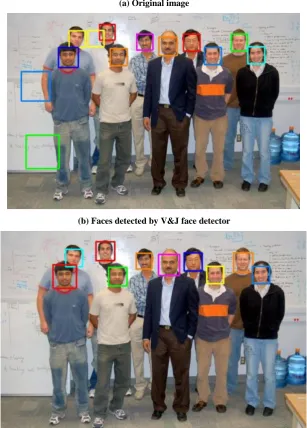
false positive rate. Figure 5 shows the results of face detection before and after applying our combinatorial
43 | P a g e
(a) Original image
(b) Faces detected by V&J face detector
(c) Faces detected by our combinatorialapproach
Fig. 5 Results of face detection with V&J and our approach
In this approach, first skin regions in the input image are identified using above mentioned method and then
Viola and Jones algorithm is applied for detecting faces. After applying skin color classifier, all non-skin
regions replace with black, whereas skin regions remain stationary. This helps face detection algorithm to
quickly identify non-faces which include majority pixels of each image. Also this method efficiently reduces
false positive rate. Figure 5 shows the results of face detection before and after applying our combinatorial
44 | P a g e
V. EXPERIMENTAL RESULTS
In this section a detailed experimental comparison of the above stated approach has been presented. We have
used 100 color images with complex background obtained from internet and applied Viola and Jones based face
detection and our combinatorial approach on these images. Then we compare the results from two aspects, that
is accuracy and face detection speed. The accuracy is obtained by using the following equation:
% Accuracy = 100 – (False positive Rate + False negative Rate)
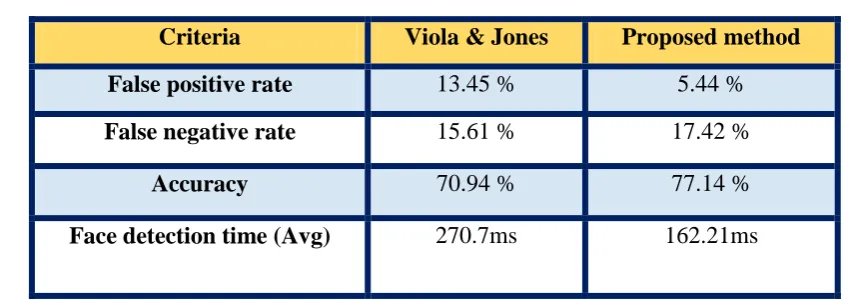
The results of applying Viola and Jones face detection system and the proposed method are shown in Table 1.
Table 1: V&J face detector results
Criteria
Viola & Jones
Proposed method
False positive rate
13.45 %
5.44 %
False negative rate
15.61 %
17.42 %
Accuracy
70.94 %
77.14 %
Face detection time (Avg)
270.7ms
162.21ms
Clearly proposed method improve viola and Jones face detector in terms of both accuracy and speed. However,
false negative rate in our method is a little bit increased. In figure 6 these two methods have been compared in
terms of False Positive Rate, False Negative Rate, and Accuracy.
0.00% 10.00% 20.00% 30.00% 40.00% 50.00% 60.00% 70.00% 80.00% 90.00% False positive rate False negative rate Accuracy
Viola & Jones
Our Proposed method
Fig. 6 Comparison of two Methods
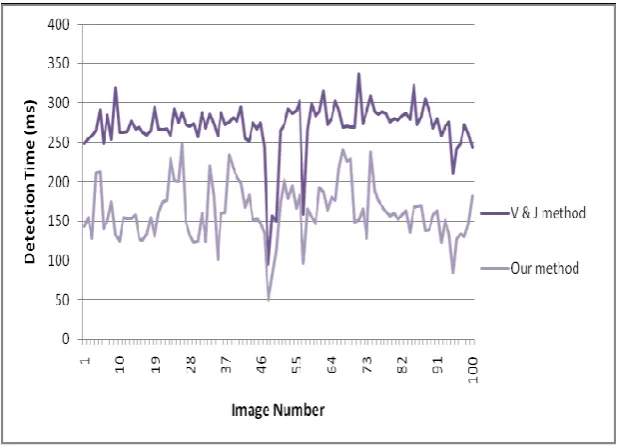
Figure 7 demonstrates detection time among 100 images in comparison of our method and Viola and Jones
45 | P a g e
Fig. 7 Comparison of detection time between two methods
VI. CONCLUSION AND FUTURE WORK
In this paper we briefly described Viola and Jones face detector. Skin color classification has also been
discussed and the combination of these two methods is proposed as a combinatorial face detection system. The
results show that our proposed method efficiently increases face detection speed as well as decreases false
positive rate.
For the future work, in order to increase efficiency of our method other colorspaces and methods for skin color
classification will be studied and examined.
REFERENCES
[1]. Curran, K., X. Li, et al. (2005). "Neural network face detection." Imaging Science Journal, the 53(2):
105-115.
[2]. Jiang, J. L. and K. F. Loe (2003). S-AdaBoost and pattern detection in complex environment, in: Proc.
IEEE Conf. Computer Vision and Pattern Recognition Workshops.
[3]. Kovac, J., Peer, P. and Solina, F. (2003). "Human skin color clustering for face detection." EUROCON
2003. Computer as a Tool. The IEEE Region 8 2.
[4]. Li, S. Z. and Z. Q. Zhang (2004). "FloatBoost Learning and Statistical Face Detection." IEEE
TRANSACTIONS ON PATTERN ANALYSIS AND MACHINE INTELLIGENCE: 26 (9) 1112-1123.
[5]. Liu, C. and Wechsler, H. (2002). "Gabor feature based classification using the enhanced fisher linear
discriminant model for face recognition." Image Processing, IEEE Transactions on 11: 467-476.
[6]. Osuna, E., Freund, R. and Girosit, F. (1997). "Training support vector machines: an application to face
detection." 130-136.
[7]. Rowley, H. A., Baluja, S. and Kanade, T. (1998). "Neural network-based face detection." Pattern
46 | P a g e
[8]. Schneiderman, H. and T. Kanade (1998). Probabilistic Modeling of Local Appearance and SpatialRelationships for Object Recognition, in: Proc. IEEE Conf. Computer Vision and Pattern Recognition, pp
45-51.
[9]. Schneiderman, H. and T. Kanade (2000). A Statistical Approach to 3D Object Detection Applied to Faces
and Cars, Ph.D. Dissertation, Carnegie Mellon University, the Robotics Institute.
[10]. Shih, P. and C. Liu (2004). Face Detection Using Discriminating Feature Analysis and Support Vector
Machine in Video, in: Proc. 17th Intl. Conf. Pattern Recognition, IEEE Computer Society Washington,
DC, USA.
[11]. Singh, S. K., Chauhan, D. S., Vatsa, M. and Singh, R. (2003). "A Robust Skin Color Based Face
Detection Algorithm." TAMKANG JOURNAL OF SCIENCE AND ENGINEERING 6: 227-234.
[12]. Vezhnevets, V., Sazonov, V. and Andreeva, A. (2003). "A Survey on Pixel-Based Skin Color Detection
Techniques."
[13]. Viola, P. and M. J. Jones (2004). "Robust Real-Time Face Detection." International Journal of Computer
Vision 57(2): 137-154.
[14]. Viola, P. and M. Jones (2001). Rapid Object Detection Using a Boosted Cascade of Simple Features, in: