300 | P a g e
MULTIDIMENSIONAL MODELING COMPARISON
ON CONCEPTUAL VIEW
Sushil Kumar
1, Amit Sharma
2Asst Professor,IIMT College of Engg,Gr,Noida
ABSTRACT
Many OLAP usages indicate that their usability performance degrades due to wrong interpretation of business
dimensions. In this paper, we are focusing about business dimensions by multidimensional data model
structures for the DWs. Multidimensionality is just a design technique that separates the information into facts
and dimensions by understanding the business processes and the required dimensions . Many approaches have
been suggested but we will focus on widely accepted star Schema with slight improvement using Snowflake
Schema a variation of star schema, in which the dimensional tables from a star schema are organized into a
hierarchy by normalizing them. Multidimensional model present information to the end-user in a way that
corresponds to his normal understanding of his business dimensions, key figures or facts from the different
scenarios that influence user’s requirement .
Keywords: Business Dimensions, Multidimensional Modeling, Data Warehouse, OLAP, Star
Schema, Snowflake Schema, Fact.
I. INTRODUCTION
1
DW generalize and consolidate the data in the multidimensional space. The construction of DW involves data
warehouses involves data cleaning, data integration, and data transformation and can be viewed as an important
preprocessing step for data mining. Moreover, data warehouses provide on-line analytical processing (OLAP)
tools for the interactive analysis of multidimensional data of varied granularities, which facilitates effective data
generalization and data mining. A data warehouse is a set of data and technologies aimed at enabling the
executives, managers and analysts to make better and faster decisions. DWs to manage information efficiently
as the main organizational asset. The principal role of DW in taking strategic decisions, quality is fundamental.
Data warehouse systems are important tools in today’s competitive, fast-changing era. In the last several years,
many firms have spent millions of dollars in building enterprise-wide data The DWs have to inherent support for
complex queries however its maintenance does not suppose transactional load. These features cause the design
techniques and the used strategies to be different from the traditional ones. Many people feel that with
competition mounting in every industry and domain, data warehousing is the latest must-have marketing
weapon and panacea —a way to retain customers by learning more about their requirements
Enterprise DW3 -An enterprise DW provides a centralized database architecture for decision support for the
enterprise.
Operational Data Store-It has a broader enterprise wide frame, but unlike the real one. Enterprises DW, data is
301 | P a g e
Data Mart -Data mart is a subset of data warehouse and it supports a specific domain, business process.1.1 Characteristics of DW
8The main characteristics of data warehouse are:
Subject oriented. DW is organized around major subjects, such as, supplier, product, customer and sales.
Separate, DW isalways a physically distinct store of data transformed from the application data found from
the traditional OLTP environment. Due to this separation, a data warehouse does not require transaction
processing, recovery, and concurrency control mechanisms. It usually combines two operations in data
accessing: initial loading of data and access of data.
Time Variant. Problems have to be addressed; trends and correlation’s have to be explored. They are time
stamped and associated with defined periods of time2.
Not dynamic. When the data is updated, it is done only periodical, but not as on individual basis.
Integrated Performance. The data which is requested by the user has to perform well on all scales of
integration. Data cleaning and data integration techniques are applied to ensure consistency in naming
conventions, encoding structures, attribute measures, and so on.
Consistency. Architectural and contents of the data is very significant and can only be ensured by the use of
metadata: this is independent from the source and collection date of the data.
1.2-data warehouse building process
7To construct an effective data warehouse we have to analyze business processes, dimension and
business environment. After obtaining the DW logical schema, build it through apptlication of
transformations to the source logical schema, and apply the construction of a large and complex
information system, can be viewed as the construction of a large and complex building, for which the owner,
architect, and builder have different views. These perspectives are merged to form a complex framework that
represents the top-down, business-driven, or owner’s perspective, as well as the bottom-up, builder-driven, or
implementer’s view of the information system. The multidimensional model transforms the visualization of a
schema into a more business-focused framework. All these structures cubes, measures and dimensions interact
with each other to provide an extremely powerful reporting environment.
Most of the multidimensional database systems used in business framework and decision support applications is
particular. Generally, they can be categorized into two categories: 1st is the special traditional relational DBMS
which create multi-dimensional schemas such as star schema and snowflake schema by applying the mature
theory of relational database systems, the 2nd is the multi-dimensional database systems which are designed
specially for online analysis. All dimensional tables are directly connected with the fact table and do not
generate connections with other dimensional tables. However, it will need to separate one dimension into many
dimensions as per business dimension mappings. Such structure is called the snowflake mode, a slight
modification of star adding relational constraints of normalization. Relational database systems are suitable for
OLTP4 applications, but it does not guarantee to meet the expectations of online analytical processing
applications in real time environment. Relational OLAP3 systems which are inherently ORDBMS can only be
classified as relational database systems, because after changing into systems supporting OLTP applications,
302 | P a g e
database (DB) which is optimized for DW and OLTP applications. Multidimensional databases are mostlygenerated using the given data from existing RDs, a multidimensional database allows a user to refer problem
and questions related to concizing business operations and trends analysis. An OLTP application that processes
data from a multidimensional database is formally referred as a multidimensional OLTP application. A
multidimensional database or a multidimensional database management system implies the ability to rapidly
accept the data in the database so that answers can be generated easily. A number of vendors provide products
that use multidimensional databases. An approach to how data is stored and the user interface differs. To
multidimensional database systems, applications are eased due to uniform specifications does not exist. They are
special database systems which do not support comprehensive query, Four different views regarding the design
of a data warehouse must be deemed: the top-down view, the data source view, the data warehouse view, and
the business query view. The top-down view allows the selection of the relevant information vital for the DW.
This information resembles the current and future business requirements. The data source view shows or reflect
the information being captured, stored, and managed by operational systems. This information may be
documented at various Hierarchies of detail and accuracy, from individual data source tables to integrated data
source tables. Data sources are often modeled by traditional data modeling approach, such as the
entity-relationship model or CASE (computer-aided software engineering) tools. The data warehouse view combines
fact tables and dimension tables. It represents the information that is stored inside the DW, including
predetermined aggregates and counts, as well as information pertaining to the source, date, and time of origin,
added to provide historical scenario. Finally, the business query view is the perspective of data in the data
warehouse from the viewpoint of the end user.
II. MULTI DIMENSIONAL MODELING
It is a technique for formalizing and visualizing data models as a set of measures that are defined by common
aspects of the business processes. Business Dimensional modeling has two basic concepts.
Facts:
• A fact is a collection of related data items, composed of Business measures. • A fact is a focus of interest for the decision making Business process. • Measures are continuously valued results that describe facts.
• A fact is a business statistics.
Dimension:
The parameter over which we have to perform analysis of facts and data.
The parameter that gives meaning to a measure number of customers is a fact, perform analysis over time.
Dimensional modeling has been coherent architecture for building distributed DW Applications. If we come
up with more complex queries for our DW which involves three or more dimensions. This is where the
multi-dimensional database plays a eminent role. Dimensions are distributed by which summarized data can
be used. Cubes are data manipulating units composed of fact tables and dimensions from the data
warehouse (DW). Dimensional modeling also has emerged as the only coherent architecture for building
303 | P a g e
III. MULTI-DIMENSIONAL MODELING USING BUSINESS DIMENSION
Multidimensional database technology has come a long way since its inception more than 30 years ago. It has
recently begun to reach the mass market, with major providers now delivering multidimensional database
engines along with their traditional relational database software, often at no extra cost. A multidimensional data
model is typically referred for the design of corporate data warehouses and departmental data marts. Such a
model can be adopted with star schema, snowflake schema, or fact constellation schema. The core of the
multidimensional model is the data cube, which consists of a large set of facts (or measures) and a number of
business dimensions. Business dimensions are the entities or perspectives with respect to organizations that
wants to keep information and are hierarchical in nature.Multi-dimensional technology has also made significant
gains in scalability and maturity to describe the organizations current business requirement. Multidimensional
model is based on three key concepts
• Modeling business rules • Cube and measures • Dimensions
Multidimensional data-base technology is a key term in the interactive analysis of large amounts of data for
decision-making purposes. Multidimensional data model is introduced based on relational elements. Dimensions
are modeled as dimension relations. Data mining applications provides knowledge by searching
semi-automatically for previously unknown patterns, trends and their relationships in multidimensional databases
structures. OLAP software enables analysts, managers, and executives to gain insight into the performance of an
enterprise through fast and interactive access to a wide range of views of data organized to reflect the
multidimensional nature of the enterprise wide data.
3.1 The Goals of Multi-Dimensional Data Models
To enable end-user to access the information in a way that corresponds to his normal understanding of his
business, key figures or facts from the different perspectives that relates with the business environment that
influence them.
To facilitate the physical implementation that the software recognizes (the OLAP), thus allowing a program
to easily access the data required for processing.
3.2 Usages of Multi-Dimensional modeling use business dimensions
INFORMATION PROCESSING: support for querying, basic statistical analysis, and reporting using
crosstabs, graphs, tables or charts. A current trend in data warehouse information processing is to construct
low-cost Web-based application tools for global access integrated with Web browsers.
ANALYTICAL PROCESSING Using dimensions with OLAP it includes OLAP operations such as
slice-and-dice, drill-down, roll-up, drill-through, drill-across and pivoting. It generally operates on historical data in
both summarized and detailed forms. The major strength of on-line analytical processing over information
304 | P a g e
DATA MINING support with KDD (knowledge discovery in databases) it helps to discovers hidden patternsand associations, clustering, performing classification and prediction, and presenting the mining results using
visualization tools etc.
3.3 Logical Multidimensional Model
The multidimensional data model is important because it enforces simplicity. As Ralph Kimball states in his
landmark book, The DW Toolkit:‖ The central attraction of the dimensional model of a business is its simplicity
that simplicity is the fundamental key that allows users to understand DBs, and allows software to navigate
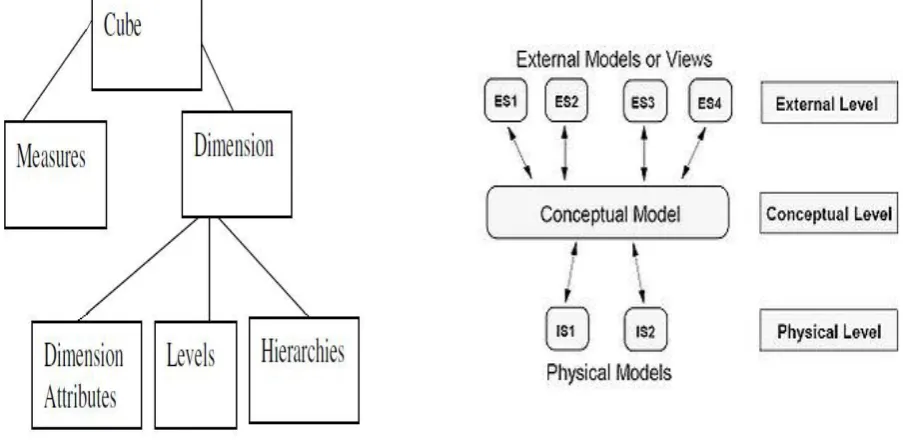
databases efficiently.‖ The multidimensional data model is composed of logical cubes, measures, dimensions,
hierarchies, levels, and attributes. The simplicity of the model is inherent because it defines objects that
represent real-world business entities. Analysts know which business measures they are interested in examining,
which dimensions and attributes make the data meaningful, and how the dimensions of their business are
organized into levels and hierarchies. Multidimensional data cubes, are the basic logical model for OLAP
applications12. The focus of OLAP tools is to provide multidimensional analysis to the underlying information.
To achieve this goal, these tools employ multidimensional models for the storage and presentation of data.
Figure1: Diagram of logical Multi dimensional model
Figure 1: Keys of multidimensional model
A logical model (figure1) for cubes based on the key observation that a cube is not a self-existing entity, but
rather a view over an underlying data set. Logical cubes provide a means of organizing measures that have the
same shape, that is, they have the exact same dimensions. The relational model forces users to manipulate all the
elements as a whole, which tends to lead to confusion and unexpected result sets. In contrast, the
multi-dimensional model allows end users to filter each dimension in isolation and uses more friendly terms such as
Add, Keep and Remove. Users can quickly and easily create multi level queries. The multi-dimensional query
305 | P a g e
separately. This allows users to divide and analyze what would be a very complex query into simple manageablesteps. The multidimensional model also provides powerful filtering capabilities. Additionally, it is also possible
to create conditions based on measures that are not part of the final report. Because the dimensional query is
independent of the filters, it allows complete flexibility in determining the structure of the condition. The
relational implementation of the multidimensional data model is typically a star schema, or a snowflake schema.
3.4 Conceptual View
Conceptual view describes the semantics of a domain, being the scope of the model. For example, it may be a
model of the interest area of an organization or industry. This consists of entity classes, representing kinds of
things of significance in the domain, and relationships assertions about associations between pairs of entity
classes. A conceptual view specifies the kinds of facts or propositions that can be expressed using the model. In
that sense, it defines the allowed expressions in an artificial 'language' with a scope that is limited by the scope
of the model. Early phases of many software development projects emphasize the design of a conceptual data
model. Such a design can be detailed
into a logical data model6. In later stages, this model may be translated into physical data model. However, it is
also possible to implement a conceptual model directly.
Multidimensional Conceptual View provides a multidimensional data model that is intuitively analytical and easy
to use. Business users’ view of an enterprise is multidimensional in nature. Therefore, a multidimensional data model conforms to how the users perceive business problems.
3.5 Star schema architecture with business dimension scenario
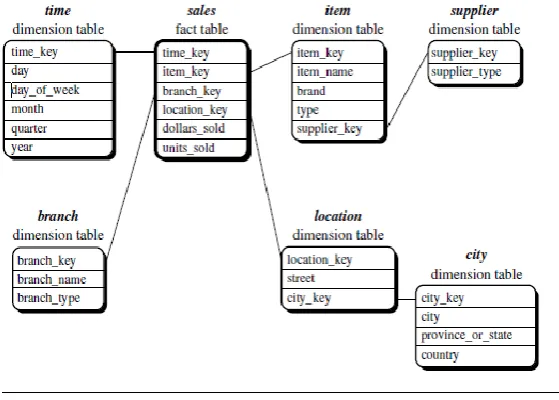
it consists of a fact table for a particular business process ( for example: Sales analysis would take Sales as fact
table) with a single table for each dimension table. Star Schema is the special design technique for
multidimensional data representations. It Optimize data query operations instead of data update operations. Star
Schema is a relational database schema for representing multidimensional data. It is the simplest form of data
warehouse schema that contains one or more dimensions and fact tables15. It is called a star schema because the
entity-relationship diagram between dimensions and fact tables resembles with a star like structure where one
fact table is connected to multiple dimensions. The center of the star schema consists of a huge fact table and it
points towards the dimension tables. The advantage of star schema is slicing down, performance increase and
easy understanding of data.
Steps in designing star schema
• Identify a business process for analysis. • Identify measures or facts.
• Identify the dimensions for facts.
306 | P a g e
3.6 Snowflake schema
Snowflake schema: The snowflake schema is a variant of the star schema, where some dimension tables are
normalized, and enhanced further splitting the data into additional tables16. The resulting schema graph forms a
shape similar to a snowflake.
3.7 Important aspects of Star Schema & Snow Flake Schema
In a star schema every dimension will have a primary key and also a dimension table will not have any parent
table. Whereas in a snow flake schema, a dimension table will have one or more parent tables. Hierarchies for
the dimensions are stored in the dimensional table itself in star schema. Whereas hierarchies are broken into
separate tables in snow flake schema16,17. These hierarchies help to drill down the data from topmost hierarchies
307 | P a g e
IV. PROPOSED MODEL
In this section we will summarize the basic concepts of object oriented multi-dimensional model [19]. The multi
dimensional model is the core of the comprehensive object oriented model of a DW containing all the details
that are necessary to specify a data cube, the dimensions, the classification hierarchies, the description of fact
and measures attributes.
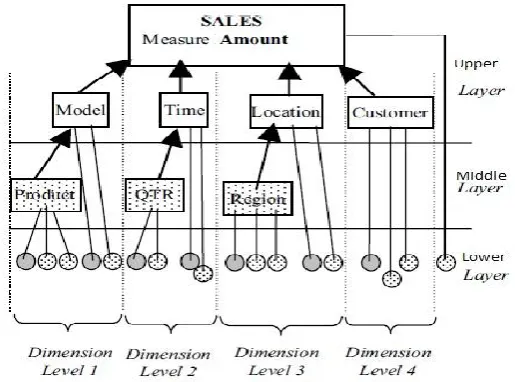
Figure 3: Hierarchical View of Proposed Model Schema
At the lowest layer, each vertex represents an occurrence of an attribute or measure, e.g. product name, day,
customer city etc. A set of vertices semantically related is grouped together to construct an Elementary Semantic
Group at lower layer. On next, several related elementry are group together to form a Semantic Group at middle
layer – the next upper layer constructs to represent any context of business analysis. A set of vertices of any
middle, those determine the other vertices of the lower, is called Determinant Vertices. This layered structure
may be further organized by combination of two or more middle as well as lower group to represent next upper
level layers from the topmost layer the entire database appears to be a graph with middle as vertices and edges
between middle layer object. Dimensional Semantic Group is a type of middle layer object to represent a
dimension member, which is an encapsulation of one or more lower layer group along with extension and / or
composition of one or more constituent middle layer groups. Fact Semantic Group (FSG) is a type of group
represents facts, which are an inheritance of all related lower, middle and a set of upper defined on measures. In
order to materialize the Cube, one must ascribe values to various measures along all dimensions and can be
created from FSG.
Example
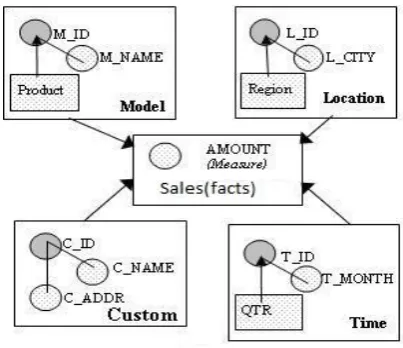
Let consider an example, based on Sales Application with sales Amount as measure and with four dimensions –
Customer, Model, Time and Location with the set of attributes {C_ID, C_NAME, C_ADDR}, {M_ID,
M_NAME, P_ID, P_NAME, P_DESC}, {T_ID, T_MONTH, Q_ID, Q_NAME, YEAR} and {L_ID, L_CITY,
308 | P a g e
say Product, QTR and Region respectively. Then in the notation of GOOMD model, there will be four middlelayer groups {DCustomer, DModel, DLocation, DTime} with hierarchy.
Figure 4: Schema for Sales Application in Proposed Model
model also provides algebra of OLAP operators those will operate on different semantic groups. The Select
operator is an atomic operator and will extract vertices from any middle layer groups depending on some
predicate P. The Retrieve operator extracts vertices from any Cube using some constraint over one or more
dimensions or measures. The Retrieve operator is helpful to realize slice and dice operation of OLAP. The
Aggregation operators perform aggregation on Cube data based on the relational aggregation function like
SUM, AVG, MAX etc. on one or more dimensions and are helpful to realize the roll-up and drill down
operations of OLAP.
V. COMPARISONS OF CONCEPTUAL DESIGN MODELS
Property 1 (Additivity of measures): DF, starER and OOMD support this property. Using ME/R model, only
static data structure can be captured. No functional aspect can be implemented with ME/R model.
Property 2 (Many-to-many relationships with dimensions):StarER and OOMD support this property. DF and
ME/R models do not support many-to-many relationships.
Property 3 (Derived measures): None of the conceptual models include derived measures as part of their
309 | P a g e
Property 4 (Non-strict and complete classification hierarchies)Although DF and ME/R can define certain attributes for classification hierarchies; starER model can define
exact cardinality for non-strict and complete classification hierarchies. OOMD can represent non strict and
complete classification hierarchies.
Property 5 (Categorization of dimensions -specialization/ generalization): All conceptual design models
except DF support this property.
Property 6 (Graphic notation and specifying user requirements):
All modeling techniques provide a graphical
notation to help designers in conceptual modeling phase.ME/R model also provides state diagrams to model
system’s behavior and provides a basic set of OLAP operations to be applied from these user requirements.
OOMD provide complete set of UML diagrams to specify user requirements and help define OLAP functions.
Property 7 (Case tool support): All conceptual design models except starER have case tool support18.
VI. CONCLUSION
This paper helps us to enlighten our comprehensibility with the multidimensional structure related to business
processes and dimensions. Multi-dimensional data model combined with facts and context dimensions using
Star and Snow Flake schema. This paper relates the various dimensional modeling according to the
multi-dimensional space, language aspects and physical representation of the traditional Database Model and establish
relationship multidimensional data to object oriented data.
REFERENCES
1. Jiawei Han and Micheline Kamber Data Mining: Concepts and Techniques, Second Edition. Morgan
Kaufmann publications
2. S.Kelly.Data Warehousing in Action.John Wiley &Sons(1997).
3. Kimball, R. ―The Data Warehouse Toolkit: Practical Techniques for BuiIding Dimensional Data
Warehouses‖. John Wiley and Sons 1996. ISBN 0-471-15337-0
4. S.Chaudhuri,U.Dayal.An overview of data warehousing and OLAP technology. SIGMOD Record 26,1
(1997).
5. G.Colliat.OLAP, relational and multi-dimensional database systems.SIGMOD Record 25, 3 (1996)
6. M. Golfarelli, D. Maio, and S. Rizzi. The dimensional fact model: a conceptual model for data warehouses.
7. M. Jarke, M. Lenzerini, Y. Vassilious, and P. Vassiliadis, editors. Fundamentals of Data Warehousing.
8. L. Cabibbo and R. Torlone. A logical approach to multidimensional databases. In Proc. of EDBT-98, 1998.
9. E. Franconi and U. Sattler. A data warehouse conceptual data model for multidimensional aggregation. In
Proc. of the Workshop on Design and Management of Data Warehouses (DMDW-99), 1999.
10. McGuff, F. ―Data Modeling for Data Warehouses‖October, 1996 from
http://members.aol.corn/fmcguff7dwmodel/dwmodel.html
11. Gyssens, M. and Lakshmanan, L.V.S. ―A foundation for multi-dimensional databases,‖ Technical Report,
310 | P a g e
12. M.Blaschka,C.Sapia,G.H¨ ofling, and B. Dinter. Finding Your Way through Multidimensional DataModels. In DEXA ’98, pages 198–203, 1998. http://www.pentaho.org (16.06.2006), 2006.
13. Antoaneta Ivanova, Boris Rachev Multidimensional models- Constructing DATA CUBE International
Conference on Computer Systems and Technologies - CompSysTech’2004
14. Multidimensional Database Technology by Torben Bach,Pedersen,Christian S. Jensen,Aalborg University
15. Rakesh Agrawal, Ashish Gupta, and Sunita Sarawagi.Modeling multidi-mensional databases. Research
Report, IBM Almaden Research Center, San Jose, California,1996.
16. P. Vassiliadis and T.K. Sellis, ―A Survey of Logical Models for OLAP Databases,‖ ACM SIGMOD
Record, vol. 28, no.4, 1999.
17. L. Cabibbo and R. Torlone. A logical approach to multidi-mensional databases. In Proc.of EDBT-98, 1998
18. Deepti Mishra, Ali Yazici, Beril Pinar Başaran ―A Casestudy of Data Models in Data Warehousing‖.
19. Anirban Sarkar, Swapan Bhattacharya ―Object Relational Implementation of Graph Based Conceptual